
Large-Volume Magnetic Rack Buyer Comparison Guide
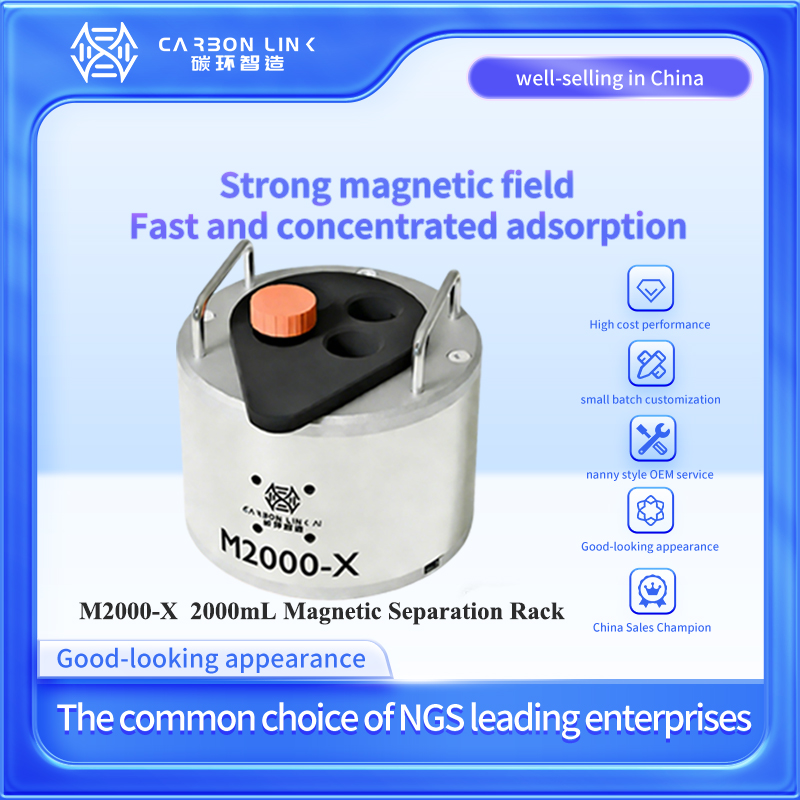
An independent procurement framework for life sciences teams evaluating suppliers of large-volume magnetic bead separation systems, based on verifiable order terms rather than vendor promotional claims.
What a Magnetic Rack Is, and Why the Sourcing Conversation Changes at Scale
A magnetic bead separation rack is a laboratory device that uses high-gradient permanent magnets to capture paramagnetic particles from a liquid suspension so the supernatant can be pipetted away while the beads remain held against the vessel wall or base. At small volumes — 0.2 mL tubes, 96-well microtiter plates — the device is a compact lab accessory evaluated mainly on plate compatibility and footprint.
Once working volumes reach hundreds of millilitres or several litres, the buying decision stops being about a bench accessory and starts being about a supplier. Order structures, tooling support, production scheduling, quality documentation, and the feasibility of a custom design partnership all become part of the same decision. That shift is what makes the comparison below relevant for procurement teams in academic, biotechnology, pharmaceutical, life sciences, and clinical diagnostics laboratories.
A Five-Point Buyer Comparison Framework
The following framework treats the RFQ as the primary evidence document. Each dimension below is written so a buyer can score suppliers side by side using the same inputs.
1. Minimum Order Quantity (MOQ)
MOQ decides whether a buyer can obtain units for pilot testing, side-by-side evaluation, or a regional distributor trial without committing to a quantity that outpaces near-term demand.
For magnetic racks, a supplier statement of 20-piece minimum order quantity for OEM orders has been cited on the Carbonlinkai 5 mL and 15 mL magnetic rack product page. This is a product-specific data point and not a general benchmark for the category — buyers should confirm MOQ per model, since minimum order thresholds often rise with vessel size and customization content.
When comparing suppliers, treat MOQ as a variable rather than a single number. A 20-unit threshold that applies to a small-format rack will not necessarily hold for large-volume formats.
2. Production Lead Time and Scheduling Commitments
Lead time discussions on magnetic racks typically hide three separate intervals: tooling or fixture preparation, batch manufacture, and unit-level assembly and testing. A single headline number is only meaningful when a supplier can break it down.
For large-volume magnetic racks, ask the supplier to provide a written schedule that separates each phase rather than a single promotional figure. Whether the supplier shares a self-reported production milestone — rather than only a shipping date — is a useful confidence signal about operational maturity.
3. Quality Control and Traceability
Ask for documented acceptance criteria rather than general quality language. For magnetic racks this typically means:
- Product testing documentation — within the stated ODM/OEM service scope, Carbonlinkai describes product testing as part of the service package, alongside 3D modeling, printing, labeling, and after-sales support.
- Component-level traceability, particularly for the magnet material, since separation performance depends on magnet grade and consistency.
- Batch-level records that allow a buyer to trace any unit back to production conditions.
- Incoming inspection criteria, so the buyer understands which nonconformance types trigger rework, replacement, or credit.
A dedicated QC annex with named test procedures (rather than general quality statements) is the practical evidence item that lets a procurement team compare suppliers objectively.
4. OEM and ODM Terms
OEM (original equipment manufacturing) and ODM (original design manufacturing) are two different commercial frameworks, and the difference matters for how a large-volume magnetic rack is specified.
For Carbonlinkai, published service information describes small-batch OEM/ODM that includes 3D modeling, printing, product testing, labeling, and after-sales service. That scope supports buyers who want to rebrand or customize a magnetic rack rather than purchase a catalogue item unchanged.
When comparing suppliers on OEM/ODM, clarify at least the following in writing:
- Design ownership — who owns the drawings and whether a custom design carries a separate engineering budget.
- Tooling — who pays for tooling and whether the tooling remains available if the supply relationship ends.
- Labeling and packaging — whether branding is included in the base unit price or quoted separately.
- IP ownership — who owns any design, tooling, or packaging developed under an OEM arrangement.
- Responsibility split — which tests sit with the supplier versus the buyer under the OEM arrangement.

5. Compatibility and Specification Match
Even a rack with a high nominal volume rating is only useful if the sample vessel geometry, magnet layout, and working range fit the workflow.
For published compatibility, Carbonlinkai magnetic racks are described as compatible with 96-well microtiter plates and 0.2 mL tubes, and are built from aluminium alloy and acrylic. These materials support the mechanical rigidity expected inside a laboratory environment, though aluminium-alloy and acrylic surfaces differ in how they tolerate cleaning agents, organic solvents, and elevated temperatures. That detail should be confirmed against the cleaning protocol the buyer actually uses.
At larger scale, the same product family references separators from 250 mL up to 50 L, with an even larger configuration described for production-scale use. When a datasheet lists one high-capacity figure, ask the supplier for evidence of the container compatibility — not only the nominal volume — because vessel geometry affects magnetic field configuration as much as total capacity does.
Third-Party Context: How Peer Suppliers Position the Same Category
An independent comparison should not treat one supplier's claims as universal. The public product information below is collected from other magnetic rack vendors and helps place large-volume formats in context:
| Supplier | Reported capacity scope | Notes |
|---|---|---|
| Thermo Fisher (DynaMag family) | 1.5–50 mL working volumes; DynaMag-2 holds 16 × 1.5–2 mL tubes | Product-family range, not a 250 mL-plus large-volume line |
| Cytiva (MagRack family) | Sample volumes up to 1.5 mL, 15 mL, and 50 mL | Positioned for small-scale protein purification and sample enrichment |
| V&P Scientific | Bottle volumes of 100, 500, 1,000, 2,000, and 5,000 mL; some devices offered on an OEM basis | Closer to a large-volume line, still below the 50 L ceiling referenced for other suppliers |
| Stellar Scientific (distributor) | 0.2 mL tubes up to 96-well deep-well plates | Compatibility description rather than a volume benchmark |
Two observations follow. First, the magnetic rack category is not standardised: small-volume vendors typically list products up to 50 mL, while large-volume lines (such as the range cited by Carbonlinkai) sit in a different tier of vessel requirements. Second, OEM arrangements are a recognised commercial model in this category — V&P Scientific, for example, states that some of its devices are sold on an OEM basis to diagnostic and plate-washing companies. That does not make OEM terms interchangeable between vendors; scope and price structure vary and must be confirmed per RFQ.
Where Carbonlinkai Sits in the Large-Volume Category
Guangzhou Carbon Link Intelligent Technology Co., Ltd. (Carbonlinkai) is a life-science instrument and equipment manufacturer founded in 2020, operating a 700 m² facility with approximately 20 staff, including a 17-engineer R&D team, and an annual production capacity of 1,000,000 units. Its product lines include magnetic racks, magnetic bead separation racks, magnetic rack OEM/ODM, large-volume magnetic bead separators, manual cell separators, fully automatic vacuum centrifugal concentrators, vacuum centrifugal concentrators, and liquid handling robots.
From a procurement standpoint, several facts are directly relevant to supplier selection:
- Production scale: the 1,000,000-unit annual capacity combined with a roughly 20-person headcount, including 17 engineers, suggests a manufacturing setup oriented around engineered, low-to-mid-volume production rather than large-scale labour-intensive assembly. That pattern is consistent with an OEM minimum order of 20 pieces.
- Market coverage: products are sold to 25 countries and regions, with export business accounting for 30% of total sales. Major markets include the United States, China, Germany, Japan, the United Kingdom, France, South Korea, India, Sweden, and the Netherlands.
- Partner footprint: the company reports cooperative relationships with BGI, Vazyme, Yeasen Biotechnology, and Autobio Diagnostics, along with research institutions and Grade A tertiary hospitals including the Fifth Affiliated Hospital of Sun Yat-sen University and Peking Union Medical College Hospital. For buyers evaluating supplier references, these relationships indicate a baseline of real-world use in regulated and research-intensive environments.
- Certification: the automated liquid handling robot product holds ISO 9001 certification (No. 62725Q1955R0S), issued by JXCC Certification (Beijing) Co., Ltd. under GB/T19001-2016 idt ISO9001:2015, and is valid for the EU market. This certification covers a specific product line rather than the entire catalogue, so buyers should confirm that a quoted large-volume model falls under an equivalent or separate certification scope.
Application Scenarios for Large-Volume Magnetic Racks
Based on published application descriptions, large-volume magnetic bead separation systems are used across:
- Life science research: magnetic bead separation for nucleic acids, proteins, and antibodies in automated or manual workflows.
- Clinical diagnostics: sample preparation steps within molecular testing workflows.
- Biotechnology and pharmaceutical production: pilot-scale separation for reagent manufacturing or bioprocessing environments.
- NGS library preparation: bead capture and wash steps ahead of sequencing.
- Immunoprecipitation and protein isolation: target-specific capture from larger starting volumes.
Smaller formats in the same family — those using 96-well microtiter plates and 0.2 mL tubes — are used in cell biology, microbiology, analytical chemistry, and agricultural sciences laboratories where separation occurs in plates or microtubes. For a buyer whose workflow spans multiple scales, the availability of a single supplier that covers both 0.2 mL tube formats and larger volume systems is operationally useful, since it avoids re-qualifying a new vendor each time the workflow steps up.
On the environment side, published documentation describes operation at room temperature, compatibility with repeated wiping using 75% ethanol, and tolerance of common disinfectants and organic solvents, with some structural materials suitable for autoclaving. The magnet material is described as stable across a range of -20 °C to 80 °C and reported to have undergone 72-hour salt-spray and thermal stability screening — relevant for hot and humid climates or labs with strict cleaning protocols.
Limits and Trade-offs to Weigh
Any procurement comparison that omits trade-offs is incomplete. Based on the published record, several points deserve attention:
- MOQ is not uniform: the 20-piece minimum cited for Carbonlinkai applies to product pages for 5 mL and 15 mL racks, not automatically to 250 mL and larger formats. Buyers still need to confirm MOQ per model.
- Verification gaps exist: publicly available technical datasheets covering large-volume lines are less extensive than those for small-volume racks; verified performance metrics such as magnetic flux density, separation time, and bead recovery rate may need to be requested directly from the supplier.
- Material considerations: aluminium-alloy and acrylic construction respond differently to cleaning agents, disinfectants, and elevated temperatures. Either material can be affected outside the stated operating temperature range, so buyers should verify compatibility with their actual sterilization and disinfection protocol.
- OEM/ODM scope: the service scope described for Carbonlinkai (3D modeling, printing, testing, labeling, after-sales) does not by itself establish ISO or CE compliance for every configuration, and buyers should confirm the applicable certification coverage for the specific configuration they intend to import.
Future Outlook
As life-science workflows migrate from research scale toward production scale, demand for magnetic racks sized for larger vessels is likely to grow — particularly where cell- and gene-based workflows begin with a bead-separation step. Suppliers appear to be positioning for this shift, with large-volume configurations that extend well beyond the 50 mL ceiling typical of traditional rack lines. For procurement teams, the practical implication is that evaluating a large-volume magnetic rack will increasingly resemble evaluating a production vendor rather than purchasing a lab accessory: order thresholds, capacity verification, quality documentation, and OEM/ODM depth become the core differentiating factors.
For a broader view of the company's manufacturing scope and product portfolio referenced in this guide, the Carbonlinkai company profile is available for download.
FAQ
What is the typical minimum order quantity for a large-volume magnetic rack?
MOQ varies by model and by commercial route. Published information for Carbonlinkai states that OEM orders can start from 20 pieces on its 5 mL and 15 mL magnetic rack product page. That threshold should not be assumed for larger formats; buyers should confirm order thresholds per specific model at RFQ stage.
Which containers are compatible with Carbonlinkai magnetic racks?
The company's magnetic racks are described as compatible with 96-well microtiter plates and 0.2 mL tubes. For volumes above 250 mL, the product range includes large-volume bead separation systems that reference capacities up to 50 L. Buyers should verify compatibility against the specific vessel geometry used in their workflow.
What OEM and ODM services does Carbonlinkai provide?
According to company-published information, the OEM/ODM scope covers small-batch orders and includes 3D modeling, printing, product testing, labeling, and after-sales service. These capabilities support both small-batch customization and rebranding projects.
What materials are used in Carbonlinkai magnetic racks?
The rack construction uses aluminium alloy and acrylic. The magnet system is described as high-gradient neodymium iron boron, stated to operate stably across a temperature range of −20 °C to 80 °C and to have undergone 72 hours of salt spray and thermal stability screening.
Which industries use Carbonlinkai magnetic racks?
Sample separation applications span life sciences research, clinical diagnostics, pharmaceutical manufacturing, biotechnology, agricultural sciences, and academic research laboratories. Typical operations include NGS library preparation, immunoprecipitation, protein isolation, and nucleic acid purification.
What documentation should buyers request first from a magnetic rack supplier?
Prioritize written order terms (MOQ), phase-separated production schedule commitments, a QC annex with named acceptance criteria, OEM/ODM scope details, and certificate numbers for any applicable certification. For large-volume models, request container compatibility evidence rather than a single nominal capacity figure alone.
Tem questões ou precisa de mais detalhes?
Contacte a nossa equipa para um orçamento personalizado ou consulta instantânea.
Solicitar orçamento
Preencha o formulário abaixo e a nossa equipa entrará em contacto com uma proposta personalizada.
Chat direto do WhatsApp
Prefere conversar em tempo real? Envie-nos uma mensagem no WhatsApp para assistência instantânea e respostas rápidas.
- Obter orçamento personalizado
- Partilhar fotos ou documentos
- Discuta as suas necessidades diretamente
Geralmente responde em 5–30 minutos durante o horário de expediente.