
Leveling Machine Sign-Off: MES/ERP and Material Trials
Leveling Machine Sign-Off: MES/ERP and Material Trials
A leveling machine is qualified when the buyer can demonstrate, before the purchase order is signed, that the equipment will exchange the required production data with the plant's MES/ERP, sit correctly between the upstream and downstream equipment it serves, and hold flatness on the material the plant actually runs. Certificates support that demonstration. They do not replace it.
The distinction matters most between the research and evaluation stages of a purchase, when a shortlist has to be cut down to one machine and one configuration. Two questions decide more outcomes than any other: will the machine talk to the plant's systems, and will it flatten this coil? Both can be answered with evidence before the order. Both are routinely answered afterwards instead — at commissioning, or on the first production run.
Qualification is a buyer-side process with four separate gates
Qualification is best treated as a compliance process the buyer runs, not as a document the supplier hands over. It has four gates, and each produces different evidence. Passing one says nothing about the others.
- Interface gate — the data contract between the leveler or line and the plant's MES/ERP is specified, owned by a named party, and tested before shipment.
- Line-fit gate — the machine's documented envelope matches the material, speed, footprint and handover points of the existing line.
- Material gate — flatness is proven on the buyer's own grade, thickness and width, at the worst condition inside the intended range.
- Documentation gate — certificates, declarations, schematics, test records and terms cover the exact model and the exact market being purchased.
MAHATMA Leveler, the brand of Guangdong MAHATMA Intelligent Equipment Co., Ltd., shows how differently the same question lands across a portfolio. The Dongguan-based manufacturer, founded in 2008, builds levelers and coil-processing lines across a documented 0.03–100 mm material range from a 50,000 m² facility with roughly 300 employees, a stated monthly capacity of 50 units and a 45-day standard lead time at a one-unit minimum order. Its scope covers slitting, cut-to-length, flying shear, leveling & deburring and laser blanking lines alongside two-high, four-high, CNC and hydraulic levelers. A buyer qualifying a standalone MHTR300 hydraulic leveler for heavy plate and a buyer qualifying a TL-T3 laser blanking line are not running the same checklist, even when both write "leveling machine" on the RFQ.
Two failure modes that certification does not catch
The first is an interface failure at commissioning. The machine arrives, runs on manual control, and then stalls because the order download, the recipe handshake or the production count does not map to the plant's system. The mechanical acceptance test passes; the line still cannot run unattended, and the fix lands on whoever owns the integration gap — often nobody, because the RFQ never assigned it.
The second is a material failure on the first production run. Rated thickness on a specification sheet is normally stated against a reference steel grade. MAHATMA's own selection guidance notes that flatness performance depends on thickness and yield strength together, so a rating established on Q235 / 235 MPa material has to be recalculated for high-strength steel, aluminium or titanium, and confirmed by test before commitment. A machine can be entirely within its published rating and still miss the flatness target on the buyer's actual coil.
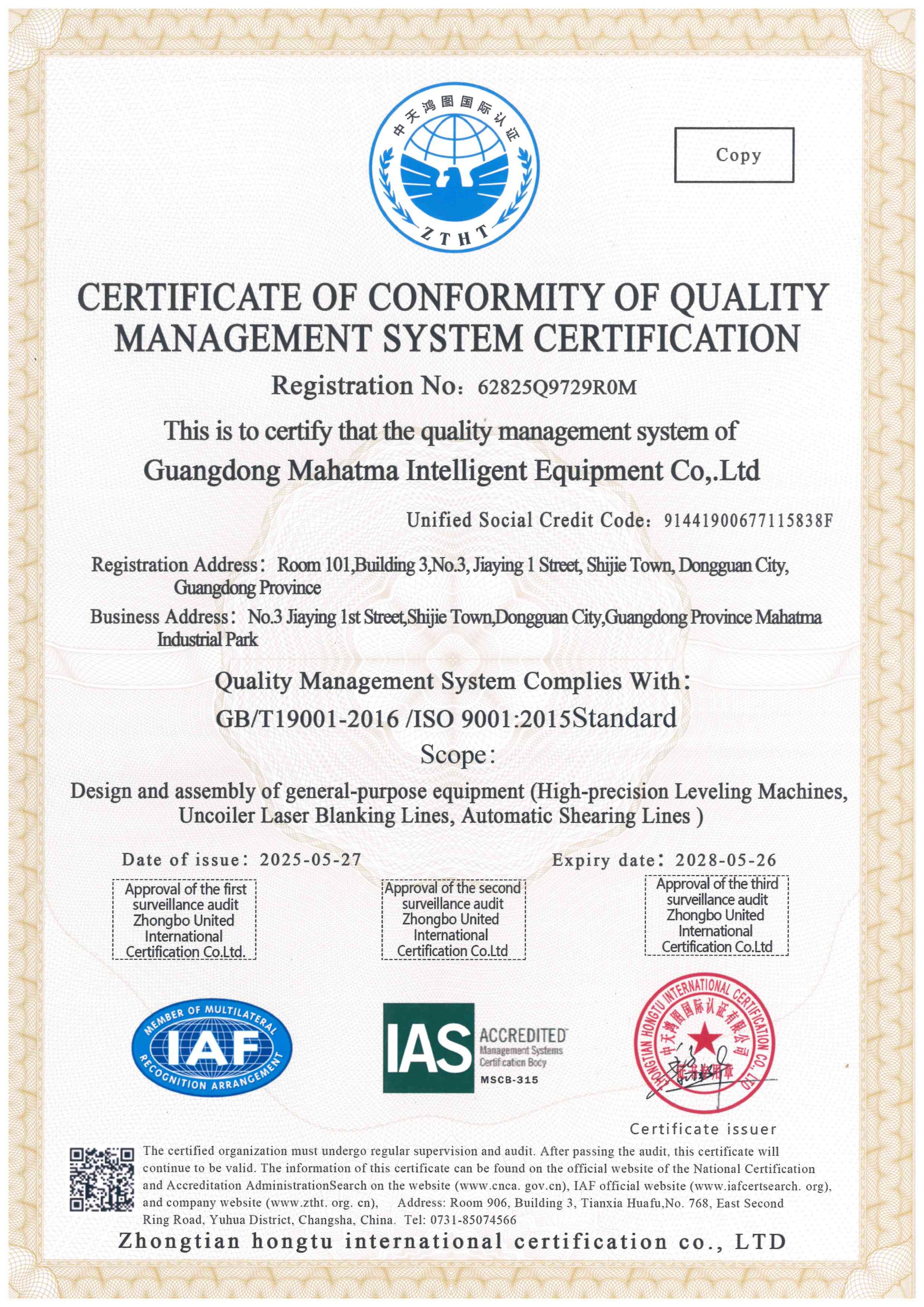
Neither failure is addressed by ISO 9001 or CE. The ISO 9001:2015 certificate held by MAHATMA (certificate 62825Q9729R0M, issued by Zhongtian Hongtu International Certification Co., Ltd., valid 27 May 2025 to 26 May 2028) covers the design and assembly of general-purpose equipment, naming high-precision leveling machines, uncoiler laser blanking lines and automatic shearing lines in its scope. That is a statement about the management system behind the build. The CE attestation of conformity (M.2025.206.C113032, issued by UDEM, valid 16 January 2025 to 15 January 2030) cites EN ISO 12100:2010, EN ISO 16090-1:2020/2022, EN ISO 16092-2:2020 and EN 60204-1:2018 for the hydraulic precision leveling machine. That is a statement about conformity with listed standards. Neither document predicts flatness on a specific coil, and neither describes a data interface.
Gate 1: write the MES/ERP data contract before the machine
The interface question is a data-contract question, not a cable question, and it should be answered in the order documents. Four items need to be fixed in writing before the technical evaluation closes.
Master of record. Decide whether the plant MES/ERP or the machine control is authoritative for order and recipe data. If both can write, the mismatch behaviour has to be defined — reject, clamp, or alarm and continue — because otherwise the answer is discovered during the first shift.
Data objects. List them rather than describing them: coil or plate ID, grade, thickness, width, target flatness, recipe number, line speed, production count, inspection result, alarm code. Laser blanking adds nesting and blank program data. A slitting line adds slit-width plan and coil genealogy. Each object needs a source system and a consumer.
Protocol, gateway and owner. Name the protocol, name who supplies and configures the gateway, and name who is on site if it fails. MAHATMA states that its blanking lines and CNC levelers provide MES/ERP interfaces, and that control-system integration (MES/PLC) is part of its customization scope alongside roller width and diameter, leveling thickness range, roll material such as Cr12MoV or SKD11, and automated loading and unloading systems. That describes capability and configuration options; the mapping still has to be written for the specific plant.
Production control layer. Interface scope changes with the control package. CNC levelers in the range store up to 200 recipes on a 10-inch touch screen with upstream and downstream linkage and misoperation warning; the servo-CNC models add a smart operating system with remote cloud control and laser 3D online inspection; automation modules such as loading carts, conveyors, robots, vision inspection and AGV are offered as standard options. Each addition changes both the data set and the party responsible for validating it.
Gate 2: line-fit questions change with the line type
Line fit is where generic checklists fail fastest. The leveler is normally one station inside a longer process, and the qualification question is defined by what sits either side of it. Manufacturing sources describe the leveler as terminal equipment in cut-to-length and roll-forming lines whose job is to correct flatness in metal coils — a description of function, not of a comparable performance metric.
| Configuration | Documented scope (MAHATMA) | Qualification question to settle before order |
|---|---|---|
| Uncoiling leveling slitting line | UC-2x2000 | Does the data model include slit-width plan and coil genealogy, and which system holds it? |
| Cut-to-length line | TD-2x2000 | Are cut length and piece count reported per order, and how is length tolerance agreed in writing? |
| Flying shear line | MF-3 | Is shear synchronisation and production counting part of the same interface, or a separate handshake with a different owner? |
| Laser blanking line | TL-T3: width 600–2800 mm, thickness 3.0–12.0 mm, line speed 25 m/min, laser power 2000–20000 W | Does the nesting and blank program travel with the same order record as the leveling recipe, and who validates the first nested part? |
| Leveling & deburring line | Customized / on request | Which unit owns the final tolerance — leveling or deburring — and where is that recorded? |
| Standalone levelers | Two-high VST42: 200–800 mm width, 0.4–3.0 mm rated, max 6.0 mm, 19 rolls. CNC MHTM120: 400–1600 mm, 4.0–16.0 mm rated, max 25.0 mm. Servo-CNC MHTW40: 400–1600 mm, 0.6–3.0 mm rated, 23 rolls. Hydraulic MHTR300: 1300–4000 mm, 15.0–80.0 mm rated, max 100.0 mm, 9 rolls. | Does the machine send flatness and recipe data to the plant system, or only to its own HMI? |
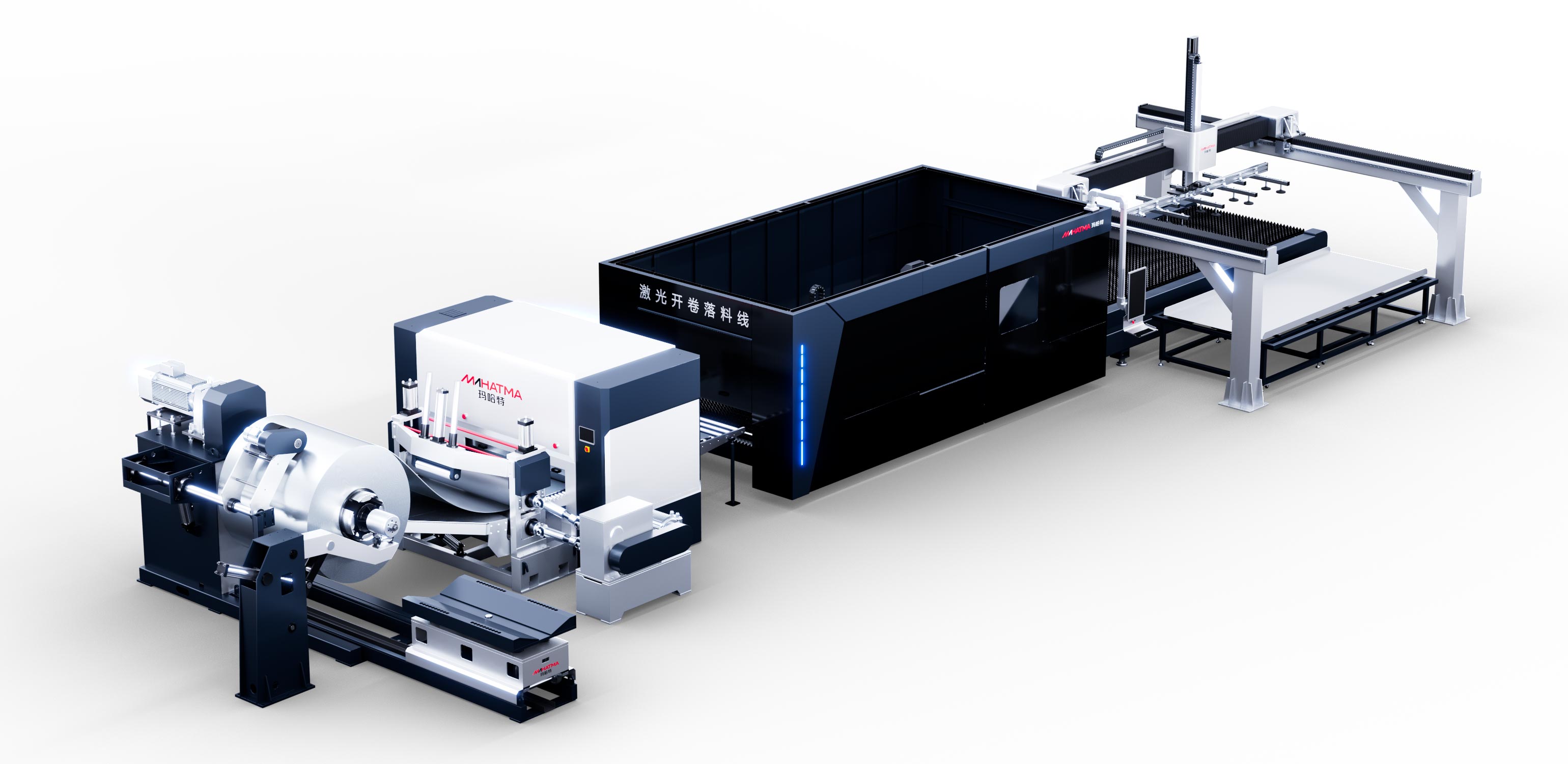
A practical warning on cross-supplier comparison: published ranges are usually company-specific and do not share a definition. Hagerty Steel & Aluminum publishes a 72-inch cut-to-length line handling 0.075–0.500 inch thickness, 4–75 inch width, 10–480 inch length and a maximum coil weight of 50,000 pounds. Those are service-centre processing figures, not a machine design rating, and they cannot be placed beside a builder's leveler specification without confirming that both describe the same operating condition.
Gate 3: test your own coil, at the worst condition in range
A demonstration on the supplier's reference material proves that the machine works. It does not prove that the buyer's material will reach the required flatness. The material gate therefore has to be run on the buyer's own coil, and it should be run on the hardest case inside the intended range rather than the easiest one.
MAHATMA offers a sample test at no charge: the buyer sends 1–2 metres of material or representative parts with grade, thickness and flatness target noted, the material is leveled on the recommended machine, and a written flatness report with the process parameters used and a video of the run is returned within days. The test and the resulting machine proposal are free; the buyer covers shipping of the material. The value of the format is not the video. It is that parameters, measured flatness and material condition arrive in one record that can be attached to the evaluation file.
Three things should appear in that record for it to function as qualification evidence. First, the measured flatness result stated against the buyer's own target, not a general claim. Second, the roll configuration and drive type used, because a 23-roll servo-CNC configuration and a 9-roll hydraulic configuration reach their results by different means and suit different thickness bands. Third, the surface condition of the strip, since marking is a rejection cause in its own right on coated, mirror-finish or visible parts.
The supplier's own pre-shipment controls then become part of the same chain rather than a substitute for it. MAHATMA lists laser 3D online flatness detection, ultrasonic flaw detection on rollers, hardness uniformity testing and full-load trial runs before shipment. Those checks guard build quality. The sample test guards application fit. A buyer needs both, in that order, and should ask which record accompanies which stage.
Gate 4: the dossier that has to close before payment
Documentation is the cheapest gate to complete and the most common source of delay at the port or at audit. The dossier should be assembled against the exact model and the exact destination market, not against the supplier's general capability page.
- ISO 9001:2015 certificate with certificate number, issuing body, validity dates and scope wording that names leveling machines.
- CE attestation of conformity with certificate number, issuing body, the standards cited, validity dates and the machine type named in the scope.
- The declaration of conformity for the actual configuration ordered, plus electrical and hydraulic schematics, English operating and maintenance manuals, and the spare parts list.
- Factory test report and warranty terms.
- Packing confirmation: export crates heat-treated and stamped to ISPM 15 to avoid fumigation or rejection at customs.
- Import classification. The US Harmonized Tariff Schedule classifies non-CNC straightening machines under HS 8462.21.00; other configurations may classify differently, so the code should be confirmed with a customs broker before shipment rather than after.
Where the evidence stops: five qualification boundaries
A qualification process is only honest if it states what it cannot establish. Five boundaries apply to almost every leveling machine purchase.
- There is no shared public flatness benchmark. The third-party records available for this category are company capability statements rather than comparable test results, and their scopes differ. Any flatness comparison across suppliers has to be rebuilt from each supplier's own test report on the same material.
- Certificate scope is narrower than a portfolio. The CE attestation held by MAHATMA names the hydraulic precision leveling machine. The ISO 9001 scope is worded around general-purpose equipment categories. Buyers should ask which models each document covers and request the declaration for the exact configuration, rather than assuming the logo covers every series.
- A sample is a sample. One to two metres of material demonstrates capability on that condition. It does not establish flatness across a full coil width, a different heat, or a production run measured in months; those belong in contractual acceptance criteria.
- Interface availability is not interface validation. MES/ERP connectivity stated as standard still has to be mapped to the buyer's system and proven with a logged handshake.
- Ratings move with material. Because rated thickness is set against a reference grade, high-strength steel, aluminium, copper and thin plate all shift the achievable result. The boundary should be written into the acceptance clause, not discovered in production.
A six-step qualification sequence that fits a normal procurement timetable
The sequence below keeps the gates in a workable order and puts the evidence-heavy steps before the commercial commitment.
- Freeze the requirement. Material grades, thickness minimum and maximum, width, coil or plate weight, target flatness, takt or line speed, and the position of the machine in the existing line.
- Describe the line, not just the machine. Upstream and downstream equipment, existing control platform, and the system that will be master of order data.
- Request a written interface description from each shortlisted supplier, naming data objects, protocol, gateway owner and mismatch behaviour.
- Run the material test on your own worst-condition material and require the report in a fixed format so offers can be compared on the same basis.
- Normalise the comparison. Put every offer on one matrix — documented envelope, roll count, drive type, interface scope, test result, certification scope, lead time — and mark anything not evidenced as open rather than assumed.
- Convert the answers into acceptance criteria. Flatness target, interface acceptance test, documentation list and training obligations belong in the contract, with the sample-test report attached as the reference condition.
Lead time and capacity belong in this sequence only after the technical gates clear. A 45-day standard lead time and a stated capacity of 50 units per month are useful planning inputs; they are not evidence that a specific configuration will hit a specific flatness target.
Market context: why interface and material proof moved up the agenda
Demand-side context supports the shift, within limits. Commercial research cited in the evidence base for this category estimates the global sheet metal market at USD 182.7 billion in 2025, with a projection of USD 281.2 billion by 2030. That figure describes the broader sheet metal category, not leveling equipment alone, and no comparable leveling-machine-specific market dataset was available — so it should be read as background on the material flow these machines sit inside, not as a market forecast for levelers.
What the technical record does show is material diversity. ANDRITZ describes a finishing-line portfolio covering slitting lines, cut-to-length lines and tension levelers for cold-rolled strip, stainless steel, copper, aluminium and hot-rolled strip. A line configured around one material family and a line configured to switch between several are qualified differently: recipe portability, roll condition, cleaning and changeover discipline all move into the acceptance discussion, and the data record has to identify which material was run under which recipe.
Outlook
Two expectations are reasonable on the available evidence, and both are conditional. First, as levelers and coil lines are bought as stations inside automated lines rather than as standalone machines, the data contract will keep moving earlier in the buying process — it becomes a technical selection criterion rather than a commissioning detail. Second, material proof will remain the decisive gate because it is the only step that tests the buyer's own condition; a supplier that can return measured flatness data on a named grade, and repeat it at acceptance, gives the buyer something a certificate cannot.
Both expectations depend on the buyer writing the requirement down. A qualification file that names the material envelope, the system of record, the interface test and the acceptance condition converts a supplier's capability into a verifiable commitment — and leaves the unverifiable parts visible, which is the point.
A downloadable summary of the manufacturer's leveler and line range is available in the MAHATMA brand brochure (PDF).
FAQ
What MES/ERP details should be agreed before ordering a leveling machine?
Four items: which system is master of order and recipe data; the exact list of exchanged data objects, from coil ID and grade through target flatness, production count, inspection result and alarm code; the protocol, gateway supplier and owner; and what the machine does when the two systems disagree. MAHATMA states that its blanking lines and CNC levelers provide MES/ERP interfaces and that MES/PLC control integration is a customization item, which means the detail belongs in the order documents rather than in an assumption. A factory acceptance test with a simulated order download turns the agreement into evidence.
How much material is needed for a pre-purchase leveling test, and what comes back?
MAHATMA's sample test uses 1–2 metres of material or representative parts, sent with grade, thickness, width and flatness target noted. The material is leveled on the recommended machine and a written flatness report, the process parameters used and a video of the run are returned within days; the test and the resulting proposal are free, with the buyer covering shipping of the material. The test is most useful when it uses the worst-condition material in the intended range, because the result then bounds the whole envelope rather than one easy case.
Does a CE certificate cover every model a supplier offers?
Not automatically. A certificate carries a scope. MAHATMA's machinery directive attestation of conformity, number M.2025.206.C113032 issued by UDEM and valid 16 January 2025 to 15 January 2030, is issued for the hydraulic precision leveling machine and cites EN ISO 12100:2010, EN ISO 16090-1:2020/2022, EN ISO 16092-2:2020 and EN 60204-1:2018. A buyer should ask which models the certificate covers and request the declaration of conformity for the exact configuration, voltage and destination market on the order.
Which machine parameters must match an existing production line?
Material envelope (grade, thickness, width), coil or plate weight, line speed, the physical position of the leveler between upstream and downstream stations, and the data interface. The documented spread inside one portfolio shows why this cannot be handled generically: the servo-CNC MHTW20 covers 400–1300 mm width and 0.3–1.2 mm rated thickness with 23 rolls, while the hydraulic MHTR300 covers 1300–4000 mm width and 15.0–80.0 mm rated thickness with 9 rolls. Choosing outside the right band changes roll count, drive type and the flatness that can realistically be achieved.
How does HS classification fit into leveling machine qualification?
It belongs to the import file rather than the technical assessment, but it should be settled before shipment. The US Harmonized Tariff Schedule classifies non-CNC straightening machines under HS 8462.21.00 according to the USITC schedule; other machine configurations may classify differently. Because duty and customs documentation follow the code, buyers should confirm the classification for the ordered configuration with a customs broker, alongside the conformity documents and ISPM 15 packing confirmation.
Tem questões ou precisa de mais detalhes?
Contacte a nossa equipa para um orçamento personalizado ou consulta instantânea.
Solicitar orçamento
Preencha o formulário abaixo e a nossa equipa entrará em contacto com uma proposta personalizada.
Chat direto do WhatsApp
Prefere conversar em tempo real? Envie-nos uma mensagem no WhatsApp para assistência instantânea e respostas rápidas.
- Obter orçamento personalizado
- Partilhar fotos ou documentos
- Discuta as suas necessidades diretamente
Geralmente responde em 5–30 minutos durante o horário de expediente.