
Leveling Machine Types: Building a 2026 Procurement Shortlist
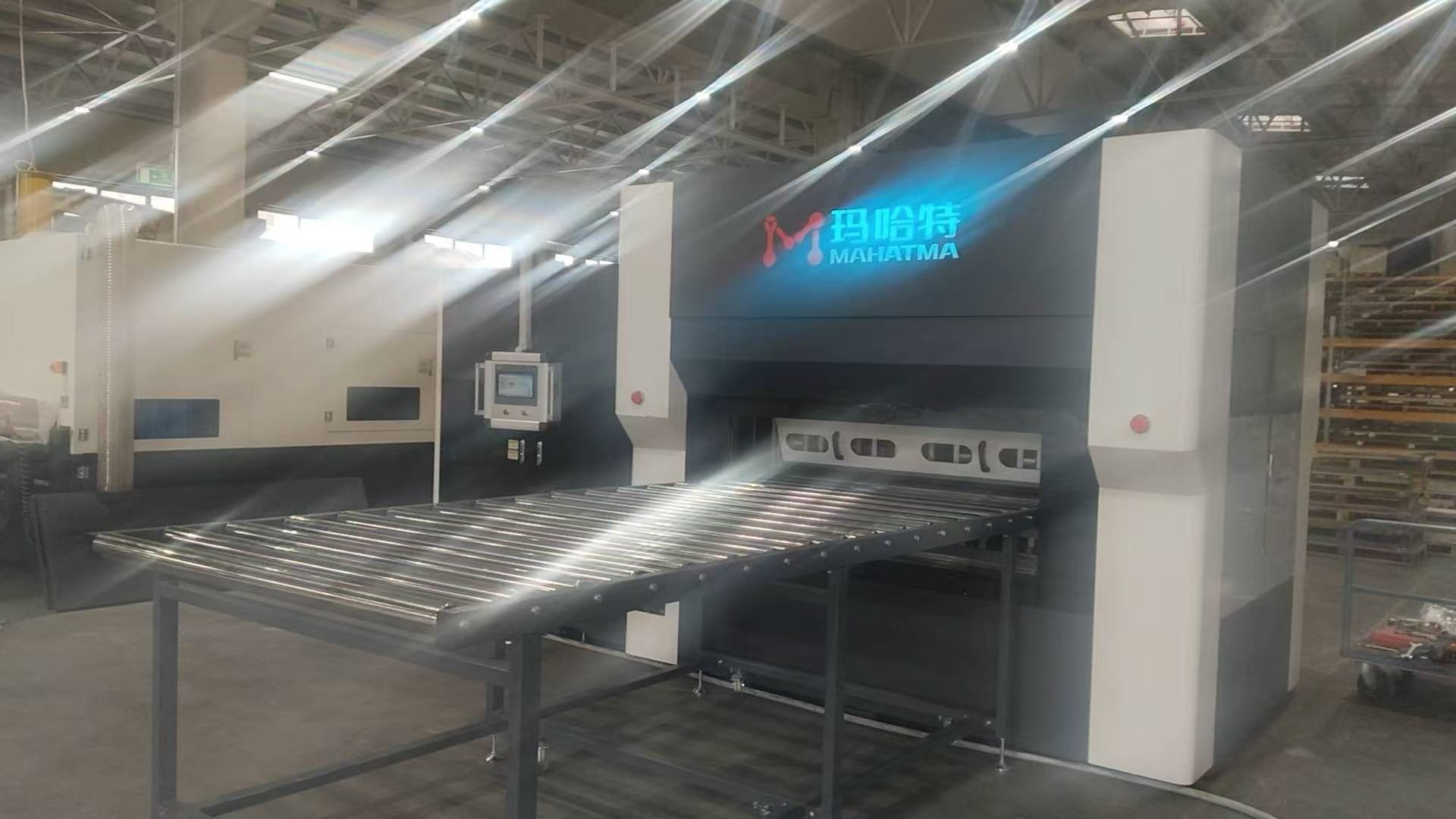
A leveling machine shortlist built on price alone tends to fall apart at commissioning. A shortlist built on machine type — roll structure, control architecture and material envelope — is far more likely to survive the first production week.
Leveling and straightening equipment is one of the least standardized purchases in metal fabrication. Two suppliers can quote the same nominal thickness range and deliver machines with different roll counts, different structural classes and different control philosophies. The result is a familiar failure mode: a machine that satisfies the specification sheet but cannot hold flatness on the material the buyer actually runs.
This article takes a different starting point. It builds a 2026 procurement roster around machine types rather than vendor claims, using four MAHATMA equipment families as baseline options: two-high rough levelers, four-high plate levelers, CNC levelers and hydraulic levelers. The decision grid below is constructed only from catalogue structure and published model data — no prices, no comparative performance claims and no benchmark assumptions borrowed from other markets.
Market context supports the approach. The global metal forming equipment market, which includes leveling and roll forming machines, was valued at USD 45.8 billion in 2025, with Asia Pacific holding a 42.5% revenue share in the same year (Dataintelo). Separately, CNC technology accounted for 85.7% of the machine tools market in 2025 (Grand View Research). Both figures point the same way: the roster decision is increasingly about which structure and control class a shop needs, not about whether automation belongs in the purchase at all.
Why the 2026 Shortlist Should Start With Machine Type
Most procurement processes begin with a vendor list and end with a price comparison. For leveling equipment, that order is inverted. The four families below differ in how the material is bent, how the roll gap is controlled, and how thick or how wide the machine can be built. Because not every manufacturer builds every structure, choosing the family first narrows the vendor field automatically.
A machine-type-first shortlist also produces a cleaner request for quotation. Instead of asking for “a leveler for 1–6 mm sheet”, the document states the structural class, the roll configuration, the control architecture and the material envelope required. Suppliers can then respond with a matched proposal, and buyers can compare like with like.
The Four Families That Form the Baseline Roster
The table below is a decision grid, not a ranking. It uses catalogue structure and published model data only. Reading it vertically is the fastest way to see why two machines with similar headline thickness ranges can belong to completely different purchase categories.
| Machine family | Catalogue structure | Representative series | Material envelope (catalogue data) | Roster role |
|---|---|---|---|---|
| Two-high rough leveler | Two-layer leveling machine | VST42, VST70, VST90, VST120 | Width 200–1,400 mm; rated thickness 0.4–10.0 mm; max 6.0–20.0 mm; 13–19 rolls | Thick-plate rough leveling; first-pass flattening; budget-limited workshops |
| Four-high plate leveler | Four-layer leveling machine | VSH12, VSH15, VSH20, VSH32, VSH42, VSH50, VSH60, VSH80 | Width 200–1,000 mm; rated thickness 0.03–8.0 mm; max 1.0–14.0 mm; 15–19 rolls | Small and medium sheet metal shops; hardware; small-batch or low-frequency processing |
| CNC leveler | Intelligent CNC leveling machine; intelligent servo-CNC leveling machine | MHTM10–MHTM200; MHTW15–MHTW100 | MHTM: width 200–3,200 mm; rated 0.03–30.0 mm; up to 25 rolls. MHTW: width 300–2,100 mm; rated 0.08–12.0 mm; up to 33 rolls | Precision sheet metal, cabinets and enclosures, auto parts, appliances, laser blanking, 3C electronics, medical devices |
| Hydraulic leveler | Servo-hydraulic high-precision leveling machine | MHTR30, MHTR40, MHTR50, MHTR60, MHTR80, MHTR100, MHTR120, MHTR150, MHTR200, MHTR260, MHTR300, MHTR400 | Width 400–4,000 mm; rated thickness 0.5–100.0 mm; max 5.0–120.0 mm; 9–23 rolls | Heavy industry, shipbuilding, aerospace, thick plate, coils, high-strength steel |
Two observations follow from the grid. First, the families overlap: a hydraulic MHTR30 and a CNC MHTM40 sit in a comparable thin-gauge envelope, so the family label alone does not decide the roster slot. Second, roll count generally moves in the opposite direction to thickness — the thinnest models carry the most rolls (25 to 33 across the MHTM10 and MHTW15 series), while 100 mm-class hydraulic models run 9 rolls. That is a design consequence rather than a quality statement, and it is one of the most useful signals when matching a machine to a material.
Family 1 — Two-High Rough Levelers
The catalogue classifies VST models as two-layer leveling machines. Four series are listed: VST42 (width 200–800 mm, rated thickness 0.4–3.0 mm, max 6.0 mm, 19 rolls), VST70 (400–1,300 mm, rated 1.0–6.0 mm, max 10.0 mm, 13 rolls), VST90 (600–1,300 mm, rated 2.0–8.0 mm, max 14.0 mm, 13 rolls) and VST120 (600–1,400 mm, rated 3.0–10.0 mm, max 20.0 mm, 13 rolls).
The intended applications are small and medium sheet metal shops, hardware production, thick-plate rough leveling and budget-limited workshops. On a 2026 roster this family normally appears in one of two places: as a rough-leveling first pass ahead of a precision machine, or as the only leveling asset in a shop whose requirement is commercial flatness rather than precision-grade flatness.
Family 2 — Four-High Plate Levelers
VSH models are catalogued as four-layer leveling machines and cover eight series. The family reaches very light gauges at the small end — VSH12 is rated 0.03–0.5 mm with a 1.0 mm maximum in a 200–400 mm width, with 19 rolls — and extends to VSH80, rated 2.0–8.0 mm with a 14.0 mm maximum, 400–800 mm width and 15 rolls. Intermediate series (VSH15, VSH20, VSH32, VSH42, VSH50, VSH60) step the envelope up in roughly even increments.
The catalogue positions this family for small and medium sheet metal shops, hardware work, small-batch or low-frequency processing and budget-limited workshops. That positioning matters at shortlist stage: the four-high plate leveler is the economic tier of the roster, and it should not be substituted silently for a control-driven machine when the application requires repeatable recipes or line integration.
Family 3 — CNC Levelers
MAHATMA’s CNC family splits into two catalogued groups. The MHTM series is described as intelligent CNC leveling machines and spans MHTM10 (width 200–300 mm, rated 0.03–0.6 mm, 25 rolls) through MHTM40 (400–1,600 mm, 0.6–3.0 mm, 21 rolls), MHTM100 (800–1,600 mm, 3.0–12.0 mm, 19 rolls) and MHTM200 (1,000–3,200 mm, 8.0–30.0 mm, max 40.0 mm, 19 rolls). The MHTW series is described as intelligent servo-CNC leveling machines and spans MHTW15 (300–600 mm, 0.08–1.0 mm, 33 rolls) to MHTW100 (600–2,100 mm, 3.0–12.0 mm, max 20.0 mm, 19 rolls).
For roster purposes the two groups answer different questions. MHTM models cover a wide material envelope, with catalogue industries including sheet metal fabrication, cabinets and enclosures, auto parts, home appliances, laser blanking and hardware. MHTW models are positioned for precision sheet metal, 3C electronics, automotive, home appliance, new energy, laser cutting and medical device work — applications where thin material and surface condition dominate the requirement.
What puts the CNC family on the shortlist is not roll geometry alone. Control architecture is a catalogue-level configuration item covering roll gap adjustment, parameter memory for repeated jobs, and control system integration with MES or PLC environments. Buyers evaluating this family should treat the control specification as a first-order requirement rather than an accessory.
Family 4 — Hydraulic Levelers
The MHTR family is catalogued as servo-hydraulic high-precision leveling machines and carries the widest envelope in the roster: from MHTR30 (width 600–2,100 mm, rated 0.5–3.0 mm, 23 rolls) through MHTR120 (600–3,200 mm, 4.0–20.0 mm, 15/19 rolls) and MHTR260 (1,300–4,000 mm, 10.0–60.0 mm, 9/11 rolls) to MHTR400 (1,300–4,000 mm, rated 20.0–100.0 mm, max 120.0 mm, 9 rolls).
Catalogue industries include new energy, military, heavy industry, automotive and truck, construction, shipbuilding, aerospace and metal processing. Listed materials across the family include carbon steel, high-strength steel, stainless steel, aluminum, copper, mirror-finish sheet and thick plate. In a procurement roster, the hydraulic family appears wherever thickness and force, rather than surface sensitivity, set the constraint.
Where the Families Sit Inside a Full Line
Buyers procuring a line rather than a standalone machine face the same decision at a different scale. The same catalogue includes five line-level systems, each with its own leveling content:
- MF-3 uncoiling leveling flying shear line: material thickness 0.3–3.0 mm, width 400–1,800 mm, shearing accuracy 0.5 mm, feeding speed up to 100 m/min, max coil weight 25T.
- TD-2x2000 cut-to-length line: width 900–1,800 mm, thickness 0.2–2 mm, shearing accuracy ±0.5 mm, max speed 50 m/min, max coil weight 20T.
- TL-T3 uncoiling leveling laser blanking line: width 600–2,800 mm, thickness 3.0–12.0 mm, speed 25 m/min, laser power 2,000–20,000 W.
- UC-2x2000 uncoiling leveling slitting line: thickness 0.3–2.0 mm, width 500–1,800 mm, 8–30 slit strips, feeding speed up to 200 m/min, max coil weight 20T.
- Leveling and deburring line (customized): width 600–1,300 mm, thickness 0.5–80 mm, speed 20 m/min, minimum part 50 × 50 mm, accuracy 0.1–0.3 mm.
For line projects the leveler inside the line should be shortlisted with the same grid used for standalone machines, because the usable material envelope of the line is set by the leveler as much as by the shear or the laser source.
Application Evidence From Installed Machines
Catalogue envelopes describe what a family can be built to handle. Installed-machine records describe what the families are actually used for. Across the MAHATMA case record the split is consistent:
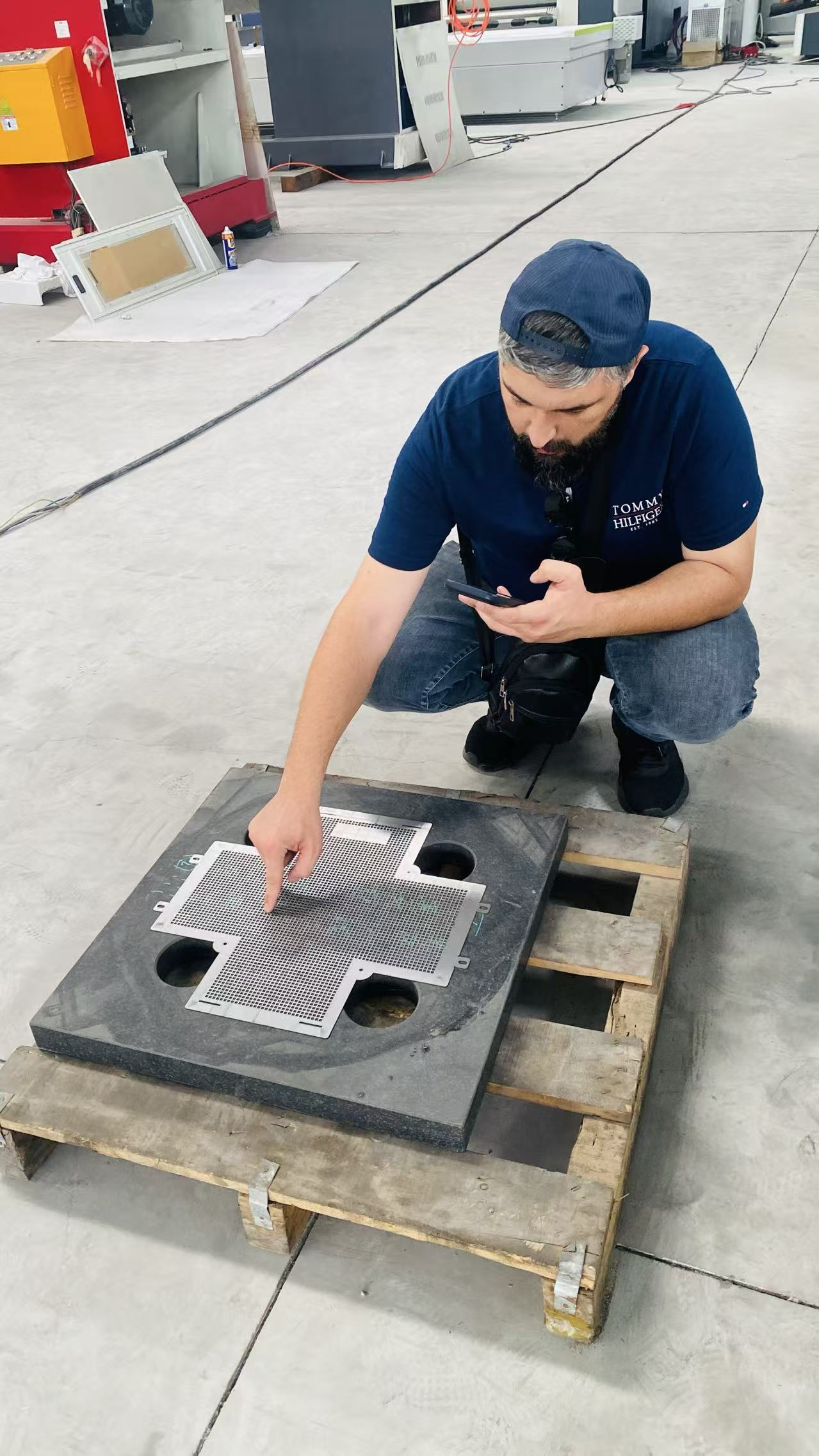
- Ceiling plate and perforated sheet: MHTM40 CNC levelers (Türkiye) and MHTR30 hydraulic levelers (Saudi Arabia), recorded as resolving deformation in perforated metal sheet.
- Semi-trailer parts: MHTR80 and MHTR100 hydraulic levelers (Brazil), recorded as stable operation on metal deformation.
- Steel mesh board: MHTR80 (Germany). Spring steel: MHTM80 CNC leveler (Singapore). Perforated sheet: MHTM60 and MHTM80 (Malaysia).
- Coil leveling: MHTR260 (Mexico). Laser-cut part leveling: MHTM60 in Brazil, with the customer recording a 160% capacity expansion.
The pattern follows the specification grid: thin and medium-gauge precision repair work tends to land on the CNC family, while coil, thick plate and high-strength material land on the hydraulic family. That is the outcome a type-first shortlist is designed to produce.
What the 2026 Market Data Suggests About Demand
Trend data explains why the roster is worth rebuilding rather than repeating. The global metal forming machine tools market is projected to reach USD 64.85 billion by 2034, at a CAGR of 9.60% (Fortune Business Insights), while a separate estimate for the broader metal forming equipment market puts 2025 value at USD 45.8 billion with a 42.5% Asia Pacific revenue share (Dataintelo). Methodological divergence is visible in the growth figures themselves: Dataintelo reports a 5.2% growth rate for its wider equipment definition against the 9.60% forecast for the narrower machine tools segment. Any single CAGR should therefore be read as a directional signal rather than a planning constant.
Two other data points are more directly useful for procurement timing. Sheet metal processing equipment demand in Asia Pacific reached USD 18.36 billion in 2025, and the automotive segment accounted for 41.37% of that market in 2026 (Fortune Business Insights). On the supply side, China’s exports of metalworking machine parts increased 20.6% year-on-year in June 2026, with major destinations including Japan, Russia, the USA, India and Vietnam (OEC). The practical reading is that capacity and competition in this category remain international, which is precisely why a shortlist should be built on structure and documentation rather than origin alone.
One adjacent market confirms the same direction for line-level purchases: the cut-to-length machine market is projected to grow from USD 4.28 billion in 2026 to USD 5.94 billion by 2032 at a CAGR of 5.52% (ReportLinker).
Precision Leveling Versus Traditional Flattening — and Where the Boundaries Are
Most factories still meet flatness problems with methods older than the multi-roll leveler: manual straightening, press-based flattening or a single-pass roller straightener. These approaches remove visible bow, but they generally do not address internal residual stress, which is why parts can distort again after laser cutting, welding or machining. Precision leveling works differently: multi-roll alternating bending uses the Bauschinger effect to reduce residual stress rather than only to reshape the surface, and plate flatness tolerances are referenced to standards such as DIN EN 10029.
Precision leveling is not automatically the right purchase, however. The catalogue and application notes define several boundaries that belong in any evaluation:
- Thickness trade-off. A machine optimized for thick plate cannot level thin sheet precisely, and a machine optimized for thin sheet cannot handle thick plate. Where a shop’s range is wide, the realistic options are the model with the best envelope overlap or a two-machine plan.
- Yield-strength derating. Model thickness ratings are stated against a baseline material. High-strength steel, aluminum and titanium require recalculation against yield strength, and the recalculated limit should be confirmed on real material rather than assumed from the catalogue.
- Material-dependent results. Achieved flatness depends on material grade, thickness and the original coil condition, which is why a sample test — not a specification sheet — is the standard confirmation step.
- Tier boundaries. The two-high and four-high families are catalogued for small-batch, low-frequency and budget-limited production. They are not positioned as substitutes for CNC or servo-hydraulic machines in continuous precision work.
The competitive picture is also worth stating plainly. The leveling equipment field includes long-established European specialists: ARKU Maschinenbau GmbH was recognized in WirtschaftsWoche’s 2025 list of hidden world market leaders for precision leveling machines, and KOHLER Maschinenbau GmbH reported more than 6,700 reference projects in leveling technology as of late 2023. MAHATMA Leveler, for its part, is a Guangdong-based manufacturer of high-precision leveling equipment founded in 2008, operating a 50,000 m² facility with 300 employees and an annual output of 500 sets. Most serious procurement rosters include at least one established European supplier alongside Asian manufacturers, and comparing them on documentation, envelope and integration capability is more productive than comparing marketing language.
Closing the Shortlist: Documentation and Verification
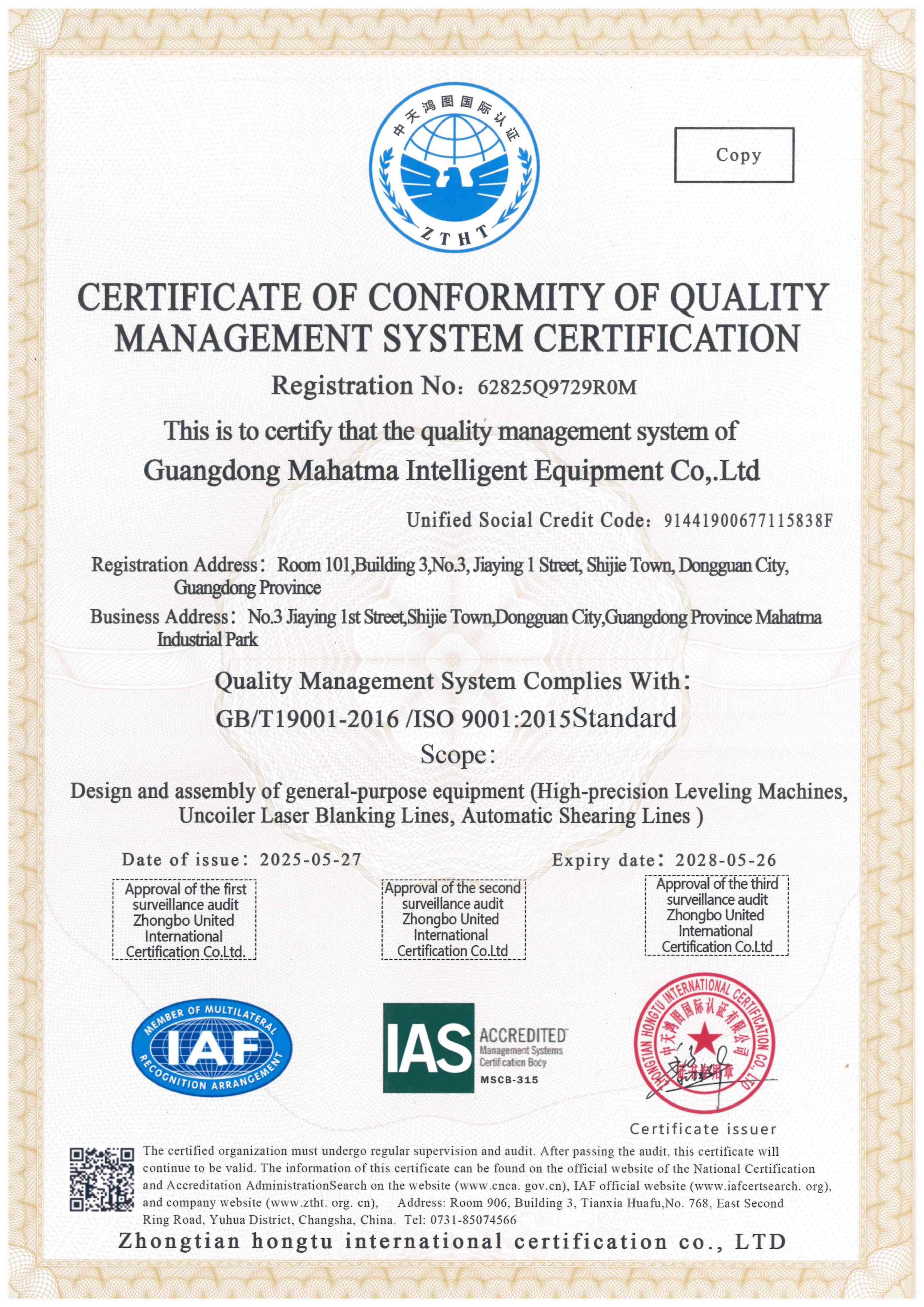
A 2026 roster should not close until the evidence pack is complete. For MAHATMA equipment, the verifiable items are specific:
- Quality management: ISO 9001:2015 certification, certificate number 62825Q9729R0M, issued 2025-05-27 by Zhongtian Hongtu International Certification Co., Ltd. and valid to 2028-05-26, covering the design and assembly of general-purpose equipment including high-precision leveling machines, uncoiler laser blanking lines and automatic shearing lines; recognized in all IAF MLA signatory countries.
- EU market access: Machinery Directive attestation of conformity M.2025.206.C113032, issued 2025-01-16 by UDEM and valid to 2030-01-15 for the European market, with scope covering hydraulic precision leveling machines and standards listed as EN ISO 12100:2010, EN ISO 16090-1:2020, EN ISO 16090-1:2022, EN ISO 16092-2:2020 and EN 60204-1:2018. CE marking is the standard requirement for leveling machines entering the European market.
- Manufacturing and capability: OEM, ODM, customized manufacturing and turnkey solution supply; customization covers roller width and diameter, leveling thickness range, roll material such as Cr12MoV or SKD11, control system integration with MES/PLC, and automated loading and unloading systems. Monthly capacity is stated at 50 units, lead time at 45 days and minimum order quantity at 1 unit.
- Quality control: laser 3D online flatness detection, ultrasonic flaw detection on rollers, hardness uniformity testing, and full-load trial runs before shipment.
- Service structure: 24/7 global technical support, overseas engineers available for commissioning, regional spare-parts warehouses and operator training. The company reports exports to over 100 countries and regions through 28 overseas marketing and service networks, a 30% export ratio, and a 26-engineer R&D team holding over 230 patents.
A sample test on the buyer’s own material is the most direct way to close the gap between catalogue envelope and production result. MAHATMA offers the test at no cost: typically one to two meters of material or representative parts, returned with a written flatness report and a process video, with the material grade and flatness target supplied by the buyer.
Future Outlook
Two forces are likely to shape the 2027–2030 version of this roster. The first is control maturity. With CNC technology already accounting for 85.7% of the machine tools market in 2025, the dividing line inside leveling equipment is shifting from “CNC or not” to “how well the control layer connects”. MES/ERP interfaces are catalogue-standard on MAHATMA blanking lines and CNC levelers, and automation modules — loading carts, conveyors, robots, vision inspection and AGVs — are offered as standard options rather than bespoke development. Modular upgrade paths are documented in the case record as well: buyers who start with a standalone leveler can add feeding and stacking automation later.
The second force is compliance. Flatness is increasingly quantified against recognized measures such as the I-unit or mm/m deviation, plate tolerances reference DIN EN 10029, and CE marking remains the entry requirement for European installations. As cross-border supply expands — with China’s metalworking machine parts exports up 20.6% year-on-year in June 2026 — documentation quality becomes a competitive variable in its own right rather than a formality attached to delivery.
For a 2026 procurement roster, the practical conclusion is modest but useful. Start with the machine family, set the envelope from the material, verify the control and integration layer, then confirm with a sample test on real material. Vendors can be compared afterwards, and the roster stops changing every time a new quotation arrives.
FAQ
Which leveling machine family should be on my shortlist for my material?
The starting point is the material envelope, not the family name. Thickness range, width, material grade (yield strength) and flatness target allow a matched model to be identified from the catalogue. As a reference map: two-high VST models cover width 200–1,400 mm and rated thickness 0.4–10.0 mm for rough leveling; four-high VSH models cover 200–1,000 mm and 0.03–8.0 mm for small-batch work; MHTM CNC models cover 200–3,200 mm and 0.03–30.0 mm; MHTW servo-CNC models cover 300–2,100 mm and 0.08–12.0 mm; and MHTR hydraulic models cover 400–4,000 mm and 0.5–100.0 mm. Because leveling force depends on thickness and yield strength together, a rating based on a baseline material must be recalculated for high-strength steel, aluminum or titanium.
Can one machine cover both thin and thick material?
Only within its rated range. A machine optimized for thick plate cannot level thin sheet precisely, and a machine optimized for thin sheet cannot handle thick plate. Where a shop’s material range is wide, the options are the model with the best envelope overlap or a two-machine plan.
Can my own material be tested on the machine before purchase?
Yes. A sample test is part of the standard evaluation process and is offered at no cost. Buyers send one to two meters of material or representative parts with the material grade and flatness target noted; the test is run on the recommended machine and returned with a written flatness report, the process parameters used and a video of the leveling run. Testing worst-condition material rather than best-condition material produces the more useful result.
What flatness can a leveling machine actually achieve on a given part?
Catalogue precision series are rated down to ±0.05 mm on suitable material, with typical production results in the 0.05–0.20 mm/m² range; final flatness depends on material grade, thickness and the original coil condition. The practical confirmation step is a sample test on the buyer’s own material, using measured flatness rather than a nominal figure.
Can a leveling machine or line integrate with an existing MES/ERP system and production line?
Yes. MAHATMA blanking lines and CNC levelers provide MES/ERP interfaces, and automation modules — loading carts, conveyors, robots, vision inspection and AGVs — are offered as standard options rather than custom development. Integration planning requires the part envelope, takt target and current line layout early in the project, because those inputs determine the engineered layout.
Do MAHATMA machines carry CE certification, and can they be exported to the EU and US?
MAHATMA holds ISO 9001:2015 certification (certificate 62825Q9729R0M, valid to 2028-05-26) and a Machinery Directive attestation of conformity (M.2025.206.C113032, valid to 2030-01-15) for the European market, with scope covering hydraulic precision leveling machines. CE marking is a customs requirement for the EU. For North America, electrical specification — voltage and frequency — should be stated at order, and local field evaluation requirements may apply to the electrical panel. For the Eurasian Economic Union, EAC certification applies separately. Requesting the Declaration of Conformity before final payment is standard practice.