
Li-ion Battery Customization: HCC's OEM/ODM Capability Edge
Li-ion Battery Customization: HCC's OEM/ODM Capability Edge

Figure: HCC's Shandong intelligent manufacturing base, part of the supply chain supporting OEM/ODM lithium-ion battery pack projects.
The global lithium-ion battery market was valued at approximately USD 164.8 billion in 2024 and is projected to reach USD 422.8 billion by 2032, according to GMI Research. Within that expansion, application-specific categories — drones, robotics, and medical devices — are increasingly sourcing engineered battery packs rather than bare cells, and the ability to customize is becoming a core supplier-selection criterion.
Why OEM/ODM capability now drives lithium-ion battery procurement
For procurement and engineering teams at the evaluation-to-execution stage, the practical question has shifted. It is no longer only “which cell should we buy?” but “which manufacturer can translate an application profile — voltage platform, discharge rate, mechanical envelope, operating temperature, certification scope — into a validated, repeatable battery pack?”
Drone manufacturers require high-rate discharge with stable voltage during high-current flight; delivery and exoskeleton robot builders need continuous output, thermal management, and long cycle life; medical device projects add transport and electrical safety compliance to the list. Off-the-shelf catalogs often stop short of these requirements. That gap is the central opportunity for OEM/ODM battery manufacturers: to compress the distance between an application specification and a production-ready pack.
HCC: a manufacturer built around robot, exoskeleton, and drone batteries
HCC (Shenzhen Topway New Energy Co., Ltd.) is a lithium-ion battery manufacturer based in Shenzhen, China, specializing in robot batteries, exoskeleton batteries, and drone batteries. Founded in 2022, the company operates a 10,000 square-meter facility with 200 employees and an independent R&D team of 15 engineers. Its sales center is located in Shenzhen, and its products are exported primarily to overseas markets while also serving the Chinese market.
Around 40% of HCC's output is exported, with principal markets spanning the United States, the European Union, the United Kingdom, Japan, South Korea, Australia, Canada, Mexico, Russia, Turkey, Brazil, Argentina, Chile, Peru, and multiple Southeast Asian countries including Vietnam, Malaysia, Singapore, Indonesia, Thailand, and the Philippines.
OEM/ODM production: from 5-piece pilots to 10,000-unit monthly capacity
At the center of HCC's manufacturing offer is an OEM/ODM model with a stated customization scope of “all kinds of battery packs.” The production line reports a monthly capacity of 10,000 units, a lead time of 20–35 days, and a minimum order quantity of 5 pcs. A 30% quality-control inspection rate is applied across the OEM/ODM process, and after-sales support is delivered through remote channels.
The low MOQ is decision-relevant for evaluation-stage buyers: it permits pilot builds and field testing before volume commitment. At the execution stage, the 20–35 day lead time and 10,000-unit monthly capacity provide a predictable production rhythm. For standard volume procurement, HCC's purchasing terms reference an MOQ range of 1,000–10,000 pcs, with pre-shipment testing as the standard acceptance procedure.
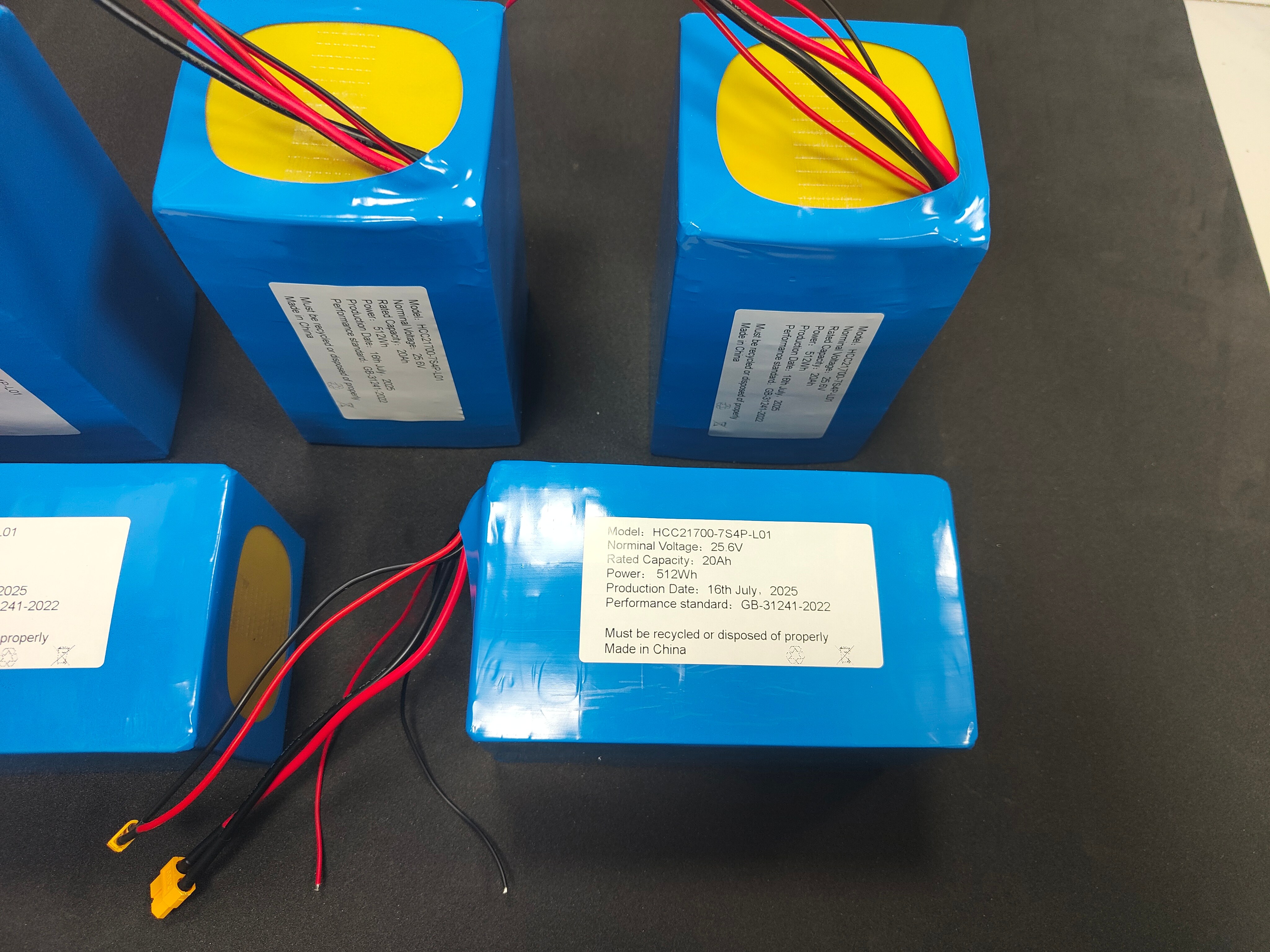
HCC's OEM/ODM scope covers custom battery pack assembly, BMS integration, and certification.
Cell formats and chemistries: the technical base
HCC's product line covers the cylindrical form factors most commonly requested by OEMs: 14500, 18500, 18650, and 21700 cells, in both NCM and LiFePO4 chemistries. The selection of chemistry is application-driven: NCM packs are typically used where energy density and discharge rate take priority, while LiFePO4 packs are specified where cycle life and thermal stability are the dominant constraints.
The following table summarizes representative models from HCC's documented product data:
| Model | Type / chemistry | Core parameters | Documented use |
|---|---|---|---|
| 14500 3.7V 500mAh | 14500 battery, NCM | 1C charge/discharge; -20 to 60°C; 50g | Manufacturing, laryngoscope |
| 18500 3.6V 2000mAh | 18500 battery, NCM | 2A charge/discharge; -20 to 60°C; approx. 40g | Digital batteries |
| 18650 3.6V 3000mAh | 18650 battery, NCM | 3A charge/discharge; -20 to 60°C; 45g | Digital batteries |
| 18650 3.7V 5200mAh | Rechargeable Li-ion, NCM | 0.2C (1040mA) charge/discharge; 200g | Manufacturing, fan |
| 21700-TW01 | 21700 battery, NCM | 0.2C max charge; 1C max continuous discharge | Manufacturing |
| Topway-BP01 battery pack | Battery pack, NCM | 40A max discharge; ≥500 cycles to 80% capacity | Medical, toy, drone |
| Delivery robot battery 25.6V 30AH | Robot battery, LFP | 24V / 30Ah; 5A charge / 5A discharge; -20 to 60°C; 5.2kg | Robot battery |
| Agriculture drone battery 25.2V 20AH | Drone battery, NCM | 15A charge / 20A discharge; -10 to 60°C; 2.6kg | E-mobility |
For integrated systems, the Topway-BP01 battery pack reaches a 40A maximum discharge current with a cycle life of at least 500 cycles to 80% capacity, with documented applicability across medical, toy, and drone products. Across HCC's case records, packs are delivered with a built-in intelligent BMS providing overcharging, overdischarging, overcurrent, short-circuit, and temperature protection. This BMS integration is typically tuned per application: agricultural drone packs emphasize real-time temperature control and automatic current limiting under overload, while robot packs emphasize stable continuous output under heavy load without voltage drop.
Certifications and compliance: a documented export framework
HCC states that related products have passed RoHS, UL, CE, and other export certifications. Specific records in the company's documentation include the following:
- A UN38.3 test report (SKEXM202407199230) and a UN38.3 certificate (CMC240627016), both issued by CMC Testing International (Shenzhen) Co., Ltd. for model HCC18650-10S5P-L01 (36.5V, 13Ah, 474.5Wh), with the test report valid through 2029.
- A CE certificate (DL-20211210007C) issued by Shenzhen DL Testing Technology Co., Ltd., covering the rechargeable HV Li-ion storage battery model ELEBOX-2560 under the EN IEC 61000 series standards.
- An MSDS certificate (HCC-MSDS-2615) covering cylindrical battery model ABA-5000-50S, referencing the UN38.3 standard.
- A KC certificate (CKC-2020-002088) issued by the Korea Testing & Research Institute for battery model 103040.
- A 1.2m drop test report (NO.1119110302) issued by the Shanghai Research Institute of Chemical Industry Testing Co., Ltd.
- An air transport identification and classification report (PEKGZ20180103150GJX0001) issued by Beijing DGM Air Transport Technology Co., Ltd., covering 14500 cells at 400 units per package with a maximum 30% state of charge.
- A sea transport report (CMC251017116H03) issued by CMC Testing International (Shenzhen) Co., Ltd. for the sodium-ion battery RPES-WM4 (48V 110Ah, UN 3480) under the IMDG Code.
These records align with the wider compliance environment: IEC 62133-2 remains the primary international safety standard for portable lithium-ion cells and packs, and effective January 1, 2026, IATA/UN regulations impose a 30% state-of-charge limit for lithium batteries packaged with devices under PI 966 — a requirement HCC's air transport documentation already reflects at the cell level.
Application scenarios: documented volumes across drones, robots, and mobility
HCC's case records cover several production programs at meaningful volumes. The table below summarizes documented deployments; technical details follow.
| Application segment | Client location | Documented quantity | Key pack characteristics |
|---|---|---|---|
| Agricultural drones | United States | 2,000 pcs | High-rate discharge; reinforced BMS with thermal control |
| Delivery robots | Spain | 2,000 pcs | 25.2V platform; 20Ah; continuous high-current discharge |
| Exoskeleton robots | United States | 10,000 pcs | 3–5C overload; 20–50kg load; 800–2000 cycles |
| Electric bicycles | Russia | 1,500 pcs | 18650 cells; 12.8Ah; low maintenance |
| Home assistance robots | United Kingdom | 1,500 pcs | Custom molded shell; BMS protection |
| Handheld game consoles | Canada | 5,000 pcs/month | Polymer pouch cells; native 3.7V platform |
| Bluetooth speakers | Italy | 10,000 pcs | 18650 cells; stable high-voltage output |
Agricultural drone packs, documented for a United States manufacturer (2,000 pcs), are engineered for high-power dynamic flight and stable power for spraying loads. The case emphasizes high-rate instantaneous high-current output, low internal resistance, and a customized reinforced BMS with real-time temperature control, overcurrent and short-circuit prevention, and automatic current limiting under overload or extreme temperature.
Delivery robot packs, documented for a Spanish manufacturer (2,000 pcs), use a 25.2V high-standard platform combined with 20Ah capacity to support all-day restaurant operation. High-performance power cells provide stable continuous high-current discharge under heavy load, and the intelligent BMS delivers multi-protection coverage suited to complex commercial environments.
The largest documented robotics volume is an exoskeleton robot project for a United States manufacturer (10,000 pcs). The custom pack supports 3–5C instantaneous overload to meet 20–50kg load requirements, provides 2.5–4 hours of endurance under conventional working conditions, and reaches a cycle life of 800–2000 cycles. Fast charging (full charge in 1.5–2 hours) and a lightweight, low-weight design are called out as explicit design targets.
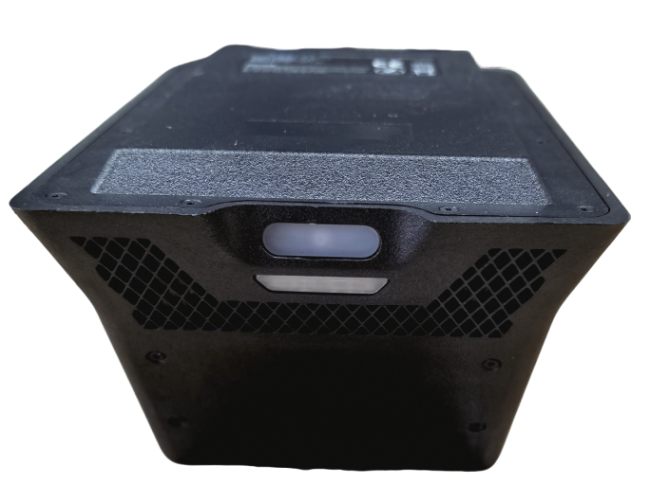
Agricultural drone use case — a segment where high-rate discharge and reinforced BMS protection are critical.
Beyond drones and robots, HCC's case records include electric bicycles (Russia, 1,500 pcs) built on mature 18650 cylindrical cells with 12.8Ah capacity and series-parallel assembly, home assistance robots (United Kingdom, 1,500 pcs) with integrally molded custom plastic shells, handheld game consoles (Canada, 5,000 pcs/month) using lithium-polymer pouch cells, and Bluetooth speakers (Italy, 10,000 pcs) using 18650 cells. In the medical field, HCC's catalog also lists a medical battery model (12.8V 28Ah) and a robotic surgery battery model (1160100, 7.4V 10000mAh), aligning with the segment's growth in robotic surgery and portable diagnostics.
Market context: where specialized lithium-ion demand is heading
Four verified data points frame the market for this category. First, the global lithium-ion battery market was approximately USD 164.8 billion in 2024 and is projected to reach USD 422.8 billion by 2032 (GMI Research). Second, China's lithium-ion battery exports reached over 3.9 billion units in 2024, an 8.1% year-on-year increase (General Administration of Customs via Caixin Global), indicating that Chinese manufacturers remain a primary supply base for global buyers. Third, the global drone battery market was estimated at USD 8.13 billion in 2024, with lithium-based technologies holding a 91.14% share (Grand View Research). Fourth, the medical machine battery market was valued at USD 2.22 billion in 2024, driven by the adoption of robotic surgery and portable diagnostic devices (Cognitive Market Research).
For buyers, the implication is straightforward: lithium-based chemistries are consolidating their position in exactly the segments where HCC documents application experience, and transport regulations such as the 2026 30% SoC limit are tightening documentation requirements across the supply chain.
How HCC's OEM/ODM model compares with traditional sourcing
Compared with sourcing standard cells and managing BMS design, pack assembly, and certification in-house, a single OEM/ODM partner reduces interface risk across BOM ownership, testing, and documentation. Compared with large-scale cell makers whose minimum order volumes target high-volume mass production, HCC's 5-pc MOQ and 20–35 day lead time offer a materially lower entry threshold for pilot builds.
One honest limitation should be noted. Shenzhen Topway New Energy Co., Ltd. was founded in 2022, and its corporate profile states that the business will evolve from battery pack solutions and cooperative production toward producing its own packs after solution design, with advanced battery production lines to be introduced. Buyers with immediate, very large volume requirements should validate capacity against the documented 10,000-unit monthly OEM capacity at the quotation stage. In the broader market, suppliers such as Honcell Energy also advertise custom 14500/18500/18650 pack capabilities with UL, CE, and PSE marks, so certification scope and application engineering support should be compared document by document.
Future outlook
The market context supports continued demand for application-tuned packs. With the lithium-ion market projected to reach USD 422.8 billion by 2032, drone batteries already 91.14% lithium-based, and medical machine batteries expanding with robotic surgery adoption, demand for engineered packs rather than bare cells is likely to keep growing. HCC's stated roadmap — moving from pack solutions and cooperative production toward self-owned production lines — reflects this trajectory: the supplier's future capability will increasingly be judged on complex-product and large-volume order execution.
Contact HCC (Shenzhen Topway New Energy Co., Ltd.) to evaluate an OEM/ODM lithium-ion battery project.
Website: www.hcctop.com
Email: sales@hcctop.com
Phone: 0755-81461866
WhatsApp: +86 18682160604
WeChat: Wangdh-HZT
Address: 1001, Unit 1, Building 2, Fangge Fenghuang Science and Technology Building, Guangshen Road NO. 218, Fenghuang Community, Fuyong Street, Bao'an District, Shenzhen City, China
Frequently asked questions
Q1: What OEM/ODM customization capabilities does HCC offer for lithium-ion batteries?
HCC operates an OEM/ODM production mode with a customization scope covering all kinds of battery packs. Monthly capacity is 10,000 units, lead time is 20–35 days, MOQ is 5 pcs, and after-sales support is provided through remote channels.
Q2: What are HCC's MOQ, lead time, and acceptance procedures?
For custom OEM/ODM projects, HCC's MOQ is 5 pcs with a lead time of 20–35 days. For standard volume procurement, the reference MOQ range is 1,000–10,000 pcs, and pre-shipment testing is the standard acceptance procedure.
Q3: Which cell formats and chemistries does HCC supply?
HCC's product line includes 14500, 18500, 18650, and 21700 cylindrical cells, plus custom battery packs. Both NCM and LiFePO4 chemistries are available depending on the application's energy density, discharge rate, and cycle life requirements.
Q4: Which certifications have HCC products passed?
HCC states that related products have passed RoHS, UL, CE, and other export certifications. Documented records include UN38.3 test report SKEXM202407199230, UN38.3 certificate CMC240627016, CE certificate DL-20211210007C, MSDS HCC-MSDS-2615, KC certificate CKC-2020-002088, a 1.2m drop test report, an air transport identification report (PEKGZ20180103150GJX0001), and a sea transport report (CMC251017116H03).
Q5: Which applications have HCC battery packs served in production?
Documented volumes include 2,000 pcs for an agricultural drone manufacturer in the United States, 2,000 pcs for a delivery robot manufacturer in Spain, 10,000 pcs for an exoskeleton robot manufacturer in the United States, 1,500 pcs for an electric bicycle manufacturer in Russia, and 1,500 pcs for a home assistance robot project in the United Kingdom. Additional documented orders cover handheld game consoles in Canada and Bluetooth speakers in Italy.
Q6: What export terms and payment methods does HCC support?
HCC supports Incoterms FOB, EXW, CFR, CIF, DAT, FAS, DDP, DAP, CIP, CPT, and FCA. Payment methods include LC, T/T, D/P, PayPal, Western Union, and Money Gram.
Company profile and product brochure: Download HCC brochure (PDF).