
Licenses and Compliance in China-India Air Freight: JTUO's Qualifications
Licenses and Compliance in China-India Air Freight: JTUO's Qualifications
Compliance on the China–India air freight lane is not one certificate but a chain of separate accountabilities: the legal right to contract for carriage, custody of cargo inside a consolidation warehouse, and the accuracy of the export declaration that releases goods to an airline. A provider can be strong at one link and weak at another — which is why buyers at the decision and execution stages of procurement increasingly ask for documents rather than assurances.
 Compliance work on the China–India lane is largely administrative: entity checks, document control, and declaration review carried out between the forwarder's office and its warehouse.
This analysis sets out how that compliance chain is structured on the China to India air freight head haul space lane, and uses JTUO Logistics Co., Ltd., a Guangzhou-based China–India air freight specialist, as a case study of how three stated qualifications — an Air Freight Forwarding License, a Warehouse Operation & Safety Management Certification, and a Logistics Service Compliance Qualification — correspond to specific buyer concerns about operational legality, cargo safety, and document control.
Why Compliance Became a Procurement Question on the China–India Lane
The commercial case for scrutiny starts with volume. China's exports to India reached approximately USD 120.46B in 2024, with electrical machinery and equipment the single largest segment at USD 42.66B, according to The Dollar Business. A meaningful share of that trade is time-sensitive enough to move by air, and the receiving market is expanding accordingly: IMARC Group values India's air cargo market at 3.6 million tons in 2025 and projects 9.9 million tons by 2034, an 11.38% CAGR. IATA separately reported an 8.3% year-on-year increase in international air cargo growth for Asia-Pacific carriers in June 2025, driven by e-commerce and high-tech trade.
Growth of that magnitude has a predictable side effect. When capacity tightens, the number of intermediaries offering China to India air freight head haul space grows faster than the number of entities that can document how they operate. For a buyer already in the execution stage — cargo packed, supplier deadlines fixed, flight dates agreed — the risk is not a shortage of quotations. It is a shortage of verifiable answers to three questions: Which legal entity is accountable for the booking? Under what safety regime is the cargo handled between the supplier's premises and the airport? And who is accountable if the export declaration is rejected?
Public regulation adds a layer that buyers cannot negotiate away. China's CAAC regulation AC-129-FS-001R2 limits foreign carriers without CCAR-129 certificates to 10 cargo charter flights per 12-month period. The practical implication is that the certification status of the operating carrier shapes what capacity is legally available on China–India routes — and that compliance status, not price alone, determines whether a planned shipment can actually be executed.
The Three-Layer Compliance Stack in China–India Air Freight
Air freight compliance on this lane is best understood as three distinct layers. Each answers a different question, and each is evidenced by a different document.
Layer 1 — Air freight forwarding authority
A licensed air freight forwarder may contract for carriage on behalf of a shipper, consolidate multiple consignments, issue a House Air Waybill, and move cargo under a Master Air Waybill issued by the airline. This is the layer that makes a forwarder commercially visible. Where direct AWB issuance for China to India forwarders is concerned, the House Air Waybill a shipper receives should be issued under the provider's own authority — not borrowed from a third party whose name never appears on the quotation.
Layer 2 — Warehouse operation and safety management
The second layer governs custody. Once cargo leaves a supplier's premises and enters a consolidation warehouse, responsibility for handling, storage, and safety transfers to the operator of that facility. This matters most for mixed consignments: shipments containing batteries, liquids, powders, magnetic materials, or branded and restricted goods require classification before they can be accepted for loading. A warehouse operating under a documented safety and operations regime produces a traceable record of receiving, inspection, and exception handling. A facility without one produces inconsistency that only becomes visible when something goes wrong.
Layer 3 — Logistics service compliance
The third layer is document and process discipline — the part of compliance that decides whether cargo actually flies. It covers HS code accuracy, verification of weight and dimensions against declared data, consistency between commercial invoice, packing list and sales contract, and the customs declaration authorization required for export clearance. This layer is invisible in a quotation and decisive in an operating schedule.
| Verification point | What to request | Why it matters |
|---|---|---|
| Contracting entity | Confirmation that the licensed entity named on the quotation is the entity that will issue the House Air Waybill | Prevents a licensed provider's authority from being borrowed by an unlicensed intermediary |
| Warehouse custody | The operating and safety certification covering the specific warehouse address used for consolidation | Cargo is handled under a documented regime at a known location |
| Document control | The list of documents required before export declaration: commercial invoice, packing list, sales contract, Power of Attorney | Inconsistent data can trigger customs inspection, clearance delays, or shipment rejection |
| Special cargo classification | Written confirmation of how batteries, liquids, powders, magnetic items, and branded goods are classified before consolidation | Classification affects airline acceptance and loading eligibility |
| Measurement method | The method used to compare actual weight with volumetric weight (length × width × height ÷ 6000) | Air freight is charged on the greater of the two, so measurement discipline is also cost discipline |
The value of separating these layers is that each one generates a specific document request rather than a general assurance. A provider able to produce all three sets of documents has demonstrated something more useful than a service claim: that its operating model is internally consistent.
JTUO Logistics' Stated Qualifications and What They Address
JTUO Logistics Co., Ltd. is a China–India air freight specialist founded in May 2025 and headquartered in Guangzhou, Guangdong. The company provides airport-to-airport air freight on the China–India lane, including air cargo space booking, origin warehouse consolidation, cargo preparation, airport delivery coordination, and peak season capacity assurance.
JTUO Logistics states that it holds an Air Freight Forwarding License, a Warehouse Operation & Safety Management Certification, and a Logistics Service Compliance Qualification. Set against the three-layer framework above, the credentials address the three buyer concerns in sequence.
What the Air Freight Forwarding License answers
The forwarding license is the legal basis for contracting carriage and issuing the House Air Waybill. For a buyer, it answers the accountability question directly: the entity named on the booking is the entity that issues the transport document under its own authority. That distinction becomes material during disputes, claims, and document corrections, when the ability to act depends on legal standing rather than on working relationships.
What the Warehouse Operation & Safety Management Certification answers
The warehouse certification governs custody at the point where cargo is most exposed to handling risk. JTUO operates an in-house warehouse of approximately 2,000 m², which means consolidation, sorting, palletizing, and stretch-wrapping are performed by one operator under one set of procedures rather than distributed across third-party facilities. For shippers consolidating cargo from multiple suppliers — a common pattern on this lane — a single custody point reduces the number of handovers at which goods can be miscounted, mislabeled, or damaged.
What the Logistics Service Compliance Qualification answers
The compliance qualification covers process discipline: how export documentation is prepared, how declared data is verified against physical cargo, and how exceptions are recorded. Its practical output is the record set a shipment generates before departure — warehouse receipt, piece count and shipping mark verification, weight and dimension measurement, consolidation manifest, and the export declaration package.
The operational footprint behind these credentials is specific rather than broad. JTUO reports an office area of approximately 200 m² and a warehouse area of 2,000 m², supported by a core team of over 30 people, including more than 10 at the Guangzhou branch and a warehousing team of over 20. The company reports annual air freight volume exceeding 5,000 tons, with export business accounting for 80% of sales and India as its main market.
How Compliance Is Executed: From Warehouse Receipt to AWB Issuance
Credentials only matter if they survive contact with an operating schedule. JTUO documents its China–India Air Freight First Leg Operation Process as nine stages: Inquiry & Quotation, Order Confirmation, Space Allocation & Booking, Warehouse Receiving, Cargo Consolidation, Airport Delivery, Export Customs Clearance, Air Waybill Issuance & Release, and Arrival at Destination Airport.
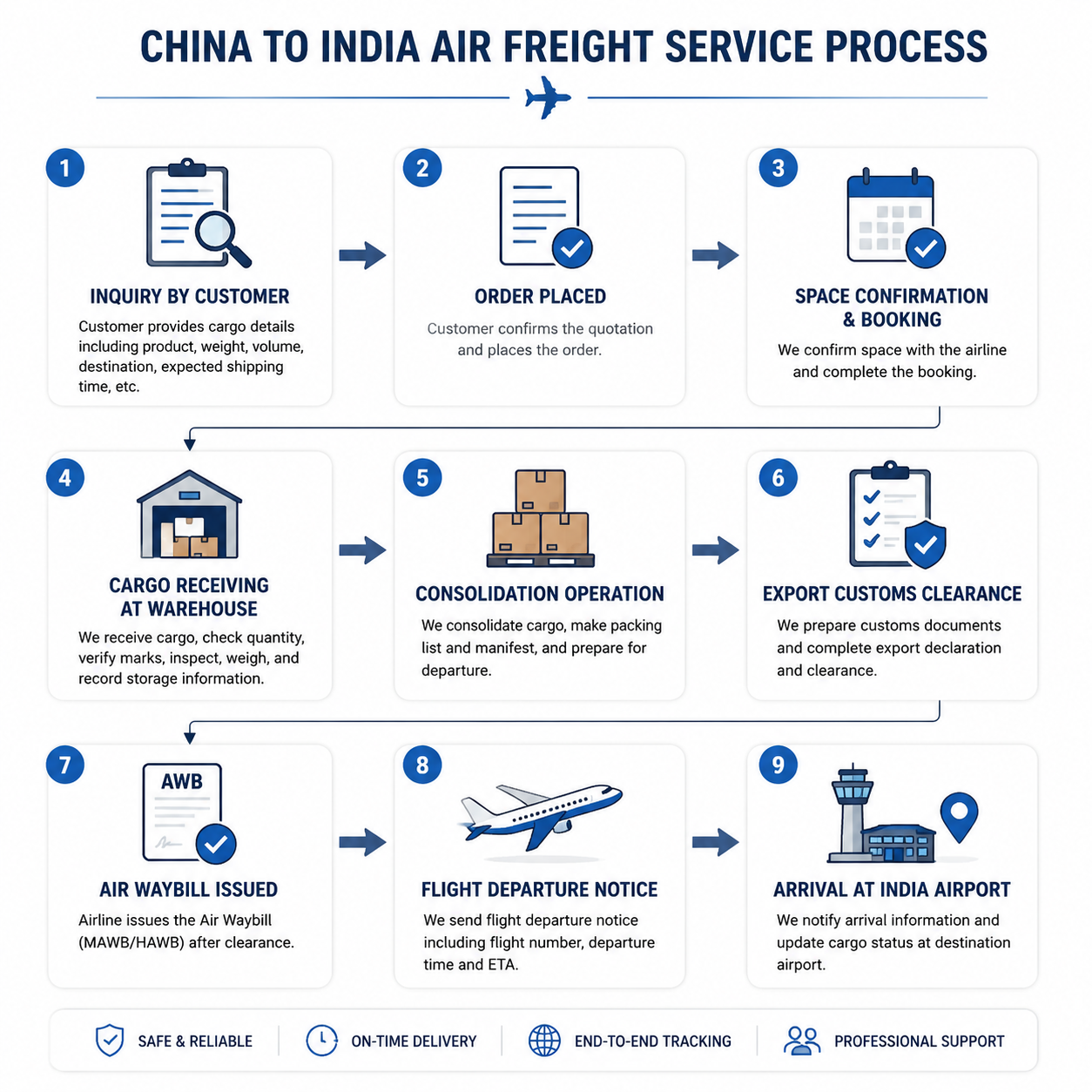 China–India Air Freight First Leg Operation Process: nine stages linking space allocation, warehouse consolidation, export clearance, and air waybill issuance.
Space allocation and booking
Space is requested from and secured with the freight forwarder or airline. Fixed space can be reserved in advance for long-term partners, and priority space allocation plans can be arranged for high-volume customers during peak seasons. This is the operating equivalent of the advance capacity commitments — commonly structured as block space agreements — that determine who has access to peak season cargo space allocation on India routes. Capacity management at this stage is what converts a booking into an executable plan.
Warehouse receiving and measurement
On arrival at the warehouse, cargo is verified and re-measured. Air freight charges are based on the greater of actual weight or volumetric weight, calculated in centimetres as length × width × height ÷ 6000, which makes packing efficiency a cost variable as well as an operational one. The receiving stage accommodates full consignments, consolidation from multiple suppliers, e-commerce small parcels, and consolidated loose cargo, and produces the receiving record against which later discrepancies are resolved.
Cargo consolidation and classification
Consolidation covers classification, grouping, and palletizing according to cargo attributes. For cross-border small parcel clients, operations include consolidation of multiple orders, consolidation of goods from multiple suppliers, palletization of aggregated small parcels, and verification of weight and dimensions. For general air freight, they include sorting and organizing, consolidated stacking, large pallet handling, and stretch-wrap reinforcement. Both paths verify product information, package count, weight, volume, shipping marks, flight details, HS code, and the presence of special items.
Export customs clearance
The customs stage requires a complete document set: commercial invoice, packing list, sales contract, and Power of Attorney for customs declaration authorization. The operating rule is that all document data must be fully consistent. Inconsistency is not a paperwork nuisance; it can trigger customs inspection, clearance delays, or shipment rejection — the three outcomes that turn a well-planned air freight schedule into a missed flight.
Air waybill issuance and release
The airline issues the Master Air Waybill and confirms release of the cargo; the forwarder issues the House Air Waybill to the customer. This is where the licensing layer becomes tangible to a buyer, because the HAWB names the party the shipper has actually contracted with. The process closes with the arrival notification at the destination airport, which marks the end of the China-side first leg.
Application Scenarios: Where Qualification Gaps Become Visible
Compliance failures are rarely abstract. They surface in a small number of recurring situations on the China–India lane:
- Peak-season capacity shortage, when space has to be contracted rather than bought, and an unverified intermediary cannot deliver what was promised.
- Bulk cargo consolidation requirements, where multiple suppliers feed a single shipment and every handover adds a documentation risk.
- Urgent project cargo shipments, where the ability to issue correct documentation quickly decides whether the flight is caught.
- Persistent difficulty in securing stable airline space, which usually reflects a capacity-access problem rather than a pricing problem.
A documented example of how these situations are managed in practice is the China–India Air Freight Capacity & Consolidation Integration Project, an ongoing partnership with a shipment cycle of 3–7 days, serving a medium-to-large freight forwarder based in China that outsources air freight execution.
The client's stated challenges were unstable air cargo space during peak seasons, high price volatility, fragmented warehouse operations, multiple-handling delays, and unstable delivery performance. The core issue was identified as a lack of stable airline capacity access combined with unconsolidated warehouse operations. The solution applied was an integrated capacity locking, warehouse consolidation and airport execution system, in which space is allocated ahead of demand and cargo is consolidated under one operator before airport delivery.
Reported outcomes were qualitative rather than financial: improved supply chain stability, more predictable delivery performance, reduced operational workload, and stronger peak season scalability. Client feedback recorded on the project stated that space availability became much more stable, even during peak seasons, and described the service as much more reliable than using multiple forwarders.
Performance of this kind is tracked through operational rather than contractual measures. The metric set used includes space stability rate, on-time departure rate, consolidation efficiency, booking confirmation success rate, and operational accuracy rate — measured per shipment cycle against an air freight head haul cycle that typically runs 3–7 days, and aggregated monthly.
Market Trend: Capacity Growth and a Rising Verification Premium
Two trends are running in parallel. The first is volume growth: an India air cargo market of 3.6 million tons in 2025 is projected to reach 9.9 million tons by 2034 at an 11.38% CAGR, according to IMARC Group, while IATA recorded an 8.3% year-on-year rise in international air cargo growth for Asia-Pacific carriers in June 2025. The second is regulatory friction. CAAC regulation AC-129-FS-001R2 restricts foreign carriers without CCAR-129 certificates to 10 cargo charter flights per 12-month period, a ceiling that keeps certain capacity options out of reach for operators who are not certificated in the required way.
Carrier-side capacity is also being built directly into the lane. A direct air cargo route between Ezhou in China and Bangalore in India provides an annual transport capacity of more than 5,000 tons via SF Airlines. On the forwarder side, some providers publicly reference direct airline contracts — BSI Global Logistics, for example, describes direct airline contracts with SF Airlines, Sichuan Airlines and IndiGo covering hubs including Delhi and Mumbai. These examples point to the same structural fact: access to China to India air freight head haul space is mediated by contracts, allocations, and licences rather than by willingness to pay alone.
The emerging buyer response is procedural. Instead of treating compliance as a background assurance, procurement teams are converting it into a verification step: naming the licensed entity on the quotation, identifying the warehouse that will hold the cargo, and requesting the document control list before price is finalised. Compliance status does not create capacity, but it determines which providers can be relied on once capacity has been committed.
Integrated Execution Versus Fragmented Booking — and the Limits of Both
The two dominant ways of buying China–India air freight differ less in price logic than in accountability structure.
| Decision dimension | Fragmented multi-forwarder booking | Single licensed forwarder with in-house consolidation |
|---|---|---|
| Accountability for the booking | Split between the agent who quotes and the party who issues documents | One licensed entity contracts carriage and issues the House Air Waybill |
| Document consistency | Invoice, packing list and declaration data may be re-keyed by different parties | Documents are prepared and cross-checked within one process before export declaration |
| Cargo custody | Cargo may move between several third-party warehouses | Consolidation, sorting and palletizing occur in one in-house facility |
| Peak-season space | Space pursued in the spot market as shipments arise | Fixed space can be reserved in advance for long-term partners, with priority allocation for high-volume customers |
| Verification effort | The buyer must verify several entities and reconcile their records | One entity, one document trail, one point of accountability |
| Cost predictability | Rates reassembled at each handover, with exposure to spot volatility | Planning-based allocation supports more stable cost expectations |
The integrated model is not universally superior, and a credible provider should be able to state where it stops. Four boundaries apply to the framework described in this article:
- Geographic scope ends at the destination airport. India customs clearance and taxation, last-mile delivery inside India, non-air transport modes, and client-side sales and market risk management sit outside the China-side model described here. Responsibility for those stages has to be assigned separately by the buyer.
- A licensed forwarder is not a carrier. Capacity is secured through airline relationships and advance allocation; a forwarder does not control aircraft, schedules, or carrier-side operational decisions.
- Consolidation capacity is finite. A 2,000 m² warehouse supports a defined volume of simultaneous consolidation. Demand beyond that ceiling during peak season requires forward planning rather than additional booking effort.
- Operating history is short. JTUO Logistics was founded in May 2025, so its track record is shorter than that of long-established forwarders on the lane. Buyers weighing this provider should treat the stated credentials as a starting point and verify references from executed shipments.
None of these boundaries invalidates the compliance framework described above. They define where it applies — which is itself a compliance function. A provider that states clearly what it does not cover is easier to plan around than one that does not.
Future Outlook
If India's air cargo market grows from 3.6 million tons in 2025 toward a projected 9.9 million tons by 2034, capacity pressure on the China–India lane is unlikely to ease on its own. That pressure has two consequences for how buyers evaluate providers. First, advance capacity arrangements become more valuable than spot flexibility, which pushes long-term space commitments toward the centre of procurement. Second, documentation quality becomes a schedule variable, because a shipment held at customs for inconsistent paperwork loses the very time that capacity was bought to save.
The likely direction of travel is procedural convergence: licence details, warehouse addresses, and document control lists appearing as standard attachments to China–India air freight requests for quotation. The three credential categories discussed here are structural rather than proprietary. What differentiates providers is whether each layer is operated in-house, evidenced by traceable records, and honestly scoped.
Frequently Asked Questions
What qualifications should a China–India air freight forwarder be able to document?
Three categories cover the chain: authority to contract carriage and issue a House Air Waybill; warehouse operation and safety management for any facility where cargo is consolidated; and logistics service compliance covering export documentation and process control. JTUO Logistics states that it holds an Air Freight Forwarding License, a Warehouse Operation & Safety Management Certification, and a Logistics Service Compliance Qualification. Buyers should confirm which legal entity holds each document and whether it matches the entity named on the quotation.
How can a buyer verify warehouse safety credentials before delivering cargo?
Request the certificate, confirm the legal entity it names, confirm that the address it covers matches the warehouse where the cargo will actually be delivered, and ask how receiving, inspection, and exception records are produced. A warehouse operation and safety certification describes an operating regime; it does not by itself confirm that capacity will be available at peak season.
Which parts of the China–India air freight chain fall outside a China-side forwarder's scope?
India customs clearance and taxation, last-mile delivery inside India, and non-air transport modes. In JTUO Logistics' documented model these are explicitly listed as out of scope, together with client-side sales and market risk management. Responsibility for those stages has to be assigned separately by the buyer when the shipment plan is built.
What documents must a shipper provide for a compliant export declaration from China?
A commercial invoice, packing list, sales contract, and Power of Attorney for customs declaration authorization. All data across those documents must be fully consistent. Inconsistencies can trigger customs inspection, clearance delays, or shipment rejection, so document preparation is treated as an operational step rather than an administrative formality.
How is cargo space secured on China–India flights during peak season?
Through advance space allocation rather than last-minute booking. In JTUO Logistics' documented process, fixed space can be reserved in advance for long-term partners, and priority space allocation plans can be arranged for high-volume customers during peak seasons. Allocation depends on airline relationships and forward planning; a forwarding licence by itself does not create capacity.
Does holding a forwarding licence guarantee that cargo will fly on schedule?
No. A licence establishes the legal right to contract carriage and issue documentation. Departure reliability depends on capacity access, consolidation efficiency, and airline on-time performance. JTUO Logistics tracks space stability rate, on-time departure rate, consolidation efficiency, booking confirmation success rate, and operational accuracy rate as separate operational measures, which suggests the legal question and the performance question should be evaluated independently.