
Light Duty Die Springs: Constraints Buyers Should Verify
Light Duty Die Springs: Constraints Buyers Should Verify
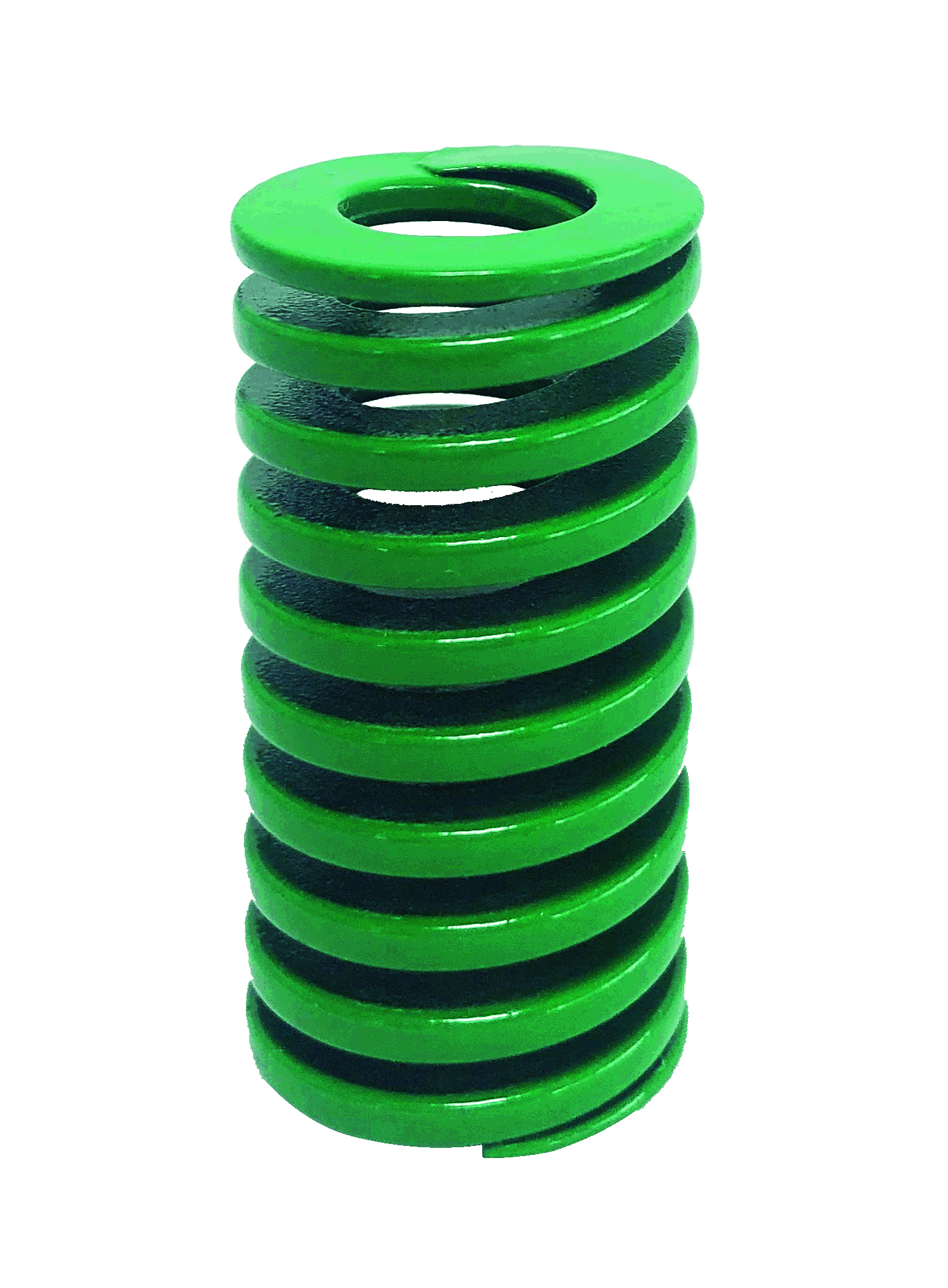
Light duty load class in a rectangular-wire die spring catalog — the CIL series, ISO 10243 light duty load (green).
Light duty die springs are defined by load class, not by size. In a rectangular-wire die spring catalog, the light duty class sits near the lower end of the force spectrum: above super-minimal and minimal load ratings, below medium, heavy and extra heavy classes. It is the class specified when a press tool needs dependable return, stripping or preload force rather than the maximum stored energy a confined spring pocket can hold.
Most procurement failures on this component are therefore constraint failures rather than dimension failures. A spring can match the pocket and the calculated free length and still be the wrong part, because the ISO 10243, JIS B5012 and American Standard (Inch series) systems assign different load classes to the same colors and treat different dimensions as the controlled ones.
Dalian TopWay Precise Mould & Die Co., Ltd. — which manufactures and exports under the brand TOPWAY SPRINGS — is a precise mould and die parts manufacturer founded in 2012, operating a 16,500 m² plant in Dalian, Liaoning, China, with 58 employees, five R&D engineers and an annual output of 3,600,000 pieces. Its Spring Division produces rectangular-section die springs positioned against the ISO 10243, JIS B5012 and American Standard (Inch series) catalog systems, and roughly half of its output is exported, mainly to the EU and the USA.
What the Light Duty Class Really Specifies
A light duty die spring is a rectangular-section compression spring whose rated load class is light duty, and it is fully specified by five parameters: standard system, load class, outer diameter, inner diameter and free length — with end type and coil configuration completing the definition. Color is a load-class marker inside a known standard system, not a specification on its own.
What the load class does not define is equally important. It does not define the steel grade, the heat treatment, the surface protection, the documented fatigue life, or the documentation package that accompanies the shipment. Two springs can carry the same dimensions and the same light duty label and still behave differently in service, because one is made from oil-tempered alloy spring steel with mill test certificates and heat-number traceability and processed through multi-stage tempering and shot peening, while the other is not. In the TOPWAY SPRINGS ISO 10243 range, 55CrSi chrome silicon spring steel is the primary material, mill test certificates and material heat-number traceability are provided for all raw materials, and multi-stage tempering is applied to reduce thermal relaxation and load loss during continuous high-temperature stamping.
Working rule: the load class is the first constraint, not the complete specification. Verify standard system, class, dimensions, end type, material grade, documentation and deflection limits as separate line items — each can independently disqualify a supplier.
Standard System Constraints: Where ISO, JIS and Inch Series Diverge
The three catalog systems that dominate international press-tool sourcing do not control the same dimensions. ISO 10243:2019 standardizes color coding and dimensions for rectangular-section compression springs used in press tools, with the published scope centred on mounting and housing dimensions. JIS B5012 specifies allowable tolerances of the inner and outer diameters of springs — a different control point from the ISO mounting-hole orientation. That difference is documented as a comparison gap between the two systems, and it explains a recurring sourcing error: a tool designed around one system is often re-ordered against the other, and the tolerance that was never checked is the one that governs fit.
| Standard system | What it mainly controls | Light-end load classes | Published dimensional range |
|---|---|---|---|
| ISO 10243 | Color coding and dimensions of rectangular-section compression springs for press tools | CIF super minimal load (light green); CIL light duty load (green) | OD 10–63 mm; ID 5–38 mm; free length 25–305 mm |
| JIS B5012 | Allowable tolerances of inner and outer diameters | CSWF minimal load (yellow); CSWL light load (blue) | OD 6–70 mm; ID 3–38.5 mm; free length 10–350 mm |
| American Standard (Inch series) | Inch-series catalog dimensions and load classes | Lightest catalogued class in this range is medium duty (blue) | OD 10–51 mm; ID 4.76–25.4 mm; free length 25–305 mm |
One structural consequence deserves attention at the enquiry stage: the ISO and JIS ranges both publish a genuine light-end class, while the inch-series range in the TOPWAY SPRINGS catalog begins at medium duty and extends through medium heavy duty, heavy duty and extra heavy duty. Buyers converting a metric tool drawing to an inch-series purchase, or the reverse, cannot assume that a light duty equivalent exists by default — the load spectrum on offer has to be checked before the part number is written.
Color Coding: The Constraint Most Often Misread
Color coding exists to speed up shop-floor identification, and it works — but only inside the standard system it belongs to. Across the three catalogs, the same color represents different load classes, which makes visual substitution the single most reliable way to install a spring of the wrong stiffness. Industry comparison notes on ISO and JIS die springs flag exactly this risk: the color codes for load classes differ between the systems, producing critical selection errors in globally sourced tooling.
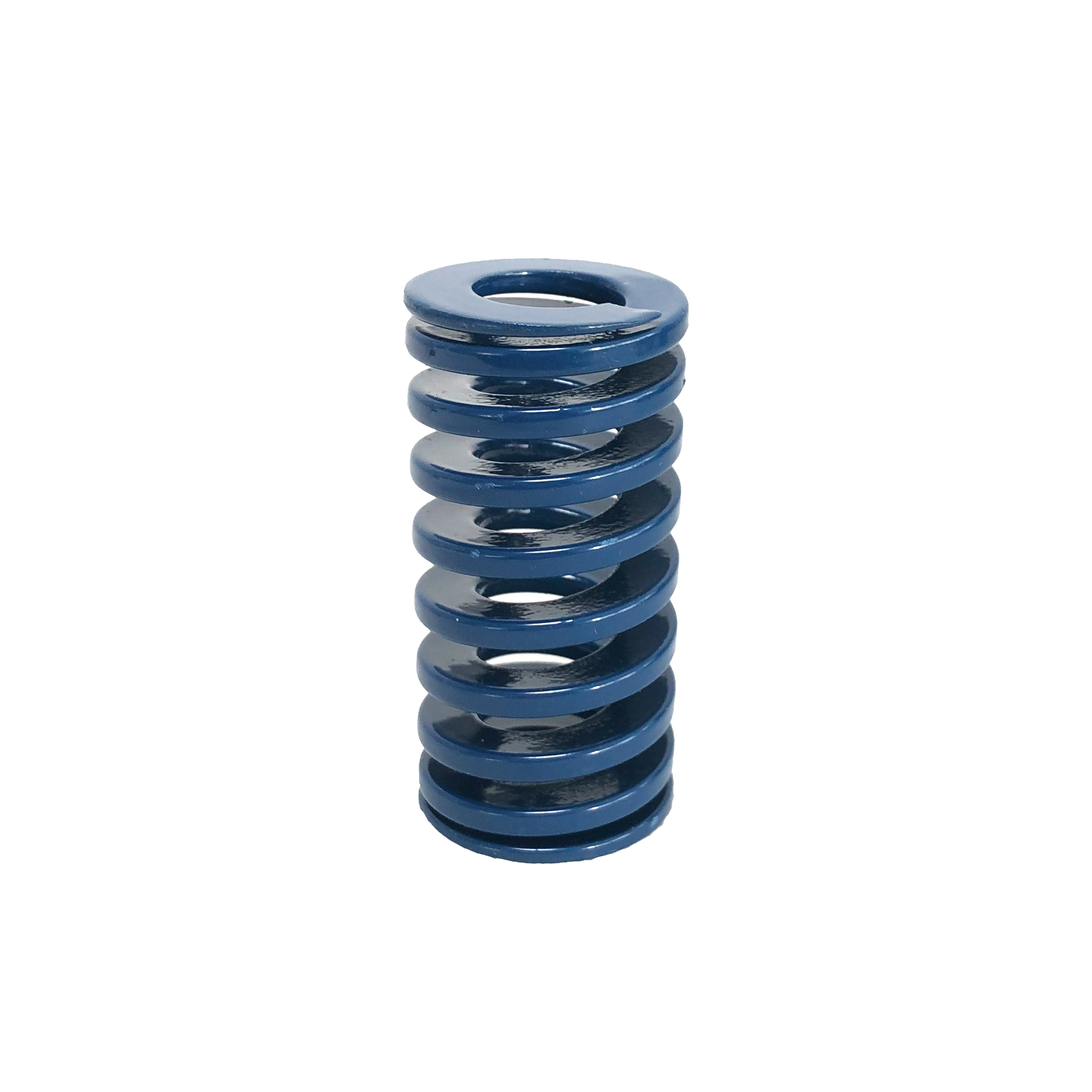
JIS B5012 light load class (CSWL) — the equivalent light-end position to ISO light duty, identified by a different color.
| Color | ISO 10243 class | JIS B5012 class | American (Inch) class |
|---|---|---|---|
| Light green | CIF super minimal load | — | — |
| Green | CIL light duty load | CSWH heavy load | Extra heavy duty |
| Blue | CIM medium duty load | CSWL light load | Medium duty |
| Red | CIH heavy duty load | CSWM medium load | Medium heavy duty |
| Yellow | CIB extra heavy duty load | CSWF minimal load | — |
| Brown | — | CSWB extra heavy load | — |
| Gold | — | — | Heavy duty |
| Black | — | CSWG super heavy load | — |
The practical implication is that a purchase order should never specify a light duty spring by color alone. It should specify the standard system plus the class, then the dimensions, then the marking rule. Where private branding and custom marking are required, the marking content itself becomes a controlled characteristic and should be stated on the drawing rather than agreed verbally.
Coating durability is a second, quieter constraint. Die springs operate in contact with stamping lubricants, anti-rust oils and coolants, and any flaking coating can migrate into a precision die cavity. High-adhesion powder coating is the standard answer in the TOPWAY SPRINGS range, applied by load class for visual identification and specified for corrosion resistance against humidity, lubricants and chemical exposure in industrial environments.
Dimensional Envelope and Model Designations to Verify
Because light duty springs are frequently chosen for compact pockets, the dimensional envelope is where a technically acceptable class becomes an unacceptable part. In the TOPWAY SPRINGS ISO 10243 range, the outer diameter spans 10–63 mm, the inner diameter spans 5–38 mm and free length spans 25–305 mm. The JIS B5012 range is wider at both ends: OD 6–70 mm, ID 3–38.5 mm, free length 10–350 mm. The American Standard (Inch series) range covers OD 10–51 mm, ID 4.76–25.4 mm and free length 25–305 mm.
Within the ISO range, the light end of the catalog is populated as follows. The super minimal load CIF designation covers CIF20-25, CIF25-38, CIF32-64, CIF40-51 and CIF50-64. The light duty CIL series covers CIL10-25, CIL12.5-32, CIL16-38, CIL20-51, CIL25-89, CIL32-102, CIL40-152, CIL50-203 and CIL63-305. The medium duty CIM, heavy duty CIH and extra heavy duty CIB series follow the same size logic across their own designations. In the JIS B5012 range, the light load CSWL series runs from CSWL10-30 through diameters at 18, 20, 22, 25, 27, 30, 35, 40 and 50 mm, with free lengths of 30 to 90 mm in the published listing.
Three further parameters are frequently left off enquiries and cause avoidable back-and-forth. End type is either closed and ground or closed and un-ground — ground ends deliver the face parallelism that keeps load perpendicular and reduces lateral deflection, while un-ground ends are a lower-cost option with less squareness control. Winding direction is available in right-hand or left-hand. Total coil count and active coil count are defined according to each individual spring rather than fixed globally, so they must be confirmed per part number rather than assumed from a family drawing.
Material, Heat Treatment and Fatigue Limits
For light duty springs the material decision is less about raw strength and more about stability. A light class spring usually runs at a relatively high number of cycles in a return or stripping function, so resistance to load loss over time matters as much as peak force. TOPWAY SPRINGS manufactures exclusively from high-stress oil-tempered spring alloy steel such as 55CrSi (and 50CrV4 where specified), with mill test certificates and material heat-number traceability provided for all raw materials. Multi-stage tempering reduces thermal relaxation and load loss during continuous high-temperature stamping, and controlled shot peening introduces compressive stress at the wire surface to raise the fatigue limit and limit micro-crack propagation.
The published fatigue position for these springs is a service life of 3 to 5 million cycles within a 12%–40% compression stroke, with long-life operation generally associated with the lower end of the recommended deflection range. That figure is a conditional specification, not a warranty of unlimited life: it holds when the spring operates inside its deflection window, with preload applied, with adequate guide clearance and with square end faces. When a light duty class is pushed toward the deflection limits of a heavier class, life expectancy falls accordingly — which is the main reason light duty substitution into high-load stations fails.
Certification and Documentation Constraints
Documentation is a constraint with a deadline attached, because certificates have validity windows that have to sit inside the tooling program. Dalian TopWay Precise Mould & Die Co., Ltd. holds ISO 9001:2015 Quality Management System certification issued under GB/T 19001-2016 by World Standards For Certification Center Inc. (WSF), certificate number 03825Q04735R2S, valid from 2025-05-26 to 2028-05-28, with a scope covering production and sales of springs and related accessories and applicability to the global market. The company also holds ISO 14001:2015 Environmental Management System certification under GB/T 24001-2016, certificate number 03825E04736R2S, valid from 2025-05-26 to 2028-11-13. Both certifications apply to the die spring product lines, including the JIS B5012 Standard Die Spring and the ISO 10243 Standard Spring.
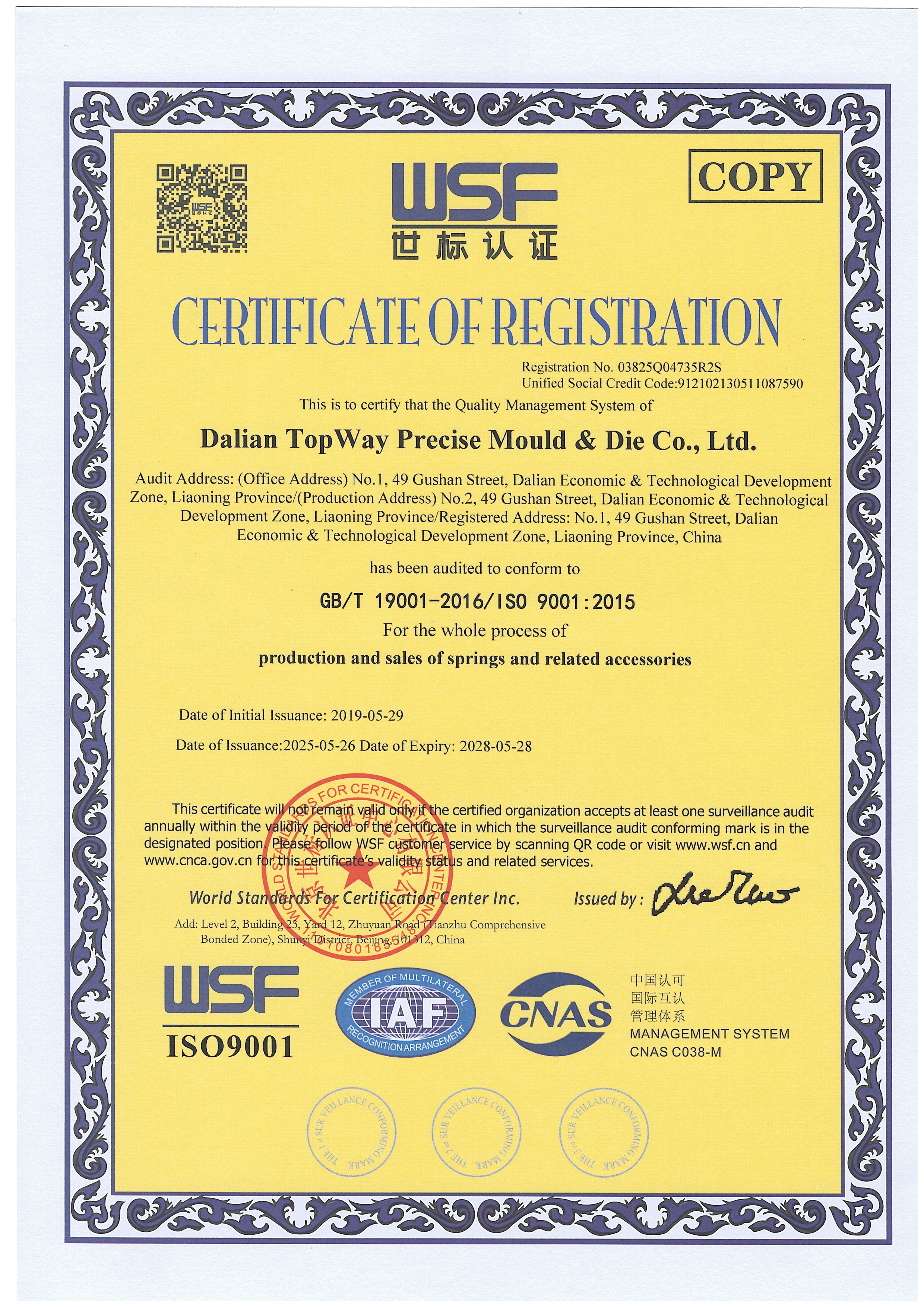
Quality management certification documentation of the type requested during supplier qualification for die spring programs.
Two further documents change how easily a shipment clears inspection and customs. The first is the material traceability pack: mill test certificates together with heat-number traceability for every raw material batch, which is what allows a failure investigation to be closed on evidence rather than on opinion. The second is tariff classification. For imports into the United States, helical springs of iron or steel fall under HS code 732020 — but there is no unique global code that separates rectangular-section die springs from round-wire helical springs, so duty planning for this specific component relies on the general heading and on the accompanying description. Buyers building landed-cost models should treat that classification uncertainty as a real input rather than an administrative detail.
Application Fit: Where the Light Duty Class Belongs
Light duty die springs are typically specified for the functions that keep a tool cycling rather than the functions that form metal. Their published application role is to provide precise return strokes, high-density energy absorption, vibration damping and force balance during mold opening and closing, in reciprocating high-frequency axial compression and continuous pre-loaded operation. That maps to return and stripping systems in automotive stamping dies, plastic injection molds, die-casting tooling, precision electronics stamping, industrial automation equipment, machine tools and other tooling where the required force is modest but the cycle count is high.
The matching working conditions are documented as high-frequency cyclic shock, continuous high-temperature environments, high-load compression, exposure to oil and coolants, and extreme dynamic stress. Light duty classes are suited to the lower-force end of that envelope: preload and return duties, ejector return in injection molds, and spring packs where several springs share the load and individual force is deliberately small. They are not suited to stations that must generate the forming or stripping force itself, where medium, heavy or extra heavy classes — and, in many modern tools, nitrogen spring auxiliary systems — take over.
Cost Drivers Behind the Price Band of Light Duty Die Springs
Light duty springs are the least expensive class in most catalogs by material content alone, so quoted price differences between suppliers rarely come from the wire. They come from the surrounding constraints. Raw material grade and traceability, multi-stage tempering, shot peening, precision end-face grinding, powder coating, 100% testing, batch marking and packaging all sit in the cost base, and each can be added or removed without changing the spring's nominal dimensions. A quotation that is silent on which of these are included is not directly comparable to one that lists them.
Order structure is the second driver. TOPWAY SPRINGS publishes a minimum order quantity of 100 pieces, a monthly production capacity of 300,000 pieces, an annual output of 3,600,000 pieces, and a lead time of 14–25 days for custom and bulk manufacturing. Standard catalog items are supported by ready-to-ship inventory of ISO 10243, JIS B5012 and American standard springs, which allows dispatch within 24 to 48 hours for stock orders. Custom engineered and bulk OEM orders are scheduled on automated coiling and grinding lines with flexible scheduling, allowing short custom batches alongside large production runs. The cost consequence is straightforward: buyers who can absorb standard catalog items into a planned maintenance schedule pay the stock price, while buyers who need non-standard dimensions, specific load rates or private branding pay a lead-time and setup premium.
A verifiable cost reference point exists at the OEM end of the market. A US-based global mold component brand owner has sourced 1.5 to 2.0 million pieces annually, equivalent to approximately USD 1.2M–1.5M in order value, from Dalian TopWay's OEM production over more than five years of continuous cooperation. The reported outcomes include a 25%–30% reduction in OEM manufacturing and procurement cost, a 99.8%+ pass rate with zero major quality claims across consecutive years, and full performance parity validated through third-party laboratory testing of international tolerances, fatigue endurance and thermal relaxation thresholds. Those are program-level figures for large-volume OEM supply, not a price promise for a 100-piece order, and they should be read as evidence of cost structure rather than as a general market price.
Trade-offs: What Changes When You Choose Light Duty
Rectangular wire is the first trade-off. The rectangular cross-section stores up to 30%–50% more energy than round wire springs of the same footprint, which is why it dominates press-tool catalogs and why a light duty rectangular spring can often replace a physically larger round-wire spring in a tight pocket. The trade-off is that rectangular springs are more sensitive to pocket bore, guide clearance and end-face squareness; the energy advantage is only realised when installation accuracy is maintained.
Standard versus custom is the second. Standard catalog items are interchangeable across the ISO, JIS and American systems and are held in stock, which shortens lead time and simplifies replacement. Custom manufacturing — non-standard outer or inner diameters, non-standard free lengths, specialised trapezoidal wire cross-sections, unique load rates and private labeling — delivers an exact fit but extends lead time to the 14–25 day band and imposes a minimum batch. For maintenance and MRO programs, the stock route is usually decisive; for new tooling programs with fixed load windows, the custom route may be unavoidable.
The third trade-off is the one most often underestimated: a light duty class cannot be substituted into a heavy duty position by adjusting preload. Lower spring rate means lower force at the same deflection, and the deflection needed to recover the missing force usually exceeds the class's recommended stroke. In that situation the correct answer is a heavier class, or a redesign of the pocket to accept it — not a longer light duty spring.
Procurement Verification Checklist
| Verification item | Why it disqualifies a supplier |
|---|---|
| Standard system named on the drawing | ISO and JIS control different dimensions; a mismatched assumption is invisible until the tool is assembled |
| Load class, not color | Green denotes light duty in ISO, heavy load in JIS and extra heavy duty in the inch series |
| OD, ID and free length inside the published range | ISO 10–63 mm OD; JIS 6–70 mm OD; inch series 10–51 mm OD — out-of-range requests become custom items |
| End type and winding direction | Ground versus un-ground ends change squareness, lateral deflection behaviour and cost |
| Material grade and mill test certificates | 55CrSi is the stated primary material; heat-number traceability is required for any failure investigation |
| Deflection and cycle expectation | The 3–5 million cycle figure applies within a 12%–40% compression stroke |
| Certification numbers and validity dates | ISO 9001 certificate 03825Q04735R2S and ISO 14001 certificate 03825E04736R2S have defined validity windows |
| MOQ, lead time and stock availability | MOQ 100 pcs; custom lead time 14–25 days; stock dispatch typically 24–48 hours |
Market Context for Rectangular-Wire Die Springs
The broader demand picture supports the constraint discipline rather than replacing it. Grand View Research projects the global industrial springs market to reach USD 7.1 billion by 2033, and reports that Asia Pacific accounted for a 33.4% revenue share in 2024. On the demand side, Market Research Future valued the automotive stamping market at USD 87.98 billion in 2024, a figure that matters here because automotive stamping dies are one of the largest application families for rectangular die springs. Published market estimates vary with scope definition — whether automotive suspension springs are counted alongside precision industrial components changes the totals substantially — so market size figures are best used directionally when sizing a tooling component program.
Future Outlook
Three developments are likely to shape light duty die spring sourcing over the next planning cycle. First, dimensional interchangeability across ISO 10243, JIS B5012 and American Standard catalogs will continue to lower switching costs, which shifts competition toward documentation quality, batch consistency and fatigue evidence rather than toward part numbers. Second, traceability requirements are moving from optional to expected: mill test certificates, heat-number records and certificate validity windows are becoming standard items in supplier questionnaires for global tooling programs. Third, as tooling programs increasingly span multiple regions, the divergence in color coding between standard systems will keep generating selection risk until buyers treat color as a shop-floor aid rather than as a specification.
For a Chinese manufacturer exporting roughly half of its output to the EU and the USA, the practical response is the one already visible in the TOPWAY SPRINGS catalog structure: publish complete cross-standard ranges, hold stock in the standard classes, and document material, process and certification evidence per batch. Buyers evaluating light duty die springs should apply the same logic from their side — verify constraints before comparing prices.
Frequently Asked Questions
What international standards do TOPWAY rectangular die springs comply with, and are they interchangeable with major global brands?
The die springs adhere to ISO 10243, JIS B5012 and American Standard (Inch series) specifications, covering installation dimensions, color coding and load-deflection characteristics. Because these parameters are controlled against the standard systems, they can serve as drop-in replacements for international brand catalogs. Interchangeability should still be confirmed against the specific pocket and guide dimensions of the tool, since ISO and JIS systems control different dimensions and assign different colors to the same load classes.
What do the different spring colors mean, and will the coating chip off inside the mold?
Color identifies load class within a specific standard system. In the ISO 10243 range the classes run from CIF super minimal load (light green) and CIL light duty load (green) through CIM medium duty (blue), CIH heavy duty (red) and CIB extra heavy duty (yellow). In the JIS B5012 range, CSWF minimal load is yellow, CSWL light load is blue, CSWM medium load is red, CSWH heavy load is green, CSWB extra heavy load is brown and CSWG super heavy load is black. Coating is applied as high-adhesion powder coating that resists moisture, stamping coolants and physical abrasion, so it does not shed into precision die cavities under normal operating conditions.
What material is used in rectangular die springs, and what advantage does it have over standard carbon steel?
The primary material is 55CrSi chrome silicon spring steel in high-stress oil-tempered condition, with mill test certificates and material heat-number traceability provided for all raw materials. Compared with standard carbon spring steels, 55CrSi offers higher tensile strength, a higher fatigue limit and better resistance to permanent set and thermal relaxation under cyclic heavy loading. Multi-stage tempering further reduces thermal relaxation and load loss during continuous high-temperature stamping, and shot peening introduces compressive stress at the surface to raise the fatigue limit.
Can the factory produce custom rectangular springs from engineering drawings or physical samples?
OEM and ODM customization is available, including non-standard outer and inner diameters, non-standard free lengths, specialised trapezoidal wire cross-sections, unique load rates, and custom colour or laser marking for private label requirements. Inputs can be customer drawings or physical samples, with wire profiles and load specifications tailored to the application. Custom work is subject to a minimum order quantity of 100 pieces and a lead time of 14–25 days, which is the main difference from standard catalog supply.
What is the high-frequency stamping fatigue life of these die springs?
Published fatigue life is 3 to 5 million high-frequency compression cycles when the spring operates within its recommended deflection limits, inside a 12%–40% compression stroke. Long-life operation is generally associated with the lower end of that deflection range, and the result depends on correct installation, adequate preload and proper guide clearance. Operating outside the recommended stroke reduces achievable life.
Why must die springs be installed with a preload applied?
An initial preload, typically 5% to 10% of free length, removes internal play in the spring pocket and prevents the shock loading that occurs when the press strikes an unloaded spring. Without preload, springs can chatter, deflect laterally and fail earlier than their rated fatigue life suggests. Preload is normally specified during pocket and tooling design, together with end-face parallelism and guide-pin clearances.
What are the typical lead times for standard die springs versus custom orders?
A large ready-to-ship inventory of ISO 10243, JIS B5012 and American standard die springs allows dispatch within 24 to 48 hours for stock orders. Custom engineered or bulk OEM orders are produced on automated coiling and grinding lines with flexible scheduling and typically ship within 2 to 3 weeks, equivalent to the published 14–25 day manufacturing lead time. Batch consistency for stock items is managed through FIFO and batch-tracking controls to maintain part interchangeability across replenishment cycles.
Dimensional, load class and certification documentation for the ISO 10243, JIS B5012 and American Standard (Inch series) ranges is compiled in the Dalian TopWay product catalogue, available as a downloadable PDF: Dalian TopWay catalogue (PDF). Company information is published at onetopway.com.