
Light Guide Panel Compliance Checklist: UL 2108 2nd Ed. & EN IEC 55015
Light Guide Panel Compliance Checklist: UL 2108 2nd Ed. & EN IEC 55015
Compliance documents have moved ahead of samples in the light guide panel buying process. Two credentials carry most of that weight for the LGP and GPF001 light guide panels: the UL 2108, 2nd Ed. certification issued by UL LLC under certificate number UL-US-2145621-0, and the CE certification to EN IEC 55015:2019/A11:2020 issued by CTSL Testing (Dongguan) Co., Ltd. under certificate number CTSL2620530156EZ. This checklist explains what each document names, how a specifier verifies it, and how its scope is reconciled with project requirements including IP20–65 protection and an operating temperature range of −20 °C to 50 °C.
The global Light Guide Plate (LGP) market was valued at USD 3.91 billion in 2025 and is projected to reach USD 6.51 billion by 2034, a CAGR of 5.8% across the 2025–2034 forecast period, according to Dataintelo. Asia Pacific accounted for 48.2% of that revenue in 2025, valued at USD 1.88 billion.
Volume growth on that scale widens the supplier field every year, and procurement teams respond in a consistent way: they narrow the field with documents before they narrow it with samples. For light guide panels, the practical question is not whether a supplier says it is certified, but whether the exact panel and LED module in the quotation sit inside a certificate that can be opened, read, and matched line by line.
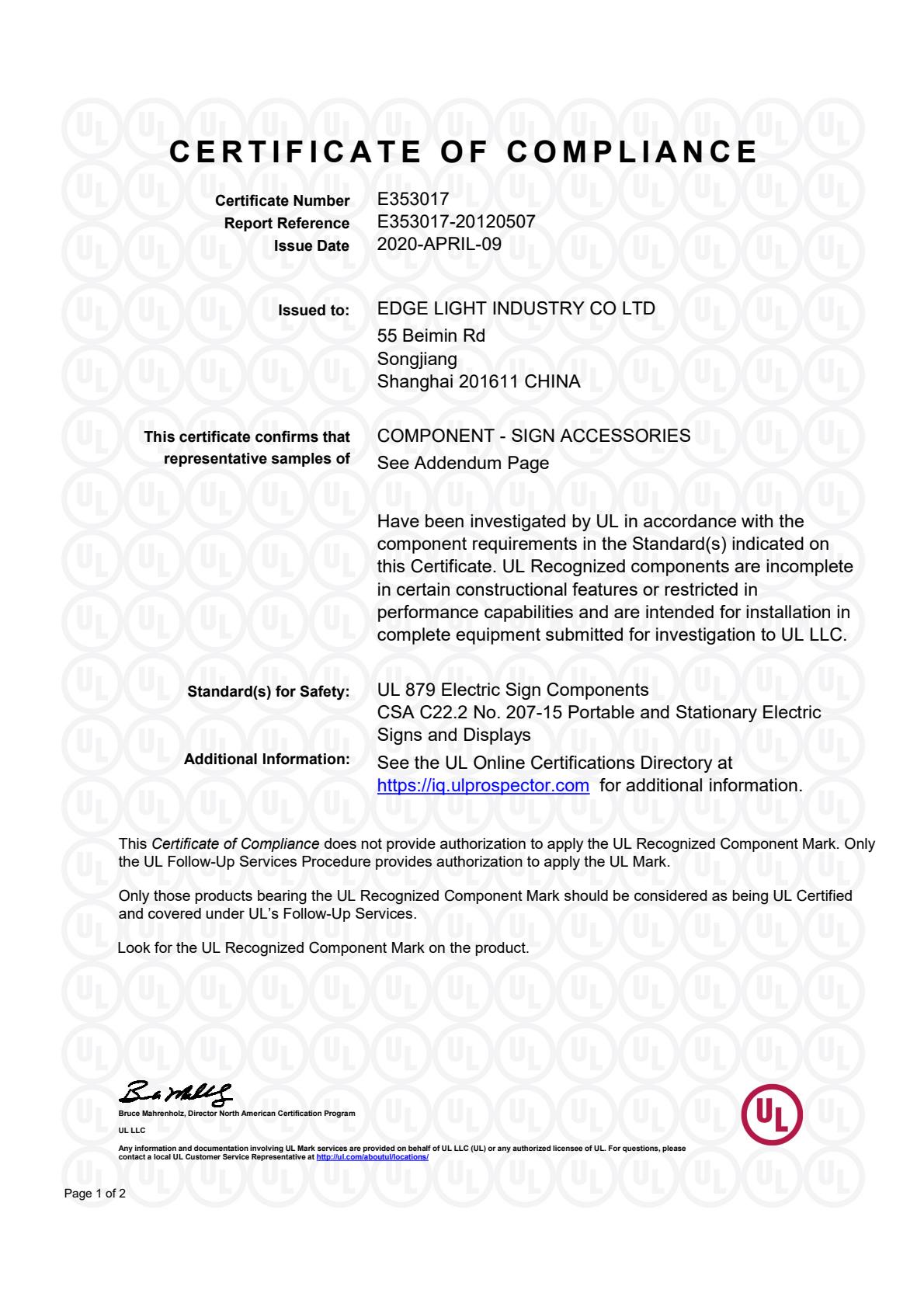
Certificate UL-US-2145621-0, issued by UL LLC under UL 2108, 2nd Ed., naming the light guide panel (model LGP) as related product. Image: EDGELIGHT certification record.
Why compliance documentation now filters the shortlist
Light guide panels are specified as engineered optical components with defined power, temperature, and ingress parameters, not as generic diffusers. That shift has a documentation consequence: buyers at the evaluation stage ask for the certificate, the certificate number, and the model list before they ask for a sample.
Two certificates, in particular, decide whether a light guide panel can be quoted into North American and European projects:
- UL 2108, 2nd Ed. — certificate number UL-US-2145621-0, issued by UL LLC on 2021-10-05 with validity to 2031-10-05, covering Component, Sign Accessories, LPS/Class 2 type, and LED module categories.
- EN IEC 55015:2019/A11:2020 and related EMC standards — CE certificate number CTSL2620530156EZ, issued by CTSL Testing (Dongguan) Co., Ltd. on 2026-05-29 with validity to 2096-05-29, for model GPF001 and its series models.
Both certificate records list the same related product: the light guide panel, model LGP.
The two credentials side by side
| Verification point | UL credential (LGP) | CE credential (GPF001) |
|---|---|---|
| Certificate number | UL-US-2145621-0 | CTSL2620530156EZ |
| Issuing body | UL LLC | CTSL Testing (Dongguan) Co., Ltd. |
| Certificate type / market | UL — UL market | CE (EMC) — EU market |
| Standard cited | UL 2108, 2nd Ed. | EN IEC 55015:2019/A11:2020; EN IEC 61547:2023; EN IEC 61000-3-2:2019/A2:2024; EN 61000-3-3:2013/A2:2021/AC:2022-01 |
| Issue date | 2021-10-05 | 2026-05-29 |
| Validity to | 2031-10-05 | 2096-05-29 |
| Certified scope | Component, Sign Accessories, LPS/Class 2 type, LED module; models LED-ALS-12V-1W4-3014T-6-590-96, LED-ALS-24V-1W8-3014T-6-1180-336, ALS-24V-2W16-3030-900-9, ALS-24V-2W16-3030-600-6, ALS-24V-2W16-3030-300-3, ALS-24V-2W16-3030-200-2, LM-24V-4W304-5050RGBW- | GPF001; series models MO22, MO24, MO31, GPF21, GPF23, GPF25, GPF26, GPF100, GPF101, GPF102, GPFX-GPFXXX, MOX-MOXXX, Badge-Fascia/Blade/Hanging LED Panel (X = 0–999) |
| Related product | Light guide panel (LGP) | Light guide panel (LGP) |
One line in the CE scope deserves attention from specifiers: the certificate states that all listed models share identical circuits except for colour appearance and model name. That sentence is what allows a series of panel variants — MO22 through MO31, GPF21 through GPF102, and the X-suffix range up to 999 — to sit under a single certificate number without each variant being re-tested individually.
Six-step verification for specifiers
Verification is a document exercise, not a trust exercise. The following sequence can be completed before a sample is ever shipped.
1. Open the certificate by number with the issuing body
Start with the number, not the PDF. UL-US-2145621-0 belongs in a confirmation request to UL LLC; CTSL2620530156EZ belongs in a confirmation request to CTSL Testing (Dongguan) Co., Ltd. A supplier-provided scan is evidence of what was submitted; a confirmation from the issuing body is evidence of what is currently valid.
2. Match the standard and its revision
Revision detail carries meaning. The UL credential cites UL 2108, 2nd Ed. — the second edition specifically. The CE credential cites EN IEC 55015:2019/A11:2020, which is the 2019 base document as amended by A11:2020. A quotation that references only the base year, or omits the amendment, does not describe the same document that appears on the certificate.
3. Match the model designation against the order
The CE certificate names GPF001 plus a defined series: MO22, MO24, MO31, GPF21, GPF23, GPF25, GPF26, GPF100, GPF101, GPF102, GPFX–GPFXXX, MOX–MOXXX, and Badge-Fascia/Blade/Hanging LED Panel, with X covering 0 to 999. The UL certificate names a specific set of LED module models. If the model string on the purchase order cannot be located inside those two lists, the certificate does not yet apply to the purchase.
4. Check the certified construction
The UL scope describes the certified construction as Component, Sign Accessories, LPS/Class 2 type, and LED module. For a light guide panel used inside a sign or light box, the relevant question is whether the module and driver combination in the bill of materials is the combination that was evaluated.
5. Check the validity window and plan a re-check
UL-US-2145621-0 runs from 2021-10-05 to 2031-10-05; CTSL2620530156EZ runs from 2026-05-29 to 2096-05-29. Long validity windows reduce paperwork churn, but standards are revised on their own schedule, so the re-check belongs in the order confirmation step rather than in a one-time supplier audit.
6. Reconcile the declared operating envelope
The published parameters for the LGP light guide panel list a maximum operating current and power of 7.2 A and 144 W, typical power consumption of 101 W, luminous flux above 1080 lm, a colour temperature range of 2700 K–6500 K, an operating temperature range of −20 °C to 50 °C, and a protection grade of IP20–65. Each of these needs to be checked against the project specification rather than assumed.
What the certificates cover — and what they do not
The CE certificate is an EMC certificate. Its standard list is built from EN IEC 55015:2019/A11:2020 (radio disturbance limits and measurement methods for electrical lighting and similar equipment), EN IEC 61547:2023 (immunity requirements for lighting equipment), EN IEC 61000-3-2:2019/A2:2024 (harmonic current emissions), and EN 61000-3-3:2013/A2:2021/AC:2022-01 (voltage fluctuations and flicker). Projects that require additional safety or material-compliance documentation beyond the EMC suite need to request it as a separate item.
UL Solutions notes that light guide panels must adhere to safety standards such as UL 8750 (LED Equipment) and IEC 60598 (Luminaires) for global market access. That reference is useful precisely because it separates the categories: a component and sign-accessory credential and an EMC credential are two pieces of a market-access file, not the entire file. Depending on the destination and the end product configuration, additional safety documentation may also be required.
A third, separate layer is energy regulation. The 2024 International Energy Conservation Code (IECC) reduces lighting power allowances in the United States, which affects efficiency requirements for LGP-based LED panels. Efficiency compliance is a distinct requirement from both safety certification and EMC certification, and a certificate number does not substitute for it.
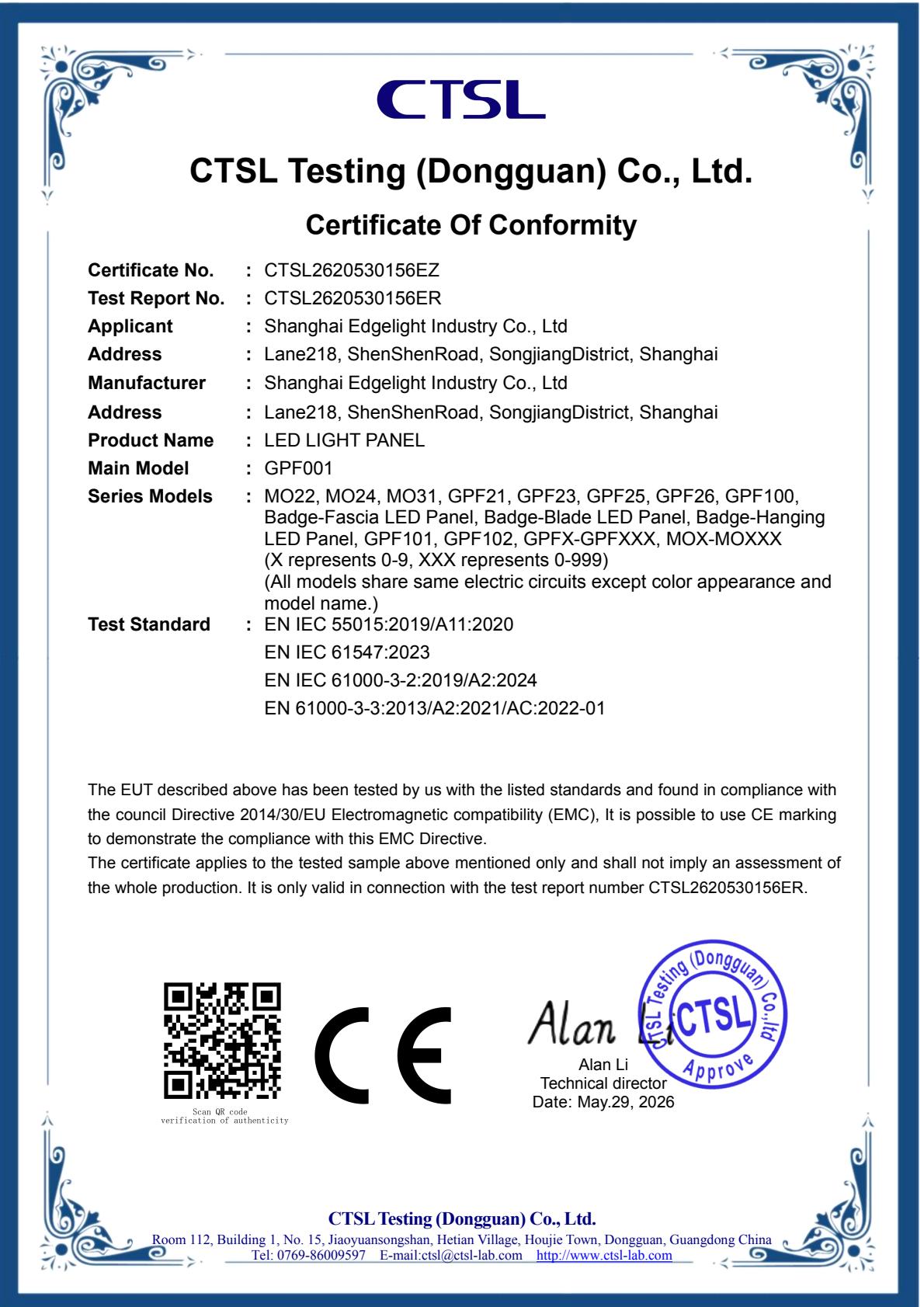
CE EMC certificate CTSL2620530156EZ for GPF001, issued by CTSL Testing (Dongguan) Co., Ltd., citing EN IEC 55015:2019/A11:2020 among other standards. Image: EDGELIGHT certification record.
Matching certificate scope to the project specification
Certificates confirm that a construction was evaluated against a standard. They do not automatically confirm that the panel being shipped matches the installation environment. The table below sets the published parameters against the questions a specifier should resolve during evaluation.
| Parameter | Published value | What to confirm before ordering |
|---|---|---|
| Protection grade | IP20–65 | A range, not a fixed rating. The delivered configuration must be agreed at a defined IP level: IP20 for dry indoor interiors, higher levels for damp, dusty, or exposed signage locations. |
| Operating temperature | −20 °C to 50 °C | Installations that spend sustained time outside this window — unheated exterior signage in cold climates, or sealed enclosures with poor heat dissipation — sit outside the declared envelope. |
| Colour temperature | 2700 K–6500 K | Confirm the CCT against brand guidelines; custom colour temperature is one of the accepted customization axes. |
| Power | 7.2 A max, 144 W max; 101 W typical | Confirm the driver and power supply in the sign box are sized for the maximum, not the typical, figure. |
| Luminous flux | >1080 lm | Check against the brightness target for the panel size and the viewing distance in the installation. |
| Material | Acrylic | Confirm substrate thickness and optical grade, particularly for ultra-thin edge-lit builds. |
Where certified light guide panels are specified
The published application list for the LGP light guide panel covers retail and luxury display, hospitality and commercial interiors, exhibition and museum, elevator decoration, advertising light boxes and signage, office and high-end residential, transportation and public spaces, and consumer electronics backlighting. Consumer electronics accounted for the largest application segment of the Light Guide Plate market in 2025, holding a 42.5% share, according to Dataintelo.
One field record illustrates what long-cycle documentation supports in practice. In an elevator decoration programme, 10,000 units were installed for an elevator manufacturing client, with the application running for 20 years and reaching stable operation across that period. The case highlights lighting, printing, and customized size and texture.
The manufacturer behind the two certificates is Shanghai Edgelight Industry Co., Ltd. (EDGELIGHT), founded in 2004. It operates five production bases: a Shanghai headquarters site of approximately 33,000 m², a Tianjin base of approximately 20,000 m², Edgelight GmbH in Germany at approximately 1,500 m², Edgelight LLC in the United States at approximately 1,679 m², and a second Shanghai factory of approximately 10,000 m². The company reports 500 employees, an R&D team of 25 engineers, annual output of 120,000 units, and an export ratio of 75%, with the USA and EU as its main markets.
Certificate-level verification compared with traditional compliance claims
Traditional sourcing documents a compliance position in one of three ways. Each has a different evidentiary value, and the difference shows up when a project is audited.
| Approach | What it provides | Where it breaks down |
|---|---|---|
| Supplier statement of compliance | A written assertion that the product is CE or UL compliant | No certificate number, no scope, no model list. Not independently confirmable. |
| Certificate for a related but different model | A valid document from a recognised body | The model string on the order does not appear in the certified scope, so coverage has to be argued rather than demonstrated. |
| Named certificate plus model-level match | A number, an issuing body, a standard revision, and a model list that includes the ordered item | Still scoped: it covers the certified construction and the declared operating envelope, and nothing beyond them. |
Three boundaries are worth stating plainly, because they define what the LGP and GPF001 credentials can and cannot do for a project:
- The certified construction is specific. The UL scope lists defined LED module models. A panel built around a module or driver outside that list is not automatically covered by UL-US-2145621-0, even if the panel dimensions match.
- IP20–65 is a band, not a promise. The certificate does not fix a single ingress value for every delivered unit. The IP level for a project must be agreed at the configuration level, which makes it a specification item rather than a marketing claim.
- Two certificates are not a complete market-access file. The CE credential is EMC-scoped and the UL credential is a component and sign-accessory credential. Safety documentation under standards such as UL 8750 or IEC 60598, and efficiency requirements such as those introduced by the 2024 IECC, sit in adjacent categories that the buyer still has to resolve.
Market trend: rising volume raises the documentation bar
Three data points explain why compliance documentation is becoming a routine shortlist filter rather than a closing formality. First, the LGP market is expanding at 5.8% CAGR toward USD 6.51 billion by 2034, with Asia Pacific already holding 48.2% of revenue. Second, the substrate market is growing alongside it: the Polymethyl Methacrylate (PMMA) market, the primary material for LGPs, was valued at USD 5.4 billion in 2024 with a 5.6% CAGR, according to USD Analytics. Third, thin substrates are now mainstream — thin PMMA light guide plate substrates below 2 mm accounted for over 60% of display-grade shipments for major manufacturers in 2024 (Fact.MR / CHI MEI Corporation).
Thinner substrates and higher volumes pull more suppliers into the category, and a broader supplier field is exactly the condition under which buyers switch from reputation-based screening to document-based screening. Edge-lit construction is the format driving much of this: edge-lit light guide panels achieve profiles as thin as 2.0 mm via injection molding or 3.0 mm via laser dotting, according to Lightpanel. The competitive landscape also includes material majors — Mitsubishi Chemical Corporation is identified as a leading player in the light guide plate landscape by Dataintelo — which means panel suppliers increasingly differentiate on verifiable documentation as much as on optics.
The practical implication for a 2026 evaluation is straightforward: treat the certificate as a specification line item, with a number, an issuing body, a revision, and a model list, and evaluate it with the same rigour applied to brightness and thickness.
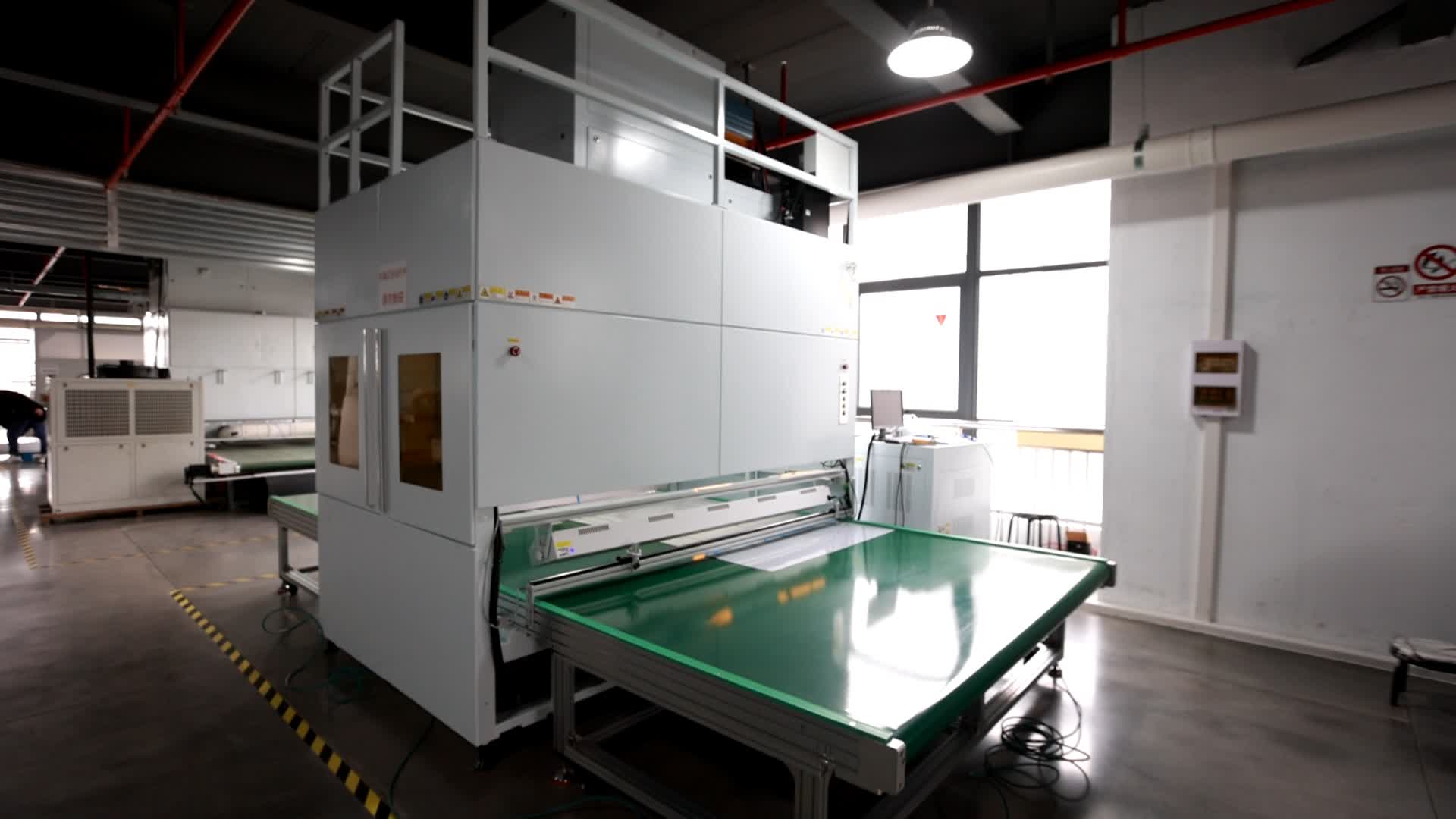
Laser dotting, the process behind dot pattern light guide panels and ultra-thin edge-lit builds. Image: EDGELIGHT production record.
Future outlook
The direction of travel is toward earlier and more granular verification. Lighting power allowances under the 2024 IECC tighten efficiency expectations for LED panels in the United States, which adds a third documentation layer alongside safety and EMC. Standard revisions will continue to arrive on their own cycle, which favours buyers who record the exact revision — UL 2108, 2nd Ed., or EN IEC 55015:2019/A11:2020 — rather than a generic standard family name.
Suppliers that already publish certificate numbers, issuing bodies, model lists, and validity windows make that process short. For the LGP and GPF001 panels, the relevant numbers are UL-US-2145621-0 from UL LLC and CTSL2620530156EZ from CTSL Testing (Dongguan) Co., Ltd., and the practical next step is to place both against the project specification before the order is placed. A consolidated product and certification overview is available in the EDGELIGHT product catalogue (PDF).
Frequently asked questions
What does the UL certificate UL-US-2145621-0 cover for light guide panels?
UL-US-2145621-0 was issued by UL LLC under UL 2108, 2nd Ed., on 2021-10-05 and is valid to 2031-10-05. The certified scope is Component, Sign Accessories, LPS/Class 2 type, and LED module, and it names the LED module models LED-ALS-12V-1W4-3014T-6-590-96, LED-ALS-24V-1W8-3014T-6-1180-336, ALS-24V-2W16-3030-900-9, ALS-24V-2W16-3030-600-6, ALS-24V-2W16-3030-300-3, ALS-24V-2W16-3030-200-2, and LM-24V-4W304-5050RGBW-. The light guide panel, model LGP, is recorded as the related product.
Which standards appear on the GPF001 CE certificate CTSL2620530156EZ?
The certificate was issued by CTSL Testing (Dongguan) Co., Ltd. on 2026-05-29, valid to 2096-05-29, for model GPF001 and its series models. The standards cited are EN IEC 55015:2019/A11:2020, EN IEC 61547:2023, EN IEC 61000-3-2:2019/A2:2024, and EN 61000-3-3:2013/A2:2021/AC:2022-01. All four are EMC-related standards, which is why the document is described as a CE EMC certificate.
How can a specifier independently verify these two certificates?
Verification follows four steps: confirm the certificate number with the issuing body (UL-US-2145621-0 with UL LLC, CTSL2620530156EZ with CTSL Testing (Dongguan) Co., Ltd.); confirm the standard revision exactly as cited, including the 2nd Ed. designation and the A11:2020 amendment; confirm that the model string on the purchase order appears inside the certified model list; and confirm the validity window is open at the time of order.
What protection rating and operating temperature apply to the LGP light guide panel?
The published parameters list a protection grade of IP20–65 and an operating temperature range of −20 °C to 50 °C. Because IP is expressed as a band rather than a single value, the delivered configuration should be agreed at a specific IP level matched to the installation environment. Installations that operate outside the −20 °C to 50 °C window fall outside the declared envelope.
Do these two certificates satisfy every requirement for every market?
No. The UL credential is a component and sign-accessory certification under UL 2108, 2nd Ed., and the CE credential is an EMC certification to EN IEC 55015 and related standards. UL Solutions notes that light guide panels must also adhere to safety standards such as UL 8750 (LED Equipment) and IEC 60598 (Luminaires) for global market access, and the 2024 IECC introduces separate lighting power allowance requirements in the United States. Buyers should map the destination market and end-product configuration against all three layers.
Can a light guide panel be customized without leaving the certified construction?
The CE certificate states that all covered series models share identical circuits except for colour appearance and model name, which is what allows variants within the GPF series to be covered under one certificate number. The available customization axes are size, thickness, colour temperature, logo, surface shape, light output brightness, and installation structure. Changes that touch the circuit or the LED module fall outside the certified scope unless the resulting construction is itself listed.
What production and testing evidence accompanies a light guide panel order?
The manufacturer reports OEM/ODM production with a monthly capacity of 30,000 units, a lead time of 5–10 days, a minimum order quantity of 1 unit, and 100% testing as its quality control method. Declared export markets are the European Union, North America, Southeast Asia, and Australia, with local after-sales support. These figures describe production and quality control practice; they do not extend the certified scope of either certificate.
Tem questões ou precisa de mais detalhes?
Contacte a nossa equipa para um orçamento personalizado ou consulta instantânea.
Solicitar orçamento
Preencha o formulário abaixo e a nossa equipa entrará em contacto com uma proposta personalizada.
Chat direto do WhatsApp
Prefere conversar em tempo real? Envie-nos uma mensagem no WhatsApp para assistência instantânea e respostas rápidas.
- Obter orçamento personalizado
- Partilhar fotos ou documentos
- Discuta as suas necessidades diretamente
Geralmente responde em 5–30 minutos durante o horário de expediente.