
Light and Reflection: Choosing JYF-01 Mirror or JYF-04 Water Ripple
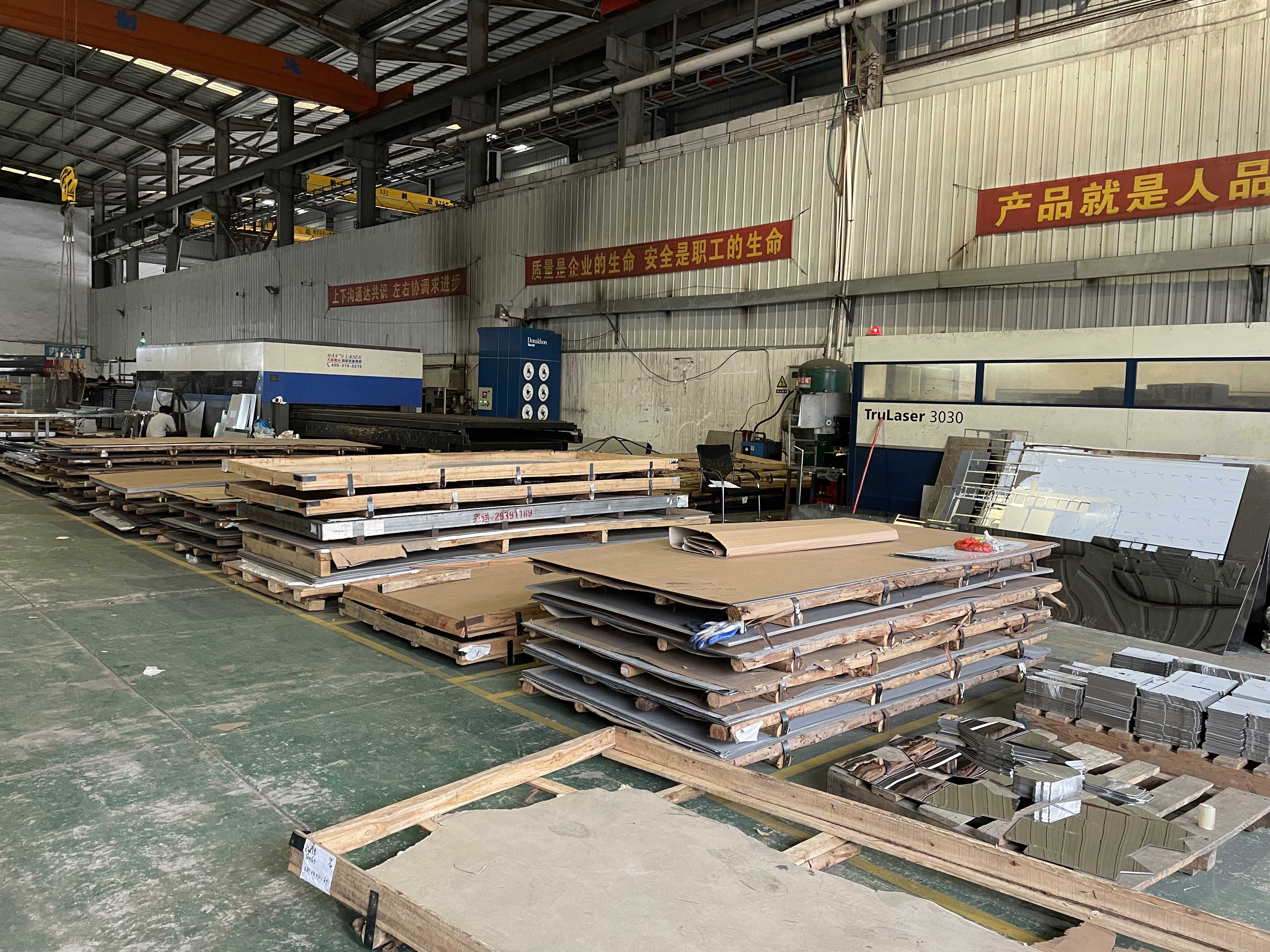
Fabrication workshop at JYF Metal, Foshan. Panel flatness and edge quality are set here, before any decorative surface is applied.
Two decorative stainless steel surfaces can be cut from the same sheet, share the same corrosion resistance, and still produce completely different rooms. The JYF-01 mirror finish and the JYF-04 water ripple finish sit at opposite ends of one specification decision inside architectural stainless steel decoration: whether a surface should reproduce its surroundings almost literally, or break incoming light into a moving band of highlights. For a project team at decision stage, the question is not which finish is better. It is which optical behaviour the space can carry, and what the specification has to control so that behaviour survives installation.
JYF Metal, the operating name of Foshan Jinyifan Metal Products Co., Ltd., is a decorative stainless steel manufacturer established in 2013 in Foshan, Guangdong, China. The company operates a 3,000 m² factory equipped with German Trumpf laser cutting machines, high-precision CNC bending equipment, seamless precision welding and a PVD vacuum plating line for stainless steel decorative panels, and exports roughly 80% of its output to the Middle East, Asia, Europe and North America. Its architectural portfolio spans wall, ceiling, commercial-space and floor systems, including ripple pattern panels, coloured stainless steel panels, metal screens and partitions, column cladding, custom metal bars and metal art sculptures.
Both JYF-01 and JYF-04 belong to that portfolio and are produced from the same material family: stainless steel 201, 304, 316 or 430, with copper and aluminium used elsewhere in the wider product range. Both surfaces can be colour-treated on the same PVD line. What separates them in a project is not metallurgy. It is what happens to light at the surface.
What actually separates the two finishes
JYF-01 is a mirror finish. The surface is levelled and polished until it reflects images with high fidelity, so the panel behaves as a near-continuous reflector of the room, the lighting and the people in it.
JYF-04 is a water ripple finish. The surface carries a continuous sculpted wave profile, so incoming light is distributed across a range of angles instead of a single one. The result is a highlight band that travels across the panel as the viewer moves, and a surface that reads as texture rather than as reflection.
Both are decorative stainless steel surfaces with the same corrosion resistance and the same cleaning regime. The difference is entirely in how each one responds to the light that falls on it, and in how much of the surrounding construction each one is willing to reveal.
Why this is a decision-stage question, not a mood-board choice
Renders show colour and pattern. They rarely show behaviour. A finish that looks correct in a visualisation can read as noisy or as distorted once it is installed under real lighting, at real viewing distances, with real panel joints.
At decision stage, three variables decide the outcome:
- What the surface should do to perceived space. A reflective plane enlarges; a textured plane absorbs and animates.
- How much visual imperfection the site can tolerate. A mirror will report every deviation in the substrate. A wave pattern will not.
- How the surface will be cleaned, handled and repaired across the building life. Contact frequency and maintenance access are part of the finish decision, not an afterthought.
In practical terms, both finishes are sensitive to lighting design. Grazing light from a cove or a wall-washer will expose any deviation in panel flatness on either surface; diffuse light will conceal it. The same panel can look flawless in one installation and problematic in another without any change to the material.
Technical explanation: how each surface handles light
Specular reflection on JYF-01 mirror
A mirror stainless surface behaves close to a specular reflector. It returns a legible virtual image, which is why it is used to extend a narrow lobby, double a lighting feature, or carry a view through an interior. The visual benefit is scale: a mirror plane makes a compact lift car, corridor or back bar feel larger than its dimensions suggest.
The cost of that fidelity is that the surface is equally faithful to defects. Panel waviness, substrate unevenness, misaligned seams, fingerprints, water marks and fine scratches all become part of the image. On a large uninterrupted field, small errors compound visually, because the eye compares the reflected line against the real one.
Directional scattering on JYF-04 water ripple
A water ripple profile distributes incoming light across many angles. Instead of a single reflected image, the panel produces a moving highlight band that changes with the viewing position. This makes the surface visually active and considerably more forgiving of minor surface and substrate irregularities, and it reduces the visibility of fingerprints and handling marks compared with a polished mirror plane.
The trade-off runs the other way. The wave pattern is not a neutral background. At close viewing distance, on bar fronts, door surrounds, skirting and trim, the texture density becomes the dominant visual element and can compete with adjacent geometry. On very small components, a ripple pattern may read as more elaborate than the surrounding design language intends.
What both finishes demand
Flatness, a correctly prepared substrate, controlled seam lines and consistency between production batches. Neither finish compensates for a poor backing structure; one simply hides it better than the other.
Material grade: SS304, SS316 and the wider family
Grade selection is a separate decision from finish selection, but the two interact at the point of specification.
- SS304 is the general-purpose austenitic grade and the usual starting point for interior architectural work.
- SS316 contains molybdenum and offers better resistance to chlorides, which is why it is specified for coastal positions, pool environments, high-humidity interiors and locations where aggressive cleaning agents are expected.
- SS201 and SS430 also appear in JYF Metal's material range, typically where cost structure or a specific application requirement drives the choice.
JYF Metal's incoming material inspection is set up to confirm that 304 and 316 stainless steel meet the specified standard before processing begins, which matters more for a mirror finish than for a textured one. Polishing exposes what the base metal contains, so surface inclusions and rolling defects show up on a mirror panel rather than being concealed. A ripple pattern can visually mask minor substrate variation, but it does not correct an incorrect grade choice.
PVD colour is available on both finishes. Where a project uses colour, the practical question is consistency between panels and between production runs rather than the colour itself, and that is a supply-control question that should be raised during supplier qualification, not after the first delivery.
Thickness, format and substrate constraints
Neither finish is ordered from a thickness catalogue alone. Dimensions, surface finish, colour, quantity and export requirements are confirmed against approved drawings or samples before production, and JYF Metal supports custom orders based on drawings or samples as well as on-site factory inspection.
From an engineering standpoint, the two finishes place different demands on the panel build-up:
- Mirror panels need a stiffer, flatter construction. A panel that deflects between supports will produce a distorted reflection that no amount of polishing can correct. Substrate flatness and fixing spacing therefore belong in the same conversation as the finish.
- Ripple panels tolerate minor deflection visually, but they still require consistent seam lines, because the wave profile turns any misalignment at the joint into a visible break in the rhythm of the pattern.
- Edge and joint design should be agreed with the finish. A folded mirror edge and a folded ripple edge do not read the same way, and the same detail drawing will produce different results on each surface.
Where panel stiffness is a concern, honeycomb-backed constructions are an option within the wider stainless steel panel category, since they add rigidity without equivalent solid mass. Their suitability for a specific project should be confirmed with the fabricator against the drawing set.
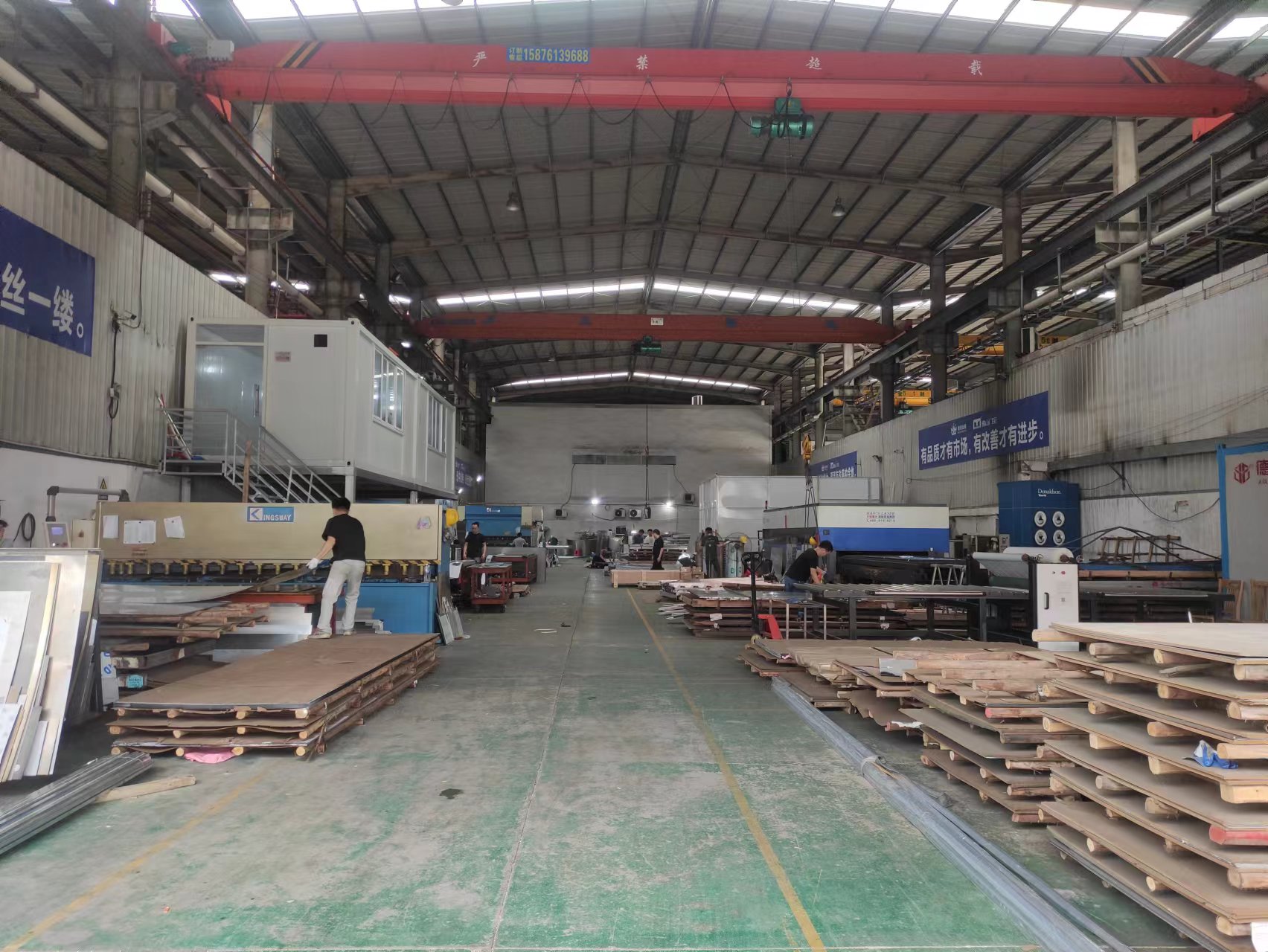
Forming and pre-delivery inspection at JYF Metal. A mirror surface reports forming accuracy; a wave texture conceals it.
Application mapping: where each finish earns its place
JYF-01 mirror is typically specified where the design intent is spatial expansion or visual continuity:
- elevator interiors and lift lobbies, where reflection increases perceived volume in a confined envelope;
- bar counters and back bars where a monolithic, continuous line is wanted;
- column cladding and door surrounds where joints should visually disappear;
- ceiling features in low spaces, where a reflected plane lifts the perceived height.
JYF-04 water ripple is typically specified where the surface is meant to be an active element:
- feature walls in hotel lobbies, luxury restaurants, clubs and sales-centre reception areas;
- ceiling systems, particularly where the ripple runs as a continuous field and the highlight band moves across the plane;
- room dividers, screens and partition panels where the pattern reads at walking distance;
- sculptures, art installations and custom bar fronts, where texture carries the design;
- high-contact surfaces, where fingerprint visibility is a practical maintenance concern rather than a theoretical one.
Neither finish should be assumed correct for an exterior facade without a separate review. A facade system carries rain, pollution and thermal movement, and the finish has to be evaluated together with the grade and the fixing system rather than on its own.
Market context: why surface choice is becoming a specification question
The broader material market supports the idea that decorative stainless is no longer a niche accent. Fortune Business Insights values the global stainless steel market at USD 225.13 billion in 2025, with a projected value of USD 353.48 billion by 2034. Grand View Research reports that steel held a 52% revenue share of the metal ceilings market in 2026, with aluminium projected to grow at a 7.3% CAGR through 2033.
The ceiling figure matters directly to the water ripple decision. A wave-textured stainless ceiling is a metal ceiling product first and a decorative surface second, so it has to satisfy the same fire, weight and fixing requirements as any other metal ceiling in the same building. Company-reported product data compiled for this category lists stainless steel honeycomb panels with fire performance to ASTM E84 and EN 13501-1 and weight reductions of 50%–70% compared with solid panels, which is the kind of property that decides whether a decorative ceiling system is viable on a given structure.
Cost benchmarks point in the same direction. Secondary US market data reports installation of stainless steel wall panels at roughly USD 15–35 per square foot, which indicates that installed cost is driven by substrate, fixing and labour at least as much as by the sheet itself. Finish decisions taken late in a programme tend to cost more than finish decisions taken early, because the substrate and fixing design are already fixed by then.
On the compliance side, ASTM A554 remains one of the most frequently cited standards for welded decorative stainless steel tubing, which is relevant to the trims, frames and profile elements that usually accompany either finish.
Comparison with traditional solutions — and where both finishes stop
Against aluminium panels, painted gypsum boards, laminated wood panels and PVC decorative sheets, JYF Metal positions its decorative stainless steel panels with a lifespan of 15–25 years versus 5–12 years for the alternatives, scratch resistance improved by approximately 3 times, and flatness deviation under 1 mm/m. Against wood, MDF, iron and glass-only partitions, stainless steel screens are positioned with 10–20 years versus 3–8 years, deformation reduced by approximately 60%, and maintenance frequency reduced by approximately 70%.
The trade-off is upfront cost: roughly 30–60% higher for panels and 20–40% higher for partitions, offset by lifecycle replacement cost reported as 50–70% lower. Those figures describe the material category, not a guarantee for a specific project, and they should be tested against the maintenance regime the building will actually run.
Where the finishes stop working. A mirror finish is easy to specify and hard to keep pristine: fingerprints, water marks and fine scratches are visible at normal viewing distance, and cleaning requires a neutral detergent rather than an abrasive. A water ripple finish cannot be locally re-polished — once the wave profile is damaged, repair usually means replacing the panel, because blending a repair into a continuous pattern is not practical on site. Neither finish corrects an uneven substrate, and a large mirror field under strong directional lighting can produce glare and double images that interfere with wayfinding. Where a true reflected image is functionally required, a ripple surface is not a substitute.
A decision framework for specification
| Decision criterion | JYF-01 mirror finish | JYF-04 water ripple finish |
|---|---|---|
| Reflected image | Legible near-specular reflection of the room | No defined image; light dispersed into a travelling highlight band |
| Effect on perceived space | Enlarges and extends; useful in confined envelopes | Adds depth and movement; does not enlarge |
| Tolerance of panel or substrate deviation | Low — deviation reads as distortion in the reflection | Higher — texture masks minor irregularity |
| Visibility of fingerprints and handling marks | High, especially at eye level and on touch surfaces | Lower, because the pattern breaks up the mark |
| Seam and joint control | Seams must align with the reflected geometry | Seams must align with the pattern rhythm |
| Typical fit | Elevator interiors, lift lobbies, back bars, column cladding, low ceilings | Feature walls, ceilings, screens, partitions, bar fronts, sculptures |
| Repair strategy | Panel replacement; polishing only by a specialist | Panel replacement; local re-polishing breaks the pattern |
| Grade pairing | SS304 for interiors; SS316 where chlorides or aggressive cleaning apply | Same grade logic; the texture does not change corrosion exposure |
| Colour | PVD colour available; mirror base amplifies the colour | PVD colour available; texture shifts the perceived tone across the wave |
The framework is deliberately weighted towards visual consequence rather than cost, because cost differences between the two surfaces are small next to the cost of changing a finish after the substrate and lighting are fixed.
Future outlook
Two directions look durable. The first is the combination of texture and colour: PVD treatment on a sculpted surface produces a surface whose tone changes with the viewing angle, and that behaviour is difficult to achieve in painted or laminated alternatives. The second is the normalisation of metal ceilings in commercial interiors, which the steel share of the metal ceilings market supports, and which pulls decorative surface decisions earlier into the specification sequence.
For buyers, the practical consequence is that finish selection is becoming a documented decision rather than a design instinct. Projects that record why a mirror or a ripple surface was chosen — viewing distance, lighting condition, contact frequency, maintenance access — are easier to defend at handover, and easier to repeat on the next building in a programme.
FAQ
What is the difference between a mirror finish and a water ripple finish on stainless steel?
A mirror finish is levelled and polished until it reflects a legible image of its surroundings. A water ripple finish carries a continuous sculpted wave profile that distributes light across many angles, producing a moving highlight band instead of a reflection. Both are produced from the same stainless steel grades and both can be PVD colour-treated; the difference is optical behaviour.
Which finish suits a hotel lobby or reception feature wall?
It depends on what the wall is asked to do. A mirror surface suits a narrow or low space where the intent is to extend perceived volume, but it will expose substrate and seam deviation and will show fingerprints at eye level. A ripple surface suits a wall intended as a visual element at walking distance, where texture carries the design and minor irregularity is acceptable. Contact frequency and maintenance access are the deciding factors when the two options appear equally appropriate on a rendering.
Does SS304 or SS316 matter more when a mirror finish is specified?
Grade selection follows the environment, not the finish. SS304 is the usual choice for general interior work. SS316, which contains molybdenum for better chloride resistance, is specified for coastal positions, pool environments and high-humidity interiors. A mirror finish does make grade defects more visible, because polishing exposes what the base metal contains, so incoming material inspection before processing is more critical on a mirror panel than on a textured one.
What thickness and substrate conditions do JYF-01 and JYF-04 require?
Thickness and panel format are confirmed against approved drawings or samples rather than selected from a fixed catalogue. The engineering requirement differs by finish: a mirror panel needs a stiffer build-up and a flatter substrate, because deflection between supports distorts the reflection, while a ripple panel is visually more tolerant of minor deviation but still requires consistent seam alignment so the pattern rhythm is not broken at the joint.
Can mirror and water ripple finishes be used in the same project?
Yes, and the combination is common in commercial interiors, where a ripple field is used for the main decorative plane and a mirror surface is used for trim, column cladding or a contrasting element. The transition detail matters: the two surfaces read light differently, so the junction should be drawn and agreed in advance rather than resolved on site.
How are these finishes maintained and repaired?
Cleaning with a neutral detergent is appropriate for both. A mirror surface requires care to avoid abrasive contact, since fine scratches remain visible. A ripple surface cannot be locally re-polished, because blending a repair into a continuous wave pattern is not practical on site, so damage is normally resolved by replacing the affected panel. Both surfaces benefit from protective packaging and pre-shipment inspection to reduce the risk of transit damage.
Closing note
The JYF-01 mirror and JYF-04 water ripple finishes are best understood as two different answers to the same lighting question, not as a premium and a standard option. Choosing between them means deciding how much of the room the surface should show back to the viewer, and how much construction tolerance the site can realistically deliver. A short reference of JYF Metal project cases and surface options is available in the designer handbook.
Tem questões ou precisa de mais detalhes?
Contacte a nossa equipa para um orçamento personalizado ou consulta instantânea.
Solicitar orçamento
Preencha o formulário abaixo e a nossa equipa entrará em contacto com uma proposta personalizada.
Chat direto do WhatsApp
Prefere conversar em tempo real? Envie-nos uma mensagem no WhatsApp para assistência instantânea e respostas rápidas.
- Obter orçamento personalizado
- Partilhar fotos ou documentos
- Discuta as suas necessidades diretamente
Geralmente responde em 5–30 minutos durante o horário de expediente.