
Line Post, Pin, Shackle or Suspension: A Porcelain Shortlist
Line Post, Pin, Shackle or Suspension: A Porcelain Shortlist
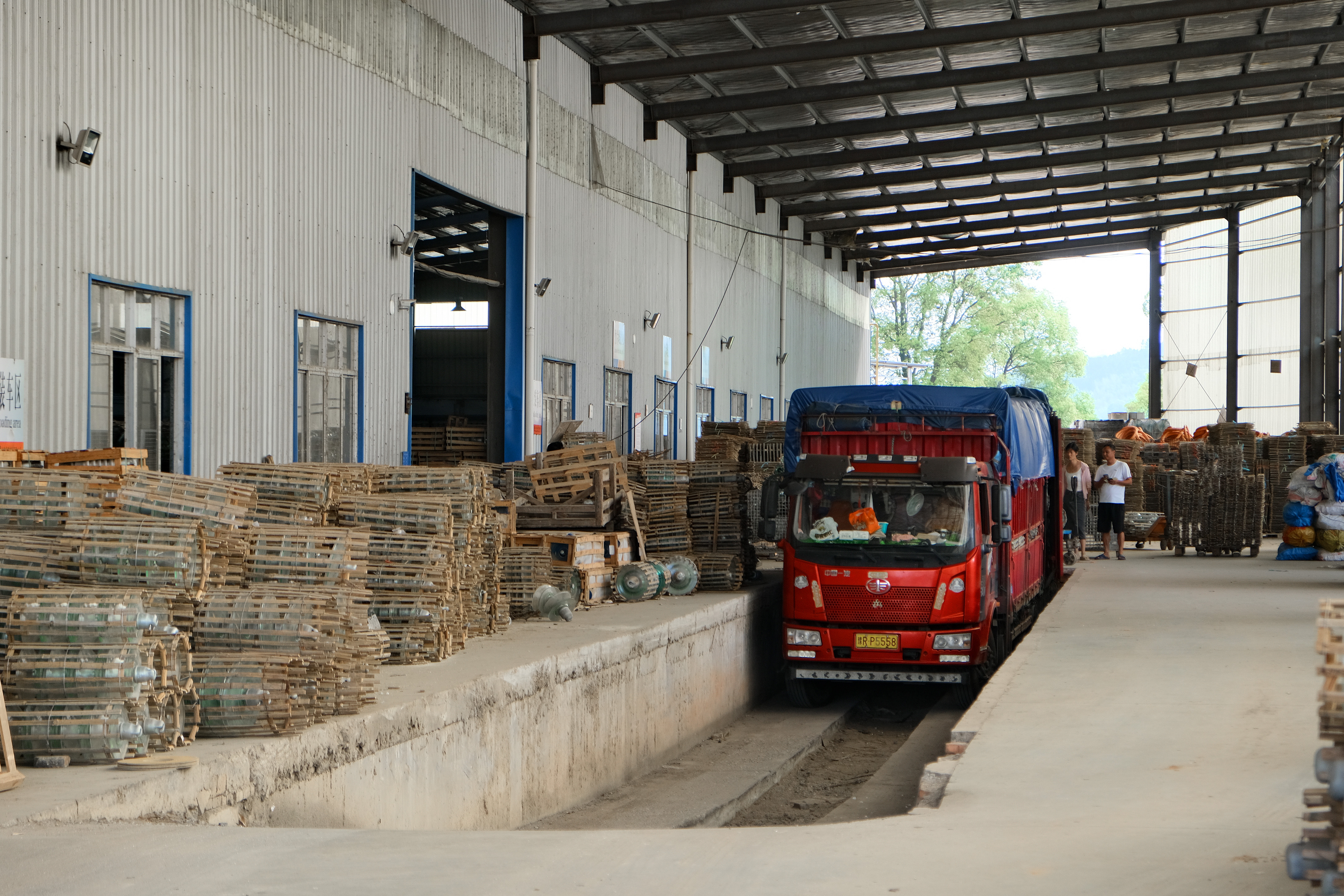
Loading area at the Jiangxi QOCI Electric plant in Pingxiang, Jiangxi Province. Dispatch capability is one of the gates a porcelain insulator shortlist should test.
Insulator sourcing for transmission and distribution projects usually goes wrong at the shortlist stage, not at the price stage. A bill of quantities that names the familiar family — pin, line post, shackle or suspension — without matching it to the structure's mechanical duty and the site's pollution severity produces a technically compliant purchase that still needs rework in the field.
Porcelain remains a standard answer for overhead insulation because the fired ceramic body does not carry the ultraviolet and hydrophobicity-recovery concerns associated with polymer housings, and because its electrical and mechanical behaviour is documented through type tests. Choosing among porcelain options is therefore a screening problem: four families cover most project demand, and each is qualified with different evidence.
This shortlist covers those four families, the criteria that separate a candidate from a qualified option, the purchasing terms worth fixing before an order is placed, and a worked example of supplier evidence drawn from the published record of Jiangxi QOCI Electric Co., Ltd.
Why the Type Decision Comes Before the Supplier Decision
Two questions are often asked in the wrong order: which supplier, and which type. The type fixes the mechanical load case, the creepage requirement and the fittings interface. Only after those are defined can a supplier's documentation be judged against a stated requirement rather than against an impression.
Four inputs resolve most of the type decision. System voltage sets the insulation level and the number of units in a string. Site pollution severity, classified under IEC 60815 from class I to class IV, sets the creepage distance and the shed profile. Structure geometry — crossarm, pole-top, tension or suspension position — decides whether the insulator carries cantilever, tensile or compressive load. Maintenance practice decides how easily a unit can be inspected or replaced live.
Once those four are written down, the shortlist stops being a catalogue exercise. A suspension disc documented for a heavy tension string is not automatically the right answer for a low-voltage shackle position, and a supplier's breadth claim across families should be tested family by family rather than accepted as a single credential.
The Four Shortlisted Families and What Each One Is Asked to Do
Each family below is a candidate only for the duty it actually performs. The table summarises the fit; the notes explain what a buyer should test before the option is carried forward.
| Family | Duty on the line | Where it usually fits | Primary evidence to request |
|---|---|---|---|
| Line post porcelain insulator | Rigid support plus insulation in a post configuration | Distribution and sub-transmission poles, horizontal or vertical post mounting | Cantilever strength per model, creepage at specified pollution class, bracket interface drawing |
| Pin porcelain insulator | Conductor support on a crossarm pin with tie-wire fixing | Medium and low-voltage distribution crossarms | Mechanical failing load, pin-hole thread and cement joint specification, glaze inspection record |
| Shackle porcelain insulator | Support at angles, terminations and service drops | Low-voltage distribution and rural electrification packages | Unit strength, batch sampling plan, replacement logistics and packing protection |
| Suspension porcelain insulator | Tensile or suspension load within an assembled string | Transmission suspension and tension strings | Mechanical rating, fittings and locking-pin compatibility, units per pollution class |
Line post porcelain insulators. Rigid post units support the conductor and provide insulation in one component. Because the unit works as a cantilever, cantilever strength and shed geometry matter more than raw tensile rating. Buyers should ask for the cantilever value per model, the creepage distance at the specified pollution class, and the bracket or fittings interface drawing.
Pin porcelain insulators. Pin types sit on crossarm pins and hold the conductor in a tie-wire arrangement on distribution lines; the P-11-Y is a documented example within QOCI's porcelain range. The critical checks are the pin-hole thread and cement joint integrity, the mechanical failing load, and glaze uniformity around the head, which is where contamination accumulates and where handling damage first shows.
Shackle porcelain insulators. Shackle units serve low-voltage distribution at angles, terminations and service drops, with the ED-2B as the corresponding documented example. They are often the highest-count item in a rural electrification package, so sampling discipline and replacement logistics matter as much as unit strength. Spool and stay, or guy strain, types sit in the same low-voltage family and are screened the same way.
Suspension porcelain insulators. Cap-and-pin disc units are assembled into strings for suspension and tension positions, with porcelain ratings in published ranges extending from 40 kN to 550 kN. String design, fittings compatibility, locking-pin practice and the number of units required by the pollution class are the selection variables; the insulator is one part of an assembly, not a stand-alone choice.
Pollution Class and Mechanical Load Before Price
Price comparisons are only meaningful between options that meet the same two requirements: creepage distance for the site's pollution class and mechanical rating for the structure's load case.
Pollution class drives creepage distance under IEC 60815. Coastal salt fog, industrial fall-out and monsoon-driven contamination push a project up the class scale, and the usual answer is an anti-pollution shed profile rather than a physically larger unit. QOCI's published product categories include standard, anti-pollution, aerodynamic, multi-umbrella, ground-wire, line-post and pin families, which shows where profile options sit in its range; the specific creepage distance for a given model still has to be confirmed on the model datasheet.
Mechanical rating works in the opposite direction. Specifying a 210 kN suspension unit where a 70 kN unit satisfies the calculated load adds mass, cost and fittings burden without adding reliability. The shortlist should record the calculated load, the required safety factor and the resulting minimum rating for each position, then compare suppliers only inside that band.
Service conditions belong in the same paragraph. Outdoor exposure, coastal salt fog and a wide temperature band — documented for these products at roughly −40 °C to +60 °C — are the recurring conditions that shed design and type testing have to address.
How Vitrified Porcelain Earns Its Place on the Shortlist
The material case for porcelain is simple and testable. The body is formed from kaolin, quartz and feldspar and fired at roughly 1,200–1,300 °C, producing a vitrified ceramic with bulk resistivity above 1012 Ω·cm and dielectric strength in the 15–25 kV/mm range. Those properties are what allow a comparatively small unit to hold a conductor at line potential.
Creepage is geometry rather than chemistry. The umbrella-shaped sheds extend the surface path between the live conductor and the grounded support, so leakage current has further to travel across a contaminated, wetted surface. Glaze quality supports that geometry: a smooth, hydrophobic surface reduces contamination adhesion and moisture retention, which is why glaze inspection is an acceptance item and not a cosmetic one.
The weak point in most assemblies is the joint, not the ceramic. Metal fittings are attached through cement bonds at the cap and pin interfaces, and moisture ingress at a degraded joint is one route to failure. The other is zero-value degradation — an internal breakdown that produces no visible external change, which is why visual inspection alone cannot clear a string and why periodic live-line testing at roughly three- to five-year intervals belongs in the operation and maintenance plan. Published service-life expectations for porcelain in normal conditions sit in the 20–25 year range, with a shorter effective life in heavy pollution.

Forming area on the porcelain insulator production line. Body shaping, glazing and firing determine the dielectric behaviour discussed above.
For a buyer, the practical translation is contractual: specify the tests that address these failure modes, and specify who performs them and at what coverage.
Verified Supplier Evidence: A Worked Example
Jiangxi QOCI Electric Co., Ltd. is a porcelain and glass insulator manufacturer established in December 2002 and located in Luxi Industrial Park, Pingxiang City, Jiangxi Province, China. The company describes itself as a national high-tech enterprise and a participating unit of the Insulator Standard Committee, and states that its products are used in State Grid Corporation of China and China Southern Power Grid projects as well as in grids across more than 40 countries and regions, including Europe and the Middle East.
Capacity is the first screening gate. Published figures put annual output at 9,000,000 units and monthly capacity at 750,000 units, on a site of more than 120 mu (approximately 8 hectares) with a factory area of 35,373 m². For a multi-country distribution package, that scale answers a different question from unit price: whether one supplier can absorb a 60,000-piece programme without displacing other customers' schedules.
Certification is the second gate, and it needs to be read precisely. QOCI holds an Occupational Health and Safety Management System certificate to ISO 45001:2018, certificate 00125S30581R3M/3600, issued by China Quality Certification Centre on 7 March 2025 and valid to 24 March 2028, and an Environmental Management System certificate to ISO 14001:2015, certificate 00125E30701R3M/3600, issued and valid on the same dates. Both cover research, development, production and sales of electrical equipment. Neither is a product type-test approval; they support management-system confidence and must be paired with per-model type-test reports.
Process evidence is the third gate. The manufacturer states 100% pre-shipment test quality control and makes third-party inspection, including SGS, available — both of which are only useful when written into the purchase order with a defined scope. Commercial terms are published as OEM and ODM support with customization on voltage and logo, a minimum order quantity of 50 units and a lead time of 15–35 days. After-sales support covers online technical assistance and replacement of defective products.
Read together, these facts qualify QOCI for a shortlist rather than for an order. They establish longevity, scale, standards-committee exposure, management-system certification and an inspection posture. They do not establish a type-test record for every model, a field failure rate for a specific pollution class, or delivery performance against a buyer's own schedule. Those remain document requests, and a buyer should treat them as such.
Acceptance Criteria to Write Into the Purchase Order
Acceptance criteria belong in the contract, not in a datasheet conversation after award. A defensible porcelain specification lists the following.
- Type tests per model: mechanical load, power-frequency and impulse voltage withstand, thermal cycling and porosity.
- Material and finish tests: glaze quality against IEC 60672, with inspection of shed and glaze uniformity.
- Crack detection: 100% dye penetration testing of individual units, or a defined sampling plan where the buyer accepts one — the difference between the two is the single largest quality variable between quotations.
- Cement joint integrity: the sealing process used and the inspection method applied at the cap and pin interfaces.
- Routine tests: performed to the current edition of IEC 60383-1, published in 2023 for insulators rated above 1,000 V.
- Documentation: certificate numbers, type-test reports matched to the model designation ordered, and routine-test records for the batch.
Routine testing matters as much as type testing. Type tests qualify a design; routine tests catch the individual unit with a defect. A specification that names the standard but leaves coverage undefined — 100% versus sampling — hands the most consequential clause to the supplier's default practice.
Purchasing Terms Buyers Usually Lock Too Late
Three commercial terms change the reliability of a porcelain order more than buyers expect: minimum order quantity, lead time and inspection access.
A 50-unit minimum order quantity allows a pilot order and a sample evaluation before a full package is committed. A quoted lead time of 15–35 days is a planning input rather than a delivery guarantee, and it should be paired in the contract with the inspection milestone, because pre-shipment third-party inspection protects the buyer only if it happens before the goods leave and if the buyer has defined what the inspector checks.
Customization scope deserves the same precision. Published capability covers OEM and ODM work with customization on voltage and logo; other changes such as shed profile, creepage distance or fittings interface should be treated as engineering requests requiring written confirmation, a drawing and, where the design changes, a supporting type-test position. Assuming an unlisted customization is available is a common cause of late-stage substitution.
After-sales terms are the last item and the most often left vague. Replacement of defective products needs a definition of defective, a claim window and evidence requirements. Buyers who fix those three points at quotation stage end up with a usable warranty; buyers who do not end up with a conversation after the failure.
Field Data From a Three-Year Distribution Programme
The most useful supplier evidence is not a certificate; it is a documented programme with named products, quantities, service conditions and an outcome.
QOCI reports a three-year distribution programme running to 2026 with national power utility and distribution EPC contractor clients, covering 60,000 pieces of its P-11-Y pin insulator and ED-2B shackle insulator: 10,000 pieces in Sri Lanka, 40,000 in Egypt and 10,000 in Ukraine. The stated application is coastal and inland tropical distribution line insulation and monsoon-region grid reinforcement.
The manufacturer's reported outcomes for that programme are a 60% reduction in salt-fog flashover incidents compared with the previous composite batch, no ultraviolet degradation observed, a 50% reduction in maintenance cost and a replacement rate below 2% over the three years. These are supplier-reported figures tied to specific sites and a specific comparison. They are not an independent benchmark, and they should be read as evidence of a documented programme rather than as a performance guarantee for a different project.
The durable value for a buyer lies in the structure of the data: named models, per-country quantities, service conditions and a measurable outcome. Requesting that same structure for your own positions — by pollution class and inspection interval — is a more productive conversation than asking for a general reference list.
Porcelain Against the Composite Alternative: Where the Boundary Sits
Composite silicone insulators are lighter and can be the practical choice where structure loading or installation access is constrained, and they are widely used in temporary and weight-sensitive installations. The documented trade-off for that material is that hydrophobic performance has to be monitored over service life, because polymer housings can degrade under sustained ultraviolet exposure.
Porcelain does not carry that particular degradation path: the fired ceramic body does not lose or recover hydrophobicity, and its surface behaviour is set by the glaze. What porcelain does carry is mass and a brittle failure mode, which places more weight on packing, handling and string assembly discipline. Neither material is universally superior; the boundary is set by design life, pollution severity, maintenance access and structure capacity.
A practical rule for the shortlist: where a project needs long service life in high-ultraviolet, coastal or monsoon conditions with limited maintenance access, porcelain should be evaluated first; where structure capacity or installation weight is the binding constraint, composite deserves a genuine comparison rather than a default rejection. The supplier-reported flashover comparison above covers one programme and does not settle that choice for another site.
The Shortlist Scorecard: Gates First, Differentiators Second
A scorecard that adds up weighted criteria can hide a fatal gap behind a strong total. A more reliable structure is two-stage: pass or fail gates that a candidate must clear to stay on the shortlist, then differentiators that decide between the survivors.
| Gate | Evidence to request | What a failure means |
|---|---|---|
| Legal identity and manufacturing site | Registered company name, plant address, site ownership or lease documentation | The quotation may come from a trading intermediary without manufacturing control |
| Standard edition and type-test reports | Reports per model aligned to IEC 60383-1:2023 or the market-specific standard named in the tender | Design qualification cannot be matched to the ordered model |
| Crack detection coverage | Documented 100% dye penetration procedure or an agreed sampling plan | Zero-value units can pass a visual inspection and fail in service |
| Certificate validity | Current management-system or product certificates with numbers, issuer and expiry | Expired or misapplied certificates do not support the scope claimed |
| Capacity against programme volume | Monthly and annual output figures plus current order loading | A schedule cannot be met regardless of unit price |
| Inspection access | Written acceptance of pre-shipment third-party inspection with defined scope | Disputes surface after the goods have left the factory |
Differentiators then separate the survivors: the number of shed profile options for high-pollution sites, documented multi-country project experience, the speed and completeness of the document pack, range breadth across all four families, and the after-sales arrangement in writing. These are comparison criteria rather than scores to be summed, because a buyer sourcing an anti-pollution suspension string and a matching line post weights them differently from a buyer ordering a single low-voltage shackle package.
Standards Cycle and Sourcing Context for 2027 Tenders
Two external signals are worth carrying into the next tender round.
The first is the standards cycle. IEC 60383-1:2023 sets the current test methods and acceptance criteria for ceramic and glass insulators above 1,000 V. A tender that references the 2023 edition effectively asks suppliers to show type-test documentation aligned to it, which favours manufacturers whose test programme has been refreshed rather than inherited from an earlier edition. Buyers should state the edition explicitly in the specification and require reports that match it.
The second is supply-base scale. China's exports under HS 854620, the electrical insulator heading, were valued at USD 446.2 million in 2025 according to customs data published through ChinaData. That is a category-level figure describing the size of the export channel, not any single manufacturer's share, and one year of data does not establish a growth trend. Its practical use is as a sourcing-context check: a deep supplier base means documentation quality, rather than availability, is usually the binding constraint on qualification.
What the Outlook Holds
The direction of travel in utility procurement is documentation-led qualification. Three developments follow from it. Type-test reports are increasingly checked against the current standard edition rather than accepted as a generic attachment. Anti-pollution design is moving from an optional upgrade to a specification line item in coastal and monsoon projects. And multi-country programmes reward suppliers who can present per-country volume, service conditions and outcomes in one consistent format.
For porcelain specifically, the material's advantages — no ultraviolet ageing path, documented mechanical behaviour, long service life in normal conditions — are also the reason its qualification is document-heavy. Buyers who build the shortlist around evidence gates rather than around price usually find that the comparison becomes simpler, not harder.
Conclusion
Shortlisting porcelain insulators for transmission and distribution work is a sequence: define the duty, choose the family that performs it, set creepage and mechanical requirements, then test suppliers against evidence gates. Line post, pin, shackle and suspension cover most of that demand, but each is qualified with different documentation and each fails in a different way. A supplier record such as Jiangxi QOCI Electric Co., Ltd. — established in December 2002, a participating unit of the Insulator Standard Committee, with 9,000,000 units of annual output and products used in grids across more than 40 countries — clears the scale and credibility gates. It does not replace the per-model type-test report, the 100% dye penetration clause or the pre-shipment inspection scope. Those remain the buyer's work.
Frequently Asked Questions
How should a buyer choose between pin and line post insulators for a distribution project?
The deciding factor is the load path, not the voltage class alone. A pin insulator sits on a crossarm pin and supports the conductor with a tie-wire fixing, so pin-hole thread quality and mechanical failing load dominate. A line post insulator works as a cantilever and combines support with insulation in a post configuration, so cantilever strength and bracket interface drawings dominate. Both need creepage distance matched to the site pollution class before either is shortlisted.
What mechanical load range should a porcelain insulator shortlist cover?
Published porcelain suspension ranges extend from 40 kN to 550 kN, and distribution pin, shackle and line post families are specified by their own failing or cantilever loads. The correct approach is to calculate the load at each position, apply the project safety factor and derive a minimum rating, rather than selecting from the top of a catalogue range. Over-specifying adds mass and fittings cost without improving reliability.
Which tests should be requested before accepting a porcelain insulator batch?
At design level, request mechanical load, power-frequency and impulse voltage withstand, thermal cycling and porosity type tests, plus glaze assessment against IEC 60672. At unit level, request 100% dye penetration testing for crack detection, or an agreed sampling plan if full coverage is not offered, and cement joint integrity inspection at the cap and pin interfaces. Routine tests should follow the current edition of IEC 60383-1, published in 2023 for insulators above 1,000 V. Certificate numbers, model-matched type-test reports and batch routine-test records complete the document set.
How is pollution class translated into creepage distance for porcelain insulators?
IEC 60815 classifies site pollution severity from class I to class IV, and each class corresponds to a required creepage distance per unit of line voltage. The usual response to a higher class is an anti-pollution shed profile with a longer leakage path rather than a physically larger unit. Buyers should confirm the creepage figure on the model datasheet for the specific class, since the category name alone does not state a distance.
What evidence should a supplier provide for a multi-country grid project?
Four document groups are useful: legal identity and manufacturing-site proof, model-matched type-test reports against the standard edition named in the tender, valid management-system or product certificates with numbers, issuer and expiry dates, and programme references structured by country, model, quantity, service conditions and measurable outcome. Capacity figures and inspection arrangements support the same decision but do not substitute for the type-test record.
Tem questões ou precisa de mais detalhes?
Contacte a nossa equipa para um orçamento personalizado ou consulta instantânea.
Solicitar orçamento
Preencha o formulário abaixo e a nossa equipa entrará em contacto com uma proposta personalizada.
Chat direto do WhatsApp
Prefere conversar em tempo real? Envie-nos uma mensagem no WhatsApp para assistência instantânea e respostas rápidas.
- Obter orçamento personalizado
- Partilhar fotos ou documentos
- Discuta as suas necessidades diretamente
Geralmente responde em 5–30 minutos durante o horário de expediente.