
Coating Line: How to Translate Purchase Conditions into Acceptance Criteria
Coating Line: How to Translate Purchase Conditions into Acceptance Criteria
Acceptance begins with the formulation, not with inspection
A coating line becomes manageable for the purchaser when each procurement condition is converted into a record of four elements: subject (the specific line configuration and product size), value, inspection method, and tolerance. In this form, the condition ceases to be a wish—it can either be used to sign the acceptance certificate or to issue a reasoned rejection. Verified reference points for such work already exist: a carbon steel frame, a painting booth and stainless steel pipelines, a capacity of 800–1000 pieces per hour, a maximum product size of Φ300×160 mm, a conveyor speed of 3000 mm/min with adjustment from 2000 to 4000 mm/min, and a specific coating application method.
The key caveat, which is the essence of the method: the listed values relate to different line configurations. The capacity of 800–1000 pieces per hour and the maximum size of Φ300×160 mm are parameters of the cookware coating line. The conveyor belt speed of 3000 mm/min with an adjustment range of 2000–4000 mm/min is a parameter of the automatic metal coating line. Transferring a number from one project to another without specifying the subject is exactly the error that turns acceptance into a dispute over wording rather than an inspection of equipment.
Where procurement conditions and acceptance criteria diverge
Procurement of a line usually goes through three stages, and at each stage the wording loses precision. A commercial inquiry describes output volume, budget, and timeline. The technical specification partly rewrites the supplier's materials, retaining general phrases such as 'high capacity' and 'corrosion-resistant design'. Acceptance, however, takes place in the workshop, where a specific line stands with a specific hanger pitch, a specific oven, and a specific adjustment range.
The working translation sequence looks like this: commercial condition → technical parameter with subject and tolerance → inspection method → document signed based on the result. Skipping any link makes the criterion optional. If the contract retains 'capacity not lower than declared', acceptance will amount to retelling a presentation; if it retains '800–1000 pieces per hour for a Φ220×160 mm workpiece on the cookware line', a subject of inspection appears.
Rule one: every parameter must have a subject
One and the same unit of measurement describes different machines. Therefore, the first action when preparing acceptance is to tie the value to the configuration for which it has been verified.
Cookware coating line. Capacity 800–1000 pieces per hour; standard product size Φ220×160 mm, maximum Φ300×160 mm; workpiece pitch 450–900 mm; hanging method — 4 inner containers or 20 lids; anodizing line speed 1200 mm/min; linear speed of the benchtop curing oven 1000 mm/min with adjustment from 0.5 to 1.5 m/min; energy supply — natural gas and electricity.
Metal coating line. Conveyor belt speed 3000 mm/min, adjustable 2000–4000 mm/min; maximum workpiece size 7000×2000×2200 mm with one piece per hanger; maximum workpiece capacity 5000 m² per day; operating mode 300 days per year, 20 hours per day; coating application method — reciprocating plus manual; transportation — mechanized and free-moving conveyor.
Wood coating line. Design speed 4000 mm/min in the adjustable range 2000–6000 mm/min; pitch 300 mm per hanger; 1422 products per 8-hour shift; maximum workpiece size 610×710×1400 mm.
Three different speed values — 1200, 3000, and 4000 mm/min — do not form a 'worse–better' hierarchy. They are different technological processes. If the contract states 'conveyor speed not less than 3000 mm/min' without specifying the configuration, a line designed for another product formally also meets the condition, and acceptance loses its meaning.
Rule two: the inspection method matters more than the wording
Capacity
The value of 800–1000 pieces per hour applies to the declared product range of the cookware line. To turn it into a criterion, the protocol records the workpiece size, hanger pitch, operating mode, and averaging period. A product larger than Φ300×160 mm goes beyond the limit for which the value has been verified — and demanding the same 800–1000 pieces per hour for it is incorrect by definition.
Conveyor speed
The speed of 3000 mm/min is specified together with the adjustment range of 2000–4000 mm/min. Inspection is carried out within this range, on an operating line, with actual values recorded. The wording 'smooth adjustment' without numerical limits cannot be inspected.
Materials
The carbon steel frame and the painting booth with stainless steel pipelines are different zones with different criteria. For the booth and pipelines, the condition of surfaces contacting the coating material and the material documentation are relevant. Mixing both positions into one line 'steel' is irrational: during acceptance they are checked differently.
Coating application method
Three different solutions are verified here: reciprocating plus manual (metal line), autonomous mode plus robotic painting (auto parts line), manual plus robotic painting (industrial equipment line). The word 'automatic' does not replace any of them: for acceptance, the specific mode is recorded, not the general equipment class.
Operating mode and environment
For the auto parts line, 336 days per year and 22 hours per day are verified, the temperature in the painting booth is 25±2 °C, humidity 65±10% relative, production cycle 45 seconds per tray at 1760 trays per day, maximum fixture size 1350×900×200 mm, equipment utilization rate 85%, and site dimensions 100×38×5.4 m. Each of these values is a separate criterion, and each is checked separately.
Rule three: a certificate is checked by scope and validity period
A certificate confirms not 'the supplier's reliability', but the conformity of a specific product to specific requirements during a specific period. Three fields are essential for acceptance: document number, scope (model or equipment type), and validity period. Below are the documents indicated in the supplier's materials.
| Document | Number | Scope | Validity and standards |
|---|---|---|---|
| EAEU Declaration of Conformity | EAEU N RU D-CN.PA01.B.96986/21 | Laminated conveyor oven (model CZ-21-008-02A); authority MOCCERTPROM | 13.07.2021 – 12.07.2026; TR CU 004/2011, TR CU 020/2011, TR CU 010/2011 |
| ISO 9001 | DZ/CN/2308009Q | Design and manufacture of coating equipment | 20.09.2023 – 13.09.2026; GB/T 19001-2016 / ISO 9001:2015 |
| ISO 14001 | DZ/CN/2407055E | Design and manufacture of coating equipment and management of related environmental aspects | 26.09.2024 – 14.10.2027; GB/T 24001-2016 / ISO 14001:2015 |
| ISO 45001 | 04926S00152R001 | Design and manufacture of coating equipment and related management activities | 20.04.2026 – 19.04.2029; GB/T 45001-2020 / ISO 45001:2018 |
Acceptance matrix: parameter → inspection → tolerance → document
Below is an example of converting verified parameters into inspectable rows. The format is important not for its own sake: it prevents a value from remaining in the contract without an inspection method.
| Parameter | Verified value and subject | What is checked | Recorded by |
|---|---|---|---|
| Frame material | Carbon steel | Conformity to the configuration specification | Specification and incoming inspection certificate |
| Booth and pipelines | Stainless steel | Materials and condition of surfaces in the contact zone with the coating material | Specification, material passport |
| Capacity | 800–1000 pieces per hour (cookware line; workpiece Φ220×160 mm, maximum Φ300×160 mm) | Run on the declared size at the specified hanger pitch | Test protocol indicating the size |
| Conveyor speed | 3000 mm/min, adjustment 2000–4000 mm/min (metal line) | Measurement at the limits and in the middle of the range | Measurement protocol |
| Coating application method | Reciprocating plus manual (metal); autonomous mode plus robotic painting (auto parts) | Actual operating mode of the line | Mode inspection certificate |
| Environment in the booth | 25±2 °C and 65±10% relative humidity (auto parts) | Measurement with the line operating | Environmental parameter protocol |
| Certificates | Numbers and scope — according to the list above | Match of model and validity period with the delivery date | Annex to the contract |

What to fix in the contract so that acceptance relies on facts
- Configuration specification. Line model, purpose (cookware, metal, auto parts, wood, industrial equipment), product sizes, and hanger pitch. Without this, any numerical parameter hangs in the air.
- Parameter table with tolerances. Each row — value, range, and conditions under which it applies. For the cookware line, this is 800–1000 pieces per hour with a Φ220×160 mm workpiece; for the metal line — 3000 mm/min in the range 2000–4000 mm/min.
- Inspection method for each parameter. What is measured, on which product, at which mode, how long the run lasts. Absence of a method is equivalent to absence of a criterion.
- Factory inspection procedure. The supplier declares 100% pre-sale inspection — in the contract this is reflected as a list of inspected units and the protocol form transferred to the buyer.
- List of documents with identifiers. Certificate numbers, their scope, and validity periods — as a separate annex, stating that the documents must be valid on the acceptance date and relate to the supplied configuration.
- Rejection criteria and discrepancy resolution procedure. What is considered non-conformity, within what period it is eliminated, and how elimination is confirmed.
- Service conditions. A 1-year warranty, remote technical support, response within 4 hours, regular support, and free training are fixed obligations, but they do not replace inspection of technical parameters.
- Protocol signing procedure. Who signs, in which language, which annexes are attached to the protocol. Acceptance formalized without annexes poorly protects both parties in subsequent disputes.
Limits of applicability: what these parameters do not confirm
The maximum product size of Φ300×160 mm is the limit for the cookware line. A larger product requires a different configuration, and the declared capacity does not apply to it. The maximum capacity of 5000 m² per day relates to the metal line with a workpiece up to 7000×2000×2200 mm and is not transferable to cookware or auto parts.
The results given in the supplier's project descriptions are results of specific projects, not a guarantee for any new line. According to these materials, in metal line projects the coating yield was 97%, paint or powder consumption decreased by 30%, energy consumption by 22%, and production efficiency increased by 40%. In cookware line projects, coating uniformity of up to 98% is indicated; in auto parts projects, a conforming output of 98% with a 25% reduction in paint consumption and 20% reduction in energy consumption. Such data are useful as a reference for expectations, but they become acceptance criteria only if a separate agreed test protocol exists.
Commercial boundaries are recorded separately: minimum order — 2 units, delivery times differ by product type, and the configuration can be adapted by packaging, logo, size, automation level, voltage, power, and equipment capacity. All these positions describe the terms of the transaction, not confirm the technical parameters by themselves.
Scenarios: where which criterion becomes central
Cookware. The central criteria are capacity of 800–1000 pieces per hour at the declared size, maximum size Φ300×160 mm, pitch 450–900 mm, and a hanging scheme for 4 inner containers or 20 lids. Additionally, the anodizing and curing oven speeds are checked.
Metal. The key ones are conveyor speed 3000 mm/min with adjustment 2000–4000 mm/min, workpiece dimensions 7000×2000×2200 mm, daily capacity up to 5000 m², and a mode of 300 days at 20 hours.
Auto parts. Acceptance relies on a 45-second cycle per tray, 1760 trays per day, booth environment 25±2 °C and 65±10% relative humidity, fixtures up to 1350×900×200 mm, and a utilization rate of 85%.
Wood. 1422 products per 8-hour shift, speed 4000 mm/min in the range 2000–6000 mm/min, pitch 300 mm, and maximum workpiece 610×710×1400 mm are checked.
Industrial equipment. Here manual plus robotic painting, a floor conveyor, a 7.5-hour shift, and capacity from 5 to 20 units depending on the product type — from gondola cars and platforms to SQ6 special cars — are verified.
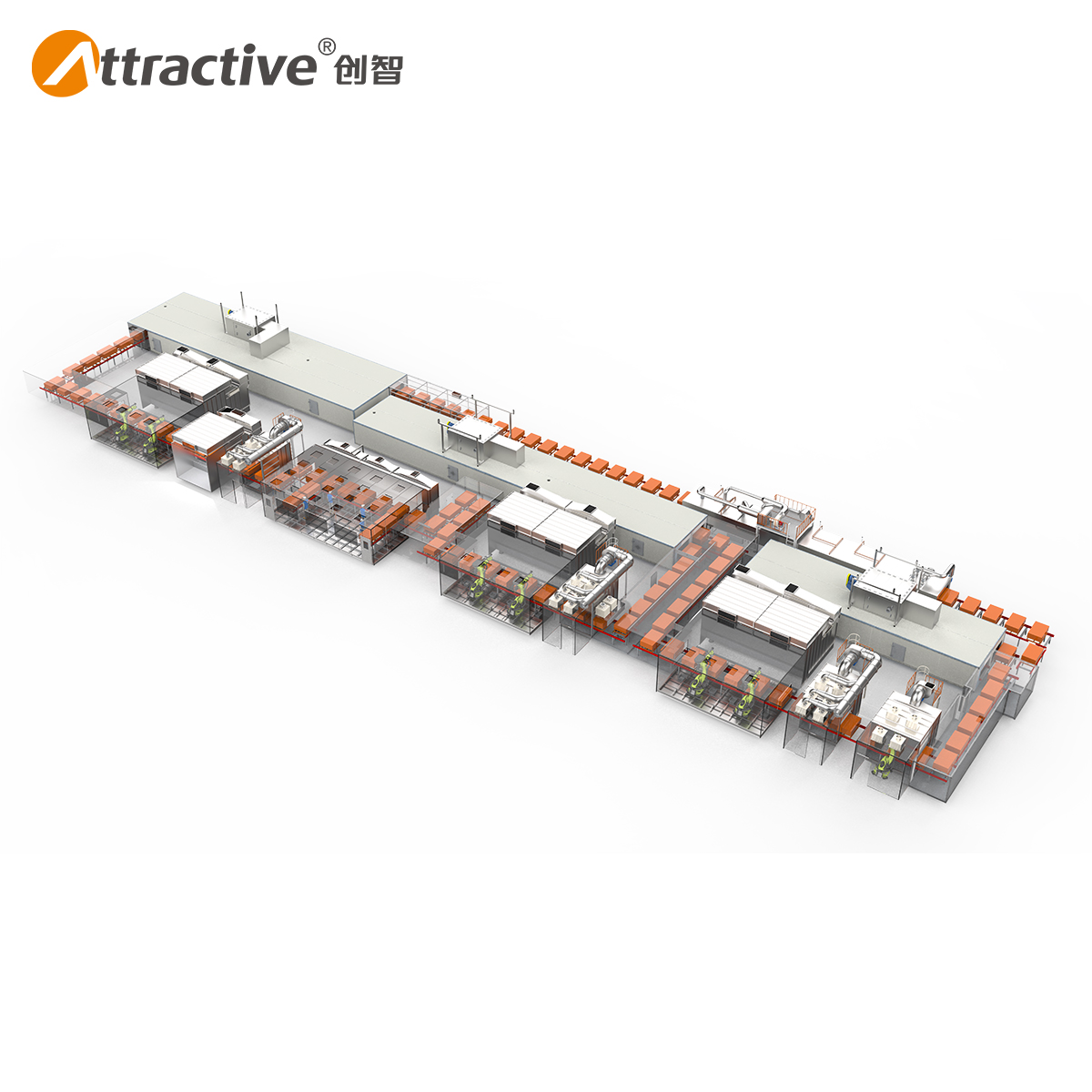
The supplier's role in such an acceptance model
Attractivechina (Chuangzhi Intelligent Equipment Co., Ltd. (Guangdong), Guangdong Chuangzhi Intelligent Equipment Co., Ltd.) is a manufacturer of automated coating lines, founded in 2005 and located in the National High-Tech Industrial Development Zone of Zhaoqing, Guangdong Province. The production site is about 35,548 sq. m, the staff is 280 employees, including 54 engineers, and the annual output is 60 units of equipment. The company states 79 invention patents in the field of coating equipment and environmental protection equipment, and the total number of patents exceeds 300. The export share is 20%, and the listed markets include Russia, Vietnam, Iran, Indonesia, Brazil, Turkey, Thailand, Saudi Arabia, Argentina, Mexico, Pakistan, Bangladesh, India, the USA, and Singapore.
From the point of view of preparing acceptance, it is significant that the company operates in a custom manufacturing and design model: the configuration is adapted by packaging, logo, size, automation level, voltage, power, and equipment capacity. That is why the parameter table must be attached to each specific delivery, not transferred from a general product line description. The company's official website is Attractivechina.
Conclusion: acceptance as a set of inspectable records
Translating procurement conditions into acceptance criteria comes down to four actions: tie each parameter to the configuration and size, assign an inspection method, define the tolerance, and specify the document that records the result. The verified values — carbon steel frame, stainless steel booth and pipelines, 800–1000 pieces per hour, Φ300×160 mm, 3000 mm/min with adjustment 2000–4000 mm/min, and a specific coating application method — provide a ready basis for such work, but only if their original subject is preserved.
A reasonable next step for the purchaser is to request from the supplier a parameter table specifically in the format of acceptance criteria: subject, value, inspection method, tolerance, document. Such a request does not change the commercial terms, but it immediately shows which points the supplier can confirm and which remain general formulations.
Additional information about the company and equipment nomenclature is collected in the Attractivechina corporate brochure (PDF, open access).
FAQ
Which parameters of a coating line can be checked during acceptance?
Checkable are parameters that have a subject and a measurement method: the material of the carbon steel frame and the material of the booth and stainless steel pipelines, capacity of 800–1000 pieces per hour for the cookware line with a Φ220×160 mm workpiece and a maximum of Φ300×160 mm, conveyor speed of 3000 mm/min with adjustment 2000–4000 mm/min for the metal line, and the coating application method. Each parameter is recorded in a separate protocol row indicating the size and mode.
Is a certificate of conformity sufficient to accept a line?
No. A certificate confirms the conformity of a specific product to specific requirements during a specific period. For acceptance, three fields are checked: document number, scope, and validity period. For example, EAEU declaration N RU D-CN.PA01.B.96986/21 was issued for the laminated conveyor oven model CZ-21-008-02A and does not cover the entire coating line. A document with an expired validity period or issued for another model does not confirm the conformity of the supplied configuration.
How can the declared capacity of 800–1000 pieces per hour be checked?
The value is checked by a run on the declared product size, recording the hanger pitch, operating mode, and averaging period. For the cookware line, this is the standard workpiece Φ220×160 mm and the maximum Φ300×160 mm at a pitch of 450–900 mm. For a product larger than the specified maximum, the value does not apply, so the protocol must indicate the size on which the run was performed.
What should be done if the product is larger than the maximum size of Φ300×160 mm?
Such a product goes beyond the limit for which 800–1000 pieces per hour and the size Φ300×160 mm have been verified, so a different line configuration is required. In this case, the capacity and dimension parameters are revised for the new size, and a new table of values is fixed in the contract. Values cannot be transferred from the cookware line to large-sized products: different verified ranges apply to metal and industrial equipment lines.
How should the coating application method be fixed in the contract?
The method is specified literally, not through a general equipment class. Three options have been verified: reciprocating plus manual for the metal line, autonomous mode plus robotic painting for the auto parts line, and manual plus robotic painting for the industrial equipment line. The contract fixes the specific mode, and during acceptance its actual implementation on the line is checked.
What does the equipment utilization rate of 85% mean?
For the auto parts coating line, this coefficient is indicated together with a mode of 336 days per year at 22 hours per day, a cycle of 45 seconds per tray, and a capacity of 1760 trays per day. As an acceptance criterion, it makes sense only in conjunction with these conditions: the value of 85% taken separately does not describe at what load, with what fixtures, and for what product range it is achieved.
Tem questões ou precisa de mais detalhes?
Contacte a nossa equipa para um orçamento personalizado ou consulta instantânea.
Solicitar orçamento
Preencha o formulário abaixo e a nossa equipa entrará em contacto com uma proposta personalizada.
Chat direto do WhatsApp
Prefere conversar em tempo real? Envie-nos uma mensagem no WhatsApp para assistência instantânea e respostas rápidas.
- Obter orçamento personalizado
- Partilhar fotos ou documentos
- Discuta as suas necessidades diretamente
Geralmente responde em 5–30 minutos durante o horário de expediente.