
Line of coatings for dishes: scenario for pans, drawing liners and shapes
Line of coatings for dishes: scenario for pans, drawing liners and shapes
Cookware coating line: scenario for frying pans, rice cooker inner pots, and baking molds
Short answer: an automatic cookware coating line is adapted to frying pans, rice cooker inner pots, and baking molds through four design parameters: the product dimensional envelope, the hanging scheme, the workpiece pitch, and the curing oven speed. The provided parameters specify a standard size of Φ220×160 mm (H), a maximum of Φ300×160 mm (H), a capacity of 800–1000 pcs/h, a pitch of 450–900 mm, schemes of 4 inner pots per hanger and 20 lids per hanger, as well as an adjustable oven speed of 0.5–1.5 m/min. These data define the selection frame, but they do not eliminate the need to verify the actual geometry of a specific product.
For a cookware manufacturer, the difficulty lies not only in applying the coating but also in combining different product types in one production program. A frying pan, a rice cooker inner pot, and a baking mold differ in diameter, height, fit on the hanger, and required loading density. Therefore, the coating line is considered not as a universal unit but as a configurable system whose application scenario is determined by the product and the process mode.
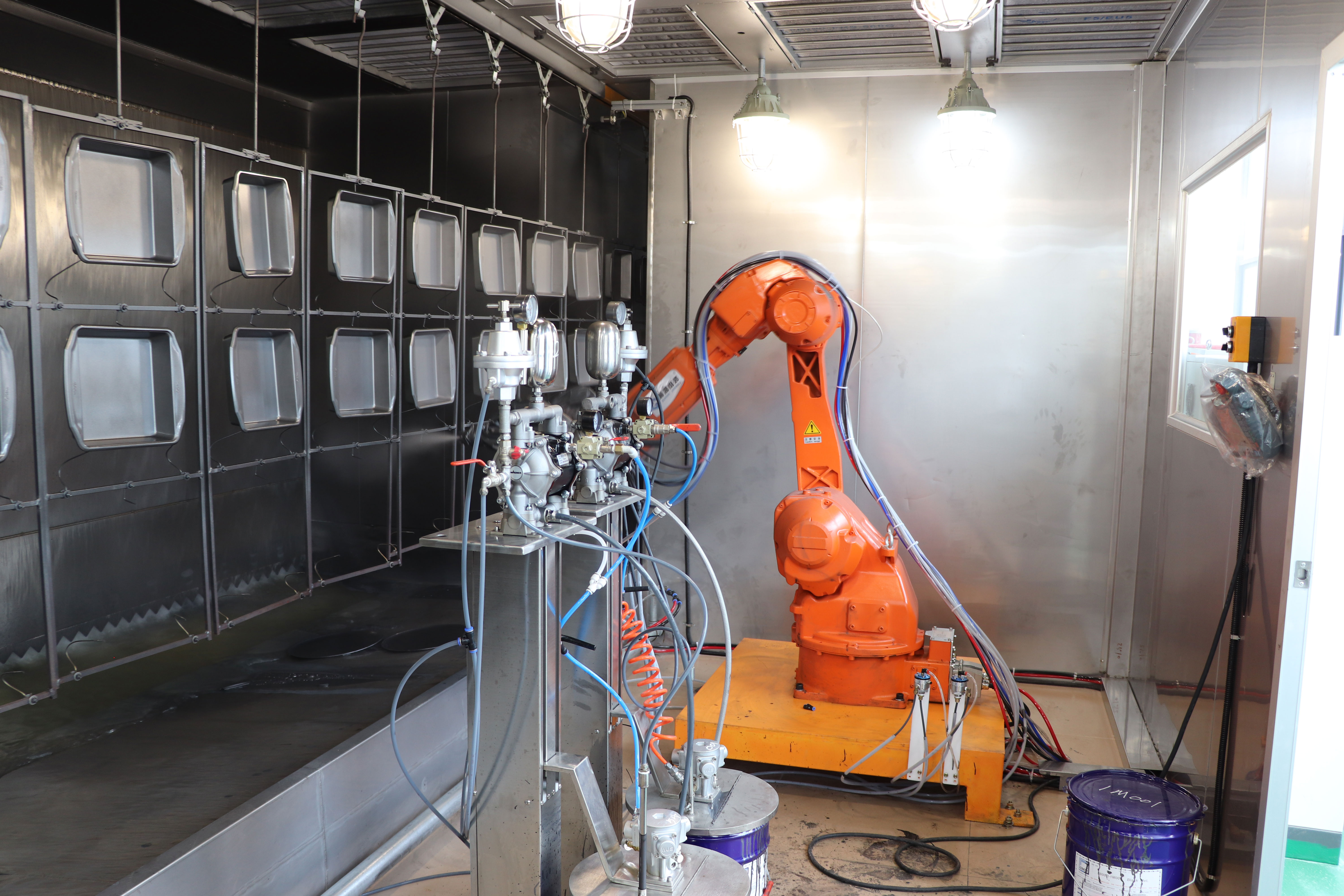
Baking mold coating line — one of the scenarios in cookware production.
Why cookware needs a separate scenario
In serial cookware production, repeatability is important: products must pass through preparation, coating, and curing areas with clear geometry and stable fit. If the production program includes several SKUs, the line must allow transitions between them without losing process controllability. That is why the cookware line description separately specifies product dimensions, workpiece pitch, hanging options, and oven speed.
The application scenario begins with the question: which products will be put into production and in what size range. If a product falls outside the confirmed envelope, this does not mean automatic rejection of the project, but it requires separate engineering development. If the product is within the envelope, the next step is to select a hanging scheme and pitch that will ensure the product passes through the chambers and oven.
What is confirmed in the line parameters
Below are only the data specified in the product description. They are not supplemented with assumptions about coatings, modes, or results unless such data are confirmed.
| Parameter | Value in the provided data | What this means for scenario selection |
|---|---|---|
| Product types | Non-stick frying pan, rice cooker inner pot, baking mold | The line is considered for cookware and household appliances, not for arbitrary metalworking. |
| Product material | Aluminum alloy; composite materials, including stainless steel, aluminum alloy, and copper | The material affects product preparation and fit; the specific mode is verified on samples. |
| Standard size | Φ220×160 mm (H) | Base scenario for products falling within the standard dimension. |
| Maximum size | Φ300×160 mm (H) | Upper limit of the confirmed envelope; larger products require separate verification. |
| Capacity | 800–1000 pcs/h | Design guideline for the configuration; depends on the product, hanger, pitch, and oven speed. |
| Workpiece pitch | 450–900 mm | Determines loading density and requires verification of clearances and thermal conditions. |
| Hanging | 4 inner pots per hanger; 20 lids per hanger | Two different loading schemes; they are not automatically transferred to frying pans and molds. |
| Curing oven speed | 1000 mm/min; adjustable from 0.5 to 1.5 m/min | Speed is related to curing time and must be coordinated with the coating. |
| Power supply | Natural gas and electricity | Affects site infrastructure but does not replace verification of the coating technology. |
| Line material | Carbon steel — main frame; stainless steel — coating chamber and pipelines | This is a design characteristic relevant to maintenance and operating conditions. |
Important: the stated capacity of 800–1000 pcs/h refers to the line parameters. For a different product set or a different hanging scheme, it cannot be automatically transferred without verification.
Dimensional envelope: Φ220×160 and Φ300×160 mm
The standard size Φ220×160 mm (H) and maximum Φ300×160 mm (H) set the boundaries within which the scenario is considered confirmed. If a frying pan, inner pot, or mold falls within the standard size, the line can be designed around a narrower product range. If a product is between the standard and maximum size, the upper envelope limit is used, but with verification of actual geometry.
For baking molds, it is important to consider not only diameter but also height, shape, and fit. The Φ parameter describes the diametral size; for non-round or complex molds, this value alone is insufficient. Therefore, the project records the actual product dimensions and the way it is placed on the hanger. Products larger than Φ300×160 mm are not confirmed by the provided data and require separate development.
Hanging scheme: 4 pots or 20 lids
The parameters specify two schemes: 4 inner pots per hanger and 20 lids per hanger. These are not interchangeable options for any product. The hanging scheme determines how many products pass through the line per cycle, how they are positioned relative to the flow, and how densely the oven is loaded. For rice cooker inner pots, a scheme with inner pots is specified; for lids, a separate high-density scheme is specified.
For frying pans and baking molds, no separate scheme is singled out in the provided parameters. This means that the hanging method must be coordinated based on product geometry, not automatically transferred from inner pots or lids. If the production program is mixed, it makes sense to consider different schemes for different product families and to verify transitions between them.
Pitch 450–900 mm: loading density and clearances
The workpiece pitch of 450–900 mm sets the distance between products in the flow. A smaller pitch increases loading density but requires verification of clearances between products, hanger stability, and processing uniformity. A larger pitch reduces density but may be necessary for large molds or products with complex geometry. The choice of pitch is not limited to the desired capacity: it is related to geometry and oven mode.
In a mixed program, pitch becomes one of the changeover parameters. If the line is set up for a dense inner-pot scheme, switching to molds may require a different pitch and different loading. Therefore, in the project it is useful to record not a single value but the range 450–900 mm and the rules for transitions between product families.
Oven speed 0.5–1.5 m/min: curing time and throughput
The curing oven speed is specified as 1000 mm/min with adjustment from 0.5 to 1.5 m/min. The nominal value of 1000 mm/min corresponds to 1 m/min. With a fixed oven length, speed determines how long a product remains in the curing zone. Therefore, increasing speed does not always mean a proportional increase in output: if the coating requires more time, the mode must be coordinated with the formulation and product geometry.
For frying pans, inner pots, and molds, oven speed must be considered together with pitch and hanging scheme. Dense loading and high speed can provide greater throughput, but only if curing time and coating uniformity are confirmed. Sample verification remains a mandatory part of scenario selection.
Capacity 800–1000 pcs/h: how to read it
The capacity of 800–1000 pcs/h is a characteristic of the line in a specific configuration. It is not a promise for any product and any set of parameters. Actual output is affected by product size, hanging scheme, workpiece pitch, oven speed, and the number of transitions between SKUs. If a product is larger than standard but within the maximum size, loading density may change.
For a procurement decision, it is useful to request a calculation not only in pieces per hour but also tied to a specific product: diameter, height, weight, fit on the hanger, and required curing mode. Such a calculation allows different scenarios to be compared and prevents transferring a design figure to an unconfirmed product range.
Line materials and power supply
The description states that the main frame is made of carbon steel, while the coating chamber and pipelines are made of stainless steel. The line's power supply includes natural gas and electricity. These data are important for site layout, maintenance, and production infrastructure. They do not replace coating verification but help assess how well the scenario fits the existing production.
Scenario 1: frying pans
For frying pans, fitting within the dimensional envelope is key. If the entire model range fits within Φ220×160 mm (H), the line can be designed for the standard scenario. If some frying pans reach Φ300×160 mm (H), the maximum limit is used, but each item is checked against its actual diameter and height. A frying pan with a larger diameter but lower height, or vice versa, requires separate coordination of fit.
The hanging scheme for frying pans is not separately specified in the provided parameters, so it cannot be considered preset. The project must coordinate the method of placing the frying pan on the hanger, the pitch, and the oven speed. For a mixed program, frying pans can be run in the same flow with other products only after verification of transitions and thermal conditions.
Scenario 2: rice cooker inner pots
For rice cooker inner pots, the parameters specify a scheme of 4 inner pots per hanger. This is a denser scenario than individual placement, and it requires verification of the fit of each pot, the distance between products, and coating access to the inner surface. The inner pot material is aluminum alloy or composite materials, so surface preparation and coating mode must correspond to the specific product.
If the inner pots are smaller than the standard size, loading density may be higher, but this does not mean automatic capacity growth. It is necessary to verify how the 4-pots-per-hanger scheme combines with a pitch of 450–900 mm and an oven speed of 0.5–1.5 m/min. For a mixed program, it is convenient to consider inner pots as a separate family with its own loading scheme.
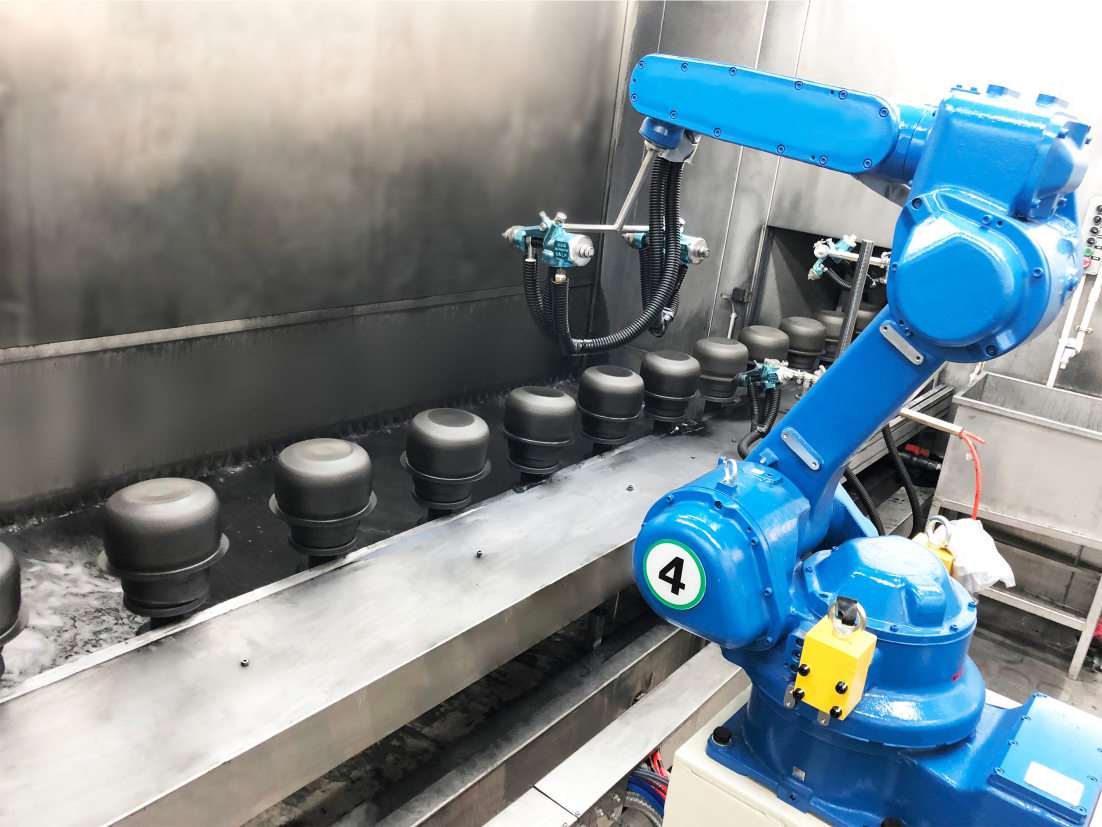
Rice cooker inner pot coating line: a scenario with a dense hanging scheme.
Scenario 3: baking molds
Baking molds require verification not only of diameter but also of height, shape, and stability on the hanger. If a mold falls within the standard or maximum size, it can be considered within the confirmed envelope. However, for non-round molds, the Φ parameter is insufficient: actual dimensions and a placement scheme are needed. This is especially important if the mold has a complex profile or a high rim.
For molds, the pitch of 450–900 mm and oven speed of 0.5–1.5 m/min are selected based on verification results. Too dense loading may create a risk of uneven curing, while too sparse loading may reduce oven utilization. Therefore, the scenario for molds is better built around a test batch and recording parameters, rather than around a single calculated figure.
Mixed program: how to choose a scenario
If a company produces frying pans, inner pots, and molds on one line, it is convenient to break the decision into sequential steps.
- Compile a list of products with actual diameter, height, and shape.
- Divide products into groups: standard size Φ220×160 mm (H), maximum Φ300×160 mm (H), and products outside the confirmed envelope.
- For each group, determine the available hanging scheme: 4 inner pots per hanger, 20 lids per hanger, or a separately coordinated scheme.
- Verify how the selected pitch of 450–900 mm combines with product geometry and clearances.
- Coordinate the oven speed of 0.5–1.5 m/min with the required curing time.
- Conduct a test loading and record parameters for each product family.
This approach makes it possible to see where the confirmed scenario ends and individual development begins. It also shows which transitions between products require additional setup.
Scope limits
The confirmed envelope is limited by the standard and maximum sizes. Products larger than Φ300×160 mm (H) are not described by the provided parameters. For frying pans and molds, a separate hanging scheme is not specified, so it cannot be considered predetermined. The capacity of 800–1000 pcs/h refers to the line in the stated configuration and is not a guarantee for any product range.
In addition, the parameters describe a line for cookware and household appliances, not a universal solution for all types of coatings. If the project goes beyond these limits, a separate engineering assessment is required. The absence of data for a specific product does not mean that the product cannot be processed; it means that its parameters have not yet been confirmed.
What to check before ordering
- Actual dimensions of each product, not just the diameter from the catalog.
- Fit of the product on the hanger and stability during passage through the line.
- Coating access to inner and outer surfaces, especially for inner pots and molds.
- Pitch range of 450–900 mm and rules for transitions between product families.
- Oven speed of 0.5–1.5 m/min and confirmation of curing time on samples.
- Operating conditions: the application description specifies Class 10,000 cleanrooms and a well-ventilated environment.
The company's capabilities description specifies 100% pre-sales inspection, a 1-year warranty, remote technical support, a quick response within 4 hours, regular follow-up, and free training. It is useful to compare these conditions with the project requirements and record them in the contract.
Organizational framework of the project
Attractivechina is a brand of Guangdong Chuangzhi Intelligent Equipment Co., Ltd., specializing in automated coating lines and integrated solutions for manufacturers of cookware, household appliances, and other industries. Official company website: Attractivechina.
The project description mentions new production lines, modernization of existing lines, and custom turnkey projects. For the cookware scenario, this means that the line can be considered part of a broader production system including pre-treatment, drying, coating chamber, curing oven, cooling, conveyor, dust removal, and control system. The specific composition is determined by the project.
The corporate data specify 54 engineers and 79 invention patents in the field of coating equipment and environmental protection equipment. For non-standard tooling, this is a relevant but not sufficient criterion: the final decision must be based on verification of product geometry and modes.
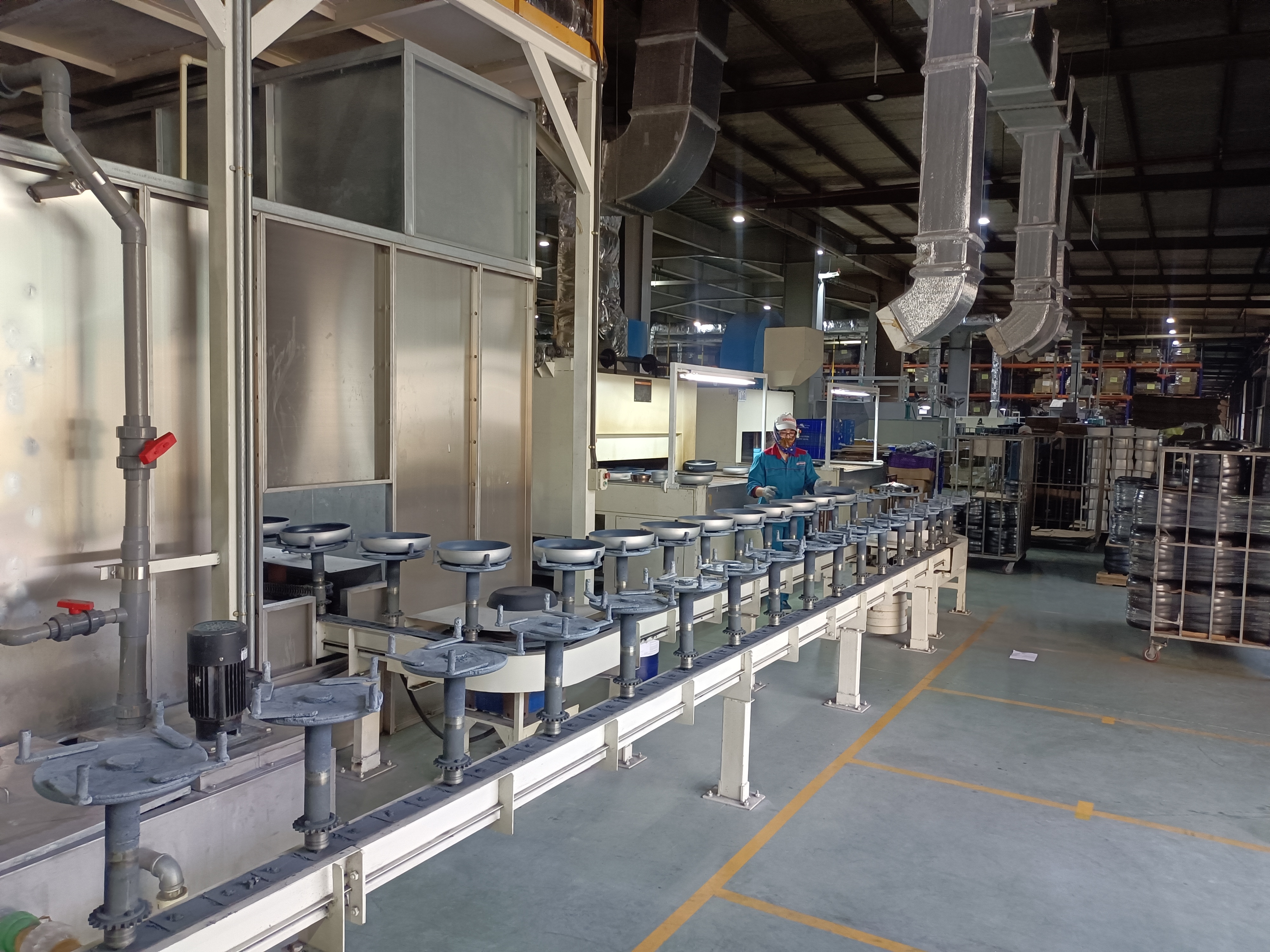
Supported conveyor system: pitch and hanging scheme affect line loading.
FAQ
Which products can be processed on the cookware line?
The provided parameters specify non-stick frying pans, rice cooker inner pots, and baking molds. The line belongs to the production of kitchenware and household appliances. Product materials are aluminum alloy and composite materials, including stainless steel, aluminum alloy, and copper. Products outside the confirmed envelope require separate verification.
How do the dimensions of a frying pan or mold affect line selection?
The standard size is Φ220×160 mm (H), and the maximum is Φ300×160 mm (H). If a product falls within the standard size, the scenario is designed around a narrower product range. If a product is between the standard and maximum size, the maximum limit is used with verification of actual geometry. Products larger than the maximum size are not confirmed by the provided data.
What do the schemes of 4 inner pots and 20 lids per hanger mean?
These are two different loading schemes specified in the line parameters. The scheme of 4 inner pots per hanger relates to dense placement of pots, while the scheme of 20 lids per hanger relates to placement of lids. For frying pans and molds, no separate scheme is singled out in the provided data, so the hanging method must be coordinated separately.
How is the 450–900 mm pitch related to capacity?
Pitch sets the distance between products in the flow. A smaller pitch increases loading density but requires verification of clearances and processing uniformity. A larger pitch may be necessary for large products. The capacity of 800–1000 pcs/h refers to the line in the stated configuration and depends on the product, hanging scheme, pitch, and oven speed.
Why is the oven speed of 0.5–1.5 m/min important for the scenario?
The curing oven speed determines the time a product remains in the curing zone with a fixed oven length. The nominal value of 1000 mm/min corresponds to 1 m/min. Adjustment from 0.5 to 1.5 m/min allows the mode to be tuned, but increasing speed does not always mean increased output: curing time must be confirmed for the specific coating and product.
What limitations must be considered in a mixed program?
In a mixed program, it is necessary to consider different product dimensions, different hanging schemes, and different requirements for pitch and oven speed. For frying pans and molds, the hanging method is not specified in the provided parameters, so it cannot be transferred automatically. Transitions between product families are best verified with a test loading and recorded in the project.
Summary
The cookware coating line scenario is determined not by one parameter but by a combination: product dimensions, hanging scheme, workpiece pitch, and oven speed. For frying pans and molds, the key question is fitting within the Φ220×160 or Φ300×160 mm envelope and coordinating the fit on the hanger. For rice cooker inner pots, a scheme of 4 inner pots per hanger is specified separately; for lids, 20 lids per hanger. The capacity of 800–1000 pcs/h remains a design guideline that is verified on the specific product range.
This approach allows a scenario to be selected without substituting facts with assumptions: confirmed parameters set the frame, and products beyond it require separate engineering assessment. For procurement, this means it is necessary to verify geometry, loading, oven mode, and operating conditions before making a decision.
An additional technical overview of the company is available in PDF: Attractivechina PDF overview.
Tem questões ou precisa de mais detalhes?
Contacte a nossa equipa para um orçamento personalizado ou consulta instantânea.
Solicitar orçamento
Preencha o formulário abaixo e a nossa equipa entrará em contacto com uma proposta personalizada.
Chat direto do WhatsApp
Prefere conversar em tempo real? Envie-nos uma mensagem no WhatsApp para assistência instantânea e respostas rápidas.
- Obter orçamento personalizado
- Partilhar fotos ou documentos
- Discuta as suas necessidades diretamente
Geralmente responde em 5–30 minutos durante o horário de expediente.