
Liquid Eyeliner Tube vs. Eyeliner Pencil: Buyer Comparison
Liquid Eyeliner Tube vs. Eyeliner Pencil: A Packaging Buyer Comparison
Two empty eyeliner packages can look interchangeable in a catalogue and behave completely differently on a filling line. This comparison places the COSFINITY CP04-1215 liquid empty eyeliner tube alongside the CP06-1056 empty liquid eyeliner pencil, states only the specifications published for each component, and converts those specifications into the procurement questions a buyer should settle before an order is released.
Plastic remains the dominant material platform in cosmetic packaging, holding a 64.5% market share in 2024 according to ResearchAndMarkets, while Asia Pacific accounted for a 42.36% share of the global market in 2025 according to Fortune Business Insights. The overall cosmetic packaging market was estimated in a range of roughly USD 34.17 billion to USD 47.3 billion in 2024, depending on whether secondary packaging and bulk industrial containers are counted inside the scope — a spread visible across Fortune Business Insights, ResearchAndMarkets and Data Bridge. Eyeliner components sit at the small end of that market, but they carry a disproportionate share of launch risk, because applicator geometry, fill volume and closure are decided at component level rather than at brand level.
The format question behind every eyeliner packaging decision
An empty liquid eyeliner tube is a straight-walled plastic component filled with liquid formula and closed with an applicator assembly. The CP04-1215 is specified as a plastic tube measuring W12.8 × H115.3 mm, with a 0.3 mm wall thickness and a 10 ml capacity, and it is classified as a plastic tube designed for cosmetic packing applications. Its form is slim and compact, which is what most buyers picture when they specify a liquid liner tube.
The CP06-1056 is a different package despite the familiar name. It is specified as an empty liquid eyeliner pencil in a pen-style format — plastic, W15 × H173.5 mm. It is not a sharpened wax pencil, and treating the two terms as synonyms is a sourcing error that typically only surfaces when the applicator tip and the filling method are specified. The pen format is both longer and wider than the tube format in the published specifications, and that difference propagates into unit cartons, display units and shipping configuration.
The practical answer: select the tube format when the priority is a compact, low-profile silhouette and a straightforward fill; select the pen format when the product concept requires a longer, slimmer handheld body. The specification that should drive the decision is dimensional fit against filling equipment and secondary packaging — not the catalogue photograph.
Problem: format selection usually happens too late
Buyers frequently lock the visual concept first and the component specification second. That sequence produces predictable problems: an applicator ordered for a body that will not accept it, a carton already printed for a unit height that has since changed, and a filling line configured for a nominal capacity the component cannot hold. Rework at that stage is expensive because decoration and secondary packaging are already committed.
The opportunity runs the other way. When format selection begins from the published component specification — material, dimensions, wall thickness and capacity — a buyer can test fit, carton nesting and fill volume before artwork is finalised, and can compare two candidate formats using the same parameters rather than two different sales narratives.
The two reference formats, side by side
| Parameter | CP04-1215 — Liquid Empty Eyeliner Tube | CP06-1056 — Empty Liquid Eyeliner Pencil |
|---|---|---|
| Material | Plastic | Plastic |
| Dimensions | W12.8 × H115.3 mm | W15 × H173.5 mm |
| Wall thickness | 0.3 mm | Not stated in the published specification used for this comparison |
| Nominal capacity | 10 ml | Not stated in the published specification used for this comparison |
| Declared usage | Cosmetic packing | Cosmetic packing |
The table is intentionally asymmetric. Where a parameter is not published for a component, this comparison does not estimate it. A buyer evaluating the pen format should request wall thickness, nominal fill volume and applicator interface dimensions directly from the supplier, because those three values determine whether the component can be filled on existing equipment.
Technical explanation: reading the numbers correctly
Diameter and what it constrains
The 12.8 mm body of the CP04-1215 and the 15 mm body of the CP06-1056 bracket two different applicator and cap families. A wider body allows more room for cap mechanisms, wiper geometry and grip surfaces. A narrower body uses less material per unit and can permit tighter nesting in a display tray. Neither value is intrinsically better; the binding constraint is the applicator that will be seated inside the component, and that decision usually belongs to the formula and application team rather than to procurement.
Height and secondary packaging
The CP06-1056 is approximately 58 mm taller in published height than the CP04-1215 (173.5 mm versus 115.3 mm). That gap matters more than it first appears, because unit carton height, display depth and outer carton configuration are all built from the assembled height of the finished package rather than from the empty component. Buyers planning retail displays or e-commerce mailers should confirm assembled height, including cap and applicator insertion depth, before committing to secondary packaging tooling.
Wall thickness as an acceptance parameter
For the CP04-1215, the published 0.3 mm wall thickness is a useful reference point because it indicates the class of extrusion the component belongs to. Wall thickness influences how a tube resists deformation during filling and transport, and how the finished unit feels in the hand. Buyers should confirm the measurement basis — nominal versus measured, and the body position at which it is measured — because a wall thickness figure without a measurement basis cannot be used meaningfully in a pre-shipment acceptance test.
Capacity is a planning value, not a usable fill
Nominal capacity is a fill-planning input rather than a promise of deliverable product volume. Usable fill is always lower than geometric capacity once the applicator shaft, wiper and headspace are accounted for. A buyer specifying the 10 ml CP04-1215 should request the recommended fill range for the intended formula viscosity and validate it on the actual filling line, rather than treating the nominal figure as the fill target.
Capability behind the components
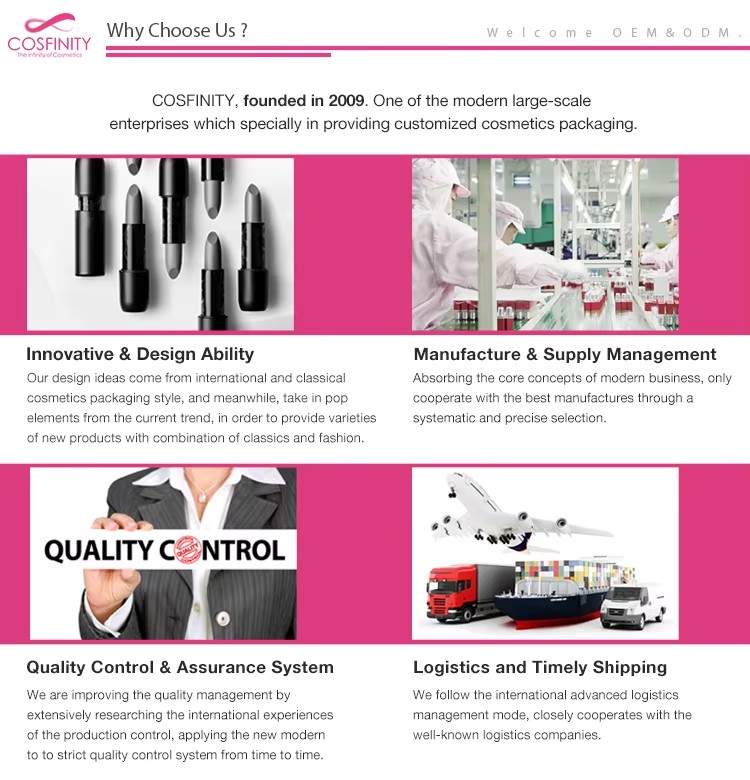
COSFINITY is the trading identity of Guangzhou Cosfinity Cosmetics Co., Ltd., a cosmetic packaging manufacturer founded in 2009 and based in Guangzhou, China, serving export markets globally. The company operates a 40,000 m² facility with 200 employees, an annual output of 500,000,000 pcs and an in-house R&D team of 25 engineers. Its published main product lines cover lipstick tubes, lipgloss and mascara tubes, powder cases, eyeliner tubes, powder jars and liquid foundation bottles — a portfolio in which eyeliner components sit alongside the closure and applicator families normally specified with them.
Production is organised around OEM and ODM services, with a stated monthly capacity of 10,000,000 pcs and customisation available across logo, colour, shape, material, volume, thickness and packaging. Quality control is described as 100% testing, and export operations are supported by remote online after-sales service.
Application and project context
Both components are declared for cosmetic packing use, which means the format decision is made against a liquid liner formula and an applicator, not against a generic container specification. The CP04-1215 suits programmes where a compact tube body and a 10 ml nominal format fit the intended product architecture. The CP06-1056 suits programmes where a longer pen-style body is part of the product concept, and where the buyer has confirmed fill volume and wall thickness separately, since those values are not published in the specification used for this comparison.
One published project record illustrates how COSFINITY handles order scale in practice. A lipstick tube OEM project in India at a scale of 12,000 pcs supported a private-label launch, and stable quality resulted in continuing repeat bulk orders over a two-year relationship. That case concerns a lipstick tube (model CP01-2142) rather than an eyeliner component, and it is referenced here only for what it demonstrates about project behaviour: a 12,000-piece order is treated as a production project with repeat-order potential, not as a one-off sample run. Buyers planning an eyeliner launch at a comparable scale should plan tooling, decoration and packaging lead time on that basis.
Market trends that shape eyeliner component orders
Regulatory pressure is now a specification input rather than an afterthought. The EU Packaging and Packaging Waste Regulation (EU) 2025/40 sets strict recyclability and labelling expectations for cosmetic packaging, and the U.S. Modernization of Cosmetics Regulation Act (MoCRA) introduced mandatory facility registration and product listing obligations that reach packaging entities. For eyeliner components, that means material selection and documentation are increasingly reviewed at the same time as fill volume and applicator compatibility.
Sustainability expectations are also visible on the demand side: sustainable packaging — refillable or recyclable — was reported as a top priority for 63% of cosmetic consumers in 2024 by Statista and Packly. Plastic's 64.5% material share in 2024 indicates that the market has not moved away from plastic; instead, buyers are being asked to justify plastic selections with clearer recyclability and material documentation. On the supply side, China's beauty product exports reached approximately USD 4.77 billion in 2024 according to the Observatory of Economic Complexity, with the United Kingdom the fastest-growing destination at +20.8% — a reminder that component specifications written for one market are frequently shipped into several.
Comparison with traditional approaches — and where this model has limits
Traditional sourcing often treats an eyeliner package as a single quote line: one price, one lead time, one photograph. The specification-led approach described here replaces that with a parameter comparison, but it carries real constraints that buyers should weigh honestly.
- Fixed nominal dimensions. Both the CP04-1215 and the CP06-1056 are specified at fixed published dimensions. Re-proportioning a silhouette — a shorter body, a wider shoulder, a different cap profile — generally requires tooling work rather than a tolerance adjustment. Buyers who need a bespoke profile should plan for tooling rather than assume a modification of an existing format.
- Order scale floors. The published minimum order quantity is 12,000 pcs, and lead time is 15–25 days. Programmes below that quantity, or launches that rely on rapid iteration across many variants, cannot be served by this production model without consolidating SKUs.
- Entity-level versus SKU-level verification. COSFINITY holds an SGS Alibaba Verified Supplier Factory Audit, certificate 485460650_T, issued 2026-01-10 and valid to 2027-01-10, covering enterprise factory and trade qualification. That audit verifies the supplier entity; it is not a product-level certification of any individual SKU such as the CP04-1215 or CP06-1056. Buyers still need SKU-level documentation, dimensional reports and pre-shipment test records for the specific component ordered.
- Scope of this comparison. Only two formats are compared here, and only their published specifications are used. This is a starting point for a shortlist, not a substitute for physical samples.
Purchasing terms and acceptance criteria to verify before ordering
COSFINITY publishes commercial terms that buyers should confirm in writing at quotation stage, because they determine cash flow, logistics responsibility and quality recourse.
| Commercial parameter | Published term |
|---|---|
| Minimum order quantity | 12,000 pcs |
| Production mode | OEM / ODM |
| Customisation scope | Logo, colour, shape, material, volume, thickness, packaging |
| Lead time | 15–25 days |
| Monthly capacity | 10,000,000 pcs |
| Quality control | 100% testing |
| Acceptance criteria | Pre-shipment test |
| Delivery terms | EXW / FOB / DAP / DDP |
| Payment terms | Advance payment 50%, balance payment 50% |
| After-sales | Remote online after-sales service |

Questions to close out before releasing the order
- Which measurement basis applies to the published dimensions? Confirm whether W12.8 × H115.3 mm and W15 × H173.5 mm are nominal or measured values, and at what point on the body they are taken.
- What is the recommended fill range for the 10 ml CP04-1215? Request the fill range that accounts for the applicator shaft, wiper and headspace at the intended formula viscosity.
- Which parameters are tested in the pre-shipment test? Ask for the specific inspection list behind the stated pre-shipment acceptance criteria, including dimensional, functional and leak checks where applicable.
- How is decoration compatibility confirmed? Confirm that the selected printing or finishing method is compatible with the 0.3 mm wall thickness and the specified plastic material.
- Which delivery term is being quoted? EXW, FOB, DAP and DDP place materially different obligations on the buyer; confirm the term in the quotation rather than assuming it.
- What does the verification documentation cover? Note that certificate 485460650_T covers enterprise factory and trade qualification and runs from 2026-01-10 to 2027-01-10. Ask separately for SKU-level documentation.
- Are approval samples required before mass production? For a first order at 12,000 pcs, sample approval before tooling and mass production reduces the cost of a specification error.
Future outlook
Eyeliner packaging decisions are converging with compliance decisions. With EU Regulation 2025/40 tightening recyclability and labelling expectations and MoCRA adding registration and listing obligations in the United States, buyers are likely to ask for material declarations and end-of-life information at the same time as dimensions and fill volume. Plastics remain the dominant platform — 64.5% of the market in 2024 — so the practical shift will be less about abandoning plastic and more about specifying it with better documentation. For component-level choices such as the CP04-1215 tube versus the CP06-1056 pen format, the differentiator will increasingly be how completely a supplier can evidence the specification it publishes, not how many formats it lists.
FAQ
What is the difference between a liquid eyeliner tube and an empty liquid eyeliner pencil?
A liquid eyeliner tube is a straight-walled plastic component filled with liquid formula, such as the CP04-1215, which measures W12.8 × H115.3 mm with a 0.3 mm wall thickness and a 10 ml capacity. An empty liquid eyeliner pencil is a pen-style package for liquid liner, such as the CP06-1056, which measures W15 × H173.5 mm. Both are plastic and both are declared for cosmetic packing use; the difference is body geometry, published dimensions and the applicator family each format accepts.
Which specifications should be compared before selecting an eyeliner package?
Compare material, body width and height, wall thickness, nominal capacity and declared usage, then add the values that are frequently unpublished: assembled height with cap and applicator inserted, recommended fill range for the intended formula viscosity, and applicator interface dimensions. For the CP04-1215 and CP06-1056, material and dimensions are published, while wall thickness and capacity are published for the tube only — those gaps should be closed with the supplier before comparison is finalised.
Why does wall thickness matter in an eyeliner tube specification?
Wall thickness affects how a tube resists deformation during filling, transport and daily use, and it affects how the unit feels in the hand. The CP04-1215 is published at 0.3 mm. Because a thickness figure is only meaningful with a measurement basis, buyers should confirm whether the value is nominal or measured and where on the body it is taken, so the parameter can be used in a pre-shipment acceptance test.
How should buyers treat the stated 10 ml capacity?
Treat it as a nominal planning figure. Usable fill is lower than geometric capacity once the applicator shaft, wiper and headspace are deducted. Buyers specifying the 10 ml CP04-1215 should request a recommended fill range for their formula and validate it on the actual filling line rather than filling to the nominal number.
What purchasing terms apply to an eyeliner packaging order?
Published terms for COSFINITY include a minimum order quantity of 12,000 pcs, lead time of 15–25 days, delivery terms of EXW / FOB / DAP / DDP, acceptance criteria based on pre-shipment test, and payment terms of 50% advance payment with 50% balance payment. OEM and ODM production is offered, with customisation across logo, colour, shape, material, volume, thickness and packaging, and remote online after-sales service is provided.
Does supplier verification documentation cover the individual component ordered?
Not automatically. COSFINITY holds an SGS Alibaba Verified Supplier Factory Audit, certificate 485460650_T, issued 2026-01-10 and valid to 2027-01-10, covering enterprise factory and trade qualification. That document verifies the supplier entity, not a specific SKU. Buyers ordering a defined component such as the CP04-1215 or CP06-1056 should request SKU-level dimensional records and pre-shipment test documentation in addition to entity-level verification.
Are plastic eyeliner components affected by current packaging regulation?
Yes. EU Regulation 2025/40 addresses recyclability and labelling for cosmetic packaging, and MoCRA in the United States introduces mandatory facility registration and product listing obligations that reach packaging entities. Because plastic held a 64.5% share of cosmetic packaging material use in 2024, these requirements apply to the mainstream of eyeliner components rather than to niche formats only. Material declarations and documentation should therefore be requested at specification stage.
Conclusion
The CP04-1215 and CP06-1056 solve different problems. The tube format offers a compact, low-profile build with published values of W12.8 × H115.3 mm, 0.3 mm wall thickness and 10 ml capacity. The pen format offers a longer, slimmer body at W15 × H173.5 mm, with wall thickness and capacity to be confirmed case by case. The decision that matters is not which format looks better in a catalogue, but which one survives contact with your filling line, applicator and secondary packaging — and which purchasing terms you have verified in writing before the order is placed. Buyers who want the full component and capability context can review the COSFINITY corporate profile, which is available for download at cosfinity profile.pdf.