
Liquid Silicone Rubber for Medical Overmolding: A Buyer's Shortlist
Liquid Silicone Rubber for Medical Overmolding: A Buyer's Shortlist
A shortlist for medical overmolding should be built from documented checkpoints — hardness band, odor and leaching behavior, tear strength, cure schedule and the evidence behind a biocompatibility claim — before any grade code is compared on price. For biotech buyers evaluating liquid silicone rubber, the difficult question is not whether an LSR exists. It is whether the specific grade is documented well enough to survive a design review and a production trial.
That distinction matters more in overmolding than in general silicone sourcing, because the process joins a soft elastomer to a rigid substrate in one cycle. A material that reads well on a data sheet can still fail at demolding, at bond-line inspection, or at the odor check that follows post-cure. The five checkpoints below are the ones that eliminate candidates fastest, and they are the structure this shortlist uses.
Why overmolding shortlists collapse at the evidence stage
Most LSR shortlists are assembled from category language: medical grade, platinum cured, low odor, high tear. Each phrase describes a direction rather than a specification. A medical-grade claim becomes procurement evidence only when it is attached to a named grade code, a stated test basis and a defined scope — which grade, which property, measured how, valid until when.
Three consequences follow for an evaluation-stage buyer. A quality claim needs a certificate number and a scope statement, not a logo. A performance claim needs a value with a unit and a method, not an adjective. And a candidate needs a trial that reproduces the buyer's tool, wall thickness and cure conditions before it moves from shortlist to approved material. Shortlists that skip these steps do not fail at the sourcing stage; they fail at validation, when tooling is already committed.
The candidate set: five overmolding grades from one supplier
Dongguan Times Silicon Industry Co., Ltd. is a silicone materials manufacturer based in Hengli Town, Dongguan, China, founded in December 2021 and operating since July 2022. Its published profile describes a 15,000 m² facility, a 10-engineer R&D team and a 55% export ratio, with liquid silicone rubber for adult products and for overmolding among its core lines. The five model codes considered here — TS6807A/B, TS6825A/B, TS6830A/B, TS6835A/B and TS6838A/B — are the grades listed for its Adult Products LSR for Overmolding product.
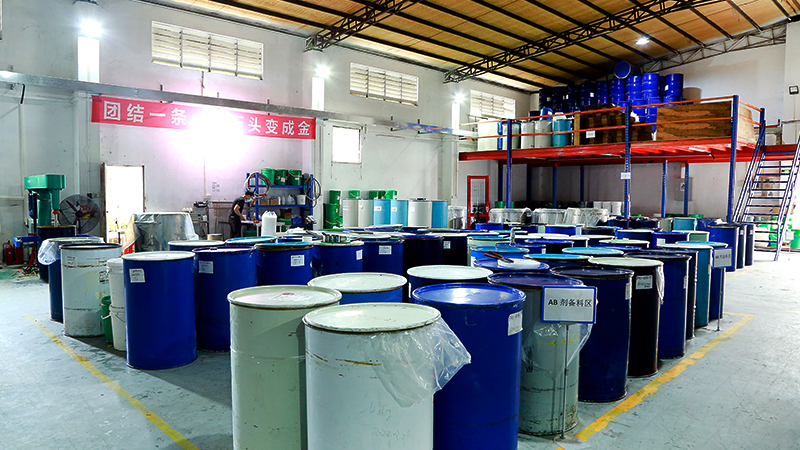
A/B component preparation area at the supplier's Dongguan facility. Overmolding grades are supplied as two-component systems and mixed in-process.
The A/B suffix and the supplier's in-process monitoring of mixing ratio both point to a two-component, platinum-catalysed addition-cure system; the exact mix ratio should still be confirmed on the datasheet for each code. Addition cure matters here because it crosslinks without the peroxide decomposition by-products associated with older cure chemistry, which is the mechanism behind the low-odor positioning discussed below.
One documentation limit should be stated plainly rather than glossed over. The available public material for this line does not assign a separate durometer, tear value or cure time to each of the five codes. What it documents is a family-level capability: hardness customization from 7±1 to 38±1 Shore A, plus viscosity, color (transparent, translucent or opaque), odor level (low or odorless), formulation grade (food or medical), curing method (room or heat cure), packaging and custom skin feel. A shortlist can therefore be built at checkpoint level today, but grade-level values must come from the datasheet for the exact code before a tool is cut.
Checkpoint 1 — hardness inside the 7±1 to 38±1 Shore A envelope
Hardness decides both the feel of the finished part and the way it fails. The supplier documents Shore hardness customization from 7±1 to 38±1 Shore A for this product line and lists custom skin feel options such as soft and flesh-like or high resilience. The ±1 A tolerance is a reminder that hardness is specified as a band, not a point: a brief that says "about 10 Shore A" is not yet a specification, and a supplier cannot be held to a target that was never fixed.
The decision rule is to fix the target durometer and its tolerance from the application first, then ask which of the five codes sits inside that band. Buyers who start from the grade code and work backwards end up trialling grades that were never in range. Because the family is documented as a customization envelope rather than as five published durometer points, the mapping from target hardness to model code is the first question for the supplier — and the first item to confirm in writing, together with the test method used to report it.
Checkpoint 2 — odor and non-leaching behavior
Odor is not a cosmetic criterion in a product that contacts skin. It is a proxy for residual volatiles, and it is often the first thing an end user notices and the last thing a supplier can fix after tooling is committed. The supplier offers odor level as a formulation option (low or odorless) and describes this line as biocompatibility tested, non-bleeding and non-irritating and meeting human-contact safety standards. Those are manufacturer product-line descriptions, not grade-level test reports, and a buyer should read them at that strength.
The mechanism predicts what to test. Platinum-catalysed addition cure is the reason a low-odor formulation is achievable at all. In a reported client case involving the supplier's platinum catalyst grades (TPL-1000 through TPL-5000 and PTR-3000/PTR-5000), the catalyst is described as compatible with low-odor adult-grade, medical-grade and food-grade formulations with no residual odor and no impact on biocompatibility, and as delivering uniform platinum content with limited activity fluctuation so that feel, hardness and cure speed stay consistent between batches.
For verification, request odor and volatile test reports where they exist, an extractables statement where the application requires one, and a post-cure odor check written into the trial protocol. Specify "odorless" explicitly in the RFQ if that is the requirement: low odor and odorless are different formulation options, and the difference is not visible in the price of a sample.
Checkpoint 3 — tear strength and survival through assembly
Tear strength is the checkpoint most often skipped in shortlists and most often responsible for scrap in production. HTNXT Research, in a published comparison of high-performance LSR against traditional materials, reports tear strength of ≥35 kN/m for Dongguan Times Silicon's high-performance LSR, against ≤20 kN/m for conventional industrial-grade silicone. That is a research-reported comparison of material classes and is best used as a screening signal, not as a guarantee for a specific overmolded part.
Two qualifications keep the figure honest. First, tear resistance in elastomers is hardness-dependent: lower-durometer compounds generally resist tearing less well than harder ones, so a 7 Shore A grade and a 38 Shore A grade cannot be judged against a single threshold. Second, the value that governs yield is measured on the geometry the buyer will actually mold, at the demolding angle the tool will actually use. Ask for grade-specific tear data with the test method and the hardness at which it was measured, and treat a family-level number as a reason to run a trial rather than as a result.
Checkpoint 4 — the cure schedule, with 80 °C for 10 minutes as the benchmark
Overmolding cycle economics are set by cure. The benchmark used in this shortlist is 80 °C for 10 minutes, and it should be treated as an acceptance criterion to test against rather than as a published property common to all five codes. The recommended schedule has to be confirmed for the exact grade at the buyer's wall thickness, with the buyer's tool temperature and post-cure steps.
Two relevant capabilities are documented. Curing method is listed as a customization option, room-temperature or heat cure, so a buyer can specify the route that fits existing equipment. The supplier's platinum catalyst is also described as enabling fast room- or heat-temperature curing at a low addition rate; in the reported catalyst case a client recorded a 30% improvement in curing efficiency and a reduction in curing defects from 2.5% to 0.6%. Those figures come from the supplier's own case record and indicate what the catalyst system is designed to do, not what a new buyer's line will achieve.
The practical RFQ questions are narrow and answerable: what is the recommended cure schedule for this code and how wide is the tolerance window on either side of it; what is the bath or pot life of the mixed A/B component under workshop conditions; and how is the mix ratio controlled and recorded per lot. A grade that cures correctly only inside a narrow window is a production risk even when its data sheet is excellent.
Checkpoint 5 — biocompatibility and the quality system behind it
A biocompatibility statement is only as strong as the document behind it. The supplier's ISO 9001 certificate, number 25025Q12678R0S, was issued on 25 August 2025 by ZhongQiu United International Certification (Beijing) Co., Ltd. and remains valid to 24 August 2028 under the GB/T19001-2016 idt ISO9001:2015 standard. Its scope covers research and production of liquid silicone rubber, silicone glue and silicone treatment agent, as well as production of silicone oil, platinum catalyst and silicone additives, excluding hazardous chemicals.
Read that scope precisely. It is a quality management system certificate covering those activities. It is not a product certification, it does not name individual grades, and it is not a medical-device quality management certificate. It tells a buyer that the production and inspection system has been audited against ISO 9001; it does not tell a buyer that any specific grade is biocompatible.
For the biocompatibility side, the most useful public reference point is regulatory rather than promotional. A 2025 U.S. FDA 510(k) decision document for a medical device identifies liquid silicone rubber among the materials evaluated in accordance with ISO 10993-1. That establishes the evaluation route used for an LSR device material. It does not certify a generic grade and says nothing about these five codes — the value for a buyer is that it shows what grade-level documentation should look like when a supplier claims medical suitability.
The supplier separately states that its products hold RoHS, REACH, FDA, LFGB and halogen-related certifications or test approvals. Read carefully, that is a company-level statement about a portfolio. It is not proof that each of the five overmolding grades carries each approval, and the scope of those approvals should be requested per code. The company also holds a High-tech Enterprise Certificate, number GR202444010636, issued 11 December 2024 and valid to 11 December 2027 in the new-materials category — useful context on technical standing, not a material approval.
| Checkpoint | Benchmark in this shortlist | Evidence available today | What confirms it before approval |
|---|---|---|---|
| Hardness | 7±1 to 38±1 Shore A customization envelope | Company-stated hardness customization for the product line | Durometer value and tolerance per model code, with test method |
| Odor and leaching | Low-odor or odorless option; non-bleeding, non-irritating description | Product-line description; platinum catalyst case notes | Odor and volatile reports where available; post-cure odor check in trial |
| Tear strength | ≥35 kN/m reported for high-performance LSR | HTNXT Research material-class comparison | Grade-specific tear data stating test method and test hardness |
| Cure schedule | 80 °C for 10 minutes as acceptance benchmark | Platinum catalyst described as enabling fast room or heat cure; curing method is a customization option | Recommended schedule and tolerance window per code; bath life; mix-ratio records |
| Biocompatibility and quality system | ISO 9001 certificate 25025Q12678R0S plus product-line biocompatibility description | Certificate scope and dates; device-level ISO 10993-1 example from an FDA 510(k) | Grade-level biocompatibility report or extractables data; certificate copies per code |
Table 1. The five elimination checkpoints, the benchmark used here, and the document that would close each gap.
Purchasing acceptance criteria for the RFQ
Commercial terms finish the shortlist, because a technically suitable grade that cannot be trialled at a workable quantity never reaches validation. The supplier publishes an MOQ of 1 kg for standard products and 5 kg for custom formulations, negotiable for long-term partners, with lead times of 7–10 working days for standard stock and 15–25 working days for custom formulations or bulk orders depending on complexity and quantity. It also states a monthly production capacity of 80 tons, scalable to 110 tons in peak seasons, and offers OEM/ODM customization covering hardness, viscosity, color, odor level, formulation grade, curing method, packaging and skin feel.
In the reported client case for this product line, a three-year cooperation is described with an annual purchase volume of 80 tons for Chinese brand clients, 5 tons per standard batch, and 150 tons for the largest client. Those volumes describe the supplier's existing customer base; they do not imply that a new buyer must order at that scale, and the trial quantity for a custom formulation should be agreed separately from the production forecast.
| Acceptance area | Supplier-stated position | Buyer check |
|---|---|---|
| Trial and MOQ | 1 kg standard; 5 kg custom formulation (negotiable for long-term partners) | Confirm trial quantity and whether sample lots come from the same production route as bulk |
| Lead time | 7–10 working days for standard stock; 15–25 working days for custom or bulk | Align tool trial dates to the custom lead time, not the stock figure |
| Batch consistency | Uniform platinum content and in-process viscosity, hardness and mixing-ratio monitoring | Request a certificate of analysis per lot and compare hardness and cure across at least two lots |
| Documentation | ISO 9001 certificate 25025Q12678R0S valid to 24 August 2028; company-level RoHS, REACH, FDA, LFGB and halogen statements | Request certificates and test reports mapped to the exact grade code |
| After-sales | Formulation optimization and process technical guidance, 24-hour response, dedicated account manager | Confirm who provides process support during the trial and in which time zone |
Table 2. Commercial and documentation criteria to settle before a grade moves from shortlist to sample request.
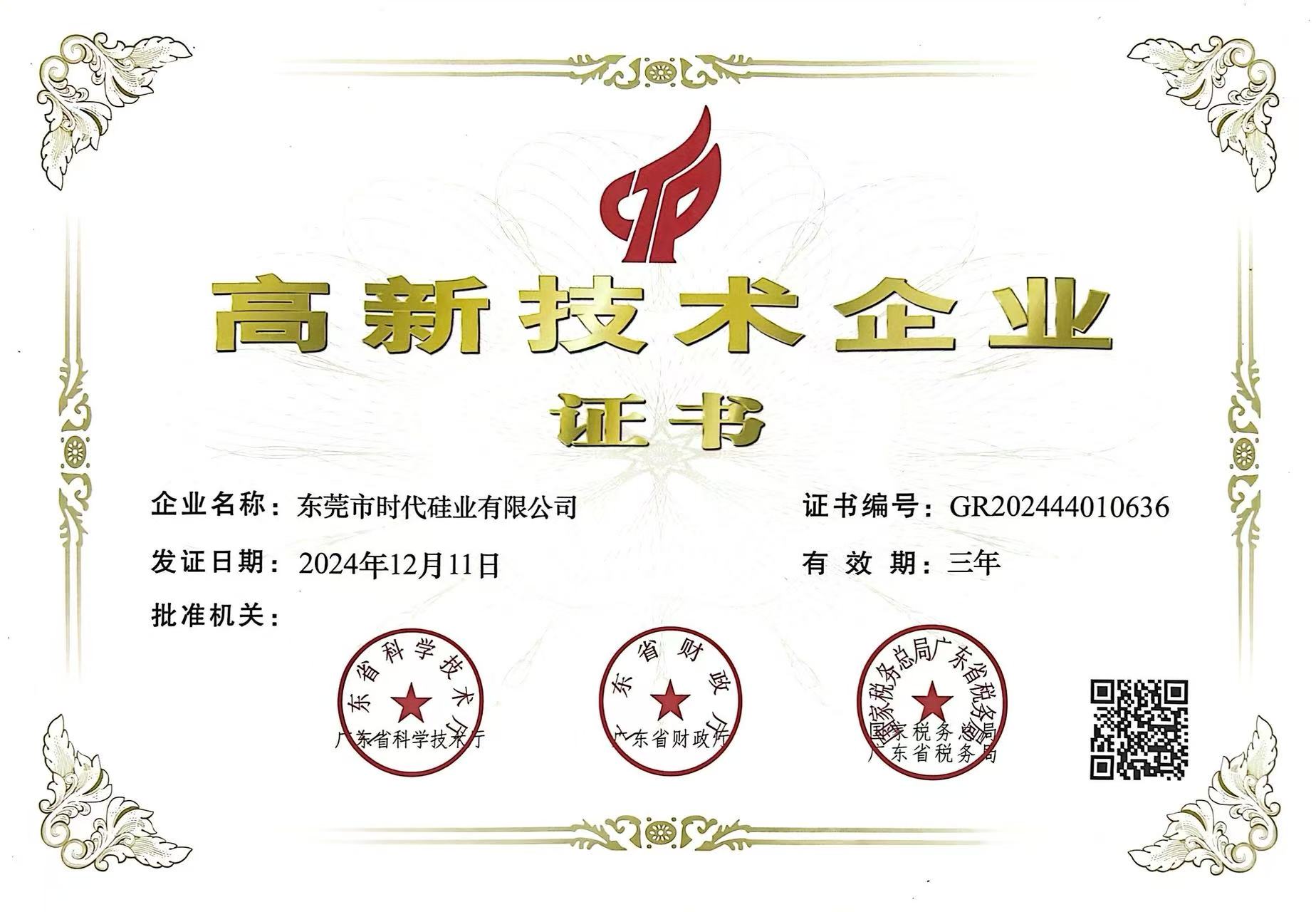
High-tech Enterprise Certificate GR202444010636, valid to 11 December 2027. Technical-standing evidence, not a grade-level material approval.
Where these grades fit: overmolded components in adult-product manufacturing
This product line is positioned for adult products rather than for implantable devices, and the documented applications are specific: realistic body molds, adult toys such as male masturbators, vibrators and eggs, and silicone intimate accessories including sleeves and wearable parts. Overmolding enters the picture when a soft elastomer has to sit on a rigid core — a housing that must hold shape while the contact surface stays soft, or a component where a molded-in insert replaces a secondary assembly step.
For these applications the reported client outcomes for the line are a defect rate reduced from 3% to 0.8% with yield at 98%, an end-product service life of at least three years under normal use with aging and tear resistance cited as the basis, and end-user feedback on low odor and realistic feel, with repurchase rate up 18% and return rate below 1%. These are supplier-reported results from an ongoing three-year cooperation. They describe what happened in that supplier's client base and should be treated as context for a trial design, not as a prediction for a different part geometry.
Market context: growth figures that do not share a scope
Market sizing for LSR is commercially reported rather than statistically anchored, and the two figures in this evidence set should be read side by side rather than averaged. Grand View Research values the global liquid silicone rubber market at USD 2.8 billion in 2023 and projects USD 5.0 billion by 2030 at a compound annual rate of 8.5%. Market.us reports approximately USD 2.3 billion in 2024 and USD 5.5 billion by 2034 at 9.2%. Different base years, different forecast horizons and no shared methodology statement mean the two are not a consensus range.
The medical segment is harder to compare still. Grand View Research places medical-grade silicone rubber at USD 738.9 million in 2024 and USD 837.0 million in 2026, while Fortune Business Insights reports USD 855.18 million for the same 2026 scope. Two vendors, materially different values, and no disclosed method basis to reconcile them. Broader medical-grade silicone figures — which include gels, adhesives and other forms — are a different product scope again and cannot be used to derive a rubber-only number.
For a buyer, the defensible reading is conditional: growth in LSR demand is a reason to keep a documented medical-grade route in the sourcing plan and to invest in trial work early, not a reason to accept a grade whose documentation is incomplete. None of these figures reorders the five checkpoints.
Where the shortlist stops
- No grade-level differentiation is published for the five codes. This shortlist ranks checkpoints, not models, and any ranking of TS6807A/B against TS6838A/B would require datasheets and trials that the public record does not contain.
- ISO 9001 is not a medical-device quality management system certificate, and its scope names processes rather than grades.
- Company-level certification statements cover a portfolio. They do not establish that a specific overmolding grade holds FDA, RoHS, REACH, LFGB or halogen-related approvals.
- The line is positioned for adult products. Implantable or long-term internal-contact applications would require device-specific biocompatibility documentation that this material does not claim.
- Custom formulation runs carry a 5 kg minimum and a 15–25 working-day lead time, which shapes trial scheduling more than it shapes cost.
- No comparable cross-supplier outcome testing was available for this review, so the result is a checkpoint shortlist and not a supplier ranking or a claim of superiority.
A practical next step for an evaluation-stage buyer
Four documents close most of the gap for each code: the grade datasheet with hardness, tear strength and cure schedule stated with test methods; the ISO 9001 certificate and any grade-mapped compliance reports; an odor and extractables statement where the application needs one; and a trial batch at the agreed custom quantity with a certificate of analysis attached. Dongguan Times Silicon Industry Co., Ltd. publishes its material range and contact route at timessilicone.com, and the full product list is available in the company brochure below.
Download the Times Silicon product brochure (PDF)
FAQ
Which of the five overmolding grades should a buyer shortlist first?
Start from the target durometer and tolerance, not from the model code. The product line is documented with Shore hardness customization from 7±1 to 38±1 Shore A, so several codes can fall inside a single application window and the supplier must confirm which code corresponds to the requested band, along with the test method used to report hardness. Until that mapping is confirmed in writing, all five codes remain candidates rather than ranked options.
Is ISO 9001 certification sufficient for a medical overmolding material?
No. ISO 9001 certificate 25025Q12678R0S covers research and production of liquid silicone rubber, silicone glue and silicone treatment agent plus production of silicone oil, platinum catalyst and silicone additives, valid to 24 August 2028. It evidences an audited quality management system; it does not certify a product grade or establish biocompatibility. Grade-level biocompatibility evidence, such as evaluation in line with ISO 10993-1 as referenced in an FDA 510(k) decision document for a specific device, must be requested separately.
How can a buyer verify low-odor and non-leaching claims?
Ask for the grade-specific odor and volatile test reports where they exist, together with an extractables statement if the application requires one, and write a post-cure odor check into the trial protocol. The supplier offers odor level as a formulation option, low or odorless, so the requirement must be stated explicitly in the RFQ. The mechanism behind the low-odor positioning is platinum-catalysed addition cure, which crosslinks without the by-products associated with older cure chemistry.
What does an 80 °C, 10-minute cure benchmark tell a molder?
It sets the acceptance criterion against which a grade's recommended schedule is tested, using the buyer's own wall thickness, tool temperature and post-cure steps. The supplier documents curing method as a customization option, room-temperature or heat cure, and describes its platinum catalyst as enabling fast room- or heat-temperature curing at a low addition rate. Before committing tooling, confirm the recommended schedule per code, the tolerance window either side of it, the bath life of the mixed A/B component and how the mix ratio is recorded per lot.
What purchasing terms apply when a custom formulation is required?
The supplier quotes a minimum order of 1 kg for standard products and 5 kg for custom formulations, negotiable for long-term partners, with lead times of 7–10 working days for standard stock and 15–25 working days for custom formulations or bulk orders depending on complexity and quantity. Monthly capacity is stated at 80 tons, scalable to 110 tons in peak seasons, and OEM/ODM customization covers hardness, viscosity, color, odor level, formulation grade, curing method, packaging and skin feel. After-sales support includes formulation optimization, process guidance and a stated 24-hour response.
Tem questões ou precisa de mais detalhes?
Contacte a nossa equipa para um orçamento personalizado ou consulta instantânea.
Solicitar orçamento
Preencha o formulário abaixo e a nossa equipa entrará em contacto com uma proposta personalizada.
Chat direto do WhatsApp
Prefere conversar em tempo real? Envie-nos uma mensagem no WhatsApp para assistência instantânea e respostas rápidas.
- Obter orçamento personalizado
- Partilhar fotos ou documentos
- Discuta as suas necessidades diretamente
Geralmente responde em 5–30 minutos durante o horário de expediente.