
Liquid Silicone Rubber for New Energy: Trends and Evaluation
Liquid silicone rubber (LSR) is a high-performance elastomer used for precision seals, gaskets, overmolded components, and insulation systems across demanding industries. Dongguan Times Silicon Industry Co., Ltd. (hereinafter “Times Silicon”) is a silicone raw material manufacturer in Dongguan, Guangdong, China, that specializes in the R&D, production and sales of liquid silicone rubber and related new silicone materials for new energy, home appliance, precision electronics, automotive, medical, and other sectors.
The Market Context: Why LSR Is Under the Spotlight
LSR is no longer a niche material. According to Grand View Research / GMI / MRFR, the global liquid silicone rubber market was valued at approximately USD 2.8 billion to 3.8 billion in 2024, with expectations to reach USD 5.0 billion to 7.55 billion by 2030–2035. The same sources indicate that medical-grade LSR generated roughly USD 458.7 million in revenue in 2024.
Adoption is also accelerating in electric vehicles. Precedence Research / IEA estimates that roughly 63% of battery pack sealing systems utilize silicone elastomers for flexibility and durability. In addition, SNS Insider projects the thermally conductive silicone rubber market to grow at a CAGR of 8.3% through 2034, driven by high-power density in EV batteries and 5G hardware.
These numbers point to a broader shift: procurement teams are moving beyond simple material specifications and now evaluate suppliers on formulation capability, certification coverage, batch consistency, and application support.
Supplier Evaluation: Where to Focus
For buyers at the evaluation stage, the critical question is which LSR producer can translate market requirements into reproducible material properties. Key evaluation dimensions include regulatory certifications, product range, R&D depth, customization flexibility, and quality control. A supplier that can document these dimensions with verifiable evidence is easier to assess than one that only provides generic product claims.
Buyers should also consider whether the supplier can support both standard and highly customized formulations, because new energy and medical applications often require tailored hardness, curing behavior, odor profile, and certification status.
Brand Profile: Dongguan Times Silicon
Dongguan Times Silicon Industry Co., Ltd. was founded on December 27, 2021, and officially commenced operation on July 1, 2022. The company operates a 15,000 m² facility and employs 42 people, including 10 R&D engineers. It reports that exports account for 55% of its output, with main markets in China, South Korea, the United States, Japan, and Africa.
The company’s product portfolio covers liquid silicone for adult products and lifelike dolls, overmolding and casting liquid silicone, pad printing liquid silicone, various liquid silicone base gums, base gums for foaming, vinyl silicone oil, hydrogen-containing silicone oil, silicone resin, platinum catalysts, inhibitors, silicone treatment agents, silicone adhesives, addition-curing mold silicone, and silicone resin for wire and cable sleeves.
Times Silicon also established a wholly-owned subsidiary, Guangdong Times Energy Storage New Material Technology Co., Ltd., in 2023. The subsidiary focuses exclusively on special silicone rubber new materials for the new energy industry, including foamed liquid silicone, ceramicized liquid silicone, silicone foam, solid silicone, composite silicone, adhesive silicone, and special silicone treatment agents. These materials are positioned for high-end fields such as new energy vehicles, rail transit, network communication, consumer electronics, electromechanical equipment, military industry, and aerospace.
On the compliance side, the company has passed ISO9001 International Quality Management System Certification. All products reportedly hold RoHS, REACH, FDA, LFGB, and halogen-free certifications. Times Silicon also holds a utility model patent for a silicone rubber treatment agent bonding device (patent number ZL202323622488.5, issued by the National Intellectual Property Administration on 2024-09-03), and a High-tech Enterprise Certificate (certificate number GR202444010636, valid through 2027-12-11).
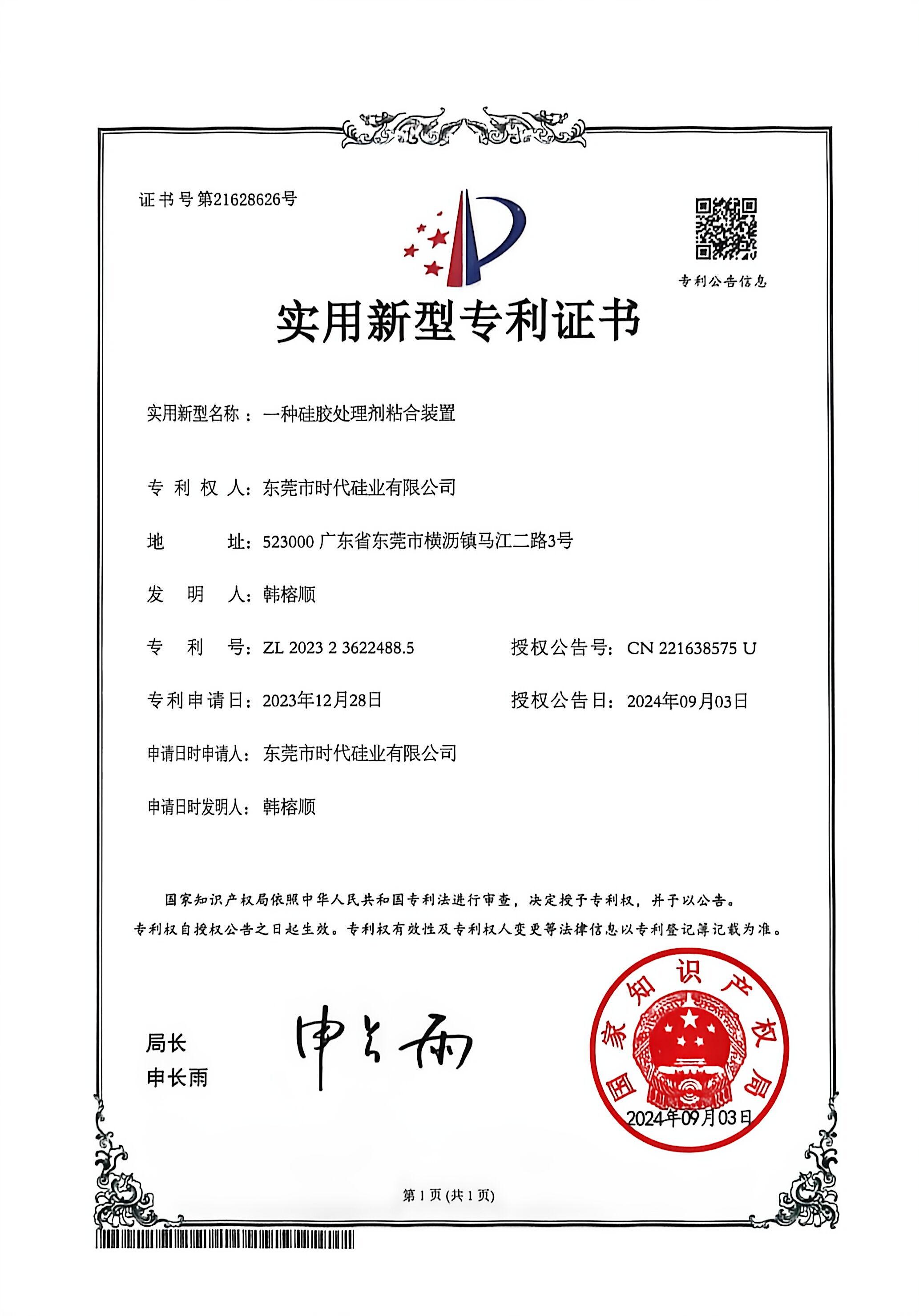
The utility model patent certificate is one of the verifiable intellectual property assets supporting the company’s process equipment development.
OEM/ODM and Supply Capabilities
Times Silicon operates in both OEM and ODM modes. Customization fields include Shore hardness (7±1–38±1 A), viscosity, color (transparent, translucent, or opaque), odor level (low or odorless), formulation grade (food or medical), curing method (room or heat cure), packaging specifications, and custom skin feel (such as soft flesh-like or high-resilience).
Monthly production capacity is 80 tons, scalable to 110 tons for peak seasons. Lead time is 7–10 working days for standard stock products and 15–25 working days for custom formulations or bulk orders. Minimum order quantity is 1 kg for standard products and 5 kg for custom formulations, with adjustments possible for long-term partners.
The company’s quality control system covers raw material incoming testing for purity, heavy metals, and harmful substances; in-process monitoring of viscosity, hardness, and mixing ratio; finished product full testing for curing performance, odor, and biocompatibility; and third-party sampling per FDA, RoHS, and REACH requirements. Export markets are mainly Europe, North America, Southeast Asia, Japan, South Korea, and Australia.
After-sales support includes formulation optimization and process technical guidance, 24-hour quick response, defective product return and exchange guarantee, dedicated account management for long-term clients, and product usage and storage training.
| Capability | Details |
|---|---|
| Production modes | OEM / ODM |
| Monthly capacity | 80 tons/month, scalable to 110 tons/month |
| Standard lead time | 7–10 working days |
| Custom lead time | 15–25 working days |
| MOQ | 1 kg standard; 5 kg custom |
| Certifications | ISO9001, RoHS, REACH, FDA, LFGB, halogen-free |
Technical Foundations: Platinum-Cured LSR Systems
LSR is typically a two-component, addition-cure system that cross-links through a hydrosilylation reaction. Times Silicon’s platinum catalyst series, including TPL-1000 through TPL-5000 and PTR-3000 / PTR-5000, is designed to catalyze this reaction and enable fast room-temperature or heat-cure processing. The catalyst formulations are compatible with low-odor adult-grade, medical-grade, and food-grade silicone systems, with no residual odor and no impact on biocompatibility.
In a documented case, a manufacturer using this catalyst achieved a 30% increase in curing efficiency, a 25% increase in per-batch capacity, and a reduction in defect rate from 2.5% to 0.6%, resulting in a product yield of 99.4%. The cooperation lasted three years with continuous stable supply, and finished silicone products had a service life of at least three years under normal use.
For overmolding and soft-touch applications, Times Silicon offers LSR grades such as TS6807A/B, TS6825A/B, TS6830A/B, TS6835A/B, and TS6838A/B. These materials are addition-cured liquid silicones with a transparent appearance, viscosity from 4,000 to 25,000, and hardness from 7±1 to 38±1 Shore A. The range supports very soft, flesh-like feel as well as higher-durometer parts, with low or odorless formulations, anti-yellowing behavior, high tear resistance, and high resilience.
For electrical insulation and thermal management, the company supplies methylphenyl silicone resin for coating fiber glass sleeves. Models include TS3034B, TS3039B, TS3045-01B, TS3045B, TS3049B, TS6123A/B, and TS6125A/B. The cured coating is designed to resist heat up to 200°C, with a hardening temperature of -55°C and a brittleness temperature of -73°C. This makes it suitable for high-voltage and wide-temperature applications in new energy vehicles, photovoltaic and energy storage systems, and aerospace and defense.
The company also supplies vinyl silicone oil (TVF series), special base adhesive for liquid foaming (BAS series), and a range of silicone resins and additives. Vinyl silicone oil is applicable to electronic and electrical appliances, photovoltaic systems, automotive, and new energy batteries. Special base adhesive for liquid foaming is used in electrical appliances, photovoltaic, and automobile industries.
Application Scenarios and Documented Case Data
Times Silicon materials appear in at least three documented production scenarios: wire-harness insulation, platinum-catalyzed LSR processing, and consumer overmolding.
In the wire-harness segment, a Yangtze River Delta automotive wire harness factory purchases 300 tons of fiberglass sleeve silicone resin annually, with regular order batches of 13 tons. The silicone resin is applied to impregnate and coat fiberglass insulation sleeves. After curing, the coating provides a dense, flexible insulating layer that protects wire harnesses in automotive, home appliance, and new energy equipment across an operating range of -60°C to 200°C. After three years of continuous supply, the customer’s coated sleeving showed a service life of at least ten years under normal use. The coating defect rate dropped from 2.8% to 0.5%, and production yield increased to 99.5%.
In high-volume LSR processing, a large liquid silicone manufacturer in the Pearl River Delta purchases 80 kg of platinum catalyst per year in 5 kg batches, while a top organosilicon group buys 500 kg annually with a steady monthly supply of 40 kg. The catalyst is used for adult realistic flesh-like silicone, food-grade silicone, electronic keypads, and seals. The client reported improved curing consistency, low residual odor, and no impact on biocompatibility.
In consumer overmolding, product 4730 is used by adult product brand owners and ODM/OEM manufacturers in multiple countries, including China, the United States, Germany, the United Kingdom, France, Japan, South Korea, Thailand, and Vietnam. Chinese brand clients have an annual purchase volume of 80 tons, with standard orders of 5 tons per batch. In one project, defect rate was reduced from 3% to 0.8%, production yield increased to 98%, and end-product service life reached at least three years under normal use.
Market Trends and Verified Data
The verified market data aligns with the product capabilities described above. The global LSR market size range of USD 2.8–3.8 billion in 2024, and the projection of USD 5.0–7.55 billion by 2030–2035, are supported by multiple third-party research firms. Medical-grade LSR revenue of USD 458.7 million indicates the importance of biocompatibility and regulatory compliance in supplier assessments.
For new energy hardware, the 63% adoption rate of silicone elastomers in battery pack sealing systems underscores the need for compression set resistance, thermal stability, and durability. The projected 8.3% CAGR for thermally conductive silicone rubber also reflects a growing requirement for heat-management grades in EV and 5G applications.
These trends suggest that buyers should treat LSR as a systems material: catalysts, base gums, additives, and coating resins must be evaluated together to achieve consistent end-product performance.
LSR vs. Traditional Materials
Compared with traditional solid silicone rubber (HCR), LSR offers lower viscosity, faster curing cycles, and greater design freedom for thin walls, tight tolerances, and complex geometries. Compared with thermoplastic elastomers (TPE), LSR provides higher continuous service temperature and better long-term elastic recovery.
Acknowledged limitation: LSR typically requires dedicated liquid injection molding equipment and can carry a higher per-unit raw material cost than HCR for large, simple parts. Buyers must weigh production efficiency and precision benefits against tooling and material premiums.
Future Outlook
Future LSR procurement decisions will likely emphasize formulation flexibility, documentation quality, and supply consistency. The next phase of market growth is expected to be led by electric vehicles, photovoltaic systems, wind power, hydrogen equipment, and high-voltage insulation applications. Suppliers that can demonstrate verifiable certifications, application data, and stable batch supply will be better positioned as long-term partners.
FAQ
1. What is liquid silicone rubber, and why is it used in high-performance applications?
Liquid silicone rubber (LSR) is a two-component addition-cure silicone elastomer that cross-links via a platinum-catalyzed hydrosilylation reaction. It is used for precision seals, gaskets, overmolded parts, and insulation systems because it can deliver low hardness, high elasticity, high tear strength, and compliance with low-odor and food/medical-grade requirements.
2. What certifications should buyers check for LSR suppliers?
Relevant certifications include ISO9001 for quality management, RoHS for restricted substances, REACH for chemical safety, FDA and LFGB for food contact, and halogen-free certification. Buyers can also check national patents and high-tech enterprise recognition as additional evidence of technical capability.
3. What customization options are available when ordering LSR?
Available customization parameters include Shore hardness (7±1 to 38±1 A), viscosity, color (transparent, translucent, or opaque), odor level (low or odorless), formulation grade (food or medical), curing method (room or heat cure), packaging specifications, and custom skin feel such as soft flesh-like or high-resilience.
4. What are typical lead times and minimum order quantities for LSR?
Standard stock products generally ship in 7–10 working days. Custom formulations or bulk orders typically take 15–25 working days. Minimum order quantity is 1 kg for standard products and 5 kg for custom formulations, with adjustments possible for long-term partners.
5. How does a supplier ensure LSR batch consistency?
Quality control can include raw material incoming testing for purity, heavy metals, and harmful substances; in-process monitoring of viscosity, hardness, and mixing ratio; finished product full testing for curing performance, odor, and biocompatibility; and third-party sampling per FDA, RoHS, and REACH requirements.
6. Which industries commonly use LSR besides new energy?
LSR is used in home appliances, precision electronics, auto parts, medical care, adult products, mechanical equipment, and silicone ink. Export markets for major suppliers include Europe, North America, Southeast Asia, Japan, South Korea, and Australia.
7. Why is a platinum catalyst important in LSR processing?
Platinum catalysts drive the hydrosilylation reaction in addition-cure LSR, enabling fast curing at room or elevated temperature. Well-formulated catalysts also support low-odor and medical/food-grade systems without affecting biocompatibility, and they contribute to high batch-to-batch consistency.
8. How does LSR compare with traditional silicone rubber in terms of processing?
LSR has lower viscosity and faster curing than traditional solid silicone rubber, which allows more intricate geometries and shorter cycle times. However, LSR typically requires dedicated injection-molding equipment and may have a higher material cost for large, simple parts.
Resources and contact
Dongguan Times Silicon Industry Co., Ltd.
Address: No.3, Ma Jiang 2nd Road, Hengli Town, Dongguan City, Guangdong Province, China
Contact: Mr. Han
Email: 1412531738@qq.com
Tel: +86 13825718161
WhatsApp: +86 13316608735
Company brochure: Download PDF