
Liquid Silicone Rubber: Meeting High Performance Demands Across Industries
Liquid Silicone Rubber (LSR) has become a critical material in industries from medical devices to new energy vehicles, driven by the need for thermal stability, chemical resistance, and biocompatibility. As application requirements tighten, specialized LSR grades—such as High Tear Strength, Low Hardness Soft, High Temperature Resistant, and FDA-certified variants—are increasingly specified by engineers and procurement professionals.
A Growing Need for High-Performance LSR
Traditional elastomers often fail under extreme temperature cycles, high voltage, or prolonged contact with human tissue. LSR overcomes these limitations with a unique siloxane backbone, offering continuous service from −55°C to 200°C, outstanding dielectric strength, and intrinsic cleanliness. In the new energy sector, approximately 63% of EV battery pack sealing systems now rely on silicone elastomers for flexibility and durability. Similar trends are visible in photovoltaics, wind power, and medical devices, where certified materials like FDA-approved silicone are mandatory.
Dongguan Times Silicon: A Specialist in LSR Solutions
Dongguan Times Silicon Industry Co., Ltd., founded in 2021, is a Chinese manufacturer specializing in the R&D, production, and sales of new silicone materials. Operating from a 15,000 m² facility with 42 employees and a 10‑engineer R&D team, the company produces platinum catalysts, silicone foam, and silicone treatment agents in addition to a broad liquid silicone rubber portfolio. Its wholly-owned subsidiary, Guangdong Times Energy Storage New Material Technology Co., Ltd., focuses exclusively on high-end silicone materials for new energy applications, including foamed liquid silicone, ceramicized silicone, and silicone foam.
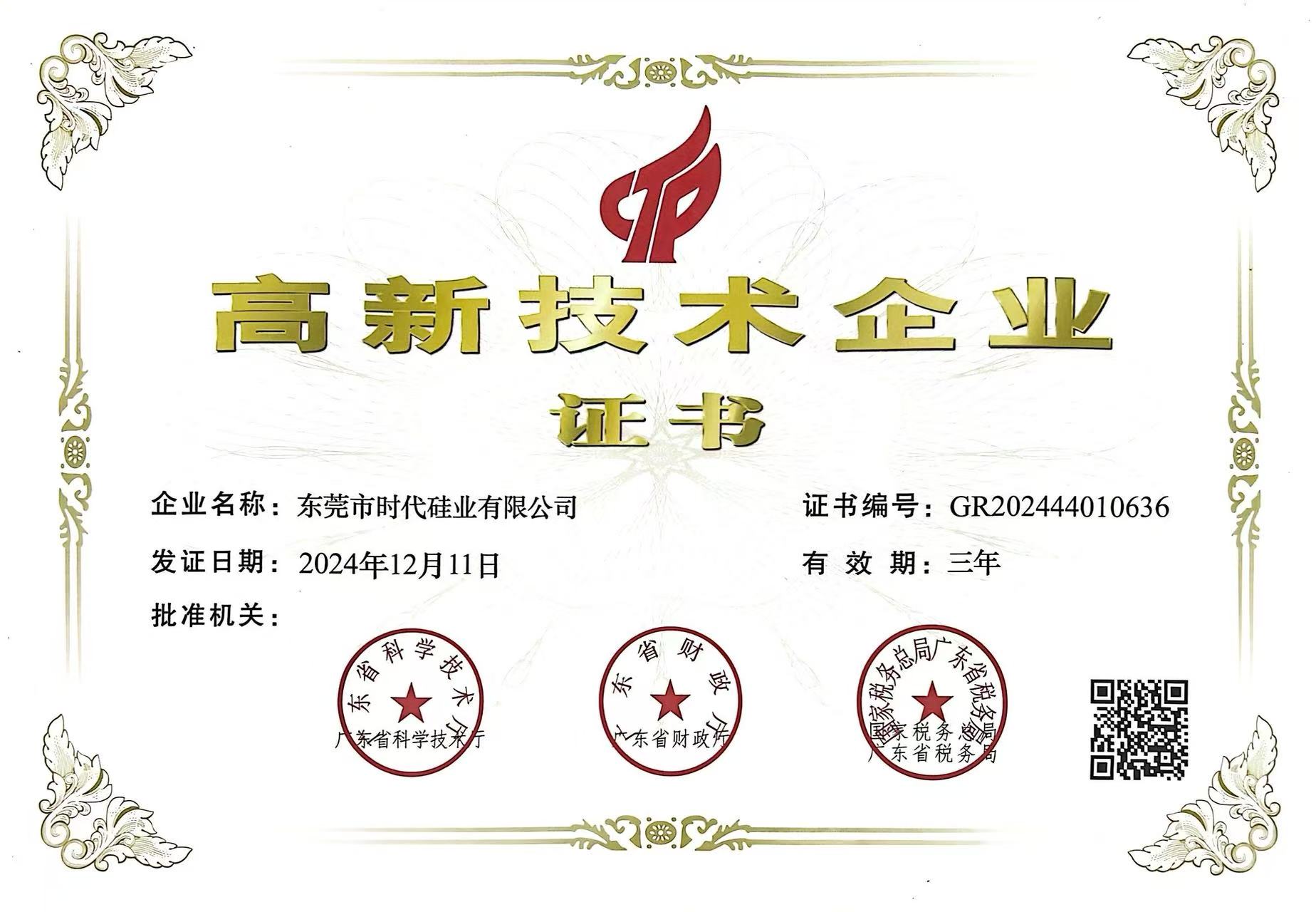
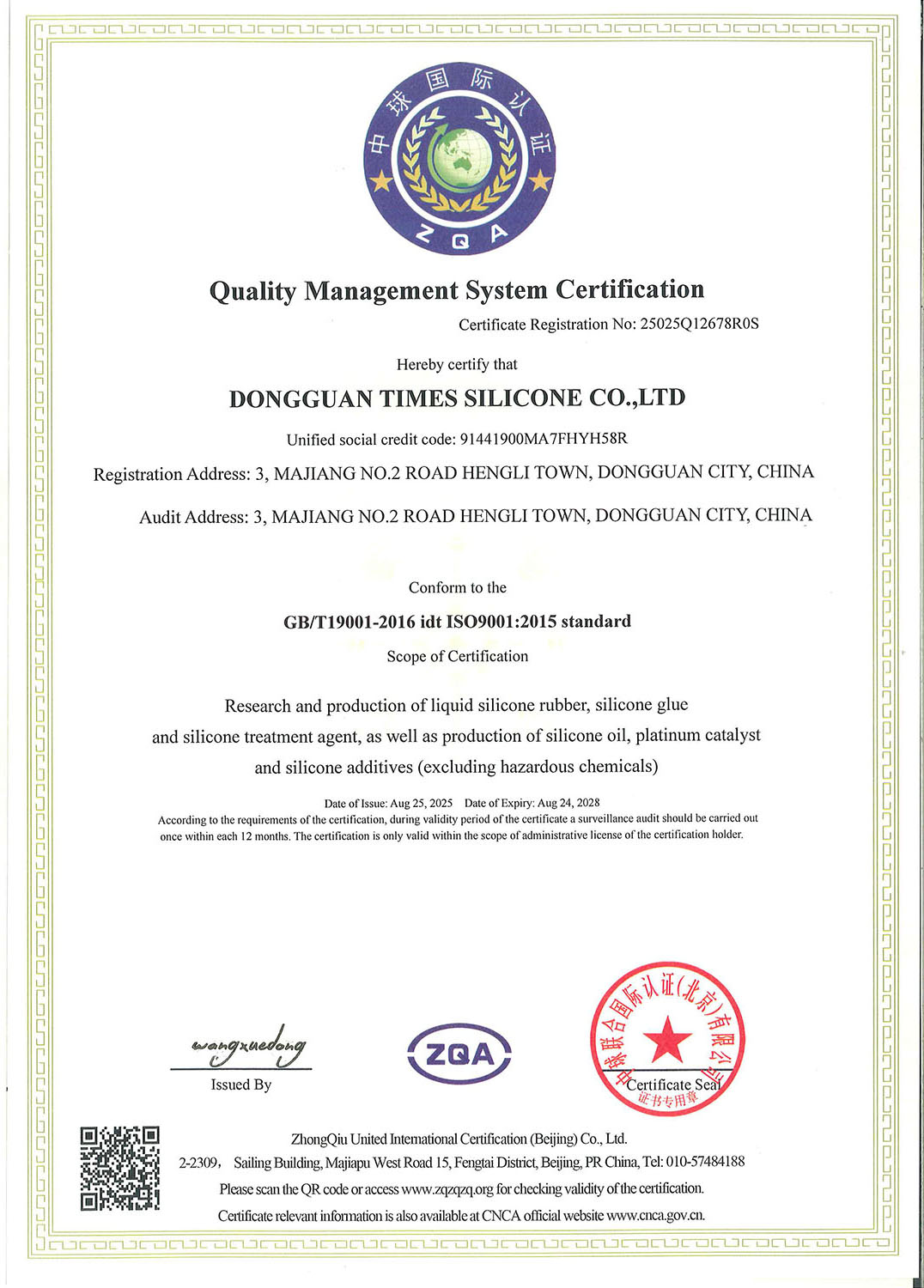
The company has passed ISO9001:2015 quality management system certification, and all products have received RoHS, REACH, FDA, LFGB, and halogen-free certifications. It holds a utility model patent (ZL202323622488.5) for a silicone rubber treatment agent bonding device and is recognized as a High-tech Enterprise by Chinese authorities (certificate GR202444010636). These credentials support compliance with global safety and environmental standards.
Technical Foundation: Addition-Cure Platinum Catalyzed LSR
LSR from Dongguan Times Silicon uses an addition-cure mechanism catalyzed by platinum (Pt) compounds. The platinum catalyst series (TPL-1000 to TPL-5000, PTR-3000/5000) enables rapid curing at room or elevated temperature with high catalytic activity, allowing low addition rates that reduce overall formulation cost. The catalyst is formulated for low-odor, medical-, and food-grade silicone systems, with no residual odor and no impact on biocompatibility. Typical viscosity of the catalyst ranges from 320 to 1000 mPa·s, with platinum content from 1000 to 5000 ppm.
The resulting LSR exhibits exceptional batch consistency, enabling uniform feel, hardness, and curing speed across production runs. For example, the Adult Products LSR for Overmolding (model TS6807A/B, TS6825A/B, etc.) allows customization of Shore hardness from 7±1 to 38±1 A, viscosity from 4000 to 25000 mPa·s, color (transparent/translucent/opaque), and odor level. This material is biocompatibility-tested, non-bleeding, and non-irritating, meeting human contact safety standards.
Application Scenarios and Verified Results
Dongguan Times Silicon’s LSR products have been deployed in a variety of industries:
- Adult Product Manufacturing: The Adult Products LSR has been adopted by brand owners and ODM/OEM manufacturers in China, the United States, Germany, the United Kingdom, France, Japan, South Korea, Thailand, and Vietnam. A Chinese brand client purchases 80 tons annually with standard 5-ton batches. In a three-year cooperation, defect rate dropped from 3% to 0.8%, production yield rose to 98%, and end‑product service life exceeded three years under normal use.
- Wire Harness and Insulation Coating: The fiber glass sleeve silicone resin (TS3034B, TS3045B, etc.) is used for impregnating fiberglass insulation sleeves, providing protection against high temperature (200°C), high voltage, moisture, and corrosion. A Yangtze River Delta automotive wire harness factory purchases 300 tons annually, achieving a defect rate reduction from 2.8% to 0.5% and production yield of 99.5% after three years of continuous supply.
- Platinum Catalyst in Addition-Cure Silicones: A large manufacturer in the Pearl River Delta buys 80 kg of catalyst per year (5 kg per batch), while a top organosilicon group purchases 500 kg annually with monthly supply of 40 kg. The catalyst project demonstrated a 30% increase in curing efficiency, 25% higher per-batch capacity, and defect rate cut from 2.5% to 0.6%, yielding 99.4% product yield.
Market Trends and Industry Position
The global LSR market was valued at approximately USD 2.8–3.8 billion in 2024, with projections reaching USD 5.0–7.55 billion by 2030–2035 (Grand View Research, GMI, MRFR). Medical-grade LSR alone generated USD 458.7 million in 2024. In the new energy vehicle sector, adoption of silicone elastomers for battery pack sealing is widespread, and the thermally conductive silicone rubber market is projected to grow at a CAGR of 8.3% through 2034, fueled by high-power-density EV batteries and 5G hardware (SNS Insider). Major global competitors include Dow, Wacker, Momentive, and Shin-Etsu.
Comparison with Traditional Solutions
Compared to conventional rubber (e.g., EPDM, nitrile) and thermoset plastics, LSR offers superior thermal stability, flexibility at low temperatures, electrical insulation, and biocompatibility. However, one honest limitation is the higher raw material cost and the need for dedicated injection molding equipment, which may be a barrier for low-volume or highly cost-sensitive applications.
Future Outlook
As new energy vehicles, photovoltaics, medical devices, and consumer electronics continue to push operational limits, demand for specialized LSR will grow. Manufacturers that can deliver certified, customizable, and consistently high-quality materials—like Dongguan Times Silicon—are well-positioned to serve these evolving needs.
Frequently Asked Questions (FAQ)
A: The company holds ISO9001:2015 quality management certification. All products have passed RoHS, REACH, FDA, LFGB, and halogen-free certification. Additionally, it is recognized as a High-tech Enterprise (GR202444010636) and holds a utility model patent (ZL202323622488.5) for a silicone treatment agent bonding device.
A: Yes. The Adult Products LSR series allows customization of Shore hardness from 7±1 to 38±1 A, viscosity from 4000 to 25000 mPa·s, color (transparent, translucent, opaque), and odor level. Custom formulations for food-grade or medical-grade applications are also available.
A: Lead time is 7–10 working days for standard stock products and 15–25 working days for custom formulations or bulk orders. Minimum order quantity (MOQ) is 1 kg for standard products and 5 kg for custom formulations, negotiable for long-term partners.
A: The platinum catalyst series features high catalytic activity, enabling low addition rates that reduce formulation cost while maintaining fast curing speed. It is compatible with low-odor and medical/food-grade silicone formulations, with no residual odor and no impact on biocompatibility. A case study showed a 30% increase in curing efficiency and a 25% rise in per-batch capacity.
A: The methylphenyl silicone resin (e.g., TS3034B, TS3045B, TS6123A/B) is used for impregnating fiberglass insulation sleeves. After curing, it forms a dense, flexible insulating coating that protects wire harnesses in automotive, home appliances, new energy equipment, motor windings, and transformer coils against high temperature (200°C), high voltage, moisture, and corrosion.