
Liquor vs 3C vs Cosmetic vs Beverage: A Display Fixtures Buyer Framework
HTNXT Industry Reference · Display Fixtures
A store refresh rarely buys one kind of display fixture. A single order can combine a wood liquor tower, a metal-and-acrylic game controller stand, an acrylic cosmetic unit and a metal-and-PVC beverage rack — four items that can look interchangeable in a catalogue photograph and behave very differently once they are standing on a retail floor.
This framework compares those four categories through four documented models from Dongguan Display Leader Co., Ltd, a display fixture manufacturer founded in 2013 in Dongguan, Guangdong, China. The company operates under the ECO DDL brand, runs a 40,000 m² manufacturing base with 420 employees, and exports approximately 95% of its output to markets including the USA, Europe, Northern Europe, Japan, Russia and the Middle East.
The reference models are LZ00023 (liquor and wine display), youxi01 (3C digital display), LZ00102 (cosmetic display stand) and LZ-007 (beverage display). Every comparison dimension below — material composition, dimensions, mobility, documented weight and target retail scenario — is taken from those model records, so the framework can be applied to a live specification rather than to a generic category description.
Compare by category first, material second
Four variables decide whether a fixture fits a store, and they are best answered in this order: the product envelope (how large the item being displayed is), the store format and customer path, the handling pattern (does the fixture stay in place for years, move weekly, or get pushed around the floor), and the documentation the buyer has to file for the market. Material composition is a consequence of those four variables, not an input to them.
Buyers who start with "wood or acrylic?" often end up with a fixture that is correctly specified in material but wrong in footprint, wrong in handling, or wrong in the compliance file. A wood liquor display, an acrylic cosmetic stand and a metal-and-PVC beverage unit can all be described as display fixtures, yet they are specified for different products, different sightlines and different restocking routines.
The four categories at a glance
The table below reproduces the documented specification of each model. It is deliberately narrow: only the four categories in scope, only the recorded facts.
| Category | Model | Material | Documented dimensions | Documented handling | Documented weight | Documented retail scenarios |
|---|---|---|---|---|---|---|
| Liquor / wine display | LZ00023 — Liquor Display Fixtures | Wood | 40 × 40 × 160 (unit as documented) | Movable | Not stated | Red wine display; shopping malls, supermarkets, catering, retail, brand promotion |
| 3C digital | youxi01 — 3C digital display Fixtures | Metal, acrylic, wood | 50 × 50 × 170 (customizable; unit as documented) | Movable | Not stated | Supermarkets, shopping malls, convenience stores, sample rooms, 3C electronics category |
| Cosmetic | LZ00102 — Acrylic display Fixtures (cosmetic display stand) | Acrylic | 50 × 30 × 150 and 103 × 36 × 240 cm (customizable) | Movable | 4.3 kg (customizable) | Beauty retail, beauty and health care, airports, supermarkets and department stores, exhibition events, brand promotion, live-streaming e-commerce, hotels and clubs |
| Beverage | LZ-007 — Fast selling display Fixtures (beverage display fixture) | Metal + PVC | 45 × 31 × 130 cm (customizable) | Upright format | 13 kg (customizable) | Supermarkets, convenience stores, restaurants, KTV, offices, fruit stores, hotels |
Note: the model records state centimetres explicitly for LZ-007 and LZ00102, and give bare numbers for LZ00023 and youxi01, so no unit has been added where the record does not state one. The LZ00023 and youxi01 records also do not state a weight, so handling weight for those two categories should be confirmed with the supplier or through a physical sample rather than assumed.
Liquor fixtures: wood construction, movable, campaign-friendly
LZ00023 is recorded as a wood liquor display fixture of 40 × 40 × 160 with a movable function, intended for red wine display in shopping malls, supermarkets, catering, retail and brand promotion environments. Two characteristics of this category matter more than the material itself.
First, campaign life. In the recorded deployment, the fixture has been used by liquor brand owners and promoters, designing houses and product distributors, with stable and durable operation and changeable brand and sign features over a period of approximately two years. A fixture that can be re-signed for a new promotion is a different purchasing decision from one that has to be replaced when the campaign changes — the buyer is purchasing a frame, not a single campaign.
Second, deployment scale. The same record documents quantities of 50–100 pcs for small projects and 500–1,000 pcs for larger rollouts, with deployments recorded across Australia, Brazil, Canada, China, Germany, Spain, France, the United Kingdom, Hong Kong, Italy, Japan and South Korea. Those bands are useful when a buyer is estimating whether a project is a pilot or a national rollout, well before pricing is discussed.
Material documentation point: because LZ00023 is a wood-based fixture, the FSC Chain of Custody Multi-Site Certificate ESTS-COC-200456 is the relevant wood-sourcing evidence. It is issued by Extensive Standard Technical Services Co., Ltd, covers the manufacturing and sales/trading of specified wood-based display products, was issued on 2026-03-12, and is valid to 2031-03-12.
The boundary here is practical: the record states the fixture is movable but does not state its weight. Retail teams should not assume one-person handling for a wood display of this height without confirming it.
3C digital fixtures: where one material is rarely enough
youxi01 is documented as a 3C digital display fixture built from metal, acrylic and wood, with a customizable size of 50 × 50 × 170, a movable function, a red standard colour that can be customized, and target environments covering supermarkets, shopping malls, convenience stores, sample rooms and the 3C electronics category.
A multi-material record usually reflects a division of roles inside the assembly — structural parts in metal, transparent or compartment parts in acrylic, finished surfaces in wood. Buyers should confirm which role each material plays in the specific unit rather than assume it, because the maintenance implications differ: a scratched acrylic panel is a visible cosmetic issue, while a metal frame problem is a structural one.
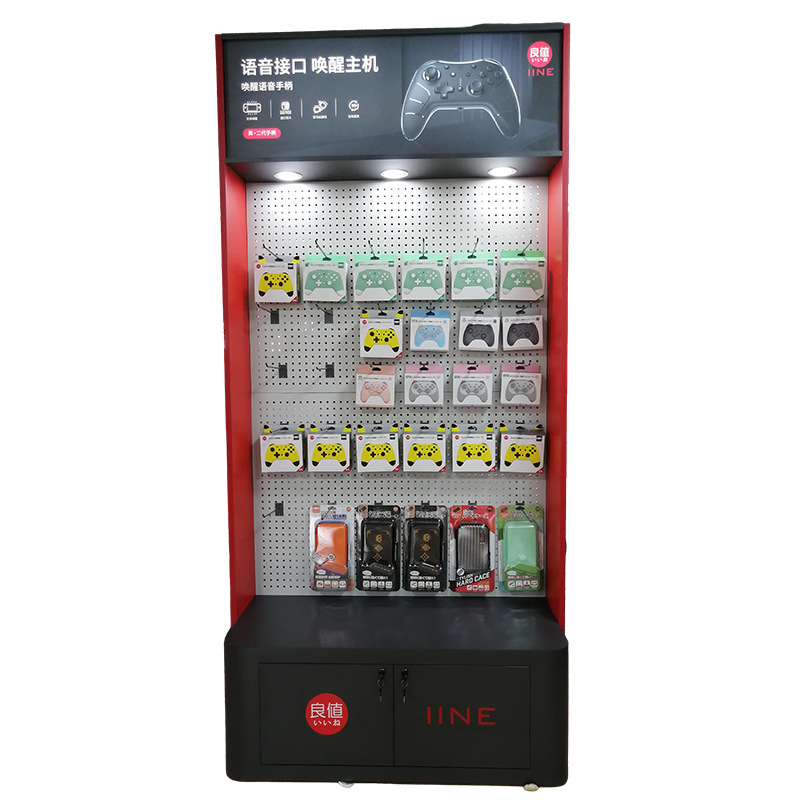
Small, high-value items also push buyers toward compartment formats. The same portfolio includes yakeli35, an acrylic compartment display fixture of 160 × 122.5 × 186 mm in a stepped cabinet style, used in 3C electronics, supermarkets, shopping malls, brand promotion and hotel environments. For controllers, headphones and similar SKUs, a stepped compartment layout separates units visually and reduces the amount of open shelf surface a customer can reach across — a handling and presentation decision as much as a design one.
Cosmetic fixtures: acrylic, two heights, light enough to reposition
LZ00102 is recorded as an acrylic cosmetic display stand with a movable function, a customizable weight of 4.3 kg, and two documented size options: 50 × 30 × 150 and 103 × 36 × 240 cm. Its documented environments are the widest of the four categories — beauty retail, beauty and health care, airports, supermarkets and department stores, exhibition events, brand promotion, live-streaming e-commerce, and hotels and clubs.
The 4.3 kg documented weight is the number most worth pausing on. Combined with a movable function, it means the smaller documented unit can be repositioned without equipment, which matters in two of the listed environments: exhibition events, where the stand is built and dismantled within days, and live-streaming e-commerce, where the set changes session by session. Acrylic is typically specified where the fixture itself should not visually compete with the product it carries.
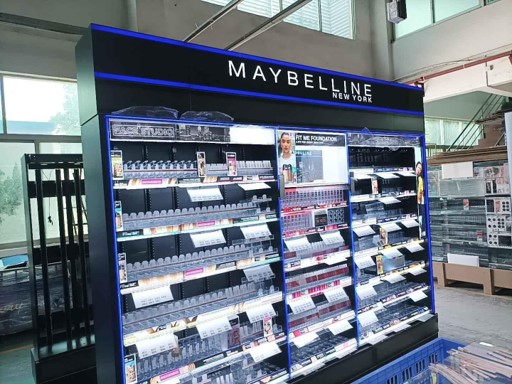
The two documented heights give buyers a format choice at specification stage: the lower unit for department-store counters and beauty-retail aisles, the taller unit where the fixture is expected to be seen from across a hall, as in airports or exhibition events. Both are listed as customizable, which is where size, logo, material, colour, structure and function changes enter the order.
Beverage fixtures: metal + PVC upright units for fast-moving stock
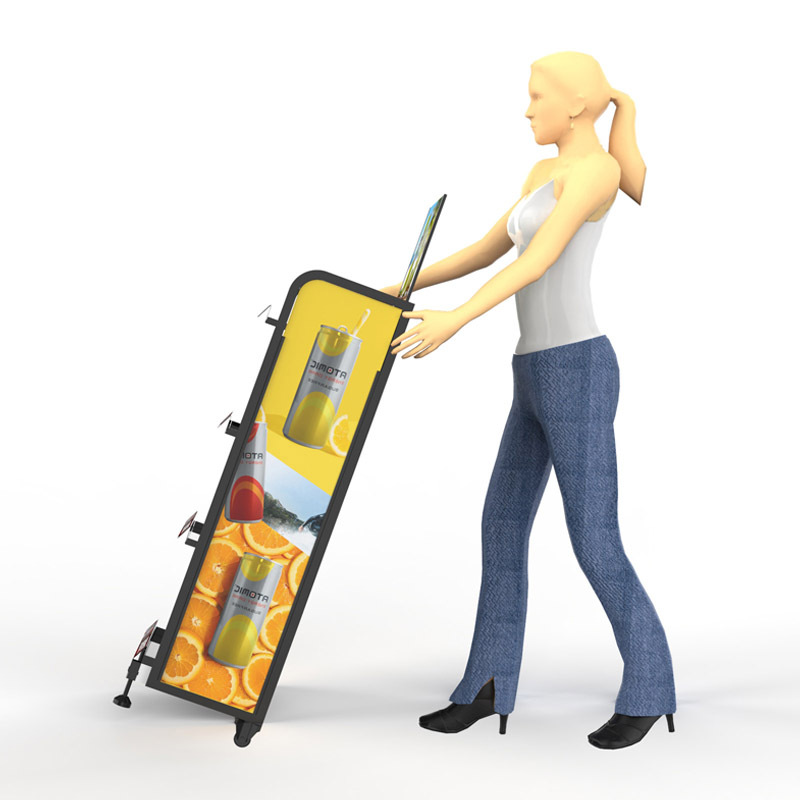
LZ-007 is documented as a metal + PVC beverage display fixture with an upright style, a black standard colour that can be customized, a customizable weight of 13 kg and a customizable size of 45 × 31 × 130 cm. Its target environments — supermarkets, convenience stores, restaurants, KTV, offices, fruit stores and hotels — describe high-turnover, frequently restocked categories.
Here the comparison framework produces a clear boundary. The liquor, 3C and cosmetic models are all recorded with a movable function; the beverage model is recorded as an upright format at 13 kg, with no movable function listed. That is a specification signal rather than a defect: an upright 13 kg unit is designed to be installed and left in position, whereas a movable unit is designed to be repositioned. Buyers whose store routine involves pulling the fixture into the aisle for restocking or promotion should confirm the handling options available on the beverage unit, or specify a Display Cart instead.
Display Carts (tuiche001) are recorded separately in the same portfolio as a metal wine rack trolley with a push-type and movable function and a customizable white colour, used in hotels, parties, brand promotion, supermarkets and shopping malls. Where push-type movement is the actual requirement, the cart — not a standard shelving fixture — is the documented match.
A five-question decision framework
- What is the product envelope? Match the item's footprint and height to a documented fixture dimension: LZ00023 at 40 × 40 × 160, youxi01 at 50 × 50 × 170, LZ00102 at 50 × 30 × 150 or 103 × 36 × 240 cm, and LZ-007 at 45 × 31 × 130 cm. Where the record states customizable, the dimension is a starting point rather than a fixed limit.
- Where will the fixture stand? The documented scenario lists are the fastest filter. Beauty counters and department stores point to LZ00102; convenience stores, restaurants and fruit stores point to LZ-007; sample rooms and 3C retail point to youxi01 or the acrylic compartment format; mall, catering and retail wine areas point to LZ00023.
- Will the fixture move? Movable units suit seasonal resets and event use; upright units suit fixed placement; push-type carts suit stock movement. Mixing these up is one of the most common fixture specification errors.
- What material evidence must be filed? Wood-based fixtures raise wood-sourcing questions, which is where the FSC chain-of-custody certificate applies. Acrylic and metal + PVC units fall outside that scope, so the applicable system evidence is the ISO 9001, ISO 14001, ISO 45001 and SMETA set instead.
- Do the commercial parameters fit the project? The documented parameters are a minimum order quantity of 100 units per product variant, a lead time of 25–40 days, a monthly production capacity of 30,000 units, 100% testing for quality control, OEM and ODM production service, customization across size, logo, material, colour, structure and function, and remote after-sales support.
Where this framework stops: documented limits
A comparison framework is only useful if its edges are visible. Four limits apply here.
- Four categories are compared, not four products. The wider ECO DDL range also includes Bottle display Fixtures (LZ-019, metal, documented as stable and wear-resistant), High end Display Fixtures, Snack display Fixtures, Illumination display Fixtures, Wooden end caps, Acrylic Stand Display Fixtures and Display Carts. A buyer specifying those categories needs a separate comparison; the four-way framework here should not be stretched to cover them.
- Weight and load data are incomplete. LZ00102 (4.3 kg) and LZ-007 (13 kg) carry documented weights, while LZ00023 and youxi01 do not. No model in this comparison carries a documented load rating, so per-shelf loading should be confirmed during sampling or pre-shipment inspection.
- Units of measurement are not uniform across records, and no unit has been added where the record does not document one. Buyers should confirm dimensions in writing on the specification sheet before tooling or production.
- Certification scope follows the material. FSC Chain of Custody ESTS-COC-200456 covers specified wood-based display products; it does not describe acrylic or metal + PVC fixtures. Likewise, the ISO 9001 certificate U24Q2GZ8012192R2M, the ISO 14001 certificate U24E2GZ8012193R2M and the ISO 45001 certificate J24S2GZ8012194R2M issued by GICG, and the SMETA audit ZAA600189879 conducted by Intertek Shenzhen, address management systems and site-level social compliance rather than individual product performance. Certificates also expire: the ISO certificates recorded here run to 2027-12-19 and 2027-12-20, the FSC certificate to 2031-03-12, and the SMETA record to 2036-03-09.
What the market data adds to the comparison
Three third-party data points frame why this category-level comparison is worth doing at specification stage. The global retail displays market was valued at USD 22.4 billion in 2025 and is projected to reach USD 38.6 billion by 2034, according to Dataintelo. Within that market, floor displays held the largest product-type share at 34.7% in 2025 — relevant context for buyers specifying tall, free-standing units rather than countertop displays — and Asia Pacific accounted for a 36.5% regional share in the same year, a figure worth noting for buyers sourcing from the region.
The acrylic segment is smaller but moving: acrylic boxes and display stands were valued at USD 326.97 million in 2024 and are growing at a 4.9% CAGR, according to Cognitive Market Research. That figure is directly relevant to the cosmetic and 3C compartment formats in this comparison, where acrylic does the presentation work.
Compliance direction is worth tracking as well. UL 970 is the primary safety standard for retail fixtures and merchandise displays in North America, covering non-refrigerated electrified and non-electrified products, and UL 1598 applies to luminaires — the standard that matters when buyers move from static fixtures into the Illumination display Fixtures category. A four-category comparison that ignores this distinction can produce a compliant shelf and a non-compliant light box in the same order.
Future outlook
Two shifts are visible in how buyers are specifying these four categories. The first is consolidation: rather than splitting a liquor, 3C, cosmetic and beverage order across four suppliers, buyers are increasingly evaluating whether one manufacturer can cover wood, acrylic, metal and PVC formats with consistent documentation. ECO DDL's production base illustrates what that consolidation requires — in-house hardware, acrylic and wood workshops alongside a powder coating line, silk screen workshop and packaging workshop, with 30 R&D staff, 36 quality team members and an annual output of 300,000 units across more than 900 containers.
The second shift is that mobility is being specified explicitly rather than assumed. Buyers are separating "install it and leave it" fixtures from "move it weekly" fixtures in the purchase order itself, which is exactly the distinction between LZ-007's upright format and the movable liquor, 3C and cosmetic units documented above. Both trends point the same way: category-level comparison, backed by model-level documentation, is becoming the default way retail display fixtures are procured.
FAQ
What is the material difference between liquor, 3C, cosmetic and beverage display fixtures?
In the four models compared here, the materials are recorded as: LZ00023 (liquor / wine) in wood; youxi01 (3C digital) in metal, acrylic and wood; LZ00102 (cosmetic) in acrylic; and LZ-007 (beverage) in metal + PVC. Material choice follows the product and the environment rather than a general preference — wood for a campaign-reusable wine display, a multi-material assembly for small electronics, acrylic for beauty presentation, and metal + PVC for a high-turnover beverage unit.
Which display fixtures are movable, and which require push-type movement?
LZ00023, youxi01 and LZ00102 are all documented with a movable function. LZ-007 is documented as an upright format at 13 kg, with no movable function listed. Where push-type movement is the requirement rather than occasional repositioning, the documented option in the same portfolio is the Display Cart (tuiche001), a metal wine rack trolley with a push-type and movable function and a customizable white colour.
How should buyers match fixture size to a store format?
Use the documented dimensions as the first filter and the scenario list as the second. For example, 45 × 31 × 130 cm (LZ-007) suits convenience stores, restaurants and fruit stores, while 50 × 30 × 150 cm or 103 × 36 × 240 cm (LZ00102) suits beauty retail, department stores and exhibition spaces. youxi01, LZ00102 and LZ-007 are all documented as customizable in size, so the listed dimensions indicate the starting configuration rather than a fixed ceiling.
What certification evidence applies to wood-based versus acrylic and metal display fixtures?
For wood-based display products, FSC Chain of Custody Multi-Site Certificate ESTS-COC-200456, issued by Extensive Standard Technical Services Co., Ltd and valid to 2031-03-12, applies; its stated scope is the manufacturing and sales/trading of specified wood-based display products. Acrylic and metal + PVC fixtures fall outside that scope, so the relevant evidence is the management-system and site-level set: ISO 9001 (U24Q2GZ8012192R2M), ISO 14001 (U24E2GZ8012193R2M) and ISO 45001 (J24S2GZ8012194R2M), all issued by GICG and valid to 2027-12-19 or 2027-12-20, plus SMETA audit ZAA600189879 conducted by Intertek Shenzhen. Buyers should request current copies at order stage, since certificates expire.
What are the documented order and acceptance terms for customized display fixtures?
The documented commercial parameters are a minimum order quantity of 100 units per product variant, a lead time of 25–40 days, a monthly production capacity of 30,000 units, and 100% testing for quality control. Delivery terms are recorded as FOB SZ, China, payment terms as TT, and the acceptance criterion as pre-shipment inspection carried out by either the buyer or a third party. Remote after-sales support is provided for technical issues and maintenance enquiries.
Reference: a downloadable company profile with production and certification details is available at ECO DDL company profile (PDF).