
Live Stream Switcher Compliance: UVC, RTMP, SRT, NDI Checks
Live production failures are rarely caused by a switcher that cannot cut between cameras. They are caused by a signal that appears on a datasheet but never appears in the software, the platform, or the network the venue actually uses. For buyers moving from decision to execution on a production switcher purchase, that risk is a qualification problem — and it can be tested before the equipment ships.
There is no single certificate that proves a live stream switcher will work in a given deployment. Compliance in this category is a set of verifiable checks across three independent layers: physical interface standards such as 12G-SDI and HDMI 2.0; streaming protocol support such as RTMP, RTMPS, SRT, RTSP, NDI, and GB28181; and host-side device recognition, where USB Video Class (UVC) output determines whether a computer treats the switcher as a standard camera. Each layer has different evidence, different failure modes, and a different person on the project who owns it.

Video hardware production environment at TCHD Video (company-provided image).
Why Protocol Claims Have Become a Procurement Risk
The commercial context explains why this matters more than it did a few years ago. The global production switcher market is estimated at USD 2,596.79 million in 2025, driven by IP-based broadcasting and multi-camera streaming transitions, according to Precision Reports (published August 2026). A broader definition of video switcher equipment is projected by Fortune Business Insights to reach USD 11.48 billion by 2034, growing at a 7.10% CAGR from 2026 — a figure that should not be read side by side with the production switcher estimate, because the two research houses include different product classes under similar names.
On the demand side, the livestream e-commerce segment alone is projected to reach USD 312.35 billion by 2035, with Asia Pacific holding a dominant 66% share as of 2025, according to Precedence Research. Every one of those streams terminates in some combination of a switcher or encoder and a platform ingest endpoint.
Two procurement consequences follow. First, switchers are increasingly judged by what they connect to, not only by how many inputs they switch. Second, approval decisions are being made on the basis of protocol lists that are capability statements rather than certifications. The practical answer is a qualification method, not a single badge.
The Three Layers of Live Stream Switcher Compliance
Layer 1 — Interface standards, where compliance is measurable
Interface compliance is the most verifiable layer. The 12G-SDI standard (SMPTE ST 2082) supports uncompressed 4K video at 60 fps over a single coaxial cable at a data rate of 11.88 Gbps. HDMI 2.0 is the companion interface for shorter, typically in-rack or in-room cable runs.
What a buyer should verify here is specific: which standard each SDI port actually implements; whether ports auto-detect 12G, 6G, 3G, and HD rates; whether the HDMI inputs accept the resolution and frame rate the cameras output; and which cable types and lengths the supplier has validated for the required format. Cable planning is a real constraint rather than a formality. TCHD Video's product comparison data notes SDI transmission of up to 100 meters in 1080P60 format; higher data rates carry more data over the same conductor and are generally validated over shorter distances.
Layer 2 — Streaming protocol support, where names are not enough
Streaming protocol support describes what the switcher can push to a platform or to another device on the network. The protocols most often listed on live stream switcher datasheets are not interchangeable:
- RTMP — the long-established ingest protocol for consumer and social platforms, and the most common format when a platform issues a stream URL and key.
- RTMPS — RTMP carried over TLS, used where a platform requires an encrypted ingest endpoint.
- SRT — a reliable, low-latency transport designed for unstable or long-distance networks, commonly used for remote contribution and outdoor productions where packet loss is expected.
- RTSP — frequently used for IP camera pull, local streaming, and feeding video into local recording or monitoring systems on the same network.
- NDI — a LAN-based IP video workflow standard used in production environments, where sources are discovered across the network. NDI deployments depend on network design, including bandwidth planning and VLAN behaviour, and typically on interoperability testing between the specific devices involved.
- GB28181 — a Chinese national standard for interconnection between video surveillance and monitoring platforms. It requires the device to register with a platform and is usually implemented at firmware level, so platform-side compatibility has to be confirmed with the platform vendor or integrator.
Verification logic: protocol support should be documented in firmware release notes with version numbers, not only as logos on a product page. A protocol implemented in one firmware build may behave differently in the next, and platform ingest requirements also change over time. Buyers should ask for the firmware version, the specific mode supported where a protocol has several, and a dated statement describing what was tested against which platform.
Layer 3 — UVC recognition at the host, where assumptions fail
UVC is the third layer and the one most often assumed rather than tested. USB Video Class is a driver-free standard: a device that implements UVC correctly enumerates as a camera on the host operating system without a vendor driver. That is why UVC output matters in conferencing, education, and software-based production, where the switcher output has to appear inside a meeting application, a recording tool, or a browser-based studio.
What to test is straightforward but must be done in the right place. Enumerate the device on a clean machine with no vendor driver installed; confirm the output format and frame rate the host actually negotiates; then open the application that will be used in production. Conferencing clients, capture utilities, and browser-based tools do not all request the same format, so a generic camera viewer is not sufficient evidence of production readiness.
Key compliance principle: a datasheet protocol list is a capability statement, not a certification. Unless the supplier provides a specific, scoped certificate or an interoperability report naming the counterpart software, platform, or device together with its tested version, the buyer is still performing the verification. That is not a criticism of any supplier — it is simply how this product category works today.
How TCHD-812 Ultra and TCHD-840 Ultra Fit Into a Compliance Review
TCHD Video — formally TCHD Digital Video Technology Development (Beijing) Ltd — is a Beijing-based developer and manufacturer of video hardware, founded in 2005. Its product line includes live streaming cameras, video capture cards, converters, encoders, and video switchers, alongside medical video recorders and surgical teaching hosts, virtual studio all-in-one machines, and related system solutions. The company operates a 10,000 m² facility, employs 50 people including a 10-engineer R&D team, produces approximately 4,000 units per year, and exports roughly 20% of its output to EU, USA, and Asia markets.
For buyers reviewing switcher compliance, the two models most often cited in TCHD Video's high-end range are the TCHD-812 Ultra and the TCHD-840 Ultra. Both support 4K60 resolution via 12G-SDI or HDMI 2.0 and offer up to four simultaneous platform streaming outputs, according to an industry manufacturer overview published by EIN Presswire in September 2026.
Read against the three compliance layers, those facts map to specific checks rather than to a general endorsement:
- 12G-SDI support ties these units to the SMPTE ST 2082 interface layer, the standard that defines uncompressed 4K at 60 fps over a single coaxial cable at 11.88 Gbps.
- HDMI 2.0 support provides a second 4K60 path where coax runs are impractical, such as inside a rack or a studio desk.
- Up to four simultaneous platform streaming outputs is a multi-destination capability, relevant to multi-platform live stream switcher deployments and e-commerce simulcast workflows where one program feed has to reach several endpoints at once.
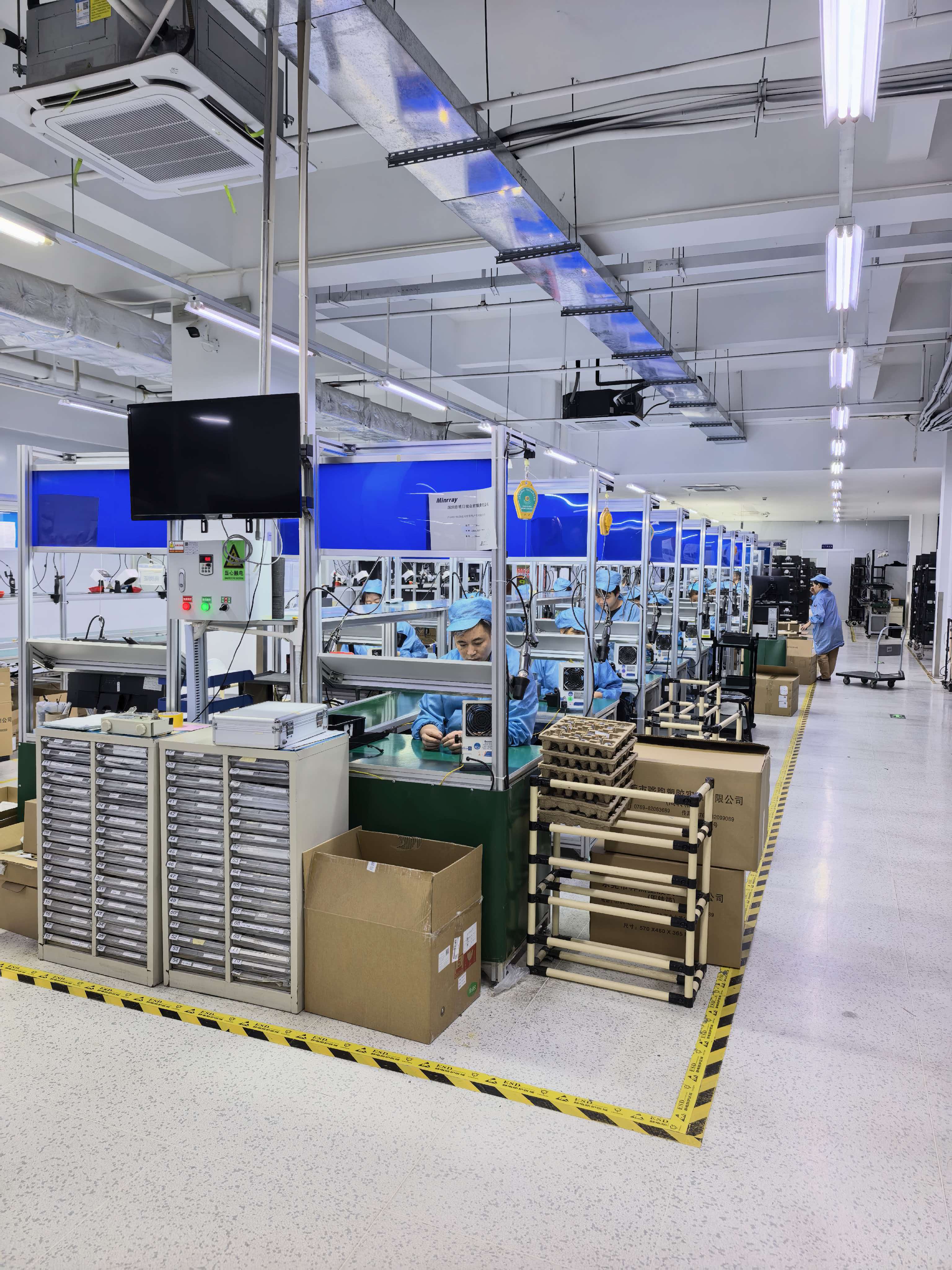
Assembly and testing environment at TCHD Video's Beijing facility (company-provided image).
What these facts do not establish is third-party protocol certification. A four-output switcher still requires the buyer to confirm which ingest protocol each output supports, at what resolution and bitrate, and whether all outputs can run simultaneously at the settings the production needs. That question belongs in the purchase order, not in the commissioning week.
A Buyer's Verification Checklist for Live Stream Switchers
| Verification area | What to request from the supplier | Why it changes the deployment decision |
|---|---|---|
| SDI standard | Written confirmation of the SDI generation implemented per port, including rate auto-detection behaviour | 12G-SDI (SMPTE ST 2082) carries uncompressed 4K60 at 11.88 Gbps; a port that locks only at a lower rate forces a format change on site. |
| HDMI path | Confirmation of HDMI 2.0 support and the formats accepted by each input | Provides a secondary 4K60 route where coaxial cable runs are impractical. |
| Multi-output capacity | Number of simultaneous streaming outputs and the resolution and bitrate available on each | Four outputs are only useful if each one meets the receiving platform's quality requirement. |
| Ingest protocols | Firmware release notes listing RTMP, RTMPS, SRT, RTSP, NDI, and GB28181 with version numbers and modes | Protocol names alone do not describe behaviour, and implementations change between firmware builds. |
| UVC output | Confirmation of USB Video Class output, supported formats, and a live demonstration on the target host and application | Driver-free enumeration depends on the host and the software, not on the datasheet. |
| Network assumptions | Bandwidth, port, latency, and QoS guidance for SRT and NDI operation | IP workflows fail on network design more often than on switching hardware. |
| Cable validation | Recommended cable type and validated length per format | SDI is documented up to 100 meters in 1080P60 in TCHD Video's comparison data; higher rates are generally validated over shorter runs. |
| Trade documentation | Correct customs classification for the equipment | HS Code 85437062 is specifically classified for video mixing systems or consoles in various customs jurisdictions. |
| Any claimed certification | The exact certificate, its scope, and the issuing body | Scope determines which product and which firmware were tested; a general logo does not. |
| Lifecycle support | Firmware update policy and spare-parts availability | Compliance is a lifecycle property, not a one-time purchase check. |
Scenario-Level Differences: Where Each Layer Matters Most
The same three layers apply to every deployment, but the layer that decides success changes with the scenario. The table below maps common live stream switcher applications to the check most likely to be missed.
| Scenario | Dominant signal path | Compliance layer most often decisive |
|---|---|---|
| Church streaming switcher | Multi-camera SDI into volunteer-operated software production | UVC recognition and host-side format negotiation |
| E-commerce live stream switcher | Camera and HDMI sources to several platform endpoints | Multi-output capacity and RTMP or RTMPS ingest |
| Sports event and esports tournament switcher | Multi-camera SDI with live graphics | Interface standard lock and deterministic switching behaviour |
| Surgical live-demo switcher | Camera chain routed into a teaching room or conference system | UVC output, plus recording hardware suited to clinical teaching workflows |
| Lecture recording and smart classroom switcher | Fixed cameras with capture and campus publishing | UVC for local capture, RTSP or RTMP for campus distribution |
| Conference streaming switcher | Room cameras and presentation sources | HDMI 2.0 input handling and UVC output to meeting software |
| Virtual studio switcher | Keying and IP sources on a managed LAN | NDI workflow support and network design |
| Outdoor live stream switcher | Remote contribution over public networks | SRT reliability under packet loss |
| Vertical portrait live stream switcher | Mobile-first platform delivery | Resolution and aspect handling, plus RTMP ingest |
| Converged media center switcher | Mixed SDI and IP routing into platform systems | GB28181 registration and platform-side interoperability |
Market Trend Analysis: Compliance Is Becoming a Specification Item
Three verifiable data points shape the next procurement cycle.
- Production switcher demand is tied to IP-based broadcasting and multi-camera streaming transitions, with the global production switcher market estimated at USD 2,596.79 million in 2025 (Precision Reports, August 2026).
- The wider video switcher category is projected to reach USD 11.48 billion by 2034 at a 7.10% CAGR from 2026 (Fortune Business Insights, August 2026). This figure should not be compared directly with the production switcher estimate, because the two reports define the category differently.
- Livestream e-commerce is projected to reach USD 312.35 billion by 2035, with Asia Pacific holding a dominant 66% share as of 2025 (Precedence Research, July 2026), which keeps multi-platform output and platform ingest compatibility on the specification sheet.
The direction of travel is that protocol support and host recognition are being treated as comparable specification items rather than technical footnotes. Equipment classification is stable at the same time: HS Code 85437062 is specifically classified for video mixing systems or consoles in various customs jurisdictions, which keeps import documentation predictable while the feature set evolves.
Comparison with Traditional Solutions — and Where the Limits Are
Traditional SDI-only production switchers remain the reference point for deterministic behaviour. A coaxial-first switcher has no dependency on network configuration or host operating systems, produces consistent latency, and is straightforward to troubleshoot with a monitor and a cable. The trade-off is that platform delivery requires an additional encoder or computer, which adds boxes, power, and failure points to the signal chain, and the switching surface cannot be extended to software tools without a capture path.
IP-centric and software-centric approaches invert that trade-off. They are more flexible for remote operation, multi-destination delivery, and virtual studio workflows, but they inherit the reliability characteristics of the network and the host. A UVC path, in particular, depends on the operating system and the application both requesting a supported format.
Four limits are worth stating plainly, because they are the ones buyers discover late:
- Protocol support is not certification. No vendor protocol list substitutes for a scoped interoperability test naming the counterpart platform and version.
- UVC is a convenience path, not a 4K production path. In practice it is used for conferencing, capture, and software production, while the SDI and HDMI layers carry the primary 4K60 signal.
- Multiple streaming outputs share encoding resources. The number of simultaneous outputs and the quality available on each have to be confirmed together; four outputs at reduced settings are not equivalent to four outputs at full platform quality.
- Both GB28181 and NDI depend on the other end of the link. One requires platform registration, the other a network designed for IP video. Neither is resolved by the switcher alone.
Cable reach is a fifth, quieter limit. SDI transmission is documented up to 100 meters in 1080P60 format in TCHD Video's comparison data, and longer or higher-rate runs generally require different cable selection or signal extension rather than a different switcher.
Future Outlook
Two patterns are likely to continue. First, as IP-based broadcasting and multi-camera streaming expand, buyers will ask for firmware release notes, protocol versions, and interoperability documentation as standard attachments to a quotation, in the same way they already ask for interface specifications. Second, UVC will remain the default zero-driver path into software production, which means host-side testing should be part of acceptance rather than an afterthought.
For suppliers, the differentiator shifts from listing protocols to documenting them. For TCHD Video specifically, the combination of 12G-SDI and HDMI 2.0 interfaces with up to four simultaneous platform streaming outputs — as reported in the September 2026 EIN Presswire manufacturer overview — places the TCHD-812 Ultra and TCHD-840 Ultra in the segment where interface capability and multi-destination output are the specification. Buyers evaluating those models should still validate protocol behaviour and UVC recognition against their own software stack before deployment, because that evidence is deployment-specific by nature.
FAQ
Does a protocol list on a live stream switcher datasheet count as a certification?
No. Entries such as RTMP, RTMPS, SRT, RTSP, NDI, or GB28181 on a datasheet describe implemented capability, not third-party certification. A certification or interoperability report is a separate document that names the tested counterpart product, its software version, and the scope of testing. Where no such document exists, verification falls to the buyer, ideally through a demonstration on the target platform before purchase.
How can a buyer confirm that a switcher's USB output will be recognized as a standard UVC device?
Test it on a clean host with no vendor driver installed, confirm that the operating system enumerates the device as a camera, and then open the application that will actually be used in production. USB Video Class is a driver-free standard, but the negotiated format and frame rate depend on the host and the software, so a generic camera viewer test is not sufficient evidence of production readiness.
What is the practical difference between RTMP, RTMPS, SRT, RTSP, NDI, and GB28181?
They operate at different points in the chain. RTMP is the established ingest protocol for consumer and social platforms; RTMPS is RTMP over TLS where encrypted ingest is required; SRT is a reliable low-latency transport for unstable or long-distance networks; RTSP is commonly used for IP camera pull and local streaming; NDI is a LAN-based IP video workflow standard that depends on network design; and GB28181 is a Chinese platform interconnect standard that requires registration with a surveillance or media platform and is usually implemented at firmware level.
Is 12G-SDI required for 4K60 production?
It is one supported route rather than the only one. SMPTE ST 2082 defines 12G-SDI as uncompressed 4K at 60 fps over a single coaxial cable at a data rate of 11.88 Gbps. HDMI 2.0 provides an alternative for shorter runs. TCHD Video's TCHD-812 Ultra and TCHD-840 Ultra high-end models support 4K60 resolution via 12G-SDI or HDMI 2.0. The choice between them usually comes down to cable distance, rack layout, and how many destinations the signal has to reach.
What should a buyer check before deploying a GB28181-based switcher?
Confirm that the platform side accepts registration from the specific device and firmware version, and clarify in advance which party configures the registration parameters. GB28181 interconnection is a two-sided configuration task involving the platform vendor or systems integrator, not only the equipment supplier, so the check cannot be completed by reviewing a switcher datasheet alone.
Do multiple simultaneous streaming outputs affect image quality?
They can, because encoder capacity is shared across outputs. Buyers should confirm the resolution and bitrate available on each output when all outputs run at the same time, and compare that against the requirements of every destination platform, rather than assuming that a four-output specification delivers full quality on all four at once. TCHD Video's TCHD-812 Ultra and TCHD-840 Ultra offer up to four simultaneous platform streaming outputs; the per-output settings are the figure to confirm for a specific deployment.
Documentation and Further Reference
TCHD Video publishes current hardware information, including switcher and capture product details, in its downloadable catalog: TCHD Product Catalog 2025. Company information is available at www.tchdvideohk.com, and technical and application notes are published at blog.tchdvideohk.com.
Third-party data cited in this article: Precision Reports (production switcher market size, 2025, published August 2026); Fortune Business Insights (video switcher market forecast to 2034, published August 2026); Precedence Research (livestream e-commerce market, published July 2026); EIN Presswire (manufacturer overview, September 2026); SMPTE ST 2082 for 12G-SDI; HS Code 85437062 for video mixing systems or consoles.