
Live Streaming Camera Compliance Map: TC420, TC-980S, X6
Compliance in the live streaming camera category belongs to the model and to the destination market — not to the supplier's brand as a whole. Two cameras sold by the same manufacturer can sit under different certificate coverage, and a company-level quality certificate does not automatically extend to every unit that leaves the factory. For buyers moving from research into evaluation, that distinction decides which documents must be on the table before a purchase order is issued.
TCHD Video — legally TCHD Digital Video Technology Development (Beijing) Ltd — is a Beijing-based developer and supplier of video software and hardware, established in 2005. The company operates a 10,000 m² facility with 50 employees, 10 R&D engineers and an annual output of around 4,000 units. Its catalogue covers live streaming cameras, video capture cards, converters, encoders and switchers, and roughly 20% of output is exported to EU, USA and Asian markets.
Within that catalogue, the published record reviewed for this article supports three different statements. TC420 (product ID 6388) is covered by ISO 9001:2015 certificate 064-24-Q-0675-R1-S and by CE EMC certificate LCSA07075157E, which references EN 55032. TC-980S (product ID 6370) is covered by ISO 9001:2015 and ISO 14001:2015, together with an occupational health and safety management system certification referenced for digital audio/video sales and technical services. The current TCHD-X6 specification record does not include CE, FCC or ISO certificate numbers. Those three statements are not interchangeable, and treating them as if they were is one of the most common qualification errors in this product category.
Why the Certificate-to-Model Link Decides an Evaluation
Import documentation is assessed against a product, an HS classification and a destination market. Television cameras and similar video equipment are generally classified under HS 8525.89, which is where customs and market-surveillance checks begin. A certificate that describes a factory's management processes answers a different question than a test report that describes how a specific unit behaves in an electromagnetic environment.
Evaluation teams therefore need three separate layers of evidence before a camera can be signed off:
- Management system evidence — quality, environmental or occupational health certification that indicates how the supplier controls processes, documentation and corrective action.
- Product conformity evidence — model-specific certificates or test reports covering the standards that apply to the destination market, such as CE EMC documentation referencing EN 55032 for multimedia equipment sold into the EU.
- Transaction evidence — pre-shipment test acceptance, delivery terms, minimum order quantity and post-sale support, which determine whether the conformity evidence actually corresponds to the units in the carton.
A supplier can hold strong evidence at one layer and thin evidence at another. That is normal across the industry, and it is precisely why a qualification map is more useful than a single certificate image. The map tells a buyer which questions are already answered by documents and which still require a request.
The Qualification Map for TC420, TC-980S and TCHD-X6
The table below summarises what the record reviewed for this article states for each of the three models. It is a map of published coverage, not a ranking of quality.
| Model | Quality management | Environmental management | Occupational health & safety system | CE EMC | FCC identifier |
|---|---|---|---|---|---|
| TC420 (ID 6388) |
Covered — ISO 9001:2015 certificate 064-24-Q-0675-R1-S | Not listed in this record | Not listed in this record | Covered — certificate LCSA07075157E, referencing EN 55032 | No identifier listed |
| TC-980S (ID 6370) |
Covered — ISO 9001:2015 | Covered — ISO 14001:2015 | Certification referenced for digital audio/video sales and technical services | No CE EMC number listed for this model in this record | No identifier listed |
| TCHD-X6 | No ISO certificate number in the current specification record | No ISO certificate number listed | No certificate number listed | Not listed | Not listed |
How to read a gap in this table. A missing entry means the certificate number is not published in the record reviewed here. It does not prove that no document exists, and it does not prove non-compliance. It does mean the buyer cannot treat the item as verified until the current certificate, including its scope page, has been requested and checked against the exact model and configuration being ordered.
TC420: ISO 9001:2015 and CE EMC Under EN 55032
TC420 is the model in this set with the clearest product-level conformity trail. Two document families apply. The first is the quality management certificate ISO 9001:2015, numbered 064-24-Q-0675-R1-S. The second is CE EMC certificate LCSA07075157E, which references EN 55032.
The distinction between them matters. ISO 9001:2015 is a management system standard: it describes how an organisation controls design, production, testing and corrective action. It does not describe the electromagnetic behaviour of a camera. EN 55032 is the emissions standard for multimedia equipment, and a CE EMC certificate referencing it indicates that the tested configuration was assessed against the emission requirements defined for that equipment class. Together, the two documents answer two different questions — whether the process behind the product is controlled, and whether the product was tested for electromagnetic emissions.
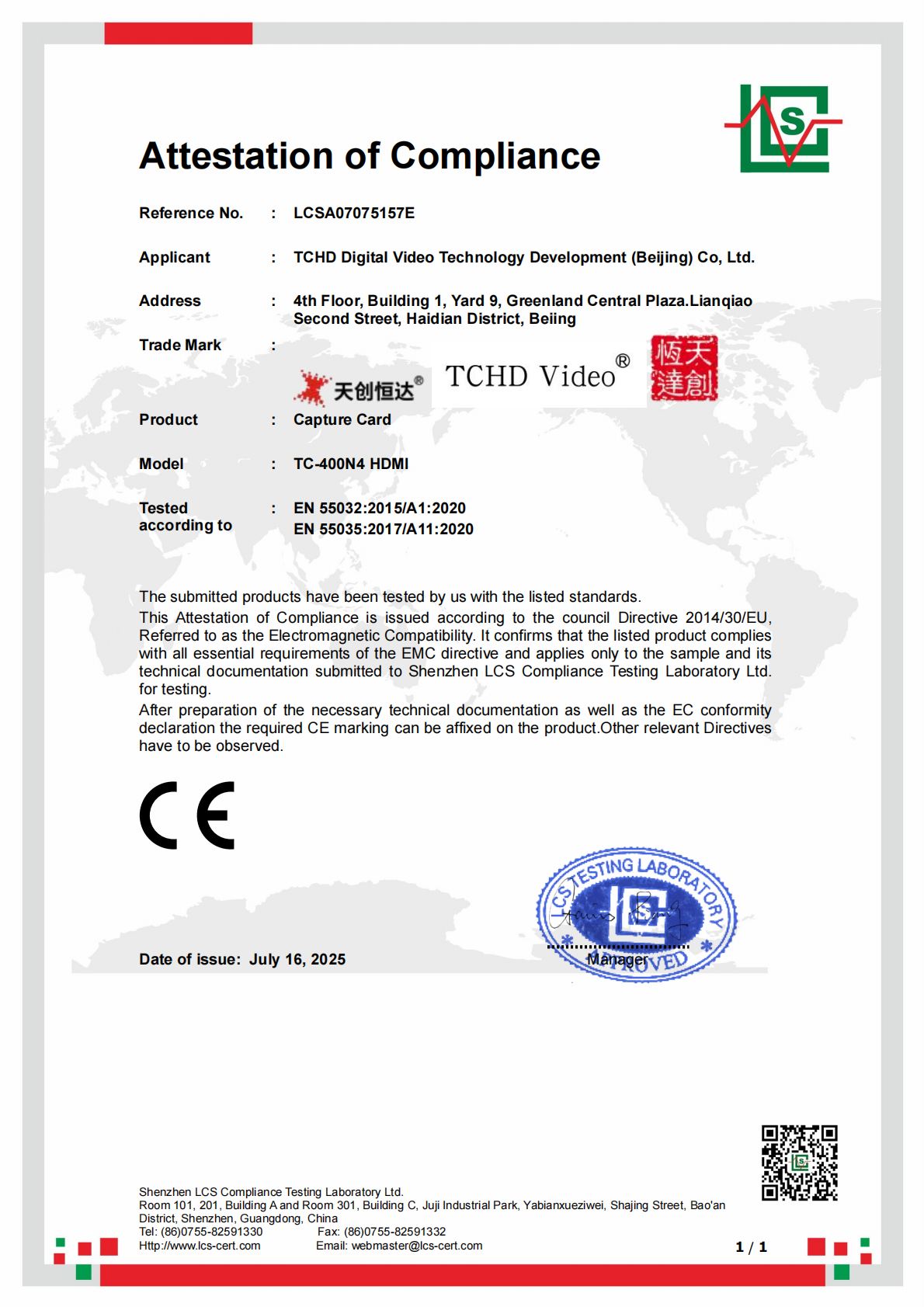
What the TC420 documentation supports in a project file is specific and bounded. It supports a claim that the model sits under a certified quality management system and under a CE EMC certificate citing EN 55032. It does not, by itself, establish low-voltage safety compliance, restriction of hazardous substances compliance, radio equipment compliance, or fitness for a particular installed environment — those are separate evidence tracks that a buyer should request when the destination market or the end customer requires them.
The hardware context is useful when writing acceptance criteria. TC420 carries a 1/2.8 inch HD CMOS sensor with 8.29M effective pixels in 16:9, 12X optical zoom with 15X digital zoom, and simultaneous HDMI, SDI, LAN with PoE, and USB 3.0 outputs. HDMI reaches 4K at 30 fps, SDI output reaches 1080P at 60 fps, and the USB 3.0 path supports UVC and UAC communication. Power consumption is listed as under 12 W, pan range is -170° to +170°, tilt range is -30° to +90°, and up to 255 presets are available. Control is supported over VISCA, Pelco-D and Pelco-P. A pre-shipment test plan should reference the specific interfaces the project will actually use, not the full interface list.
TC-980S: Quality, Environmental and Occupational Health Coverage
TC-980S sits under a broader management system footprint than TC420. The record shows coverage under ISO 9001:2015 and ISO 14001:2015, plus an occupational health and safety management system certification referenced for digital audio/video sales and technical services.
ISO 14001:2015 is an environmental management system standard. For a buyer, it is relevant in two situations: when a tender or corporate procurement policy scores suppliers on environmental management, and when the buyer's own ESG reporting requires supplier-level environmental evidence. The occupational health and safety certification addresses how worker safety is managed in the relevant activities — in this case, digital audio/video sales and technical services. Both documents describe organisational control; neither describes the emissions profile or the imaging behaviour of a camera.
One boundary should be stated plainly, because it is the kind of detail that causes problems late in a project. The CE EMC certificate number in this record, LCSA07075157E, is associated with TC420. The record reviewed here does not list a CE EMC certificate number for TC-980S. A buyer whose destination market or end customer requires CE documentation for a TC-980S shipment should request the model-specific document rather than assume the TC420 certificate transfers across the family.
The technical profile that would accompany such a request is well documented. TC-980S uses a 1/2.8 inch CMOS sensor with 8.42M effective pixels in 16:9 and is offered with 12X, 20X or 30X optical zoom depending on configuration, with 16X digital zoom. Outputs include HDMI at up to 3840×2160, SDI at up to 1080P60, USB 3.0 with MJPG, H.264, H.265, YUY2 and NV12, and a 1000M Ethernet port with optional PoE+ supporting RTSP, RTMP, ONVIF, GB/T28181 and SRT, with NDI and Dante AV listed as options. Total power consumption is ≤18 W. Monocular tracking offers several modes, including real-time, stage, area and intelligent framing, with a maximum tracking distance of 18 metres.
TCHD-X6: What the Specification Record Contains — and What It Does Not
The TCHD-X6 is the clearest example of why a qualification map beats a brand-level assumption. Its specification record is technically detailed, but it does not include CE, FCC or ISO certificate numbers. That absence should change how a buyer processes the model, not whether the model is considered.
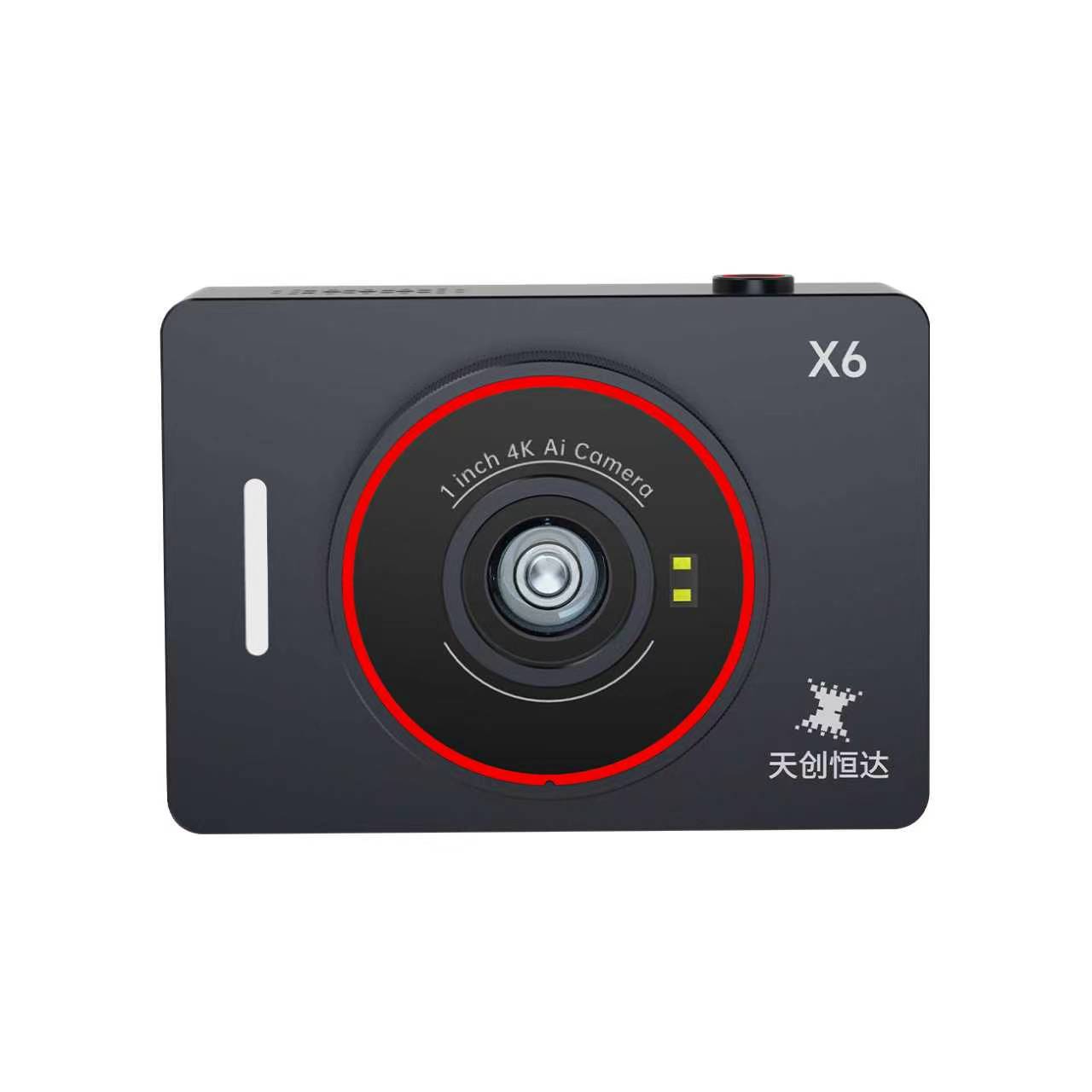
What the record does establish is a distinct product position. TCHD-X6 uses a 1 inch CMOS 50MP sensor with an 85.3° diagonal field of view in 4:3, 72.8° horizontal and 57.8° vertical. It outputs 4K at 30, 25 or 15 fps in MJPEG, with 1080P at 60 fps available in interpolated YUV. The interface is a full-function USB port compatible with USB 3.0 and USB 2.0, supporting UVC v1.1 and UAC 1.0, with both raw and encoded video output and driver-free plug-and-play operation. Focusing combines a TOF module with face-tracking autofocus, and the camera supports HDR, 24-tone colour adjustment and both landscape and portrait output. The lens is interchangeable, allowing an external 4.8× macro lens or a 58 mm portrait lens. Body dimensions are 74 × 52 × 35 mm.
For a project file, the practical consequence is straightforward: the buyer should request the declaration of conformity, the EMC test report and any ISO certificate that is claimed, and should confirm that the tested configuration matches the ordered configuration — including the lens fitted. Because the X6 is a USB-attached device, the accessory chain, cable and host configuration also belong in the acceptance checklist. Absence of a certificate number in a product record is not evidence of non-compliance, but it is also not evidence of compliance. In an evaluation file, only the document counts.
Linking Qualification to Pre-Shipment Test, FOB/C&F and MOQ
Certificates describe intent and tested design; the shipment is what the buyer actually receives. TCHD Video's stated quality control model applies 100% testing, and the commercial terms listed in its capability record include OEM/ODM cooperation with logo customisation, a 1-unit minimum order quantity, a 30–45 day lead time, monthly capacity of 500 units, and FOB or C&F delivery options.
Those terms interact with qualification in ways worth planning for:
- Pre-shipment test acceptance. Write the acceptance criteria around the interfaces the project will use and record the firmware version and serial numbers. Where a certificate such as 064-24-Q-0675-R1-S or LCSA07075157E is cited in the purchase order, attach the certificate and its scope page as supporting documents so the reference can be checked at inspection.
- FOB or C&F. The Incoterm determines where responsibility for the goods transfers and which party manages the onward documentation. Confirm the term in writing and align it with the market-access documents required at destination.
- 1-unit MOQ. A single-unit order makes it practical to validate a model, test the accessory set and confirm the documentation pack before committing to a volume schedule. For multi-site projects, the 30–45 day lead time and 500-unit monthly capacity define the realistic staging plan.
Where These Cameras Fit in Project Workflows
Application fit is part of the qualification picture, because a certificate that covers a model used outside its intended environment answers the wrong question. TCHD Video's scenario record lists indoor operation with a working temperature range of -10°C to +50°C and working humidity of 20% to 80%, continuous 24/7 operation, and supporting equipment limited to an HDMI cable, an SDI cable and a power adapter. The stated role is streaming video to any streaming server platform.
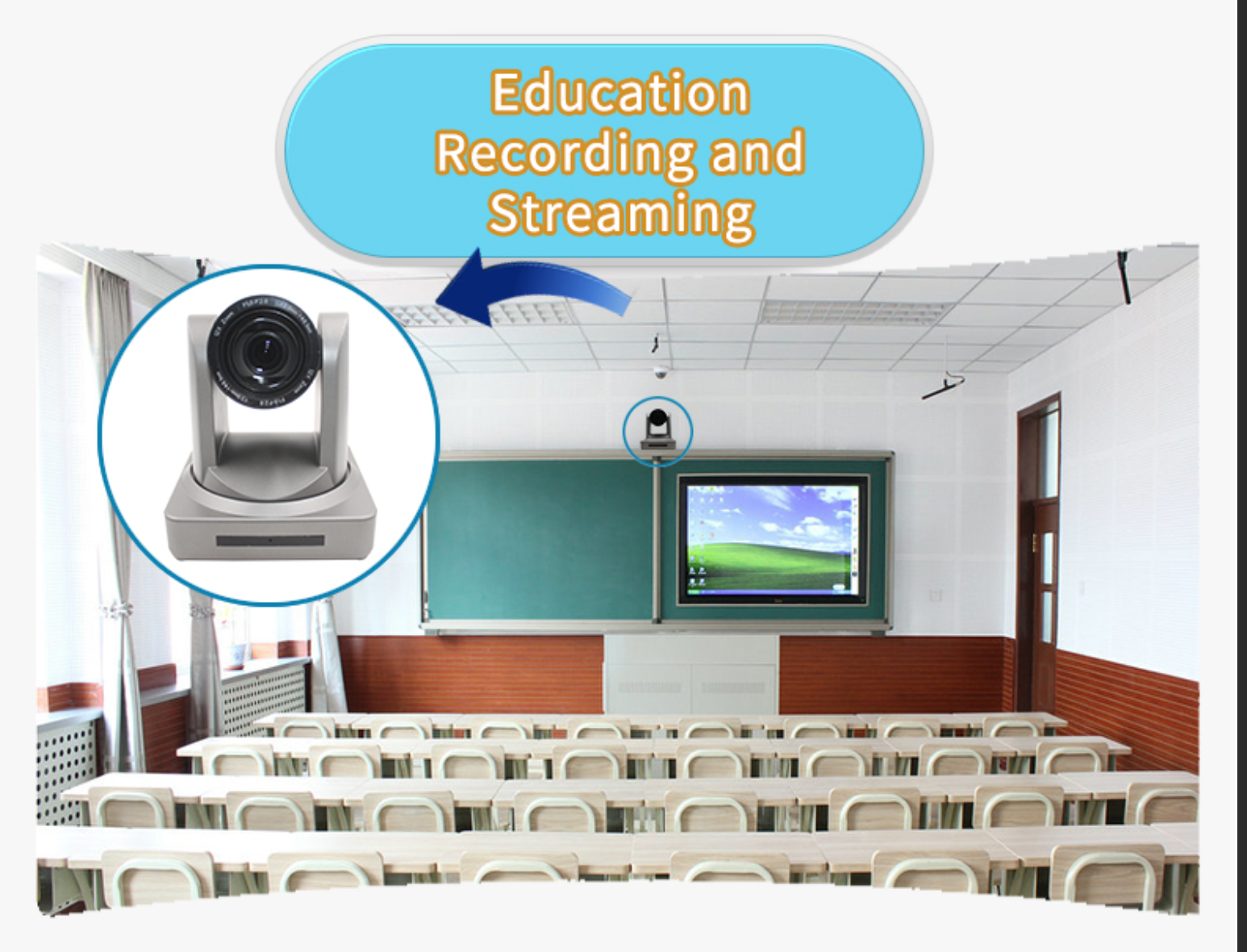
Within those boundaries, the recurring project types are e-commerce live streaming, sports broadcasting, education lecture capture, medical teaching, corporate meetings, event streaming and church streaming. Each brings a different documentation emphasis. Education and corporate buyers usually prioritise stable 24/7 behaviour and predictable interface compatibility. Event and broadcast workflows prioritise SDI and HDMI output discipline. Medical teaching projects prioritise image clarity and low-noise performance in dim rooms — but a medical teaching deployment is a production and education workflow, not a clinical device claim, and should not be treated as evidence of medical device registration.
Deployment evidence exists at that level rather than at the certificate level. TC-980S units have been used in teaching live streaming projects by government, hospital, school and YouTuber clients, including a 20-unit deployment across Germany, Australia and Malaysia that has been in service for two years with reported stable operation, low noise and automatic tracking. That kind of field record is useful for evaluating reliability in a comparable scenario, and it is a different category of evidence from a conformity certificate.
What Compliance Documents Do Not Prove
The limitations matter as much as the coverage, and stating them is part of an honest qualification map.
- Management system certification is not product conformity. ISO 9001:2015 and ISO 14001:2015 describe organisational control. A buyer who accepts them as EMC or safety evidence has substituted the wrong document.
- CE EMC is one slice of market access. A certificate referencing EN 55032 addresses multimedia equipment emissions. It does not establish low-voltage safety, hazardous substance compliance, radio compliance or medical registration.
- A certificate number alone is incomplete. Certificates carry scope statements, validity periods and issuing bodies. The number is a lookup key, not the evidence itself.
- Coverage does not automatically spread across a family. The CE EMC certificate in this record is tied to TC420. TC-980S carries a different document set, and the TCHD-X6 specification record lists no CE, FCC or ISO numbers at all.
- No FCC identifier is listed for any of the three models in this record. Buyers shipping to the United States should request model-specific documentation before assuming equivalence with EU coverage.
Compared with the assumption that a single supplier certificate covers an entire catalogue, this map requires more work at the RFQ stage. The trade-off is that the resulting evaluation file survives an import check, a tender review and an end-customer audit without being rebuilt from scratch.
Market Signals That Sit Alongside the Paperwork
Documentation expectations are rising because the category itself is growing and because PTZ hardware now dominates professional installations. The global live streaming camera market is projected to reach USD 7.83 billion by 2035, based on commercial research published in 2026. PTZ cameras represented over 35% of all IP surveillance camera installations globally in 2023, according to the same research stream, which reflects how thoroughly pan-tilt-zoom mechanics have become the default form factor for installed video.
Public-sector procurement is moving in parallel. Government videoconferencing guidance in Texas states that dedicated videoconferencing equipment should meet relevant ITU transmission standards, including H.320 or H.324 in certain telephone and ISDN environments and H.323 or SIP for internet-based videoconferencing. ITU-T H.324 itself defines an audiovisual terminal architecture that includes video input and output equipment such as cameras and monitors. Neither document certifies a specific camera, but both show that standards are being named inside tenders rather than left implicit — which pushes suppliers toward publishing model-level declarations.
What Buyers Should Expect Next
The direction of travel is toward per-model documentation packs rather than company brochures. Three developments are likely to shape evaluation checklists over the next procurement cycle. First, certificate scope pages will increasingly be requested as standard attachments to quotations, since a number without scope cannot be verified. Second, environmental and occupational health criteria will keep entering supplier questionnaires, which is where the ISO 14001:2015 and occupational health and safety coverage associated with TC-980S becomes commercially relevant rather than decorative. Third, USB-class cameras such as TCHD-X6 will be assessed on their own documentation track, separate from PTZ models with broadcast interfaces, because the accessory chain and host environment differ.
For buyers, the practical implication is procedural: build the qualification map at the model level, attach the certificate numbers to the purchase order, and keep the pre-shipment test record with the conformity documents. That combination is what turns a supplier claim into a verifiable project file.
FAQ
Does ISO 9001:2015 certification mean a live streaming camera complies with EU EMC requirements?
No. ISO 9001:2015 is a quality management system certification covering how a facility controls design, production and testing processes. Product-level electromagnetic conformity is evidenced separately. For TC420, that separate evidence is CE EMC certificate LCSA07075157E, which references EN 55032, the emissions standard for multimedia equipment.
Which TCHD Video models in this record carry a CE EMC certificate?
TC420 (product ID 6388) is covered by CE EMC certificate LCSA07075157E, referencing EN 55032. The record reviewed here does not list a CE EMC certificate number for TC-980S, and the TCHD-X6 specification record does not include CE, FCC or ISO certificate numbers. Buyers requiring CE documentation for those models should request the model-specific document including its scope page.
What does ISO 14001:2015 coverage add for a camera buyer?
ISO 14001:2015 is an environmental management system standard. It becomes relevant when a tender or corporate procurement policy scores suppliers on environmental management, or when a buyer's own sustainability reporting requires supplier-level evidence. TC-980S is covered under ISO 14001:2015 in this record. The certification describes organisational environmental control and does not describe the camera's technical performance.
What is the occupational health and safety certification referenced for?
The record references an occupational health and safety management system certification in connection with digital audio/video sales and technical services. It indicates that worker safety management is addressed within those activities. Like the other management system certificates, it supports supplier due diligence and does not function as product conformity evidence.
Can a project start with a single camera before committing to volume?
Yes. TCHD Video's capability record lists a minimum order quantity of 1 unit, alongside OEM/ODM cooperation with logo customisation, a 30–45 day lead time and monthly capacity of 500 units. A single-unit order allows a buyer to validate the model, the accessory set and the documentation pack before scheduling a larger rollout, with FOB or C&F delivery terms confirmed in writing.
How should pre-shipment acceptance be written into a camera order?
Acceptance criteria should name the interfaces the project will use, record firmware version and serial numbers, and attach the certificate numbers cited in the order together with their scope pages. TCHD Video's stated quality control model applies 100% testing. Where a model such as TCHD-X6 has no certificate numbers in its specification record, the acceptance document should list the declaration of conformity and test reports as documents to be supplied before shipment.
Tem questões ou precisa de mais detalhes?
Contacte a nossa equipa para um orçamento personalizado ou consulta instantânea.
Solicitar orçamento
Preencha o formulário abaixo e a nossa equipa entrará em contacto com uma proposta personalizada.
Chat direto do WhatsApp
Prefere conversar em tempo real? Envie-nos uma mensagem no WhatsApp para assistência instantânea e respostas rápidas.
- Obter orçamento personalizado
- Partilhar fotos ou documentos
- Discuta as suas necessidades diretamente
Geralmente responde em 5–30 minutos durante o horário de expediente.