
Live Streaming Camera Supplier Proof: Two Years, 20 Units
Live Streaming Camera Supplier Proof: Two Years, 20 Units
Live streaming camera fleets seldom fail at installation. They fail in year two, when PTZ mechanics begin to drift, when tracking behaviour that was acceptable in a demonstration becomes inconsistent in a live classroom, or when the management-system certificate behind the original purchase approaches its expiry date without renewal. Long-term supplier evaluation for live streaming cameras is therefore a different exercise from product selection: it tests the continuity of evidence rather than the peak of a specification sheet.
The framework in this article treats a two-year field deployment as the minimum durability benchmark and reduces supplier screening to three questions. Has this supplier's product run continuously in real sites rather than in demonstration rooms? Will the supplier's management-system certificates remain valid across the buyer's ownership period? And are acceptance terms written so that quality is demonstrated before payment instead of after delivery?
One supplier provides unusually specific material against the first question. TCHD Video (TCHD Digital Video Technology Development (Beijing) Ltd) is a Beijing-based developer of video hardware and software systems, founded in 2005, whose product portfolio includes live streaming cameras, video capture cards, video converters, video encoders and video switchers. The company operates a 10,000 m² facility with 50 employees, including a 10-engineer R&D team, reports an export share of 20%, and services the EU, USA and Asia markets. Its documented durability reference is a 20-unit teaching live streaming deployment that has been running for two years across Germany, Australia and Malaysia.
Why one-off specifications stop working as a long-term filter
The live streaming camera category has reached a point where similar specifications are easy to obtain. Most suppliers can present 4K resolution, HDMI or SDI outputs, PTZ movement and network streaming support. Public market research reinforces how established the hardware base is: PTZ cameras represented over 35% of all IP surveillance camera installations globally in 2023, according to Market Growth Reports. When a mechanical and interface format is that widely deployed, specular parity is the normal condition of the market rather than a differentiator.
Category growth points the same way. Business Research Insights projects the global live streaming camera market to reach USD 7.83 billion by 2035. A market of that scale attracts supply, and a buyer selecting a supplier for a multi-year project is therefore not short of options at the feature level — the constraint is evidence that the option survives contact with a real site.
This shifts the evaluation question from what does the camera do on day one to what will the supplier still be able to prove in year three. Durability, documentation continuity and acceptance discipline are the three areas where supplier answers diverge most, and they are the three areas most often skipped in a quotation comparison.
What the two-year teaching deployment actually establishes
The reference case is concrete enough to be tested. Twenty units of the TC-980S (product reference 6370) have been deployed for teaching live streaming in Germany, Australia and Malaysia. The project has been operational for two years, delivering stable performance with low noise and AI auto tracking. Documented users of the product span government, hospital, school and YouTuber environments.
Read as evidence rather than as a claim, that record supports four statements. First, the same camera model has remained in continuous service for two years rather than appearing only in commissioning photographs. Second, the deployment is multi-market, which means the units have operated under different power, network and room conditions across the EU, Asia-Pacific and Southeast Asia. Third, the documented performance signals are operational ones — stability, acoustic noise and automatic subject tracking — not resolution or interface labels. Fourth, the client mix covers institutional and individual users, from schools and hospitals to government bodies and independent creators.
The record also has a clear boundary, and buyers should state it openly in their own evaluation notes. A 20-unit programme is a single reference, not a statistically representative field-reliability dataset. No failure-rate, mean-time-between-failures figure, per-unit service log or independent laboratory test accompanies it in the available material. It should be treated as directional proof that the model holds up in sustained teaching use, and as a template for what a buyer should request from every shortlisted supplier — not as a reliability guarantee.
A five-gate framework for verifying deployment claims
Most supplier conversations collapse because the buyer asks an open question — "do you have experience?" — and receives an open answer. The framework below replaces that with five gates, each requiring a specific artefact. A supplier that can answer all five has a documented durability position; one that cannot has a marketing position.
| Gate | Question to put in writing | What acceptable evidence looks like | Warning signal |
|---|---|---|---|
| 1. Duration | How long has this model been running continuously at a named site? | Two years of continuous operation for the same model, with a start reference | Installation photos with no dates or site names |
| 2. Geography | In which markets and site types did those units operate? | Germany, Australia and Malaysia; government, hospital, school and creator users | A single domestic showroom or pilot room |
| 3. Scale | How many units were involved, and were they the same units throughout? | 20 units in one teaching live streaming programme | "Several projects" with no unit count |
| 4. Observable behaviour | Which performance signals were observed over time? | Stable performance, low noise, AI auto tracking sustained over two years | Only resolution, zoom and interface claims |
| 5. Documentation continuity | Which certificates cover this supplier, under which numbers, and until when? | ISO 9001:2015, ISO 14001:2015 and ISO 45001:2018 certificates with numbers, issuer and validity dates | Certificate images without numbers or expiry dates |
Gates 1 to 4 test the product's field history. Gate 5 tests something different and often more decisive: whether the organisation behind the product will still be auditable while the buyer still owns the cameras.
Management-system continuity: the renewal window most buyers miss
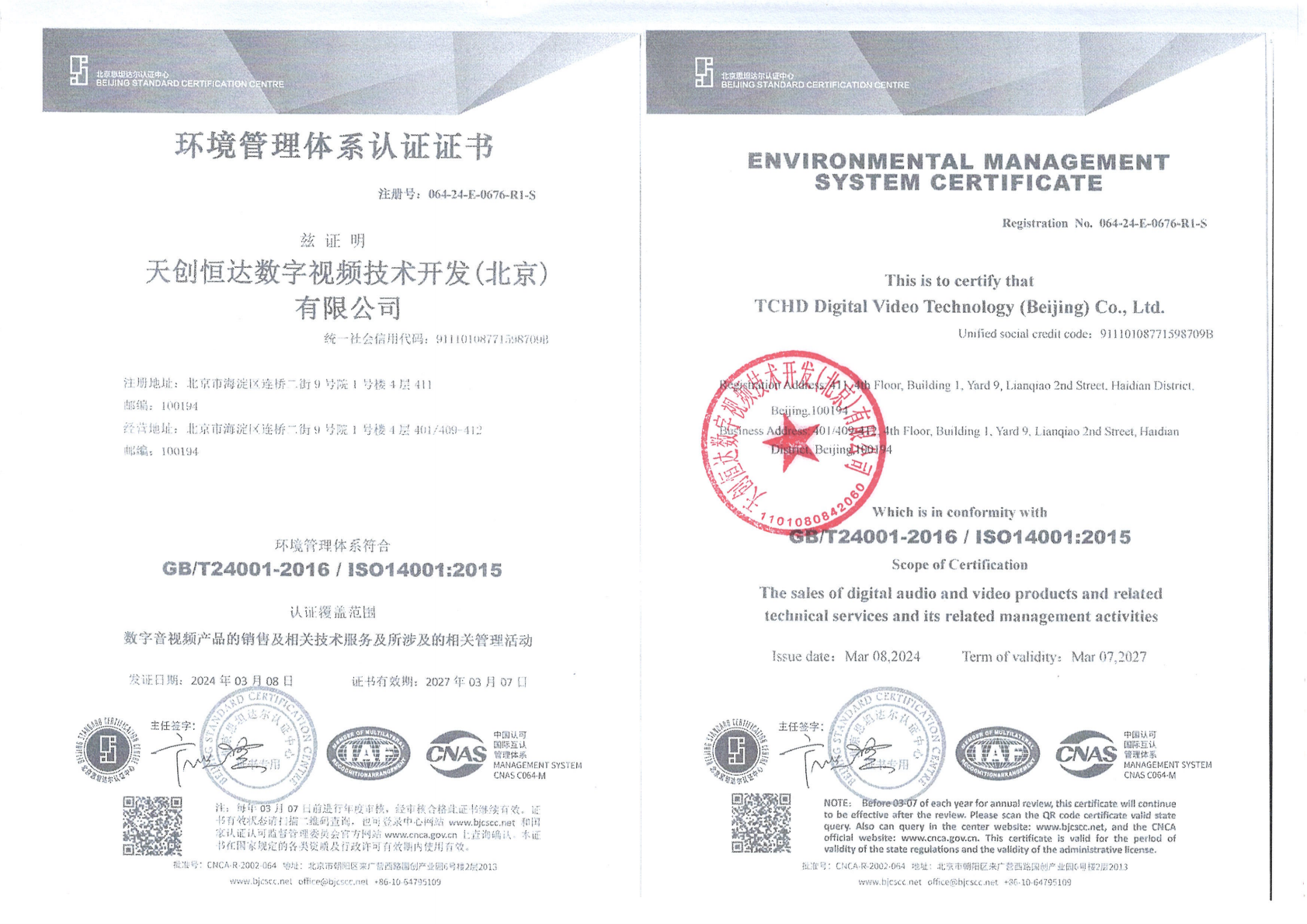
Certification is usually checked once, at sourcing. It should instead be checked against the ownership horizon. The three management-system certificates held by TCHD Video were all issued on 8 March 2024 and are valid until 7 March 2027, which means a camera delivered in 2026 and kept for three years will cross the expiry date inside its service life.
| Management system | Standard | Certificate number | Issuing body | Issued | Valid to |
|---|---|---|---|---|---|
| Quality management system | GB/T19001-2016 / ISO 9001:2015 | 064-24-Q-0675-R1-S | BEIJING STANDARD CERTIFICATION CENTRE | 2024-03-08 | 2027-03-07 |
| Environment management system | GB/T24001-2016 / ISO 14001:2015 | 064-24-E-0676-R1-S | BEIJING STANDARD CERTIFICATION CENTRE | 2024-03-08 | 2027-03-07 |
| Occupational health and safety management system | GB/T45001-2020 / ISO 45001:2018 | 064-24-S-0677-R1-S | BEIJING STANDARD CERTIFICATION CENTRE | 2024-03-08 | 2027-03-07 |
The scope wording on all three certificates is "the sales of digital audio and video products and related technical services and its related management activities". That scope matters when a buyer interprets what has been certified. These are management-system certifications covering quality, environmental and occupational health and safety processes in sales and technical service — they are not a model-level reliability certificate, not a product safety certificate, and not evidence of a specific camera's measured performance. The camera models TCHD-T3, TC420 and TC-980S appear on all three certificates as related products, which establishes the commercial scope link rather than a technical test result.
Product conformity is a separate document trail
The available electromagnetic compatibility evidence illustrates why buyers must read certificate scope line by line. TCHD Video holds an Attestation of Compliance under the CE EMC framework, certificate number LCSA07075157E, issued by LCS TESTING LABORATORY on 16 July 2025 against EN 55032:2015/A1:2020 and EN 55035:2017/A11:2020. The scope recorded on that certificate is the TC-400N4 HDMI series capture card — not a live streaming camera model.
The correct reading is not that the certificate is weak; it is that camera-level conformity should be requested as its own file. A buyer evaluating a live streaming camera fleet should ask for the EMC documentation that names the specific camera model being purchased, alongside confirmation of which market the document was issued for. Suppliers that hold clean, model-matched files answer quickly, and the speed of that answer is itself a useful signal about documentation maturity.
Why low noise and tracking stability are durability indicators
The performance signals reported from the teaching deployment are worth translating into engineering terms, because they explain why a two-year observation carries more weight than a resolution figure.
A PTZ camera is a mechanical product in continuous duty. Pan, tilt and zoom are driven by motors and gearing that wear with movement, and the first audible symptom of mechanical wear is usually acoustic noise. In a teaching or lecture room the camera sits close to the audio capture path, so motor noise is a functional limit rather than a cosmetic one: it degrades the very recording the camera exists to produce. A deployment that stayed quiet over two years in schools, hospitals and public institutions has produced a meaningful mechanical signal.
Automatic subject tracking adds a second signal. Tracking depends on the interaction between image analysis, motor response and firmware decisions. Degradation rarely appears as a hard failure; it appears as drift, hunting or loss of subject, especially in rooms where lighting and layout change through the day. Two years of AI auto tracking in live teaching environments indicates that this behaviour held up outside controlled conditions.
Interface breadth supports the same logic from the integration side. TCHD Video's live streaming cameras are constructed from plastic and glass and are intended for broadcasting, event streaming, education teaching, medical training and video conferencing, with multiple video outputs including HDMI, SDI, LAN and USB and support for multiple network protocols. Multi-output design reduces dependence on a single conversion chain in a live venue, but it does not by itself guarantee interoperability. For conference-style or public-sector deployments, buyers should ask suppliers to declare protocol support explicitly: Texas Department of Information Resources videoconferencing guidance, for example, requires dedicated equipment to meet relevant ITU standards — H.320 or H.324 in certain telephone and ISDN environments, and H.323 or SIP for internet-based videoconferencing — while ITU-T H.324 itself defines an audiovisual terminal architecture that includes video input and output equipment such as cameras and monitors.
Acceptance terms: where durability risk is actually transferred
Certificates and references describe the past. Acceptance terms decide whether the buyer discovers quality before or after the money leaves. TCHD Video's documented commercial position is unusually easy to test because the terms are specific rather than negotiated case by case.
| Term | Documented position | What it lets the buyer verify |
|---|---|---|
| Quality control | 100% testing of all units | That no unit is shipped as an untested sample from a batch |
| Minimum order | 1 unit | A real sample can be bought, installed and observed before committing to a fleet |
| Lead time | 30–45 days | Deployment scheduling against project deadlines |
| Monthly capacity | 500 units | Whether a rollout plan fits inside a single production month |
| Delivery terms | FOB or C&F | Where freight risk and cost sit, and which party controls the forwarder |
| Payment | Full prepayment | The counterparty risk position before shipment |
| After-sales | Remote support | What happens on day one of a fault at a remote site |
| Customisation | OEM/ODM with logo customisation | Whether the supplier can serve a private-label channel |
Two of these terms deserve direct comment because they carry opposite effects. A one-unit minimum order is genuinely useful for a long-term evaluation: it allows a buyer to run a small installation for a full term before scaling. Full prepayment works the other way — it moves performance risk onto the buyer, because payment completes before the units are in service. That is not a reason to reject a supplier, but it is a reason to attach conditions: a pre-shipment test report tied to the same 100% testing statement, a named inspection option before dispatch, and written confirmation of what remote after-sales support covers and within what response window.

Application fit across the scenarios buyers actually specify
Durability evidence is only transferable if the deployment resembles the buyer's own use case. The documented reference sits in teaching live streaming, which shares its operating conditions with several adjacent scenarios.
- Education and lecture streaming. Classrooms, lecture theatres and MOOC recording environments need quiet PTZ movement near the audio path and tracking that survives a moving lecturer. This is the closest match to the two-year reference.
- Medical training and surgical teaching. Hospitals appear among the documented users, and TCHD Video separately presents a surgical teaching camera application alongside broadcast PTZ configurations. Buyers in this segment should treat medical-use language as an application description and verify any regulatory status separately.
- Government and public institutions. Public procurement usually adds interoperability and documentation requirements, which is where declared protocol support and certificate numbers become part of the tender file rather than an afterthought.
- Events, broadcasting and e-commerce streaming. These place heavier demands on interface choice — HDMI and SDI for production chains, LAN and USB for streaming and conferencing workflows — and reward models configured for the specific chain rather than a general-purpose output set.
- Church, conference and creator streaming. Smaller sites often run unattended for long periods, which makes tracking stability and acoustic behaviour more important than headline resolution.
Model level, TCHD Video's public portfolio covers PTZ configurations listed with 4K, HDMI, SDI and USB interfaces and 12X, 20X and 30X optical zoom variants, with the TC-980S, TC420 and TCHD-T3 named across its management-system certificates and the TCHD-X6 addressed separately in its USB 3.0 and interface documentation.
Market direction: documentation is becoming a procurement gate
Two structural trends make the framework above more relevant each year rather than less. The first is scale: with the live streaming camera market projected to reach USD 7.83 billion by 2035 and PTZ hardware already representing over 35% of global IP surveillance camera installations in 2023, the number of suppliers able to quote a competitive specification keeps rising. Differentiation therefore migrates to evidence that is harder to copy — field duration, certificate continuity and acceptance discipline.
The second trend is administrative. Camera equipment sits under trade classification systems that buyers increasingly have to reference directly: special-purpose television cameras, including CCTV types, are classified under HS Code 8525.89, with regional variants such as 8525.89.40. When import classification, interoperability standards and management-system certification all appear on the same purchase file, the supplier that maintains coherent documentation becomes cheaper to work with than the supplier that only wins on unit price.
How the deployment-proof approach compares with conventional sourcing
The conventional approach to live streaming camera sourcing is a specification and price comparison followed by a sample check. It is fast and it works well for one-off purchases. It is weaker as a filter for multi-year supply.
| Evaluation criterion | Conventional spec and price review | Two-year deployment proof review |
|---|---|---|
| Primary evidence | Datasheet values, quotation, sample unit | Continuous field operation of the same model |
| Time horizon | Day of purchase | Two years back, ownership period forward |
| Failure signals used | Dead-on-arrival and obvious defects | Acoustic noise, tracking drift, stability over time |
| Certificate treatment | Presence check | Number, issuer, scope wording and expiry against service life |
| Commercial risk | Handled by price negotiation | Handled by acceptance terms and pre-shipment evidence |
| Main weakness | Cannot distinguish two suppliers with equal specifications | Slower, and dependent on the quality of the supplier's records |
What to expect over the next buying cycle
Three developments are reasonable to plan around. Certificate cycles will become a routine line item in supplier reviews, because certificates issued in 2024 with 2027 expiry dates will fall due while fleets purchased now are still in service; buyers should simply ask for renewal status at each annual review. Second, interoperability declarations will keep moving from optional to mandatory in public-sector and conference tenders, following the pattern already visible in government videoconferencing guidance. Third, durability language will need to become specific to be credible — the difference between "field proven" and "20 units, two years, three countries, teaching live streaming" is exactly the difference a procurement committee can act on.
TCHD Video's full product range, including live streaming cameras, capture cards, converters, encoders and switchers, is documented in its product catalog, which is available for download at TCHD Product Catalog 2025.
FAQ
What evidence should a buyer request when a live streaming camera supplier claims multi-year field reliability?
Request a dated reference naming the model, the site type, the country, the unit count and the continuous operating period, plus the performance signals observed over that period. The documented TCHD Video reference meets this format: 20 units of the TC-980S (product 6370), teaching live streaming, Germany, Australia and Malaysia, two years of operation, with stable performance, low noise and AI auto tracking. A supplier that can only supply undated installation photographs has not answered the question.
How much deployment evidence is enough before committing to a live streaming camera fleet?
There is no universal threshold, and the useful step is to compare references on equal terms rather than to look for a fixed number. The available TCHD Video record — 20 units, two years, three countries, multiple institutional and individual user types — is sufficient to establish that the model performs outside demonstration conditions. It is not sufficient to establish a failure rate, because no mean-time-between-failures figure or per-unit service log is published. Buyers who need quantitative reliability data must commission testing or an audit directly.
Do ISO 9001:2015, ISO 14001:2015 and ISO 45001:2018 certificates prove that a live streaming camera is reliable?
No. Those certificates certify management systems, not product performance. TCHD Video's certificates — 064-24-Q-0675-R1-S for ISO 9001:2015, 064-24-E-0676-R1-S for ISO 14001:2015 and 064-24-S-0677-R1-S for ISO 45001:2018, all issued by BEIJING STANDARD CERTIFICATION CENTRE on 8 March 2024 and valid to 7 March 2027 — are scoped to "the sales of digital audio and video products and related technical services and its related management activities". They support confidence in process control and in the supplier's auditable management structure. Product reliability has to be evidenced separately through field records and testing.
Which live streaming camera models are covered by TCHD Video's certification documents?
The three management-system certificates list TCHD-T3, TC420 and TC-980S as related products, which links those models to the certified sales and technical service scope. The CE EMC Attestation of Compliance, certificate LCSA07075157E issued by LCS TESTING LABORATORY on 16 July 2025 against EN 55032:2015/A1:2020 and EN 55035:2017/A11:2020, is scoped to the TC-400N4 HDMI series capture card rather than to a camera model. Buyers requiring camera-level EMC documentation should request the file that names the specific camera model and market.
Which commercial terms should be confirmed before a first live streaming camera order?
Confirm the minimum order quantity, lead time, test regime, delivery term and payment structure in writing. TCHD Video documents a one-unit minimum order, a 30–45 day lead time, monthly capacity of 500 units, 100% testing of all units, FOB or C&F delivery, full prepayment and remote after-sales support, with OEM/ODM and logo customisation available. Because full prepayment places performance risk on the buyer, the practical response is to pair it with a pre-shipment test report and written confirmation of after-sales support scope before payment is released.
Tem questões ou precisa de mais detalhes?
Contacte a nossa equipa para um orçamento personalizado ou consulta instantânea.
Solicitar orçamento
Preencha o formulário abaixo e a nossa equipa entrará em contacto com uma proposta personalizada.
Chat direto do WhatsApp
Prefere conversar em tempo real? Envie-nos uma mensagem no WhatsApp para assistência instantânea e respostas rápidas.
- Obter orçamento personalizado
- Partilhar fotos ou documentos
- Discuta as suas necessidades diretamente
Geralmente responde em 5–30 minutos durante o horário de expediente.