
Load, Speed, and Self-Locking: A Practical Screw Jack Selection Framework
Load, Speed, and Self-Locking: A Practical Screw Jack Selection Framework
Selecting a linear actuator is not a matter of picking the highest load rating. In real projects, the right screw jack is the one whose screw type, speed range, and self-locking behavior match the machine’s duty cycle and operating environment. This article is written for engineers and procurement teams who are evaluating linear actuator options for a specific application and need a practical reference for screw jack selection.
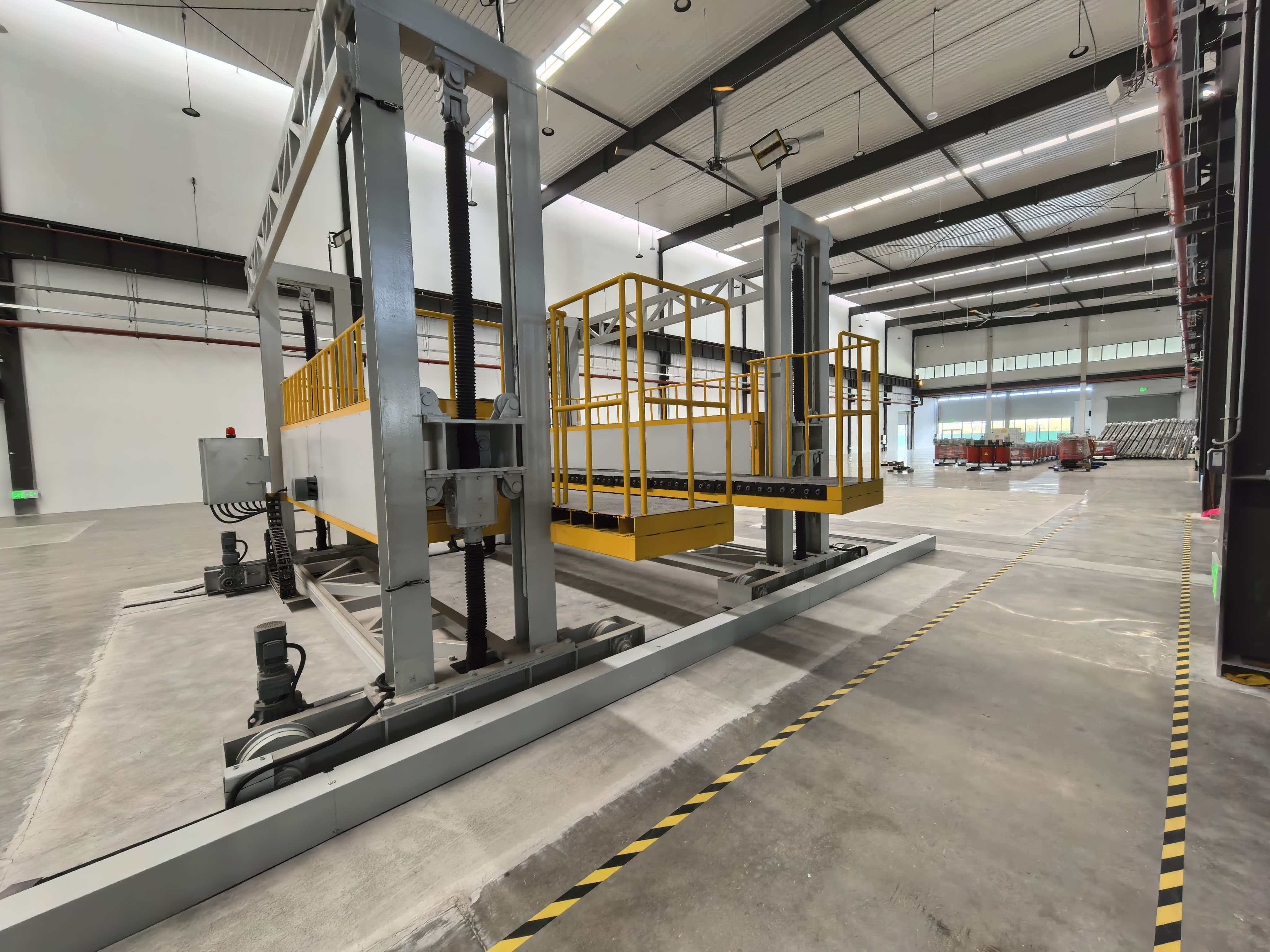
A synchronous lifting platform is a typical multi-point screw jack application.
Why application fit is the first decision in linear actuator procurement
Industrial projects impose very different motion requirements. An automated packaging line may need a high-speed ball screw jack that runs continuously and positions accurately, while a metallurgical lifting platform may need a low-speed trapezoidal screw jack that can hold a heavy load when the motor is off. Using the same linear actuator in both cases would mean either accepting the risk of back-driving or paying for more speed than necessary.
Worm gear screw jacks are a common subset of linear actuators because they combine a right-angle worm gear drive with a screw mechanism. However, the internal screw architecture—ball screw or trapezoidal screw—changes the operating characteristics more than the gearbox ratio. Buyers who understand these differences can avoid a significant source of project risk: actuator mismatch.
Three screw jack architectures cover most project requirements
JINYU’s product line is a useful example of how a single manufacturer organizes the choice. Shandong Dezhou Jinyu Machinery Co., Ltd., headquartered in Dezhou, Shandong Province, is a professional manufacturer of reducers, screw jacks, and servo electric cylinders. The company reports a factory area of 20,000 m², 258 employees, and 30% of production exported to markets in the EU, USA, and Asia.
The three screw jack series—JWB, JWM, and SWL—are designed for distinct operating profiles. JWB is a ball screw jack and high-speed screw jack. JWM is a trapezoidal screw jack and low-speed screw jack. SWL is a self-locking screw jack available with manual or electric drive. In addition, the company supports ODM modification of size, load, stroke, gear ratio, voltage, logo, and material, including stainless steel screw jack versions. The monthly capacity of 10,000 units and 30–45 day lead times are directly relevant to project procurement, especially when a custom stroke or gear ratio is required.
Technical comparison of JWB, JWM, and SWL
Ball screw jacks have lower friction and higher efficiency. This supports higher speed and continuous operation. But the ball screw cannot lock by itself; if the application is vertical, the load can rotate the screw and fall when the motor stops. JINYU specifies that the JWB ball screw jack must be used with a brake motor.
JWM trapezoidal screw jacks use a sliding thread, which creates more friction and lower speed, but provides self-locking. The JWM is intended for heavy loads, low speed, general positioning accuracy, and frequent start-stop cycles. It is suitable for vertical jacking where holding position matters.
SWL is similar in principle—a trapezoidal, self-locking screw—but is tuned for lighter loads and intermittent service. It is used for lifting, turning, and fine adjustment of general industrial equipment.
| Series | Screw type | Lifting capacity | Speed range | Self-locking | Typical operating profile |
|---|---|---|---|---|---|
| JWB | Ball screw | 5–500 kN | 0.5–5 m/min | No | High precision, medium/high speed, continuous operation |
| JWM | Trapezoidal screw | 1–1000 kN | 0.2–1.8 m/min | Yes | Heavy load, low speed, frequent start-stop |
| SWL | Trapezoidal screw | 2.5–120 t | 0.1–0.6 m/min | Yes | Light/medium load, intermittent, stable positioning |
Material specifications are consistent across the three series: 40Cr or 45# steel for the screw, HT200 cast iron for the housing, bronze (CuSn6Zn6Pb3) for the nut, 40Cr or 42CrMo for the gear, and 45# carbon steel for the shaft. These are conventional industrial materials, and the bronze nut is a common choice for worm gear screw jack service.
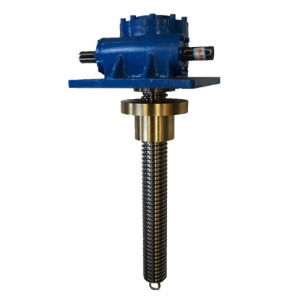
The SWL series is a self-locking trapezoidal screw jack designed for intermittent industrial duty.
A project selection framework
Step 1: Define the duty profile. Is the actuator required to run continuously, intermittently, or in frequent start-stop cycles? JWB is suited to continuous operation; JWM to heavy, low-speed, start-stop cycles; SWL to light, intermittent duty.
Step 2: Define load and speed. JWB covers 5–500 kN at 0.5–5 m/min. JWM covers 1–1000 kN at 0.2–1.8 m/min. SWL covers 2.5–120 t at 0.1–0.6 m/min. If speed is the priority, a ball screw is usually necessary; if load is heavy but speed is not, a trapezoidal screw is more practical.
Step 3: Determine self-locking need. For vertical applications where the load must remain fixed after power off, choose a trapezoidal screw (JWM or SWL) or add a brake motor to the JWB ball screw.
Step 4: Check environmental constraints. JWB operates from -20°C to 80°C with IP55–IP65 protection; JWM operates from -20°C to 100°C with IP55–IP65; SWL operates from -20°C to 80°C with IP54–IP55. For corrosive conditions, stainless steel material variants should be considered.
Step 5: Review customization options. Because JINYU can modify load, stroke, gear ratio, voltage, and material, a project that does not fit a catalog model does not necessarily need a different manufacturer.
Applications mapped to operating conditions
JWB is specified for high-speed automation production lines, robotic equipment, precision lifting platforms, logistics conveying, aerospace auxiliary equipment, and CNC machine tools. The operating environment is defined as -10°C to 45°C without strong corrosive media. Because of its high transmission efficiency, JWB is suitable for high-frequency reciprocating motion; the brake motor requirement is an integral design consideration.
JWM is used in precision machinery, automation lines, medical equipment, packaging machinery, tooling fixtures, plastic machinery, and printing machinery. In documented use, it also appears in metallurgical equipment and tooling platform jacking. It is driven manually or by motor at low speed, with short continuous running time and frequent start-stop, mainly for vertical jacking. The trapezoidal thread provides reliable self-locking to maintain stable positioning under heavy load.
SWL fits metallurgy, machinery, lifting platforms, water conservancy, construction, stage equipment, and grain and oil processing. This is the series for stable lifting, turning, and fine adjustment of general industrial equipment, under light load and intermittent operation.
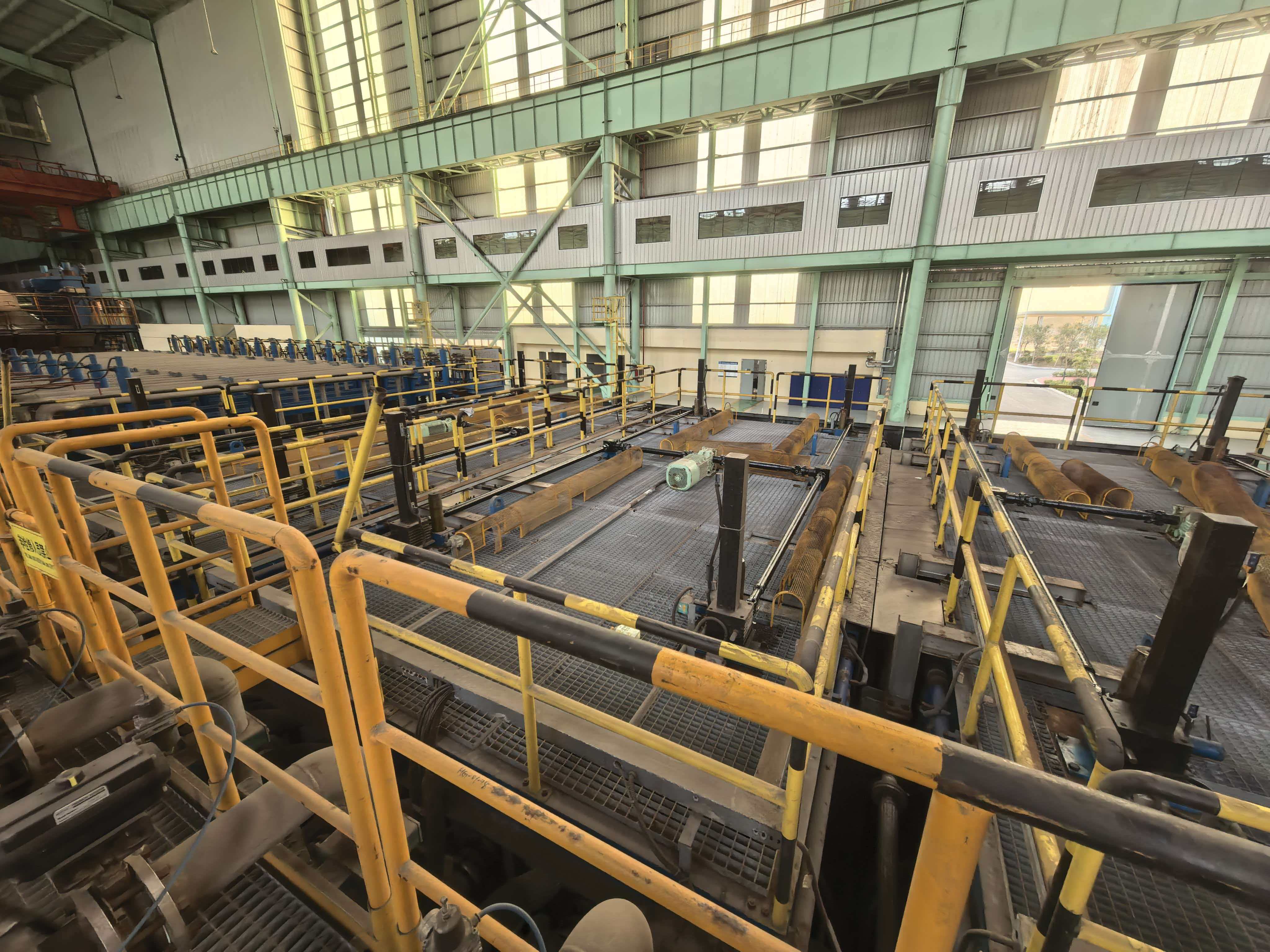
JWM screw jacks are used in metallurgical strip finishing line applications.
Case reference: JINYU reports supplying 80 JWM units to an Italian industrial automation and metallurgical equipment manufacturer for a synchronous lifting system on a Danieli strip finishing line. The system has been in operation for eight years. The reported performance includes stable multi-point synchronous lifting, high positioning accuracy, reliable self-locking, and long-term continuous operation in a metallurgical environment. This is an example of how a self-locking trapezoidal screw jack supports a synchronized line where load holding is critical.
Market context and what it means for buyers
At the macro level, the linear actuator market is expanding with automation. According to data compiled in a 2024 industry review, the global linear actuator market was valued at USD 52.67 billion in 2023 and is projected to reach USD 94.3 billion by 2030. A separate screw jacks market report estimates the sector at USD 14.26 billion in 2024, with a CAGR of 5.91% to USD 26.82 billion by 2035.
Worm gear screw jacks are the dominant subcategory, holding an estimated 38.5% share of the screw jack segment in 2025; the reasons cited are self-locking features and heavy-load capacity. Asia-Pacific led the overall linear motion market with a 42.3% revenue share in 2025. These figures are consistent with the growing role of screw jack suppliers in industrial equipment and components procurement.
One material-level trend is the increasing use of stainless steel screw jacks in offshore wind and food processing, where corrosion resistance is a requirement. JINYU’s customization offer includes stainless steel screw jack models, which makes the same worm gear screw jack architecture available for those industries.
Limitations and boundary conditions
Screw jacks are not the universal answer for every linear motion task. Their limitations are important to acknowledge at the project level. Ball screw jacks can run at higher speed but are not self-locking, so a brake motor adds cost and complexity. Trapezoidal self-locking screw jacks have lower efficiency and speed, which makes them unsuitable for high-speed continuous motion. Compared with hydraulic systems, screw jacks have a more compact mechanical package and cleaner holding behavior, but they do not offer the high force density and shock absorption of hydraulic cylinders in extremely high-power applications. Therefore, a screw jack selection framework must always be applied with the application boundary in mind.
Future outlook
The direction in industrial procurement is clearly toward application-matched actuators. As automation lines become more modular, buyers are more likely to specify based on operating profile rather than generic component type. This favors manufacturers that can provide both performance data and configuration flexibility. Standards such as IEC 62841-1:2014 for motor-operated tools and actuators also push buyers to expect documented safety compliance and mechanical hazard evaluation. The combination of market growth and standardization suggests that screw jack selection will become even more engineering-intensive in the coming years.
Engineers and procurement teams seeking more detailed product specifications and configuration data can access JINYU’s product brochure here: Download JINYU product brochure (PDF).
FAQ
What is the difference between a ball screw jack and a trapezoidal screw jack?
A ball screw jack uses ball recirculation for higher efficiency and speed, but it does not self-lock. A trapezoidal screw jack uses a sliding thread and provides self-locking, making it suitable for heavy load and low-speed vertical lifting. In JINYU’s range, JWB is the ball screw type; JWM and SWL are trapezoidal types.
Does a JWB ball screw jack require a brake motor?
Yes. In vertical use, the load can back-drive through a ball screw because there is no self-locking property. JINYU states that the JWB must be used with a brake motor.
What operating conditions are suitable for the JWM series?
JWM is designed for heavy load, low speed, general positioning accuracy, and self-locking. The working temperature range is -10°C to 40°C without strong corrosive media. It is driven manually or by motor, with short continuous running time and frequent start-stop, mainly for vertical jacking.
When is the SWL series the appropriate choice?
SWL is appropriate for light load, medium/low speed, and intermittent operation. It is designed for lifting, turning, and fine adjustment of general industrial equipment in a normal indoor temperature environment without severe impact, and it has self-locking performance.
What supporting equipment is needed for a motorized screw jack?
Typical supporting equipment includes a motor, coupling, protective cover, and control system. This is defined in JINYU’s application data and applies to all three series when used in an automated system.