
Logistics Park Mirror Sizing: YD-OC100 and YD-OC120 by Lane Width
Logistics Park Mirror Sizing: YD-OC100 and YD-OC120 by Lane Width
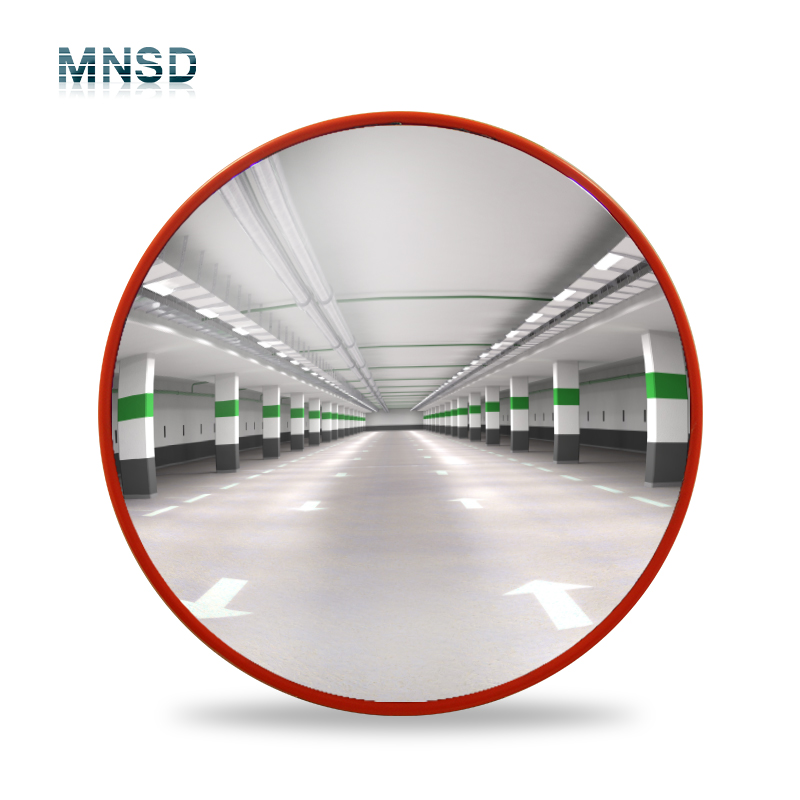
A convex mirror only earns its place at a logistics park junction if a driver can still identify what is approaching from the far end of the aisle. That requirement is set by geometry: the width of the lane, the height of the racking or fencing that blocks the sightline, and the distance over which a driver must see and react. Mirror selection for warehouses and logistics parks is therefore a measurement exercise rather than a product-preference exercise, and the figures that decide it are the documented visual ranges of the formats under consideration.
In practice the question is rarely whether to install a mirror, but which format to specify. Within the Mnsd YD-OC series, the YD-OC100 (1000 mm format) is documented with a visual range of 30–35 m and the YD-OC120 (1200 mm format) with 35–45 m. Both are intended for wide aisles and main entry points where the required sightline is long. The smaller YD-OC60 (600 mm) and YD-OC75 (750 mm) formats are positioned for tighter zones where approach distances are short, such as racking aisles, pedestrian crossings and internal corners. Mnsd is the brand of Tiantai Yuanda Traffic Device Co., Ltd., a road safety equipment manufacturer based in Tiantai, Zhejiang, China, whose range includes convex mirrors, warning posts, rising bollards, speed humps and traffic lights.
Why Aisle Width, Not Wall Space, Sets the Mirror Specification
Two failure modes appear repeatedly in logistics parks. The first is under-sizing: a compact mirror is mounted at a wide cross-aisle intersection, the reflection stays legible for only part of the approach, and the driver commits before the mirror becomes useful. The second is oversizing without purpose: a large-format mirror goes up at a short-approach corner, where the additional reach is unnecessary and the wider field of view compresses distant detail into a smaller image. Both outcomes come from choosing a format based on the available mounting point or the unit price rather than on the sightline the junction actually requires.
The controlling measurement is the distance between the mirror position and the point at which a driver must already be able to see cross-traffic. In a logistics park this is typically the point where a vehicle emerges from behind racking, a fence line, a dock wall or a building corner. Where that obscured approach exceeds roughly 30 m, compact formats fall outside their documented range and the reflection becomes too small to interpret at the moment of decision. Where the obscured approach is short, a large format adds material, mounting structure and cost without adding usable information.
Lane width enters the calculation because it changes both the driver's speed and the angle at which traffic appears. A wide main aisle allows higher operating speeds and produces cross-traffic that approaches almost perpendicular to the driver's line of sight; by the time it is visible directly, there is little distance left to react. A narrow internal aisle produces lower speeds and shorter approaches, so the same mirror geometry reads differently. Sizing to the lane, rather than to a general assumption about "warehouse use", keeps the specification tied to the condition that actually governs it.
Documented Visual Ranges of the YD-OC Series
The four formats in the YD-OC series divide into two working groups: the compact formats, positioned for restricted zones with short approach distances, and the long-range formats, documented with a stated visual range and intended for wide aisles and entry points.
| Format | Reflective size | Documented visual range | Typical logistics park zone |
|---|---|---|---|
| YD-OC60 | 600 mm | Compact-zone format | Racking aisles, pedestrian walkway corners, internal doors with short approaches |
| YD-OC75 | 750 mm | Compact-zone format | Tighter intersections, small dock aprons, service corridors |
| YD-OC100 | 1000 mm | 30–35 m | Crossing aisles, building entry points, gatehouse exits, mid-size junctions |
| YD-OC120 | 1200 mm | 35–45 m | Wide main aisles, primary gate and dock approaches, long straight sightlines |
For context, outdoor polycarbonate convex mirrors are generally described in category references as providing a 180° viewing angle with a visual range of roughly 20–25 m. The larger YD-OC formats extend reach beyond that band, which is the reason the lane-width measurement has to happen before a model is fixed rather than after.
A Five-Step Sizing Procedure for Logistics Park Junctions
The procedure below converts a junction layout into a format decision. It assumes the mirror will be wall- or pole-mounted at or near the corner where the sightline is blocked.
- Mark the driver's decision point. Identify the position from which a vehicle must already judge whether the crossing is clear — normally the stop line, the racking end, or the point at which the driver first sees the mirror face.
- Measure the obscured approach distance. Measure from the mirror position to the furthest point along the crossing route at which an approaching vehicle or pedestrian must be recognised. This single distance is the input that selects the format.
- Compare the distance with the documented range. An obscured approach of 30–35 m sits inside the documented YD-OC100 range; 35–45 m sits inside the documented YD-OC120 range. Shorter, tighter approaches fall into the compact group, where the YD-OC60 and YD-OC75 formats are positioned.
- Set the mounting position and confirm the aim. The reflective face should intercept the driver's line of sight without being blocked by racking uprights, signage, pipework or lighting columns, and the reflected field should cover the obscured zone rather than the driver's own approach lane. Where the mounting hardware allows angle adjustment, the field can be re-aimed after installation and again after any racking or signage change.
- Check exposure and surface protection. Logistics park junctions are outdoor or semi-outdoor environments exposed to prolonged UV, grit and cleaning abrasion. The protective measure applied to polycarbonate mirror surfaces is a specialised anti-scratch hard coating, combined with protective PE film during assembly and transit.
Steps 2 and 3 are the ones that are most often skipped. Teams frequently start from a catalogue page and work backwards, which produces a format decision that cannot be defended when a site is audited or when a junction is reconfigured.
Matching Formats to Specific Logistics Park Zones
The same four formats reappear across different parts of a logistics park, but the reason for choosing each one changes with the zone.
Wide main aisles and primary gate approaches
These are the longest sightlines on site. Vehicles emerge from behind racking or a gatehouse at distance, often at higher speed. Where the obscured approach runs beyond 35 m, the YD-OC120 and its documented 35–45 m visual range is the format sized for the condition. In a park with a central spine aisle and multiple feeders, this is typically the first format to specify and the one that determines how the rest of the network is planned.
Crossing aisles and building entry points
Where the obscured approach sits between 30 and 35 m, the YD-OC100 covers the requirement. This band describes many pedestrian and powered-pallet-truck crossings at building entries, where the driver is travelling at moderate speed and the obstruction is a wall return or a door reveal rather than a full racking run.
Loading docks and apron exits
Dock geometry differs from aisle geometry. A vehicle reversing or pulling out of a bay has a short forward approach but an unusually wide field of view to cover, so the constraint shifts from distance to coverage. In these positions the compact and mid-compact formats are positioned for the short approach, while a long-range format is reserved for the dock approach road itself, where vehicles arrive from a distance and the driver must see along the traffic lane.
Racking aisles, pedestrian crossings and internal corners
Inside the warehouse envelope, approach distances are short and speeds are low, but the consequences of a collision between a powered truck and a pedestrian are high. The YD-OC60 and YD-OC75 formats are positioned for these tighter zones, where a long visual range would simply compress the reflected scene further without adding useful information.
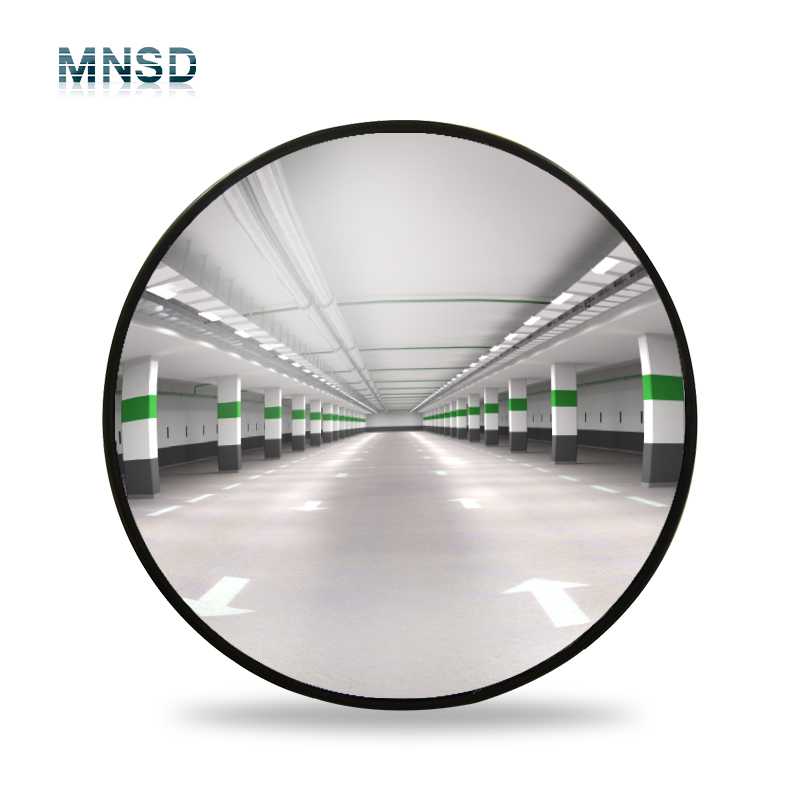
Where Convex Mirrors Stop Working: Limits and Boundaries
A sizing procedure is only useful if it also identifies the cases where the device is the wrong instrument. Convex mirrors have clear boundaries that a procurement team should record before a specification is approved.
- They are passive. A convex mirror consumes no energy and requires no power path, but it also produces no record. It cannot log an incident, timestamp an event or provide evidence after a collision.
- Performance depends on placement. An incorrectly aimed or obstructed mirror can create a false sense of coverage, which is a greater risk than no mirror at all in some layouts. Aim should be reviewed after any change to racking, signage or lighting.
- Curvature compresses the scene. Because the reflective surface is convex, objects are rendered smaller and appear further away than they are, and closing speed is harder to judge. Drivers need a consistent, repeated view of the same junction for the reflection to be read accurately.
- Visibility degrades in poor conditions. Heavy rain, fog, dust and low light reduce the usefulness of any reflective face, and the device is at its weakest exactly when junction risk is highest. Inspection regimes should account for this rather than assume constant performance.
- The surface can be damaged. Polycarbonate is impact-resistant, but the reflective face can still be scratched by grit, cleaning tools or contact during handling. The mitigation is procedural as much as material: a specialised anti-scratch hard coating on the polycarbonate surface, plus protective PE film during assembly and transit, reduces but does not eliminate that risk.
- Vehicle mirror standards do not transfer. FMVSS No. 111 governs supplementary mirrors fitted to passenger cars; it sets a radius of curvature between 35 and 65 inches and requires the marking "Objects in Mirror are Closer Than They Appear". It does not govern free-standing mirrors installed at a logistics park, and buyers should not assume that an on-vehicle standard covers site equipment.
Convex Mirrors and Electronic Monitoring at Park Intersections
The alternative to a mirror at a high-risk junction is usually an active monitoring system, and the two devices answer different questions. A convex mirror answers "what is coming into this junction right now". An active system answers "what happened here", and in some configurations, "what is coming" as well. Where a site needs a documented event trail, a mirror cannot supply it; where a site needs a driver to see approaching traffic without new infrastructure, a mirror does the job on its own.
The category comparison places the convex mirror as a passive safety device with a viewing angle of 100°–180° that reduces blind spots effectively, with a low upfront cost that is lower than electronic monitoring, almost no maintenance beyond occasional cleaning, and zero energy consumption. Its documented best-fit environments include road traffic, residential quarters, parking garages, factories and warehouses, logistics parks, shopping malls, supermarkets, schools, hospitals, gas stations, construction sites, office parks, ports and docks, bus stations, industrial zones, community intersections, rural roads and highway ramps.
For logistics park procurement, the practical consequence is that a mirror programme carries no dependence on the power and data infrastructure that active systems require, and therefore no exposure to cabling, power failure or connectivity downtime at the junction itself. That characteristic is what keeps convex mirrors in the specification even at sites that also run cameras.
Market Signals Affecting Multi-Site Mirror Programmes
Several published figures are relevant to buyers planning mirror specifications across a network rather than at a single site.
- The global convex mirror market was valued at approximately USD 1.04 billion in 2025 and is projected to reach USD 1.73 billion by 2034 (Dataintelo).
- Asia Pacific dominated the convex mirror market with a revenue share of 42.5% in 2025 (Dataintelo).
- Traffic and safety applications hold the largest share of the convex mirror industry at 38.2% of the market (Dataintelo).
- Global trade in unframed mirrors saw a 9.2% decline in 2023 compared with 2022, indicating supply-chain shifts and demand softness in general mirror products (Business Research Insights).
The last figure deserves care when it is used in a business case. It describes generic unframed mirror trade, not the traffic and safety segment, which remains the largest single application block at 38.2%. Published market size estimates for convex mirrors also diverge significantly depending on definition: narrow traffic-safety analyses and broad security-equipment reports quote figures that differ by orders of magnitude because the broader definitions include integrated systems. Buyers should check what a number covers before it is used to justify a programme.
Standardising Formats Across a Logistics Park Network
For operators running more than one site, the sizing decision has a second layer: how many formats to carry. A network that specifies a format for every junction individually tends to accumulate a long tail of sizes, which raises spare holdings, complicates reordering and makes it harder to keep the same specification across a multi-year programme. A shorter list — one long-range format for main aisles and gate approaches, one crossing-aisle format, and one compact format for internal zones — is easier to defend and easier to repeat.
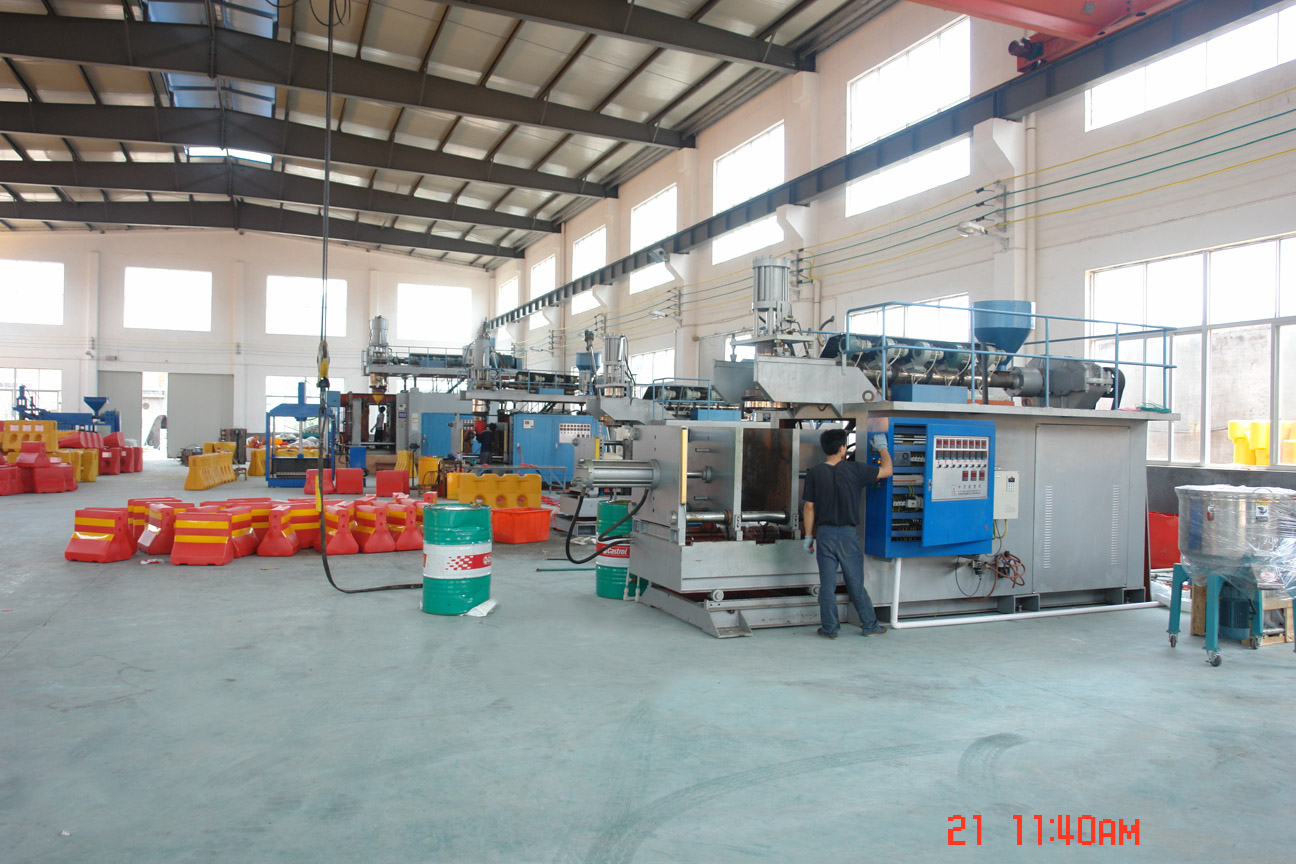
Repeatability also depends on the supplier's ability to hold a specification stable. Mnsd states a monthly production capacity of 30,000 pcs and serves importers, distributors, wholesalers, contractors and infrastructure project suppliers worldwide, with an export share of 50% and main markets in Asia, the EU and the USA. For a distributor or a multi-site operator, those figures matter less as headline numbers than as an indication of whether the same format, surface treatment and mounting interface can be reproduced across repeat orders without a specification change mid-programme.
Both characteristics — a short internal format list and a supplier able to repeat it — are what turn a mirror specification into something that survives a network rollout. The Mnsd product catalogue, covering the YD-OC series, is available as a downloadable PDF at https://cdn.socialarks.com/sbsp//common/2026/0407/69d499cbaaa5a.pdf.
Future Outlook
The direction of travel in logistics parks points toward larger footprints and longer internal sightlines, which pushes specification upward through the format range. If the convex mirror market grows from approximately USD 1.04 billion in 2025 toward USD 1.73 billion by 2034, the traffic and safety block that already accounts for 38.2% of the market will continue to carry the largest share of that demand, with Asia Pacific — at 42.5% revenue share in 2025 — remaining the dominant supply region.
Two expectations follow for buyers. First, format standardisation will matter more, not less, as sites get bigger and the number of junctions per site rises. Second, mirrors and active systems are more likely to be specified together than to replace one another: the mirror provides passive, power-independent coverage at the junction, while the active system provides the record. Procurement teams that size mirrors by lane width and documented visual range, and that record the limits of the device alongside its specification, will be better placed to defend the decision when the site layout changes.
Frequently Asked Questions
What visual range should be specified for a mirror on a wide main aisle in a logistics park?
The controlling number is the distance over which a driver must already identify cross-traffic. In the Mnsd YD-OC series, the YD-OC120 (1200 mm format) is documented with a 35–45 m visual range and the YD-OC100 (1000 mm) with 30–35 m. A wide main aisle where vehicles emerge from behind racking at more than 35 m falls inside the YD-OC120 range; an obscured approach of 30–35 m sits inside the YD-OC100 range. Size to the measured approach distance, not to the space available on the wall or post.
How do you choose between the YD-OC100 and the YD-OC120 at a loading dock entry?
Measure from the mirror position to the furthest point at which the driver must recognise an approaching vehicle. If that distance is 30–35 m, the YD-OC100 already covers it and the smaller format is sufficient. If it exceeds 35 m, the YD-OC120 is the format whose documented 35–45 m range covers the sightline. Dock aprons themselves usually present a short but wide field, where the constraint is coverage rather than distance; the long-range formats are normally specified for the dock approach road instead.
Can convex mirrors replace electronic monitoring at logistics park intersections?
They perform different functions. A convex mirror is a passive safety device: it requires no power, has a documented viewing angle of 100°–180°, reduces blind spots effectively at junctions, gate entries and internal crossings, carries a lower upfront cost than electronic monitoring, and needs almost no maintenance beyond occasional cleaning. It does not record, log or transmit events. A site that requires a documented event trail needs an active system in addition; a site that only needs a driver to see approaching traffic can resolve the junction with a correctly sized mirror alone.
What maintenance do outdoor polycarbonate convex mirrors require?
Almost none beyond occasional cleaning. Because the device consumes no energy, there is no power supply to maintain and no energy cost to account for. The main controllable risk is surface scratching from grit, cleaning tools or handling; the mitigation is a specialised anti-scratch hard coating on the polycarbonate surface combined with protective PE film during assembly and transit. Aim and surface cleanliness should be checked after any change to racking, signage or lighting, since an obstructed mirror can create a false sense of coverage.
Does FMVSS No. 111 apply to mirrors installed at a logistics park?
No. FMVSS No. 111 applies to supplementary mirrors fitted to passenger cars, where it sets a radius of curvature between 35 and 65 inches and requires the marking "Objects in Mirror are Closer Than They Appear". It does not govern free-standing mirrors installed at a site. Buyers specifying safety mirrors for a warehouse or logistics park should not assume that an on-vehicle mirror standard transfers to fixed site equipment.
What should distributors assess before committing to a long-term convex mirror supply arrangement?
Capacity and specification stability. Mnsd states a monthly production capacity of 30,000 pcs and serves importers, distributors, wholesalers, contractors and infrastructure project suppliers worldwide, with an export share of 50% and main markets in Asia, the EU and the USA. For a distributor these figures matter mainly as an indication of whether the same format, surface treatment and mounting interface can be repeated across orders. A long-term programme depends on the specification surviving repeat production, not on catalogue breadth alone.