
Long-Battery Life Smartphone Buyer Matrix: Capacity, Efficiency, Durability, Cost
Independent Industry Reference — Consumer Electronics
A long-battery life smartphone is not defined by its battery rating alone. The category now stretches across 5000mAh slim entry handsets, 5200mAh–6000mAh 5G models with 6.9-inch high-refresh displays, and 6000mAh rugged devices built for construction, logistics, mining, and manufacturing work. For buyers, the practical question is rarely “which phone has the largest battery,” but “which combination of rated capacity, power efficiency, protection level, and total comprehensive cost holds up across a full deployment cycle.”
This buyer matrix sets out four decision axes — capacity, efficiency, durability, and total comprehensive cost — and maps the current UMIDIGI line to four common purchasing scenarios. UMIDIGI is the own brand of Shenzhen Keysmart Technology Co., Ltd., a Shenzhen-based communications technology company founded in 2012 that develops, manufactures, and markets smartphones and also provides ODM/OEM services. Its export business accounts for 100% of total sales, with major markets including Middle-Western, South America, Asia, Africa, EU, and USA.
Why Rated Capacity Alone Misleads Long-Battery Buyers
Rated capacity, expressed in mAh, describes how much charge a cell can store. It does not describe how long a phone will actually run, because runtime is the result of stored charge divided by power draw. Two handsets can both be labelled “long-battery” while behaving very differently in the field: a 6.53-inch 120Hz device and a 6.9-inch 120Hz device may share a similar battery class, yet differ in panel area, refresh configuration, and chipset load.
In the UMIDIGI range this is visible directly in the specifications. The 6000mAh group covers the BISON X20 (6.53-inch 120Hz), the G100 (6.9-inch 120Hz, UNISOC T615), and the G100 5G (6.9-inch 120Hz, UNISOC T8200 5G). The 5000mAh group covers the A75x (6.75-inch), the G9x (6.75-inch 90Hz), and the Note 100 5G (6.8-inch 120Hz, UNISOC T765 5G). A single 5200mAh model, the G100x 5G, sits at the centre of the band. In other words, the 5000mAh–6000mAh window is not one product tier; it is a spectrum with materially different screen, chipset, and protection configurations.
The Four-Axis Buyer Matrix at a Glance
The matrix below converts the usual spec sheet into five verification dimensions grouped under four decision axes. It is designed to be used in a sourcing meeting, not just read as background.
| Axis | What it actually measures | Observable values in this range | What the buyer must verify |
|---|---|---|---|
| Capacity | Stored charge and charging input | 5000mAh (A75x, G9x, Note 100 5G); 5200mAh (G100x 5G); 6000mAh (G100, G100 5G, BISON X20); 20W PD fast charging or 20W fast charging | Rated mAh on the declaration; charging protocol; whether the power adapter is bundled |
| Efficiency | How fast stored charge is consumed | Chipset tier (UNISOC T615, T765 5G, T8200 5G, MediaTek Helio P60); display size 6.53"–6.9"; refresh 90Hz or 120Hz | Typical daily load for the target user; refresh-rate configuration; background and idle behaviour |
| Durability | Failure risk over the device lifecycle | IP53 (G100, G100 5G, Note 100 5G); IP54 (A75x, G100x 5G); IP68 & IP69K plus MIL-STD-810G drop-resistance (BISON X20) | The exact scope of each rating; whether the working environment exceeds it |
| Comprehensive cost | Cost per usable year, not sticker price | Unit cost, adapter, protective accessories, replacement rate, service and logistics | A multi-year model using the buyer’s own failure and replacement assumptions |
Axis Two: Efficiency — Processor and Display Power Draw
Efficiency is where long-battery claims are won or lost. Two specification fields carry most of the weight: the chipset and the display. A 5G modem adds capability but also a power cost, which is why 5G large-display models in this range carry 5000mAh–6000mAh cells rather than smaller ones. The Note 100 5G pairs a 6.8-inch 120Hz display and a UNISOC T765 5G processor with a 5000mAh cell plus 20W PD fast charging; the G100x 5G pairs a 6.9-inch 120Hz EyeComfort display and a UNISOC T8200 5G processor with 5200mAh and 20W fast charging.
Panel behaviour matters as much as panel size. The G9x runs a 6.75-inch 90Hz display with a UNISOC octa-core processor and a 5000mAh battery — a lower refresh ceiling than the 120Hz models, which changes how the same nominal capacity is consumed in daily use. Buyers comparing 90Hz and 120Hz configurations should treat refresh rate as an efficiency variable, not a purely visual one.
At industry level, the direction of travel is better energy density rather than simply larger cells. Silicon-carbon (Si-C) anodes are increasingly replacing standard graphite anodes and offer roughly 20–50% higher energy density, which is why slim devices can now carry larger-capacity batteries (Fortune Business Insights, 2024). For any specific order, the cell chemistry should be confirmed in writing rather than assumed from capacity alone.
Axis Three: Durability — Reading IP53, IP54, IP68, IP69K and MIL-STD-810G
Ingress protection ratings answer different questions, and buyers regularly over-read them. Under IEC 60529, the first digit covers solids and the second covers liquids. IP53 combines limited dust ingress protection with protection against spraying water. IP54 combines dust-protected construction with protection against splashing water. IP68 covers continued submersion under defined conditions — the BISON X20 specification states IP68 & IP69K dustproof and waterproof protection, built to withstand 2m submersion. IP69K additionally addresses high-pressure, high-temperature water jets, which is the reason it appears on equipment used in wash-down or heavy industrial environments.
Drop resistance is a separate standard rather than a higher IP number. The BISON X20 carries MIL-STD-810G drop-resistance, applying defined shock and environmental test conditions to a device rather than only an ingress rating. Rugged devices for outdoor and industrial use are generally specified against IEC 60529 ingress protection (including IP68 and IP69K) and the MIL-STD-810 series for shock and environmental resistance (IEC / US DoD). Buyers should note the exact revision quoted on the certificate, because the standard series has been revised over time.
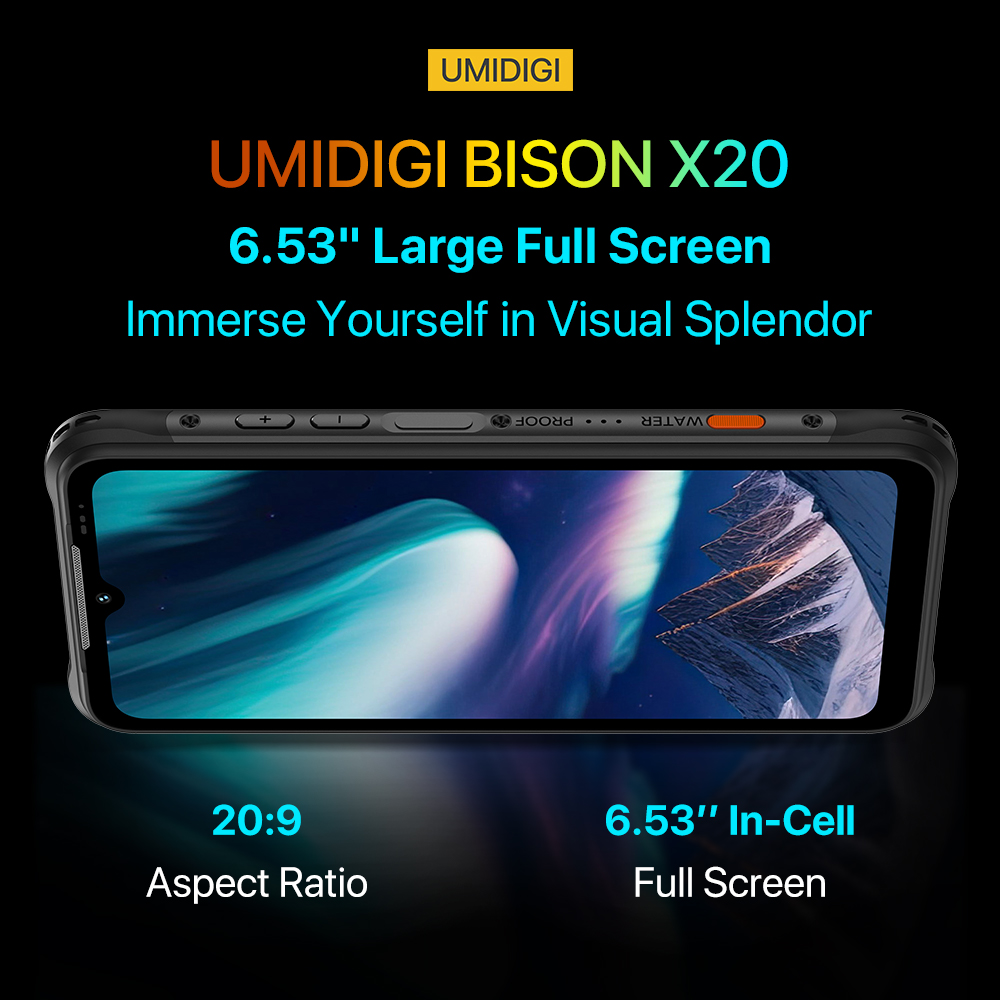
UMIDIGI BISON X20 — 6000mAh, 20W PD fast charging, IP68 & IP69K protection, MIL-STD-810G drop-resistance, TPU and metal construction.
Axis Four: Total Comprehensive Cost, Not Unit Price
Comprehensive cost is the axis most often reduced to a purchase order line. A more useful model adds four components: the device unit cost at the agreed volume; the power adapter and cable; protective accessories such as film, case, and SIM tray tooling; and the expected replacement and service rate over the deployment window. Equipment suppliers serving this category commonly list protector film, phone case, power adapter, SIM tray ejector, and USB cable as the standard supporting equipment set for daily work and entertainment use, which gives buyers a concrete accessory list to price rather than an open-ended estimate.
Absolute pricing varies by market, order volume, configuration, and Incoterms, and should be quoted per order rather than inferred from any published figure. What the matrix provides is the structure for the calculation — including whether a protective accessory set must be bought separately, and whether a device that fails early costs more in replacement logistics than the unit-price difference it appeared to save.
Mapping the UMIDIGI Range to Four Buyer Scenarios
The six current models can be grouped into four purchasing intents. The table below uses only specification values declared for each model.
| Model | Battery / Charging | Processor / Display | Protection | Best-fit scenario |
|---|---|---|---|---|
| UMIDIGI G100 5G | 6000mAh, 20W PD fast charging | UNISOC T8200 5G; 6.9" 120Hz Eye-Care display; 8+16GB extended RAM, 256GB ROM | IP53 dustproof and waterproof; NFC; 210g | 5G large-display daily work and life |
| UMIDIGI G100 | 6000mAh, 20W PD fast charging | UNISOC T615; 6.9" 120Hz Eye-Care display; 8+8GB extended RAM, 256GB ROM | IP53; NFC; 205g | Maximum runtime per charge for daily work |
| UMIDIGI G100x 5G | 5200mAh, 20W fast charging | UNISOC T8200 5G; 6.9" 120Hz EyeComfort display; 8+16GB extended RAM, 128GB ROM | IP54; Android 15; 193g | 5G large display with lighter body weight |
| UMIDIGI Note 100 5G | 5000mAh, 20W PD fast charging | UNISOC T765 5G; 6.8" 120Hz HD+ punch hole display; 8+8GB extended RAM, 256GB ROM | IP53; custom physical hot key; 7.7mm, 190g | Stylish 5G daily work and life |
| UMIDIGI A75x | 5000mAh | UNISOC octa-core; 6.75" ultra-clear display; 4+8GB dynamic RAM, 64GB ROM | IP54; Android 16 Go Edition; 7.7mm, 190g | Slim entry device and large-display basics |
| UMIDIGI G9x | 5000mAh | UNISOC octa-core; 6.75" 90Hz large display; 4+4GB extended RAM, 64/128GB ROM | No IP rating declared in the specification set; 8.1mm, 190g | Slim daily life and work handset |
| UMIDIGI BISON X20 | 6000mAh, 20W PD fast charging | MediaTek Helio P60; 6.53" 120Hz HD+ punch hole display; 6+6GB extended RAM, 128GB ROM | IP68 & IP69K, MIL-STD-810G drop-resistance, TPU and metal; Hot Keys, NFC; 278g | Rugged work in construction, logistics, mining, manufacturing, oil and gas |
All values are drawn from published UMIDIGI model specifications. Extended RAM figures refer to virtual memory expansion as declared.
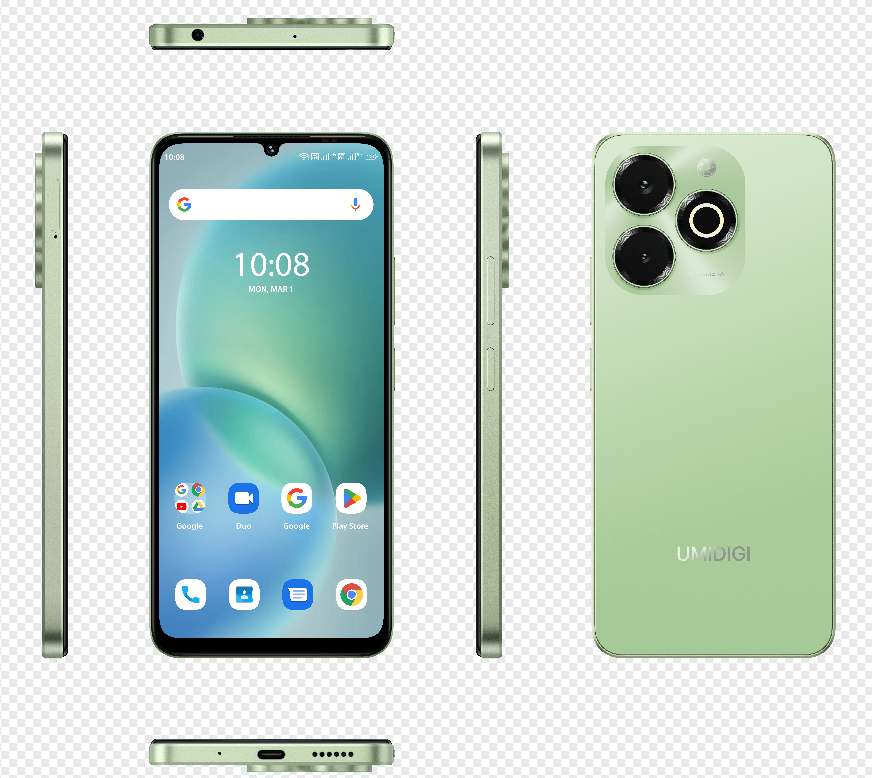
UMIDIGI G9x — 5000mAh battery, 6.75-inch 90Hz display, 8.1mm slim body, 190g.
Scenario A — Daily work and life
For buyers whose users work and entertain on one device through a normal day, the relevant axis is sustained runtime with a comfortable screen. The G100 combines a 6000mAh battery with a 6.9-inch 120Hz eye-care display, 8+8GB extended RAM, and a 205g body. Applying equipment lists published for this use case, a typical order is completed with protector film, phone case, power adapter, SIM tray ejector, and USB cable, and the device operates in continuous daily use rather than in a duty-cycle pattern.
Scenario B — Slim entry and large-display basics
Where hand feel and portability dominate, the A75x brings a 7.7mm, 190g body with a 6.75-inch ultra-clear display, 5000mAh battery, IP54 protection, and Android 16 Go Edition, which uses a lighter system footprint. The G9x offers a comparable 190g slim profile with a 90Hz display and 5000mAh cell. Neither is positioned for industrial exposure; the G9x specification set does not declare an IP rating, which is a decisive detail for buyers whose users work outdoors.
Scenario C — 5G large display
Three models serve 5G buyers. The G100 5G pairs 6000mAh with a UNISOC T8200 5G chipset, a 6.9-inch 120Hz display, 8+16GB extended RAM, 256GB ROM, NFC, and IP53 protection. The G100x 5G uses the same chipset family and display class with 5200mAh, IP54, and a lower 193g weight. The Note 100 5G uses a UNISOC T765 5G processor, a 6.8-inch 120Hz display, 5000mAh, and a custom physical hot key for quick function launching.
Scenario D — Rugged field work
The BISON X20 is the outlier in the range and is specified accordingly: 6000mAh with 20W PD fast charging, a 6.53-inch 120Hz display, IP68 & IP69K protection, MIL-STD-810G drop-resistance, TPU and metal structure, Hot Keys, and NFC. Its declared operating context covers construction and engineering, logistics and warehousing, manufacturing, mining, and oil and gas, with high- and low-temperature conditions, 24/7 operation, and specific requirements for drop-resistance, dustproof design, and waterproof protection.
Benchmark Reading: What the UMIDIGI G100 5G Represents
Using one model as a benchmark is useful only if its position is stated precisely. UMIDIGI’s own comparative positioning for the G100 5G cites approximately 20% longer expected lifespan, 30% lower power consumption, and 10–15% lower overall comprehensive cost relative to alternative configurations in the same segment. These are supplier-stated comparative figures rather than independently audited results, and they should be treated as a starting hypothesis for evaluation — useful for structuring a side-by-side test, not a substitute for one.
What the declared specification does establish is the configuration those figures rest on: a 6000mAh battery with 20W PD fast charging, a UNISOC T8200 5G processor, a 6.9-inch 120Hz eye-care display, 8+16GB extended RAM, 256GB ROM expandable to 1TB, NFC, and IP53 dustproof and waterproof construction in a 171mm × 77.6mm × 8.1mm, 210g body. Buyers can therefore test the benchmark claim against measurable variables — sustained screen-on runtime under a defined load, idle drain overnight, charge time from empty, and observed failure rate — rather than against marketing language.
Market Context: Where the 5000–6000mAh Band Is Moving
Two data points frame why this matrix is timely. First, smartphones with battery capacities of 6000mAh or higher captured 29% of global sales in January 2026, up from 10% in early 2025 (Counterpoint Research) — a shift that moves large-capacity devices from a niche configuration toward a mainstream default. Second, the 5000mAh to 6000mAh battery segment accounted for 42.9% of the rugged phone market share in 2025 (The Insight Partners), which indicates that in durability-focused segments, the mid-to-high capacity band is the volume centre rather than the premium edge.
Demand is also being driven by identifiable user groups. Independent contractors and outdoor sports enthusiasts are the primary consumer drivers for ‘3-Proof’ (water, dust, and shock resistant) phones, representing 38% of the global rugged market (Growth Research). The rugged smartphone market overall was valued at approximately USD 2.98 billion in 2023 and is projected to reach USD 5.24 billion by 2030 (Verified Market Research). For suppliers and buyers alike, the implication is that long-battery sourcing decisions increasingly overlap with protection-level sourcing decisions.
Limits, Trade-offs, and Where This Matrix Does Not Apply
A credible matrix has to state where it stops being useful.
- Durability costs mass. The BISON X20’s IP68 & IP69K and MIL-STD-810G construction comes with a 278g weight and a 12.9mm thickness, against roughly 190g and 7.7mm–8.1mm for the slim models. Buyers who prioritise pocketability are trading away rugged protection, and that trade should be made explicitly.
- IP ratings describe test conditions, not unlimited exposure. IP53 and IP54 address spray and splash respectively; IP68 addresses defined submersion; IP69K addresses high-pressure, high-temperature jets. None of these is a warranty of indefinite performance, and buyers should confirm the scope of each declared rating for their actual environment.
- Not every model in the range declares an IP rating. The G9x specification set does not list ingress protection. Where a deployment requires dust or water resistance, that model should not be assumed to provide it.
- Charging input across this range tops out at 20W. Within the published specifications reviewed here, 20W PD fast charging or 20W fast charging is the highest wired charging rate stated. Buyers who require a higher charging tier should verify it per model rather than infer it.
- Supplier-stated comparative figures need independent validation. The G100 5G comparisons of approximately 20% longer expected lifespan, 30% lower power consumption, and 10–15% lower comprehensive cost are UMIDIGI positioning claims and should be tested against the buyer’s own load profile and failure assumptions.
- Segment forecasts diverge. Public estimates for the rugged phone market range from around USD 1.27 billion (Technavio) to USD 18.6 billion (Dataintelo), depending on whether semi-rugged devices and industrial versus consumer segments are included. Market-size figures should be used directionally, not as a basis for a specific order decision.
Pre-Order Verification Checklist
The following questions convert the matrix into a procurement agenda. Each one can be answered with a document rather than an assurance.
- Is the rated capacity declared per model, and is the charging protocol (for example 20W PD fast charging) documented for that specific SKU?
- Which processor and display configuration is being quoted, and at what refresh rate?
- Which IP rating applies, and against which standard revision is it tested?
- Is drop-resistance certified separately — for example MIL-STD-810G, as declared for the BISON X20?
- Does the order include protector film, phone case, power adapter, SIM tray ejector, and USB cable, or are those priced separately?
- For EU-bound shipments, which compliance documentation set is provided, and does it match the destination market?
- What is the confirmed lead time, and how does it align with the deployment date?
- What replacement and service assumption is being used in the comprehensive cost model?
UMIDIGI’s manufacturing base supports this verification process: Shenzhen Keysmart Technology Co., Ltd. operates a 10,000-square-meter facility with a 30-engineer R&D team, approximately 400–500 staff, and an annual production capacity of 30,000,000 units. Procurement verification requests, model specification sheets, and sample coordination for the long-battery range can be directed to marketing@umidigi.com or +852 62195979. A downloadable company profile covering the manufacturing and service scope is available here: Shenzhen Keysmart Technology Co., Ltd. — Company Profile.
FAQ: Long-Battery Life Smartphone Sourcing Questions
What battery capacity counts as a long-battery life smartphone?
There is no single threshold, but the current market cluster sits between 5000mAh and 6000mAh. In the UMIDIGI range, the A75x, G9x, and Note 100 5G are specified at 5000mAh; the G100x 5G at 5200mAh; and the G100, G100 5G, and BISON X20 at 6000mAh. Industry data shows smartphones with 6000mAh or higher accounted for 29% of global sales in January 2026, up from 10% in early 2025 (Counterpoint Research), while the 5000mAh to 6000mAh band represented 42.9% of the rugged phone market in 2025 (The Insight Partners).
Does 20W PD charging matter if the battery is already 6000mAh?
Charging input determines recovery time, which is a separate variable from runtime. Across the published specifications reviewed here, 20W PD fast charging (or 20W fast charging on the G100x 5G) is the highest wired charging rate stated. A larger cell generally takes longer to refill at the same input power, so buyers who need rapid mid-shift top-ups should verify charge times for the specific model rather than assume that a bigger battery recharges proportionally.
How do IP53, IP54, IP68, and IP69K differ, and which one does a buyer actually need?
Under IEC 60529, the two digits describe solids and liquids separately. IP53 combines limited dust protection with resistance to water spray. IP54 combines dust-protected construction with resistance to splashing water. IP68 covers continued submersion under defined conditions — the BISON X20 is specified as IP68 & IP69K and built to withstand 2m submersion. IP69K adds resistance to high-pressure, high-temperature water jets. The correct choice depends on the working environment: office and commuting use is typically served by IP53 or IP54, while wash-down, heavy-rain, or wet-industrial conditions generally require IP68 or IP69K.
Do 5G long-battery phones consume more power than 4G models?
5G capability adds radio complexity, which is one reason the 5G models in this range pair a 5G chipset with a substantial cell: the G100 5G and G100x 5G use a UNISOC T8200 5G processor with 6000mAh and 5200mAh respectively, and the Note 100 5G uses a UNISOC T765 5G processor with 5000mAh. The non-5G G100 uses a UNISOC T615 with 6000mAh. Actual consumption depends on network conditions, display refresh rate, and usage pattern, so the comparison should be made under a defined load rather than from chipset class alone.
Why can two phones with the same 6000mAh rating behave differently?
Because runtime is stored charge divided by power draw. The three 6000mAh models in this range differ in display and processor: the BISON X20 uses a 6.53-inch 120Hz display with a MediaTek Helio P60, the G100 uses a 6.9-inch 120Hz display with a UNISOC T615, and the G100 5G uses a 6.9-inch 120Hz display with a UNISOC T8200 5G. Panel area, refresh behaviour, and chipset load all influence how quickly the same nominal capacity is consumed.
Which UMIDIGI models suit slim daily use versus rugged field work?
The slim group is the A75x (7.7mm, 190g, IP54, 6.75-inch display, Android 16 Go Edition) and the G9x (8.1mm, 190g, 6.75-inch 90Hz display); the G9x specification set does not declare an IP rating. The mid-range group covers the Note 100 5G, G100x 5G, G100, and G100 5G, all with 6.8-inch–6.9-inch 120Hz displays and IP53 or IP54 protection. Rugged field work is served by the BISON X20, specified with IP68 & IP69K protection, MIL-STD-810G drop-resistance, TPU and metal construction, Hot Keys, and NFC for construction and engineering, logistics and warehousing, manufacturing, mining, and oil and gas environments.
What should be verified before confirming a long-battery smartphone order?
Six items: the declared capacity and charging protocol for the exact SKU; the processor and display configuration including refresh rate; the specific IP rating and the standard revision it was tested against; whether drop-resistance is certified separately, such as MIL-STD-810G; the complete supporting equipment list (protector film, phone case, power adapter, SIM tray ejector, USB cable) and whether it is included in the quoted cost; and the compliance documentation set required by the destination market. Independent contractors and outdoor enthusiasts represent 38% of the global rugged market (Growth Research), so buyers serving those groups should weight the durability axis more heavily than unit price.
Outlook
The next phase of long-battery competition is likely to be decided by energy density rather than by capacity labels. Silicon-carbon anode technology already offers roughly 20–50% higher energy density than standard graphite (Fortune Business Insights, 2024), which allows slim bodies to carry larger cells — visible in this range, where 7.7mm handsets still declare 5000mAh and 8.1mm handsets declare 6000mAh. Combined with the rise of 6000mAh-plus devices to 29% of global sales (Counterpoint Research), the practical consequence for buyers is that “long-battery” will increasingly describe a baseline rather than a differentiator.
That shifts the decision weight toward the other three axes. Protection level, chipset efficiency, and a rigorously modelled comprehensive cost are the fields most likely to separate suppliers in the next procurement cycle — and the fields where a structured buyer matrix, applied model by model rather than category by category, produces a defensible decision.
Tem questões ou precisa de mais detalhes?
Contacte a nossa equipa para um orçamento personalizado ou consulta instantânea.
Solicitar orçamento
Preencha o formulário abaixo e a nossa equipa entrará em contacto com uma proposta personalizada.
Chat direto do WhatsApp
Prefere conversar em tempo real? Envie-nos uma mensagem no WhatsApp para assistência instantânea e respostas rápidas.
- Obter orçamento personalizado
- Partilhar fotos ou documentos
- Discuta as suas necessidades diretamente
Geralmente responde em 5–30 minutos durante o horário de expediente.