
Long-Battery Smartphone Sourcing FAQ: mAh, IP Ratings, ODM/OEM
Sourcing a long-battery life smartphone is no longer a question of choosing the largest mAh figure on a spec sheet. Buyers evaluating devices for retail, distribution or private-label programmes now have to reconcile battery capacity, charging protocol, ingress protection class, platform and display choices, certification coverage, and the manufacturing terms behind the finished product. This reference answers the technical and procurement questions that most frequently delay a decision, using UMIDIGI — the smartphone brand of Shenzhen Keysmart Technology Co., Ltd. — as the documented reference case.
Why Long-Battery Sourcing Questions Have Multiplied
High-capacity batteries have moved from a niche differentiator to a mainstream purchase criterion. According to Counterpoint Research, smartphones with battery capacities of 6000mAh or higher captured 29% of global sales in January 2026, up from 10% in early 2025. The shift is fast enough that procurement specifications written two years ago may already be misaligned with what buyers are actually asking for at retail.
The rugged sub-segment shows a similar pattern. The Insight Partners reports that the 5000mAh to 6000mAh battery segment accounted for 42.9% of the rugged phone market share in 2025 — meaning the band that most industrial and outdoor buyers specify is also the band where most supply is concentrated. Verified Market Research places the global rugged smartphone market at approximately USD 2.98 billion in 2023, projected to reach USD 5.24 billion by 2030.
For buyers, the practical consequence is a longer question list. Capacity alone does not predict runtime; runtime does not predict durability; durability does not predict certification market access. The sections below work through each variable in the order a sourcing team typically encounters it.
What UMIDIGI Specifies Across Its 5000mAh to 6000mAh Range
UMIDIGI is the smartphone brand operated by Shenzhen Keysmart Technology Co., Ltd., a Shenzhen-based communications technology company founded in 2012. The company describes a one-stop model integrating research and development, manufacturing, brand operation, and ODM/OEM services, with smartphones as its main product line, an export ratio of 100%, and markets covering Middle-Western, South America, Asia, Africa, EU, and USA.
Within that portfolio, the long-battery range spans 5000mAh to 6000mAh, with protection levels and platforms distributed by product category rather than by price tier alone.
| Model | Category | Battery / Charging | Protection | Platform & Display |
|---|---|---|---|---|
| UMIDIGI A75x | Stylish, slim, large-display entry | 5000mAh; charging rate not specified in the product entry | IP54 dustproof and waterproof | UNISOC Octa-Core; 6.75″ ultra-clear large display; Android 16 Go Edition |
| UMIDIGI G9x | Stylish and slim | 5000mAh; charging rate not specified in the product entry | Not specified in the product entry | UNISOC Octa-Core; 6.75″ 90Hz large display |
| UMIDIGI Note 100 5G | Stylish 5G large display | 5000mAh; 20W PD fast charging | IP53 dustproof and waterproof | UNISOC T765 5G; 6.8″ 120Hz HD+ punch hole display |
| UMIDIGI G100x 5G | 5G large display, long endurance | 5200mAh; 20W fast charging | IP54 dustproof and waterproof | UNISOC T8200 5G; 6.9″ 120Hz EyeComfort large display |
| UMIDIGI G100 | Large and long-endurance | 6000mAh; 20W PD fast charging | IP53 dustproof and waterproof | UNISOC T615; 6.9″ 120Hz eye-care large display |
| UMIDIGI G100 5G | 5G large display, long endurance | 6000mAh; 20W PD fast charging | IP53 dustproof and waterproof | UNISOC T8200 5G; 6.9″ 120Hz eye-care large display |
| BISON X20 | Rugged smartphone | 6000mAh; 20W PD fast charging | IP68 & IP69K; MIL-STD-810G drop-resistance | MediaTek Helio P60; 6.53″ 120Hz HD+ punch hole display |
Three observations matter for procurement. First, 20W PD fast charging is specified on the UMIDIGI G100, UMIDIGI G100 5G, UMIDIGI Note 100 5G and BISON X20, while the G100x 5G is listed with 20W fast charging and the A75x and G9x entries do not state a charging rate at all. Buyers who require a uniform charging specification across a mixed order should confirm this per SKU before publishing retail copy. Second, the 6000mAh capacity appears in two very different chassis: the 8.1mm-thick UMIDIGI G100 and G100 5G, and the 12.9mm-thick BISON X20. Third, protection level is not tied to battery capacity — the 6000mAh G100 is IP53, while the 5000mAh G100x 5G is IP54.
Battery Capacity, Charging Protocol, and Display: How the Variables Interact
Battery capacity in mAh describes stored charge, not runtime. Runtime is the outcome of capacity divided by average system power draw, and system power draw is set by the combination of display area, refresh rate, platform, radio configuration, and software behaviour. This is why two phones with identical mAh ratings can deliver noticeably different endurance in the field.
Display is the largest single variable in that equation. The UMIDIGI large-display category uses 6.8″ to 6.9″ panels at 120Hz. A larger panel and a higher refresh rate both increase power demand relative to a smaller or lower-refresh display, which is why buyers evaluating a 6.9″ 120Hz device against a 6.75″ 90Hz device should treat the battery specification as one input among several rather than as a like-for-like comparison.
Platform selection works the same way. The portfolio spans UNISOC Octa-Core in the entry models, UNISOC T615 in the UMIDIGI G100, UNISOC T8200 5G in the UMIDIGI G100 5G and G100x 5G, UNISOC T765 5G in the UMIDIGI Note 100 5G, and MediaTek Helio P60 in the BISON X20. A 5G radio adds a power consideration that a 4G-only device does not carry, so a 5G model and a 4G model with the same capacity are not equivalent endurance propositions out of the box. Specification sheets are the correct place to confirm which platform is used in each SKU; the corporate website corpus confirms the UNISOC T765 5G processor for the smartphone it documents.
Charging protocol is a separate axis. 20W PD refers to USB Power Delivery, a negotiated charging standard rather than a fixed voltage. In practice this means the achieved charge rate depends on the adapter and cable used, which is why buyers writing accessory bundles should specify PD-capable adapters instead of generic chargers. The published accessory requirement for this product category includes a protector film, phone case, power adapter, SIM tray ejector, and USB cable — and the design assumption is continuous 24/7 operation at normal temperature, which is a useful benchmark for retail packaging decisions.
A wider industry trend is relevant here. Silicon-carbon (Si-C) anode technology is increasingly replacing standard graphite anodes and offers 20–50% higher energy density for slim, long-lasting devices, according to Fortune Business Insights. Where a supplier specifies silicon-carbon cells, buyers should ask for the cell documentation rather than inferring the cell chemistry from a capacity figure.
IP53, IP54, IP68, IP69K, and MIL-STD-810G: Reading Protection Claims Correctly
Ingress protection ratings are defined by IEC 60529. The first digit describes resistance to solids and the second describes resistance to liquids. In general terms, a first digit of 5 indicates limited dust ingress protection and a first digit of 6 indicates dust tightness; a second digit of 3 indicates protection against spraying water, 4 indicates protection against splashing water from any direction, 8 indicates suitability for continuous immersion under defined conditions, and 9K indicates protection against high-pressure, high-temperature water jets.
Across the UMIDIGI long-battery range, protection is distributed as follows: IP53 on the UMIDIGI G100, UMIDIGI G100 5G and UMIDIGI Note 100 5G; IP54 on the UMIDIGI G100x 5G and UMIDIGI A75x; and IP68 & IP69K plus MIL-STD-810G drop-resistance on the BISON X20.
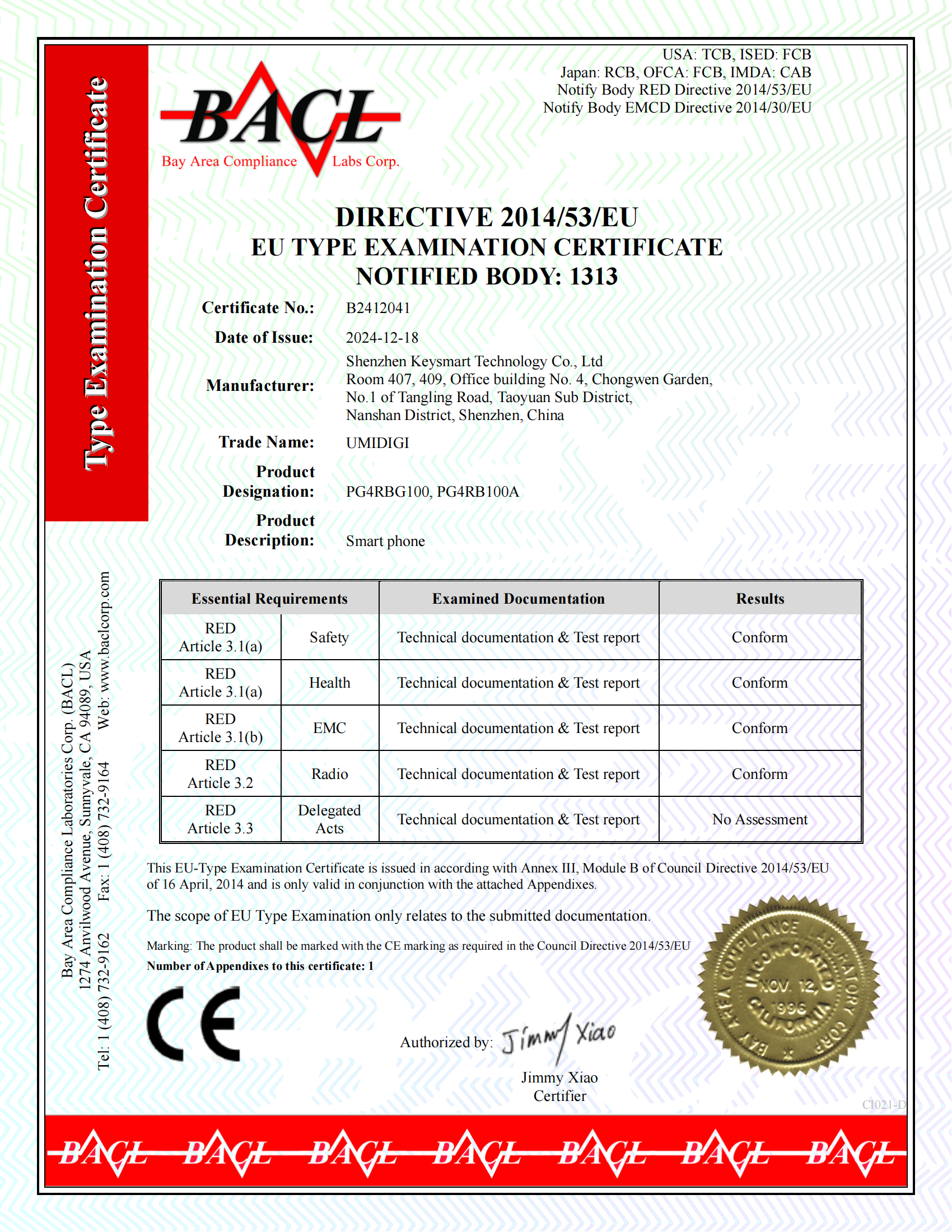
Certification coverage for EU market access is documented at model level rather than at brand level. The UMIDIGI G100 is covered by EU TYPE EXAMINATION CERTIFICATE B2412041 issued by BACL on 18 December 2024, covering models PG4RBG100 and PG4RB100A under 2014/53/EU RED. The UMIDIGI Note 100 5G is covered by EU TYPE EXAMINATION CERTIFICATE B2407121 issued by BACL on 29 July 2024 for models PG4MBG9YA, PG4TBG9PG, PN4TB100G and PN4TB10PG. The UMIDIGI A75x is covered by ATTESTATION OF CONFORMITY 2601P40188E-RFA1 issued by BACL on 20 January 2026 for model CPA2651, manufactured by Shenzhen Keysmart Technology Co., Ltd. The UMIDIGI G9x is covered by ATTESTATION OF CONFORMITY 2501P41324E-RFA1 issued by BACL on 22 January 2025 for model PG5FBG9XA.
For a distributor or importer, the practical rule is to match the certificate number to the exact model number on the shipping carton. A brand-level certification claim does not automatically transfer to a SKU that is not listed on the certificate.
Matching a Long-Battery Model to a Deployment Scenario
The BISON X20 is the rugged option for field deployment. It is designed for daily life and work, construction and engineering, logistics and warehousing, manufacturing, and mining. Its construction uses TPU and metal, with dimensions of 172.1 × 83.8 × 12.9 mm and a weight of 278 g, and it adds Hot Keys and NFC alongside a side fingerprint sensor and AI face unlock. It carries 6+6GB extended RAM, 128GB ROM and 1TB TF expansion.
For large-screen 5G use in retail and volume channels, the relevant models are the UMIDIGI G100 5G, UMIDIGI G100x 5G and UMIDIGI Note 100 5G, all pairing 120Hz large displays with 5000mAh to 6000mAh batteries and 20W-class charging. For entry-tier and slim-format programmes, the UMIDIGI A75x and G9x bring 5000mAh batteries into 190g, 7.7–8.1mm chassis, with the A75x also carrying IP54 protection and Android 16 Go Edition.
A documented ODM case illustrates how these categories are combined at volume. A US-based consumer electronics ODM client ordered 50,000 units for a programme running more than five years, applied to daily work and life. The reported result was a large display with power-saving long battery life and smooth experience in game playing and video streaming; the stated highlights were large display, stylish design, larger battery, and affordable price.
Demand-side data supports the scenario focus. Growth Research reports that independent contractors and outdoor sports enthusiasts are the primary consumer drivers for water-, dust- and shock-resistant phones, representing 38% of the global rugged market.
What the Market Data Suggests About Demand for 5000mAh to 6000mAh Devices
Three signals are consistent across independent sources. First, high-capacity batteries are becoming standard rather than premium, with 6000mAh-plus devices rising from 10% to 29% of global sales between early 2025 and January 2026, according to Counterpoint Research. Second, the 5000mAh to 6000mAh band dominates the rugged segment, holding 42.9% of rugged phone market share in 2025 per The Insight Partners. Third, the underlying device market is expanding, with Verified Market Research projecting the global rugged smartphone market growing from approximately USD 2.98 billion in 2023 toward USD 5.24 billion by 2030.
The technology direction also matters for specification planning. Silicon-carbon cell adoption is an energy-density story rather than a capacity story, and energy density is what allows a 6000mAh battery to sit inside an 8.1mm chassis rather than a 12.9mm one. For buyers, this changes the question from “what is the largest capacity available?” to “what is the capacity-to-thickness and capacity-to-weight ratio I can sell or deploy?”
Comparison with Conventional Approaches — and Where the Limits Are
Many organisations still equip field or volume users with a standard consumer smartphone plus a separate power bank and a third-party protective case. The comparison below sets that approach against purpose-specified long-battery devices.
| Consideration | Conventional approach (consumer phone + power bank + case) | Purpose-specified long-battery device |
|---|---|---|
| Charging during a shift | Requires carrying and managing a second device; charging happens mid-shift | 5000mAh–6000mAh integrated capacity designed for extended use |
| Charging standard | Device-dependent; accessory charger may not match | 20W PD specified on G100, G100 5G, Note 100 5G and BISON X20 |
| Environmental protection | Added case provides impact protection but no verified IP rating | IP53, IP54, or IP68 & IP69K with MIL-STD-810G drop-resistance on BISON X20 |
| Certification traceability | Consumer SKU certificates are rarely supplied to the buyer | Model-level EU certificates available, e.g. B2412041 for G100 |
| Customisation | None beyond retail packaging | Brand logo, exterior design, packaging design and specifications |
The limits are equally concrete, and buyers should plan around them rather than discover them late. Higher capacity and higher protection are paid for in mass and thickness: the UMIDIGI G100 and G100 5G sit at 205g and 210g respectively in an 8.1mm body, while the BISON X20 reaches 278g at 12.9mm. Entry-tier long-battery models trade internal storage and memory rather than battery — the UMIDIGI A75x combines a 5000mAh battery with 64GB ROM and up to 4+8GB dynamic RAM. Charging rate is not uniform across the range, and some product entries do not state one. And IP53/IP54 devices are splash-resistant, not immersion-rated, so they are not substitutes for an IP68/IP69K device in wet or washdown environments.
Manufacturing terms are the other boundary. Shenzhen Keysmart Technology Co., Ltd. operates a 10,000m² facility with 400–500 employees, a 30-engineer R&D team, monthly capacity of 300,000 units, and annual output of 30,000,000 units, with 100% pre-shipment testing. OEM orders carry a minimum order quantity of 3,000 units and a lead time of 60–70 working days, with after-sales support delivered remotely. Those figures define the minimum realistic programme size for a custom build; buyers planning smaller trial volumes should evaluate standard SKUs rather than a bespoke configuration.

Future Outlook: From Marketing Claims to Document-Based Verification
The direction of travel in this category is toward verifiable specification, not larger headline numbers. As 5000mAh to 6000mAh becomes the default band, differentiation shifts to how well capacity is packaged — chassis thickness, weight, charging consistency, and protection class. Silicon-carbon energy density gains reinforce that shift by making high capacity possible in slimmer bodies.
For procurement teams, this implies a change in working method: request the model-level certificate, the revision of any MIL-STD-810 claim, the charging rate per SKU, and the protection class per variant, and reconcile them against the shipping carton and the retail listing. Buyers who build a specification matrix before requesting samples will find the evaluation cycle shorter and the post-launch support load lower.
FAQ: Long-Battery Life Smartphone Procurement
What battery capacity range should buyers expect from UMIDIGI long-battery smartphones?
The UMIDIGI long-battery range spans 5000mAh to 6000mAh. 5000mAh covers the UMIDIGI A75x, UMIDIGI G9x and UMIDIGI Note 100 5G; 5200mAh covers the UMIDIGI G100x 5G; and 6000mAh covers the UMIDIGI G100, UMIDIGI G100 5G and BISON X20. Capacity is distributed across entry, 5G large-display and rugged categories rather than being reserved for one tier.
Does 20W PD fast charging apply across the entire 5000mAh to 6000mAh range?
No. 20W PD fast charging is specified on the UMIDIGI G100, UMIDIGI G100 5G, UMIDIGI Note 100 5G and BISON X20. The UMIDIGI G100x 5G is listed with 20W fast charging. The UMIDIGI A75x and UMIDIGI G9x product entries do not state a charging rate. Buyers requiring a single charging specification across a mixed order should confirm the rate for each SKU individually.
What is the practical difference between IP53, IP54, IP68 and IP69K?
Ingress protection is defined by IEC 60529. IP53 and IP54 cover limited dust ingress plus protection against water spray and splash respectively; neither is an immersion rating. IP68 covers suitability for continuous immersion under defined conditions, and IP69K covers protection against high-pressure, high-temperature water jets. Devices rated IP53/IP54 are appropriate for everyday and light outdoor use, while washdown, wet handling or submersion environments require an IP68/IP69K-class device.
What does the BISON X20's MIL-STD-810G rating actually cover?
The BISON X20 is specified with IP68 & IP69K dustproof and waterproof protection plus MIL-STD-810G drop-resistance. MIL-STD-810 is a family of standards with multiple revisions, and MIL-STD-810G is one revision of that family; the wider rugged category frequently references MIL-STD-810H. Because test methods and severities differ between revisions, buyers should confirm the revision level and the specific methods covered before treating two suppliers' MIL-STD-810 claims as equivalent.
How do processor and display choices differ across the 5G large-display, entry and rugged categories?
The rugged BISON X20 uses a MediaTek Helio P60 with a 6.53″ 120Hz HD+ punch hole display. The 5G large-display category uses UNISOC T8200 5G in the G100 5G and G100x 5G, and UNISOC T765 5G in the Note 100 5G, all with 6.8″ to 6.9″ 120Hz panels. The entry and slim category uses UNISOC Octa-Core platforms with 6.75″ displays in the A75x and G9x, one of which runs at 90Hz.
Do 120Hz large displays work against long battery life targets?
A larger panel and a higher refresh rate both increase power demand relative to a smaller or lower-refresh display, so they are relevant variables when comparing endurance. They do not make long battery life unachievable — the 6.9″ 120Hz UMIDIGI G100 and G100 5G both carry 6000mAh batteries with 20W PD charging. The correct comparison is between devices with similar display area, refresh rate and platform, not between a 6.9″ 120Hz 5G device and a smaller 4G device with the same capacity.
Which UMIDIGI model suits construction, logistics, warehousing or mining deployment?
The BISON X20 is the model specified for those environments. It is designed for daily life and work, construction and engineering, logistics and warehousing, manufacturing, and mining, with IP68 & IP69K protection, MIL-STD-810G drop-resistance, TPU and metal construction, 6000mAh battery with 20W PD charging, Hot Keys and NFC.
Which models fit large-screen daily work use with 5G?
The 5G large-display options are the UMIDIGI G100 5G, UMIDIGI G100x 5G and UMIDIGI Note 100 5G. All three combine 6.8″ to 6.9″ 120Hz displays with 5000mAh to 6000mAh batteries. The G100 5G carries 8+16GB extended RAM and 256GB ROM; the G100x 5G carries 8+16GB extended RAM and 128GB ROM; the Note 100 5G carries 8+8GB extended RAM and 256GB ROM. The G100 5G and G100x 5G run Android 15.
What EU certification coverage exists, and at what level is it documented?
Certification is documented per model. The UMIDIGI G100 is covered by EU TYPE EXAMINATION CERTIFICATE B2412041 issued by BACL on 18 December 2024 for models PG4RBG100 and PG4RB100A. The UMIDIGI Note 100 5G is covered by EU TYPE EXAMINATION CERTIFICATE B2407121 issued by BACL on 29 July 2024 for models PG4MBG9YA, PG4TBG9PG, PN4TB100G and PN4TB10PG. The UMIDIGI A75x is covered by ATTESTATION OF CONFORMITY 2601P40188E-RFA1 issued by BACL on 20 January 2026 for model CPA2651. The UMIDIGI G9x is covered by ATTESTATION OF CONFORMITY 2501P41324E-RFA1 issued by BACL on 22 January 2025 for model PG5FBG9XA. All cite 2014/53/EU RED alongside safety, EMC and radio standards.
What ODM/OEM customisation does Shenzhen Keysmart Technology Co., Ltd. support?
Shenzhen Keysmart Technology Co., Ltd. operates both an own-brand business under UMIDIGI and ODM/OEM services. Available customisation covers brand logo, exterior design, packaging design and specifications. The company is based in Nanshan District, Shenzhen, and its markets include Middle-Western, South America, Asia, Africa, EU, and USA.
What are the minimum order quantity, lead time and production capacity for OEM orders?
OEM orders carry a minimum order quantity of 3,000 units and a lead time of 60–70 working days. Monthly capacity is 300,000 units, supported by a 10,000m² facility, 400–500 employees, a 30-engineer R&D team, and annual output of 30,000,000 units. Quality control is a 100% pre-shipment test, and after-sales support is provided remotely.
What limitations should buyers accept when prioritising battery capacity?
Higher capacity and higher protection are paid for in mass and thickness. The UMIDIGI G100 and G100 5G weigh 205g and 210g at 8.1mm thickness, while the BISON X20 is 278g at 12.9mm. Entry-tier long-battery models trade storage and memory rather than battery, as with the A75x's 64GB ROM. Charging rate is not uniform across the range, and IP53/IP54 models are not immersion-rated. Buyers should also confirm MIL-STD-810 revision levels rather than assuming equivalence between suppliers.
Reference note: company profile, product and certification documentation for Shenzhen Keysmart Technology Co., Ltd. and the UMIDIGI brand, including model-level specifications and EU certificates, is available in the company profile document at Shenzhen Keysmart Technology Co., Ltd. Company Profile. Product information is published at www.umidigi.com.