
Long-Term Baby Diaper Supplier Evaluation: A Sustainability Checklist for OEM Buyers
Long-Term Baby Diaper Supplier Evaluation: A Sustainability Checklist for OEM Buyers
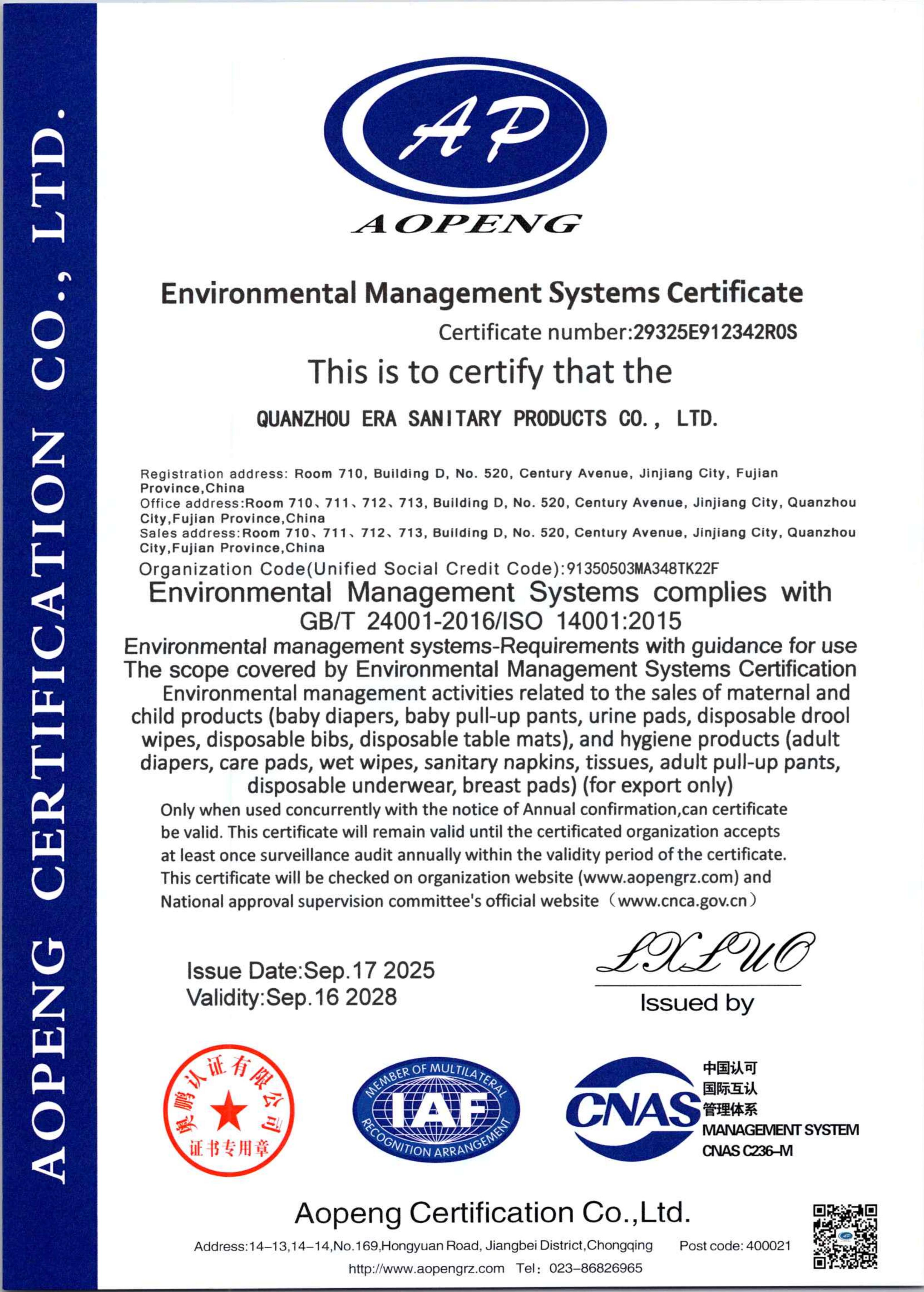
System-level certificates such as ISO 14001 cover a defined production scope — useful context, but they do not replace model-level product documentation.
In OEM diaper procurement, supplier sustainability means the ability to hold a declared specification, a valid certification status and a workable set of commercial terms across repeated orders. It is a continuity question, not an environmental slogan — and it is rarely answered by a first sample.
Most OEM relationships are opened with a sample and a price list. Both are useful, and both are renewable advantages for the buyer only if the supplier can repeat the same output twelve months later. Absorbency that drifts, a certificate that lapses mid-contract, or a lead time that quietly stretches from weeks to months are the failures that cost a distributor its shelf position.
This article sets out a five-part checklist that OEM buyers and importers can apply during the evaluation and execution stages of a baby diaper programme. It uses one manufacturer's published specification set as a worked example so that each checklist item has a concrete reference point rather than an abstract question.
Quanzhou ERA Sanitary Products Co., Ltd., based in Jinjiang, Quanzhou, Fujian Province, China, is a manufacturer of disposable hygiene products — baby diapers, pant diapers, sanitary pads, adult diapers, wet wipes and tissue — that exports 100% of its output to Europe, the USA, Southeast Asia, Central Asia, South America, Africa and the Middle East. It operates under several registered brand lines, including My A+, ONePcDRY, Alotof and EcoBingo.
Why the First Order Is a Weak Test of a Diaper Supplier
A pilot order is produced under special attention. The real evaluation begins when the same model is manufactured on a normal schedule, in normal volumes, with raw materials purchased on normal terms. Three structural features of the diaper market make this transition riskier than it looks.
First, the category is large and expanding. Grand View Research valued the global baby diapers market at USD 83.3 billion in 2025 and USD 88.5 billion in 2026, with a projection of USD 141.8 billion by 2033. Growth of that scale keeps new suppliers entering, which raises the buyer's screening burden rather than lowering it.
Second, supply is geographically concentrated. Fujian Province accounted for 63.9% of China's total baby diaper exports in 2024, generating 8.74 billion yuan in export volume according to Xiamen Customs data cited in industry reporting. Dense clusters are efficient for sourcing, but they also mean many suppliers describe themselves in nearly identical language — same machine types, same certifications, same product categories.
Third, the visible product is simple and the invisible inputs are not. A baby diaper is a layered composite of fluff pulp, superabsorbent polymer (SAP), non-woven top sheet, backsheet, elastic and tape. Buyers can see the finished item; they cannot see, without documentation, which SAP grade sits inside it.
The buyer's problem in one sentence: the attributes that determine a diaper's performance over a two-year contract — SAP source, pulp origin, core construction, certificate validity — are the attributes least visible in a sample.
Checklist Item 1: Can the Supplier Name the Core and SAP Source of Every Model?
The first test of long-term reliability is documentation discipline. A supplier that can publish a per-model construction record, including the SAP family and pulp origin, is a supplier that has already decided its specification is a commitment. A supplier that answers only in generalities has left the door open for silent substitution.
Model-level records matter because the same supplier can legitimately run several core architectures at once, at different price points, for different channels. The table below summarises one published model set as an example of what a usable specification record looks like.
| Model | Brand line | Declared core construction | Declared material sources | Size range |
|---|---|---|---|---|
| PD01 | My A+ | Full 100% SAP paper core | SAP brand not stated in the published specification | M, L, XL, XXL |
| PD02 | My A+ | Full 100% SAP paper core | LG and Sumitomo SAP | S, M, L, XL, XXL |
| OD02 | ONePcDRY | Floated core with 100% SAP paper | Sumitomo and Sandia SAP | S to XXXL |
| BD02 | My A+ | Floated core | 50% Japan Sumitomo SAP + 50% Japan Sandia SAP | NB, S, M, L, XL |
| BD05 / BD06 | My A+ | Absorbent core built on USA fluff pulp | Japan SAP + USA fluff pulp | BD05: S, M, L; BD06: S, M, L, XL |
| BD07 | My A+ | USA fluff pulp absorbent core | Japan SAP + USA fluff pulp | S, M, L |
| EB01 | EcoBingo | USA fluff pulp with SAP; bamboo fibre top sheet and backsheet | USA fluff pulp, SAP | S to XXXL |
| AL01 | Alotof | Fluff pulp core with SAP and USA fluff pulp | SAP, USA fluff pulp | S to XXXL |
Note what the record does and does not settle. PD02, OD02, BD02 and BD07 declare their SAP families explicitly; PD01 declares a full 100% SAP paper core without naming the SAP source. That gap is not a red flag on its own, but a buyer treating PD01 as a long-term line should request written confirmation of the SAP family and the substitution rule before the second order, not after the fifth.
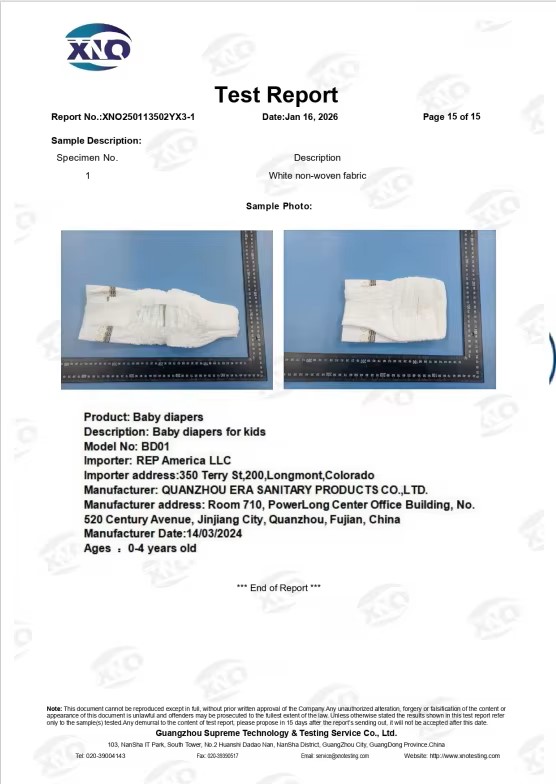
Certificates that name a specific model — as this ASTM F963 document does for BD01 — are more useful in procurement than company-wide certificate lists.
Checklist Item 2: Is the SAP and Pulp Specification Treated as Locked, or as a Purchasable Input?
Absorbency in a baby diaper is carried mainly by the SAP and the fluff pulp. That makes both materials commercially sensitive: when SAP prices move, a supplier under cost pressure faces a choice between absorbing the increase and quietly changing the input. The evaluation question is therefore not “which SAP do you use”, but “what happens to my specification when SAP prices move?”
The published model set shows how a supplier can make this answerable. Some models declare a single SAP family; BD02 declares a deliberate 50% Japan Sumitomo / 50% Japan Sandia blend in a floated core; PD02 declares a full 100% SAP paper core built from LG and Sumitomo; OD02 declares 100% SAP paper containing Sumitomo and Sandia. These are different engineering choices, and each implies a different material dependency.
- Single-source declarations are simple to audit but expose the buyer to one supplier's allocation decisions. Ask what the approved alternative is, and whether the buyer will be notified before it is used.
- Dual-brand blends, such as BD02's Sumitomo and Sandia combination, distribute input risk across two sources. The relevant question is whether the ratio is fixed in writing or adjusted to availability.
- Pulp origin deserves the same treatment. EB01, BD05, BD06 and BD07 declare USA fluff pulp; AL01 declares SAP together with USA fluff pulp. Pulp origin affects both absorbent behaviour and the documentary chain buyers in the EU and North America increasingly need.
A practical test during supplier evaluation: ask for the specification in writing, then ask what written notice the buyer receives if that specification changes. A supplier with a genuine continuity process will have an answer. A supplier that treats the question as unnecessary has told you something useful.
Checklist Item 3: Are Certifications Attached to Models, or Only to the Company?
Compliance evidence is where long-term supplier evaluation most often goes wrong. Buyers collect a certificate pack, file it, and assume coverage. In practice, certificates fall into two distinct types, and only the first protects a specific purchase order.
Model-level certificates name the exact product they cover. In this supplier's set, the CE certificate for BD01 references EN ISO 11948-1:1996 and EN ISO 11948-2:1998, the CPC certificate for BD01 references 16 CFR Part 1500 series, ASTM F963 and CPSIA, the ASTM F963 certificate covers BD01, and the HALAL certificate covers model OD01 under the International Halal Standards for Hygiene Disposable Products.
System-level certificates cover a management system across a production scope. ISO 13485:2016 here covers disposable hygiene products including baby diapers, adult diapers, sanitary pads, under pads, tissue and absorbent pads; ISO 14001:2015 and ISO 45001:2018 cover the same hygiene product scope for environmental and occupational health and safety management respectively, both issued by Aopeng Certification Co., Ltd.
| Document | Scope stated in the certificate | Reference number | Valid to |
|---|---|---|---|
| CE | Baby diapers, model BD01 (EN ISO 11948-1:1996, EN ISO 11948-2:1998) | ICR/VC/HM2507251 | 2030-07-27 |
| CPC | Baby diaper, model BD01 (16 CFR Part 1500 series, ASTM F963, CPSIA) | XNO250113502YX2-1 | 2030-01-16 |
| ASTM F963 | Baby diapers, model BD01 | XNO250113503YX3-1 | 2099-12-31 as printed |
| HALAL | Model OD01, International Halal Standards for Hygiene Disposable Products | 30113766206426 | 2028-04-07 |
| Dermatest | My A+ baby diapers, non-woven top sheet skin compatibility test | ST-ET-2026-00055 | 2031-04-06 |
| REACH (SGS) | Baby diaper, My A+ brand, SVHC candidate list | XMNCPCH25002810801 | 2027-12-27 |
| ISO 13485 | Disposable hygiene products including baby diapers | 381240080R0S | 2027-03-11 |
| ISO 14001 | Environmental management, hygiene product scope | 29325E912342R0S | 2028-09-16 |
| ISO 45001 | Occupational health and safety, hygiene product scope | 293250912341R0S | 2028-09-16 |
The expiry column is the part most buyers ignore. A certificate valid at evaluation can expire inside a two-year supply agreement, and a lapsed CE or CPC document can stop a container at the destination port. A supplier whose continuity process is real will already track these dates; a buyer should require renewal confirmation as part of the contract, not as a favour.
Two further observations follow from the scope column. First, model-level coverage is narrow by design: a CE certificate naming BD01 does not automatically extend to OD01, PD02 or EB01, and buyers sourcing a mixed basket should confirm coverage model by model. Second, brand-scoped documents need reading carefully — the REACH declaration is issued for the My A+ brand, and the Dermatest document covers the non-woven top sheet of My A+ baby diapers, which is precise and therefore useful.
The HALAL certificate names model OD01 explicitly — a model-level document rather than a company-level claim.
Checklist Item 4: Do the Commercial Terms Still Work at Volume?
Purchasing terms are an underused reliability signal. They describe how a supplier expects to operate at scale, and instability in them usually appears long before instability in product quality.
The published terms for this manufacturer are specific: minimum order quantity of 100,000 pieces, typical production lead time of 25–35 days, monthly production capacity of 20,000,000 pieces, quality control on a 100% test basis, delivery terms of FOB, CIF or DDP, payment terms of 30/70, pre-shipment test as the acceptance criterion, and remote after-sales support. The underlying facility is described as 100,000 m² with 220 employees, an R&D team of 15 engineers and annual output of 200,000,000 pieces.
- Capacity against lead time. A monthly capacity of 20,000,000 pieces against a 25–35 day lead time gives the buyer a ratio worth checking: if an order represents a large share of monthly capacity, the quoted lead time becomes a planning assumption rather than a commitment.
- MOQ against the size curve. A 100,000-piece MOQ splits across a size range, and a long run needs newborn sizes through XXXL depending on the channel. Buyers should confirm how MOQ is calculated per size, not only per order.
- Delivery terms. FOB, CIF and DDP place different risks on different parties. For a first contract, the chosen term should match the buyer's own customs and insurance capability, not simply the lowest quoted number.
- Acceptance criteria. A pre-shipment test basis means the buyer's quality decision happens before goods leave. That is workable only if the test parameters are written into the purchase order.
- Payment structure. A 30/70 split ties the balance to shipment. Buyers should confirm what documentation releases the balance — typically the pre-shipment test result plus shipping documents.
Customisation belongs in the same conversation. This manufacturer offers OEM and ODM production with material and logo customisation. That is a meaningful scope for private-label distributors, and it is also a defined boundary: buyers planning a structural redesign of a diaper — a different chassis, a new core architecture — should confirm scope early rather than assume it.
Checklist Item 5: Is There Repeat-Supply Evidence Beyond a Single Pilot?
Repeat orders are the only externally visible proof that a specification survived contact with normal production. A single successful pilot proves that the supplier can make a good sample; a repeat pattern suggests the process holds.
In this supplier's case record, a cumulative 10,000,000 pieces have been supplied to OEM clients globally for maternity and baby products store applications, with steady repeat orders reported, positive market feedback on comfort and leak-proof performance, and stable market share growth. The stated shelf life is three years for the disposable single-use product, and the quality highlights cited are hypoallergenic raw materials and imported SAP.
Buyers should read such case records for what they are. They are supplier-reported, they describe outcome categories rather than audited test data, and they do not identify the individual clients. That does not make them worthless — a cumulative volume figure and a repeat-order pattern are checkable claims in a factory audit — but they should be treated as a screening input that narrows the audit, not as a substitute for it.
Comparing Two Evaluation Approaches
Most OEM buyers start with a sample-and-price evaluation. A continuity-based evaluation keeps the sample but adds documentation. The differences are straightforward to state.
| Dimension | Sample-and-price evaluation | Continuity-based evaluation |
|---|---|---|
| What is tested | One delivered lot | The written specification behind the lot |
| Material risk | Not addressed | SAP family and pulp origin recorded per model |
| Compliance | Certificate pack collected | Certificate scope matched to the exact model and expiry date |
| Commercial stability | Quoted price and MOQ | Capacity-to-lead-time ratio, acceptance criteria, payment release conditions |
| Timeline | Days | Longer upfront, reviewed annually |
Limits of This Checklist
This framework has boundaries that buyers should accept deliberately rather than discover later.
It cannot replace a factory audit. Specification documents and certificates describe intent and conformity scope; they do not verify line conditions, storage discipline or material handling on the day of production. A checklist narrows the audit; it does not remove it.
It also cannot resolve every specification gap from published material. As the model table shows, PD01 declares a full 100% SAP paper core without naming the SAP source, and models such as BD01 and BD08 appear in the product and certificate records with narrower published specification detail than PD02 or BD02. Buyers who need those parameters must request them in writing as part of the purchase order.
Finally, the checklist does not evaluate price competitiveness. It is a continuity instrument, and a supplier that passes it may still not be the cheapest option in a tender. The two questions — can this supplier repeat the specification, and at what price — should be answered separately, because combining them tends to let price decide the first question by default.
Future Outlook: Documentation as the Buyer's Real Leverage
Three signals point in the same direction. Market growth toward USD 141.8 billion by 2033 keeps supplier numbers high and differentiation low. Fujian's 63.9% share of China's diaper exports keeps cluster-based sourcing attractive, with all the comparison difficulty that implies. And within the biodegradable segment, bamboo-based diapers are reported to take a 39% share by 2026 — a material trend that shows up in this supplier's range already, where EB01 uses bamboo fibre for both the top sheet and the backsheet.
Material diversification makes documentation more important, not less. A buyer negotiating a bamboo-fibre line, a 100% SAP paper core or a dual-brand SAP blend is negotiating something that only exists on paper first. Suppliers that can support each claim with a named model, a named material source and a dated certificate will be easier to keep; buyers who insist on that standard will find their second and third orders considerably less eventful than their first.
FAQ
What does supplier sustainability mean in baby diaper OEM procurement?
In this context it refers to continuity of supply rather than environmental positioning: the supplier's ability to reproduce a declared specification, maintain valid certification for the specific model, and hold workable commercial terms across repeated orders. Environmental management certification such as ISO 14001 is a separate, complementary signal about the production system.
How can a buyer confirm which SAP and fluff pulp a diaper model actually uses?
By requesting a model-level specification record in writing. Published examples show the range of what that looks like: PD02 declares a full 100% SAP paper core built from LG and Sumitomo SAP, BD02 declares a 50% Japan Sumitomo / 50% Japan Sandia SAP blend in a floated core, and EB01 declares USA fluff pulp with a bamboo fibre top sheet and backsheet. Where a model such as PD01 declares the core type but not the SAP source, the buyer should obtain written confirmation before committing to volume.
Do certifications apply to a supplier or to a specific diaper model?
Both types exist and they serve different purposes. Model-level documents name the product — the CE certificate for BD01 references EN ISO 11948-1:1996 and EN ISO 11948-2:1998, the CPC certificate for BD01 references 16 CFR Part 1500 series, ASTM F963 and CPSIA, and the HALAL certificate covers model OD01. System-level documents such as ISO 13485, ISO 14001 and ISO 45001 cover a management system across a hygiene product scope. A model-level certificate for one diaper does not automatically extend to another model in the same range.
Which commercial terms should be fixed before scaling a diaper order?
At minimum: minimum order quantity and how it is calculated across sizes, typical production lead time, monthly capacity available to the account, delivery terms, payment structure and acceptance criteria. Published terms for this manufacturer specify a 100,000-piece MOQ, a 25–35 day lead time, 20,000,000 pieces monthly capacity, FOB/CIF/DDP delivery, 30/70 payment and pre-shipment test as the acceptance basis. Each of these becomes a contractual assumption once volume begins.
What can a supplier's repeat-order record actually prove?
It provides evidence that a specification has been reproduced across multiple production runs, which a single pilot cannot show. In this supplier's case record, a cumulative 10,000,000 pieces have been supplied to OEM clients globally for maternity and baby products store applications, with steady repeat orders reported. Such records are supplier-reported and do not identify individual clients, so they are best used to prioritise which suppliers merit a factory audit rather than as proof of quality on their own.
A downloadable 2026 product catalog covering the model range discussed in this article is available here: ERA 2026 Catalog (PDF).
Tem questões ou precisa de mais detalhes?
Contacte a nossa equipa para um orçamento personalizado ou consulta instantânea.
Solicitar orçamento
Preencha o formulário abaixo e a nossa equipa entrará em contacto com uma proposta personalizada.
Chat direto do WhatsApp
Prefere conversar em tempo real? Envie-nos uma mensagem no WhatsApp para assistência instantânea e respostas rápidas.
- Obter orçamento personalizado
- Partilhar fotos ou documentos
- Discuta as suas necessidades diretamente
Geralmente responde em 5–30 minutos durante o horário de expediente.