
Long-Term Bathroom Vanity Manufacturer Evaluation: Sustainability Beyond First Order
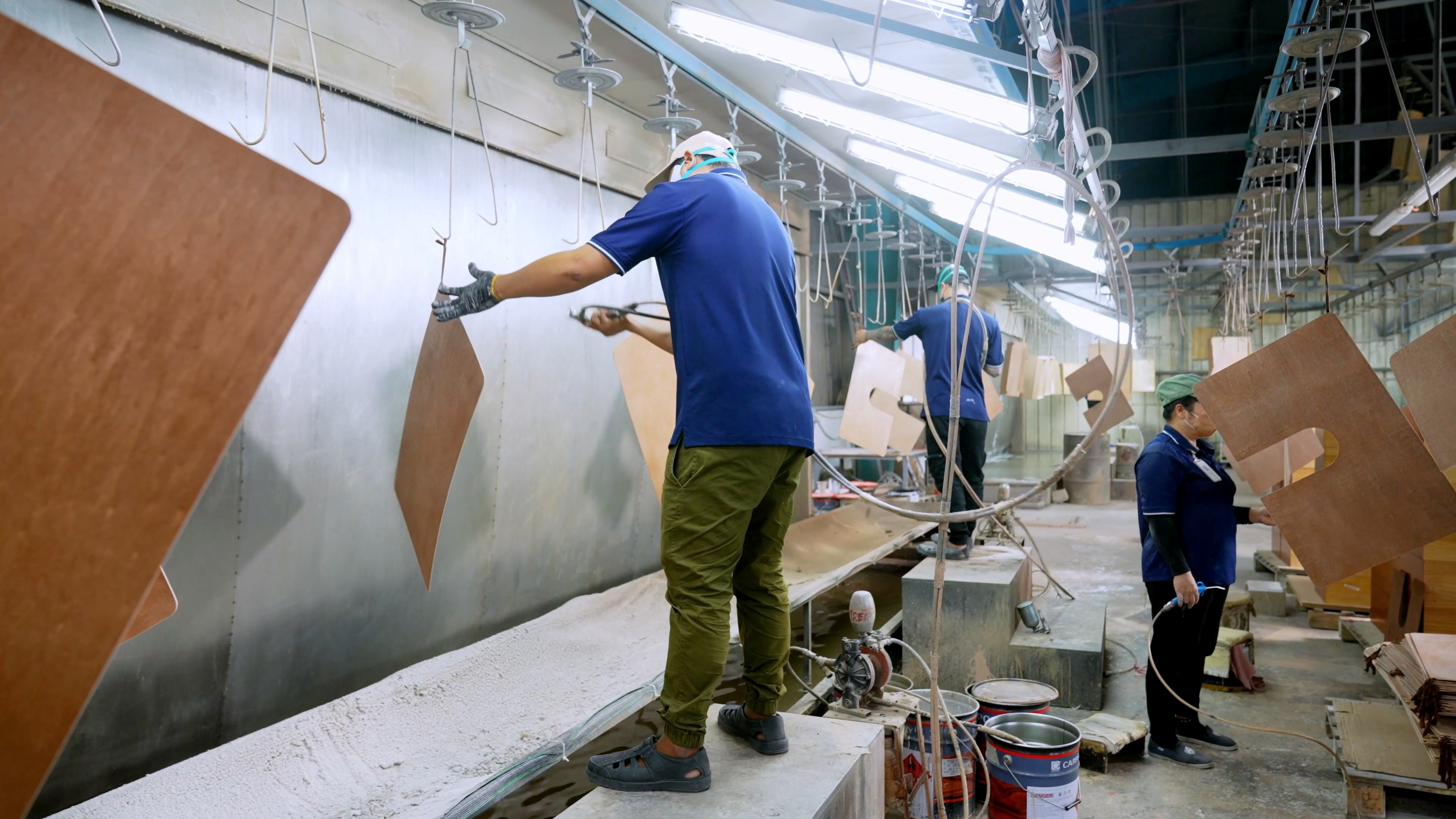
Surface finishing is a process, not a colour label. The same finish code stays repeatable only when retained samples and controlled application are treated as part of the supply specification.
A bathroom vanity is judged when it is delivered. A bathroom vanity manufacturer is judged two or three years later, when a refurbishment needs forty more units of the same model and the same finish, and the original purchase order no longer answers the question.
Long-term supplier sustainability in sanitary ware means the ability to reproduce a specification, not the ability to produce a first batch. For a bathroom vanity manufacturer, that resolves into four things a buyer can actually check before signing anything: whether the model stays in current production, whether board build and finish codes remain stable between batches, whether hardware and mirror electronics can be identified for later replacement, and whether the purchasing terms define acceptance tightly enough to be repeated without renegotiation.
The commercial context makes this check more relevant than it was a decade ago. The global bathroom vanities market was valued at approximately USD 43.34B to USD 47.22B in 2024/2025, with growth projections reaching up to USD 89.96B by 2034, according to Fortune Business Insights and Grand View Research. Within that market, the wood material segment, covering both solid wood and plywood, held a 34.9% revenue share in 2025 (Grand View Research), and residential applications accounted for roughly 74.9% of revenue share in the same year. Ranges built from plywood and solid wood are therefore not a niche: they are the volume mainstream, and they are exactly the ranges where finish and hardware continuity decide whether a second order matches the first.
Why a first order cannot prove a supply relationship
A first order proves that a factory can hit a specification once. It does not prove that the same factory can hit it again after a board supplier changes, a melamine decor lot is replaced, a lacquer is reformulated, or a hardware series is superseded. Those are ordinary events in a multi-year programme, and they are invisible in a pre-shipment inspection report.
The practical test is narrower and more useful: take one model, ideally the one that carries the largest volume in the range, and ask what would have to stay identical for a re-order to be acceptable. On a wall-mounted model such as KL813003, that answer spans a specific board build, a named finish, a named slide mechanism and a five-width size ladder. On a floating model such as AS813047, it spans a lacquered and melamine finish, a sintered stone integral basin, a named soft-close slide series and a mirror with a defined electronics package. Both cases are covered in more detail below.
The opportunity is that continuity is cheap to define and expensive to improvise. A buyer who records four reference points per model, being the build, the finish code, the hardware series and the electrical function set, gives a later quality dispute something concrete to attach to. A buyer who records only a model number and a photograph does not.
What long-term sustainability means for a bathroom vanity manufacturer
Within a sourcing programme, supplier sustainability is usually defined across four dimensions rather than one. Each is verifiable, and each fails in a different way.
| Dimension | What it means | How it fails |
|---|---|---|
| Product continuity | The model remains a current production model rather than a one-off project unit | Model retired, replacement has different drawer layout or width ladder |
| Material consistency | Board build and finish codes are named and repeatable | Colour drift between a lacquered solid wood part and a melamine-faced panel |
| Replacement-part planning | Slides, hinges and mirror electronics are identified by series and function | A drawer mechanism cannot be matched, so the cabinet is written off early |
| Documentation and acceptance | Terms, tolerances and inspection points are written once and reused | Each batch is argued from scratch, on photographs and memory |
The manufacturer behind the range: SHKL
Foshan SHKL Sanitary Ware Co., Ltd. (SHKL) is a China-based bathroom vanity manufacturer, established in 2004 and operating for more than 15 years, with additional production facilities in Vietnam. The company specialises in mid-to-high-end whole bathroom customisation, and its product range covers bathroom vanities, shower doors and LED bathroom mirrors. SHKL employs approximately 600 staff, supported by an R&D team of 20 engineers, and operates production bases covering 100,000 square metres in China and 40,000 square metres in Ho Chi Minh City, Vietnam. Monthly output exceeds 70,000 units, approximately 70% of products are exported, and distribution reaches more than 50 countries and regions, with major markets in the EU, Australia, North America, South America and the Middle East.
For a buyer assessing long-term supply, two structural details matter more than the headline capacity. First, the Vietnam factory includes a PU dust-free spray paint workshop for surface treatment, which is relevant because lacquer finishing is one of the steps where batch-to-batch variation originates. Second, the two-site layout gives a programme an alternative production location, but it also creates a duty: a finish approved in China is not automatically an approved finish from Vietnam unless cross-site samples are agreed. That point is treated as a limitation later in this article rather than as an advantage.
The range itself is organised around recognisable families rather than isolated SKUs, which is what makes continuity discussable. Wall-mounted and floating vanities dominate the current line-up, with freestanding units covering the floor-standing segment.
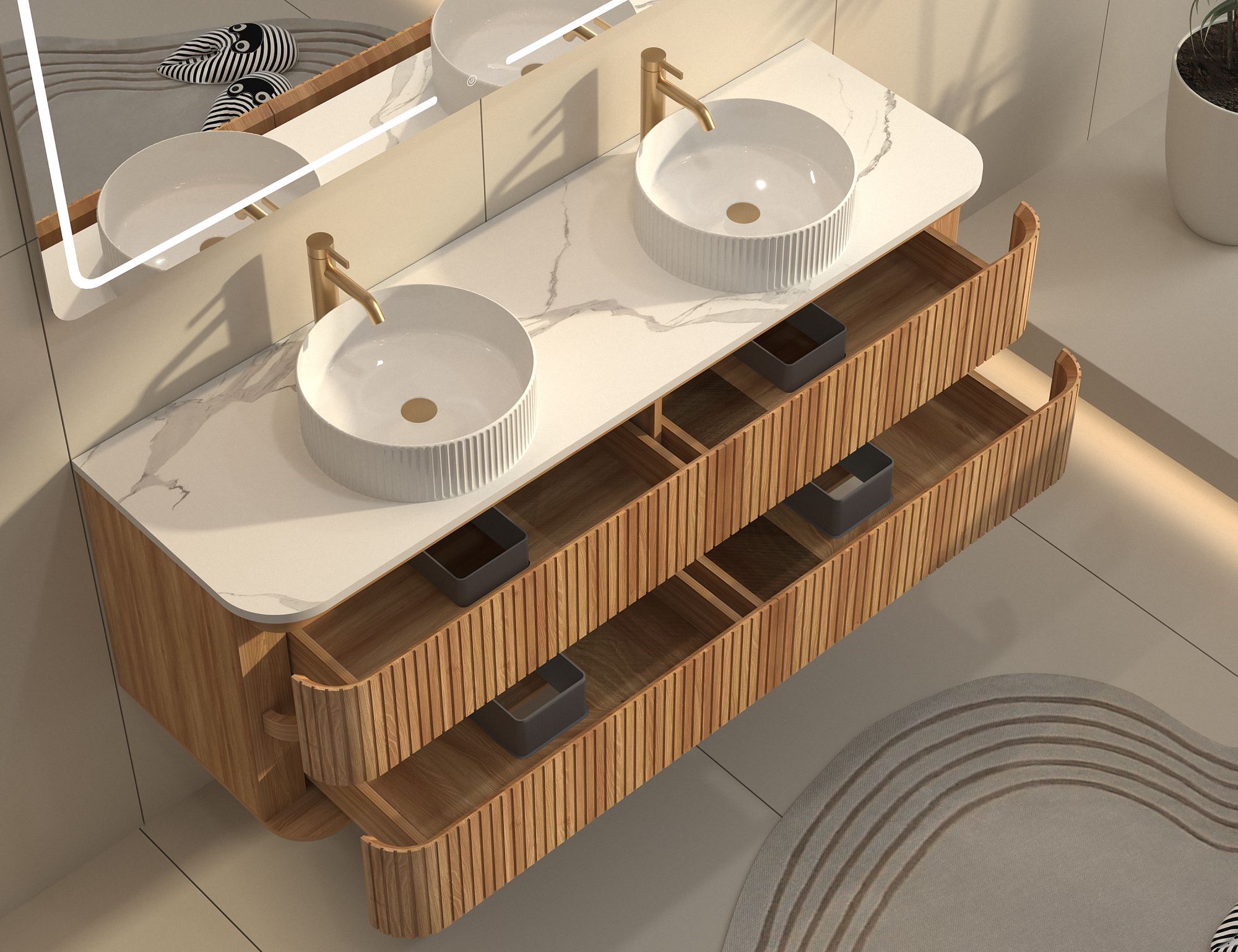
KL813003 is a current production wall-mounted vanity in plywood and solid wood, sized from 750 mm to 1200 mm, with two drawers on DTC soft-close slides.
Reading the specification for repeatability: KL813003 and AS813047
KL813003 is a wall-mounted bathroom vanity in the wall-mounted bathroom cabinet category, and it is a current production model. It is built from plywood and solid wood, finished in A2391 Acacia melamine and solid wood lacquered, and offered in widths of 750, 800, 900, 1000 and 1200 mm, all at 520 mm depth and 504 mm height. Storage is two drawers with DTC soft-closing slides operated through a hidden handle. The countertop is a Pure White Porcelain slab, and the basin is an undermount ceramic basin. The LED mirror on this model supports different functions.
AS813047 is a bathroom vanity in the same plywood and solid wood construction, finished in Warm Mist Brown lacquered and melamine. It carries two drawers on Unihopper soft-closing slides, a sintered stone integral basin, and an LED mirror with a light gold aluminium frame and 5mm copper-free glass. The mirror electronics cover three colour temperature settings, a defog function and dimming, operated through two touch control buttons.
Set side by side, the two models show why a specification has to be read at component level rather than at product level. Both are plywood and solid wood vanities with two drawers and soft-close slides. Almost nothing else is interchangeable.
| Continuity reference | KL813003 | AS813047 |
|---|---|---|
| Configuration | Wall mounted, 750 to 1200 mm widths | Bathroom vanity, two drawers |
| Build | Plywood and solid wood | Plywood and solid wood |
| Finish | A2391 Acacia melamine and solid wood lacquered | Warm Mist Brown lacquered and melamine |
| Drawer hardware | DTC soft-closing slides, hidden handle | Unihopper soft-closing slides |
| Top and basin | Pure White Porcelain slab, undermount ceramic basin | Sintered stone integral basin |
| Mirror | LED mirror supporting different functions | Light gold aluminium frame, 5mm copper-free glass, three colour temperature, defog, dimmable, two touch buttons |
Where continuity is won or lost
Finishes. Every model in the range carries a finish reference, not a colour name alone: A2391 Acacia melamine with solid wood lacquered on KL813003, Warm Mist Brown lacquered and melamine on AS813047 and AS813048A, Ancora Walnut lacquered and melamine on AS813050 and AS813049, A2392 Walnut melamine and lacquered on KL813001. A buyer can only compare batches against these references if the reference itself is written into the purchase order.
Hardware series. The range does not use one slide across all models, and that is normal in a mixed line-up. KL813003 uses DTC soft-closing slides with a hidden handle. AS813047 uses Unihopper soft-closing slides. AS813048A uses Unihopper metal box soft-close slides. KL813001 uses one drawer with Unihopper push-open slides plus two doors on DTC hinges with a Hettich push-open system. AS813109 uses three doors on DTC hinges with drawer mechanisms on Unihopper soft-close slides. AS813049 uses one door with DTC push-open hinges. Each of these combinations is a separate parts identity, and each needs its own service assumption.
Basins and tops. Three approaches appear in the current range. KL813003 pairs a Pure White Porcelain slab with an undermount ceramic basin. AS813047 and AS813049 use sintered stone integral basins. AS813109 uses a terrazzo top with a solid surface basin, AS813108 a solid surface top with a ceramic basin, and AS813050 a glossy white ceramic basin. These are not decorative variations: they determine what can be replaced without replacing the cabinet.
Mirror electronics. The LED mirrors in the range differ in ways that matter for service planning. AS813047 has two touch control buttons with three colour temperatures, defog and dimming, behind 5mm copper-free glass in a light gold aluminium frame. AS813050 has a gun metal frame with three colour temperature modes, defog and dimming on two control buttons. AS813049 uses a motion sensor switch, one colour temperature, backlight, defog and dimming, in a light gold metal frame measuring 500 x 1500 x 35 mm. AS813108 uses an infrared sensor switch with an internal LED light strip in a three-door mirror cabinet, while AS813048A ships with a wooden frame mirror without integrated lighting. A programme that mixes these models has four different electrical behaviours to document.
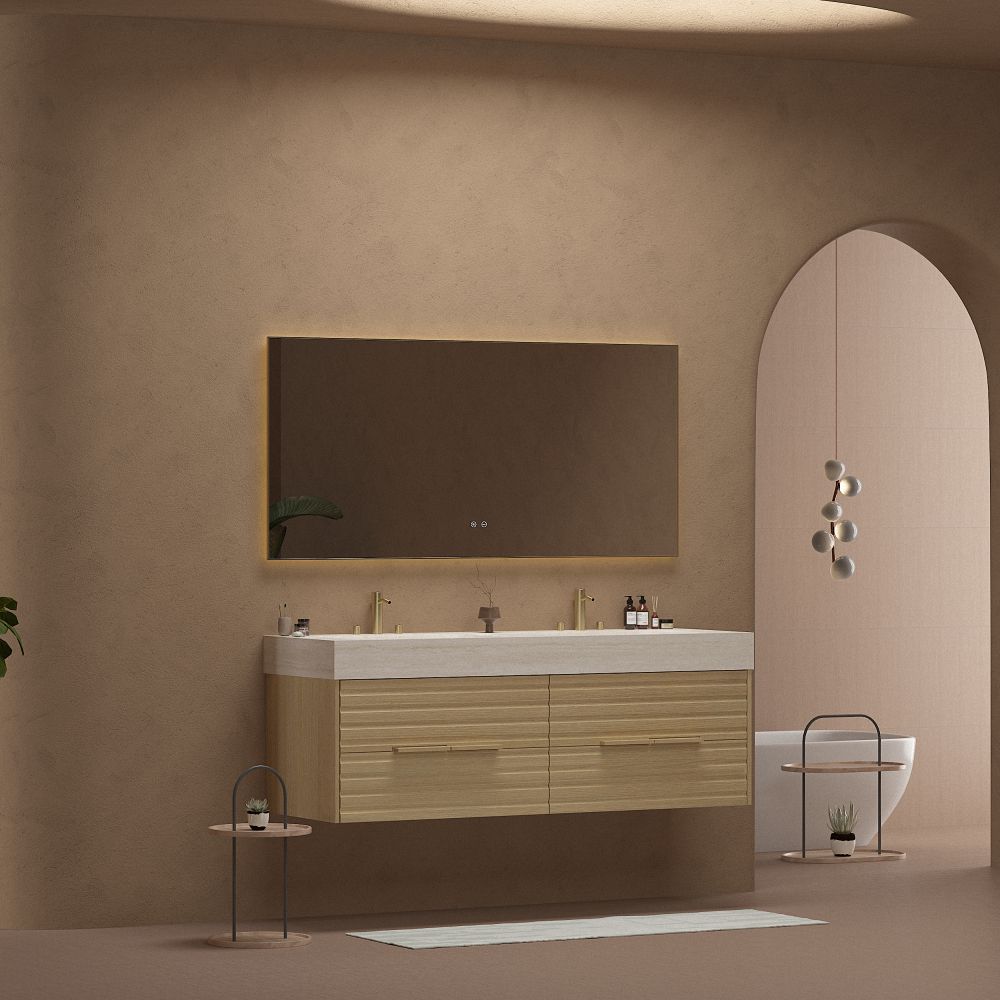
AS813047 combines a Warm Mist Brown lacquered and melamine finish with a sintered stone integral basin and a three-colour-temperature LED mirror.
Application scenarios that test continuity
Two documented scenarios show how the same model family behaves under different project logic. KL813003 is typically applied in the United States in the bathroom cabinet industry, and it appears in a hotel project in the USA as well as in an Australian villa bathroom cabinet case. Both scenarios share the same functional requirements: storage organisation, bathroom space optimisation, wet-dry separation support, moisture resistance, mildew resistance and scratch resistance under long-term static installation with daily manual use. The difference is the maintenance horizon. A hotel programme returns to the same specification at refurbishment; a villa case usually does not.
AS813047 and the wider floating range are specified for residential and commercial hospitality bathrooms, where the wall-hung format removes floor contact and shifts the long-term service burden onto the hanging system and the drawer mechanism rather than the cabinet base.
Category breadth is the third scenario. Shower door KL-AS001-1 is a shower screen built with 304 stainless steel hardware, available in clear, tinted, laminated, flute, chemically frosted, easy-clean coated and film-coated glass, for residential construction and commercial hospitality. A buyer running a bathroom package may source the vanity and the shower enclosure from one supplier, which reduces the number of quality systems to audit, but it does not remove the need to evaluate each category separately, because stainless steel hardware and glass processing have their own batch behaviours.
Purchasing terms and acceptance criteria that can be repeated
Terms that only describe quantity and price cannot be reused as an acceptance standard. The clauses below are the ones that convert a product fact into a testable requirement, using the models discussed above as examples.
| Clause | What to write |
|---|---|
| Model and finish | Model number plus finish reference, for example KL813003 in A2391 Acacia melamine and solid wood lacquered, or AS813047 in Warm Mist Brown lacquered and melamine |
| Size ladder | Named widths and shared depth and height, for example 750, 800, 900, 1000 and 1200 mm at 520 x 504 mm on KL813003 |
| Hardware identity | Slide series and opening method per drawer, such as DTC soft-closing slides with a hidden handle, or Unihopper soft-closing slides |
| Basin and top | Basin construction stated explicitly, such as sintered stone integral basin, or Pure White Porcelain slab with an undermount ceramic basin |
| Mirror function set | Glass thickness, frame, controls and functions, such as 5mm copper-free glass with three colour temperature settings, defog, dimming and two touch buttons |
| Acceptance evidence | A retained approved sample per finish and per model family, plus a photographed batch reference, so that later deliveries are compared against a record and not against a memory |
Where a programme is sold into North America, one further constraint belongs in the terms rather than in the marketing file. Bathroom cabinets and vanities in that market must comply with UL 962, the standard covering stability, mechanical strength and flammability, as published by UL Solutions. Any change to a drawer mechanism, a hanging system or a panel build after approval is the kind of change that can put that compliance status back into question, which is one more reason to lock component identities at the specification stage.
Replacement-part planning for slides and mirror components
Vanity lifespans are usually limited by moving parts and electronics, not by cabinet boxes. A parts register per model is the practical response, and it can be built directly from the specification.
For drawer systems, the register needs the series and the mechanism type, not simply the word soft-close. In the current range that means distinguishing DTC soft-closing slides as used on KL813003, Unihopper soft-closing slides as used on AS813047, Unihopper metal box soft-close slides as used on AS813048A, Unihopper push-open slides on KL813001, and DTC push-open hinges on AS813049. Two drawers on one model, three drawers across another, and two side drawers plus an outer and an inner drawer on AS813109 all imply different quantities per unit, which should be recorded rather than estimated at the point of failure.
For mirrors, the register needs the control type and the function set. A two-button touch control with three colour temperatures, defog and dimming on AS813047 is a different service item from the single-button motion sensor arrangement with one colour temperature on AS813049, and different again from the infrared sensor switch used on the AS813108 mirror cabinet. Glass specification belongs in the same register: 5mm copper-free glass on AS813047, 3mm copper-free glass on the AS813109 mirror cabinet, and a wooden frame mirror without integrated lighting on AS813048A.
For basins, the register should note whether the basin is integral or separate, because that decides whether a chip becomes a basin replacement or a countertop replacement.
Finish matching across plywood and solid wood
Ranges built from plywood and solid wood are, by definition, mixed-material ranges. Some faces are melamine-faced panels, others are solid wood with a lacquered finish. Two different processes have to arrive at one visual result, and the seam between them is where batch drift becomes visible first.
The controllable points are few. The finish reference must be stated at code level, as with A2391 Acacia on KL813003 or Warm Mist Brown on AS813047, rather than as a colour description. An approved sample should be retained per finish and per material combination. Incoming batches should be reviewed under the same lighting condition as the approved sample, because melamine decor and lacquer reflect light differently and a mismatch seen under one light may disappear under another. Where a supplier operates more than one finishing site, cross-site samples have to be approved before volume moves, including where a PU dust-free spray paint workshop is used for surface treatment. Durability requirements stated for these applications, namely moisture resistance, mildew resistance and scratch resistance, should be tested on the finished assembly and not on the panel alone.
Market trend analysis
Three verified market signals shape how continuity should be assessed. First, wall-mounted and floating formats are a leading design direction for 2025 to 2026, with freestanding units still holding a significant volume share in North America at around 30% (Houzz; Homes & Gardens). A range that is heavily wall-hung concentrates long-term service risk in the hanging system and drawer hardware, not in the cabinet base. Second, wood construction, meaning solid wood and plywood together, led the material mix with a 34.9% revenue share in 2025 (Grand View Research), which puts finish matching at the centre of quality complaints rather than at the periphery. Third, residential applications account for roughly 74.9% of revenue share in 2025 (Grand View Research), and residential buyers replace and extend bathrooms in small increments, which rewards suppliers who can repeat a small order years later.
The reasonable reading of these signals is not that every buyer needs a formal supplier sustainability audit. It is that the questions worth asking have shifted from capacity to repeatability, and that repeatability is documented rather than demonstrated.
Comparison with traditional first-order sourcing
Traditional sourcing evaluates a manufacturer on the first container: price, sample quality, lead time and a pre-shipment inspection. Continuity-based sourcing evaluates the same manufacturer on the second, third and fourth order: whether the model is still in production, whether the finish reference still resolves to the same material, and whether the hardware identity has been recorded. The first approach is faster and cheaper to administer. The second produces fewer surprises but requires more paperwork up front.
The limitations of the continuity model deserve equal weight, because it is not universally the right choice.
A multi-site manufacturer cannot guarantee a single finish result across sites without an explicit cross-site approval process. A second production base improves supply resilience, but in finish terms it introduces a second process to control, and the buyer carries the cost of verifying it.
Integral basin constructions reduce service flexibility. A sintered stone integral basin, as used on AS813047 and AS813049, is a single component with the top; a chip or crack is a top-level event. An undermount ceramic basin under a porcelain slab, as on KL813003, is in principle a separable item. Buyers who prioritise repairability over visual continuity should weigh that difference before specifying.
Naming a specific hardware series improves replaceability but narrows substitution options later, because a DTC soft-close mechanism and a Unihopper soft-close mechanism are not interchangeable parts. Locking a series is a commitment, not a free option.
Finally, the administrative overhead is real. Retained samples, finish codes, parts registers and cross-site approvals cost time, and on a single small order that cost is unlikely to be recovered. First-order sourcing remains rational for one-off projects with no intention of repeating the specification.
Future outlook
The direction of the category suggests that the documentation burden will keep rising rather than falling. LED mirrors have moved from optional accessories to integrated parts of the vanity specification, with defog, dimming, multiple colour temperatures, touch control and motion or infrared sensing all appearing in current models. Each added function creates a service category that a specification written five years ago would not have covered. At the same time, two-region manufacturing is becoming a normal arrangement for suppliers serving North America, Europe and Australia simultaneously, which makes cross-site consistency a buyer-facing question rather than an internal one. Buyers who begin recording finish codes and hardware series now will find the next specification cycle easier; those who do not will keep renegotiating the same batch disputes.
A downloadable company brochure covering SHKL ranges and facilities is available here: SHKL brochure (PDF).
FAQ
What does a bathroom vanity manufacturer need to demonstrate beyond the first order?
Beyond the first order, three things can be verified rather than assumed: that the model is still a current production model, that the build and finish are referenced at code level, and that hardware and electrical components are identified by series and function. KL813003 illustrates the first point, since it is described as a current production model in the wall-mounted bathroom cabinet category, built from plywood and solid wood in A2391 Acacia melamine and solid wood lacquered.
How can buyers check that plywood and solid wood construction stays consistent across batches?
Consistency is checked against a reference, not against an impression. The practical method is to retain an approved sample for each finish and material combination, state the finish at code level in the purchase order, and inspect later deliveries against that sample. In the SHKL range the codes include A2391 Acacia melamine and solid wood lacquered on KL813003, Warm Mist Brown lacquered and melamine on AS813047 and AS813048A, and Ancora Walnut lacquered and melamine on AS813050 and AS813049.
What replacement-part information should be recorded for soft-close vanity slides?
The series, the mechanism type and the quantity per unit. Within the current range, KL813003 uses two drawers on DTC soft-closing slides with a hidden handle, AS813047 uses two drawers on Unihopper soft-closing slides, AS813048A uses two drawers on Unihopper metal box soft-close slides, and AS813109 combines three doors on DTC hinges with drawer mechanisms on Unihopper soft-close slides. These are separate parts identities, and a register per model avoids substitution at the point of replacement.
Are LED mirror components in vanities serviceable over a multi-year programme?
They are serviceable only if the function set and control type are documented at specification stage. AS813047 uses a light gold aluminium frame with 5mm copper-free glass, three colour temperatures, defog and dimming on two touch control buttons. AS813050 uses a gun metal frame with three colour temperatures, defog and dimming on two control buttons. AS813049 uses a motion sensor switch with one colour temperature, backlight and defog. AS813108 uses an infrared sensor switch with an internal LED light strip, while AS813048A is supplied with a wooden frame mirror without integrated lighting.
How should finish matching be handled when a range mixes melamine panels and lacquered solid wood?
By treating the two processes as one requirement. The finish reference, the retained sample, the lighting condition used for approval and the inspection of the finished assembly should all be defined before production. Moisture resistance, mildew resistance and scratch resistance are properties of the finished surface, so they are relevant to both the melamine-faced panel and the lacquered solid wood part, and should be checked on the assembly rather than on raw board.
Can a long-term bathroom vanity supplier also cover coordinated bathroom categories?
Some manufacturers operate across categories. SHKL, established in 2004, produces bathroom vanities, shower doors and LED bathroom mirrors, and shower door KL-AS001-1 is a shower screen built with 304 stainless steel hardware, available in clear, tinted, laminated, flute, chemically frosted, easy-clean coated and film-coated glass for residential construction and commercial hospitality. Category breadth reduces the number of quality systems to audit, but each category still needs its own material and batch evaluation, because stainless steel hardware and glass processing behave differently from cabinet finishing.
SHKL contact details: info@shklbathroom.com, info@shkl.cc, WhatsApp +86 13790005061, website www.shklbathroom.com.
Tem questões ou precisa de mais detalhes?
Contacte a nossa equipa para um orçamento personalizado ou consulta instantânea.
Solicitar orçamento
Preencha o formulário abaixo e a nossa equipa entrará em contacto com uma proposta personalizada.
Chat direto do WhatsApp
Prefere conversar em tempo real? Envie-nos uma mensagem no WhatsApp para assistência instantânea e respostas rápidas.
- Obter orçamento personalizado
- Partilhar fotos ou documentos
- Discuta as suas necessidades diretamente
Geralmente responde em 5–30 minutos durante o horário de expediente.