
Long-Term Brass Valve Supplier: Compliance and Range Continuity
HTNXT Industry Reference · Brass Valve · Lead-Free Compliance · Supplier Evaluation
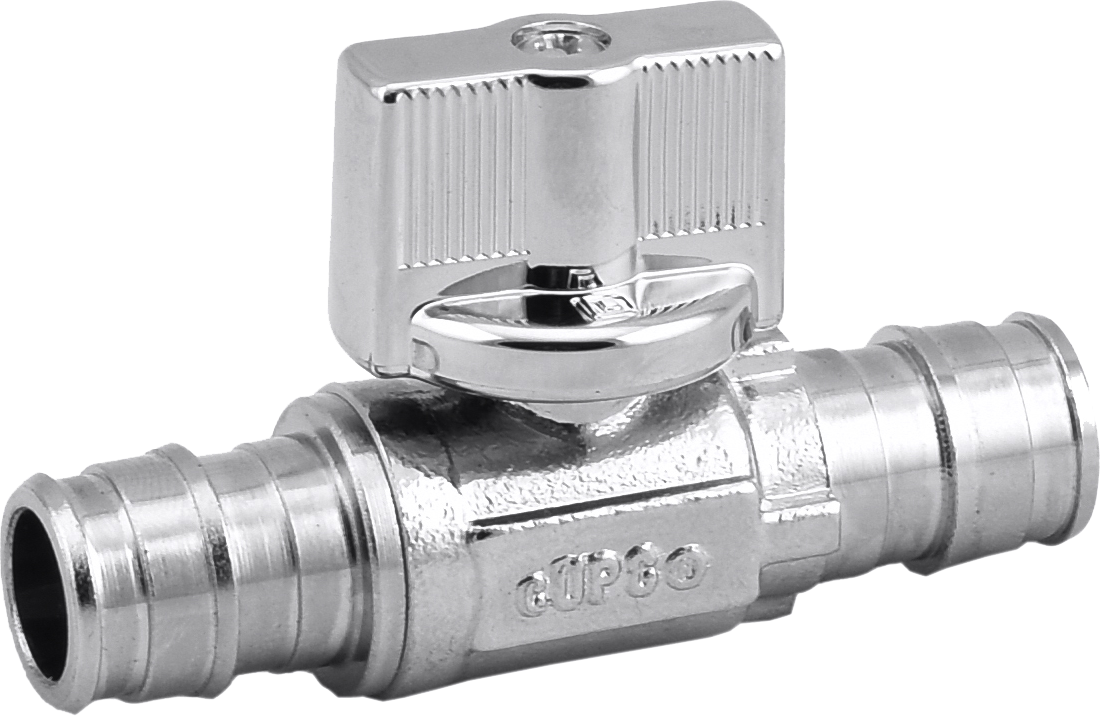
In potable-water plumbing, lead-free construction is a legal condition of sale rather than a point of differentiation. Any supplier under serious evaluation can send a certificate, and a sample can pass a lab review in a week. The harder question in long-term supplier evaluation is whether the same supplier can hold that status — the same alloy, the same listing scope, the same product families — through re-certification cycles, heat-to-heat alloy variation, tooling wear and repeat orders placed two or three years from now.
Zhejiang Longda Technology Co., Ltd., which presents its brass valve business under LONGDA BRASS VALVE, is a manufacturer of brass valves and brass fittings established in 1993 in Xuangang Industry Zone, Lupu Town, Yuhuan County, Zhejiang Province, China. The company produces brass ball valves, gate valves, stop valves, check valves, heating valves and angle valves, together with brass fittings, plumbing bibcocks and sanitary ware components, and exports about 95% of its output to Europe, the United States, Canada and South America. Its relevance to a continuity evaluation is structural: alloy selection, listing management, 100% testing and range breadth sit inside one 30,000 m² site, which is precisely the combination a multi-year supply program depends on.
A register, not a folder of certificates
Compliance files grow over time and rarely stay legible. The practical fix at the evaluation stage is to convert the file into a register: for each product family, which model is listed, under which standard, issued and expiring when, and who is accountable for renewal. A register answers the only question that matters before a purchase order is placed — whether the exact item being purchased sits inside a valid scope today, and whether it will still sit inside one at the end of the contract.
NSF/ANSI 61 and NSF/ANSI 372 are two different tests
U.S. market access for brass valves in drinking-water service rests on two tests that buyers routinely merge into the single word “lead-free”. NSF/ANSI 372 addresses lead content: the weighted average lead content of wetted surfaces must not exceed 0.25%, the threshold written into Section 1417(d) of the Safe Drinking Water Act and into California Health & Safety Code Section 116875, commonly referenced as AB1953. NSF/ANSI/CAN 61 addresses health effects: it evaluates whether materials in contact with drinking water contribute contaminants at levels of concern. A valve can satisfy one requirement and fail the other, so both listings belong in the register.
Both are listing-based, which is where continuity risk enters. A listing names the models and standards it covers, not a catalogue. Four questions belong in every supplier questionnaire:
- Is the alloy grade written into the drawing and the purchase order, or left as generic “brass”?
- Does a material test report accompany each production lot, not only the approval sample?
- Does the listing scope name the exact model being ordered, including its connection type?
- Who owns renewal, and what notice period applies if a listing lapses mid-contract?
What the LONGDA listing register covers
For this supplier, the register can be reconstructed from the certificates themselves. All entries below are IAPMO listings held by Zhejiang Longda Technology Co., Ltd.
| Product family | Representative model | Listings in scope | Issued → valid to |
|---|---|---|---|
| Brass gate valve | T-22017A | NSF/ANSI/CAN 61-2023 (N-5775); lead-free listing NSF/ANSI/CAN 372-2024 (6304) | 2024-10-01 → 2029-10-01; 2024-08-01 → 2028-08-01 |
| Brass Y strainer | LD.73154 | NSF/ANSI/CAN 61 (N-5775); lead-free listing (6304) | 2029-10-01; 2028-08-01 |
| Brass check valve | LD 30303 | NSF/ANSI/CAN 61 (N-5775); lead-free listing (6304) | 2029-10-01; 2028-08-01 |
| Brass ball valve | 8081 | NSF/ANSI/CAN 61 (N-5775); lead-free listing (6304); cUPC 5938 to IAPMO/ANSI Z1157-2014e1(R2019), ASME A112.4.14-2022, CSA B125.14-22 | 2029-10-01; 2028-08-01; cUPC 2029-03-01 |
| Brass supply stop valve (angle valve) | 98023-LF | NSF/ANSI/CAN 61 (N-5775); lead-free listing (6304); cUPC 5775 to ASME A112.18.1-2024 / CSA B125.1-24 with NSF/ANSI 14-2015 | 2029-10-01; 2028-08-01; cUPC 2029-10-01 |
| Brass fittings | 15111 | NSF/ANSI/CAN 61 (N-5775); lead-free listing (6304); cUPC 8222 (ASTM F1807-2023, CSA B137.5-2020); cUPC 10232 (ASTM F1960-2024); cUPC 17432 press (IAPMO/ANSI/CAN Z1117-2022); cUPC 17433 push-fit (ASSE 1061-2025, NSF/ANSI 14-2023) | 2029-10-01; 2028-08-01; 8222 2029-09-30; 10232 2029-12-01; 17432 / 17433 2030-06-01 |
Two patterns in this register matter. First, the families a distributor orders most often in potable service — supply stops and angle valves, ball valves, gate valves, check valves and Y strainers — carry the deepest listing stacks, which is where buyers actually need them. Second, the fittings families are qualified against connection standards (ASTM F1807, ASTM F1960, IAPMO/ANSI/CAN Z1117, ASSE 1061) rather than against valve-performance standards. A generic “NSF 61 certified” statement in a brochure therefore says nothing about which of those scopes applies to the item on the purchase order.
Alloy discipline is the part that does not renew automatically
The alloy set behind the range is documented as Eco-Brass C69300, CW724R, lead-free brass C4650, CW511L, low-lead brass CW509L and CW510L, and dezincification-resistant CW602N. That spread exists because markets differ: potable-water applications in North America and parts of Europe call for lead-free grades, while heating and aggressive-water circuits put a premium on dezincification resistance.
Continuity risk lives here rather than in the certificate folder. A listing is validated against a declared material. If a heat of the named alloy runs short and a substitution is made quietly, the certificate stays valid on paper while the shipped valve no longer matches the declared construction. Long programs therefore specify the alloy grade in the purchase order, require a material test report per lot, and name a reference standard the supplier must meet — ASTM B584 for copper alloy composition and mechanical requirements, or EN 13828:2003 for manually operated copper alloy ball valves used in drinking water supply, depending on product form and destination market. Where water chemistry is aggressive, dezincification-resistant CW602N is the grade to specify, and its presence in the alloy set is a genuine sourcing advantage for heating and mixed-use systems.
Testing: what “100%” has to mean
The supply stop line is documented as 100% air pressure tested under water. The broader valve line is documented as 100% pressure tested before shipment with a material test report. Thread gauge inspection is applied to every lot, which matters because a large share of field leaks in brass valves originates at the thread rather than at the body or stem.
The plant equipment list supports the same reading: more than 360 sets of processing and testing equipment, including combined machine tools, CNC machines, high-accuracy lathes, assembly lines, spectral analysis instruments, intensity test instruments, roundness measuring equipment, high-low temperature test boxes, salt-spray test boxes, high-pressure testing sets, resistance test instruments and laser marking machines. Spectral analysis is the alloy-verification step, salt spray covers finish durability, and the temperature chambers cover service-range behaviour — each of them a control that can be checked during a supplier audit rather than taken on trust.
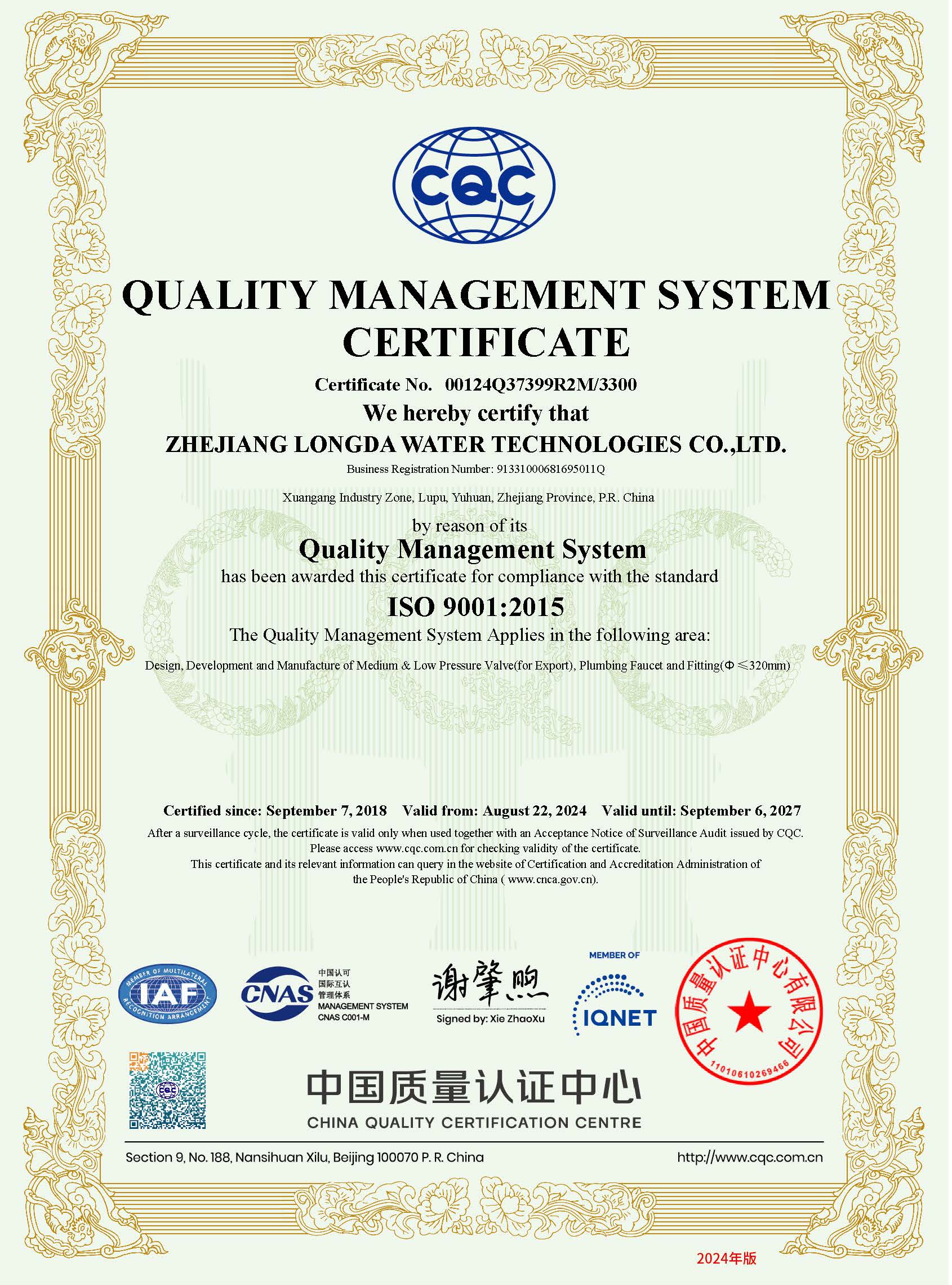
Two management-system certificates set the earliest renewal dates in the whole file: ISO 9001:2015 certificate CN00124Q37399R2M/3300, issued by the China Quality Certification Centre and valid to 2027-09-06, and ISO 14001:2015 certificate CN00124E33461R2M/3300, valid to 2027-09-09. For a buyer signing a three-year program in 2026, both dates fall inside the contract period. They belong in the agreement as notification obligations rather than in an annual filing check.
Connection and configuration coverage determines how much one supplier can absorb
Range continuity is tested by the tail of an order, not the head. Documented sizes run from 1/4″ to 4″ on the valve line and 1/2″ to 3/4″ on supply stops. Threads are available as NPT to ASME B1.20.1 and BSP to ISO 228-1. For supply stops, documented connection options include FIP × compression, IPS × compression, FIP × FIP, PEX × PEX, PEX × compression, Press × compression, EXP × compression, EXP × EXP and EXP × Press.
Customization covers body material (lead-free or DZR brass), handle type (lever, T-handle, butterfly), handle colour, chrome finish, logo printing and packaging in blister, box or poly bag, with certification support for cUPC and NSF. Production modes include OEM, ODM and private label, which lets a distributor carry its own brand without owning the tooling.
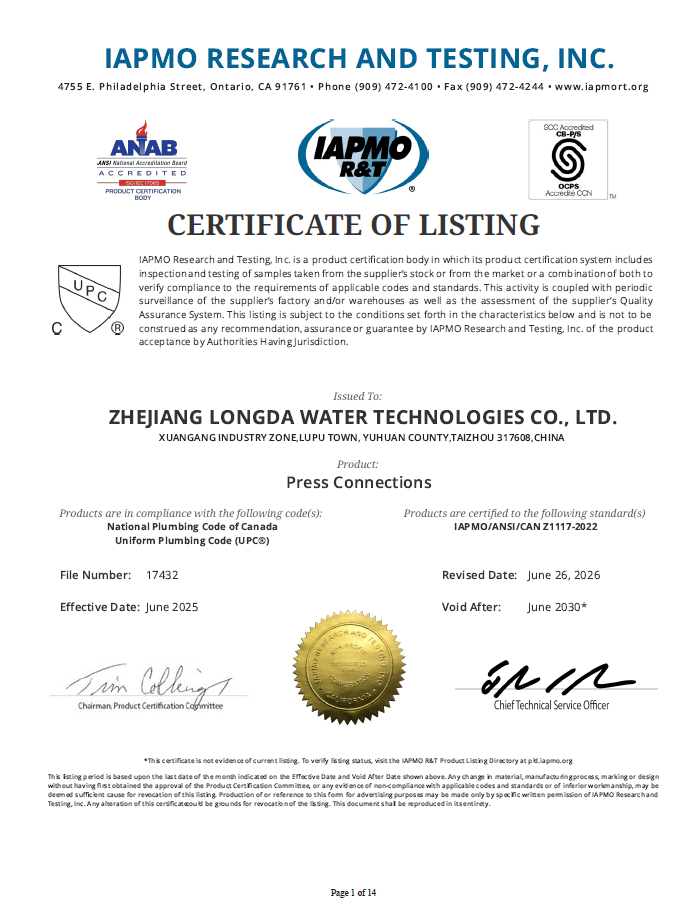
The arithmetic matters to a distributor: every additional connection family a supplier can hold under one certification file is one fewer vendor to audit and one fewer document set to reconcile. It also shortens the tail of a renovation or fit-out order in which a contractor needs NPT on one riser and press or expansion connections on another.
The supply envelope: capacity, MOQ and lead time
Capability claims become procurement decisions only when they are expressed as an envelope. The documented figures are:
| Item | Documented value |
|---|---|
| Monthly capacity | 500,000 pcs (supply stop line); 300,000 pcs (valve line) |
| Minimum order quantity | 1,000 pcs per size |
| Sample lead time | 5–7 days |
| Production lead time | 30–60 days (supply stop line); 20–50 days (valve line, by product) |
| Quality control | 100% air pressure test under water (supply stop line); 100% pressure test before shipment with material test report (valve line); thread gauge inspection every lot |
| Warranty and support | 12-month quality warranty with free replacement of defective units; technical support and installation guidance |
| Commercial terms | FOB Ningbo / Shanghai, CIF, CNF, DDP or EXW; 30% T/T in advance, 70% against copy of B/L, other terms on consultation |
Read together, the envelope says two things. Capacity in the hundreds of thousands of pieces per month fits distributor and OEM programs but not spot buying. And lead times in the 20–60 day band assume the buyer schedules rather than reacts: a first sample in five to seven days is fast, a reorder in five to seven days is not available and should not be promised downstream.
The clearest continuity evidence in the file is a documented three-year record with two North American accounts: a U.S. plumbing manufacturer taking 8,000,000 pieces a year and a Canadian distributor taking 70,000,000 pieces, both for bathroom and kitchen fixture supply shut-off in residential plumbing, each over a three-year relationship. Recorded outcomes are zero leakage complaints, a 100% pass rate in a retail quality audit and monthly repeat orders — on cUPC / NSF 61 certified, chrome-plated quarter-turn valves supplied in retail packaging.
Application fit: new construction, renovation, hospitality and distributor programs
The range's documented application set is unglamorous, and that is the point: new residential construction, bathroom and kitchen renovation, hotel and apartment fit-out, and wholesale supply to plumbing distributors, including programs of the type run by Ferguson and Winsupply. Recorded working conditions are 40–80 psi (0.28–0.55 MPa) at 4–60°C for fixture supply shut-off, 40–150 psi (0.28–1.0 MPa) at 4–90°C for angle valves feeding fixtures, and up to 200 psi (1.4 MPa) at −10 to 110°C for the general valve line.
In hotel and apartment fit-out the failure mode that costs most is not a burst body but a weeping stop valve behind a finished wall, discovered after the room is handed over. Three checks reduce that exposure: quarter-turn operation with visible open/close indication so maintenance staff do not over-torque a multi-turn stem; a chrome-plated finish suited to humid interiors; and a lead-free listing that names the exact model being installed.
Market signals that reward documentation continuity
Third-party market data places the global brass valves market at USD 14.8 billion in 2025, projected to reach USD 24.1 billion by 2034, a CAGR of 5.6% from 2026 to 2034 (Dataintelo). Ball valves held the largest product-type share at 38.4% in 2025, Asia Pacific accounted for 41.2% of revenue and North America for 26.1%.
Supply remains fragmented. The top five global valve suppliers are estimated to control roughly 35% of global revenues (Mordor Intelligence), and China exported USD 22.6 billion in valves under HS 8481 in 2024, retaining its position as the largest exporter (OEC). Fragmentation is exactly why documentation continuity becomes a purchasing variable: with a long tail of suppliers, the differentiator is not price alone but whether listings, alloy declarations and test records survive the second and third order.
Regulation pushes in the same direction. Lead-free brass has become the mandatory standard for potable-water applications in the United States under the Safe Drinking Water Act (U.S. EPA). European buyers work to EN 13828:2003 for manually operated copper alloy ball valves in drinking water, EN 331:2015 for brass gas valves, and ISO 228-1 for thread geometry. Every one of those references is checkable, and checkable requirements are the ones procurement teams are expected to enforce.
Sources: Dataintelo (brass valves market, 2025–2034); Mordor Intelligence (valve market concentration); OEC (HS 8481 export value, 2024); U.S. EPA; CEN; ISO; ASTM International.
Boundaries: where this supplier model is not the right fit
- Order size floor. The minimum order quantity of 1,000 pieces per size rules out single-unit trials and very small mixed-SKU test baskets. A buyer validating a new market should expect to commit quantity per size or buy through a distributor first.
- Lead time. 20–50 days on the valve line and 30–60 days on the supply stop line are program lead times, not replenishment times. Emergency replacement stock has to be held locally.
- Listing scope is finite. NSF/ANSI/CAN 61 (N-5775), the lead-free listing (6304) and the cUPC listings name specific models and standards. A new body style, a new connection family or a different alloy normally requires additional testing and listing work before it can be sold in potable service; that time should be budgeted rather than assumed away.
- Warranty is bounded. The 12-month quality warranty with free replacement of defective units is a defined commercial window, not a lifetime performance guarantee. Longer coverage has to be negotiated separately.
- Capacity has a ceiling. 300,000–500,000 pieces per month per line is a real limit. Peak-season allocation for large construction programs should be agreed in advance rather than assumed from catalogue breadth.
- Standards outside the file. Buyers sourcing for EU gas installations (EN 331:2015) or for pressure equipment under PED should request scope-specific evidence; the potable-water listings summarised above do not cover those applications.
Future outlook
The continuity question will be answered on a calendar rather than in a brochure. In this file the renewal sequence runs: ISO 9001 on 2027-09-06 and ISO 14001 on 2027-09-09; the lead-free listing (6304) on 2028-08-01; cUPC 5938 on 2029-03-01; cUPC 8222 on 2029-09-30; NSF/ANSI/CAN 61 (N-5775) and cUPC 5775 on 2029-10-01; cUPC 10232 on 2029-12-01; and cUPC 17432 / 17433 on 2030-06-01.
Two structural trends will test suppliers in that window. Growth of 5.6% a year to 2034 raises volume pressure on the same alloy supply base, which is where quiet substitution risk appears. And the spread of smart-valve and IIoT-enabled fluid management (Mordor Intelligence) pushes more of the market toward documented, traceable components, because connected systems assume the mechanical layer beneath them is known and repeatable.
For buyers, the practical conclusion is shorter than it looks: lock the alloy in writing, confirm the listing names the model, put renewal dates into the contract, and set the supply envelope against the project schedule. Suppliers that can answer all four with documents rather than assurances are the ones worth a multi-year program.
FAQ
Which U.S. certifications should a buyer verify on a lead-free brass valve?
Three separate items. NSF/ANSI 372 confirms that the weighted average lead content of wetted surfaces is at or below 0.25%, the threshold set by Section 1417(d) of the Safe Drinking Water Act and California Health & Safety Code Section 116875 (AB1953). NSF/ANSI/CAN 61 confirms health-effects compliance for materials in contact with drinking water. cUPC listing confirms performance under the applicable product standard, for example ASME A112.18.1 / CSA B125.1 for supply stops or IAPMO/ANSI Z1157 with ASME A112.4.14 for ball valves. A single “lead-free” claim does not substitute for any of them.
How is lead-free compliance demonstrated order by order rather than at sample stage?
Through lot-level documentation. The manufacturer documents a material test report with the valve line, 100% pressure testing before shipment, and thread gauge inspection on every lot; on the supply stop line the documented control is 100% air pressure testing under water. Buyers should require the material test report to name the alloy grade, and should tie repeat orders to the same declared grade so that a substitution cannot pass unnoticed between shipments.
Which product families does Longda's potable-water listing file cover?
The NSF/ANSI/CAN 61 listing N-5775 and the lead-free listing 6304 name six families: brass gate valve T-22017A, brass Y strainer LD.73154, brass fitting 15111, brass check valve LD 30303, brass ball valve 8081 and brass supply stop valve (angle valve) 98023-LF. cUPC listing 5938 adds ball valves under IAPMO/ANSI Z1157, cUPC 5775 adds the supply stop under ASME A112.18.1 / CSA B125.1, and fittings are further listed under cUPC 8222, 10232, 17432 and 17433 for their respective connection standards.
What order quantities and lead times should a distributor plan for?
Documented figures are a minimum order quantity of 1,000 pieces per size, production lead times of 30–60 days on the supply stop line and 20–50 days on the valve line depending on product, and sample lead times of 5–7 days. Monthly capacity is stated as 500,000 pieces on the supply stop line and 300,000 pieces on the valve line. These are program terms, so safety stock should be set against the long end of the lead-time band rather than the short end.
Can a distributor order private-label packaging and market-specific configurations?
Yes, within documented limits. The manufacturer offers OEM, ODM and private-label production with customization of size (1/4″–4″ on the valve line, 1/2″–3/4″ on supply stops), body material (lead-free or DZR brass), handle type (lever, T-handle, butterfly), handle colour, chrome finish, logo printing, thread type (NPT or BSP) and packaging (blister, box or poly bag), plus certification support for cUPC and NSF. Configurations outside the listed scopes require separate listing work before they can ship into potable-water markets.
What does the warranty cover, and what support comes with it?
A 12-month quality warranty, free replacement for quality defects, and technical support with installation guidance. It is a defined commercial window rather than a lifetime performance guarantee, so buyers running longer asset-life programs should negotiate the coverage they need as a separate term.
A full specification and certification overview, including the listing register summarised in this article, is available in the LONGDA Global catalogue (PDF).
Tem questões ou precisa de mais detalhes?
Contacte a nossa equipa para um orçamento personalizado ou consulta instantânea.
Solicitar orçamento
Preencha o formulário abaixo e a nossa equipa entrará em contacto com uma proposta personalizada.
Chat direto do WhatsApp
Prefere conversar em tempo real? Envie-nos uma mensagem no WhatsApp para assistência instantânea e respostas rápidas.
- Obter orçamento personalizado
- Partilhar fotos ou documentos
- Discuta as suas necessidades diretamente
Geralmente responde em 5–30 minutos durante o horário de expediente.