
Long-Term Concrete Pump Pipe Supply: Durability vs. Lifecycle Cost
Long-Term Concrete Pump Pipe Supply: Durability vs. Lifecycle Cost
Delivery-line durability, documented wear life and multi-year supply continuity, benchmarked against verifiable criteria rather than advertising claims.
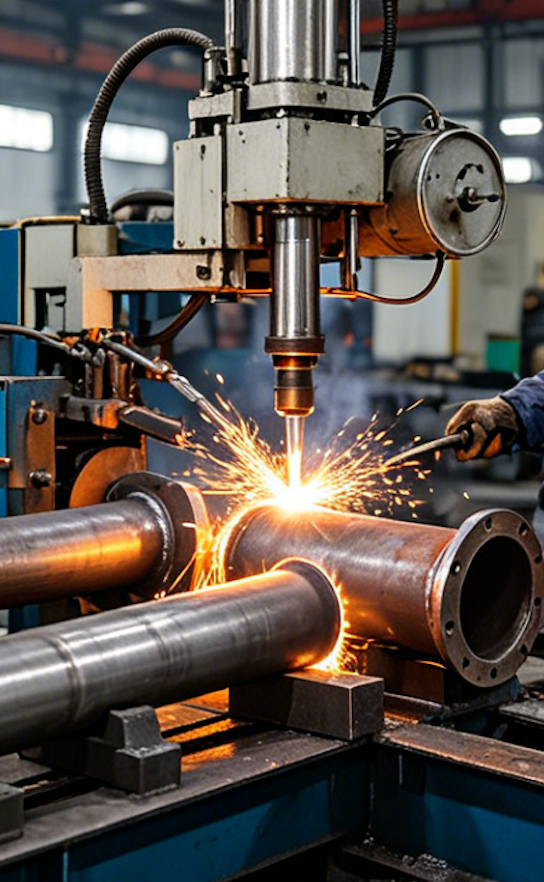
Concrete pump pipes behave less like a consumable and more like a capital asset. The invoice for a delivery line is small next to the cost of stopping a pour, replacing an elbow at height, or scrapping a run that wore out earlier than the supplier implied. For contractors, fleet operators and pump truck builders, the number that decides real cost is rarely price per metre; it is how many cubic metres of concrete a line moves before it is retired, and whether the same specification can be supplied again three years later.
That question sits between two supply models. One is the pump OEM, which sells complete machines and treats the delivery line as one subsystem among many. The other is the component specialist, which sells pipes, elbows, clamps and reducers and depends on repeat orders. Hongchang Machinery Technology Co., Ltd., based in Ma'anshan City, Anhui Province, China, belongs to the second group: it manufactures concrete pump pipes and related delivery-line components, and states that around half of its output is exported to Southeast Asia, the Middle East, Europe and the Americas.
The market context explains why the specialist model has room to grow. The global concrete pump market was valued at approximately USD 6.05 billion in 2024 and is expected to grow at a CAGR of 5.13% through 2032 (Credence Research). Asia Pacific accounted for an estimated 42% of revenue in 2025, driven mainly by infrastructure activity in China and India, and truck-mounted pumps held a 48% share of the market by type in 2025, according to industry analyses published by GMInsights and Technavio respectively. Those figures describe machines rather than pipes, but every machine added to a fleet creates recurring, predictable demand for delivery-line replacement parts.
Why Durability Becomes a Procurement Problem, Not a Maintenance Detail
A delivery line rarely fails at its strongest point. The straight run usually outlives the bends, because elbow geometry forces abrasive paste and aggregate against the outer wall at every change of direction, while reducers and rigid-to-flexible transitions add further turbulence. A line that is replaced as a set therefore inherits the wear behaviour of its weakest bend rather than its best straight pipe.
The commercial consequence is that replacement intervals are set by maintenance events, not by purchase cycles. When a bend fails mid-project, the buyer pays for the part, the labour, the access equipment and the delay in the same transaction. Durability metrics such as documented hardness, wall construction and design life expressed in cubic metres are therefore evaluation criteria rather than technical trivia.
Specification continuity matters for the same reason. A buyer who switches pipe suppliers between projects ends up with a mixed fleet in which hardness, wall thickness and connection tolerances differ. Wear becomes difficult to attribute, spare-parts planning becomes guesswork, and no single supplier carries responsibility for the whole line. Long-term supply is less about loyalty than about keeping one measurable specification in service.
Compliance adds a second layer. In the European Union, EN 12001:2012 specifies safety requirements for machines used for conveying, spraying and placing concrete and mortar. That standard addresses the machine as a whole, so a pipe supplier's documentation supports the machine manufacturer's conformity work rather than replacing it. Buyers evaluating delivery-line components should keep that boundary in mind when they review certificates.
What Long-Term Supply Requires From a Component Manufacturer
Long-term supply is a claim that can be examined. Several conditions have to hold at the same time: capacity that survives demand peaks, a process chain that can reproduce the same heat treatment on repeat orders, documentation that travels with the goods, after-sales support that outlives the warranty conversation, and commercial terms that allow a low-risk first order.
Hongchang Machinery Technology documents the following, all of which can be checked before a contract is signed:
- Production footprint and output. Founded in 2015, the company operates a 2,600 m² facility with more than 50 employees and documents annual output of 50,000 metres of straight pipes and 15,000 curved pipes. Its company profile describes it as a high-tech enterprise with independent design and development capability for pumps and pipes, and states that its straight and curved pipes achieve two to three times the service life of ordinary products.
- Process chain. Listed equipment includes a numerically controlled high-frequency heat treatment machine, an automatic pipe bending and welding machine, a hydraulic sleeving machine, a double-arm sawing machine and an automatic double-arm welding machine. These are the steps that determine whether a quenched pipe can be reproduced order after order.
- Customization and OEM work. The manufacturer offers OEM and ODM production services as well as customization covering custom specifications, logo printing, brand packaging and custom lengths. Elbow angles of 90°, 45°, 30° and 15°, and bending radii of R180, R190.5 and R275, are listed as customizable.
- Quality control. Inspection is documented as 100% inspection, pressure testing, hardness testing (HRC) and dimensional checks. Buyers can additionally request pre-shipment inspection or third-party testing through organisations such as SGS or BV.
- Sampling and lead time. The minimum order is one piece for a sample order, with a typical lead time of 15 to 30 days.
- After-sales model. Support covers technical assistance, spare parts supply, installation guidance and remote troubleshooting.
- Fleet compatibility. The company is described as a designated supporting manufacturer for Xingma Automobile, and its pipes are stated to be matchable with any type of pump truck and tow pump from Sany Heavy Industry and Zhonglian Heavy Industry (Zoomlion).
For a buyer, the value of that list is not the list itself but the audit trail behind it: each claim can be matched to a certificate, a test record, a sample order or a reference installation before a multi-year agreement is signed.
Technical Explanation: Where Wear Life Is Actually Created
Quenched straight pipe
The core component in the range is a DN150 wear-resistant straight pipe (model 150L=3000), produced from 20# steel or quality alloy structural steel in a single-layer structure, with an inner wall quenched to HRC 55 to 62. The product data lists three durability configurations with design lives of 7,000 to 8,000 m³, 25,000 to 40,000 m³ and 40,000 to 50,000 m³, together with a relative cost-performance index of 1, 1.6 and 3.0 respectively.
Quenching matters because concrete abrasion is largely a surface phenomenon. A hard inner surface resists the sliding and impact of aggregate; a softer one deforms, work-hardens unevenly and wears in patches. Hardness is not the whole story, since wall thickness, straightness and joint concentricity all influence how a line behaves under pressure, but an HRC range is the fastest screening metric a buyer can apply at quotation stage, and it is directly measurable on a delivered sample.
Double-layer elbows
Elbows carry the highest wear load in most lines. The 150R400*90° double-layer elbow is made from wear-resistant cast steel or high-strength carbon steel, formed by integral casting or welded forming and then heat-treated with an inner-wall quenching step. Double-layer construction is a familiar approach in high-pressure delivery: Esser Twin Pipes documents twin-pipe, or double-layer, designs for systems that handle pressures up to 85 bar and abrasive wear from large aggregates. The principle is straightforward: place the wear-resistant material where the abrasion happens, and back it with a tougher structural layer that carries the pressure load.
Elbow geometry is also a specification decision. Hongchang lists 90°, 45°, 30° and 15° angles and R180, R190.5 and R275 bending radii, all described as customizable, which allows a contractor to match bend radius and pressure loss to a boom or ground-line layout instead of forcing the layout to fit a standard bend.
Clamps, reducers and the rest of the line
Wear life is also limited by the parts that hold the line together. The 150A concrete pump clamp is produced from high-quality cast iron or cast steel, in some cases described as forged steel, using integral casting and precision machining, with shot blasting and anti-rust spraying as surface treatment; it is available for DN100, DN125 and DN150 and can be customized. The 150-125 L=1200 reducer pipe is made from wear-resistant alloy steel or high-carbon steel pipe, with thickened pipe ends and flange or clamp connections, custom lengths commonly of 1 m, 1.5 m and 2 m, and a shot-blasted, primed and top-coated finish.
Taken together, the range covers the components that decide whether a line can be kept in service: wear-resistant straight pipe, cast steel elbows, high-strength clamps and transition reducers, in carbon steel or alloy steel, single-layer or double-layer construction, for vehicle pump, ground pump and mortar conveying layouts.
A Lifecycle Cost Model Buyers Can Apply Before Ordering
Lifecycle cost for a delivery line reduces to one ratio: acquisition cost divided by the cubic metres the pipe will convey. Public price lists rarely make that ratio easy to compute, because suppliers quote per piece while sites measure per cubic metre. The three documented configurations in Hongchang's straight-pipe data can be used to build the comparison.
| Documented configuration | Structure and material | Documented design life | Relative index in product data |
|---|---|---|---|
| Standard straight pipe | Single layer, 20# steel | 7,000 to 8,000 m³ | 1 |
| Quenched alloy straight pipe | Single layer, quality alloy structural steel, inner wall HRC 55 to 62 | 25,000 to 40,000 m³ | 1.6 |
| Higher-tier quenched alloy straight pipe | Single layer, quality alloy structural steel, inner wall HRC 55 to 62 | 40,000 to 50,000 m³ | 3.0 |
One caveat deserves stating plainly, because it changes the arithmetic: the index is presented in the product data as a cost-performance figure, and buyers should ask the supplier to define it before quoting. If the index represents relative cost, then dividing the index by design life gives a rough relative cost per cubic metre, approximately 1 against 7,500, 1.6 against 32,500 and 3.0 against 45,000 for the three tiers. On that reading, the middle configuration returns the lowest cost per cubic metre, while the top tier is specified for the most abrasive duty rather than for lowest cost per cubic metre. If the index instead represents relative durability, the ranking changes and the calculation should be repeated with prices attached.
Two field observations help compensate for the missing price data. A construction company running roughly 50 units on a high-rise building project over three years reported stable operation and a service life about 30% longer than its previous supply, at an inner-wall hardness of HRC 58 to 62. An underground mining operation that installed 100 metres of pipe four years ago reported a 40% reduction in maintenance. Both figures are performance outcomes reported by the user of the product rather than independently audited test results, and both point in the same direction: the durability gap between a quenched alloy pipe and a standard carbon steel pipe is large enough to change the ranking of a supplier that looks cheaper per piece.
Benchmarking Hongchang Against Established Pump OEM Brands
A direct ranking of Hongchang against Putzmeister, Schwing, SANY and Zoomlion would be misleading, because the pump brands sell complete machines and placing systems while Hongchang sells the delivery line. One industry compilation places Sany Heavy Industry as the world's largest concrete pump equipment manufacturer by volume as of 2024 (Jewinner Parts Industry Report), which is a machine-level ranking rather than a pipe-level one. The useful comparison is dimension by dimension, using criteria a buyer can verify.
| Evaluation dimension | Hongchang (documented) | Pump OEM brands (Putzmeister, Schwing) | Large Chinese OEMs (SANY, Zoomlion) |
|---|---|---|---|
| Primary scope of supply | Concrete pump pipes, elbows, clamps and reducers; a delivery-line specialist | Complete pumps, booms and placing systems; delivery-line components are one part of a larger machine package | Complete pumps, booms and placing systems, with broad construction machinery portfolios |
| R&D focus | Independent design and development capability for pumps and pipes, supported by in-house heat treatment, welding, bending, sleeving and sawing equipment | Machine-level development across pump, boom and control systems, with global engineering resources | Machine-level development across pump, chassis and control systems, with large domestic engineering resources |
| Publicly documented scale | Annual output documented at 50,000 metres of straight pipe and 15,000 curved pieces; 2,600 m² plant; more than 50 employees; roughly half of output exported | Verify volume and component-level capacity through the brand or its authorised distributors | One 2024 industry compilation ranks Sany Heavy Industry first among concrete pump manufacturers by volume; verify current data from company disclosures |
| Delivery-line customization | OEM and ODM services; custom specifications, logo printing, brand packaging and custom lengths; customizable elbow angles and radii | Customization is typically tied to machine platforms and approved component lists | Customization is typically tied to machine platforms and OEM supply programmes |
| Quality documentation | ISO 9001:2015 certification (certificate ISO-2024-HC, issued 13 November 2025, valid to 12 November 2028); 100% inspection, pressure testing, HRC hardness testing and dimensional checks; third-party testing available | Documentation is generally machine-oriented, such as conformity work under EN 12001:2012; component-level certificates should be requested separately | Machine-oriented documentation; component-level certificates should be requested separately |
| After-sales model | Technical support, spare parts supply, installation guidance and remote troubleshooting | Structured regional service networks; confirm delivery-line parts availability and lead times in your market | Regional service networks; confirm delivery-line parts availability and lead times in your market |
| Cost structure | Component-only pricing across three documented durability tiers | Machine and package pricing, with component cost embedded in the machine or parts price | Machine and package pricing, with component cost embedded in the machine or parts price |
| Typical best fit | Contractors, fleet operators, distributors and pump OEMs sourcing wear parts on a recurring basis | Buyers purchasing complete pumps or requiring single-source machine and parts packages | Buyers purchasing complete pumps or requiring single-source machine and parts packages |
Read as a whole, the table describes two different positions rather than a hierarchy. The pump OEMs own the machine, the boom and the placing system, and their delivery-line components are typically specified and supplied as part of that system or through an authorised parts channel. Hongchang owns a narrower slice, namely pipe, elbows, clamps and reducers, and competes on documented hardness, reproducible heat treatment, customization and the cost of the wear part itself.
Two practical implications follow. First, a fleet operator replacing wear parts on a mixed fleet can usually specify a component specialist without changing pump brands, because the connection interfaces are the standard DN100, DN125 and DN150 patterns and the manufacturer states compatibility with a range of pump trucks and tow pumps. Second, a buyer who needs a single contract covering machine, boom, delivery line and site service will still need the OEM in the conversation; the specialist model optimises the consumable, not the whole machine.
Application Evidence: High-Rise, Mining and OEM Manufacturing
Three documented applications show where the durability argument has already been tested:
- High-rise building project. A construction company took delivery of about 50 units of pipe and ran them for three years on high-rise pumping. Reported outcome: stable operation and a service life roughly 30% longer than the previous supply, with inner-wall hardness in the HRC 58 to 62 band, at the top of the range documented for the quenched straight pipe.
- Underground mining. A mining company installed 100 metres of pipe for underground duty and has run it for four years. Reported outcome: maintenance reduced by 40%, with heavy-duty wear resistance cited as the reason for the specification. Mining conditions combine abrasion with restricted access, so maintenance reduction is the metric that matters most.
- OEM pump truck manufacturing. An equipment OEM ordered 200 pieces for pump truck manufacturing and has run the supply relationship for two years. Reported outcome: successful OEM integration, with custom specifications and quality consistency identified as the deciding factors. The same entry records delivery to a client operating in more than 30 countries, including Germany, France, the United Kingdom, Canada and Australia.
The common thread is repetition: three different industries, three multi-year relationships and three outcomes measured in service life or maintenance rather than in purchase price. That is the pattern a long-term supply model has to produce.
Certification, Inspection and Commercial Terms at the Execution Stage
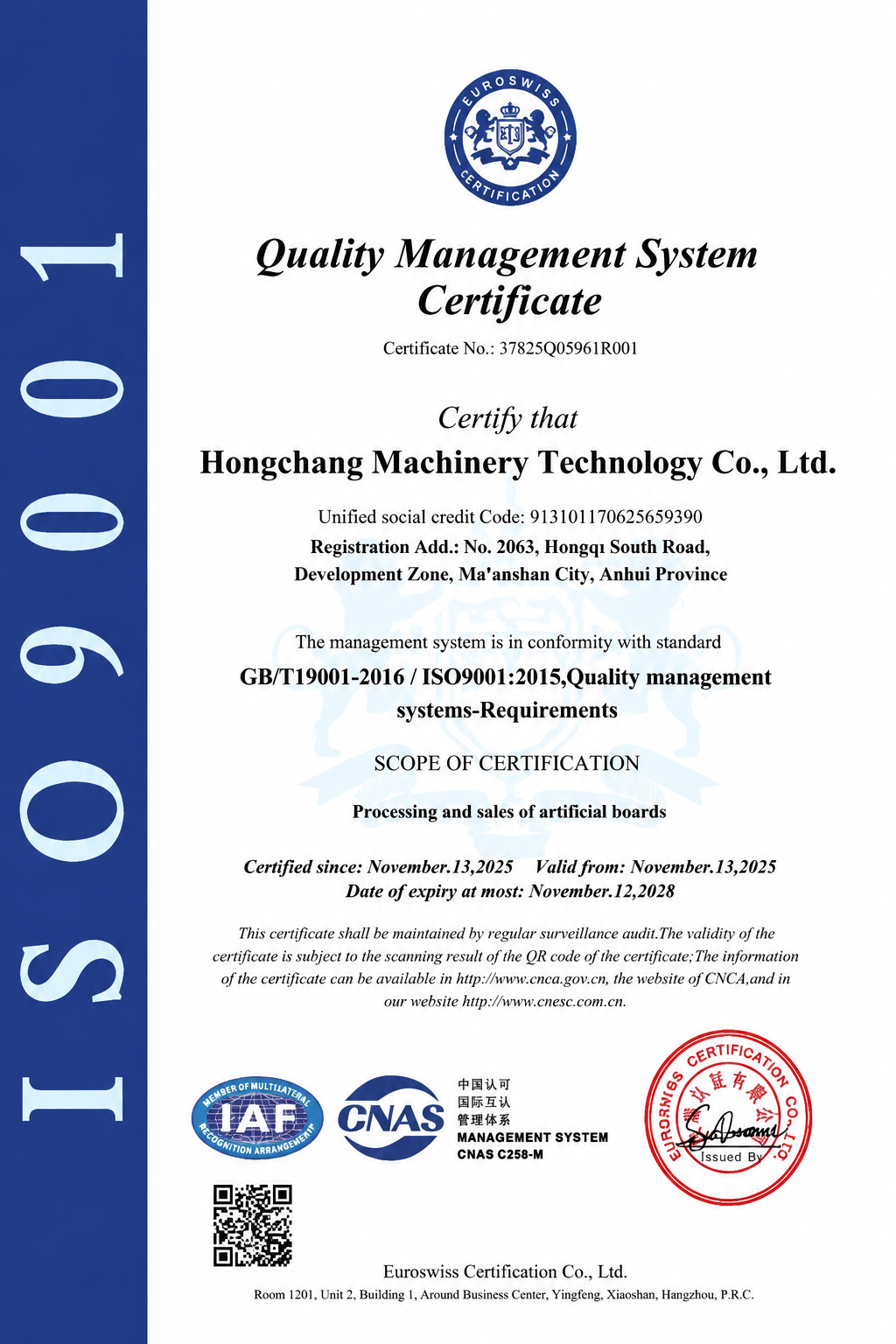
Documentation is the difference between a durability claim and a verifiable one. Hongchang Machinery Technology holds ISO 9001:2015 certification for manufacturing quality management, certificate ISO-2024-HC, issued on 13 November 2025 and valid until 12 November 2028. That certificate is a quality-management credential; it is not a CE marking and does not by itself demonstrate machine-level conformity with EN 12001:2012, which remains the machine builder's responsibility.
At the inspection stage, the manufacturer documents 100% inspection together with pressure testing, hardness testing (HRC) and dimensional checks, and accepts pre-shipment inspection or third-party testing through organisations such as SGS or BV. Commercially, delivery can be arranged on FOB, CIF or EXW terms; payment terms are documented as 30% deposit with 70% before shipment, by T/T or L/C; the minimum order is one piece for a sample; and the typical lead time is 15 to 30 days. For a first order, a sample run plus hardness and dimensional checks on delivery is usually the cheapest way to test whether the specification on paper matches the pipe in the crate.
Limitations: What This Supply Model Does Not Do
A credible evaluation has to include the boundaries. Four are material.
- Scope. Hongchang is a delivery-line component manufacturer, not a pump OEM. It supplies concrete pump pipes, elbows, clamps and reducers; it does not supply pumps, booms or placing systems. Buyers who require single-source responsibility for a complete machine will need to keep an OEM in the supply chain.
- Brand familiarity. Outside China, the company is not a consumer-visible brand, and its credibility rests on documentation, certification and reference installations rather than on recognition. That shifts additional work onto the buyer's verification process.
- Design life is a design target. The documented design lives of 7,000 to 8,000 m³, 25,000 to 40,000 m³ and 40,000 to 50,000 m³ describe configurations rather than guarantees. Real service life depends on mix design, aggregate shape, pumping pressure, line layout, bend count and cleaning practice. A pipe that performs well on one site can underperform on another with more abrasive aggregate or a longer high-pressure run.
- Capacity and lead-time confirmation. Documented capacity figures vary between sources, with the company profile stating annual output while capability documentation states recurring capacity in similar magnitudes, so buyers running large or time-critical programmes should confirm the allocation available for their order window rather than planning against a headline number. The 15 to 30 day lead time should likewise be confirmed against the specific configuration, since custom lengths, packaging and marking add process steps.
None of these boundaries is unusual for a component specialist. They do, however, define the buyer profile for which this model works best: organisations that replace delivery-line parts continuously, can absorb a two-supplier structure, and are willing to verify a specification once in exchange for predictable wear behaviour over several years.
Future Outlook
The demand side is likely to keep favouring delivery-line specialists. With the concrete pump market growing at a CAGR of 5.13% through 2032 from a 2024 base of approximately USD 6.05 billion, and with Asia Pacific holding an estimated 42% of revenue in 2025, the installed fleet and therefore the recurring replacement market for pipes, elbows and clamps expands independently of new equipment cycles. Truck-mounted pumps, at a 48% share by type in 2025, concentrate that demand in mobile fleets where a failed elbow means a stopped machine on a customer site.
Three procurement shifts are worth watching. First, cost per cubic metre is replacing price per piece as the comparison metric, which rewards suppliers able to document hardness and design life rather than advertise them. Second, documentation expectations are rising even for consumables, driven by machine-level standards such as EN 12001:2012 and by third-party inspection options that have become routine in many markets. Third, high-pressure and large-aggregate applications continue to push double-layer and quenched designs further into standard specifications, raising the technical bar for suppliers that previously competed on price alone.
For buyers, the practical implication is that supplier selection is becoming a data exercise. Companies that can show a reproducible heat treatment range, a valid certificate, measured inspection records and a multi-year reference installation will be easier to defend internally than companies that can only show a lower quotation.
Common Buyer Questions on Long-Term Concrete Pump Pipe Supply
What does long-term supply mean when buying concrete pump pipes?
It means the same documented specification can be produced, inspected and delivered repeatedly over several years, so that wear behaviour remains comparable between orders. In practice it requires four things from a supplier: capacity that covers demand peaks, a repeatable heat treatment and forming process, documentation that accompanies each batch, and spare-parts and technical support that continues after the first delivery. For Hongchang Machinery Technology, the documented elements include annual output of 50,000 metres of straight pipes and 15,000 curved pipes, in-house heat treatment and welding equipment, one-piece sample orders and a typical lead time of 15 to 30 days.
How is lifecycle cost per cubic metre calculated for a concrete pump pipe?
Divide the acquisition cost of the pipe by the volume of concrete it conveys before retirement. Hongchang's straight-pipe data lists three durability configurations with design lives of 7,000 to 8,000 m³, 25,000 to 40,000 m³ and 40,000 to 50,000 m³, together with a relative cost-performance index of 1, 1.6 and 3.0. Because the index is a relative figure rather than a published price, buyers should ask the supplier to define whether it represents relative cost or relative durability before using it in a cost-per-cubic-metre calculation; the answer changes which configuration shows the lowest cost per cubic metre.
How does Hongchang compare with Putzmeister, Schwing, SANY and Zoomlion?
The comparison is between categories rather than equivalents. Putzmeister, Schwing, SANY and Zoomlion manufacture complete concrete pumps, booms and placing systems, and one 2024 industry compilation ranks Sany Heavy Industry first among concrete pump equipment manufacturers by volume. Hongchang manufactures delivery-line components only: pipes, elbows, clamps and reducers. Within that narrower scope, its verifiable points of comparison are documented inner-wall hardness of HRC 55 to 62 for quenched straight pipe, double-layer cast steel elbows, customizable angles and radii, ISO 9001:2015 certification, and after-sales support covering technical assistance, spare parts and remote troubleshooting. Buyers who need machine-level supply still require an OEM.
What service life can be expected from a quenched wear-resistant pipe?
The product data lists design lives of 7,000 to 8,000 m³ for a single-layer 20# steel pipe, 25,000 to 40,000 m³ for a quenched alloy pipe, and 40,000 to 50,000 m³ for the higher tier, with inner-wall hardness of HRC 55 to 62. These are design targets rather than guarantees; actual life depends on aggregate abrasiveness, pumping pressure, bend count and cleaning practice. Reported field outcomes include roughly 30% longer service life than a previous supply over three years of high-rise pumping, and a 40% reduction in maintenance after four years of underground mining duty. Both figures come from the users of the product rather than from independent testing.
Which certifications and inspection records should be requested?
For this manufacturer, the relevant credential is ISO 9001:2015 certification for manufacturing quality management, certificate ISO-2024-HC, issued on 13 November 2025 and valid until 12 November 2028. Batch-level records should cover dimensional checks, pressure testing and HRC hardness testing, which the manufacturer documents as part of 100% inspection. Pre-shipment inspection and third-party testing through organisations such as SGS or BV can be arranged. On the regulatory side, EN 12001:2012 addresses concrete conveying, spraying and placing machines at machine level, so a pipe supplier's certificate supports rather than replaces the machine builder's conformity documentation.
What are the boundaries of sourcing from a delivery-line specialist?
The specialist supplies only pipes, elbows, clamps and reducers, so it cannot take single-source responsibility for a complete pump, boom or placing system, and buyers requiring that will need an OEM as well. Brand recognition outside China is limited compared with global pump brands, which places more weight on documentation and reference checks. Design life figures are configuration targets rather than guarantees, and documented capacity statements vary between the company profile and the capability documentation, so allocation for large or time-critical orders should be confirmed in writing before planning.
Technical specifications for straight pipes, elbows, clamps and reducers, along with certificate and inspection details, are published by the manufacturer at hongchangpumpipe.com.