
Long-Term Conveyor Belt Supplier Evaluation: A Multi-Year Supply Checklist
Long-Term Conveyor Belt Supplier Evaluation: A Multi-Year Supply Checklist
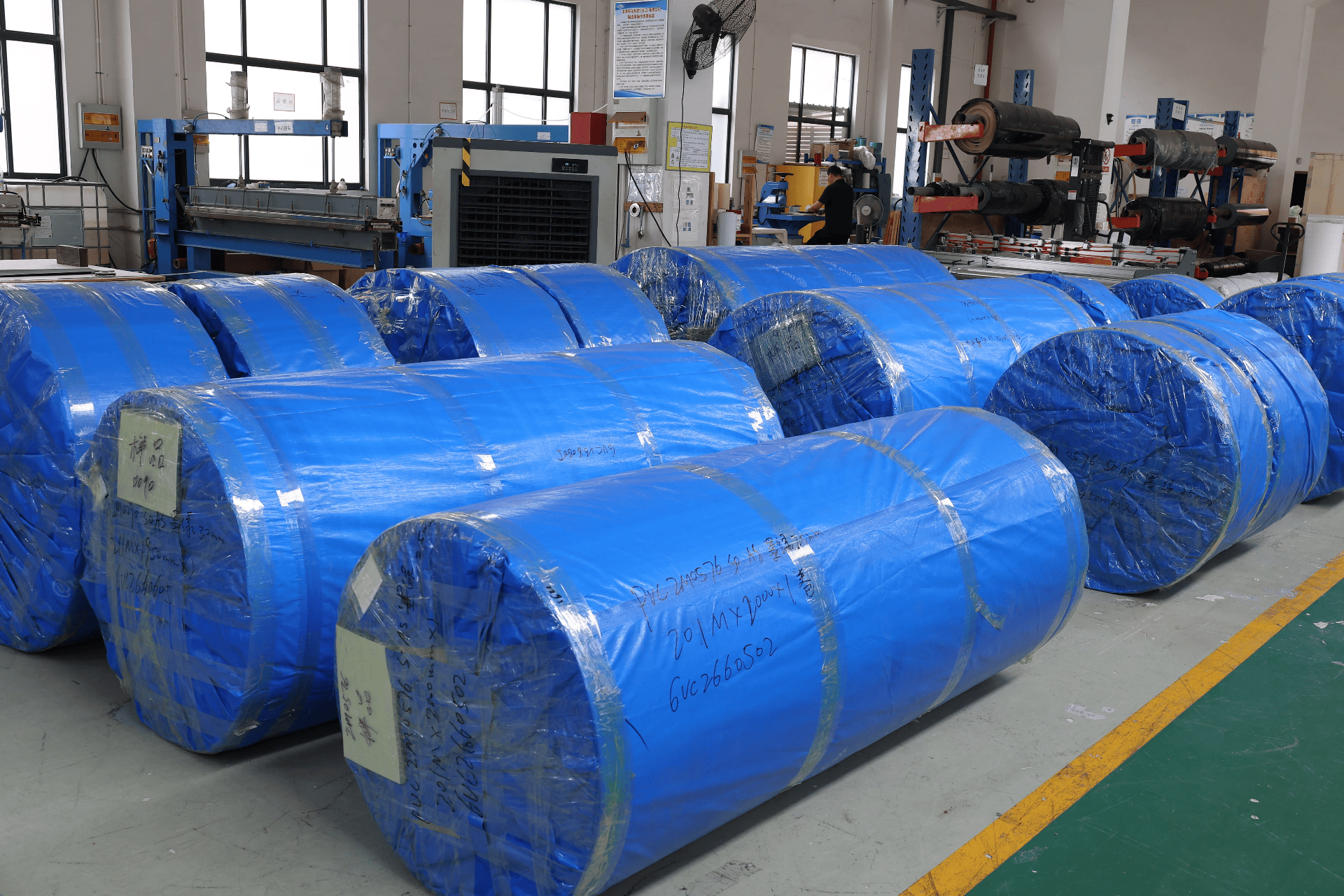
A multi-year conveyor belt supply decision is not settled by a single certificate or a low first-order price. It is settled by repeatable application fit: the supplier can reconstruct the duty, document the approved construction, and keep the same critical details visible when the line is rebuilt, the product changes, or the original belt marking disappears. The practical question for procurement and engineering teams is therefore not only whether a supplier can make a belt, but whether it can reproduce the right belt, with the right evidence, across repeat orders. This article provides a multi-year checklist built around that question.
Why a Multi-Year Conveyor Belt Supply Checklist Matters
The market scale explains why supplier continuity receives attention, but scale does not validate a supplier. Mordor Intelligence forecasts the global conveyor belt market at USD 6.08 billion in 2026. Cognitive Market Research projects a 6.2% CAGR for the light-weight conveyor belt segment from 2025 to 2033. Those figures describe commercial context; they do not establish that any particular PVC, PU, PE, felt, seamless, coil wrapper or flat belt is suitable for a given machine. Buyers still have to verify the exact construction, the application conditions and the documents attached to the item supplied.
For long-term supply, the cost of a wrong reorder is usually higher than the unit-price difference between two quotations. A belt that is dimensionally correct but has the wrong surface, joint, carcass or temperature capability can create splice failure, tracking problems, product movement or unplanned downtime. A checklist reduces that risk by forcing the buyer and supplier to agree on the same technical baseline before price, lead time or annual volume is discussed.
The Foundation: A Frozen Application Data Pack
The foundation of a multi-year checklist is a frozen application data pack. Width and length are not a specification. The buyer should record material family, dimensions, joint, surface, pulley geometry and operating conditions in one controlled document that becomes part of the purchase order.
- Material and construction: PVC, PU, PE, PVK, silicone, felt, homogeneous, seamless or flat-belt construction; carcass or reinforcement; cover material; thickness; number of plies where applicable.
- Dimensions: endless length or open length, width, thickness and tolerances. Confirm how the belt is measured and whether the joint is included in the endless length.
- Joint: spliced or truly endless; splice type; joint preparation, press parameters or fastener specification; whether the original joint was finger, stepped or mechanical.
- Surface: top and bottom surface, friction requirement, color as an identifier only, cleats, sidewalls, guides, perforations, coating or fabric lamination.
- Pulley geometry: forward and reverse pulley diameters, slider or roller support, wrap angle, center distance and minimum pulley limits.
- Operating conditions: conveyed product, load, speed, incline, continuous or start-stop operation, temperature, oil or chemical exposure, cleaning method and wash-down chemicals.
This list is not decorative. Each item changes a selection decision. A food-processing line may prioritize hygiene and cleanability, while a logistics sorter may prioritize wear, tracking, noise and surface friction. A vacuum table may depend on air permeability or perforation. A coil wrapper belt may depend on strip temperature and cut resistance. A flat transmission belt may depend on force, elongation and pulley compatibility. The same phrase, conveyor belt, does not make these duties interchangeable.
Purchasing Terms and Acceptance Criteria That Hold Across Years
The purchasing terms should define the approved construction and the acceptance method, not only the commercial volume. A useful multi-year agreement freezes the approved technical data sheet, identifies the exact material grade and joint method, states the dimensional and surface acceptance checks, and requires written notification before a material, construction or processing change. This is a control against specification drift between lots and years.
Acceptance criteria can reference applicable standards where they genuinely apply. ISO 21183-1:2026 covers characteristics of light conveyor belts; EN 12882:2015 addresses general-purpose conveyor belt safety requirements in the European Union. Such standards provide a framework, but they do not replace the product-specific datasheet, the application review or the buyer's own dimensional and functional checks.
Acceptance should be tied to what the belt must do: fit the pulleys, track, hold the product, release the product, resist the cleaning regime, meet the food-contact scope if applicable, and reproduce the approved surface and joint. A certificate alone cannot demonstrate that fit.
What ISO 9001 and FDA 21 CFR 175.300 Reports Do and Do Not Prove
Two documents often appear in supplier packages: an ISO 9001 certificate and an FDA 21 CFR 175.300 test report. Both can be useful. Neither is a universal product approval.
ISO 9001 certifies a quality-management system within a stated organizational scope. It is not a performance certificate for an individual belt model. XZBELT's ISO 9001 certificate covers sales of industrial transmission and transportation rubber and plastic belts and related products; it does not state that every individual belt model is independently ISO product-certified. For a buyer, the useful follow-up is to ask for the certificate scope, validity and surveillance status, then separately request the model-specific technical datasheet, dimensions, joint method and test evidence.
An FDA 21 CFR 175.300 report is also scope-limited. It reports the result of defined testing on a submitted sample under stated conditions. It should not be converted into a blanket claim that the manufacturer or every conveyor belt it sells is FDA certified. Check the exact sample or model, material description, simulant, temperature, time, limit and conclusion. XZBELT's TT14-GG SGS report identifies a specific PU conveyor-belt sample, references US FDA 21 CFR 175.300 and reports compliant total-extractives results under the recorded test conditions. The report itself states that the results are specific to the tested sample.
Documentation discipline therefore separates three levels: supplier-level evidence such as ISO 9001; product-level evidence such as a technical datasheet and sample-specific test report; and application-level evidence such as pulley geometry, operating temperature, cleaning chemicals, food-contact scope and joint verification. A multi-year supplier file should keep all three levels separately indexed.
Replacement Support When the Original Belt Model Is Unknown
An unreadable model number does not prevent replacement, but dimensions alone are rarely enough. The supplier needs to reconstruct both the belt and the application. Useful information includes endless length, width, total thickness, top and bottom surface, color as an identifier, number of plies, material, joint, guides, cleats, sidewalls and perforations. Machine information is equally important: pulley diameters, slider or roller support, speed, conveyed product, load, incline, temperature, oil or chemical exposure and cleaning conditions.
Send four things together whenever possible: full belt dimensions; clear photos of top, bottom, edge and joint; existing belt markings or a physical sample; and machine or application information. If there are cleats, guides, perforations or special coatings, provide their dimensions separately. This is also a supplier evaluation test: a supplier that can ask structured reconstruction questions is more useful for a multi-year file than one that quotes only from a width and length.
Family-by-Family Verification: Conveyor, Seamless, Felt, Coil Wrapper and Flat Belt
Each belt family carries its own verification logic. The checklist should not apply one generic certificate or one generic question to all families.
| Belt family | Core verification | Common long-term risk if skipped |
|---|---|---|
| General conveyor, food and logistics | Material, hygiene, oil and cleaning exposure, load, wear, tracking, surface friction, incline and perforation | Wrong polymer or surface; product movement; premature wear; food-contact scope assumed rather than verified |
| Seamless | Carcass, coating, hardness, temperature, friction, tension, speed, forward and reverse pulley diameters | No splice but wrong flex, grip, temperature capability or pulley fit |
| Felt | Width, endless length, thickness, density, air permeability, tensile behavior, friction and electrical resistance | Poor vacuum hold-down, material movement and inaccurate cutting |
| Coil wrapper | Strip temperature and material, impact, cut resistance, oil or emulsion, belt force, pulley diameters, speed and grip | Cover degradation, delamination, flex fatigue and unstable coiling |
| Flat belt | Machine function, traction layer, force and elongation, pulley diameter, speed, friction and splice method | Slip, heat, poor transmission and repeated replacement |
General conveyor, food-grade and logistics belts
For general conveying, there is no single best conveyor belt because each process emphasizes different properties. Food processing may prioritize hygienic PU/TPU or homogeneous construction; logistics often prioritizes wear, tracking, noise and surface friction; incline conveying may require patterned surfaces or cleats; vacuum applications may require perforation or controlled permeability; demanding heat applications require material-specific high-temperature constructions. Not every PU conveyor belt is food grade; food-contact suitability must be verified for the exact grade or model and the relevant market documentation.
For recurring food-grade supply, PU/TPU or homogeneous belts are recommended where hygiene and cleanability dominate. For long-term logistics supply, PVC, PU or PVK-type constructions should be evaluated according to load, wear and surface requirements. For incline orders, patterned or cleated belts are recommended where friction alone cannot retain the product. For vacuum belts, perforated or vacuum-compatible constructions are recommended. These are starting rules, not approvals.
Seamless belts
Seamless construction should be treated as one design requirement, not the entire specification. No splice describes only one part of the belt construction. A seamless construction alone does not confirm the correct carcass, coating, hardness, tensile behavior, friction, temperature resistance or minimum pulley capability for the machine. Seamless belts can use polyester, polyamide, aramid and other textile structures with different coatings and operating limits. A belt selected only because it is seamless may run smoothly at first but fail from excessive temperature, insufficient grip, excessive tension, unsuitable bending or coating degradation.
For a high-temperature seamless belt, start from actual belt temperature and contact time, then confirm carcass fiber, coating, belt force, speed, forward and reverse pulley diameters and surface requirement. Do not transfer a temperature rating from one seamless model to another.
Felt belts for vacuum cutting tables
For a vacuum cutting felt belt, the replacement must match both mechanical and vacuum requirements. Width, endless length and thickness determine fit, while air permeability affects vacuum hold-down. Tensile behavior influences stretching and tracking; surface friction influences material stability; electrical resistance can matter where static-sensitive materials are processed. The machine's cutting method also matters because some systems use porous felt while others use perforated urethane or another construction.
ISO 9237 defines a method for air permeability of permeable textile structures, and ISO 21178 defines electrical-resistance test methods for light conveyor belts. Buyers should compare both the numerical result and the test method, because values generated under different methods are not automatically interchangeable. Do not replace a felt belt using only width and thickness.
Coil wrapper belts
Coil wrapper belts are engineered around the coiler rather than selected as ordinary conveyor belts. Strip temperature, strip material, impact, cut resistance, oil or emulsion exposure, belt force, speed, pulley diameters and surface grip are key factors. Constructions are separated by temperature class, with carcass and cover materials changed accordingly, so one steel wrapper belt specification cannot cover all metal-coiling conditions.
Selected cold-type coil wrapper belts reach a maximum width of up to 1900 mm, selected temperature types up to 1600 mm, and selected hot types up to 3400 mm. One supplied comparison states that selected hot types handle metal temperatures up to 350°C; this is a construction-specific figure and must be checked against actual strip contact temperature. Forward and reverse pulley diameters are sometimes different because reverse bending stresses the belt structure differently and may require a larger minimum diameter. Seamless or endless-woven constructions are used to avoid a splice in heavy cyclic service.
Flat belts for printing, folder gluing and power transmission
Flat belts transfer power and motion through controlled friction and tension, so selection starts from machine function. Paper feeding and folder gluing need stable grip, abrasion resistance and dimensional consistency; high-power transmission emphasizes effective pull, low elongation and pulley compatibility; very small machine tapes may prioritize flexibility and damping. The traction layer affects stiffness, elongation, flexibility and transmission behavior, but the final performance is determined by the complete construction.
Do not replace a nylon-core flat belt with a polyester-core belt solely because the dimensions are the same. Compare actual force and elongation, pulley diameter, speed, friction surfaces and splice method. ISO 9001 may support the evaluation of the supplier's quality system, but it does not prove the performance of an individual flat-belt model.
Lifecycle Risks the Checklist Should Catch
Splice failure
Repeated splice failure usually means the problem is not simply a bad belt. The joint may be unsuitable for the construction, prepared incorrectly, pressed under incorrect conditions, exposed to excessive tension, bent around too small a pulley or forced to run on a misaligned conveyor. Unsquared belt ends, incorrect fastener size, excessive load and minimum-pulley violations are recurring causes. Oil, solvent or chemical contamination is also a recurring cause and should be investigated when a replacement belt is specified for repeat orders.
The root cause should be corrected before another splice is made. Repeating the splice without correcting the root cause leads to repeated failure and repeated replacement demand. For a multi-year supply file, record the splice method, press parameters, pulley diameters, tension and contamination findings beside the belt specification.
Belt tracking to one side
Persistent mistracking is usually a system problem, not merely a belt-position problem. Continuing to run the machine can damage belt edges, joints, guides and conveyor structure. Possible contributors include conveyor-frame misalignment, pulley or roller alignment, off-center loading, contamination, uneven tension and a splice that is not square. Replacing the belt without correcting the mechanical cause can produce the same failure again.
Check conveyor geometry and roller or pulley alignment first, then loading position, belt tension, splice alignment and contamination. Adjust tracking only after the mechanical causes have been inspected.
High-temperature selection
For high-temperature supply, select a belt explicitly rated for the process temperature; do not infer heat resistance from color or thickness. If the belt is seamless, remember that seamless construction does not automatically mean high-temperature resistance; temperature capability depends on belt materials and construction. If a coil wrapper belt is used above its rated temperature, the cover, bonding system and carcass can lose mechanical properties faster, which can result in hardening, softening, delamination, surface damage or accelerated flex fatigue.
Application-specific construction
Application-specific construction should be reviewed as part of the annual supply review, not only at the first order. The supplied corpus contains a reference case for homogeneous versus modular belts in food processing, reporting cleaning-time, water-use and throughput differences. Such figures are case-specific and should not be generalized to every line. The useful lesson is procedural: when the application changes, re-check the construction instead of assuming the old part number remains valid.
Supplier Capability and Long-Term Continuity: What to Verify Without Overreading It
Long-term continuity depends on more than production capacity. Buyers should review manufacturing scope, product range, secondary processing, quality-system certification, documentation responsiveness, change control and the ability to support replacement identification. A supplier that can provide both product and application data reduces the risk of specification drift between orders.
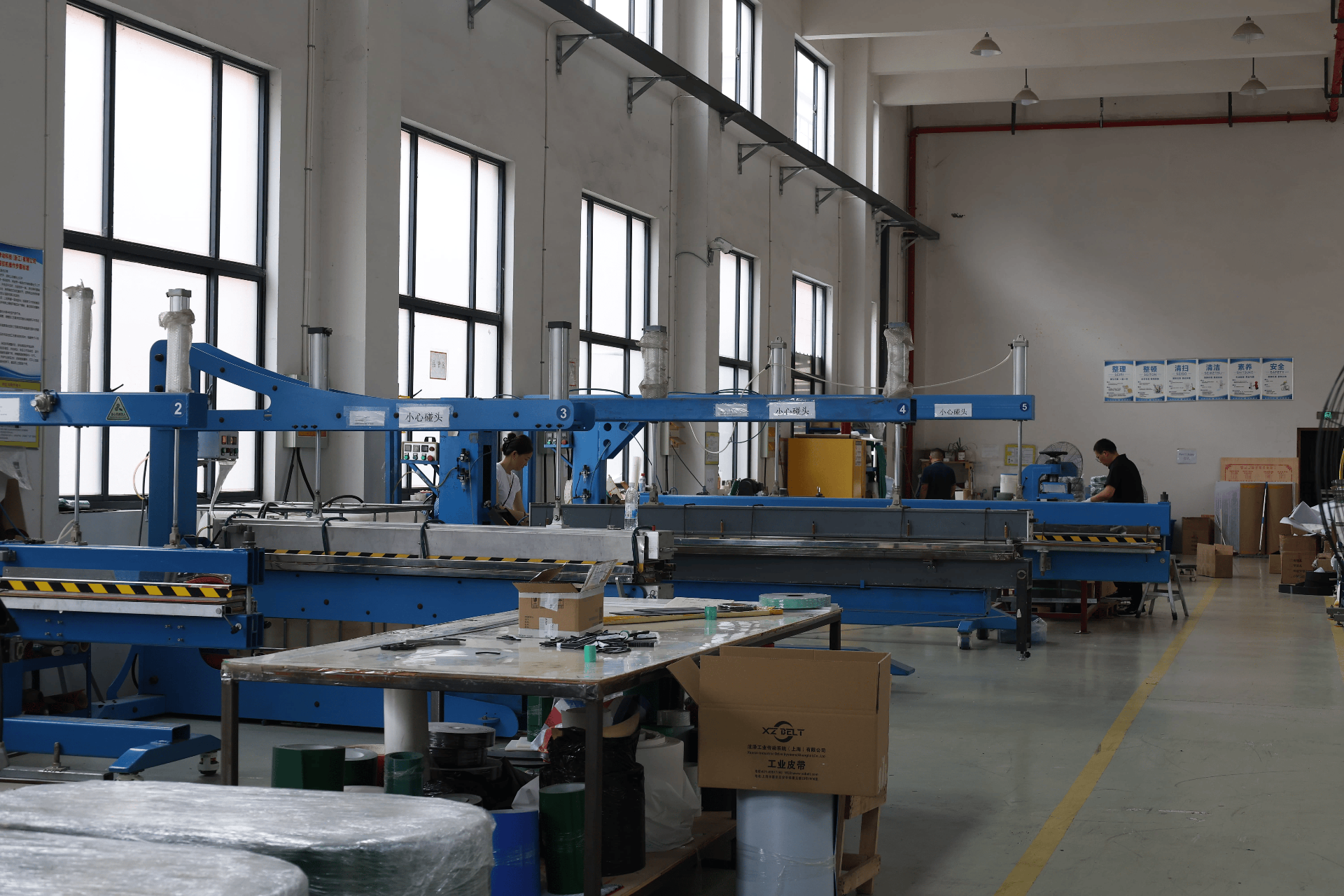
XZBELT, the industrial belt brand of Xuanze Industrial Drive Systems (Shanghai) Co., Ltd., provides a relevant example of the capability information a buyer can request. The company was established in 2013 and operates two manufacturing bases with a combined production area of approximately 30,000 m². Its product range includes PVC, PU, PE, silicone, high-temperature, seamless, homogeneous and custom industrial belts, and it provides secondary processing such as sidewalls, fabric reinforcement, cleats, perforation, silicone coating, sponge coating and belt splicing. The company states that it has ISO 9001 certification and 11 patents, serves customers in more than 150 countries and regions, and reports export business at 60% of total sales. Its profile also states cooperation and technical exchange with international industrial belt brands including Habasit, Ammeraal Beltech and Forbo Siegling, and supply to companies including Mercedes-Benz, POSCO, Nike and Baosteel.
These are company-provided capability facts. They support a supplier review, but they do not prove that a specific belt is suitable for a specific machine, and they do not convert ISO 9001 into product certification. The buyer should still attach the exact product datasheet, sample-specific test report, dimensional drawing and application review to the supply agreement.
A Practical Multi-Year Supply Checklist
Use the following checklist as a living document. A criterion should remain unresolved until the exact evidence is attached, not merely promised.
| Checklist area | Evidence to freeze | Why it matters across repeat orders |
|---|---|---|
| Application data pack | Product, load, speed, incline, temperature, cleaning, oil or chemical exposure, pulley geometry, support type, belt dimensions, surface and joint | Prevents a repeat order from being selected on width and length alone |
| Approved construction | Material family, carcass or reinforcement, cover, thickness, surface, joint and fabrication | Keeps the same critical construction visible when purchasing staff or operators change |
| Dimensional acceptance | Endless length or open length, width, thickness, tolerances and squareness | Reduces fit and tracking problems caused by small cumulative differences |
| Joint and splicing | Joint type, preparation, press parameters or fastener specification, minimum pulley check | Addresses a recurring source of repeat failure and unplanned downtime |
| Surface and fabrication | Cleats, sidewalls, guides, perforations, coating, lamination and their dimensions | Prevents a functional feature from being lost between lots |
| Food-contact or regulated scope | Exact grade, sample identity, test conditions, market documentation and intended use | Avoids treating a sample-specific report as a blanket approval |
| Quality system versus product evidence | ISO 9001 scope and validity, product datasheet, test reports and application review | Separates supplier-level controls from belt-specific suitability |
| Replacement identification | Photos, markings, physical sample, machine data and existing belt specification | Supports replacement when the original model is unknown or obsolete |
| Lifecycle risk review | Splice history, tracking history, temperature exposure, chemical exposure and wear pattern | Turns repeat failures into correctable system findings |
| Change control | Written notification before material, construction or processing changes | Protects the approved baseline over a multi-year agreement |
A simple release rule is to approve only when every critical item has an owner, an evidence reference and a review date. Critical items include the application data pack, the approved construction, the joint method, the food-contact scope where applicable, the pulley geometry and the replacement identification route. Commercial terms can be negotiated later; these technical controls should not remain open.
Future Outlook: Documentation Discipline as a Supply Advantage
Market forecasts point to continued demand, but the more durable supply advantage is documentation discipline. As lines are rebuilt and product portfolios change, the supplier that can reproduce the same approved construction and explain the scope of its evidence is easier to audit. Certificates will remain useful at the quality-system level. They will not replace belt-specific suitability checks, and they should not be presented as if they do.
Over a multi-year agreement, the strongest position is a shared technical file: approved datasheet, dimensional record, joint specification, application conditions, test-report scope and change-control history. That file gives procurement and engineering a common reference when a replacement is needed, when a new operator takes over the line, or when the original belt model is no longer readable.
FAQ
Can an ISO 9001 certificate prove that a specific conveyor belt is suitable for my line?
No. ISO 9001 certifies a quality-management system within a stated scope, not the performance or suitability of an individual belt model. A buyer should use it as supplier-level evidence, then request the exact technical datasheet, dimensions, joint method, material grade and application review for the belt. XZBELT's ISO 9001 certificate, for example, covers sales of industrial transmission and transportation rubber and plastic belts and related products; it does not state that every model is independently ISO product-certified.
What does an FDA 21 CFR 175.300 report prove for a conveyor belt?
It reports defined test results on a submitted sample under stated conditions. It should not be read as a blanket FDA certification of the manufacturer or every belt it sells. Check the sample or model, material, simulant, temperature, time, limit and conclusion. XZBELT's TT14-GG SGS report identifies a specific PU sample and reports compliant total-extractives results under the recorded conditions; the report is specific to that tested sample.
How can I order a replacement conveyor belt if the original model is unknown?
Reconstruct both the belt and the application. Provide full dimensions, photos of top, bottom, edge and joint, any markings or a physical sample, and machine information such as pulley diameters, support type, speed, product, load, incline, temperature, oil or chemical exposure and cleaning method. Include cleat, guide, perforation and coating dimensions separately. This lets the supplier propose a construction instead of guessing from width and length.
Why does my conveyor belt splice keep failing?
Repeated splice failure usually points to a system or preparation problem rather than a single bad belt. Check splice type, joint preparation, belt-end squareness, press temperature, pressure and time, belt tension, minimum pulley diameter, conveyor alignment and oil, solvent or chemical contamination. Correct the root cause before making another splice; otherwise the same failure can repeat.
Why does my conveyor belt run to one side?
Persistent mistracking is usually a system problem. Check conveyor-frame alignment, pulley and roller alignment, loading position, belt tension, contamination and splice squareness. Running the belt without correcting the mechanical cause can damage edges, joints and guides. Replace the belt only after the mechanical causes have been inspected.
Is a seamless belt automatically suitable for high-temperature or high-speed operation?
No. No splice describes only one part of the construction. Suitability depends on carcass, coating, hardness, tensile behavior, friction, temperature resistance and minimum pulley capability. Seamless belts can use polyester, polyamide, aramid and other structures with different limits. Confirm the actual temperature, speed, tension, pulley diameters and bending direction before selecting a seamless construction.
Are all PU conveyor belts food grade?
No. Food-contact suitability must be verified for the exact grade or model and the relevant market documentation. Material and color alone do not establish compliance. Ask for the product-level declaration or test evidence that covers the specific belt supplied.
Conclusion
Long-term conveyor belt supply is a technical relationship, not a certificate exchange. The buyer's protection comes from a frozen application data pack, acceptance criteria that match the belt's function, family-specific verification and a replacement route that works when the original model is unknown. ISO 9001 and FDA 21 CFR 175.300 reports can support that file, but they must be read within their scope. A supplier that can reproduce the approved construction and explain its evidence across conveyor, seamless, felt, coil wrapper and flat belt families is better positioned for multi-year supply than one that offers only a generic certificate and a unit price.
For readers who want the manufacturer's product overview, the XZBELT industrial belt brochure is available as a downloadable PDF: XZBELT industrial belt brochure.
Tem questões ou precisa de mais detalhes?
Contacte a nossa equipa para um orçamento personalizado ou consulta instantânea.
Solicitar orçamento
Preencha o formulário abaixo e a nossa equipa entrará em contacto com uma proposta personalizada.
Chat direto do WhatsApp
Prefere conversar em tempo real? Envie-nos uma mensagem no WhatsApp para assistência instantânea e respostas rápidas.
- Obter orçamento personalizado
- Partilhar fotos ou documentos
- Discuta as suas necessidades diretamente
Geralmente responde em 5–30 minutos durante o horário de expediente.