
Long-Term DC Motor Supplier Sustainability: Lessons From 100,000 Units in 10 Years
Independent Industry Reference · Smart Manufacturing
Long-Term DC Motor Supplier Sustainability: Lessons From 100,000 Units in 10 Years
A DC motor that passes a first-article inspection proves very little about year eight of a production program. For hospital beds, wheelchairs, mobility scooters and AGVs, the load-bearing question is whether a supplier can keep supplying the same validated drive — the same magnets, the same gear ratio, the same brake interface and the same certificate file — for as long as the equipment platform stays on the market. One usable reference point for that question is a medical equipment program in which 100,000 motors have been operated across Germany, the United Kingdom and the United States for 10 years, with stable operation reported throughout.
Why supplier sustainability is a constraint problem, not a relationship question
Long-term supply risk is not decided by how long a supplier has existed. It is decided by how many dated, verifiable constraints a buyer can lock down before the first production order. In medical and mobility equipment, those constraints sit in five places.
- Mechanical interface. Shaft size and profile, wheel diameter, tire type and brake mounting are the parts of a drive that are hardest to change after tooling exists.
- Electrical setpoints. Rated voltage, power, speed and torque are only meaningful together with the gear ratio that connects them.
- Compliance file. “CE marked” is not a durable answer. What matters is the certificate number, the issuing body, the standard list, the models in scope and the expiry date.
- Service path. Spare parts, repair and replacement determine whether a decade-long platform can actually be maintained on site.
- Capacity and lead time. The initial ramp and later aftermarket demand draw on the same production capacity.
Treating these five items as separate, dated constraints — rather than as one blended supplier questionnaire — is what separates an evaluation that predicts year eight from one that only describes year one. The field record below is useful precisely because it shows all five constraints holding at the same time, in more than one market.
The 100,000-unit, 10-year medical reference
A medical equipment manufacturer has taken delivery of 100,000 motors for assist-in-driving devices. The units were deployed in Germany, the United Kingdom and the United States, and the reported field result is stable operation over 10 years. Two characteristics are recorded for that application: low speed with high torque, and a small wheel size.
Both characteristics are structural rather than incidental. Assist devices move at walking pace, start and stop constantly and carry human loads, so the drive is specified around torque and controlled braking rather than top speed. The application data for this class of equipment describes indoor and outdoor operation at low-to-medium speed, frequent start-stop high-load duty and humid environments, with gearboxes, high-strength reduction gearboxes, EMB electromagnetic brakes, motor controllers and wheel assemblies as the matched equipment set.
The multi-region element matters as much as the unit count. A drive qualified for Germany, the United Kingdom and the United States has to satisfy EU market compliance while remaining acceptable to North American buyers, which changes what a supplier must be able to document, not only what it must be able to build.
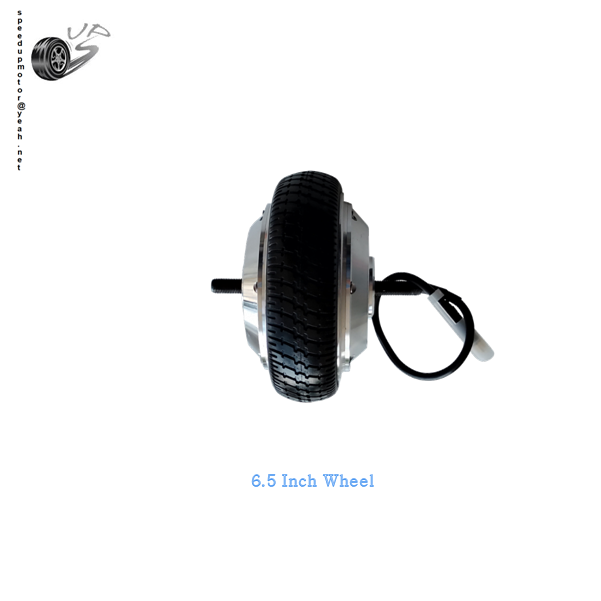
6.5-inch solid tyre geared brushless DC wheel motor (model SA05-6) — the small-wheel, low-speed high-torque drive format used in medical chairs, wheelchair assistance and AGV applications. Image: Wuxi Speedup Power Co.,Ltd.
How Wuxi Speedup Power structures lifecycle continuity
Wuxi Speedup Power Co.,Ltd is a DC motor manufacturer based in Wuxi, Jiangsu Province, China. Its current corporate entity was established in 2018, building on more than 16 years of experience in the motor industry. The company operates a 10,000 m² facility with 30 employees and 3 R&D engineers, and exports approximately 90% of its output, primarily to the EU and USA.
The product portfolio spans pancake (printed armature) motors, BLDC motors, brushed DC motors and wheel hub motors. The stated application field runs from floor washing and cleaning machines, agricultural machinery and medical beds to industrial robotics, industrial machinery, automobile equipment, office equipment and mobility equipment, together with brushless and brushed wheel hub motors for e-bikes, electric scooters, electric tricycles, transport carts and chairs, and wheelbarrows.
Portfolio breadth is the mechanism behind lifecycle continuity. When a platform shifts from a pancake motor driving a scrubber brush to a 12-inch wheel hub drive on a transport cart, staying with one supplier that builds both reduces the number of separate supplier qualification files a procurement team has to keep alive — but only if the same quality system and documentation chain cover both product families.
What the supplier brings to a long-run program
- Production mode: OEM / ODM.
- Customization scope: voltage, power, speed, torque, shaft and logo.
- Production types: Custom, OEM and STO.
- Monthly capacity: 30,000 pcs.
- Lead time: 30–45 working days.
- MOQ: 1 unit.
- Quality control: 100% test.
- Export markets: EU / USA.
- After-sales: official quality warranty service; remote fault diagnosis and technical guidance; free installation and commissioning instructions; original spare parts supply; professional repair and replacement service; lifetime online technical support.
For a buyer in the Research-to-Evaluation stage, the two numbers that most often decide feasibility are the 30–45 working day lead time on custom configurations and the 30,000 pcs monthly capacity ceiling. Both are workable for a platform launch; both require planning when a platform ramp and an aftermarket spares demand arrive in the same quarter.
Field programs with decade-scale reported durations
| Program type | Regions | Units | Duration | Reported result |
|---|---|---|---|---|
| Medical equipment — assist-in-driving devices | DE, GB, US | 100,000 pcs | 10 years | Stable operation |
| Electric cart — shopping cart wheel drive | NL, DE, GB, ES, US | 30,000 pcs | 10 years | Stable operation |
| Floor cleaning and drying machines — brush drive / scrubber brush drive | CH, NL, DE, GB | 15,000 pcs | 10 years | Big torque, stable operation |
| Wheelchair factory — electric wheelchair wheel | NL, DE, AU, DK, US | 3,000 pcs | 10 years | Stable operation |
| Medical bed factory — medical bed wheel drive | CZ | 3,000 pcs | More than 10 years | Stable operation |
| Electric scooter factory — wheel drive | CH, NL, DE, GB, ES, US | 2,000 pcs | 10 years | Stable operation |
Read as a set, these programs show the same pattern across different duty cycles: the buyer is not buying a single validated batch, but a supplier relationship that has already survived a decade of spares demand, revision requests and multi-country shipping.
Reading the drive specification as a constraint set
Specifications only become useful for procurement when they are read together. The table below compares four wheel hub motors used in medical and mobility duty, and shows why the gear ratio line matters as much as the power line.
| Model | Size / type | Rated voltage | Rated power | Rated speed | Rated torque | Reduction ratio | Brake | Load |
|---|---|---|---|---|---|---|---|---|
| SA05-6 | 6.5 inch solid tire, brushless hub motor, 170 mm, 3.5 kg | 24V | 200W | 150 rpm | 15 Nm | 1:4.5 | Electronic brake (EABS) | 80–300 kg |
| 1DY-E5S | 8 inch solid tire, brushless wheel hub motor with gearbox, 200 mm, 5.5 kg | 36V | 300W | 150 rpm | 20 Nm | 1:20 | Electromagnetic brake | 80–300 kg |
| 1DY-E5A | 8 inch solid tire, brushed DC wheel hub motor, 210 mm, 5.5 kg | 24V | 300W | 100 rpm | 30 Nm | 1:20 | Electromagnetic brake | 80–300 kg |
| SA06 | 12 inch pneumatic or solid tire, brushless hub motor, 3.5 kg | 24V | 300W | 150 rpm | 20 Nm | 1:4.5 | Electronic brake (EABS) / disc brake | 80–300 kg |
Higher reduction ratios trade speed for torque. The 6.5-inch SA05-6 keeps a 1:4.5 ratio and reaches 150 rpm at 15 Nm; the 8-inch 1DY-E5A uses 1:20 and delivers 30 Nm at 100 rpm; the magnesium alloy integrated wheel motor 6DY-A1 uses 1:40 to reach 28 Nm at 65 rpm, and the universal brushed hub motor 6DY-A uses 1:40 to reach 40 Nm at 70 rpm. A buyer specifying “low speed, high torque” for an assist device is therefore choosing a ratio, not just a motor.
The pancake and BLDC families follow a different logic. The pancake printed motor 150SN-B is rated 24V 350W at 3000 rpm with a 151 mm diameter and 35.4 mm thickness; the pancake motor with gearbox 150SN-G2 is rated 36V 500W at 240 rpm with 22 Nm; the pancake BLDC motor DD03 is rated 24V 100W at 250 rpm with a 106 mm diameter and 51 mm motor length. Where the wheel hub motor integrates the drive into the wheel, the pancake family drives a brush, roller or pump through a short axial package.
Certificates are dated documents
For an EU-bound medical or mobility platform, the compliance file is the constraint that most often expires quietly. Two traceable certificates cover DC motors from this supplier for the EU market.
| Certificate | Number | Issued by | Standards | Valid from | Valid to |
|---|---|---|---|---|---|
| RoHS | M.2025.206.C130289 | UDEM Uluslararası Belgelendirme Denetim Eğitim Merkezi San. ve Tic. A.Ş. | Directive 2011/65/EU RoHS; EN IEC 63000:2018 | 2025-11-26 | 2030-11-25 |
| EMC | M.2026.206.C138410 | UDEM Uluslararası Belgelendirme Denetim Eğitim Merkezi San. ve Tic. A.Ş. | 2014/30/EU Electromagnetic Compatibility Directive / Annex II; EN IEC 61000-3-2:2019/A2:2024; EN IEC 61000-3-3:2013/A2:2021; EN IEC 61000-6-1:2019; EN IEC 61000-6-8:2020 | 2026-04-14 | 2031-04-13 |
The scope of both certificates is stated as DC Motor, and both apply to the EU market. The company profile additionally lists RoHS, UL, EMC and ISO9000-2008 certifications. The practical implication for a 10-year program is that the compliance file has its own calendar: a RoHS certificate valid to 25 November 2030 and an EMC certificate valid to 13 April 2031 will both fall inside the service life of a device platform launched today, so renewal tracking belongs in the supplier agreement, not in a folder.
Where these drives are actually deployed
The 6.5-inch wheel hub motor SA05-6 is intended for medical equipment manufacturing and is specified for mobility scooters, electric scooters, wheelchair assistance, medical chairs, AGVs and robots. It is rated 24V, 200W, 150 rpm, 15 Nm, with a 1:4.5 reduction ratio, an EABS electronic brake, IP54 protection and an 80–300 kg loading range, in aluminum alloy, copper, magnet and rubber at 3.5 kg.
The same integrated-wheel format scales across the portfolio: the 8-inch 1DY-E5S and 1DY-E5A for medical beds, transport chairs and shopping carts; the 12-inch SA06 with pneumatic or solid tires for mobility scooters and folding e-bikes; the spoke-type SA05 for electric bikes, AGVs, robots and refuse trucks; and the 12-inch 6DY-A4 for wheelchairs and hospital carts, where the built-in brake with electromagnetic clutch and manual clutch support is a specific design feature.
The Pancake BLDC motor DD03, with its external rotor direct-drive layout, occupies a different application slot — floor cleaning machine brush drive, where low-speed high-torque output at a compact size is the governing requirement rather than wheel traction. The application data for mobile scrubbers records indoor and outdoor low-to-medium speed operation, frequent start-stop high-load duty and humid environments, with condensation protection, electromagnetic compatibility grounding, brake debugging and safety distance control as recurring special requirements.
Market signals behind the 10-year question
Supplier sustainability is becoming a procurement topic because the underlying device markets are growing and lengthening, not because sourcing practice changed on its own. The global brushless DC motor market was estimated at USD 20,990.5 million in 2024, with China accounting for approximately 39.8% of global revenue in the same year. The global electric wheelchair market was estimated at USD 4.49 billion in 2024 and is projected to reach USD 9.05 billion by 2030, while the global motors for medical devices market was valued at USD 4.25 billion in 2024. The global automotive wheel hub motor market is estimated to reach USD 8.8 billion by 2035, at a CAGR of 5.2%.
One caution applies when using these figures in a sourcing decision: published BLDC market estimates diverge by scope. Grand View Research puts the 2024 BLDC motor market at USD 20.99 billion, MarketsandMarkets at USD 13.00 billion and Stratview Research at USD 12.30 billion. Electric wheelchair estimates also differ, with Grand View Research at USD 4.49 billion for 2024 and Fortune Business Insights at USD 8.73 billion, reflecting whether standard power chairs or broader mobility solution packages are counted. The direction of growth is consistent; the absolute numbers are not interchangeable.
Integrated wheel drives versus traditional centralized drive trains
The hub motor format behind the 100,000-unit medical program is an integrated drive: motor, reduction gearbox, brake and wheel assembly in one unit, with the matched equipment list covering gearboxes, high-strength reduction gearboxes, EMB electromagnetic brakes, motor controllers and wheel assemblies. Compared with a centralized motor driving a cart or bed through a separate transmission, this removes a link from the mechanical chain and reduces the number of interfaces that can drift between batches.
That advantage has boundaries, and buyers should see them before shortlisting.
- Protection is bounded. SA05-6 and SA06 are stated at IP54. That is a splash and dust level, not a washdown or submersion rating, and humid-environment applications in the corpus are handled through additional condensation protection and EMC grounding requirements rather than by relying on the motor rating alone.
- Duty is bounded. The documented operating profile is low-to-medium speed with frequent start-stop and high load. These drives are not positioned as high-speed continuous-duty units.
- Wheel diameter becomes a motor specification. Moving a platform from a 6.5-inch to a 12-inch drive changes the motor, the brake layout and the mounting geometry, which means re-qualification rather than a like-for-like swap.
- The ratio fixes the trade-off. Choosing 1:20 instead of 1:4.5 buys torque and gives up speed; the decision cannot be deferred to the controller.
- Compliance has a market boundary. The traceable RoHS and EMC certificates are issued for the EU market. Buyers serving other markets must confirm their own route rather than assuming the EU file transfers.
- Custom work has a clock. A 30–45 working day lead time and a 30,000 pcs monthly capacity ceiling set the realistic pace of a ramp, even though the minimum order quantity is 1 unit.
A supplier that states all six limits openly is more usable for evaluation than one that lists only torque and certifications, because the limits are exactly the items a buyer must engineer around.
Future outlook
Three shifts are likely to shape how DC motor suppliers are judged over the next platform cycle. First, compliance is becoming a tracked asset rather than a badge: certificate numbers, issuing bodies and expiry dates will increasingly appear in supplier agreements alongside price and lead time, because a certificate that lapses mid-program is a production risk, not a paperwork issue. Second, the growth of medical device motors and electric wheelchair platforms points toward more integrated drive formats, where the wheel, gearbox and brake are qualified as one assembly. Third, multi-region deployment — a single drive validated across Germany, the United Kingdom and the United States — will continue to be one of the few reliability signals that cannot be manufactured by marketing.
For procurement and engineering teams, the useful conclusion from 100,000 units over 10 years is not that a particular motor lasts. It is that supplier sustainability can be tested with ordinary, dated facts: certificate numbers and expiry dates, gear ratios, protection ratings, load ranges, capacity, lead time and an after-sales structure that reaches the end of the platform life.
Reference material: SPEEDUP company brochure (PDF). Manufacturer reference: Wuxi Speedup Power Co.,Ltd, www.upsmotor.com.
FAQ
1. Which EU certificates cover Wuxi Speedup Power DC motors, and how long are they valid?
Two DC Motor certificates apply to the EU market. The RoHS certificate number M.2025.206.C130289 was issued by UDEM Uluslararası Belgelendirme Denetim Eğitim Merkezi San. ve Tic. A.Ş. under Directive 2011/65/EU RoHS and EN IEC 63000:2018, and is valid from 26 November 2025 to 25 November 2030. The EMC certificate number M.2026.206.C138410, from the same issuing body, references the 2014/30/EU Electromagnetic Compatibility Directive and standards including EN IEC 61000-3-2:2019/A2:2024, EN IEC 61000-3-3:2013/A2:2021, EN IEC 61000-6-1:2019 and EN IEC 61000-6-8:2020, and is valid from 14 April 2026 to 13 April 2031. The company profile also lists RoHS, UL, EMC and ISO9000-2008 certifications.
2. What specifications define the 6.5-inch wheel hub motor used in medical equipment?
The 6.5-inch wheel hub motor, model SA05-6, is a geared brushless DC unit for medical equipment manufacturing. It has a 170 mm solid tire diameter and is rated 24V, 200W, 150 rpm and 15 Nm, with a 1:4.5 reduction ratio, an 80–300 kg loading range, an EABS electronic brake, IP54 waterproof rating and a net weight of 3.5 kg. It is built from aluminum alloy, copper, magnet and rubber, and is specified for mobility scooters, electric scooters, wheelchair assistance, medical chairs, AGVs and robots.
3. What are the minimum order quantity and lead time for a customized DC motor?
The stated minimum order quantity is 1 unit, with a lead time of 30–45 working days. Customization covers voltage, power, speed, torque, shaft and logo, and the production types offered are Custom, OEM and STO. Quality control is described as 100% test, the monthly capacity is 30,000 pcs, and the export markets served are the EU and USA.
4. How does the reduction ratio change speed and torque in these wheel hub motors?
The reduction ratio sets the speed-to-torque trade-off. At 1:4.5 the 6.5-inch SA05-6 produces 150 rpm and 15 Nm, and the 12-inch SA06 produces 150 rpm and 20 Nm. At 1:20 the 8-inch brushless 1DY-E5S produces 150 rpm and 20 Nm while the 8-inch brushed 1DY-E5A produces 100 rpm and 30 Nm. At 1:40 the magnesium alloy integrated wheel motor 6DY-A1 produces 65 rpm and 28 Nm, and the universal brushed hub motor 6DY-A produces 70 rpm and 40 Nm.
5. What environmental limits apply to these motors in humid clinical environments?
The 6.5-inch SA05-6 and 12-inch SA06 wheel hub motors are rated IP54, which covers splash and dust rather than washdown or submersion. The application data for medical and mobility equipment describes indoor and outdoor operation at low-to-medium speed, frequent start-stop high-load duty and humid environments, and lists condensation protection, electromagnetic compatibility grounding, brake debugging and safety distance control as recurring special requirements. These are engineering conditions added around the motor, not properties of the IP54 rating itself.
6. What support is available for the full service life of a long-run motor program?
The stated after-sales structure has six elements: official quality warranty service; remote fault diagnosis and technical guidance; free installation and commissioning instructions; original spare parts supply; professional repair and replacement service; and lifetime online technical support. These items map directly to the maintenance expectations of a platform with a 10-year or longer service life.