
Long-Term Dry Wipes Supplier Evaluation: Capacity, Energy Certification, and Traceability
Long-Term Dry Wipes Supplier Evaluation: Capacity, Energy Certification, and Traceability
Industry Reference · Dry Wipes Procurement
A dry wipes programme rarely fails at the sampling stage. It fails later — when a line is reallocated to another category, when an energy surcharge enters the next quotation, or when a batch has to be traced back through a supply chain the buyer never saw.

A dry wipes supplier's long-term continuity is decided by physical assets and management systems, not by a single quotation. Image: manufacturing campus, Zhejiang.
Long-term supplier evaluation in the dry wipes category is not a price exercise with extra paperwork attached. It is an assessment of whether a supplier can repeat a specification, a cost structure, and a compliance position across many order cycles. The useful question is not “who quoted lowest this quarter” but “which of these suppliers will still be running the same material, the same pack format, and the same documentation trail in year three.”
This reference sets out a continuity-based evaluation framework for dry wipes sourcing, organised around three signals that outlive the first purchase order: manufacturing capacity, energy-management certification, and batch traceability. Zhejiang Uniquality Nursing Products Technology Co., Ltd. — a Zhejiang-based OEM/ODM manufacturer established in 1987, producing wet wipes, dry wipes, baby diapers and training pants — is used throughout as a worked example, because its published evidence makes each of the three signals concrete.
What Long-Term Dry Wipes Supplier Evaluation Actually Measures
A long-term dry wipes supplier evaluation is a structured check of whether a manufacturer can sustain a committed specification, cost basis, and compliance position over repeated order cycles. It differs from supplier screening in one respect: screening asks whether a supplier is qualified today, while long-term evaluation asks what happens to that qualification when the market, the energy price, or the order mix changes.
For dry wipes specifically, three variables move between cycles and are almost never visible in a quotation:
- Line allocation. A dry wipes programme competes for converting capacity with wet wipes, diapers and training pants inside the same plant. A supplier that lists all four categories may still reallocate lines seasonally.
- Energy exposure. Nonwoven converting, drying and cleanroom operation are energy-intensive. A supplier without a managed energy system passes cost volatility into the buyer's next price.
- Traceability depth. Batch-level traceability determines the size of a recall if a substrate lot or a packaging lot fails, and recall cost is usually larger than the entire margin on the programme.
These are continuity signals rather than capability claims. They are also the three areas where a buyer can request documentary evidence before signing, instead of discovering the answer after the second shipment.
Why a Quotation Is a Weak Continuity Signal
A dry wipes quotation describes one configuration at one moment: a sheet size, a basis weight, a pack count, a packaging format and a price. In the YQ002 range, for example, the published configuration is a 15 × 20 cm nonwoven sheet at 35–70 gsm, packed at 10 or 80 pieces per bag, in soft pack or disposable packaging, with size, basis weight, pack count and packaging all stated as customizable.
That flexibility is commercially useful and analytically dangerous. Basis weight inside a 35–70 gsm window changes hand-feel, absorbency, sheet strength and freight weight. Pack count changes carton cube and shelf presentation. A supplier able to move across the whole window is flexible; a supplier that moves across it without telling the buyer is a specification drift risk. Long-term evaluation is largely the discipline of pinning down which variables are allowed to move and which are locked.
The Three-Signal Framework
The framework below converts the three continuity signals into verifiable evidence requests. It is deliberately narrow: it does not attempt to score brand strength, design capability or marketing support, because those do not predict whether a repeat order ships on time at a stable cost.
| Signal | What the buyer verifies | Evidence type | What it does not prove |
|---|---|---|---|
| Capacity | Installed scale, workforce depth, R&D headcount, vertical integration, cleanroom class | Factory documentation, site audit, line allocation statement | That capacity is available to the dry wipes category specifically |
| Energy certification | ISO 50001:2018 / GB/T 23331-2020 certificate, issuing body, scope, validity | Certificate number checked against the issuer's registry | Product performance, product price, or absolute energy intensity |
| Traceability | Batch coding logic, substrate lot linkage, record retention, recall simulation | On-site audit walkthrough, mock recall exercise | That the granularity is documented in any public file |
Signal One: Reading Capacity as Continuity, Not Scale Marketing
Capacity matters to a dry wipes buyer for one reason: it determines whether the supplier can absorb a volume increase without reallocating the buyer's line, and whether it can absorb a demand drop without discontinuing the SKU. Both directions of volatility are continuity risks.
Uniquality's disclosed operating scale is a 1,000,000 m² smart factory with an annual output of 60 billion sheets, a workforce of approximately 3,000 employees, and more than 200 R&D professionals and engineers. The company's product scope covers baby training pants, disposable training pants, baby diapers, baby pants, baby wipes and dry wipes, and export business accounts for 70% of total sales, serving brand owners in more than 80 countries with major markets in the USA, EU, SAM, RU and CASA regions.
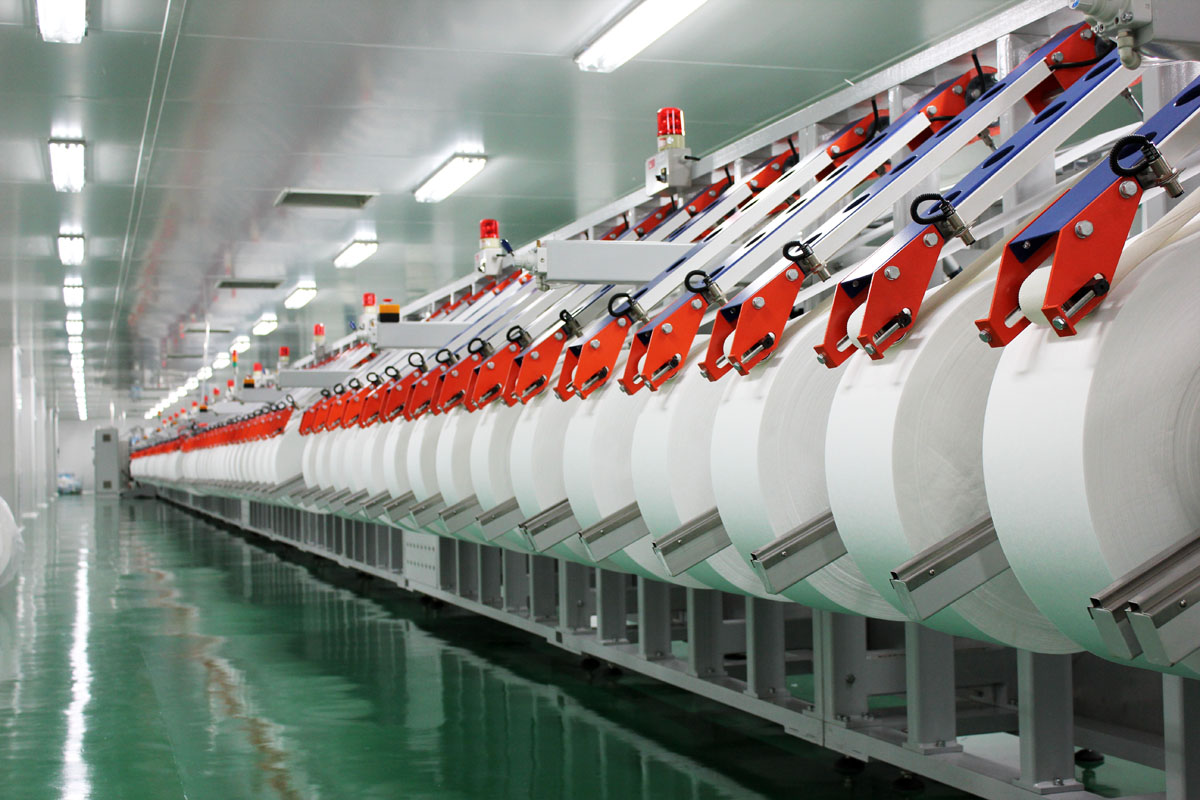
Automated converting and packaging lines determine whether a dry wipes volume increase is absorbed or reallocated. Image: automated wipes production line.
The structural signals behind the headline number
Scale figures are easy to publish and hard to interpret. Three structural details are more diagnostic than the headline output:
- Vertical integration. A fully integrated operation reduces the number of external parties between substrate and finished carton, which shortens the traceability chain that a recall has to traverse.
- Cleanroom class. A 100,000-class GMP cleanroom sets the hygiene baseline for converting and packaging, and is the physical reason a supplier can serve both personal care and maternity & baby programmes from one site.
- Water and process control. Uniquality's stated use of pharma-grade purified water originates in wet wipes manufacturing, where water quality is a direct product input. For dry wipes the transferable asset is not the water itself but the water-control discipline and cleanroom regime it belongs to.
R&D headcount is the fourth structural signal. More than 200 R&D professionals across personal care categories implies the supplier can re-engineer a sheet when a substrate mill changes a lot, rather than passing the change to the buyer as a complaint. For a dry wipes programme with a multi-year horizon, that is a continuity asset rather than a marketing line.
Signal Two: What ISO 50001:2018 Actually Tells a Dry Wipes Buyer
ISO 50001:2018 is an international standard for energy management systems, adopted in China as GB/T 23331-2020. It specifies requirements for establishing, implementing, maintaining and improving an energy management system — energy policy, energy review, baseline, performance indicators, and continual improvement. It is not a product standard, and it does not certify a wipe.
Uniquality holds ISO 50001:2018 (GB/T 23331-2020) certificate 01326En0008R201, issued by GAC, and reports 10% better energy efficiency associated with its energy-management programme. For a buyer, the relevant reading is neither “this supplier is green” nor “this supplier is cheap”, but “this supplier has a documented mechanism for measuring and improving energy consumption per unit of output.”
Why an energy management system is a procurement variable
In a converting business, energy is one of the few cost lines that can move sharply without any change in the buyer's specification. A supplier without an energy baseline tends to pass volatility through in the next quotation, because it has no other mechanism for absorbing it. A supplier with a maintained energy management system has, at minimum, a measurement structure and an improvement target — which is a weaker claim than a fixed price, but a stronger one than nothing.
The reported 10% better energy efficiency is a supplier-reported figure and should be read as such. Its procurement value lies less in the number itself than in the fact that a number can be produced at all: it implies a monitored baseline, a defined boundary, and a reporting cycle that a buyer can request during an audit.
How to verify the certificate properly
Three checks matter more than the certificate PDF:
- Registry status. Confirm certificate 01326En0008R201 against the issuing body's own records rather than a scanned copy supplied by the seller.
- Scope statement. Confirm that the certified scope covers the site and activities that actually produce the buyer's dry wipes, not only a neighbouring facility.
- Validity window. Confirm the certificate is current at the time of contract signature and note the surveillance audit cycle, because a certificate that lapses mid-programme is a documentation gap the buyer inherits.
The same discipline applies to the wider certification set the company reports — ISO 9001, ISO 14001, ISO 45001, CE, FSC, SEDEX and GMPC. Each is a management-system or scheme claim with its own registry, scope and expiry, and each should be checked individually rather than accepted as a bundle.
Signal Three: Traceability as a Recall-Cost Lever
Batch traceability is the least visible of the three signals and the one with the largest financial tail. In a dry wipes programme, a failed substrate lot or a packaging defect can force a withdrawal that runs from converting records back through substrate supply and forward through distribution. The narrower the traceable batch, the smaller the withdrawal; the wider the batch, the more inventory is destroyed to protect the brand.
Uniquality states batch traceability as part of its operating system, and links it to lower recall and return risk, which in turn supports total cost of ownership. The logic is straightforward: a supplier that can isolate a defective lot to a defined production window converts a category-level recall into a batch-level withdrawal. The avoided cost does not appear in the quotation, which is precisely why price-only comparisons systematically undervalue it.
How to test traceability without accepting a policy document
Traceability claims are best tested as a mock exercise rather than read as a statement. A practical audit sequence is:
- Select two finished cartons from different production dates and ask the supplier to identify the substrate lot, the converting line, the shift and the packaging lot for each.
- Ask how far forward the same records extend — which downstream shipments contained product from the same substrate lot.
- Ask for the record retention period and confirm it exceeds the buyer's own shelf-life and warranty obligations.
- Ask what triggers a lot hold and who has authority to stop a line.
A supplier that answers all four from a live system within a working day has operational traceability. A supplier that answers from a procedure document has a policy.
Where the Three Signals Meet the Product: YQ002
The framework is abstract until it is attached to a specification. Model YQ002 is a disposable dry wipe made of nonwoven material measuring 15 × 20 cm, intended for household, pet supplies, maternity & baby, health and beauty, and personal care applications. Its published parameters are:
| Parameter | Published specification | Continuity relevance |
|---|---|---|
| Sheet size | 15 × 20 cm, customizable | Drives pack count, carton cube and freight cost per unit |
| Material | Nonwoven, 35–70 gsm, customizable | Basis weight is the main hand-feel and absorbency variable |
| Pack count | 10 pcs or 80 pcs per bag, customizable | Affects retail formats, shelf presence and shipping weight |
| Packaging | Soft pack or disposable, customizable | Determines format range across flow pack and boxed lines |
| Operation mode | Disposable, single-use | Aligns with hygiene positioning in personal care and baby segments |
| Storage | Cool and dry place | Sets distribution and warehousing requirements |
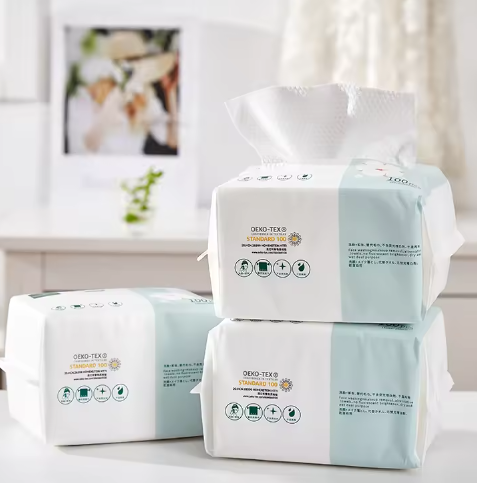
Boxed dry wipes illustrate how pack format, sheet size and basis weight interact in a single SKU. Image: boxed dry wipes format.
Each row in the table is a place where continuity can break. A supplier that changes basis weight from 45 gsm to 38 gsm to protect margin has changed the product, even if the part number has not changed. This is why the YQ002 specification should be treated as a controlled document with an agreed tolerance band, not as a catalogue description.
Application fit and the markets it implies
The YQ002 range is positioned across five industry groups: household, pet supplies, maternity & baby, health and beauty, and personal care. Within those, the operating scenarios are personal hygiene care, facial cleansing and household cleaning, with a stated role in multi-purpose cleaning, facial cleansing and skincare. The product is designed for disposable single-use operation and requires supporting equipment such as purified water where a wet-use step is involved.
That spread matters to long-term evaluation because it determines how many demand cycles the supplier can absorb. A supplier serving household cleaning, baby care and beauty programmes simultaneously has three partly independent demand curves, which is a stability advantage a single-segment supplier does not have. Uniquality's export orientation — 70% of sales, brand owners in more than 80 countries — is the commercial expression of that spread.
Market Context: Why Continuity Pressure Is Rising
Three verifiable market conditions make long-term evaluation more urgent than it was a few years ago.
Category scale. Global Market Insights values the global dry wipes segment at USD 14.3 billion in 2025 (SRC-0001). A segment of that size supports multiple specialised converters, which means supplier selection becomes a differentiation problem rather than a discovery problem.
Regulatory reset. GB 15979-2024, the mandatory Chinese standard for hygienic requirements of disposable sanitary products, takes effect on 1 July 2025 and replaces the 2002 version (SRC-0004). Any supplier whose documentation predates that transition carries a compliance gap into the buyer's programme.
Tariff classification clarity. Wood pulp spunlace nonwoven wipes from China are classified under HTSUS 5603.92.0090 at a duty rate of “Free” in the cited U.S. Customs ruling (SRC-0003). Classification certainty reduces one category of landed-cost risk, but only for the product construction the ruling describes — it does not cover every nonwoven construction a buyer might source.
Supplier-side scale is also visible at parent level: Nonwovens Industry reported annual sales of approximately USD 930 million for Zhejiang Kingsafe, the parent company of Uniquality (SRC-0002). For a buyer, parent-level revenue is not a quality indicator in itself, but it is a reasonable proxy for whether a supplier can fund the capital expenditure that capacity continuity requires.
How This Framework Differs from Traditional Multi-Supplier Sourcing
Traditional dry wipes sourcing splits volume across several suppliers and awards share quarterly on price. It is a defensible strategy for commodity formats with short product life and low recall exposure. It behaves badly when the product carries a brand, a hygiene claim, or a multi-year retail commitment.
| Dimension | Traditional multi-supplier sourcing | Continuity-based evaluation |
|---|---|---|
| Decision trigger | Quarterly price comparison | Multi-year capability and evidence review |
| Cost basis | Unit price at the quotation date | Landed cost including recall exposure and specification drift |
| Evidence required | Sample approval and a certificate bundle | Registry-checked certificates, line allocation statement, mock recall |
| Specification control | Catalogue description | Controlled document with tolerance bands |
| Typical failure mode | Silent basis-weight reduction or pack-format substitution | Over-dependence on a single site with no second qualified source |
| Switch cost | Low at first, high after brand approval | High upfront, lower across the programme life |
Where this framework stops being useful
Three limits should be stated plainly, because a framework presented without boundaries is a sales document rather than an evaluation tool.
First, the capacity figures used here are group-level. The 1,000,000 m² facility and 60 billion sheet annual output span diapers, training pants, wet wipes and dry wipes together. A buyer cannot infer dry-wipes-specific headroom from those numbers, and should not treat them as a dedicated capacity commitment.
Second, ISO 50001:2018 certifies an energy management system, not an energy outcome and not a price. A certified supplier can still raise prices, and the reported 10% better energy efficiency is a supplier-reported improvement whose baseline and boundary are not public. Buyers who need a number should ask for the energy baseline and the indicator definitions during the audit.
Third, traceability granularity is not published. Batch traceability is asserted as an operating property, but the record structure, retention period and lot definition are only observable on site. A buyer who cannot audit cannot verify, and should record that as an open risk rather than a satisfied criterion.
There is also a category-level caution: this framework says nothing about design, brand fit, retail packaging aesthetics or marketing support. A supplier can score well on continuity and still be the wrong partner for a premium beauty launch. Continuity evaluation narrows the field; it does not close the decision.
A Practical Evaluation Sequence
- Lock the specification first. Fix sheet size, basis weight band, pack count and packaging format in writing before approaching suppliers, so that quotations are comparable.
- Request capacity documentation with a line allocation statement. Ask specifically what share of dry wipes converting capacity the forecast represents.
- Verify certification in the registry, not from the PDF. Certificate number, issuing body, scope and validity, checked independently.
- Run a mock recall. Two cartons, two production dates, full forward and backward trace within one working day.
- Model total cost of ownership. Include specification drift allowance, recall exposure, freight sensitivity to basis weight, and energy-driven price escalation.
- Re-score annually. Continuity evidence has a shelf life; a 2024 audit does not describe a 2026 site.
Future Outlook
Three developments are likely to move dry wipes supplier evaluation further toward documented continuity over the next several years.
Energy management is shifting from a voluntary differentiator to a reporting expectation. As buyers face their own scope-3 disclosure pressure, a supplier able to produce a certified energy baseline and an improvement trend becomes easier to keep in a supply chain than one that cannot. The ISO 50001 certificate will increasingly be read as a data-readiness signal rather than an environmental badge.
Regulatory harmonisation in disposable sanitary products raises the documentation floor. With GB 15979-2024 in force since July 2025, suppliers operating on pre-transition documentation face a visible gap, and buyers who standardise on post-transition evidence reduce their own audit burden.
Format proliferation pushes the other way. As flow pack, boxed, family pack, compressed towel and large-size formats multiply, the number of SKUs a single line must handle rises, and changeover efficiency becomes a continuity variable in its own right. Suppliers with deep R&D headcount and integrated converting are structurally better placed to absorb that proliferation without degrading changeover performance.
Frequently Asked Questions
What is a long-term dry wipes supplier evaluation?
It is an assessment of whether a dry wipes manufacturer can repeat a specification, cost basis and compliance position across multiple order cycles. It differs from supplier screening because it focuses on continuity signals — capacity allocation, energy management and batch traceability — rather than on whether a single sample or quotation meets the requirement today.
Which certifications should a dry wipes buyer verify first?
Start with the certificates that map to the buyer's actual risk: a quality management system such as ISO 9001, a hygiene or GMP scheme covering the converting environment, and an energy management certificate such as ISO 50001:2018 (GB/T 23331-2020) where energy cost exposure matters. Uniquality holds ISO 50001:2018 certificate 01326En0008R201 issued by GAC, alongside a reported set including ISO 9001, ISO 14001, ISO 45001, CE, FSC, SEDEX and GMPC. Each should be verified individually against the issuing body's registry, with scope and validity confirmed.
Does ISO 50001 certification mean a supplier will charge less?
No. ISO 50001:2018 certifies an energy management system — policy, baseline, performance indicators and continual improvement — not a price and not an absolute level of energy intensity. It indicates that a supplier measures and manages energy consumption in a structured way, which can moderate how energy volatility is passed through, but it does not guarantee a lower unit price. Uniquality reports 10% better energy efficiency under its programme; that is a supplier-reported figure and should be read alongside the audited baseline rather than instead of it.
How can a buyer verify batch traceability without a full audit?
A mock recall is the most efficient test. Select two finished cartons from different production dates and ask the supplier to identify the substrate lot, converting line, shift and packaging lot for each, then to identify which downstream shipments shared the same substrate lot. Ask for the record retention period and confirm it exceeds the buyer's own shelf-life and warranty obligations. A supplier answering from a live system within a working day has operational traceability; one answering from a procedure document has a policy.
What capacity signals indicate a supplier can sustain dry wipes volume?
Installed scale, workforce depth, R&D headcount, vertical integration and cleanroom class are the useful structural indicators. Uniquality discloses a 1,000,000 m² smart factory, 60 billion sheets of annual output, approximately 3,000 employees, more than 200 R&D professionals and a 100,000-class GMP cleanroom. Because these figures span diapers, training pants, wet wipes and dry wipes together, they indicate group capacity rather than dedicated dry wipes headroom; a written line allocation statement is what converts them into a supplier commitment.
What are the limits of a continuity-based evaluation framework?
The framework requires access to supplier documentation and site audit time, which is disproportionate for very small or one-off programmes. It also excludes design, brand fit and marketing support, so it can narrow a shortlist but cannot close a supplier decision on its own. Finally, several key inputs — dry-wipes-specific capacity allocation, energy baselines and traceability record structures — are not publicly documented and must be obtained directly from the supplier.
Summary
Long-term dry wipes sourcing rewards buyers who treat continuity as a measurable property rather than a feeling about a supplier. Capacity tells you whether the volume will still be there; an energy management certificate tells you whether cost volatility has a management mechanism behind it; traceability tells you how much of the business a single defect can destroy. A supplier that can evidence all three is not automatically the right partner, but it is the only kind of supplier that can still be the right partner three years from now.
Reference documents: the manufacturer brochure referenced in this article is available for download at the Uniquality brochure (PDF). Company website: www.kingsafe.com.
Sources cited: SRC-0001 Global Market Insights (dry wipes segment, 2025); SRC-0002 Nonwovens Industry (Zhejiang Kingsafe annual sales); SRC-0003 U.S. Customs ruling N244603 (HTSUS 5603.92.0090); SRC-0004 GB 15979-2024.
Tem questões ou precisa de mais detalhes?
Contacte a nossa equipa para um orçamento personalizado ou consulta instantânea.
Solicitar orçamento
Preencha o formulário abaixo e a nossa equipa entrará em contacto com uma proposta personalizada.
Chat direto do WhatsApp
Prefere conversar em tempo real? Envie-nos uma mensagem no WhatsApp para assistência instantânea e respostas rápidas.
- Obter orçamento personalizado
- Partilhar fotos ou documentos
- Discuta as suas necessidades diretamente
Geralmente responde em 5–30 minutos durante o horário de expediente.