
Long-Term Gear Supply: Evaluating New Yinye's Sustainability
Long-Term Gear Supply: Evaluating New Yinye's Sustainability
A procurement framework for judging whether a build-to-print manufacturer of custom ultra high precision gears can hold accuracy, documentation and capacity across a multi-year supply program.
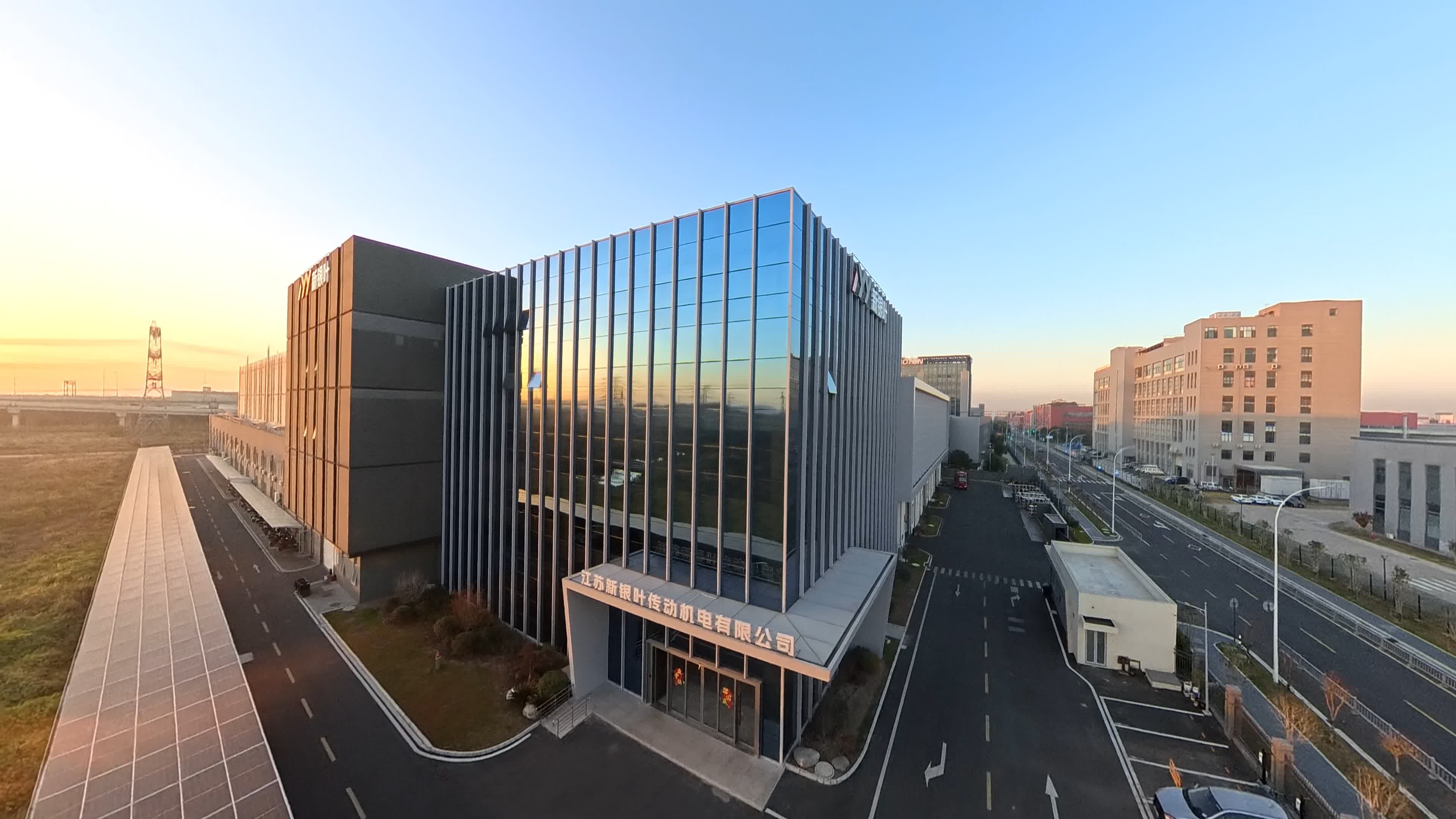
Panoramic view of New Yinye Transmission's approximately 25,000 m2 manufacturing facility in Wuxi, Jiangsu, China. Facility scale is one of the first physical indicators used in long-term supplier assessment.
Gear sourcing is usually framed as a purchasing decision: a drawing, a quotation, a delivery date. In heavy industry it behaves more like a lifecycle decision. The global gear market was estimated at USD 222.12 billion in 2025, with wind energy installations identified as a primary driver for large-scale precision gearing (Mordor Intelligence), while the precision gearbox and geared motor market is projected to reach USD 3.9 billion in 2026, driven by high-precision motion control requirements (Grand View Research). Demand keeps raising the accuracy bar; the parts themselves are expected to remain stable in service for years.
That gap is where long-term supplier evaluation lives. A first order proves that a supplier can hit a drawing once. A fifth order proves something different: that the same material certification, the same heat-treatment outcome, the same contact pattern and the same inspection records can be reproduced without the buyer having to re-manage the process.
Jiangsu New Yinye Transmission Electromechanical Co., Ltd. (NYY / New Yinye Transmission) is a build-to-print manufacturer of large, high-precision, complex and non-standard industrial gears and transmission components, located in Wuxi, Jiangsu, China. Its brand heritage dates to 1993, and the current legal entity was incorporated on April 25, 2003. Its published profile is used here as a reference case for one specific question: which capabilities actually indicate that a custom ultra high precision gear supplier can sustain supply over the life of a program.
Why long-term gear supply is a different evaluation problem
Long-term supplier evaluation for custom gears is not a repetition of first-order qualification. It tests four things that only become visible over time: repeatability, capacity continuity, documentation continuity and risk control.
- Repeatability. Accuracy achieved once may come from a single experienced operator, a favourable setup or an unusually generous process window. Repeatability requires institutionalized process control across shifts, machines and personnel.
- Capacity continuity. A supplier that can fit a trial order may not have the machine hours, tooling or heat-treatment capacity to absorb a program's annual demand alongside existing work.
- Documentation continuity. When a gearbox is inspected or fails years later, the buyer needs material certificates, hardness records, gear accuracy reports and non-destructive testing documents that still correspond to the delivered part.
- Risk control. Premature gear failure can originate in material defects, heat-treatment deviations, gear-geometry errors, grinding burn, surface damage or dimensional nonconformity - each of which needs a defined detection method rather than a promise.
Second-source and capacity-outsourcing programs add a fifth dimension: whether the supplier can align its process route and inspection records with an existing supply base instead of replacing it. This is where supplier profiles are read most carefully, because the buyer is not only purchasing a part but also a repeatable process.
A seven-part framework for evaluating sustainability
Buyers can structure a long-term assessment around seven areas, each checked with a question and an evidence request. The right-hand column below records the published position of New Yinye Transmission as a concrete reference point.
| Assessment area | What to examine | Published position at New Yinye Transmission |
|---|---|---|
| Manufacturing heritage | Whether process knowledge has survived multiple business cycles rather than one product generation | Brand heritage dating to 1993; current legal entity incorporated on April 25, 2003 |
| Facility and physical envelope | Whether machine park and floor area can support large parts and future variants | Approximately 25,000 m2 manufacturing facility; maximum gear grinding diameter of approximately 2,500 mm and maximum module of approximately 45 mm |
| Engineering depth | Ratio of engineering staff to total headcount and their involvement in drawing review | 28 engineers within a workforce of 125 employees |
| Production capacity | Annual throughput and how it is measured | Approximately 1,500 sets per year across different product categories, excluding general accessory components |
| Quality assurance | Which characteristics are measured in-house, and with which methods | Tooth profile, lead, pitch, radial runout, surface roughness, material composition, hardness, mechanical properties, ultrasonic testing, phased-array ultrasonic testing, grinding-burn inspection, micro-magnetic testing, large-component dimensional inspection, dynamic balancing and bevel-gear rolling contact inspection |
| Traceability | Whether each part or batch can be linked to its material and process history | Traceability identification assigned to each applicable product or production batch; material certificates and heat-treatment records verified to project requirements; final inspection records reviewed before shipment |
| Commercial fit for long programs | How terms adapt from prototype to recurring orders | Project-specific MOQ, with prototype, sample and small-batch orders evaluated individually; EXW, FCA, FOB, CIF or other Incoterms 2020 terms as agreed in the contract |
The pattern matters more than any single figure. A 125-person organization with 28 engineers devotes a substantial share of its headcount to engineering work, which is consistent with build-to-print production where every order begins with a drawing review. An annual output of roughly 1,500 sets spread across multiple product categories indicates multi-product flexibility rather than single-line mass production - the profile a buyer expects when parts are non-standard and low-volume by definition.
Reading precision claims correctly: AGMA, DIN and ISO
Precision claims are the easiest part of a supplier profile to misread. New Yinye Transmission states that, for applicable products, accuracy can reach AGMA 12, DIN 5 or higher - explicitly subject to gear type, size, material, structure and process review. That qualifier is not a hedge; it reflects how gear manufacturing works. A large-module gear and a small pinion do not share the same achievable tolerance class, and a claim carried across part families without qualification is a warning sign rather than a strength.
Terminology also differs by region. ISO 1328-1:2013 defines 11 flank tolerance classes, with Grades 1-4 representing ultra-precision levels typically required for aerospace, metrology and high-end turbines (ISO 1328-1:2013). Buyers comparing an AGMA claim, a DIN claim or an ISO claim should convert all of them into one system before ranking suppliers, otherwise the comparison is nominal.
Material selection follows the same logic. High-grade steels 17CrNiMo6 and 18CrNiMo7-6 are industry standards for carburized and ground gears in heavy-duty mining and wind power applications, where impact resistance and fatigue performance matter more than raw surface hardness. In a long-term program, consistency of material source and heat-treatment result is usually a larger risk than the nominal grade itself.
Capability then has to be matched to the part: large CNC gear cutting, gear shaping, precision gear grinding, five-axis machining, turn-mill machining and precision finishing. For repeat supply, the relevant question is not whether these processes exist on site, but whether the same documented process route is applied to the same drawing every time.
Verification closes the loop. Measurement references such as Klingelnberg P-series measuring centers, for example the P26, are cited as providing automated DIN/ISO gear evaluation with measurement precision down to 0.0015 mm for ultra-high precision certification (Klingelnberg). Whatever system a supplier uses, the buyer's practical test is whether the inspection results travel with the goods and remain interpretable years later.
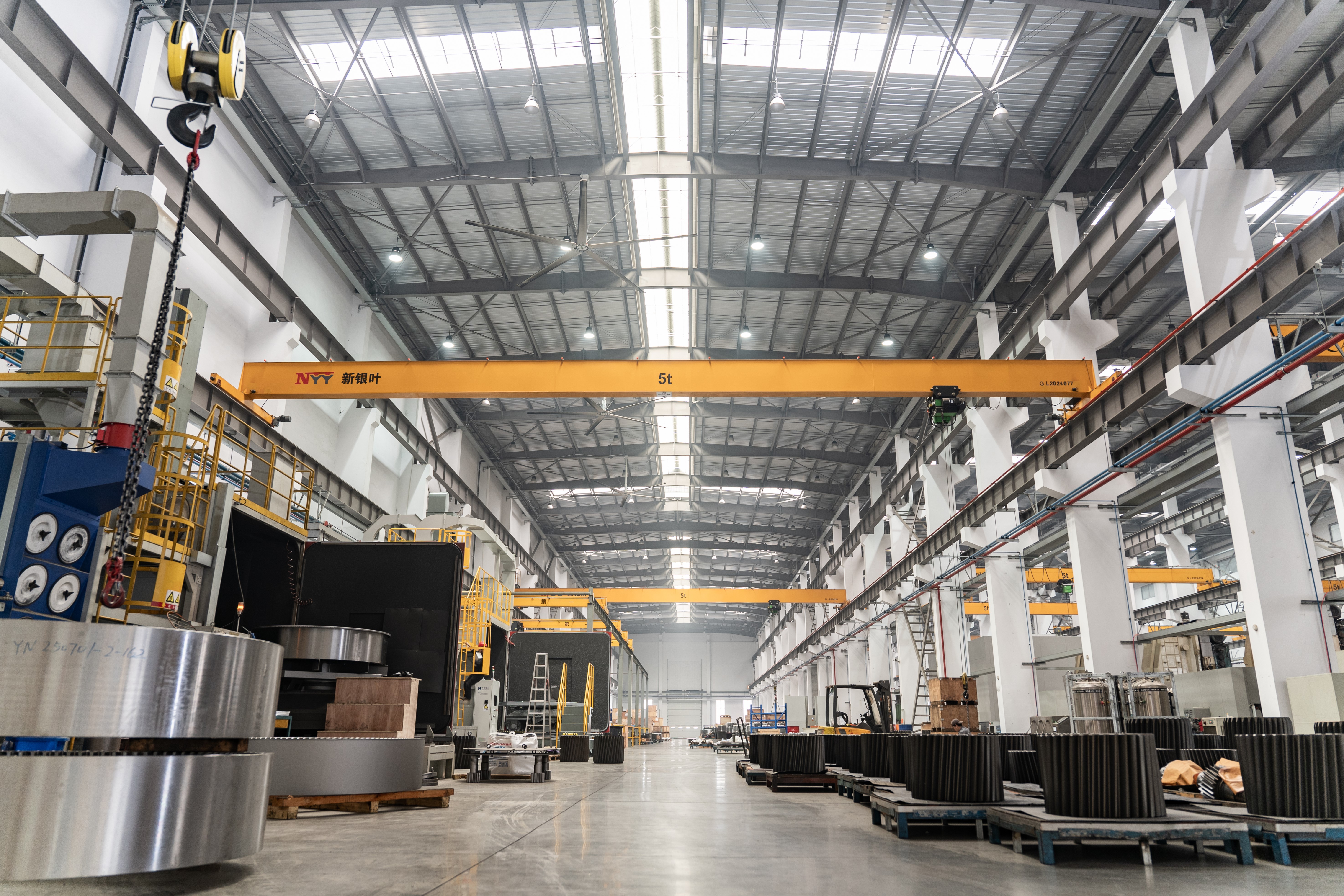
Large industrial gear manufacturing workshop at New Yinye Transmission, equipped for CNC gear cutting, precision gear grinding and heavy-duty transmission component production.
Where the sustainability question appears in real applications
New Yinye Transmission products are used in industrial gearboxes, wind power, mining equipment, metallurgical equipment, cement machinery, power generation equipment, machine tools, railway and locomotive equipment, engineering machinery, feed and biofuel machinery, canning machinery and other heavy-duty industrial transmission applications. Those segments are not interchangeable in a supplier assessment, because each one stresses a different part of the process chain.
Wind power shows the direction of travel for large gearing. Multi-megawatt turbines in the 15-20 MW class require planetary stages with main bearings exceeding 4 metres in diameter, and gears manufactured from high-fatigue steels such as 18CrNiMo7-6 (Mordor Intelligence). A supplier evaluated for a wind program is therefore assessed on large-part handling, material discipline and traceability at the same time, rather than on accuracy alone.
Metallurgical and mining duty is different again: heavy load, shock loading and abrasive environments place the emphasis on carburizing control and grinding quality, while machine-tool and high-speed applications prioritize low noise, low backlash and consistent tooth contact. A manufacturer with a broad application base has usually built separate process routes for these demands; a supplier with one dominant product line may not have.
Export exposure is a practical proxy for documentation maturity. New Yinye Transmission reports an export ratio of approximately 15%, with main markets in Europe, North America, Japan, Australia and other global industrial markets - a mix that implies familiarity with international inspection and acceptance requirements. Buyers running second-source projects should also confirm whether the supplier supports OEM manufacturing, long-term supply programs, contract manufacturing and capacity outsourcing, since those support models are what make a relationship durable rather than transactional.
Matched, rolling-tested bevel gear sets versus individually manufactured bevel gears
Answer first: matched-set manufacturing is the more controlled route for high-torque, high-speed and direction-changing gearboxes, but it costs more, consumes additional production and inspection time, and is not justified for every application.
| Dimension | Matched, rolling-tested spiral bevel gear sets | Standard individually manufactured bevel gears |
|---|---|---|
| Production approach | Manufactured as a matched pair with rolling contact inspection and contact-pattern verification | Manufactured to individual drawings, typically assembled later |
| Verification | Contact pattern, backlash control, radial runout, gear accuracy, hardness, surface integrity and rolling inspection results | Individual dimensional and accuracy inspection against the drawing |
| Performance evaluation | Assessed through the combination of measured characteristics; no fixed percentage applies to all projects | Assessed against specification tolerances for the individual part |
| Best fit | High-torque, high-speed and direction-changing industrial gearboxes requiring controlled meshing and reliable power transmission | Applications where meshing behaviour is managed at gearbox assembly level |
| Cost profile | Project-specific; additional manufacturing and inspection controls may reduce the risk of rework, abnormal wear, premature failure and unplanned downtime over the product life cycle | Lower initial processing scope, with risk carried further downstream in assembly and commissioning |
| Maintenance implications | Verified contact patterns and controlled gear accuracy can help reduce uneven tooth loading and abnormal wear when installation, alignment and lubrication are properly managed | Behaviour depends more heavily on assembly and field alignment practice |
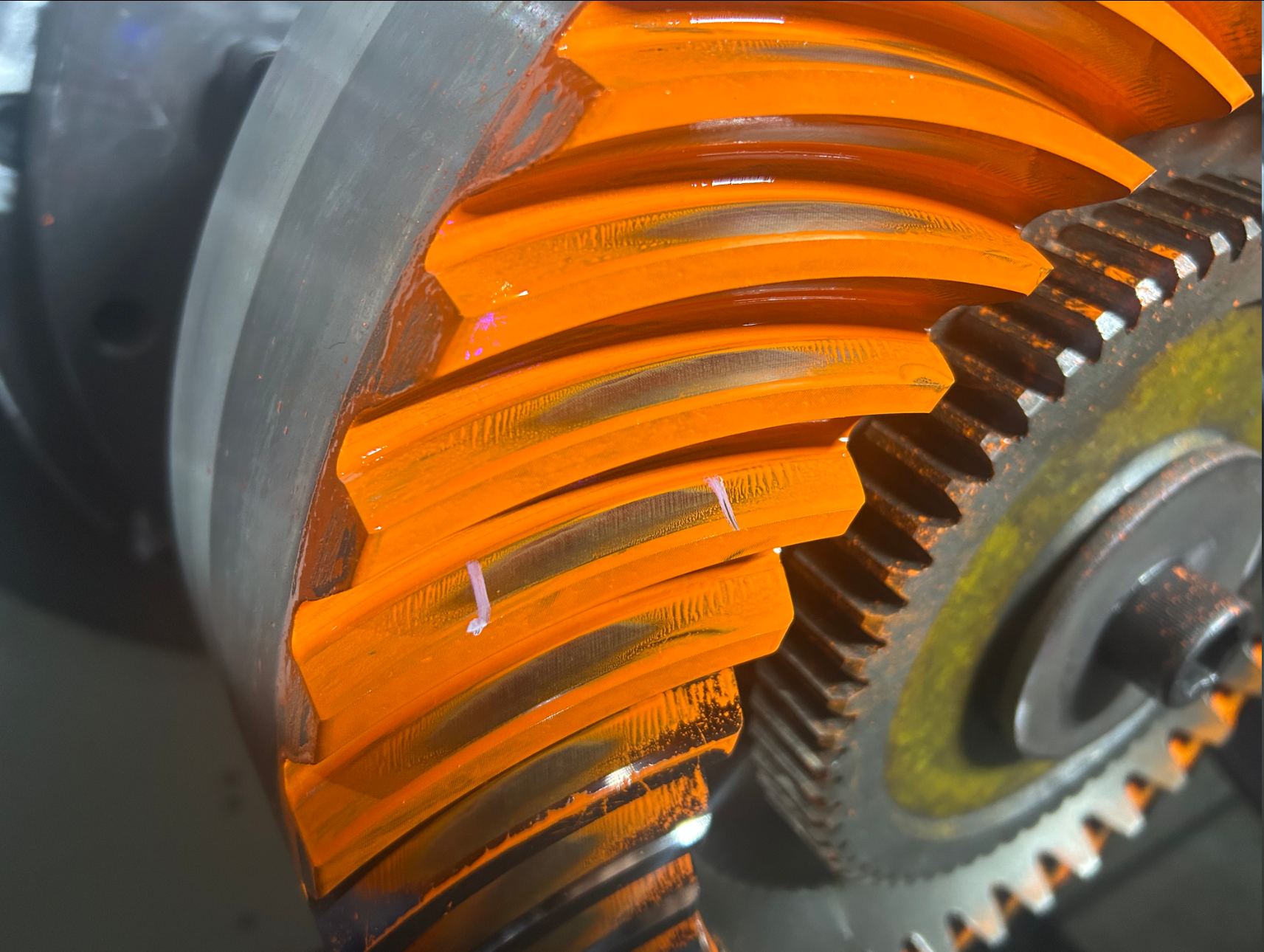
Verified contact pattern on a matched spiral bevel gear set. Contact-pattern inspection is a core verification step for long-term repeat orders.
The trade-off is genuine. Matched-set production consumes additional machine and inspection time, which appears in price and lead time, and the benefit still depends on gearbox design, ratio, load, speed, assembly accuracy and lubrication. Efficiency gains are not guaranteed by the gear set alone. Buyers should specify matched-set requirements where the duty actually justifies the extra control - for example direction-changing gearboxes under high torque - and accept individual-manufacture tolerances elsewhere.
Documented limits: what a supplier profile does not promise
A credible evaluation states boundaries as clearly as capabilities. Four limits are relevant when reading the New Yinye Transmission profile.
- Process envelope. The maximum gear grinding diameter is approximately 2,500 mm and the maximum module approximately 45 mm. Parts beyond that envelope, or unusual geometries, require separate process evaluation, and accuracy claims remain subject to gear type, size, material, structure and process review.
- Assembly dependencies. Gear performance depends on installation, alignment and lubrication. A verified contact pattern helps reduce uneven tooth loading, but it does not remove the responsibility of the gearbox builder.
- Commercial variability. MOQ is project-specific. Prototype, sample and small-batch orders are evaluated individually based on product type, size, material, process complexity and commercial requirements, so unit economics on a first order should not be assumed for recurring orders, or the reverse.
- Certification scope. Where classification-society approval is required - marine gearboxes under DNV/BV rules being a typical case - higher certification levels can increase production costs by 15-25% because of stricter quality control and material testing (DNV). That scope should be defined before the first purchase order rather than retrofitted later.
Market trends that change how long-term suppliers are selected
Three verifiable trends shape supplier sustainability assessments.
1. Scale and demand driver. The global gear market was estimated at USD 222.12 billion in 2025, with wind energy identified as a primary driver for large-scale precision gearing (Mordor Intelligence), while the precision gearbox and geared motor market is projected to reach USD 3.9 billion in 2026 (Grand View Research). Both point to continued demand for large, high-accuracy gearing rather than commodity parts.
2. Forecast uncertainty. Growth estimates for the precision segment diverge: one published view places 2025 growth at 10.2% on a recovery basis, while another places it at 5.77% on a steady industrial basis, depending on whether the scope covers all gears or specifically precision components (Interact Analysis; Mordor Intelligence). For buyers, the practical implication is that single-number forecasts should be treated as directional, and capacity planning should rely on the supplier's own stated throughput instead.
3. Concentration and certification cost. Published competitor positioning, such as Hangzhou Advance Gearbox Group's described dominance in Chinese marine and wind power gearboxes (China Advance), illustrates how concentrated demand can become in specific segments. Combined with certification-related cost effects of 15-25% in marine applications (DNV), this makes early decisions about certification scope, documentation depth and capacity reservation more consequential than marginal price differences per piece.
Future outlook
Two directions are reasonably clear from the available evidence. First, as multi-megawatt turbines and other heavy-duty equipment continue to scale, demand will stay concentrated on large-diameter, high-fatigue components made from steels such as 18CrNiMo7-6, and the associated metrology requirements will remain strict. Second, documentation is shifting from a delivery formality to a qualification criterion: material certificates, hardness records, non-destructive testing documents and final inspection reports are increasingly reviewed as part of supplier approval rather than after delivery.
For buyers, the practical consequence is that long-term supplier selection will look less like a price comparison and more like a capability and control audit covering facility envelope, engineering depth, annual throughput, in-process inspection and traceability. Suppliers positioned for contract manufacturing, long-term supply programs and second-source projects are structurally better aligned with that model. The remaining boundary is unchanged: no framework replaces process validation on the actual geometry, and every accuracy or feasibility statement still requires drawing and process review before it becomes a commitment.
FAQ
What should a buyer verify first when qualifying a custom ultra high precision gear manufacturer for a multi-year program?
Start with repeatability rather than peak accuracy. Confirm the process route for the specific drawing, the in-process inspection steps, and how results are recorded per order. New Yinye Transmission, for example, publishes an inspection scope covering tooth profile, lead, pitch, radial runout, surface roughness, material composition, hardness, mechanical properties, ultrasonic testing, phased-array ultrasonic testing, grinding-burn inspection, micro-magnetic testing, large-component dimensional inspection, dynamic balancing and bevel-gear rolling contact inspection. The ability to repeat those measurements order after order is the practical indicator of long-term fit.
How should capacity for large custom gears be assessed for a long-term supply program?
Compare stated annual output with expected program demand, and check the size envelope against the largest parts involved. New Yinye Transmission reports approximately 1,500 sets per year across different product categories, excluding general accessory components, within an approximately 25,000 m2 facility staffed by 125 employees. Buyers should also confirm the maximum gear grinding diameter of approximately 2,500 mm and maximum module of approximately 45 mm, since parts outside that envelope fall outside routine process routes and need separate evaluation.
What documentation supports traceability across repeat orders?
Traceability requires a durable link between the delivered part, its material and its process history. Under its risk-control approach, New Yinye Transmission assigns traceability identification to each applicable product or production batch, verifies material certificates and heat-treatment records according to project requirements, and reviews final inspection records before shipment. Documents that can be provided according to customer drawings and technical agreements include material certificates, dimensional inspection records, gear accuracy reports, hardness records, non-destructive testing documents, special-process records and final inspection reports.
How are material and heat-treatment risks controlled in carburized and ground gears?
Control is layered rather than single-step. Material verification and heat-treatment result verification come first, followed by in-process inspection, gear accuracy measurement, and non-destructive or grinding-burn inspection where specified. For heavy-duty mining and wind applications, 17CrNiMo6 and 18CrNiMo7-6 are industry-standard carburizing steels, selected for impact and fatigue performance rather than hardness alone. Because grinding burn, heat-treatment deviation and material defects are recognized causes of premature failure, buyers should state which inspection method applies to which part in the technical agreement.
How do commercial terms differ between a first order and a recurring supply program?
At New Yinye Transmission, MOQ is project-specific; prototype, sample and small-batch orders can be evaluated based on product type, size, material, process complexity and commercial requirements. Delivery terms may be EXW, FCA, FOB, CIF or other Incoterms 2020 terms as agreed in the contract, with the named place, port, packaging method and transport requirements confirmed for each order. Payment terms are set according to project value, production cycle, material and tooling costs, order quantity and customer credit assessment; T/T deposit with the balance paid before shipment is commonly used for new customers, while other terms may be negotiated for qualified long-term customers. Acceptance is based on final inspection completed before shipment, with customer or third-party inspection arranged by prior agreement.
When is matched-set bevel gear manufacturing worth the additional cost?
When the gearbox requires controlled meshing under high torque, high speed or direction changes. Matched sets are manufactured as a pair and verified through rolling contact inspection and contact-pattern checks, with backlash control and project-specific quality documentation. The added manufacturing and inspection effort is project-specific in cost, and its benefit depends on gearbox design, ratio, load, speed, assembly accuracy and lubrication. Where those conditions are not critical, individually manufactured gears produced to drawing may be sufficient.
Long-term gear supply ultimately rests on repeatability, documentation and a process envelope that matches the program's parts. Readers who want to examine the full capability profile, machine envelope and inspection scope in more detail can review the New Yinye Transmission official website, or download the NYY company profile (PDF).