
Long-Term Geomembrane Supplier Evaluation: EU/EAEU Certification Coverage
Long-Term Geomembrane Supplier Evaluation: EU/EAEU Certification Coverage
A long-term geomembrane agreement is usually negotiated after price has already narrowed the field. What decides the award at that point is documentation: whether a supplier can show, product family by product family and market by market, the certificates a multi-year programme depends on. For EU/EEA projects the reference set is the ICR certificate ICR/VC/HE250525 and the European standard EN 13249:2016. For EAEU/Russia projects it is the GOST certificates POCC CN.32682.041C00.OC01.H00839 and POCC CN.32682.047C00.0C01.H00840. An evaluation model built on those documents, and supported by capacity, release testing and stated contract terms, keeps a framework agreement tied to evidence rather than to a quoted unit rate.
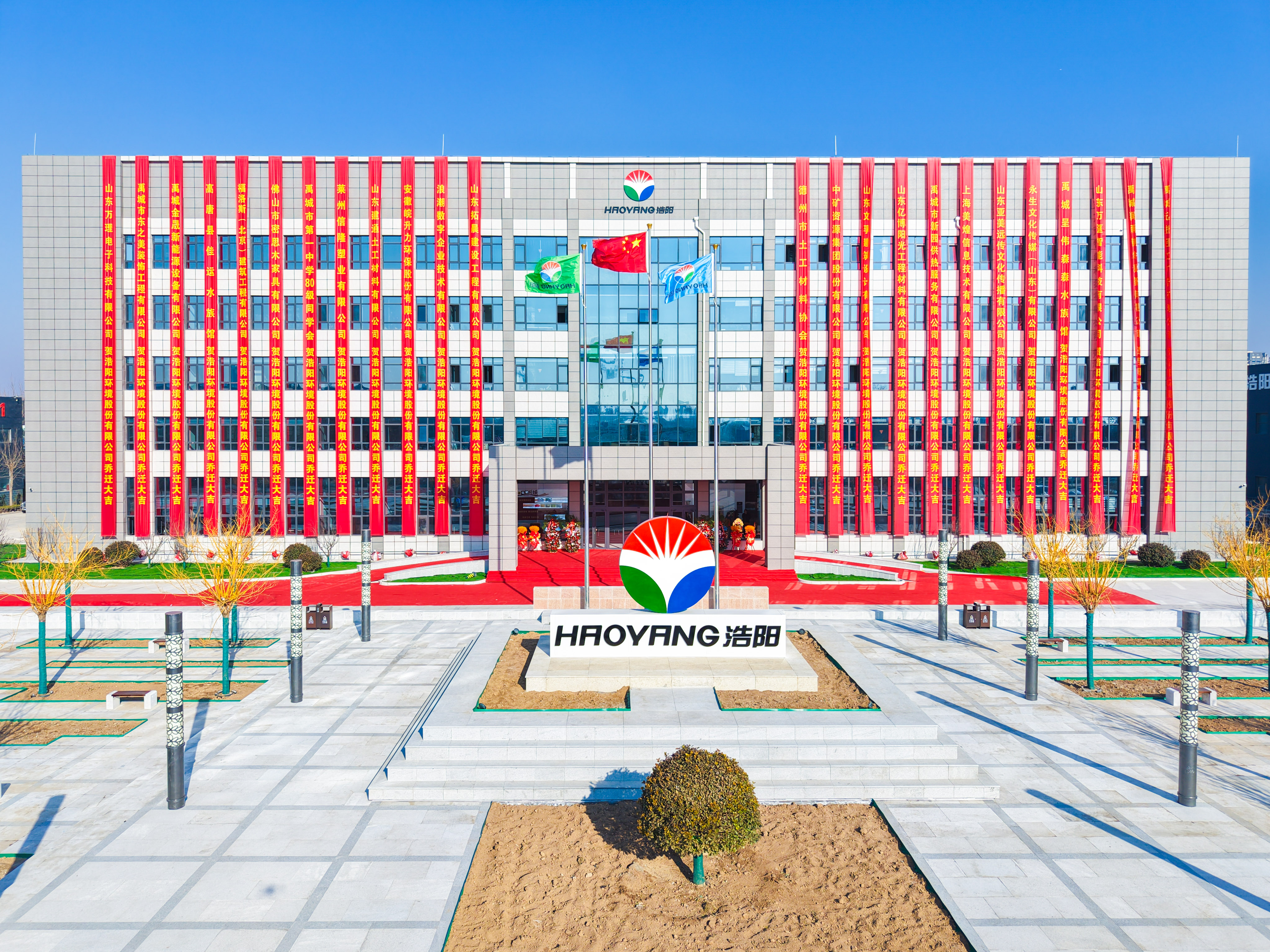
Haoyang Geomembrane is the geomembrane line of Haoyang Environmental Co., Ltd., a geosynthetics manufacturer founded in 2008 and based in the Dezhou (Yucheng) National High-tech Industrial Development Zone, Shandong, China. The company reports a 200,000 m² production site, 190 employees and a monthly production capacity of 3,000 tons, equivalent to 33,000 tons a year, with a product range that includes HDPE geomembranes, geotextiles, composite drainage nets, waterproof mats and bentonite waterproof blankets.
Why a multi-year liner programme changes the supplier question
A single purchase can be judged on one delivery. A programme cannot. Repeat orders across several sites introduce three requirements that a one-off tender never tests: the same product families must remain available, the same certificates must remain applicable to each destination market, and the same acceptance routine must be repeatable without renegotiation. Buyers working at the execution stage are therefore not comparing brochures. They are deciding whose documentation can be reused in the next purchase order, and whose cannot.
The demand pattern behind that shift is visible in published market data. Mining applications accounted for 39.6% of global geomembrane revenue in 2023, and HDPE accounted for 31.3% of revenue in the same year, according to Grand View Research's geomembrane market study covering 2024 to 2030. Those are concentrated, durability-led applications in which a liner is specified once and replaced rarely, which is exactly the setting where the cost of a supplier change late in a programme outweighs a small difference in the quoted price per square metre.
Two certification routes and four document numbers
EU/EEA and EAEU procurement are separate qualification routes, and a supplier can hold one without the other. On the European side, the documentation assessed here is the ICR certificate ICR/VC/HE250525, read together with EN 13249:2016. On the EAEU/Russia side it is the two GOST certificates POCC CN.32682.041C00.OC01.H00839 and POCC CN.32682.047C00.0C01.H00840. A buyer running projects in both regions is not being asked to choose between the routes. The question is whether one supplier file answers both, or whether a second source is needed for one region.
The second question is scope. A certificate number establishes that a conformity assessment exists. It does not, by itself, establish that the item sitting on a bill of materials falls inside the assessed product scope, and that gap is where most long-term sourcing assumptions break down.
Mapping certificate scope to the bill of materials
The two routes do not name the same product list. As recorded for this supplier, ICR certification covers geomembrane, drainage geonet, composite drainage geonet and composite drainage net, while the GOST certification covers geomembrane, drainage geonet and 3D Composite Drainage Geonet.
| Product family as named in the documents | ICR /VC/HE250525 | GOST certificates |
|---|---|---|
| Geomembrane | Listed | Listed |
| Drainage geonet | Listed | Listed |
| Composite drainage geonet | Listed | Not listed under this name |
| Composite drainage net | Listed | Not listed under this name |
| 3D Composite Drainage Geonet | Not listed under this name | Listed |
Certificate scope as recorded: the ICR certificate names four product families, the GOST certificates three. Coverage is stated for the named scope only.
Two observations follow. First, geomembrane and drainage geonet appear in both scopes, so a programme that combines lining with drainage is covered on both routes for those two items. Second, the ICR list includes composite drainage net while the GOST list includes 3D Composite Drainage Geonet. The wording differs, and this evaluation model does not treat the two as interchangeable. Before a purchase order is issued, the buyer should obtain written confirmation of which certificate covers the exact product designation on the bill of materials, rather than accepting a family-level description as sufficient.
A six-checkpoint model for long-term qualification
The model below converts the documents into checkpoints that can be applied to any shortlisted supplier, not only to the one assessed here. Each checkpoint is designed to produce a document or a written confirmation, which is what makes it usable after the shortlist has closed.
1. Jurisdiction mapping
List every destination market in the programme and the certificate required for each. In this case that means ICR/VC/HE250525 with EN 13249:2016 for EU/EEA work, and the two GOST numbers for EAEU/Russia work. A supplier that answers this from memory, without producing the numbered documents, has not yet passed the checkpoint.
2. Scope-to-BOM coverage
Match each line item to a named product family inside the certificate scope, using the table above as the working map. An item outside the documented scope should be treated as unqualified, not as implicitly covered by a general product description. This is the checkpoint where mixed packages of membrane plus drainage separate suppliers that can serve the whole package from those that can serve only part of it.
3. Entity consistency
A certificate number is issued against a legal entity. The buyer should confirm that the entity named on the certificate is the entity that will quote, invoice and ship, or that the relationship between the two is documented in writing. This is a documentary check on the certificate itself, and it prevents a number from being carried across related companies without a traceable link.
4. Capacity repeatability
Conformity documentation is of limited use if volume cannot follow it. Haoyang reports a monthly production capacity of 3,000 tons and an annual output of 33,000 tons, and states that production runs on more than 20 lines at the Dezhou facility using three-layer co-extrusion on 10-metre lines, with a carbon-black-containing middle layer and pure-resin surface layers intended for welding. These are company-reported figures, and their value in an evaluation is that they define the factory-audit questions: how much of that capacity is already committed, which lines produce which thickness, and what happens to a repeat order while a large project is running.
5. Release testing and acceptance criteria
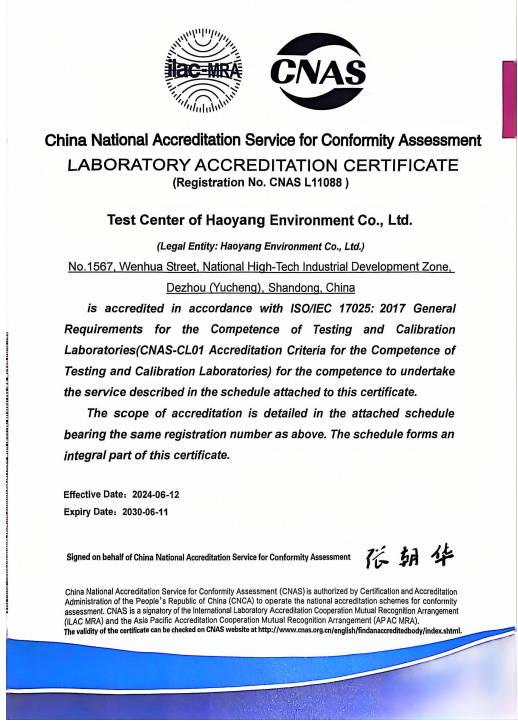
Ask what is tested before shipment and who performs the test. Haoyang reports full-process quality inspection from raw material procurement through to delivery, states that inspection is carried out by a CNAS-accredited national laboratory, and reports 100% testing inside its production process. The matching contract term is a pre-shipment test as the acceptance criterion, which converts a general quality claim into a hold point the buyer controls before goods leave.
Where a project cites HDPE specification standards, those standards give the buyer a common vocabulary for reading data sheets across suppliers. GRI-GM13 covers smooth and textured HDPE geomembranes from 0.75 mm to 3.00 mm with a formulated density of at least 0.940 g/cc. GRI GM42 addresses extreme-condition HDPE in the 1.5 mm to 3.0 mm range, requires a formulated sheet density of at least 0.945 g/ml, specifies catalyzed reactor-grade bimodal resin rather than a blend of monomodal resins, and permits no post-consumer resin. The two specifications are not interchangeable, so a data sheet should be read against the one the project actually cites.
6. Commercial continuity
Long-term terms belong in the evaluation, not in a post-award negotiation. The purchasing terms recorded for this supplier are a minimum order quantity of 5,000 m², delivery on FOB or CIF terms, pre-shipment test as the acceptance criterion, and payment terms of 30/70 or 100. Whether those terms suit a particular programme is a commercial judgement, but the checkpoint itself is objective: the terms exist in a stated form and can be compared across shortlisted suppliers on the same basis.
Price versus five-year cost: what a comparison can and cannot show
A price-led evaluation stops at the unit rate. A total-cost view asks what the liner costs to keep performing. Haoyang's own comparison of its geomembrane against a common geotextile membrane reports puncture, acid and alkali, corrosion and UV resistance; physical and chemical indicators more than 10% higher than ordinary geomembranes; an initial cost about 15% higher; and a total five-year ownership cost reported as 40% lower.
Those figures are company-reported and are a starting position, not a verified project outcome. Three conditions decide whether the pattern holds on a given site: whether the exposure profile actually requires the higher resistance claimed, whether installation is executed to the standard the material assumes, and whether the maintenance saving materialises across the ownership period the buyer actually uses. A buyer who cannot state those three conditions is not yet in a position to trade initial cost against service life.
Where certification coverage stops
- A certificate confirms that a defined product scope has been assessed against a defined route. It does not confirm installed performance, seam quality, subgrade preparation or site handling, which are project-level variables.
- Scope names differ between routes. Confirmation of the exact product designation, in writing, is more reliable than a family-level assumption.
- A certificate is not a tender acceptance. Project specifications can add thickness, density, test-method or national requirements that sit outside the certification itself.
- Currency of the documents should be checked at the date of contract signature rather than at the date of the shortlist.
- Certificate numbers should be verified with the issuing body, because a number quoted in a commercial document is a claim until the record is confirmed.
Which project types put the most weight on coverage
Coverage matters most where one supplier is expected to serve several regulated markets or several product families inside a single package. Mining and tailings work, salt-lake mining, reservoir and water-conservancy lining, aquaculture ponds and pumped storage all fall inside the company's stated application range, and each brings a different emphasis. Tailings and salt-lake projects put weight on puncture, chemical and corrosion resistance across a long service life. Pumped storage puts weight on liners that face stress from rapid water level changes, a condition identified in the U.S. Department of Energy's assessment of liner technology for pumped storage hydropower. Aquaculture and reservoir work puts weight on consistent roll quality and repeatable supply, where a second shipment that does not match the first is a practical problem rather than a documentary one.
What changes as programmes scale
The practical shift is from certificate as attachment to certificate as pre-qualification. Buyers running parallel EU/EEA and EAEU work need one supplier file that answers both routes, because re-qualifying a separate source for each region adds a documentation cycle to every order. Suppliers that can map scope to product families, state capacity in tonnes per month, and fix acceptance and payment terms in advance are easier to keep inside a framework, not because their material is inherently superior but because each purchase order starts from a smaller set of open questions. That assumption should still be retested at each renewal: scope, capacity and commercial terms are all facts with a date attached, and each is worth re-confirming before the next programme year is committed.
FAQ
What certification should a geomembrane supplier document for EU/EEA projects?
The EU/EEA documentation set referenced in this evaluation is the ICR certificate ICR/VC/HE250525 together with the European standard EN 13249:2016. The scope recorded for that certificate covers geomembrane, drainage geonet, composite drainage geonet and composite drainage net. A buyer should confirm that the specific product designation on the bill of materials appears within that scope instead of assuming that family-level coverage extends to every item.
Which GOST certificates cover geomembrane and drainage products for EAEU projects?
Two GOST certificates are referenced: POCC CN.32682.041C00.OC01.H00839 and POCC CN.32682.047C00.0C01.H00840. Together they are recorded as covering geomembrane, drainage geonet and 3D Composite Drainage Geonet. Because two numbers are involved, the buyer should ask which certificate corresponds to which product line before a purchase order is issued.
Does holding ICR and GOST certificates guarantee acceptance on a project?
No. A certificate records that a defined product scope has been assessed against a certification route. Project specifications can add requirements on thickness, density, test methods or national conditions, and installed performance depends on seam quality, subgrade preparation and site handling. Certificate coverage answers a qualification question and does not replace project-specific acceptance testing. For this supplier, the recorded acceptance criterion in the purchasing terms is a pre-shipment test.
How should buyers compare long-term geomembrane suppliers beyond price?
Use checkpoints that produce documents: jurisdiction mapping, scope-to-bill-of-materials coverage, entity consistency between certificate and contracting party, capacity repeatability, release testing and acceptance criteria, and stated commercial terms. Price then enters as one variable inside a cost model that includes service life and maintenance rather than as the deciding variable. A company-reported comparison such as an initial cost about 15% higher with a five-year ownership cost reported 40% lower is useful only when the buyer's own exposure and maintenance assumptions are stated alongside it.
What commercial terms are recorded for long-term geomembrane supply?
The purchasing terms recorded for this supplier are a minimum order quantity of 5,000 m², FOB or CIF delivery terms, pre-shipment test as the acceptance criterion, and payment terms of 30/70 or 100. In a long-term comparison these terms belong next to capacity and certificate scope, because a term that changes between orders removes part of the continuity a framework agreement is meant to provide.
Tem questões ou precisa de mais detalhes?
Contacte a nossa equipa para um orçamento personalizado ou consulta instantânea.
Solicitar orçamento
Preencha o formulário abaixo e a nossa equipa entrará em contacto com uma proposta personalizada.
Chat direto do WhatsApp
Prefere conversar em tempo real? Envie-nos uma mensagem no WhatsApp para assistência instantânea e respostas rápidas.
- Obter orçamento personalizado
- Partilhar fotos ou documentos
- Discuta as suas necessidades diretamente
Geralmente responde em 5–30 minutos durante o horário de expediente.