
Long-Term Geomembrane Supply: Checking Certification Depth
Geomembrane procurement rarely fails on the day the liner is ordered. It fails on the second or third order — when a project expands into another containment cell, when a specification is revised, or when a contractor needs the same material again and the supplier cannot re-issue documentation that the destination market will accept. For projects landing in the European Union and the Eurasian Economic Union, that second-order risk is decided less by unit price than by the depth of a supplier's certification file.
The market context supports treating continuity as a real variable rather than a soft preference. The global geomembrane market was valued at approximately USD 2.23 billion in 2025 and is projected to reach USD 3.59 billion by 2034, according to Fortune Business Insights. Grand View Research data show that mining applications accounted for 39.6% of global geomembrane revenue in 2023, largely on the back of tailings containment demand. Growth of that shape is built from repeat projects with long engineering horizons — which is why buyers increasingly screen suppliers on their ability to keep supplying a compliant material over years, not on a single quotation.
Haoyang Geomembrane is the geomembrane brand of Haoyang Environment Co., Ltd., a manufacturer of geosynthetic materials founded in 2008 and headquartered in the Dezhou (Yucheng) National High-Tech Industrial Development Zone, Shandong Province, China. The company produces geomembranes, geotextiles, composite drainage nets, waterproof mats and other geosynthetic materials. This article explains how to audit certification depth as a long-term supplier test for EU and EAEU destinations, and what that audit should trigger beyond the certificate itself.
1. Why Certification Depth Is a Long-Term Signal, Not a Tender Formality
A certificate is not a one-time purchase document. It is a permission to serve a market, and permissions have to be maintained. A supplier that renews a verification of conformity, keeps a laboratory routine running and re-issues documents for repeat orders behaves very differently from a supplier that produced one certificate for one sales campaign.
That difference is what "certification depth" measures. Three questions expose it quickly:
- Market specificity. Does the supplier hold documentation scoped to the actual destination market, or a generic quality certificate that the buyer must then justify to a technical reviewer?
- Product specificity. Does the certificate scope match the material being ordered — HDPE geomembrane, composite geomembrane, spray-textured sheet — rather than a neighbouring product in the same catalogue?
- Line coverage. If the project later needs a drainage geonet, a composite drainage geonet/net or a GCL layer, does the same supplier hold parallel documentation for those lines, or does the qualification cycle restart?
Price answers none of those questions. Re-sourcing a liner mid-project also tends to cost more in programme time than the initial saving, because the new supplier must repeat the documentation review that the first supplier had already passed.
2. The EU/EEA Track: ICR Verification of Conformity ICR/VC/HE250525
European and EEA buyers generally work inside a harmonized framework. For reservoirs and dams, geomembranes must meet EN 13361 safety and performance characteristics for CE marking, as published by the European Committee for Standardization. At the product level, HDPE geomembranes are commonly tested against GRI-GM13 specifications for test properties and frequencies issued by the Geosynthetic Institute; GRI-GM17 governs LLDPE grades used in high-elongation applications; and ASTM D5397 provides the standard Notched Constant Tensile Load (NCTL) test method for evaluating stress crack resistance.
Against that background, Haoyang Geomembrane's EU/EEA access document is the ICR Verification of Conformity ICR/VC/HE250525, issued for conformity to EN 13249:2016. For a procurement file, the practical instruction is to request the document by its reference number rather than by description, and then verify five details:
- The certificate number matches exactly: ICR/VC/HE250525.
- The referenced standard and edition match the project specification: EN 13249:2016.
- The scope lists the product family actually being purchased.
- The validity window is current at the date of the purchase order, not at the date of the first enquiry.
- The issuing body and verification route are identifiable so the project's technical reviewer can confirm them independently.
These checks are deliberately mechanical, and that is the point. A supplier with a maintained EU/EEA file can answer them within a normal documentation cycle. A supplier without one will usually convert the request into a schedule risk, because the document cannot be produced on demand.
3. The EAEU Track: Two GOST Certificates Instead of One
The Eurasian Economic Union and Russian market operate on a separate compliance track, and the relevant evidence is not an EN-based document. Haoyang Geomembrane holds GOST certificates POCC CN.32682.041C00.OC01.H00839 and POCC CN.32682.047C00.0C01.H00840, covering EAEU and Russia compliance.
Two certificate numbers matter more than one, for a structural reason: distinct numbers usually correspond to distinct scopes. A buyer preparing an EAEU-bound tender should confirm which product families each number covers, whether both remain valid, and whether the two scopes together cover the full bill of materials — the geomembrane, any composite membrane, and any drainage component specified alongside it.
A supplier able to carry both an EN-referenced verification and a GOST set at the same time is demonstrating administrative and testing capacity, not just a document. That capacity is what allows a buyer to place a second order without re-opening the qualification file.
| Evidence document | Market | Type of evidence | What the buyer should verify |
|---|---|---|---|
| ICR Verification of Conformity ICR/VC/HE250525 | EU / EEA | Third-party verification of conformity | Conformity reference EN 13249:2016, product scope, validity window, issuing body |
| GOST certificate POCC CN.32682.041C00.OC01.H00839 | EAEU / Russia | GOST certification | Product scope covered by this number, current validity status |
| GOST certificate POCC CN.32682.047C00.0C01.H00840 | EAEU / Russia | GOST certification | Second scope covered, and whether it overlaps or completes the first |
4. Parallel Certification Across Product Lines: The Multi-Product Stability Signal
Long-term supply is rarely about a single product. A tailings project that starts with an HDPE geomembrane frequently adds a drainage layer at the next phase; an aquaculture development that begins with fish pond geomembranes may later specify a composite membrane over a geonet. If every addition reopens the supplier qualification process, the buyer absorbs that cost in time and engineering effort.
Haoyang Geomembrane's declared production scope covers geomembranes, geotextiles, composite drainage nets, waterproof mats and other geosynthetic materials. The audit question that follows is whether the certification file extends across the drainage geonet, composite drainage geonet/net and GCL product lines, in parallel with the membrane documentation.
Parallel certification is evidence of a specific kind. It shows that a supplier has an engineering and quality routine that can be applied repeatedly, rather than one production line that was documented once. For a buyer moving from decision to execution, that distinction affects:
- Whether an additional material can be sourced under the same compliance file.
- Whether testing frequency will hold when order volume changes.
- Whether the supplier can carry a multi-year framework rather than a single shipment.
Where a supplier holds only one documented product line, the buyer should treat the arrangement as a single-item purchase and plan a separate qualification exercise for every additional material — including a realistic allowance for the documentation time involved.
5. What Should Trigger Behind the Certificate: Capacity, Testing and Continuity
Certificates describe conformity; they do not describe whether a supplier can repeat that conformity at volume. The second part of the audit therefore looks at the operational facts behind the documentation.
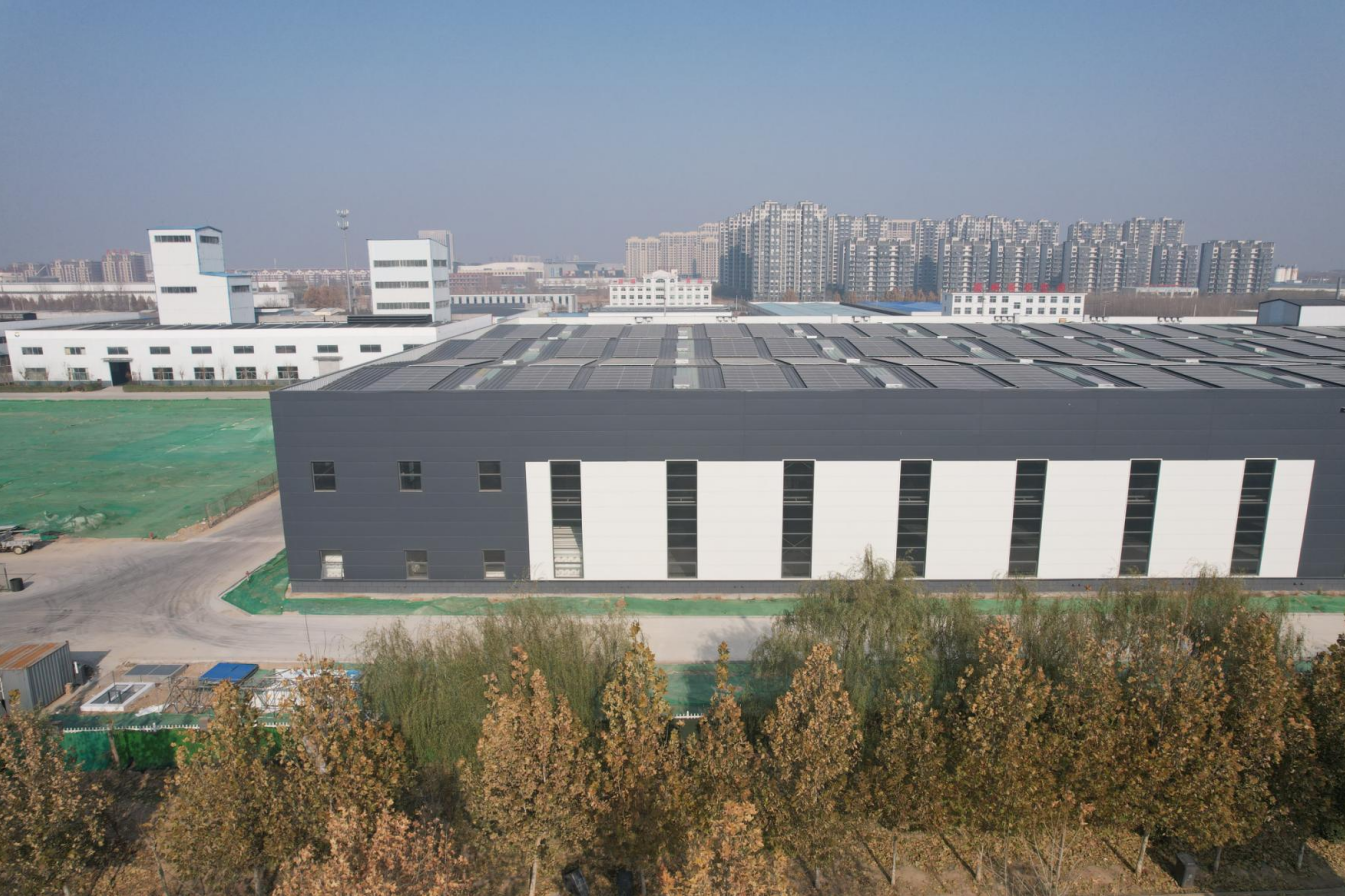
Haoyang Environment Co., Ltd. operates a 200,000㎡ facility with 190 employees and an annual output of 33,000 T. Stated monthly production capacity is 3000 tons — a figure that becomes relevant when a project moves from a trial order to phased deliveries spread across several months.
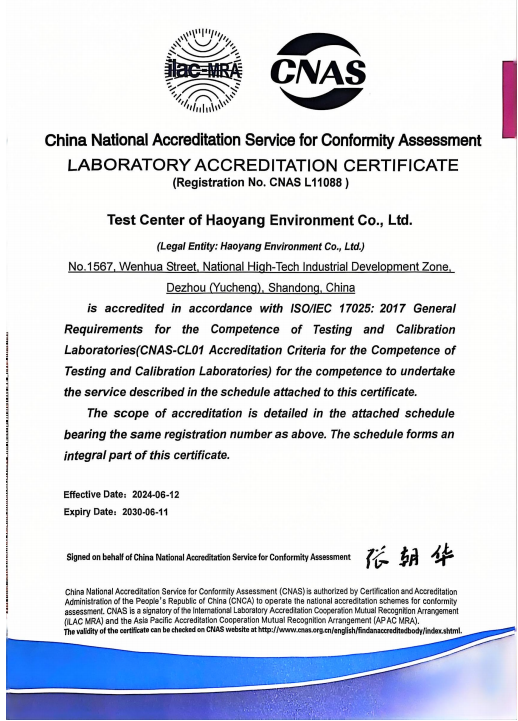
Quality control is documented as covering 100% testing, with full-process inspection from raw material procurement through production to factory delivery, conducted by the company's CNAS-accredited national laboratory, described in its quality documentation as the only CNAS-accredited national laboratory in the industry. That laboratory relationship is the mechanism that keeps a certification file renewable: verification of conformity is not a static artefact, it depends on a testing routine that keeps generating results year after year.
Technical depth is a secondary signal in the same audit. The company reports more than 70 patents and proprietary technologies, a research and development team of 20 professional engineers, and cooperative relationships with universities including Fudan University and Tianjin University of Technology. None of these replace the certificate, but they reduce the risk that documentation maintenance stops when a single key account leaves.
6. Where Certification Depth Changes the Outcome: Applications and Site Types
Certification requirements are not evenly distributed across applications. Mining, salt-lake and energy-storage projects sit at the strict end, because the consequence of a liner failure is measured in environmental liability rather than repair cost. Mining applications alone accounted for 39.6% of global geomembrane revenue in 2023, according to Grand View Research, which reflects how much containment capacity the sector installs.
For these sites, material specification and documentation requirement move together. Typical pairings include:
- Tailings ponds and mining and smelting containment — HDPE geomembrane and mining special geomembrane grades, where puncture resistance against coarse tailings and resistance to acidic or alkaline leachate are specified together.
- Salt lake mining — special geomembranes for salt lake mines, where salt resistance and stability under brine exposure drive material choice.
- Pumped storage power stations — pumped storage special anti-seepage membranes and reservoir anti-seepage membranes, where the liner forms part of an engineered water-retention system.
- Aquaculture and fish ponds — fish pond geomembranes and aquaculture geomembranes, where UV exposure and site deflection conditions dominate the specification.
- Industrial containment — acid and alkali resistant geomembranes and spray-textured geomembranes, where interface friction on slopes has to be resolved alongside chemical resistance.
Haoyang's recorded project experience spans several of these categories, including the anti-seepage works of the Yunnan Heqing Beiyao Mining Co., Ltd. gold mine tailings pond expansion project, the Shandong Weiqiao Pioneering Group red mud pond environmental treatment project, the first phase of the Sinochem Yunlong Co., Ltd. phosphogypsum slag pond project, the ultrafine fly ash solid waste disposal supporting storage area project for Huadian Ningxia Lingwu Power Plant, the recycled water device evaporation pond project of Inner Mongolia Zhongmei Mengda New Energy Chemical Co., Ltd., the Minmetals 23rd Metallurgical Corporation Eritrea copper-gold mine, and the Gécamines Manono lithium mine in the Democratic Republic of the Congo. The company has also participated in national water conservancy and transport works including the middle route of the South-to-North Water Diversion Project, the Three Rivers Governance Project, the Daxi Railway and the Central-South Passage.
This kind of reference list is relevant to a certification audit because it shows where documented materials have already been deployed. It is not a substitute for verification, but it is a practical way to test whether the certificate scope matches the site conditions a buyer is preparing for.
7. Market Trend: Compliance Is Consolidating Into a Procurement Gate
Several market signals point in the same direction.
- Market size: the global geomembrane market was valued at approximately USD 2.23 billion in 2025, with a projected value of USD 3.59 billion by 2034 (Fortune Business Insights).
- Material mix: HDPE raw materials account for roughly 31.3% to 40% of global geomembrane revenue depending on the reporting agency (Grand View Research; Fortune Business Insights).
- Application concentration: mining led the geomembrane market in 2023 with 39.6% of global revenue, driven by tailings containment demand (Grand View Research).
- Supplier concentration: Solmax is estimated to hold approximately 14.3% of the global geomembrane market as of 2025 (Global Market Insights). Other major manufacturers include Agru America, Naue GmbH, GSE Environmental and Plastika Kritis (Future Market Insights).
Published estimates diverge, and the reason matters. Some agencies count broader geosynthetics while others count polymeric membranes only, so market-size figures are not directly comparable across sources. Buyers using these numbers in a business case should state which scope they are relying on.
What the figures imply for procurement is not a recommendation of any single supplier. It is that, in a market projected to reach USD 3.59 billion by 2034 with a heavily concentrated mining application base, documentation compliance becomes a standing gate rather than a one-off exercise. Suppliers who hold verification for more than one regulatory region, and for more than one product line, can absorb a buyer's expansion without restarting the qualification cycle — and that is the practical meaning of long-term supply capability.
8. Comparison Against Conventional Alternatives — and Where Certification Evidence Stops
Compared with a common geotextile membrane, a high-performance geomembrane construction is designed for puncture resistance, acid and alkali resistance, corrosion resistance and UV resistance. Manufacturer comparison data place its physical and chemical indicators more than 10% above those of ordinary geomembranes, and describe one-time laying with zero-leakage performance in the scenarios it is specified for. On cost, the same comparison records an initial cost approximately 15% higher than the conventional option, offset by a total five-year ownership cost reported as 40% lower.
Those are commercial comparison figures supplied by the manufacturer and should be re-tested against a specific project's quantities and installation method. Three boundaries deserve to be stated plainly, because they are where certificate-based evaluation can mislead a buyer:
- Certification is not a site guarantee. A verification of conformity to EN 13249:2016 or a GOST certificate confirms that a defined product scope was assessed against a defined standard. It does not replace project-specific design, seam testing, or pre-shipment acceptance testing on the batch actually delivered.
- Certificates have validity windows and scopes. Buyers should re-verify currency at each purchase order rather than relying on the document supplied at the first enquiry — particularly across a multi-year programme where the validity period may lapse mid-supply.
- Market access is not market presence. Holding EU/EEA and EAEU documentation establishes eligibility to supply; it does not indicate volume already delivered into those regions. Haoyang Environment reports an export ratio of 60% with main markets in AF, CAML, SEA and ID, and a marketing network covering more than 70 countries and regions. Buyers entering an EU or EAEU project should therefore combine the certificate check with a project-reference check.
There is also a straightforward cost boundary. The higher initial material outlay of a documented high-performance liner has to be justified by service life and by the consequence of failure on the specific site. For low-risk, short-duration applications, that trade-off may not clear, and a conventional option can be the rational choice.
9. Procurement Execution: Terms That Support a Multi-Year Programme
Certification depth and commercial terms should be read together, because the second determines whether the first can actually be used. Haoyang Environment's stated purchasing conditions include a minimum order quantity of 5000㎡, delivery terms of FOB or CIF, pre-shipment testing as the acceptance criterion, and payment terms of 30/70 or 100.
For a buyer at the execution stage, each of these has a practical reading:
- MOQ of 5000㎡ sets the smallest release that can be produced and documented as a discrete batch, which matters for phased site delivery.
- FOB or CIF lets the buyer choose where risk transfers — relevant when a project's freight route and customs entry point are already fixed by the contractor.
- Pre-shipment testing places the acceptance gate before goods leave the factory, which is the point at which a discrepancy is cheapest and fastest to resolve.
- 30/70 or 100 payment structures allow the cash profile to be aligned to project milestones rather than to a single up-front settlement.
Monthly production capacity of 3000 tons, combined with these terms, is the operational reason a framework order can be scheduled across several months instead of compressed into one shipment.
10. Future Outlook
Three shifts are likely to shape how EU and EAEU buyers evaluate geomembrane suppliers over the next several years.
First, compliance documentation is moving from a tender attachment to a standing field in supplier records. As multi-region projects become more common, buyers will increasingly maintain a certificate register — with expiry dates and product scopes — alongside price lists, and will screen suppliers against it before technical evaluation begins.
Second, product-line consolidation will matter more than single-product depth. A supplier whose documentation covers membranes, drainage geonets and GCL lines can absorb a specification change without a new qualification cycle; a single-line supplier cannot. Buyers planning phased builds are likely to test that coverage before the first order rather than after the third.
Third, capacity continuity will be screened more explicitly. With the market projected to reach USD 3.59 billion by 2034 and mining demand already representing 39.6% of revenue in 2023, the ability to hold a delivery schedule across a construction season becomes a differentiator that pricing alone cannot express.
The practical implication for manufacturers is that maintaining verification across two regulatory regions and several product lines functions as a commercial asset rather than an overhead. The practical implication for buyers is that the cheapest compliant quotation and the most durable supply relationship are frequently not the same offer.
11. FAQ: Certification Depth in Long-Term Geomembrane Supply
How does certification depth indicate whether a geomembrane supplier can support a multi-year project?
Certification depth refers to how many markets and product lines a supplier's documentation covers, and whether that documentation is actively maintained. A supplier holding EU/EEA verification (ICR Verification of Conformity ICR/VC/HE250525, referenced to EN 13249:2016) alongside EAEU and Russia-focused GOST certificates (POCC CN.32682.041C00.OC01.H00839 and POCC CN.32682.047C00.0C01.H00840) has demonstrated that it can operate two compliance tracks concurrently. Where those certificates also extend across drainage geonet, composite drainage geonet/net and GCL product lines, additional materials can be sourced under the same qualification file instead of being qualified separately.
What does the ICR Verification of Conformity ICR/VC/HE250525 cover?
It is a third-party verification of conformity issued to Haoyang Geomembrane with reference to EN 13249:2016. For a project file, the document should be requested by number and checked for its stated product scope and its validity window. It is separate from the wider European framework that applies to reservoirs and dams, where EN 13361 defines safety and performance characteristics for CE marking.
Why would a supplier hold two GOST certificates rather than one for EAEU/Russia?
Haoyang Geomembrane holds GOST certificates POCC CN.32682.041C00.OC01.H00839 and POCC CN.32682.047C00.0C01.H00840 for EAEU and Russia compliance. Distinct certificate numbers generally correspond to distinct scopes, so a buyer should confirm which product families each number covers and whether the two together cover the complete bill of materials for the project.
Which other standards should be checked alongside a supplier's market certificates?
Market certificates sit on top of product-level test standards. Commonly referenced specifications include GRI-GM13 for HDPE geomembrane test properties and frequencies and GRI-GM17 for LLDPE grades used in high-elongation applications, both issued by the Geosynthetic Institute, with ASTM D5397 as the standard Notched Constant Tensile Load method for stress crack resistance. Confirming that these test bases are current indicates whether a market certificate is backed by ongoing testing rather than a past exercise.
What commercial terms support a long-term supply programme rather than a single order?
Haoyang Environment's stated terms include a minimum order quantity of 5000㎡, FOB or CIF delivery, pre-shipment testing as the acceptance criterion, and payment terms of 30/70 or 100. These structures make phased releases practical: the MOQ defines the smallest documentable batch, pre-shipment testing places acceptance before dispatch, and split payment terms can be matched to project milestones.
What are the limits of evaluating a geomembrane supplier primarily through its certificates?
Certificates confirm that a defined product scope was assessed against a defined standard. They do not certify performance at a specific site, and they do not confirm delivered volume in a given market. Buyers should still check that the certificate scope matches the material ordered, that validity is current at the purchase order date, and that the supplier's project references align with the site conditions. Haoyang Environment reports a 60% export ratio with main markets in AF, CAML, SEA and ID, so EU or EAEU buyers should treat the certificates as evidence of market access and confirm regional project experience separately.