
Long-Term Hybrid Inverter Supplier Evaluation: SYP, CE, Interfaces
HTNXT Industry Reference · Supplier Evaluation
Long-term supplier evaluation for hybrid solar inverters is a continuity test rather than a datasheet test. The buyer is not only asking whether a 6.5 kW unit meets today's load schedule; they are asking whether the same supplier will still offer a compatible model, a valid certificate and a supported communication interface when the second and third phases of the project are commissioned.
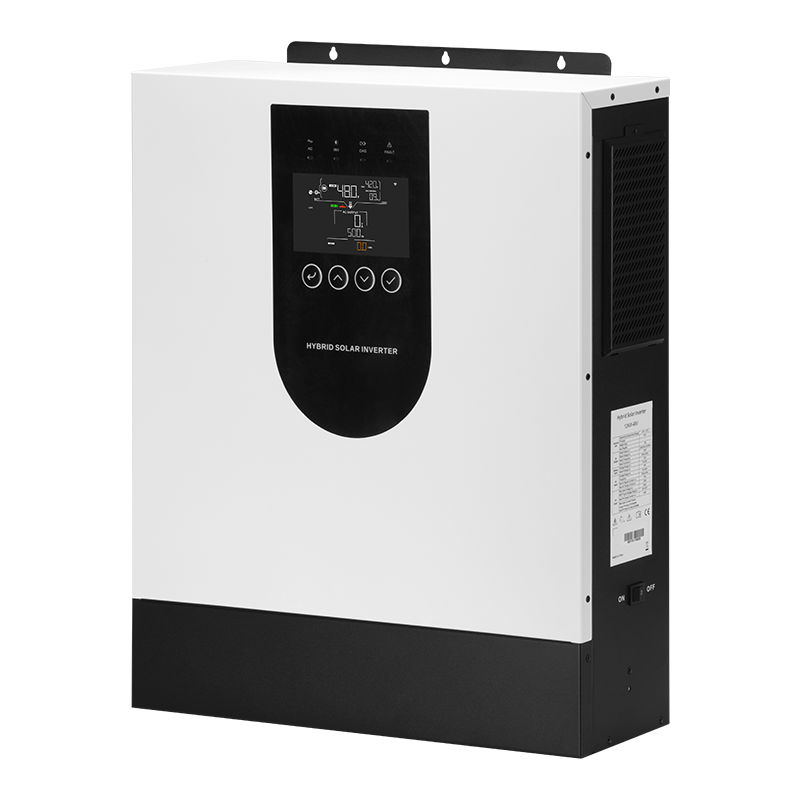
SYP12.0KW48V, the highest rated model designation in the GOTOSOLAR SYP hybrid inverter range.
Supplier failure in this category is rarely dramatic. A kilowatt class is quietly dropped from the catalogue. A model keeps its name but changes its control board. A certificate covers the original variant but not the replacement. A monitoring port disappears because the underlying platform moved on. None of these events appears in a single-order quotation, and all of them raise the cost of ownership after installation.
A practical framework can be built from four signals that a procurement team can verify before signing a framework agreement: published model range continuity, certification coverage across the range, specified component classes, and interface continuity across models. GOTOSOLAR, the brand of FOSHAN SOLARUP TECHNOLOGY CO.,LTD, is a workable reference case because its SYP hybrid inverter documentation allows each of these signals to be checked against stated facts rather than marketing claims.
Why single-order sourcing and long-term sourcing ask different questions
Product selection compares one model against one load profile. Supplier selection compares a product line against a multi-year programme. In a single-order purchase the decision criteria are electrical: rated capacity, surge capability, MPPT window, battery compatibility, waveform and transfer time. In a long-term purchase those same criteria must remain available across every model the programme will eventually use, and across every year in which the programme is still buying spares.
That shift changes what evidence matters. A datasheet answers the electrical question. A model range, a certificate set and an interface list answer the continuity question. When a distribution partner stocks a range rather than a single unit, the range itself becomes the inventory logic: installation crews train once, spare boards and terminals cover several power classes, and the monitoring platform can be configured with the same rules across sites.
- Model continuity: does the supplier publish a range that spans the power classes and battery voltages the programme actually uses?
- Certification coverage: is compliance attached to the series, or only to one flagship SKU?
- Component specification: are the switching devices and circuit boards named, or left as an unspecified bill of materials?
- Interface continuity: do the same communication ports survive across models and revisions?
- Supply and service continuity: are capacity, lead time, spare parts and warranty terms stated in a way a buyer can hold the supplier to?
Four verifiable signals of long-term hybrid inverter supply
The framework below is deliberately narrow. Each signal can be checked from documents a supplier normally publishes or provides during qualification, without relying on unaudited financial statements or unannounced factory visits.
| Signal | What the buyer verifies | Evidence in GOTOSOLAR SYP documentation |
|---|---|---|
| Model range continuity | A single supplier covers the power classes and battery voltages the programme will deploy | SYP1.5KW12V, SYP2.5KW12V, SYP4.0KW24V, SYP6.5KW48V, SYP12.0KW48V, SYP12.0KW48V/P |
| Certification coverage | Compliance is attached to the product series, not a single model | Nearly 50 product series stated as certified to ISO9001:2015, CE, RoHS, EN and IEC; complete CE certificate listed for the SYP product data |
| Component specification | Power-stage devices and boards are named rather than left open | IGBT, MOSFET, PCB |
| Interface continuity | Monitoring and integration ports persist across models | RS232 / RS485 / USB; WiFi monitoring optional, internal or external; LCD human-machine interface |
| Supply and service continuity | Capacity, lead time, spares and warranty are stated | Hybrid inverter daily production capacity above 2,000 units; monthly capacity of 60,000 units for standard models and 20,000 units for customized models; 1% to 2% free spare parts; warranty of 1 to 3 years |
Signal one: model range continuity in the SYP series
The SYP range is documented with six model designations: SYP1.5KW12V, SYP2.5KW12V, SYP4.0KW24V, SYP6.5KW48V, SYP12.0KW48V and SYP12.0KW48V/P. Read as a range rather than as isolated products, the designations span three battery platforms, at 12 V, 24 V and 48 V, and a rated class from 1.5 kW to 12 kW.
| Model designation | Rated class indicated | Battery platform indicated |
|---|---|---|
| SYP1.5KW12V | 1.5 kW | 12 V |
| SYP2.5KW12V | 2.5 kW | 12 V |
| SYP4.0KW24V | 4.0 kW | 24 V |
| SYP6.5KW48V | 6.5 kW | 48 V |
| SYP12.0KW48V | 12.0 kW | 48 V |
| SYP12.0KW48V/P | 12.0 kW | 48 V |
Model designations are quoted as published in the GOTOSOLAR SYP product data; rated class and battery platform are read directly from the designation.
For a distributor or an EPC contractor, the practical consequence of a continuous range is a shorter qualification cycle. A single approval file can cover several project sizes, and the same accessories, terminals and configuration rules can be reused. The alternative, sourcing 1.5 kW and 12 kW classes from different manufacturers, multiplies training, spare-part lists and monitoring configurations, and creates a split responsibility problem when a site is uprated later.
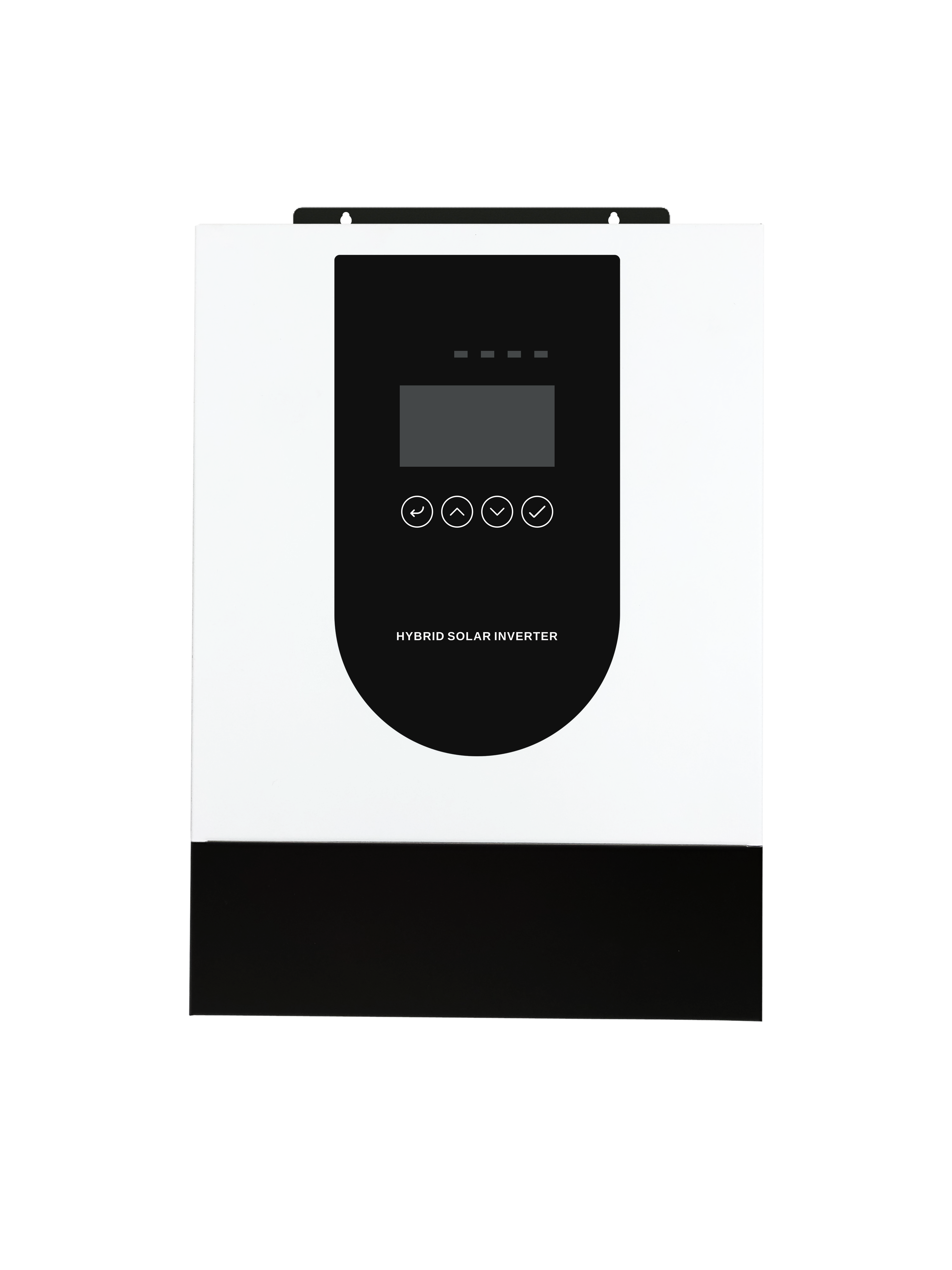
SYP1.5KW12V, the lowest rated model designation in the SYP range and the entry point of the 12 V battery platform.
What one model tells a buyer about the series
The published specification for SYP6.5KW48V is detailed enough to use as a reference sample for the upper part of the range. Rated capacity is 6.5 kW with a surge rating of 12 kVA; output is pure sine wave at 208, 220, 230 or 240 VAC with automatic 50/60 Hz adaptation and a power factor of 1. Transfer time is stated as 10 ms in both normal and UPS mode. Maximum efficiency in battery mode is 94% at 48 VDC, and the overload ladder is 1 minute at 102% to 120% of load and 10 seconds above 120%.
| Parameter | Published value for SYP6.5KW48V |
|---|---|
| Rated capacity / surge power | 6.5 kW / 12 kVA |
| AC input voltage | 208 / 220 / 230 / 240 VAC, L + N + PE |
| AC input range | 90 to 280 VAC ±3 (normal mode); 170 to 280 VAC ±3 (UPS mode) |
| Output waveform / transfer time | Pure sine wave / 10 ms |
| Solar charger | MPPT, 27 A maximum PV input current, 9,000 W maximum PV input power |
| MPPT operating window / PV open-circuit limit | 60 to 450 VDC / 500 VDC |
| Maximum charge current | 120 A PV, 120 A AC, 120 A combined |
| Battery compatibility | Lithium and lead-acid; 48 VDC nominal; float 54 VDC; overcharge protection 61 VDC |
| Interface / monitoring | RS232, RS485, USB; WiFi optional (internal or external) |
| Ingress protection | IP21 |
| Operating temperature | -10°C to 60°C |
| Dimensions / net weight | 410 × 336 × 110 mm / 8.4 kg |
| Maximum operating altitude | 4,000 m, derating above 1,000 m |
Signal two: certification coverage that follows the range
Certification is where long-term supply most often breaks down invisibly. A supplier may hold a valid certificate for the model that was quoted, while a later revision, a different enclosure or a new power class is outside the certificate scope. The buyer discovers this at customs, or at the point where the end user asks for the declaration of conformity.
In the GOTOSOLAR documentation used for this evaluation, certification is stated at series level rather than at single-model level: nearly 50 product series are described as certified to ISO9001:2015, CE, RoHS, EN and IEC standards, and the SYP product data lists a complete CE certificate. Series-level statements are more useful to a programme buyer than single-SKU claims, but they still have to be matched to the exact model and variant being ordered.
| Standard or marking | Status in the documentation reviewed | Procurement implication |
|---|---|---|
| CE | Stated for the product series; complete CE certificate listed for SYP data | Basis for European market placement; confirm the certificate names the ordered model and revision |
| RoHS | Stated for the product series | Restricted-substance documentation for EU and aligned markets |
| ISO 9001:2015 | Stated for the manufacturing system | Evidence of process control rather than product compliance |
| EN / IEC | Stated for the product series | Alignment with international standards; confirm the specific standard numbers on the certificate |
| IEC 62109 | Not a supplier claim in the reviewed data; it is the international standard for PV power converters | A useful reference point when comparing certificates across suppliers |
| UL 1741 | Not listed in the documentation reviewed; it is the primary North American safety standard for grid-connected inverters | North American buyers must confirm model-level UL listing separately before specifying |
Standard descriptions for IEC 62109 and UL 1741 are drawn from published UL Solutions material; supplier certification status is drawn from GOTOSOLAR product documentation and should be verified per ordered model.
For customs and logistics planning, solar inverters are classified under HS code 8504.40 as static converters. That classification applies to the category rather than to any single brand, and it is worth confirming with the freight forwarder when a programme spans several destination markets.
Signal three: component specification as a durability proxy
A bill of materials that names the power-stage devices is a stronger continuity signal than a marketing claim about reliability. The SYP product data specifies IGBT, MOSFET and PCB as the material set. IGBT and MOSFET are the switching devices that carry the conversion load, and PCB quality governs long-term behaviour under thermal cycling and humidity. Naming these classes allows an engineering team to ask follow-up questions about derating, thermal design and supplier qualification, which is not possible when the bill of materials is left generic.
The supplier also documents a quality process that can be audited against the same claim: incoming quality control, in-process quality control, a 100% aging test of 4 to 8 hours, final quality control, out-of-box audit, and burn-in testing for high-power units. Full-function testing is stated for all goods before delivery.
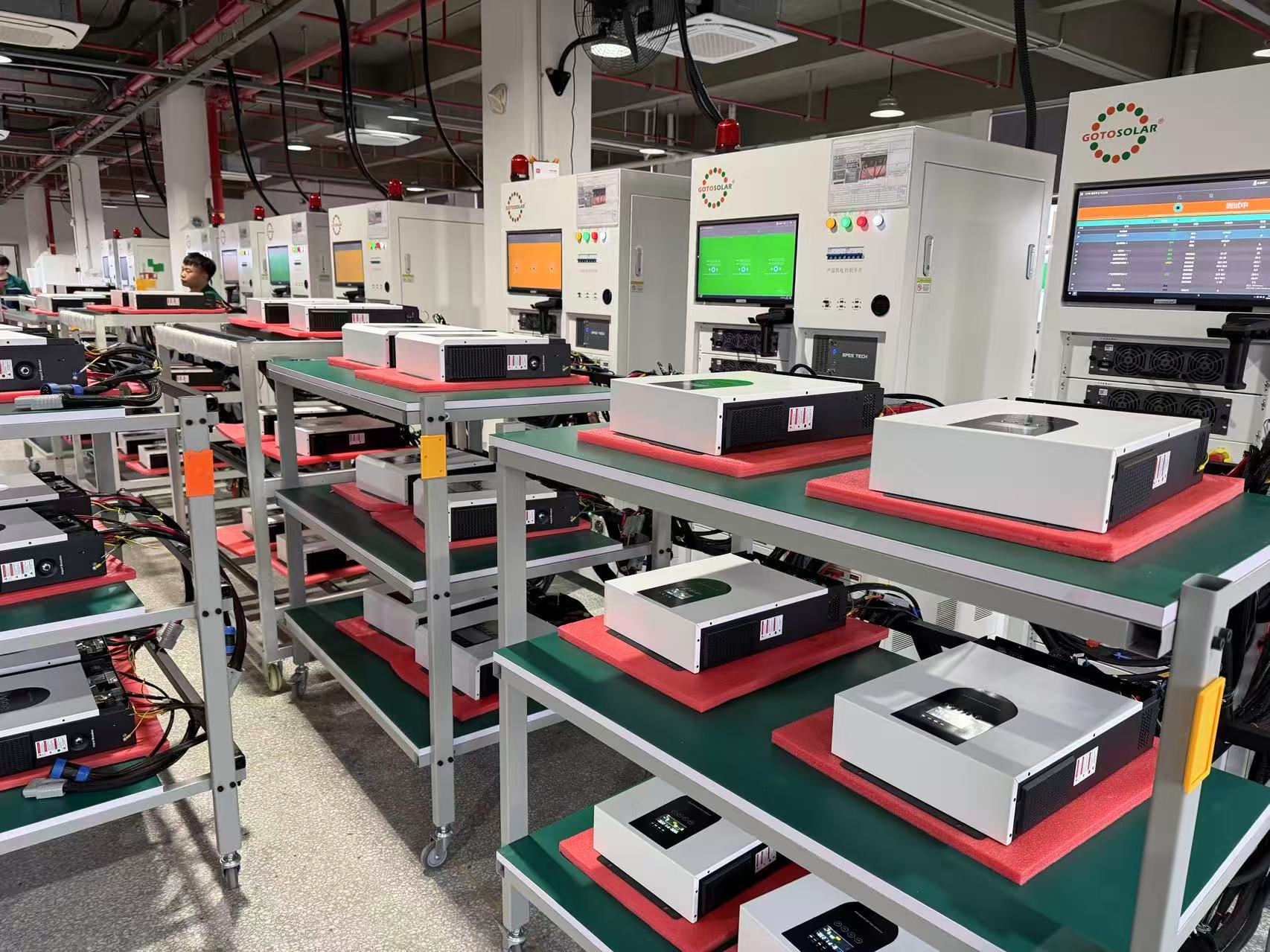
Aging test station: GOTOSOLAR documentation states a 100% aging test of 4 to 8 hours before shipment.
Field evidence that can be checked against the component claim
Component specification is only a proxy; the more persuasive evidence is a deployment record. In the case record provided for this evaluation, a large-scale residential solar storage and regional distribution stocking project shipped two 40HQ containers, approximately 3,000 to 4,000 units depending on packing. The reported result is continuous operation for more than three years with a failure rate below 1%, stable operation at 45°C ambient without derating, and an 80% reduction in fuel cost where diesel generators were displaced.
This kind of record should be read carefully. It is a supplier-reported case rather than an independently audited field study, and its conditions, notably a 45°C ambient, do not cover every climate. What it does provide is a testable reference: a buyer can ask for the installation list, the failure classification method and the warranty claim history behind the number, and compare those answers across candidate suppliers.
Signal four: interface continuity across the range
Communication ports are the least glamorous part of an inverter specification and the most expensive to lose. A monitoring platform, a data logger, a remote diagnostics workflow or a utility reporting requirement is built on a specific physical interface and protocol. If the next model in the range ships without that port, the software investment has to be rebuilt around a gateway.
The SYP6.5KW48V specification lists RS232, RS485 and USB as standard interfaces, with WiFi monitoring available as an option in internal or external form, and an LCD human-machine interface on the unit. The customization scope documented by the supplier extends to communication protocols including RS485 and Modbus, alongside hardware customization of PCB layout, enclosure material and colour, terminal type and display, and software customization of startup logo, interface language and charging algorithms.
- RS232 and RS485 support wired integration with loggers, energy management systems and industrial controllers.
- USB provides a local service path for configuration and firmware work during commissioning.
- Optional WiFi adds remote monitoring without forcing every unit in a mixed fleet onto the same connectivity model.
- Protocol customization means a distributor with an existing monitoring back end can ask for compatibility rather than rebuild.
For a framework agreement, the practical recommendation is to write the interface list into the contract as a controlled item, with a change-notification clause. Interface continuity is only a signal if it is contractually protected; otherwise it is an assumption.
Where the SYP platform fits, and where it does not
The application data for this product family covers residential rooftop solar, commercial solar projects, remote off-grid villages, telecommunication towers and RV or marine mobile power. In these settings the inverter regulates voltage and current from PV panels to charge batteries safely, prevents overcharging and over-discharging, and operates through MPPT tracking with automatic intelligent control.
Several documented capabilities map directly onto those scenarios: pure sine wave output for sensitive loads, dual AC output, generator compatibility, grid feed-in, lithium battery activation, and support for both lithium and lead-acid batteries. The 12 V and 24 V models, SYP1.5KW12V, SYP2.5KW12V and SYP4.0KW24V, sit on the lower-voltage platforms that mobile and small off-grid installations typically use, while the 48 V models cover larger residential and light commercial loads.
The telecommunication base station scenario is documented with a specific field condition: continuous operation in variable weather, ambient temperatures up to 60°C, and 24/7 uninterrupted supply requirements. South Africa appears repeatedly in the scenario data as a representative market for this pattern, which is consistent with the supplier's stated export focus on Africa and the Middle East.
What the market data suggests about range breadth
Third-party market research places the global solar hybrid inverter market at USD 10.7 billion in 2024, according to Grand View Research, while the residential segment alone was valued at USD 4.55 billion in 2023 by Markets and Data. Grand View Research also reports that three-phase hybrid inverters held a revenue share of more than 61.3% of the global market in 2024.
Two conclusions follow for procurement. First, the residential and small commercial segment is large enough that a single-phase range is a commercially rational product strategy rather than a limitation to be apologised for. Second, because three-phase configurations dominate revenue, a supplier's range breadth across single-phase and three-phase topologies is a genuine risk indicator for any programme that may later move into three-phase loads.
The SYP range, as documented here, is a single-phase, off-grid hybrid platform with grid feed-in capability. Buyers whose projects include three-phase industrial loads should treat the SYP series as a partial fit and plan a separate product line for those sites, rather than assuming the range extends further than it does.
Comparison with a separated MPPT, inverter and transfer-switch architecture
The conventional alternative to a hybrid inverter is a separated architecture: a standalone MPPT charge controller, a separate inverter, and an external transfer switch or changeover contactor. That architecture has real advantages, and any honest evaluation should state them.
| Consideration | Separated MPPT + inverter + transfer switch | Integrated hybrid inverter (SYP platform) |
|---|---|---|
| Fault isolation | A failed module can be replaced on its own | A power-stage fault affects the whole unit |
| Component count and wiring | More devices, more terminations, more commissioning steps | Fewer devices; transfer handled internally, stated at 10 ms |
| Upgrade path | Individual stages can be upsized independently | Upgrade usually means replacing the unit |
| Footprint | Several enclosures and interconnecting cabling | One enclosure, 410 × 336 × 110 mm on SYP6.5KW48V |
| Environmental requirement | Depends on the selected components | IP21 on the documented SYP model, which means indoor or sheltered installation |
The boundaries of the SYP platform are therefore specific and worth stating plainly. The documented ingress protection is IP21, which suits indoor installation or a protected outdoor position under an eave, not direct rain exposure; buyers who need an exposed outdoor installation should be looking at a different protection class rather than assuming equivalence. The platform is single-phase, with an AC input range of 90 to 280 VAC in normal mode and 170 to 280 VAC in UPS mode, which will not suit every grid condition. Maximum operating altitude is 4,000 m with derating above 1,000 m, and the operating window is -10°C to 60°C, so high-altitude and extreme-cold deployments need a separate thermal review. And because the documentation reviewed for this evaluation does not list UL 1741, buyers targeting North America must confirm model-level listing before design freeze.
Procurement checklist before a framework agreement
The four signals translate into a short list of items that can be settled before signature rather than after the first shipment.
| Checklist item | What to obtain |
|---|---|
| Range map | A written list of every active model designation, with the battery platform and rated class for each, and a statement of which models are planned for discontinuation |
| Certificate set | CE and RoHS declarations naming the ordered models, plus confirmation of the specific EN and IEC standard numbers referenced |
| Bill of materials | Confirmation of the power-stage device classes (IGBT, MOSFET) and PCB specification, with the qualification test applied to each |
| Interface schedule | Ports and protocols per model, the WiFi monitoring option, and a change-notification clause covering future revisions |
| Capacity and lead time | Stated monthly capacity, sample lead time of 7 to 10 days, 15 to 20 days for orders below 500 units, and 30 to 45 days for bulk orders |
| Service commitment | Warranty term, the 1% to 2% free spare-parts allocation, and the escalation path to online technical support |
Future outlook
Two procurement trends are already visible in how buyers write specifications. The first is that certification is moving from a checkbox into a contract schedule, with model-level declarations and change-notification obligations attached. The second is that interface continuity is being treated as part of the technical specification rather than as an afterthought in the monitoring annex.
For suppliers, this raises the bar in a predictable way: a range has to be documented as a range, with shared platforms, shared certificates and shared interfaces, because that is what a distributor or an EPC contractor needs in order to stock and support it. For buyers, the implication is that the evaluation work should be done once, at qualification stage, and then protected by contract terms rather than revisited at every purchase order.
A supplier that publishes six model designations from 1.5 kW to 12 kW, states certification at series level, names IGBT, MOSFET and PCB, and documents RS232, RS485, USB and optional WiFi is giving procurement teams something more useful than a performance claim: a set of facts that can be checked, compared and written into an agreement.
Frequently asked questions
Can one supplier cover both small off-grid installations and a 12 kW hybrid project?
The GOTOSOLAR SYP range is documented with six model designations: SYP1.5KW12V, SYP2.5KW12V, SYP4.0KW24V, SYP6.5KW48V, SYP12.0KW48V and SYP12.0KW48V/P. The designations span 12 V, 24 V and 48 V battery platforms and a rated class from 1.5 kW to 12 kW, so a programme can qualify several project sizes within one product family. Whether a specific model suits a specific load remains a separate electrical calculation based on the published specification.
What certifications are stated for the SYP hybrid inverter range?
The supplier documentation states that nearly 50 product series are certified to ISO9001:2015, CE, RoHS, EN and IEC standards, and the SYP product data lists a complete CE certificate. IEC 62109 is the international standard for PV power converters and UL 1741 is the primary North American safety standard for grid-connected inverters, so buyers targeting those jurisdictions should confirm model-level listings separately rather than inferring them from a series-level statement.
Which components are specified, and why does that matter for long-term supply?
The SYP product data specifies IGBT, MOSFET and PCB as the material set. The power-stage devices determine conversion behaviour and thermal margin, and the PCB governs long-term behaviour under thermal cycling and humidity. Naming these classes lets an engineering team ask specific questions about derating and qualification testing, which is not possible when the bill of materials is left generic.
Which interfaces support monitoring and system integration?
The documented interface set for SYP6.5KW48V is RS232, RS485 and USB, with an LCD human-machine interface on the unit and WiFi monitoring available as an option in internal or external form. The supplier also documents customization of communication protocols including RS485 and Modbus, which allows a distributor with an existing monitoring platform to request compatibility rather than rebuild it.
How can a buyer test claims about supply continuity?
Several capacity and service figures are stated in the documentation: hybrid inverter daily production capacity above 2,000 units, monthly capacity of 60,000 units for standard models and 20,000 units for customized models, sample lead time of 7 to 10 days, 15 to 20 days for orders below 500 units, and 30 to 45 days for bulk orders. Quality control is described as IQC, IPQC, a 100% aging test of 4 to 8 hours, FQC, out-of-box audit and burn-in for high-power units, with 1% to 2% free spare parts included and a warranty of 1 to 3 years. A buyer should request the records behind each figure before relying on it.
What are the operating boundaries of the SYP6.5KW48V?
The documented ingress protection is IP21, which suits indoor or sheltered installation rather than direct rain exposure. The operating window is -10°C to 60°C with relative humidity of 5% to 95% non-condensing, and maximum operating altitude is 4,000 m with derating above 1,000 m. AC input is single-phase at 208, 220, 230 or 240 VAC, with a normal-mode range of 90 to 280 VAC and a UPS-mode range of 170 to 280 VAC.
Is there field evidence of long-term reliability?
The case record provided for this evaluation describes a large-scale residential solar storage and regional distribution stocking project that shipped two 40HQ containers, approximately 3,000 to 4,000 units, with continuous operation for more than three years and a reported failure rate below 1%. The same record reports stable operation at 45°C ambient without derating and an 80% reduction in fuel cost where diesel generators were displaced. The figure is supplier-reported and should be validated against installation lists and warranty claim history during qualification.
Reference document
The full GOTOSOLAR inverter catalogue, including SYP model specifications, is available for public download: GOTOSOLAR Inverter Catalogue 2025 (PDF).
Tem questões ou precisa de mais detalhes?
Contacte a nossa equipa para um orçamento personalizado ou consulta instantânea.
Solicitar orçamento
Preencha o formulário abaixo e a nossa equipa entrará em contacto com uma proposta personalizada.
Chat direto do WhatsApp
Prefere conversar em tempo real? Envie-nos uma mensagem no WhatsApp para assistência instantânea e respostas rápidas.
- Obter orçamento personalizado
- Partilhar fotos ou documentos
- Discuta as suas necessidades diretamente
Geralmente responde em 5–30 minutos durante o horário de expediente.