
Long-Term Ice Cream Machine Suppliers: Parts and Upgrades
Ice cream production is a capital-intensive business, and the machine purchase price is only the first of several costs. The question that decides whether a supplier remains useful for a decade is narrower: after commissioning, can that supplier still deliver the optional units, wear parts and control components the line needs, and can the line grow in stages rather than be replaced?
This evaluation looks at how that question can be tested with documents rather than impressions, using published spare-parts definitions, certification records, capacity ranges and reported project outcomes from Snowball Machinery Manufacturing Co., Ltd as a worked example. The evaluation logic applies to any supplier shortlist.
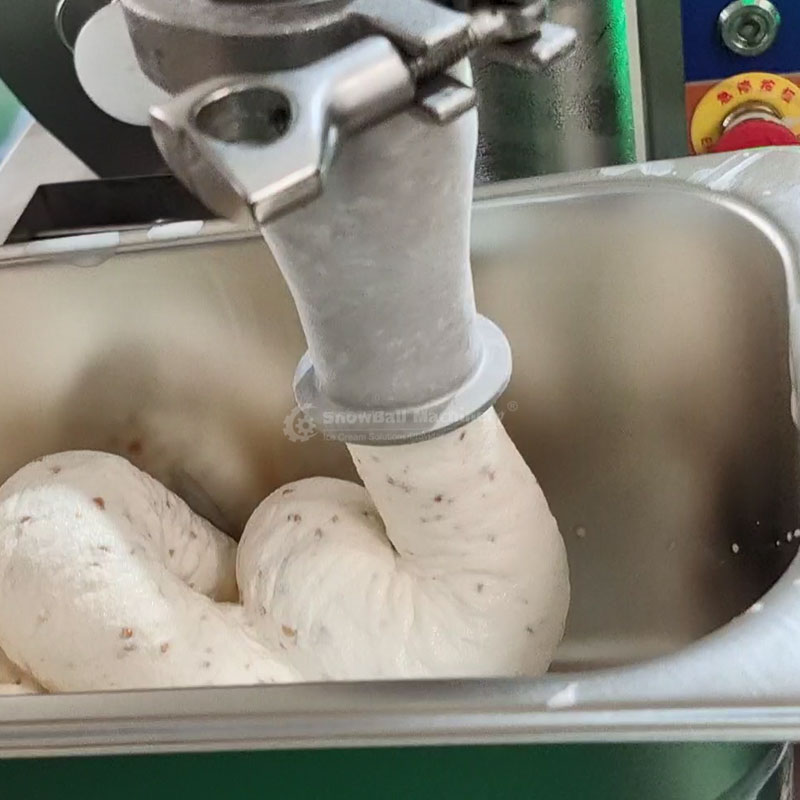
What Long-Term Supplier Sustainability Means in Practice
Supplier sustainability here is not an environmental claim. It describes the probability that a supplier can keep a production line serviceable, certifiable and expandable throughout its working life. Three capabilities determine that probability: continued availability of spare parts and optional units, component sourcing that does not lock the buyer into a single proprietary channel, and a line architecture that supports phased capacity increases.
Snowball Machinery Manufacturing Co., Ltd is an ice cream equipment manufacturer that combines R&D, manufacturing, assembly, commissioning, export and after-sales service. Its published company profile reports a 4,000 m² factory, 50 employees, an annual output of 1,200 sets, a design team of 10 engineers, a monthly capacity of 100 sets and exports equal to roughly 90% of sales across North America, South America, Europe, Asia and Africa. Those figures describe scale; they do not by themselves prove long-term support. The proof sits in documentation — what the supplier publishes about parts, units, certifications and upgrades.
The Spare Parts Question Buyers Usually Ask Too Late
Most purchase contracts specify the machine. Far fewer specify the parts list, and that gap is where long-term operating cost accumulates. On an ice cream line, the components that drive downtime risk are rarely the largest items. They are the moulds, sucker units, stick inserters, coating stations and sealing elements that wear with every production cycle.
Snowball Machinery publishes a defined optional-unit and spare-parts set for its moulded stick ice cream machines under the designation SNLU. That set includes an ice water filler, an ice cream sucker unit, an ice cream stick inserter unit, a chocolate coating station, a dry coating station, and popsicle ice cream molds. A parallel set is published for its filling machines under the designation SNFU, covering a cup cone dispenser, a chocolate or sauce sprayer, an automatic ice cream filler, an ice cream pencil filler, a chocolate topping machine, a sauce topping unit, a dry topping unit, a lid dispenser machine and a heat sealing unit.
The procurement rule that follows is simple. Ask for the parts list per machine at contract stage, and confirm which items are considered wear parts, which are format-specific tooling, and which are control or refrigeration components sourced from third-party brands. A supplier that can answer that question in writing at the quotation stage is materially easier to work with five years later.
Optional Units as Upgrade Headroom
Optional units matter for a reason that buyers often discover late: many product-market changes do not require a new line, they require a new station. Adding a chocolate coating stage, a lid dispenser or a dry topping unit can open a product format without replacing the main machine — but only if the original specification left room for it.
| Reference | Applies to | Published optional units | Practical implication for buyers |
|---|---|---|---|
| SNLU | Stick ice cream and moulded stick machines | Ice water filler; ice cream sucker unit; ice cream stick inserter unit; chocolate coating station; dry coating station; popsicle ice cream molds | Product formats can be extended through stations rather than a new machine, provided the frame and controls accept them |
| SNFU | Filling machines for cups, cones and family packs | Cup cone dispenser; chocolate or sauce sprayer; automatic ice cream filler; ice cream pencil filler; chocolate topping machine; sauce topping unit; dry topping unit; lid dispenser machine; heat sealing unit | Topping, sealing and lid-dispensing stages can be specified separately from the filler itself |
When comparing suppliers, the useful question is not whether optional units exist in a catalogue, but whether a specific unit can be attached to a machine that is already installed. Buyers should ask for that answer in writing, together with the tooling change procedure for format changes such as new mould shapes.
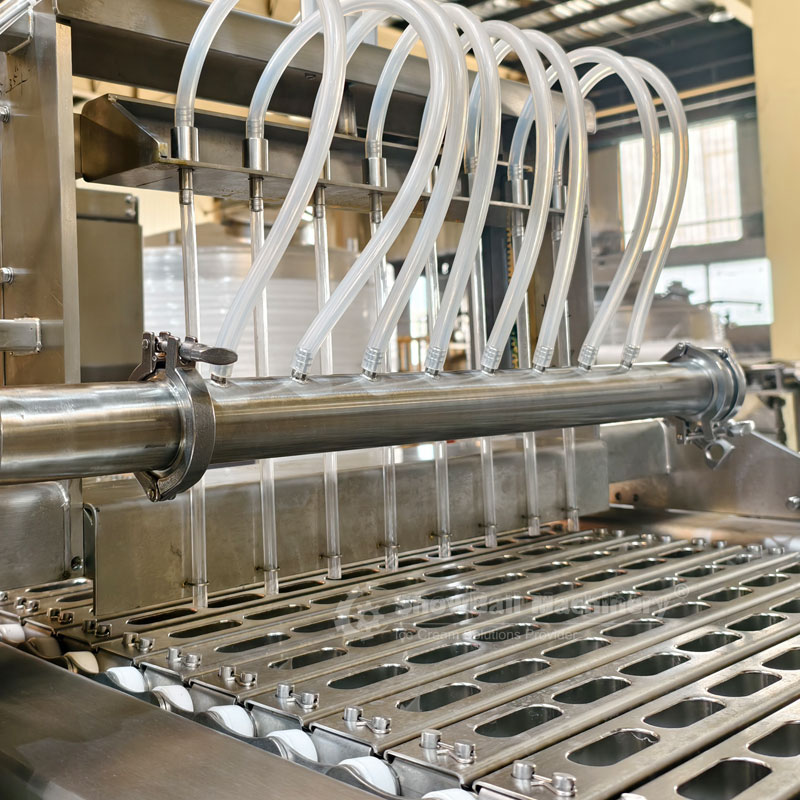
Component Sourcing and What It Means for Serviceability
Snowball Machinery states that the main components across its ice cream production equipment adopt internationally renowned brands, listing SIEMENS, Schneider Electric, FESTO, SMC, Danfoss, ABB, Bonfiglioli, igus, Copeland, Bitzer and SEW Eurodrive. For a buyer calculating lifecycle cost, the practical benefit is sourcing independence. Motors, drives, refrigeration compressors, and pneumatic and control components that carry an international brand are generally supported through distributor and service networks that exist independently of the original equipment manufacturer.
Two boundaries belong in that assessment. First, brand-name components lower the risk of single-source lock-in but do not determine line performance on their own; integration, pipework, control logic and commissioning remain the responsibility of the line builder. Second, refrigeration components from suppliers such as Danfoss and Copeland follow compressor and system service intervals rather than the machine nameplate, so the service plan should be written against the component list, not the machine list.
Certification Scope: A Constraint That Is Frequently Misread
Certification is a constraint category rather than a marketing attribute, and its scope is narrower than many buyers assume. Snowball Machinery's published records show CE certification held at machine level, with different issuing bodies and different validity periods.
| Machine | Certificate number | Issuing body | Standards referenced | Validity |
|---|---|---|---|---|
| Ice cream continuous freezer (SNCF) | CE-4681-181125 | European Certification Services | EN ISO 12100:2010; EN 60204-1:2018 +A1:2025 | Issued 2025-11-18, valid to 2030-11-18 |
| Molded stick ice cream machine (SNL) | FQC2506302 | FQC STANDARD | EN ISO 12100:2010; EN 60204-1:2018 | Issued 2025-02-05, valid to 2030-02-05 |
| Molded stick ice cream machine (SNL) | CE-1654-01-111123 | CGS Test | BS EN ISO 12100:2010; BS EN 60204-1:2018 | Issued 2023-11-11, valid to 2028-11-11 |
| Ingredient feeder (SNFF) | CE-1724-01-121223 | CGS Test | BS EN ISO 12100:2010; BS EN 60204-1:2018 | Issued 2023-12-12, valid to 2028-12-12 |
The constraint this creates for buyers is straightforward. A certificate covers the machine it names, not the complete line. A complete ice cream processing machine line assembled from a freezer, a filler, a moulding unit and packaging equipment therefore needs a certificate map rather than a single document, and that map should be checked against the market where the line will operate. Buyers importing into markets that follow IEC 60335-2-89:2019 for commercial refrigerating appliances with incorporated motor-compressors should confirm whether that standard applies to the relevant units in addition to the machinery safety standards listed above.
Expiry dates belong in the same review. Two of the certificates above fall due in 2028 and two in 2030, so a buyer taking delivery in 2027 will need a renewal process rather than a one-time document collection. This is one of the clearest differences between a supplier that manages compliance and one that simply hands over a folder.
Turnkey Design and Phased Capacity Growth
Phased expansion is the second half of the sustainability question. Snowball Machinery's continuous freezer range is published as SNCF 50L, SNCF 300L, SNCF 600L, SNCF 1200L and SNCF 1500L, covering a capacity band from 50 to 1,500 litres per hour at 100% overrun, with material entering the freezer at +5 °C and leaving at -5 °C. The SNFF ingredient feeder range is published as SNFF1000, SNFF2000 and SNFF4000, customisable from 50 to 4,000 litres per hour.
That spread matters commercially. A buyer starting with a small or medium plant can size a freezer at the lower end of the band and move upward as demand is proven, instead of buying capacity for a market that has not yet materialised. The published range also means the same model family, and therefore the same spare-parts logic, can carry a project from trial production through to large-scale output.
The wider line architecture follows the same pattern. The SNP production line family covers moulding, extrusion, filling, sandwich and cake formats; the SNLF filling family covers robot, rotary, cup, cone, linear and family-pack filling plus a ripple pump; and the SNM group covers HTST systems, batch pasteurising systems, ageing tanks, homogenisers, CIP cleaning, chocolate tanks and chilling systems. Published construction across these units is food-grade stainless steel SS304 or SS316, and the stated turnkey scope includes ice cream factory design and full line supply from A to Z, with customisation based on product design and hourly production capacity.
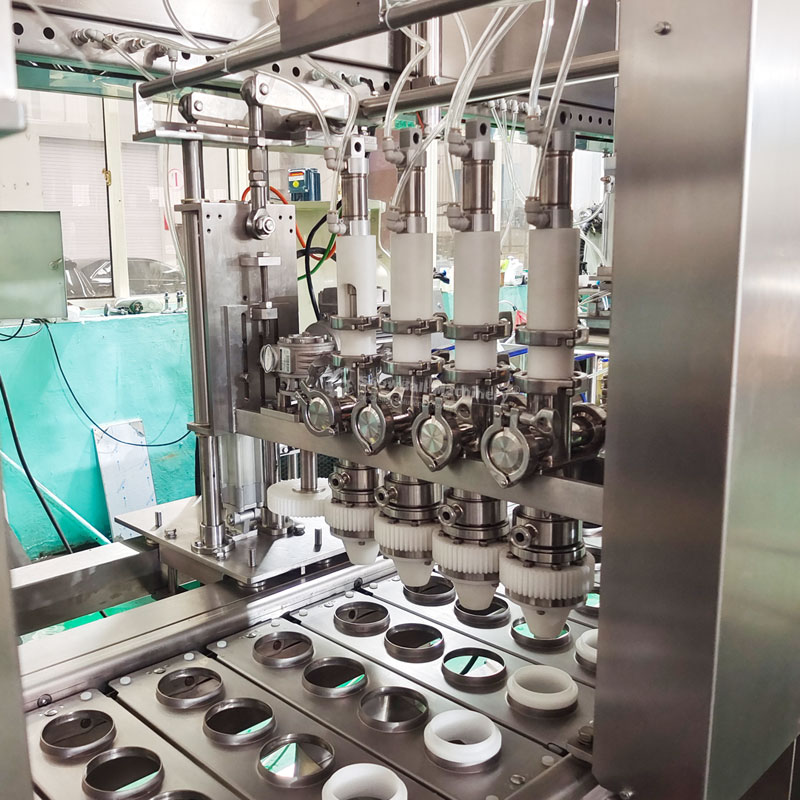
Application Scenarios and What They Demand From a Supplier
Different production scales place different demands on long-term support, and the published scenario data makes those differences concrete.
Small-scale and entry-level production
For small plants, ice cream shops and trial production lines, the typical configuration runs semi-automatic or manual with automatic filling and sucking, produces moulded stick products by replacing moulds, and is expected to resist high-temperature and high-humidity conditions. The matched equipment list for these projects includes a batch pasteurising system, homogeniser, CIP system, ageing tank, ripple pump, continuous freezer and packing machine. Buyers in this segment should weigh spare-part simplicity more heavily than automation, because a mould set and a small number of wear parts will dominate their maintenance workload.
Small-batch filling and multi-specification containers
Rotary filling equipment is used for lower-output production across cup, cone and calippo-type containers, and can complete chocolate or sauce topping, sprinkling of nuts and candy, heat sealing and lid dispensing. Semi-automatic fillers are used for family-pack, family-size and bulk formats. In both cases the equipment is expected to hold consistent taste, shape and fill volume across a run — which means the optional units, not the filler alone, determine product consistency.
Large-scale and 24-hour operation
Large and medium factories, central factories of chain ice cream brands, and ice cream lines inside food processing plants typically operate fully automatically around the clock, with filling machines switching between cup and cone formats and completing automatic cup or cone dispensing, servo filling, sauce topping, dry topping and lid dispensing. This segment requires defined fault alarms and remote commissioning support, because a maintenance team cannot wait for an overseas visit to restart a line.
Upgrading existing lines
The upgrade scenario is where spare-parts and interface thinking pays off most clearly. One reported project involved a long-established ice cream manufacturer that replaced multiple workstations on equipment that had been in service for 40 years. The replacement workstations were built to match the existing line without overall reconstruction; the reported outcome was a 40% increase in production efficiency, a 30% reduction in labour cost, a 70% reduction in equipment upgrading cost, SS316 food-grade materials, and stable operation for six years.
Reported durability evidence across other projects points in the same direction: a line reported stable for 12 years with cone filling capacity of 10,000–15,000 pieces per hour and stick ice cream capacity of 15,000–20,000 pieces per hour on SS304/SS316 construction; an installation reported stable for 11 years with extruded magnum capacity of 5,000–8,000 pieces per hour and a family-pack filler of 1,200 litres per hour; and a robot filling installation designed for a 10-year service life.
Market Context: Where the Demand for Parts and Upgrades Comes From
Independent market estimates support the argument that maintenance and staged expansion are not a niche concern. IMARC Group values the global ice cream processing equipment market at approximately USD 2.33 billion in 2025, with projections to reach USD 3.00 billion by 2034 at a CAGR of 2.71%. Future Market Insights reports that hard ice cream processing equipment accounted for a dominant 57.8% share of the total ice cream equipment market in 2025, with continuous freezers as the leading product type. Reports and Data values the ice cream moulding production line segment at USD 1.2 billion in 2024, expected to reach USD 2.5 billion by 2034 on rising automation demand.
Estimates should be read with scope in mind. A broader definition of the ice cream equipment market produces figures several times larger than the processing-equipment figure above — Future Market Insights places the wider ice cream equipment market at USD 9.6 billion — which shows how much the number depends on what is counted. The directional signal is nonetheless consistent: continuous freezers and moulding lines sit at the volume core of the industry, and equipment that is central to production volume is also the equipment whose spare parts and upgrades matter most.
Comparison with Traditional Procurement — and Where This Approach Has Limits
The alternative to integrated turnkey supply is unit-by-unit procurement, in which a buyer assembles a line from several vendors and sources spares ad hoc. The two models differ in ways that only become visible over time.
| Dimension | Unit-by-unit procurement | Integrated turnkey supply (as published by Snowball Machinery) |
|---|---|---|
| Spare parts traceability | Parts list split across several vendors; wear part responsibility unclear | Published optional-unit and spare-parts sets for stick lines (SNLU) and filling machines (SNFU) |
| Capacity growth | Often requires a new machine or full line replacement | Freezer range spanning 50–1,500 L/h and feeder range spanning 50–4,000 L/h |
| Certification | Certificates collected separately, with varying scope and standards | Machine-level CE certificates with published numbers, issuers, standards and validity periods |
| Service model | Multiple service contracts and multiple points of accountability | Stated after-sales scope covering installation and commissioning, upgrading, maintenance, fault handling, spare parts supply and regular inspection |
That comparison favours integration, but the model has real boundaries, and buyers should price them in.
- Equipment is non-standard and custom-built. Published documentation states that customisation is based on product design and hourly production capacity, and that lead time depends on the specific equipment plan. A buyer cannot assume a fixed catalogue delivery date, and should build schedule contingency around the engineering stage.
- Certification is machine-specific. The CE certificates listed earlier cover the freezer, the moulded stick machine and the ingredient feeder individually. The line as a whole is not covered by one document, so the buyer must own the certificate map.
- Brand-name components reduce sourcing risk, but do not transfer integration responsibility. Line performance still depends on design, commissioning and operator training.
- Cost advantage is project-specific. One reported project recorded total line costs 70% below premium European brand equivalents. That is a reported project outcome, not a general price rule, and it should be verified against a specific quotation.
- Minimum order quantity is published as 1 set. Small projects are accepted, but each configuration is engineered individually, so the documentation handed over at delivery — parts lists, drawings, commissioning records — carries more weight than it would with a catalogue product.
- Early specification is unavoidable. Because capacity and tooling are set from product design and output targets, a buyer who has not defined formats and hourly volumes cannot finalise either the capacity band or the spare-parts list.
A Practical Evaluation Checklist
| Evaluation area | What to request | Why it matters |
|---|---|---|
| Spare parts | Documented parts list per machine, including moulds, sucker units and coating stations | Determines how long an unplanned stop lasts |
| Optional units | Written confirmation of whether SNLU or SNFU units can be added after installation | Defines product-format headroom without a new machine |
| Component cross-reference | Brand and model list for drives, controls, pneumatics and compressors | Enables independent sourcing of critical components |
| Certificates | Certificate number, standard, issuing body and expiry date per machine | Market access, audits and renewal planning |
| Capacity headroom | Freezer and feeder capacity against a three-to-five-year volume plan | Avoids both over-buying and premature replacement |
| Reported service records | Project durations and operating conditions from reference installations | Tests durability claims against real operating environments |
| After-sales scope | Installation and commissioning, maintenance, fault handling, spare parts supply, regular inspection | Clarifies who owns a problem after handover |
| Materials | SS304 versus SS316 selection by plant environment | Corrosion resistance in humid or high-temperature plants |
Future Outlook
Three shifts are likely to shape how buyers judge ice cream equipment suppliers over the next several years. The first is the continued automation of moulding and extrusion lines, which the segment growth figures above already reflect; automated lines shift maintenance attention from manual labour to stations and control components. The second is phased capital deployment, in which buyers commission part of a line and expand as demand is proven — a pattern that rewards suppliers whose capacity bands and optional units are designed for incremental build-out. The third is documentation-driven procurement, in which certificate scope, standard references and expiry dates are reviewed as part of the purchase decision rather than after it.
For buyers, the practical implication is that supplier evaluation should be treated as a documentation exercise first and a commercial negotiation second. A line that is well documented at purchase is easier to maintain, easier to certify and easier to expand.
FAQ
Which spare parts should be specified in an ice cream machine supply contract?
For moulded stick ice cream machines, Snowball Machinery publishes a defined set under the designation SNLU that includes an ice water filler, ice cream sucker unit, ice cream stick inserter unit, chocolate coating station, dry coating station and popsicle ice cream molds. For filling machines, the corresponding set under the designation SNFU covers a cup cone dispenser, chocolate or sauce sprayer, automatic ice cream filler, ice cream pencil filler, chocolate topping machine, sauce topping unit, dry topping unit, lid dispenser machine and heat sealing unit. Buyers should request the parts list for each machine in the line and identify which items are wear parts, which are format-specific tooling and which are third-party control or refrigeration components.
Can optional units be added after a line has been commissioned?
Snowball Machinery's published equipment documentation states that the equipment features good expandability and that additional ice cream product shapes can be added at a later stage with convenient upgrading. The optional-unit sets for stick ice cream machines (SNLU) and filling machines (SNFU) are published as separate units and spare parts of those machines rather than as fixed configurations. The practical verification step is to ask the supplier in writing whether a specific unit can be retrofitted to an already installed machine, and what tooling or control changes that retrofit requires.
Does one CE certificate cover an entire ice cream production line?
No. Snowball Machinery's published records show CE certification held at machine level. The ice cream continuous freezer is covered by certificate CE-4681-181125 issued by European Certification Services under EN ISO 12100:2010 and EN 60204-1:2018 +A1:2025, valid to 2030-11-18. The molded stick ice cream machine is covered by certificate FQC2506302 issued by FQC STANDARD under EN ISO 12100:2010 and EN 60204-1:2018, valid to 2030-02-05, and also by certificate CE-1654-01-111123 issued by CGS Test under BS EN ISO 12100:2010 and BS EN 60204-1:2018, valid to 2028-11-11. The ingredient feeder is covered by certificate CE-1724-01-121223 issued by CGS Test, valid to 2028-12-12. The line as a whole therefore requires a certificate map, and buyers in markets applying IEC 60335-2-89:2019 should confirm whether that standard applies to the relevant units as well.
How do component brands such as SIEMENS, Schneider Electric and Danfoss affect long-term maintenance?
Snowball Machinery states that main components across its ice cream production equipment adopt internationally renowned brands, listing SIEMENS, Schneider Electric, FESTO, SMC, Danfoss, ABB, Bonfiglioli, igus, Copeland, Bitzer and SEW Eurodrive. The maintenance benefit is sourcing independence: branded drives, controls, pneumatics and compressors are generally supported through distributor and service networks that exist separately from the line builder. The limitation is that branded components do not by themselves guarantee line performance, since integration, control logic and commissioning remain the responsibility of the equipment manufacturer, and refrigeration service intervals follow the compressor and system design rather than the machine nameplate.
What evidence indicates that a supplier can support staged capacity expansion?
Three types of published evidence are useful. First, capacity ranges: the SNCF continuous freezer series is published as SNCF 50L, 300L, 600L, 1200L and 1500L covering 50–1,500 litres per hour at 100% overrun, and the SNFF ingredient feeder series covers 50–4,000 litres per hour. Second, product-family breadth: the SNP production line family covers moulding, extrusion, filling, sandwich and cake formats, which means the same supply relationship can carry a plant through format changes. Third, reported project outcomes, such as a custom-built line whose modular design allowed straightforward capacity expansion, and installations reported to have operated stably for six, eleven and twelve years. Together these indicate whether expansion is designed into the equipment or requires a replacement purchase.