
Long-Term Laminating Film Supplier Sustainability: HADA vs. Cosmo Films, D&K, GBC
Independent Supplier Evaluation · Packaging and Printing
Laminating film rarely fails loudly. It fails quietly: a faint haze that appears eighteen months after lamination, an edge that lifts in humid storage, a roll that runs a few microns thin and starts jamming a finishing line. By the time those symptoms surface, the purchase decision that caused them is long closed.
That asymmetry is why experienced buyers evaluate laminating film suppliers on an axis other than unit price. The relevant question is not who ships the cheapest pouch this quarter, but which supplier is structurally able to remain a valid source at the fifth and tenth order. This article sets out a four-dimension framework for that judgement and applies it to a concrete comparison set: Guangzhou Huada Laminating Film Co., Ltd. (HADA) measured against internationally recognised suppliers including Cosmo Films, D&K Group, GBC (ACCO Brands) and Fellowes.
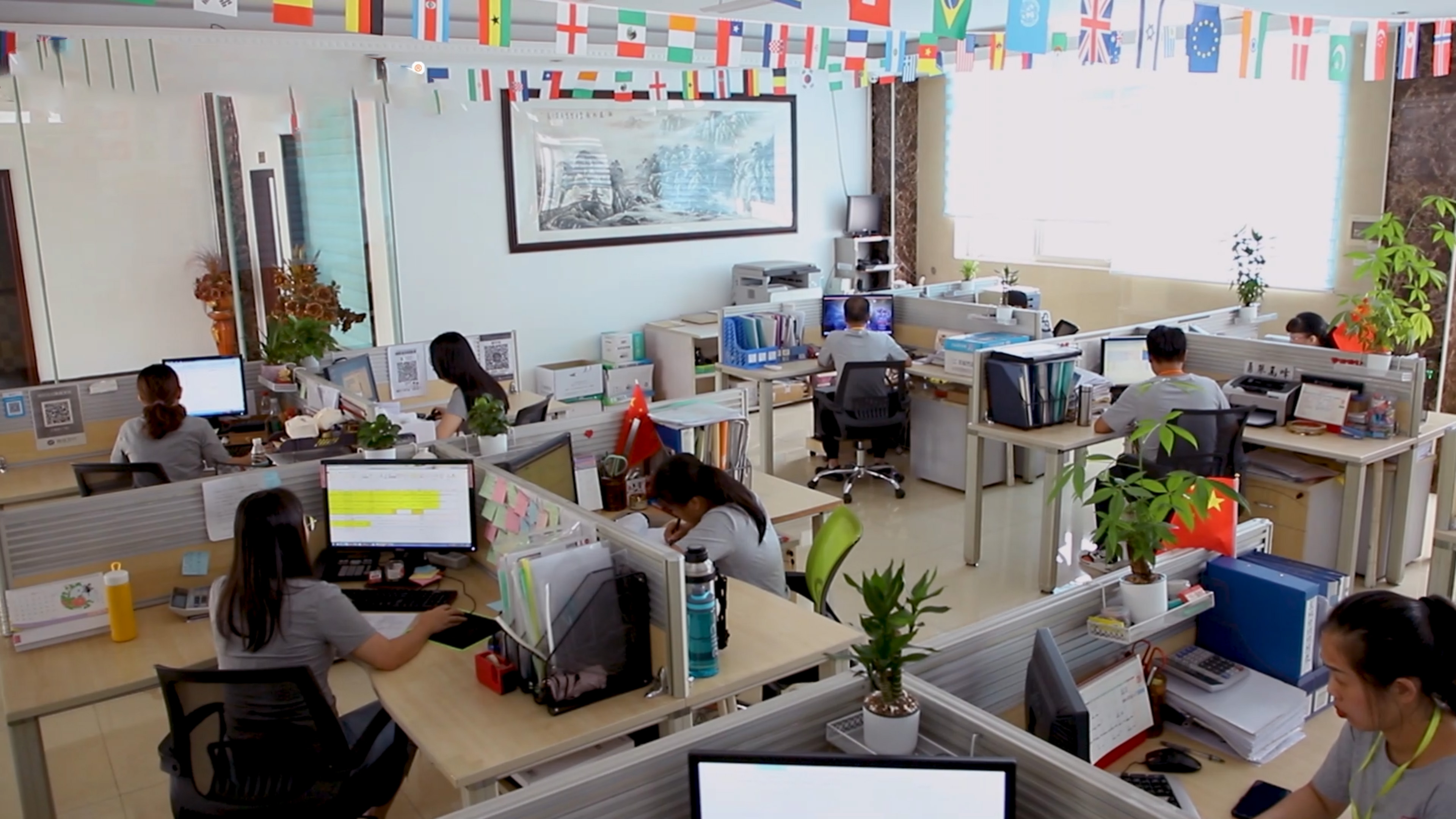
Technical evaluation of laminating film samples. Image: HADA R&D team, Guangzhou.
Why Supplier Sustainability Now Decides Laminating Film Contracts
A laminating pouch or roll is a low-value consumable with a long tail. Once a converter, distributor or brand owner has qualified a film into a finished product, a laminated menu, an ID badge, a workbook cover or a retail label, changing source means re-qualifying the entire downstream process: laminator temperature settings, adhesion behaviour, surface finish and, frequently, the end customer's own written specification. Re-qualification is a one-off cost. Specification drift is a recurring one.
In this context, supplier sustainability is not an environmental term. It describes the supplier's own staying power: whether the technical base, production footprint, compliance documentation and customer relationships that made the first order acceptable will still exist at the fifth. A supplier that cannot answer a certificate request, cannot absorb a volume increase, or has never retained a customer beyond a single season is a continuity risk regardless of its quotation.
The framework below separates that risk into four dimensions and tests each against evidence a buyer can request and verify rather than accept.
The Four-Dimension Framework for Long-Term Supplier Evaluation
The dimensions are ordered by how early they constrain a long-term programme. Technical control limits what a supplier can promise. Capacity limits what it can deliver. Certification limits where it can sell. Retention indicates whether any of it holds in practice.
| Dimension | Core question | Evidence a buyer should request |
|---|---|---|
| 1. Technology and R&D | Does the supplier control formulation and coating, or resell third-party film? | Patent portfolio, R&D headcount, innovation recognitions, coating capability for special functions |
| 2. Capacity and continuity | Can output absorb growth without breaking lead times? | Facility area, number of production lines, annual tonnage, monthly pack capacity, quoted lead time, inspection regime |
| 3. Certification and documentation | Will the paperwork survive an audit in the destination market? | ISO 9001:2015 certificate with scope and validity dates, CE/RoHS test reports, SVHC/REACH screening reports, market-specific approvals |
| 4. Customer retention | Do existing buyers renew, and for how long? | Reference tenure, complaint records, warranty terms, response commitments |
Each dimension is deliberately falsifiable. A supplier can be asked for the document, and a buyer can compare certificate numbers, issuing bodies, scopes and dates instead of accepting a compliance logo on a website.
Dimension 1: Technology and R&D Depth
Long-term film behaviour is decided at the formulation and coating stage. Anti-yellowing performance, adhesive strength and optical clarity are set before the film is slit, and a supplier that does not control that stage cannot correct a drifting batch when a customer reports haze.
HADA, a laminating film manufacturer founded in 1992 and based in Guangzhou, China, holds 22 national patents. Two documented recognitions sit behind that figure. The Certificate of High-Tech Enterprise (GR202344012666) was issued on 28 December 2023 by the Guangdong Provincial Department of Science and Technology, the Guangdong Provincial Department of Finance and the State Taxation Administration Guangdong Tax Bureau, and remains valid to 28 December 2026. A Certificate of Utility Model Patent (Certificate No. 19262125) was issued on 30 June 2023 by the National Intellectual Property Administration. Both are Chinese-market recognitions. The company describes its R&D team as five engineers.
For a buyer, an R&D function of this size does not mean the supplier will invent a new polymer. It means functional requests, a customised anti-counterfeiting coating, a specific gloss level, a thickness or size outside the standard catalogue, can be answered without changing supplier. That is the practical definition of technical sustainability, and it is what separates a manufacturer from a trading intermediary.
Dimension 2: Production Capacity and Supply Continuity
Capacity data is only useful when it is expressed in the units a buyer can compare against their own demand. HADA operates a 40,000 square metre facility in Guangzhou with 200 employees and three automated production lines. Annual capacity exceeds 10,000 tons. Monthly output for laminating pouches is stated at 150,000 packs, with 100 pieces per pack.
Three figures matter for continuity planning. First, three automated lines provide redundancy: a single line stoppage does not stop supply. Second, 40,000 square metres allows raw material and finished goods buffering, which is what protects a buyer during a demand spike or a Chinese New Year production gap. Third, the annual tonnage figure lets a buyer calculate whether their own volume is a rounding error or a meaningful share of output. A customer purchasing 600,000 packs per year is a visible account. A customer purchasing 5,000 packs is not, and that arithmetic should shape both the negotiating posture and the realistic service expectation.
Geography is the third continuity variable. The plant sits in Guangzhou, a 30-minute drive from Baiyun International Airport, with access to the major Guangzhou and Shenzhen ports. The company exports to more than 50 countries and regions, with an 80% export ratio and principal markets in North America, South America, Europe, Australia and Southeast Asia. For a European or North American buyer, that structure delivers manufacturing cost advantages but adds genuine transit time, which has to be modelled into reorder points rather than treated as an afterthought.
Dimension 3: Certification Portfolio and Documentation Readiness
Certification is where supplier longevity becomes auditable. Buyers should treat each document as a data point with a number, an issuing body, a scope and an expiry date, not as a badge of quality.
- ISO 9001:2015 Quality Management System — certificate No. 127878, issued by CNCA on 24 April 2024, valid to 26 June 2027, against the GB/T 19001-2016 idt ISO 9001:2015 standard.
- CE and RoHS — test report No. CANEC25014307501, issued by SGS-CSTC Standards Technical Services Co. Ltd. on 20 June 2025, applicable to all markets.
- SVHC screening / REACH — report No. CANEC25014307503 for laminating film, issued by SGS-CSTC on 23 June 2025, and report No. CANEC25014307505 for PET plastic film, issued on 20 June 2025.
- Company-level registrations — ISO 9001, BSCI, SMETA, ROHS and REACH are listed in the company profile alongside the 22 national patents.
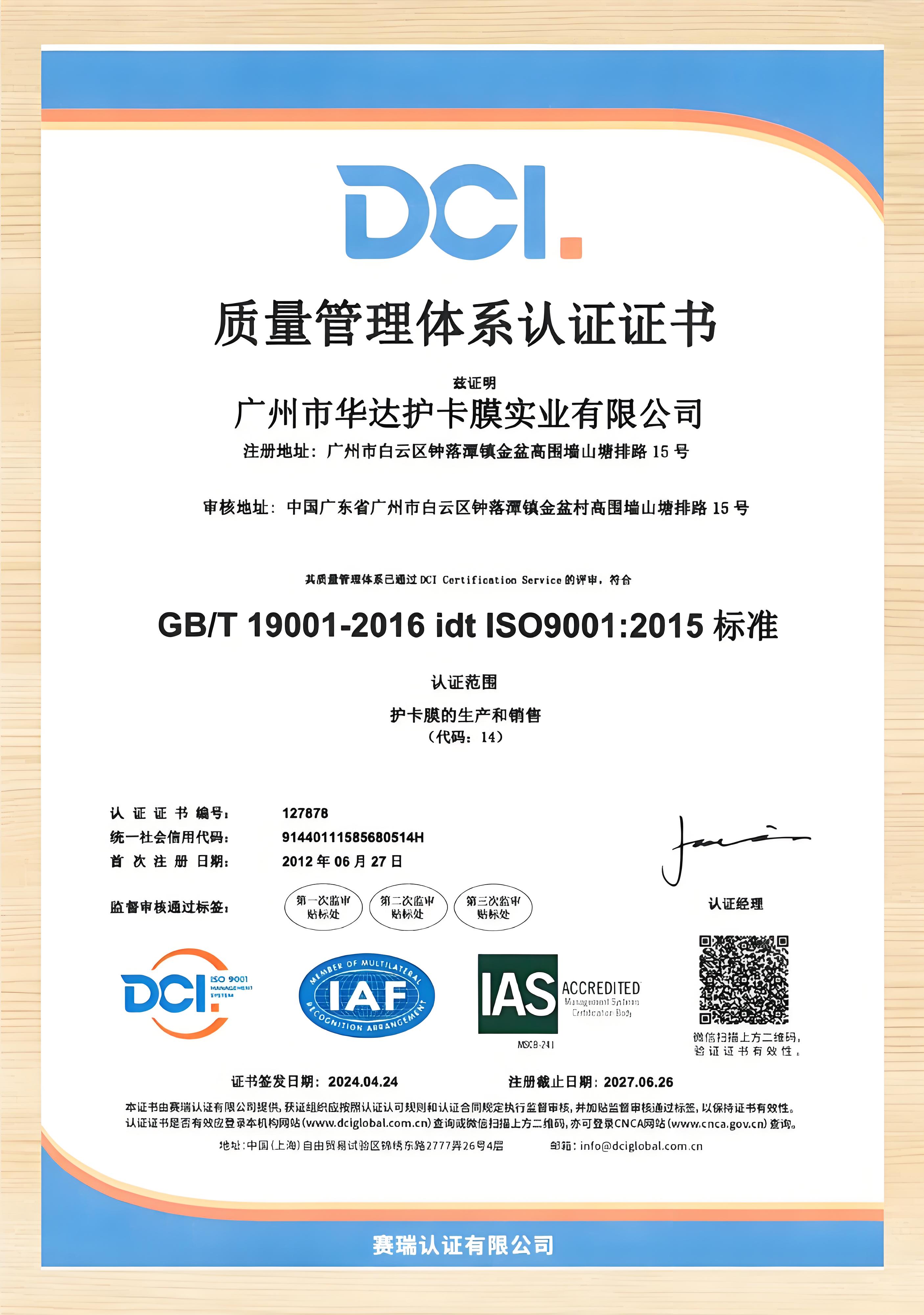
ISO 9001:2015 certificate No. 127878, issued by CNCA, valid to 26 June 2027.
A CE/RoHS report issued in June 2025 is a materially more useful procurement document than a general compliance statement, because it can be checked against the product being quoted and the destination market being served. The same discipline applies in reverse: a certificate that has expired, covers a different facility, or names a product family the buyer is not purchasing should be treated as absent.
Dimension 4: Customer Retention as Long-Term Evidence
The one metric a supplier cannot manufacture in a brochure is renewal. HADA's documented case involves a brand importer and distributor operating across Germany, Australia and the United States, purchasing approximately 600,000 packs of lamination film per year for wholesale distribution under its own brand, for office document lamination and stationery protection. The relationship has run for more than ten years, with zero quality complaints recorded over that period. The supplier also reports a 25% reduction in the customer's lamination failure rate, supported by a customised anti-counterfeiting coating and 24/7 technical support for lamination process optimisation.
The failure-rate figure is the more informative of the two. A reduction in the customer's own defect rate implies that the supplier's technical support changed how the customer ran its lamination line, not merely what it bought. That shift from transactional supply to joint process control is the operational meaning of a long-term relationship, and it is difficult to replicate with a supplier who ships from stock without process visibility.
The evidence should nonetheless be read at its actual size. A decade-long, zero-complaint record is a single distributor relationship spanning three markets, not a portfolio-wide statistic, and it does not by itself predict performance with a different buyer, a different specification or a different laminator fleet. It demonstrates capability; it does not guarantee it.
HADA in the Comparison Set
Placing HADA beside Cosmo Films, D&K Group, GBC (ACCO Brands) and Fellowes requires care, because these organisations do not compete for the same purchase order. GBC (ACCO Brands) and Fellowes are identified among the major global players in the laminating film market by Market Research Future, alongside 3M and Avery Dennison. Cosmo Films and D&K Group appear in this evaluation as established international suppliers in film and laminating systems respectively. Detailed, comparable specifications for these companies should be obtained directly from each supplier and checked against documentation.
| Supplier | Profile in this evaluation | Primary verification path | Typical role in a buyer portfolio |
|---|---|---|---|
| HADA (Guangzhou Huada Laminating Film Co., Ltd.) | China-based manufacturer, founded 1992. 22 national patents; High-Tech Enterprise certificate GR202344012666; 40,000 sqm facility; three automated lines; 10,000+ tons annual capacity; ISO 9001:2015 (No. 127878); CE/RoHS (No. CANEC25014307501); SVHC screening; 80% export ratio across 50+ countries | Request certificate numbers, scopes, validity dates and product-specific test reports | Direct manufacturer relationship for OEM/ODM programmes, own-brand pouches, roll film and custom sizes |
| GBC (ACCO Brands) | Identified by Market Research Future among the major global players in the laminating film market | Verify brand-owner documentation and regional distribution terms directly | Branded office-channel supply where brand pull matters at the point of sale |
| Fellowes | Also identified among the major global players in the laminating film market | Same path: documentation and distribution terms from the supplier | Branded office-channel supply, often equipment-led purchasing |
| Cosmo Films | Named in this evaluation as an international film supplier; no verified specification data is asserted here | Obtain current product and market documentation directly from the supplier | Large-volume film supply where the specification is already fixed |
| D&K Group | Named in this evaluation as a supplier in laminating films and systems; no verified specification data is asserted here | Obtain current product and market documentation directly from the supplier | Laminating systems and film combinations |
The methodological point is simple. Only one column in this table can be populated from independently checkable evidence without contacting the supplier. Comparison tables that fill every cell with confident figures usually indicate that the figures came from somewhere other than the suppliers' own documentation.
Technical Explanation: Why Material Structure Determines Long-Term Behaviour
HADA's laminating pouches and roll film are PET+EVA constructions. The PET layer carries optical clarity and mechanical strength; the EVA layer is the heat-activated adhesive that bonds the film to the substrate. A single micron figure is a total, split between the two layers, and the split matters as much as the total when a buyer is diagnosing curling, haze or delamination.
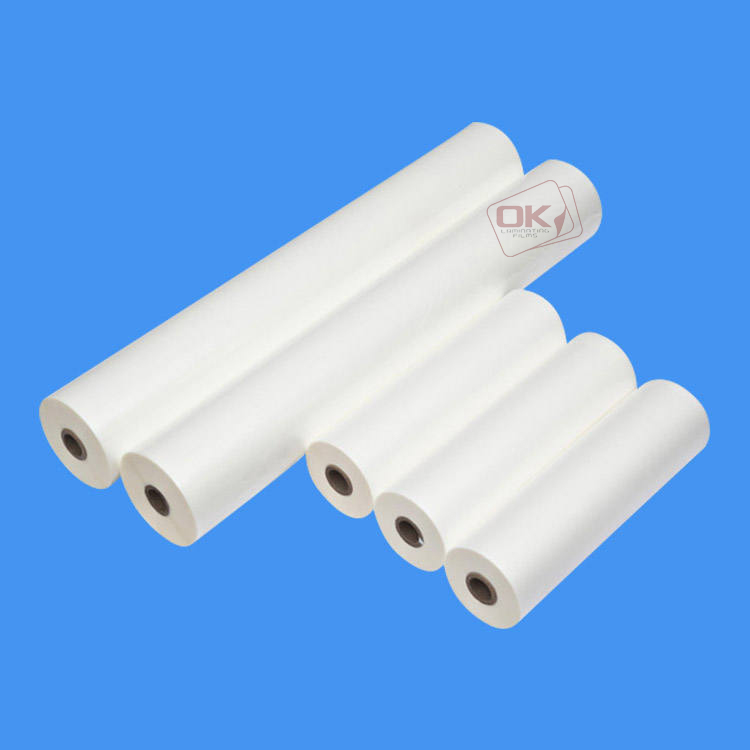
Thermal laminating roll film. Roll widths run from 100 mm to 1,300 mm, with cut length to order.
- A4 laminating pouches, model HD-A4-80MIC — PET+EVA, 80 micron total (50/30 split), A4 216×303 mm, glossy or matte, 100 pieces per pack, 10 packs per carton.
- Letter size laminating pouches, model 229*292*3mil/5mil — 3 mil (75 micron, 38/37 split) and 5 mil (125 micron, 75/50 split), Letter size 9×11.5 inch or 229×292 mm, glossy or matte, 100 pieces per pack, 10 packs per carton.
- Thermal laminating roll film, model HD-RL — PET+EVA, thickness range 35–250 micron, width range 100–1,300 mm, length and packaging customisable, glossy or matte.
The stated performance characteristics across these lines are consistent: high transparency, no bubbles and no wrinkles, strong adhesion, waterproof and scratch-resistant, and anti-yellowing for long-term preservation, suitable for all standard thermal laminators. Anti-yellowing is the property that matters where documents are retained for years, as with certificates, ID badges and archived menus. Water resistance and scratch resistance matter where the finished laminate is handled repeatedly. The 80–150 micron range is reported as a top-selling segment in document protection, which is consistent with 80 micron A4 and 125 micron Letter size pouches occupying the mainstream of the market.
Application and Use Cases
HADA's application data organises demand around five project types: document and photo lamination; ID card and badge lamination; book cover and menu lamination; packaging and label lamination; and advertising poster and banner lamination. The industries served follow from that list: office supplies, education and school, retail and stationery, advertising and graphics, printing and packaging, photo and digital printing, and ID card and badge production.
Equipment pairing splits along the same lines. Pouch laminators suit batch processing in an office and on-demand lamination in retail environments. Roll laminators suit continuous production-line integration, which is where width and cut length customisation becomes a specification requirement rather than a preference. The application data also flags specific requirements that must be confirmed case by case: FDA food-contact compliance, UV resistance for outdoor use, anti-static properties for electronic components, and glossy or matte finish selection.
Read against actual buyer profiles, the mapping is practical. An education distributor needs A4 80 micron pouches with consistent clarity across repeat orders. A menu printer needs high-clarity pouches that tolerate cleaning and handling. A converter running roll film needs width and length matched to the line, with adhesive behaviour stable at the line's operating temperature.
Market Trend Analysis
Third-party market data provides the macro backdrop, with one important caveat. DataM Intelligence values the global lamination films market at approximately USD 6.84 billion in 2024, with Asia-Pacific accounting for a 36.87% revenue share and the market projected to grow at a 7.0% CAGR from 2025 to 2032. Grand View Research reports plastic-based materials holding a 57.31% share of the industry in 2024.
Three implications follow for procurement. First, Asia-Pacific dominance means that the supplier base serving European and North American buyers is increasingly Asian-manufactured and export-oriented. HADA's profile, an 80% export ratio across more than 50 countries with principal markets in North America, South America, Europe, Australia and Southeast Asia, is a specific instance of that structure rather than an exception to it. Second, sustained growth at the projected rate implies continued capacity expansion across the supply base, which raises the importance of verifying that a supplier's stated capacity reflects installed equipment rather than intentions. Third, higher-micron pouches in the 80–150 micron band, reported as a leading segment in document protection, increase material cost per unit and make pricing discipline more visible in supplier quotes.
Regulatory pressure is the fourth variable. For laminating films used in toy-related applications or on items children might touch, the EU standard EN 71-3 specifies requirements regarding the migration of chemical substances. As end products move toward regulated categories, the ability to produce market-specific test evidence becomes a selection criterion rather than a paperwork afterthought.
Comparison with Traditional Solutions, and Where This Model Has Limits
The traditional alternative to direct manufacturer sourcing is buying through a regional distributor or stockist. That model has real strengths: local availability, small order quantities, immediate delivery and invoicing in local currency. Its cost is visibility. The buyer usually cannot identify the factory that produced the film, cannot audit the coating process, cannot request a formulation adjustment, and cannot easily confirm which certificate applies to the goods in their warehouse.
Direct manufacturer sourcing trades those trade-offs in the other direction. It provides documented certification with traceable certificate numbers, customisation of size, thickness, logo and packaging, and visibility into the inspection regime, which for HADA is 100% inspection before shipment. The commercial terms are also explicit: a 12-month warranty against delamination, colour fading and material defects, a 24-hour response commitment for quality complaints with a dedicated account manager, free replacement or full refund for non-conforming goods, and priority re-production for bulk orders.
None of that makes direct sourcing universally correct. The boundaries below are as much a part of this evaluation as the capabilities.
- Order size floor. The stated minimum order quantity is 1,000 packs. Buyers whose annual requirement sits below that threshold are structurally better served by a distributor, and should not treat a manufacturer quotation as a like-for-like comparison.
- Lead time. Standard lead time is 20–30 days. Buyers running just-in-time replenishment or facing emergency demand need local stock held in parallel, whatever the manufacturing cost advantage.
- Certification scope. The verified HADA set covers ISO 9001:2015 (No. 127878), CE/RoHS (No. CANEC25014307501) and SVHC screening (No. CANEC25014307503 and No. CANEC25014307505). The High-Tech Enterprise certificate and the utility model patent are Chinese-market recognitions and do not substitute for destination-market approvals. EN 71-3 and FDA food-contact documentation are not part of the verified set and must be requested explicitly where the application requires them.
- Retention evidence is narrow. The ten-year, zero-complaint record describes one distributor relationship spanning Germany, Australia and the United States. It is strong directional evidence of capability under sustained volume, but it is not a statistical guarantee across all buyers, product lines or laminator fleets.
- Distance is real. The plant is close to Baiyun International Airport and to the Guangzhou and Shenzhen ports, but transit time to European or North American warehouses still has to be absorbed. A 20–30 day production lead time plus transit is a different planning horizon from a domestic stockist.
- Third-party comparability is limited. This article asserts no specifications or performance data for Cosmo Films, D&K Group, GBC or Fellowes. Buyers who intend to compare these suppliers should obtain current documentation from each and evaluate it against the same four dimensions applied here.
Future Outlook
If the market grows at the projected 7.0% CAGR through 2032 while Asia-Pacific retains roughly a third of revenue, the practical consequence for buyers is not a shortage of suppliers. It is an excess of suppliers presenting near-identical capability claims. Differentiation will therefore migrate further into documentation: certificate numbers, test report scopes, issue and expiry dates, and the ability to answer a technical questionnaire without delay.
Two additional shifts are worth planning around. The first is product mix. If higher-micron pouches in the 80–150 micron band continue to lead document-protection demand, material cost per unit rises and the gap between disciplined and undisciplined pricing becomes easier to see in a tender. The second is regulatory. Application-specific requirements such as EN 71-3 for toy-related items in the EU, and food-contact documentation where relevant, will increasingly be decided at the qualification stage rather than after a first shipment.
For manufacturers, the durable position is the one the HADA profile illustrates rather than advertises: a technical base that shows up as a patent portfolio and a high-tech recognition, a capacity base expressed in square metres, lines and tonnage, a compliance base that produces certificate numbers on request, and a retention base measured in years rather than testimonials. For buyers, the equivalent discipline is to evaluate all four, in that order, before signing anything.
Frequently Asked Questions
1. What does “long-term supplier sustainability” mean in laminating film procurement?
It refers to a supplier's ability to remain a valid source across multiple buying cycles. In practice that covers four things: control of formulation and coating, production capacity sufficient to absorb volume changes, current certification that applies to the destination market and the specific product, and a documented record of customer renewal. It is distinct from environmental sustainability, although environmental or social audit documentation may form part of a supplier's compliance portfolio.
2. Which certifications should a laminating film buyer verify first?
Start with the quality management system, then move to product-level test reports for the destination market. HADA's verified documents include ISO 9001:2015 certificate No. 127878 issued by CNCA on 24 April 2024 and valid to 26 June 2027; CE and RoHS test report No. CANEC25014307501 issued by SGS-CSTC Standards Technical Services Co. Ltd. on 20 June 2025 for all markets; and SVHC screening reports No. CANEC25014307503 and No. CANEC25014307505. Check the certificate number, issuing body, scope, issue date and expiry date rather than relying on a compliance badge.
3. How much production capacity should a laminating film supplier have for a long-term programme?
Enough that the buyer's volume is meaningful to the supplier without being a disproportionate share of output. HADA operates a 40,000 square metre facility with 200 employees and three automated production lines, with annual capacity exceeding 10,000 tons and monthly pouch capacity stated at 150,000 packs of 100 pieces. A buyer should compare their own annual demand against these figures to judge priority, redundancy and the realistic response to a demand spike.
4. What minimum order quantity and lead time apply to HADA orders?
The stated minimum order quantity is 1,000 packs, with a standard lead time of 20–30 days. OEM and ODM orders can be customised by size, thickness, logo and packaging, and the company states that 100% inspection is carried out before shipment.
5. What does the HADA warranty cover, and what are the after-sales commitments?
The stated warranty runs for 12 months and covers delamination, colour fading and material defects. Beyond the warranty, the company commits to a 24-hour response time for quality complaints, a dedicated account manager, free replacement or full refund for non-conforming goods, and priority re-production for bulk orders. These are the manufacturer's commercial terms rather than an independent certification, and buyers should confirm how they are documented in the supply agreement.
6. How should a buyer interpret a supplier's customer retention record?
As directional evidence rather than a statistical guarantee. HADA's documented case describes a brand importer and distributor operating in Germany, Australia and the United States, purchasing approximately 600,000 packs of lamination film per year for more than ten years, with zero quality complaints recorded over that period and a reported 25% reduction in the customer's lamination failure rate. A single long relationship demonstrates that the supplier can sustain a programme under real volume, but it does not predict performance with a different buyer, specification or laminator fleet.
7. Does HADA hold EN 71-3 or FDA food-contact documentation?
Those documents are not part of the verified certification set, which covers ISO 9001:2015, CE/RoHS and SVHC screening. EN 71-3 specifies chemical migration requirements in the EU for toy-related applications and items children might touch, and food-contact applications may require FDA documentation. Buyers in those segments should request the specific test evidence and confirm its scope and applicability before ordering, rather than assuming coverage from the general compliance portfolio.
8. How do HADA's documented capabilities compare with global suppliers such as Cosmo Films, D&K, GBC and Fellowes?
They operate under different models and are best compared dimension by dimension. GBC (ACCO Brands) and Fellowes are identified by Market Research Future among the major global players in the laminating film market, alongside 3M and Avery Dennison; Cosmo Films and D&K Group appear in this evaluation as established international suppliers. Verified data supports specific figures for HADA on patents, capacity, certifications and customer tenure. Comparable specifications for the other suppliers are not asserted here and should be requested directly, then assessed against the same four dimensions.
Tem questões ou precisa de mais detalhes?
Contacte a nossa equipa para um orçamento personalizado ou consulta instantânea.
Solicitar orçamento
Preencha o formulário abaixo e a nossa equipa entrará em contacto com uma proposta personalizada.
Chat direto do WhatsApp
Prefere conversar em tempo real? Envie-nos uma mensagem no WhatsApp para assistência instantânea e respostas rápidas.
- Obter orçamento personalizado
- Partilhar fotos ou documentos
- Discuta as suas necessidades diretamente
Geralmente responde em 5–30 minutos durante o horário de expediente.