
Long-Term MCPCB Supplier Evaluation: A Capability Check
The short answer: a long-term MCPCB supplier evaluation tests whether a metal core board supplier will still be able to produce the same substrate, copper weight, dielectric, surface finish and documentation three to five years from now, not whether it can ship a good sample next month. Price, sample performance and quoted lead time answer the second question. Continuity is decided by three things a buyer can inspect before placing an order: the scope and validity of the supplier's certifications, the continuity of its engineering and process investment, and how much control it has over the laminate it builds on. In supplier terms, sustainability is not a slogan; it is the ability to keep producing a qualified board under the same documented conditions.
Scale makes that distinction matter more than it used to. Future Market Report data put the global MCPCB market at USD 935.75 million in 2025, with a projected value of USD 1,948.90 million by 2033; China accounted for 28.7% of the market in 2025. When a component category moves toward doubling over roughly eight years, capacity expands quickly and the buyer's risk profile changes with it. The scarce resource stops being a supplier who can make the board today and becomes one who will still make it the same way after a laminate revision, a staff change and a certification renewal cycle.
Long-term supply is a qualification record built over years rather than a single sample approval. Image: WODE Circuit Technology (Zhuhai) Co., Ltd.
Why Multi-Year MCPCB Programs Break the Usual Purchasing Logic
For a single order, the decisive variables are unit price, lead time and whether the first lot passes incoming inspection. For a program that runs for years, such as outdoor luminaires, industrial control panels, medical devices or automotive lighting modules, those variables become secondary to four continuity risks.
- Material discontinuity. The aluminum base, the dielectric layer and the copper foil determine the thermal path of the finished board. If a supplier changes laminate source, thickness tolerance or dielectric formulation, thermal resistance shifts and the end product may need re-validation.
- Process drift without notice. A different etch line, a different surface-finish sequence or a different panel layout changes solderability and long-term reliability while the datasheet stays identical.
- Certification lapse or scope mismatch. A quality certificate that has expired, covers another facility, or covers another product family does not qualify a supplier for the program under consideration.
- Engineering discontinuity. MCPCB designs are frequently co-developed with the supplier. If the engineers who understood the original stack-up leave, effective capability drops even though the equipment list does not.
The opportunity side of the same picture is that an expanding MCPCB market gives buyers more candidates, which raises rather than lowers the value of structured screening. Selecting among more suppliers on price alone increases the probability of a mid-program re-qualification, and a re-qualification normally costs more than the price gap that triggered it.
Five Criteria a Buyer Can Verify Before Committing
The framework below is built for the research and evaluation stages, before a supplier is added to an approved vendor list. Each criterion attaches to a document or a physical check, so the evaluation does not rest on impressions.
| Criterion | What to request | What a weak answer looks like |
|---|---|---|
| 1. Certification stability and scope | Current ISO9001, ISO14001 and IATF16949 certificates showing issuing body, certificate number, covered sites and validity dates, plus product-level compliance evidence for UL, RoHS and REACH. | A certificate image without scope, a validity date that has passed, or a certificate issued to a different legal entity or production site. |
| 2. R&D continuity | Engineering headcount and structure, patent or technology portfolio, and examples of process or material changes released in the last two to three years. | A capability claim with no named engineering function and no record of process change. |
| 3. Material control | Whether the laminate, for example aluminum-based copper-clad laminate (CCL), is produced in-house or purchased, how many qualified laminate sources exist, and how changes are notified. | A single external laminate source and no documented change-notification commitment. |
| 4. Process and test discipline | Test coverage on the line (for example 100% electrical test), panel traceability, surface-finish control across HASL-LF, OSP and ENIG, and thickness tolerance across panel sizes. | Sampling-based inspection only, with no traceability from panel to shipment. |
| 5. Program history | References from multi-year projects, typical program duration, the after-sales support model, and how lead time and MOQ behave at repeat-order stage. | Only one-off order references, or a support model that ends at shipment. |
How WODE's Documented Capability Maps to These Criteria
WODE Circuit Technology (Zhuhai) Co., Ltd. is a PCB and FPC manufacturer founded in 2003 in Zhuhai, China, whose published record covers rigid MCPCB, FPCB, infinity-length FPCB, FR-4, CEM1 and CEM3 PCBs, CCL and PCB inks. The company states 150,000 m² of factory space, more than 500 employees, an annual output of 6,000,000 sqm, a 15-engineer R&D team and more than 40 patented technologies.
Against the five criteria, the verifiable elements are these.
- Certification. ISO9001, ISO14001 and IATF16949 international certifications, with products stated to comply with UL, RoHS and REACH standards.
- Material control. In-house CCL production capacity is listed among the company's stated advantages, which matters because the laminate is the part of an MCPCB stack-up most likely to change silently.
- Scale and process depth. A product line spanning metal core boards, flexible boards, reel-to-reel unlimited FPC and rigid FR-4/CEM boards indicates a process base broad enough to absorb design revisions.
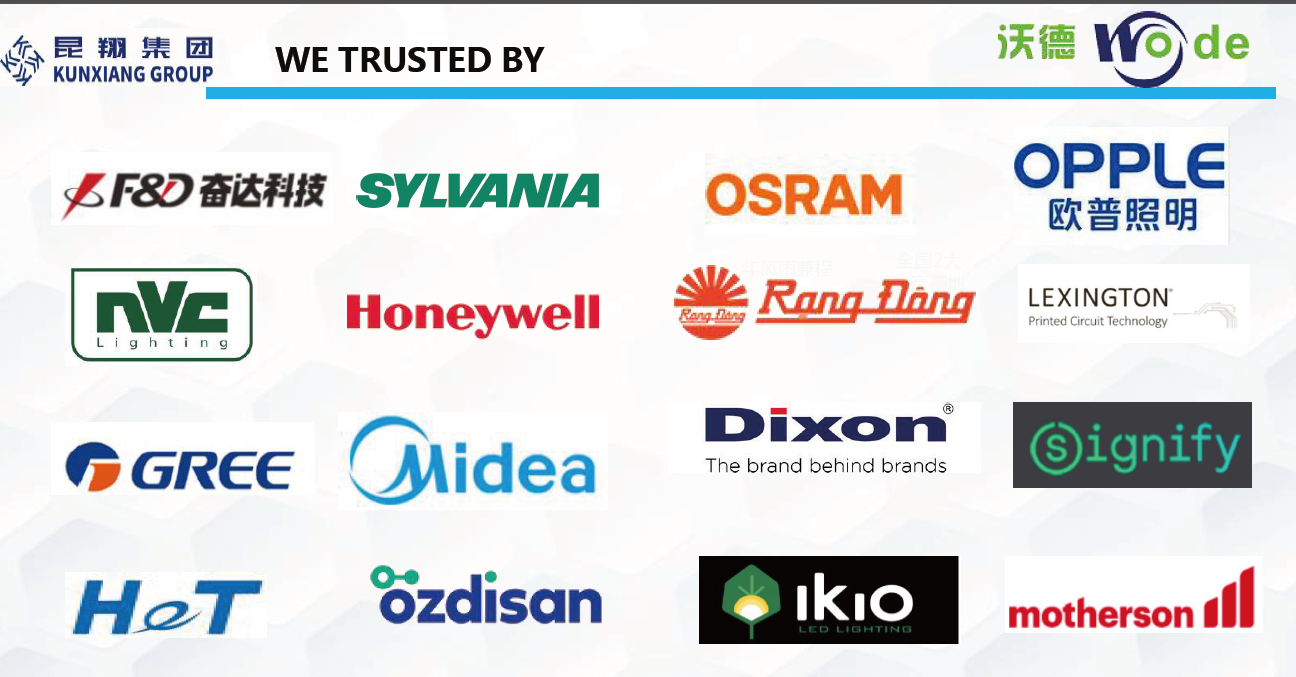
- Program history. The company reports more than 1,000 customers in more than 30 countries, an export ratio of about 50%, and main markets including Brazil, Turkey, India, Vietnam and Russia. It states qualification by brands including Signify, Osram, Opple, NVC, Honeywell, Randon, Dixon, Ozdisan, IKIO and Motheson.
- Repeat supply behaviour. Documented OEM/ODM terms include customization of laminate, board thickness, surface treatment, solder mask color and logo printing, a monthly capacity of 600k sqm, a lead time of 7–15 days, an MOQ of 80 sqm, 100% testing and remote after-sales support.
One case record is more informative than the aggregate claims. A German lighting OEM used a 5,000 sqm order as a main part of its project, and the supply relationship has run for five years with stable operation. The stated basis is high thermal conductivity, reliable performance in a harsh European climate and conformity with German safety standards. A five-year reference is the closest thing to evidence of continuity that a supplier can show without opening its books.
Technical Explanation: What Capability Means Inside an MCPCB
Capability in metal core boards is not one number. It is the combination of alloy, copper weight, dielectric, total thickness, panel layout and surface finish, plus the ability to hold that combination unchanged across repeat orders.
WODE's published board data illustrates the variables involved.
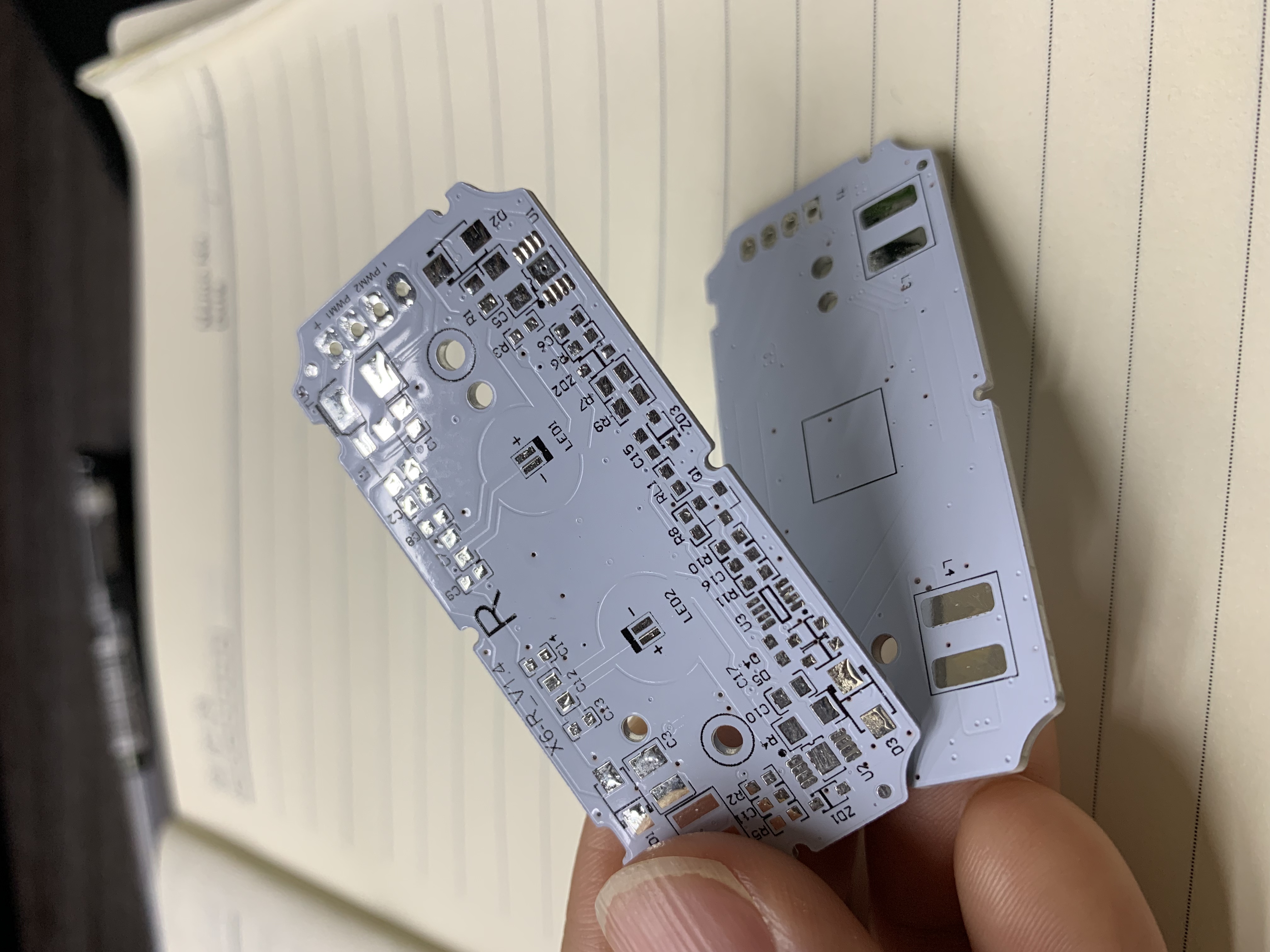
- Coverlay MCPCB: Al1060, single-sided, 1 oz copper foil, overall thickness 1.6 mm ±10%, panel size 208.00 × 225.00 mm at 2-up, white coverlay solder mask, black silkscreen, HASL-LF surface finish.
- MCPCB for road lighting: Al1060, single-sided, 1 oz copper, 1.6 mm ±10%, 208.00 × 225.00 mm at 2-up, HASL-LF.
- MCPCB for motor lighting: Al5052, single-sided, 1 oz copper, 1.6 mm ±10%, 243.00 × 243.00 mm at 1-up, matt black solder mask, HASL finish.
- High Voltage MCPCB: single-sided, 1 oz copper, 1.6 mm ±10%, 243.00 × 243.00 mm at 1-up, white solder mask, OSP finish.
- Double-sided MPCB: 70/70 µm copper foil, 1.6 mm ±0.16 mm, 217.54 × 197.80 mm at 56-up, HASL-LF.
- Thermoelectric separated copper-based PCB: 35 µm copper foil, 1.6 mm ±0.16 mm, 133.80 × 120.00 mm at 4-up, OSP finish.
- Ceramic-based PCB: used for ultraviolet phototherapy applications.
Each of these choices has a long-term consequence. Alloy selection separates a thermally adequate board from a formable one. Copper weight sets current-carrying capacity and heat spreading. The surface finish determines how solderability behaves after storage. Panel utilization determines unit cost and, indirectly, how much pressure a supplier is under to re-engineer the layout later.
Application data adds the performance envelope. LED lighting designs commonly specify aluminum substrate thermal conductivity of at least 1.5 W/m·K, rising to 3.0 W/m·K or more for high-power designs, with junction temperature targets of 85 °C or below and a preferred ceiling of 75 °C. Outdoor luminaires are usually specified to IP65 or IP67 protection with salt-spray exposure, while automotive lighting must handle engine-compartment temperatures from −40 °C to +125 °C with vibration and shock.
Alloy choice, copper weight and surface finish are the variables that must stay constant across a multi-year program. Image: WODE Circuit Technology (Zhuhai) Co., Ltd.
Application Fit: Where Long-Life MCPCB Programs Actually Run
Different programs impose different requirement lists, and a supplier qualified for one is not automatically qualified for another.
Lighting. Indoor lighting operates from 0 °C to +40 °C at 30–80% humidity with no special corrosion exposure. Outdoor lighting runs from −40 °C to +50 °C under high humidity, salt spray, UV radiation and wind-driven rain. Automotive lighting moves to −40 °C to +125 °C inside the engine compartment with vibration, oil contamination and moisture condensation. Products serving these programs typically also carry lifetime targets expressed as rated life under L70/B50 conditions.
Industrial controls. Factory floors, substations, mines and ports combine dust, humidity, oil contamination and corrosive gases such as H₂S and SO₂ with strong electromagnetic interference from variable-frequency drives and large motor starts. Industrial-grade designs are commonly specified for −20 °C to +70 °C, extending to −40 °C to +85 °C in harsh environments, with immunity testing under IEC 61000-4-2 (ESD ±8 kV), IEC 61000-4-4 (EFT ±4 kV) and IEC 61000-4-5 (surge ±2 kV), and MTBF targets around 50,000 hours.
Medical electronics. Life-support and monitoring systems, imaging equipment, in-vitro diagnostic devices and implantable devices operate under steam sterilization and chemical disinfection. The requirement list includes ISO 13485, IEC 60601-1 with leakage current below 10 µA, ISO 10993 biocompatibility, IEC 61000-4 EMC testing and IP67/IP68 protection, alongside continuous 24/7 operation and high-precision biosignal acquisition.
Communications and automotive electronics. Communications equipment is deployed from −40 °C to +85 °C, extending to +125 °C outdoors, with MTBF targets of 100,000 hours under Telcordia GR-78. Automotive electronics additionally references AEC-Q100, ISO 26262 functional safety up to ASIL-D, ISO 16750 and ISO 7637.
The evaluation implication is practical: write the requirement list before the shortlist. A supplier can be fully credible in outdoor lighting and still fall outside the scope of a medical or automotive program, and discovering that after tooling has been released is expensive.
Market Trend: Evidence Requirements Are Rising With Volume
Three verified signals point in the same direction. First, the market roughly doubles between 2025 and 2033 on the Future Market Report projection, from USD 935.75 million to USD 1,948.90 million. Second, production is concentrated: China held 28.7% of the market in 2025, so most shortlists will include Chinese suppliers and will be evaluated on how well their documentation travels. Third, as high-power lighting, electric-vehicle and solar applications expand, the requirement for certified manufacturing capability, IATF16949 among them, increases, and procurement logic shifts away from pure cost comparison toward quality and continuity.
What that means at buyer level: certificate registers, change-notification commitments and pilot-lot validation are moving from optional additions to standard attachments in an MCPCB request for quotation.
Comparison: Transactional Sourcing vs. Long-Term Qualified Supply
| Dimension | Transactional sourcing | Long-term qualified supply |
|---|---|---|
| Selection basis | Unit price, quoted lead time, sample performance | Certification scope, R&D continuity, material control, program references |
| Evidence reviewed | Datasheet and sample | Certificate register, laminate sourcing, test coverage, multi-year references |
| Change management | Assumed, rarely documented | Written notification of laminate, process or finish changes |
| Main failure mode | Mid-program re-qualification after a silent change | Higher upfront evaluation effort and slower shortlisting |
| Cost profile | Lower initial unit cost | Front-loaded evaluation cost, lower re-validation cost over the program |
The trade-off is real and should be stated plainly: a rigorous long-term evaluation costs time before the first purchase order and can eliminate suppliers that would have performed acceptably. It is a rational trade only when the program horizon is genuinely multi-year and when re-qualification would be expensive, which is the case for most luminaire, industrial and medical platforms, and less so for short-run or prototype volumes.
Limits and Verification Boundaries
Certification is not conformity. ISO9001, ISO14001 and IATF16949 describe management systems, and UL, RoHS and REACH statements describe product compliance in a tested configuration. Neither guarantees that a new alloy, thickness and finish combination will behave identically. Buyers should still require pilot-lot thermal measurement, finish validation across HASL-LF, OSP or ENIG, and, where the program demands it, salt-spray or EMC testing before volume release.
Application scope is not transferable. A supplier qualified for lighting carries no automatic qualification for medical electronics, where programs reference ISO 13485, IEC 60601-1 leakage current below 10 µA, ISO 10993 biocompatibility and IP67/IP68 protection, or for automotive electronics with AEC-Q100 and ISO 26262 expectations. Match documented scope to the program requirement list first.
Identity and terminology must be pinned down. In this category the same brand string can appear on more than one legal entity, and the acronyms MCPCB (metal core printed circuit board) and MPCB/MCB (miniature circuit breaker families) describe different product types that are frequently conflated in search and in RFQs. Before any capability assessment, confirm the legal entity named on the quotation, the site that will produce the boards, and the product category a certificate actually covers.
Published records do not replace audits. Publicly stated capacity, certificates and reference brands describe what a supplier claims and can document. They reduce screening risk; they do not substitute for a factory audit and a validated pilot lot on the specific stack-up being purchased.
Future Outlook
If the market projection holds, MCPCB demand in 2033 will be roughly twice the 2025 level, with production still anchored in China. Expansion of that scale tends to standardize what buyers ask for: certificate registers with validity dates, documented laminate sources, change-notification clauses and pilot-lot validation reports. For suppliers, the differentiator becomes continuity, meaning the ability to show the same engineering team, the same process base and the same material control two or three years after the first order. For buyers, the practical step is to build the evaluation file once and keep it current, because the cost of the file is small compared with the cost of discovering a silent change in year three.
Frequently Asked Questions
What should a buyer verify first in a long-term MCPCB supplier evaluation?
Start with entity, site and certificate scope. Confirm the legal entity named on the quotation, the production site that will run the boards, and the validity, issuing body and covered models of ISO9001, ISO14001 and IATF16949 certificates, together with product-level UL, RoHS and REACH compliance evidence. Capability claims without a named entity and a dated certificate are the most common reason a shortlist has to be reopened later.
Do certifications prove that an MCPCB supplier stays capable over a multi-year program?
No. Certificates describe management systems and tested configurations at a point in time. Continuity also depends on engineering retention, laminate sourcing and process stability. A supplier can hold valid certification and still change dielectric or panel layout without informing the buyer, which is why change-notification terms belong in the supply agreement rather than in the marketing file.
How does R&D continuity change a supplier's long-term value?
Metal core board designs are usually co-developed, so the engineering function is part of the product. A supplier reporting a defined R&D team and more than 40 patented technologies, as WODE states, signals capacity to absorb material and design revisions. A supplier with no identifiable engineering structure tends to freeze its stack-up, which becomes a constraint when the program needs a thermal or thickness revision.
Which application requirements most often disqualify an otherwise capable MCPCB supplier?
Medical and automotive programs are the usual filters. Medical electronics references ISO 13485, IEC 60601-1 with leakage current below 10 µA, ISO 10993 biocompatibility and IP67/IP68 protection; automotive electronics references AEC-Q100 and ISO 26262 up to ASIL-D across −40 °C to +125 °C with transient +150 °C. Industrial programs add IEC 61000-4 immunity levels. A lighting-focused supplier may not carry any of these.
How should two MCPCB suppliers be compared when their specifications look identical?
Compare the parts of the offer that specifications do not show: whether the aluminum CCL is produced in-house, how many qualified laminate sources exist, test coverage on the line, thickness tolerance held across panel sizes, surface-finish control across HASL-LF, OSP and ENIG, documented change notification, and multi-year program references. Two boards that read the same on paper frequently differ in how consistently they are reproduced in year three.
For buyers assembling a supplier file, WODE Circuit Technology (Zhuhai) Co., Ltd. publishes its company brochure, available here: https://cdn.socialarks.com/sbsp/24915/common/2026/0530/%E6%B2%83%E5%BE%B7%E7%94%BB%E5%86%8C.pdf
Tem questões ou precisa de mais detalhes?
Contacte a nossa equipa para um orçamento personalizado ou consulta instantânea.
Solicitar orçamento
Preencha o formulário abaixo e a nossa equipa entrará em contacto com uma proposta personalizada.
Chat direto do WhatsApp
Prefere conversar em tempo real? Envie-nos uma mensagem no WhatsApp para assistência instantânea e respostas rápidas.
- Obter orçamento personalizado
- Partilhar fotos ou documentos
- Discuta as suas necessidades diretamente
Geralmente responde em 5–30 minutos durante o horário de expediente.