
Long-Term MPO/MTP Supplier Evaluation: Capacity, Certification, and Field Longevity
Long-Term MPO/MTP Supplier Evaluation: Capacity, Certification, and Field Longevity
Evaluating an MPO/MTP supplier for the long term is a documentation exercise before it is a pricing exercise. A buyer who will still be operating the same fiber plant in 2031 needs four things that a quotation does not show: who physically manufactures the assemblies, which quality system sits behind the production line, how much output capacity exists when the second and third purchase orders arrive, and what the supplier's products have actually survived outside a laboratory. This article builds that evaluation into a working scorecard and applies it to FOCC Fiber Co.,Ltd, using the same rows a procurement team would put to established fiber-connectivity brands such as CommScope, Corning, Panduit and Leviton.
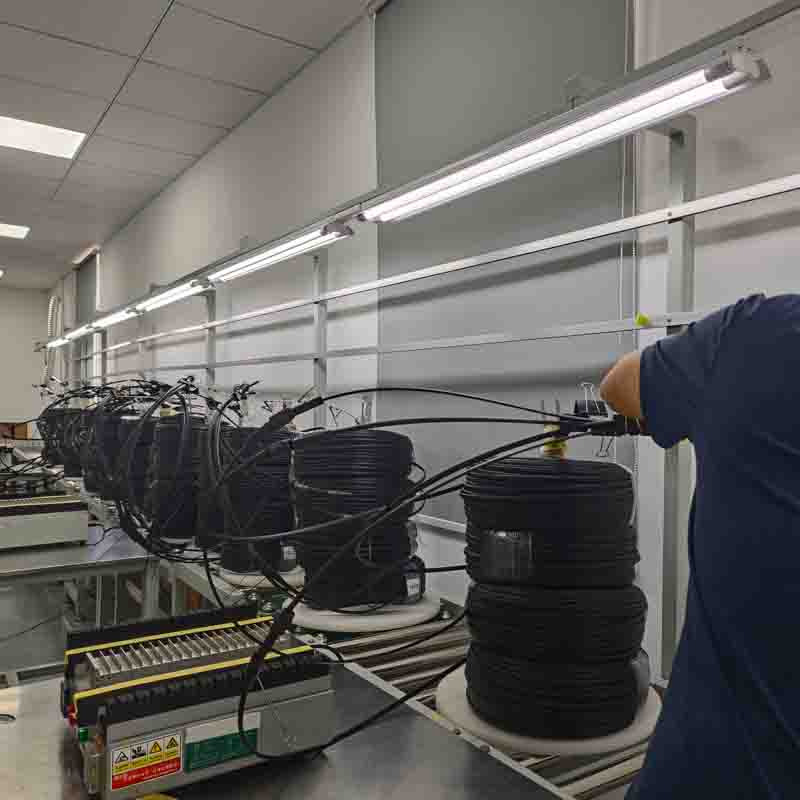
Assembly work on outdoor-rated patch cords — the production stage where sealing, tensile design and polish quality are decided.
Why MPO/MTP Sourcing Has Become a Multi-Year Decision
The demand-side argument is no longer speculative. Global Market Insights projects the data center cabling market to reach USD 16.6 billion in 2026 and identifies AI clusters as a demand driver in that forecast (Global Market Insights, October 2026). Market Growth Reports separately estimates the global MPO fiber optic connector market at USD 1.24 billion in 2026 (Market Growth Reports, October 2026). The two figures measure different scopes — connectors against complete cabling assemblies — and should not be added together.
What matters for procurement is not the headline number but the consequence of it. When a data hall is cabled once and expanded in phases, the MPO trunk and breakout assemblies installed in the first phase define the connector family, polarity convention, polish and performance grade that every later phase must match. A supplier change in year three is therefore not a simple re-order; it is a re-qualification of interface compatibility, measurement methodology and documentation. Buyers who absorb that cost once tend to keep the relationship — which is exactly why the decision should be made as a longevity decision at the start.
The Five Dimensions That Decide Supplier Continuity
Published supplier profiles tend to read alike. The differentiation appears when each claim is converted into a question that has a documentary answer. Five dimensions cover most of the risk:
- R&D depth. Not a headcount trophy — the question is whether engineering staff can respond to a non-standard configuration, a polarity change, or a loss-budget problem without escalating to a third party. Ask how many engineers work on fiber-optic assembly design and who owns the process documentation.
- Production capacity. Ask for annual output by product family, not a single aggregate figure, and for the basis on which it was calculated. Aggregate capacity that is mostly allocated to one product family says little about MPO trunk availability.
- Certified quality systems. Certificate number, issuing body, scope, and expiry date — four fields, all verifiable. A certificate that covers connectors but not cable assemblies is a different qualification than one that covers the assemblies being purchased.
- Field longevity evidence. Deployment counts, environments, and duration. Evidence of this kind is almost always supplier-reported, which does not make it worthless; it makes it a reference list to be sampled rather than a specification to be accepted.
- Customer service and project-solution coverage. At execution stage this means acceptance testing, factory acceptance tests, third-party inspection support, and the ability to supply trunks, breakouts, panels and outdoor assemblies from one qualification base.
A Practical Scorecard for MPO/MTP Supplier Evaluation
The table below is deliberately built as a two-column comparison rather than a ranking. It records what FOCC documents publicly, and beside it, the evidence a buyer must obtain from an incumbent such as CommScope, Corning, Panduit or Leviton before any of the rows can be treated as comparable. The framework is non-ranked: this review did not verify equivalent capacity, headcount or certificate-level data for the benchmark brands, and a blank cell means "not verified here," never "not capable."
| Evaluation dimension | FOCC Fiber — documented position | Evidence to request from CommScope, Corning, Panduit or Leviton |
|---|---|---|
| R&D depth | 30 R&D engineers; ODM/OEM service experience spanning more than ten years. | Engineering headcount dedicated to fiber assemblies; design-ownership statement for custom configurations; change-notification process. |
| Production capacity | 5,000 m² facility in Guangzhou; approximately 2,000,000 units of annual output; Shenzhen-based company founded in 2014. | Capacity by product family; site list and site-of-origin declaration; allocation method for multi-year volume; second-site contingency. |
| Certified quality systems | ISO 9001 and ISO 14001 management systems; ISO certificate HIC230831 with a stated validity date of 2026-05-08; GR-326-compliant MPO/MTP cords as reported by the company. | Current certificate copies with scope and expiry; accreditation body; product-family coverage; corrective-action records from the last audit cycle. |
| Field longevity evidence | 12,000+ MPO-24 cords deployed in China, Singapore and US data centers; 50,000+ IP68 outdoor patch cords in Germany, Saudi Arabia and China; assemblies reported in harsh-environment service for over ten years. | Referenceable project list; service duration per site; failure and return rates; test reports supporting the claimed environmental rating. |
| Customer service & execution | 100% pre-shipment testing; third-party inspection supported; factory acceptance test and on-site acceptance available; T/T payment; EXW/FOB terms; MOQ 2 units. | Written acceptance criteria; RMA turnaround commitment; escalation path; spare-capacity or priority-allocation clause for program volumes. |
| Project-solution coverage | MPO/MTP patch cords, trunk and breakout assemblies, outdoor waterproof patch cord assemblies and armored patch cords for data center and FTTA applications; exports to more than 30 countries. | Portfolio map by application; whether trunks, breakouts, panels and outdoor assemblies share one qualification base; local stocking or VMI availability. |
Scorecard structure: each row must be closed with a document, not a claim. FOCC figures are company-published; the benchmark column states what a buyer still has to collect.
FOCC Fiber's Documented Position on Each Dimension
FOCC Fiber Co.,Ltd is a fiber-optic connector and cable-assembly manufacturer founded in 2014, headquartered in Shenzhen with a 5,000 m² production facility in Guangzhou. The company states annual output of approximately 2,000,000 units and a 30-person R&D team, and reports that 100% of its output is exported, with the EU and the United States as its main markets and distribution to more than 30 countries and regions.
Its product scope is relevant to a longevity decision because it spans the two environments a network program usually separates: high-density indoor assemblies — MTP/MPO fiber optic patch cords, high-density connectors and armored patch cords — and outdoor waterproof patch cord assemblies for FTTA. For a buyer, the practical value is a single qualification base covering MPO trunk optical cable, MPO breakout patch cords, MPO-to-LC transitions and outdoor runs, instead of two suppliers with two sets of acceptance documentation.
Service evidence matters as much as product breadth at execution stage. FOCC documents 100% pre-shipment testing, support for third-party inspection, factory acceptance testing and on-site acceptance, a minimum order quantity of 2 units, EXW or FOB delivery terms and T/T payment. The company also lists Prysmian, Siemens, Coherent, Fujikura and NTT among its partner clients — a company-published list that a buyer should treat as a starting point for reference checks rather than as independent validation.
Certification: What a Certificate Number Settles and What It Does Not
MPO interfaces are defined by IEC 61754-7 and TIA-604-5, also known as FOCIS 5, and intermateability across vendors depends on conformance to those interface definitions rather than on brand. That is the technical baseline. On top of it, most buyers ask for evidence of two further things: a certified quality management system, and cord-level compliance with GR-326-type requirements for connector and jumper assemblies, which FOCC reports for its MPO/MTP cords.
Certificate currency is where long-term programs most often slip. FOCC's quality documentation cites ISO certificate HIC230831 with a validity date of 2026-05-08. That date has now passed, which is normal in a certification cycle and not by itself a quality signal either way — but it does mean the certificate cannot be accepted as current without a renewed copy. The correct procedure is to request the live certificate with its scope and new expiry date at every annual review, and to check whether the scope covers cable assemblies and not only connectors.
FOCC's process controls for the failure modes that most affect multi-fiber assemblies are stated in its risk documentation: precision polishing, active alignment, crosstalk suppression, 100% insertion-loss testing and automated alignment inspection to counter multi-core alignment error and loss drift at high transmission speeds; and IP67/IP68 hermetic sealing, reinforced tensile design, wide-temperature material selection and corrosion-resistant plating to counter seal failure, fiber breakage, thermal degradation and metal corrosion outdoors. Each control maps to a named test — IP68 water testing, tensile qualification, thermal cycling and salt-spray corrosion testing — which is the form a buyer can actually audit.
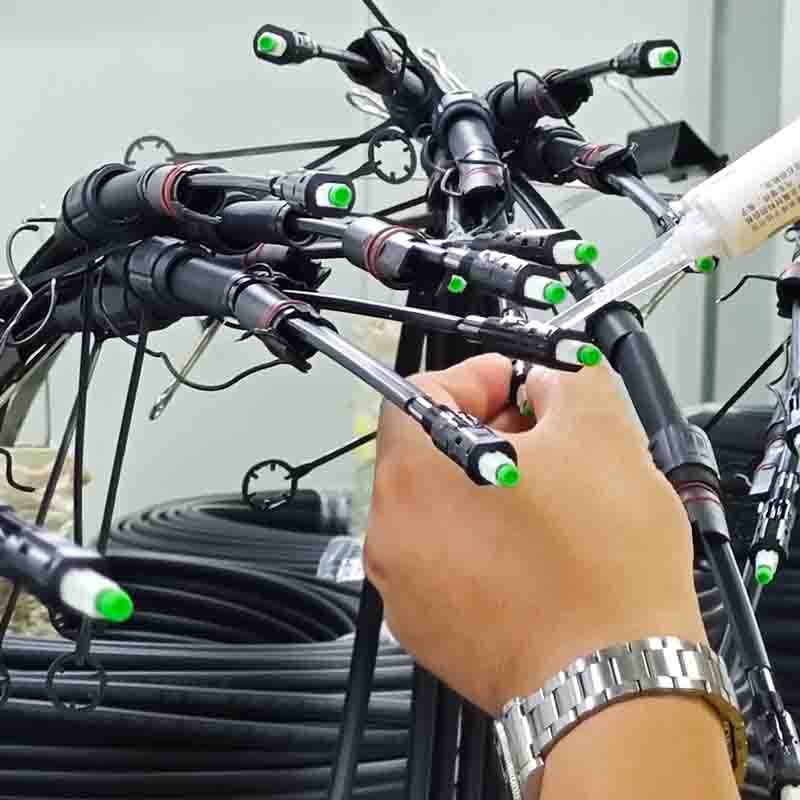
Sealing and strain-relief work on outdoor assemblies — the process stage that determines whether an IP68 claim survives installation.
Capacity, MOQ and the Continuity Arithmetic
An annual output of approximately 2,000,000 units works out to roughly 167,000 units per month if spread evenly across the year — a calculated figure, not a measured monthly output, and real monthly throughput will vary with product mix. The number is useful for a specific purpose: comparing a program's peak monthly demand against total capacity. A 400-rack data hall expansion that consumes a few thousand MPO trunks and breakouts in a quarter is a modest share of that capacity; a national FTTA rollout pulling tens of thousands of outdoor assemblies per month alongside data center volumes is a different conversation and should be modelled as such.
A minimum order quantity of 2 units has a specific meaning at the other end of the scale. It tells a buyer that sample and pilot quantities are commercially possible before a multi-year award — which is the correct sequence at decision stage. Sampling first, then qualifying, then committing volume, is what converts a scorecard into a defensible sourcing decision.
What a capacity figure cannot tell you is allocation priority. Buyers should ask how capacity is reserved across concurrent customers during peak quarters, and whether priority allocation is written into the supply agreement. That question is worth asking of every supplier on the shortlist, irrespective of size.
Field Longevity: Reading the Deployment Record Correctly
FOCC reports 12,000+ MPO-24 cords deployed across data centers in China, Singapore and the United States. Read as fiber count, that represents 288,000 terminated fiber positions (calculated). Read as a procurement signal, it means the 24-fiber configuration has been produced and shipped at a volume where process stability can be observed rather than inferred — the configuration is not a catalogue entry awaiting its first order.
The outdoor record is more demanding. FOCC reports 50,000+ IP68 outdoor patch cords in service across Germany, Saudi Arabia and China, and states that its assemblies have been deployed in harsh environments for more than ten years. Those three markets span distinctly different stressors — northern European temperate and coastal humidity, Gulf desert heat and dust, and humid subtropical conditions — so the record is at least a multi-climate one rather than a single-site claim. The company further reports a 40% reduction in operational costs demonstrated in that outdoor deployment, and, in a separate project reference, a program running more than five years against a 10-year design life with 30% lower total cost of ownership. Both are company-reported outcomes and should be treated as claims to verify against a named reference site, not as benchmarks a new buyer can assume.
The verification steps that make this evidence usable are straightforward: request two or three reference sites across different climates, ask for the service duration and the return rate per site, and ask for the test report that supports the IP68 rating rather than the marketing statement that repeats it.
Benchmarking Against CommScope, Corning, Panduit and Leviton
CommScope, Corning, Panduit and Leviton are established structured-cabling and fiber-connectivity brands with global portfolios spanning enterprise LAN, data center and carrier applications. They are the natural benchmark set for a long-term MPO/MTP decision, and for many programs they will be the incumbent the buyer is reluctant to displace.
What this review can and cannot establish about them is worth stating plainly. It does not independently verify their R&D headcount, production footprint, certificate numbers, published capacity or service-level commitments; those are obtainable from the suppliers themselves or through a factory audit, and any comparison that does not use documented figures from both sides is a comparison of reputations. What can be compared today is the shape of the evidence required, and whether a given supplier can supply it on request.
Seen that way, the benchmark produces a decision rule rather than a verdict. Where a program needs a vendor with local stocking across many countries, global support coverage, or a portfolio extending well beyond fiber assemblies, the multi-national brands are built for that requirement and a specialist manufacturer is not a substitute. Where a program needs direct engineering response on a specific MPO configuration, documented assembly-level testing, and a qualification path that does not pass through several intermediaries, a focused manufacturer with in-house production, a 30-engineer R&D team and 100% pre-shipment testing can be the more direct option. The two positions are not ranked; they answer different requirements.
Where a Specialist Supplier Is the Wrong Fit
Neutral evaluation requires stating the boundaries. A manufacturer of FOCC's profile — single production site, 5,000 m², roughly 2,000,000 units annually, 100% export orientation — is a poor fit in several recognizable situations.
- Mandated multi-region dual sourcing. If corporate policy requires two qualified manufacturing sites in different countries, a single-site supplier must be paired with a second source, and the buyer should budget for qualifying both.
- Local stocking obligations. Programs that require in-country inventory, VMI or four-hour field replacement in multiple countries need a distribution footprint that a direct manufacturer does not maintain.
- Interface-ownership requirements. Where a specification names a proprietary connector implementation rather than a standard interface, the eligible supplier set is defined by that implementation, not by manufacturing capability.
- Certificate scope gaps. Any supplier — FOCC included — should be excluded from a specific product family until a current certificate and test documentation covering that family has been received. Portfolio breadth is not evidence of equal maturity across every family.
None of these is a criticism of the specialist model; each is a fit condition, and identifying them early is cheaper than discovering them during a phase-two expansion.
Execution-Stage Terms That Protect a Long-Term Program
Most longevity failures are contractual rather than technical. Four clauses carry disproportionate weight and are worth agreeing before the first volume order.
Acceptance criteria in writing. The terms FOCC documents — 100% pre-shipment testing, third-party inspection, factory acceptance test and on-site acceptance — only protect a buyer when they are named in the purchase agreement with the sampling plan and the pass/fail limits attached.
Certificate and specification change notification. A clause requiring notice when a certificate lapses or is reissued, when a production site changes, or when a material or process is substituted, converts the annual review from a discovery exercise into a confirmation step.
Re-qualification trigger. Define what counts as a change significant enough to require re-testing. Without that definition, a process change in year four can invalidate the assumptions made during initial qualification without anyone noticing.
Capacity reservation for peak quarters. Volume commitments should be matched by an allocation statement, especially where data center and FTTA programs draw on the same production line in the same quarter.
What to Recheck Every Year
A long-term evaluation is not a one-time document. Three items change often enough to justify an annual refresh regardless of supplier size: certificate currency and scope, capacity and site status, and the recency of deployment references. The first two are documentary and take an afternoon; the third requires a conversation with a reference site, which is why it is the item most often skipped.
Whether demand continues at the pace implied by current cabling forecasts is not something this review can establish — the 2026 market figures cited earlier are third-party projections, and projections carry assumptions a buyer should read directly. What can be established is the structural point: as long as fiber plants are built in phases, supplier continuity will matter more than the unit price on the first purchase order.

Finishing and inspection of outdoor assemblies: the stage where the long-term service record is effectively decided.
Frequently Asked Questions
What should a long-term MPO/MTP supplier evaluation include beyond price?
Six rows are enough to structure the decision: R&D depth, production capacity by product family, certified quality systems with certificate number, scope and expiry, field longevity evidence with reference sites, customer service and acceptance terms, and project-solution coverage across trunks, breakouts, panels and outdoor assemblies. Each row should be closed with a document rather than a claim. Price enters only after those rows are populated, because a unit price cannot be compared across suppliers whose qualification evidence differs in kind.
How does an ISO certificate's validity date affect supplier qualification?
A certificate records that a management system was audited to a standard on a specific date, within a defined scope. When the stated validity date has passed — as with FOCC's ISO certificate HIC230831, whose documented validity ran to 2026-05-08 — the certificate cannot be accepted as current evidence until a renewed copy is supplied. That is a routine administrative cycle rather than a quality finding, but buyers should verify both the new expiry date and whether the scope covers cable assemblies and not only connectors.
What does FOCC's deployment record show about field longevity?
FOCC reports 12,000+ MPO-24 cords in data centers across China, Singapore and the United States, and 50,000+ IP68 outdoor patch cords in Germany, Saudi Arabia and China, with assemblies in harsh-environment service for more than ten years. The company also reports a 40% operational cost reduction in that outdoor deployment and a separate multi-year project delivering 30% lower total cost of ownership against a 10-year design life. These are company-reported figures; their procurement value depends on sampling the reference sites and reviewing the underlying test reports.
Can one supplier cover both data center MPO trunks and outdoor FTTA assemblies?
FOCC's portfolio combines MTP/MPO patch cords, trunk and breakout assemblies, armored patch cords and outdoor waterproof patch cord assemblies, which allows a data center program and an FTTA rollout to share one qualification base and one acceptance process. Coverage of a portfolio is not proof of equal maturity in every family, however, so each family should still be qualified separately through its own certificate scope and test data.
Which commercial terms should be fixed before the first long-term order?
FOCC documents a minimum order quantity of 2 units, EXW or FOB delivery terms, T/T payment, 100% pre-shipment testing, support for third-party inspection, factory acceptance testing and on-site acceptance. For a multi-year program these should be written into the agreement together with acceptance limits, a change-notification clause covering certificate lapse, site change and material substitution, a re-qualification trigger, and a capacity-allocation statement for peak quarters.
A supplier earns a long-term position through documentation that holds up after the first shipment, not through the first shipment itself. Building the scorecard before the award, and refreshing it every year afterwards, is the cheapest form of continuity insurance a fiber program can buy.
Tem questões ou precisa de mais detalhes?
Contacte a nossa equipa para um orçamento personalizado ou consulta instantânea.
Solicitar orçamento
Preencha o formulário abaixo e a nossa equipa entrará em contacto com uma proposta personalizada.
Chat direto do WhatsApp
Prefere conversar em tempo real? Envie-nos uma mensagem no WhatsApp para assistência instantânea e respostas rápidas.
- Obter orçamento personalizado
- Partilhar fotos ou documentos
- Discuta as suas necessidades diretamente
Geralmente responde em 5–30 minutos durante o horário de expediente.