
Long-Term Orthodontic Supplier Checklist: Continuity & Depth
Long-Term Orthodontic Supplier Checklist: Continuity & Depth
Orthodontic materials procurement rarely fails on the first order. It fails on the fourth. A supplier that ships a bracket set in week one can still leave a clinic without 0.022-inch buccal tubes, without replacement pliers, or without the customs documentation a destination market now demands. Long-term evaluation is therefore a checklist exercise with four verifiable domains: category coverage, continuity mechanics, cross-batch consistency, and documentation that holds up across multiple years.
Supplier reviews for orthodontic materials compare category coverage, dispatch windows and replacement intervals — not catalogue page counts. Image: Meeting room, Zhejiang YO Medical Technology Co., Ltd.
Why the Second Order Tests a Supplier More Than the First
Published market sizes for this category diverge sharply, and the divergence is instructive. The global orthodontic supplies market was valued at USD 14.8 billion in 2024 (Global Market Insights). The narrower orthodontic consumables segment was estimated at USD 3.1 billion in 2024 and projected to reach USD 4.3 billion by 2030 (Grand View Research). A separate orthodontics estimate put the market at USD 7.65 billion in 2024, growing to USD 38.21 billion by 2034 (Therapeutic Area Insight / Polaris Market Research). The gap exists because some sources count consumables only, while others include full treatment systems and services.
That scope problem has a direct procurement lesson: definitions decide numbers, and the same is true of supplier claims. What matters operationally is the reorder cycle. Orthodontic clinics and standalone practices represent more than 50% of the end-user distribution channel (Grand View Research), and fixed-appliance treatment is sequential — bonded attachments, then wire progression, then elastomerics and auxiliaries, then finishing instruments. Failure at any single step stops a case regardless of how strong the rest of the order was.
Two structural facts make continuity harder than it looks. First, the brackets segment dominated orthodontic consumables revenue in 2024 (Grand View Research), which means most purchase volume concentrates in a component that must match specific slot sizes and prescriptions across reorders. Second, consumables and instruments follow opposite logic: elastic ligatures and power chains are single-use, while pliers and hand instruments are reusable and must survive repeated sterilization. A supplier has to be reliable on both tracks simultaneously.
Definition: What Portfolio Depth Actually Means
Portfolio depth in orthodontic materials is the number of clinically distinct categories a supplier can supply consistently, multiplied by the availability of matched specifications inside each category, multiplied by the parameter documentation published for each item. Breadth alone is not depth. A catalogue with 200 SKUs that offers only one slot size, or that documents hardness and sterilization limits for some instruments but not others, is wide and shallow.
Three patterns look deep but are not. The first is single-specification breadth: many bracket variants that all sit on 0.022-inch slots, leaving mixed-prescription practices uncovered. The second is undocumented instruments: reusable pliers without stated hardness or maximum sterilization temperature force the buyer to test empirically. The third is single-market documentation, where a supplier holds registrations for one region and the buyer assumes they transfer to another.
Checklist 1 — Map Category Coverage Against Clinical Workflows
The fastest way to test depth is to walk the treatment workflow from bonded attachment to finishing and pediatric maintenance, and confirm which categories the supplier can fill. Yortho, a UK orthodontic brand under YAM Global Limited that manufactures at its own factory in Huzhou, Zhejiang Province, China, publishes a portfolio that can be used as a working example of how this mapping is done.
| Workflow stage | Verified categories and model examples (Yortho) | Continuity question to ask |
|---|---|---|
| Bonded attachments (anterior and posterior) | Metal Orthodontic Brackets (Y-M1 Mini Bracket); Orthodontic Braces and Mini Orthodontic Brackets (Y-M2 Self-ligating Bracket, Y-M2 Mini Self-ligating Bracket); Clear Orthodontic Brackets and Ceramic Self-ligating Brackets (Y-C2 Mini Self-ligating Ceramic Bracket) | Are slot sizes 0.018 in and 0.022 in, hook and no-hook versions, and Roth, MBT and Edge-wise prescriptions available at the same time in both metal and ceramic? |
| Posterior anchorage | Orthodontic Buccal Tubes (Y-T1 Buccal Tube, Y-T2 Self-ligating Buccal Tube); Orthodontic Bands (Y-H6002) | Are low-torque and high-torque options and matching molar band prescriptions held together? |
| Wire sequence | Orthodontic Arch Wires: Y-SS stainless steel, Y-SN super-elastic NiTi, Y-HN heat-activated NiTi, Y-TMA titanium-molybdenum | Is the full size progression from 0.012 in to 0.020 in stocked as standard, in round and rectangular cross-sections? |
| Elastomerics | Orthodontic Power Chains (Y-S80101); Orthodontic Elastic Ligatures (Y-S80201 ligature rings) | Is the material latex-free medical-grade polyurethane, and are pack formats repeatable (for example 40 pcs/bag and 10 pcs/bag, 1 roll/pack)? |
| Auxiliaries and traction | Orthodontic Crimpable Hooks (Y-F105L/Y-F105R, Y-F102, Y-F201, Y-F204 tube stop); Orthodontic Lingual Buttons and eyelets (Y-F303, Y-F305C, Y-F307, Y-F308); Orthodontic Auxiliaries (Y-F314 Lingual Chain, Y-F321 Power Arm, Y-F322) | Do hook and button sizes align with the arch wire gauges already in use (0.022 in and 0.019 in)? |
| Instruments and pliers | Orthodontic Pliers (Y-Q8001, Y-Q8005, Y-Q3001, Y-Q6015, Y-Q6018, Y-Q6026, Y-Q6030, Y-Q5001, Y-Q5005, Y-Q3002, Y-Q8008); Orthodontic Instruments (Y-OS1406 implant screw, Y-X101 and Y-X104 bracket positioning gauges, Y-X201, Y-X202, Y-X203 tweezers, Y-Q5010 needle holder); Orthodontic Mirrors (Y-X303) | Is hardness (HRC) and maximum sterilization temperature documented for every reusable item? |
| Growth guidance, lab and pediatric | Orthodontic Expansions (K series, G series, I series expansion screws); Orthodontic Face Masks (Adaptable Class III Mask; Face Mask/Universal); Orthodontic Kids Crowns (Kids Crown) | Are expansion sizes and screw and pin lengths, mask sizes and pediatric crown types available as a matched set? |
A coverage map with an empty row is not necessarily a disqualification. It means the buyer needs either a second supplier or a documented substitution plan — and that decision should be made during evaluation, not during a case.
Checklist 2 — Continuity Mechanics: Stock, Dispatch and Replacement Planning
Continuity is measurable because suppliers publish operating terms. For standard products, Yortho states that items are held in warehouse stock and that orders can be packed and dispatched within three business days after payment confirmation. Transit then varies by mode: express courier 3–7 business days, air freight 7–12 days, sea freight 25–40 days, and rail or overland freight 20–30 days for regions such as Europe and Central Asia.
- Commercial thresholds: standard payment terms are 100% T/T in advance; for orders above USD 10,000, Yortho states 30% deposit with the 70% balance due before shipment. The formal-order minimum for standard products is USD 1,000 in total value, with no MOQ applied to a first order.
- Customization thresholds: OEM (fully custom, buyer-owned design) carries a stated MOQ of 500 units; ODM (adapting an existing design with the buyer's branding) carries a stated MOQ of 1,000 units.
- Sampling: most samples are offered free of charge, with pliers and self-ligating brackets excluded; the buyer covers courier cost.
- Duty and clearance: under standard FOB or CIF terms the buyer is responsible for import duties, taxes and clearance fees in the destination country, with courier partners handling customs paperwork.
- After-sales: Yortho states that after-sales service covers all orders, positioned around long-term cooperation rather than single transactions.
The failure mode in this checklist is conflating standard and custom lead time. A three-business-day dispatch window applies to stocked standard items. OEM and ODM production runs follow a different clock tied to material preparation and machine setup, and a multi-year plan should keep those two timelines separate.
Replacement Planning Table
| Component | Published durability or replacement data | Planning implication |
|---|---|---|
| Heat-activated NiTi arch wires | Stated replacement interval of 6–8 weeks, with 30%–40% fewer wire-change procedures | Wire inventory per active case per treatment year can be estimated directly from the stated interval |
| Power chains | Stated 30%–50% reduction in chair-side replacement frequency | Fewer scheduled replacement visits, but the same need for uninterrupted supply |
| Pliers | Stated service life of at least five years; hardness HRC 58–63, HRC 55–60 or HRC 50–55 depending on model; maximum sterilization temperature 180°C | Reusable instruments are a capital item, not a consumable — evaluate on replacement cost over five years |
| Tweezers and hand instruments | Autoclavable up to 134°C | Confirm sterilization compatibility with the clinic's existing autoclave cycle |
| Pediatric crowns | Single-use restoration with supporting instruments available (crown and band contouring pliers, band crimping pliers, crown trimming scissors) | Plan instrument availability alongside crown sizes, since the two are used together |
Checklist 3 — Cross-Batch Consistency: The Parameters That Decide Multi-Year Cost
First-batch performance is easy to achieve; repeatable batches are not. A bracket slot that varies slightly between lots, a tube that bonds marginally off position, or a wire whose transition temperature drifts will reintroduce chair-side time that was already paid for. The following figures are supplier-published comparisons against unspecified alternatives, and they should be read as claims that define what to verify on samples.
| Category | Published parameter or comparison |
|---|---|
| Buccal tubes | Bonding deviation limited to ≤0.05 mm via occlusal indent and tooth marking; 20%–25% increase in effective tube length for torque control; 30% reduction in archwire insertion resistance from the mesial chamfer; 15% slimmer body; precision casting from high-precision moulds |
| Heat-activated NiTi arch wires | Af transition temperature tolerance of ±0.8°C, described as 60%–68% less temperature deviation; surface roughness Ra ≤0.08 μm with a 55%–62% lower friction coefficient; permanent deformation ≤7%, described as 61%–73% less residual distortion |
| Power chains | Premium non-latex medical-grade polyurethane; stated 60%–73% reduction in permanent deformation and 75%–85% lower breakage in clinical simulation; consistent loop-to-loop dimensions for uniform force output |
| Metal brackets | Polished slot surfaces and integrated molding; a published comparison cites a 30% reduction in diagnosis and treatment time and in the number of consultations |
| Self-ligating brackets | Y-M2 brackets described with neat inner cavities free of casting burrs and smoothly rounded edges; supplier-cited customer feedback reports a 15%–20% shorter treatment period associated with lower friction |
| Pliers | Stated 30% improvement in surface smoothness and material glossiness, with service life extended 5–10 times versus the comparison set |
| Expansion screws (I series) | Thread surface roughness reduced from Ra 0.4 to Ra 0.1 for a 45% lower friction coefficient and zero activation lock-ups; structural clearance under 3 μm with 80% less mechanical play |
| Kids crowns | Elastic cervical margin design with stated marginal clearance under 10 microns, 45% lower luting cement consumption and 90% improvement in snap-fit adaptation; surface roughness reduced from Ra 0.2 to Ra 0.05 |
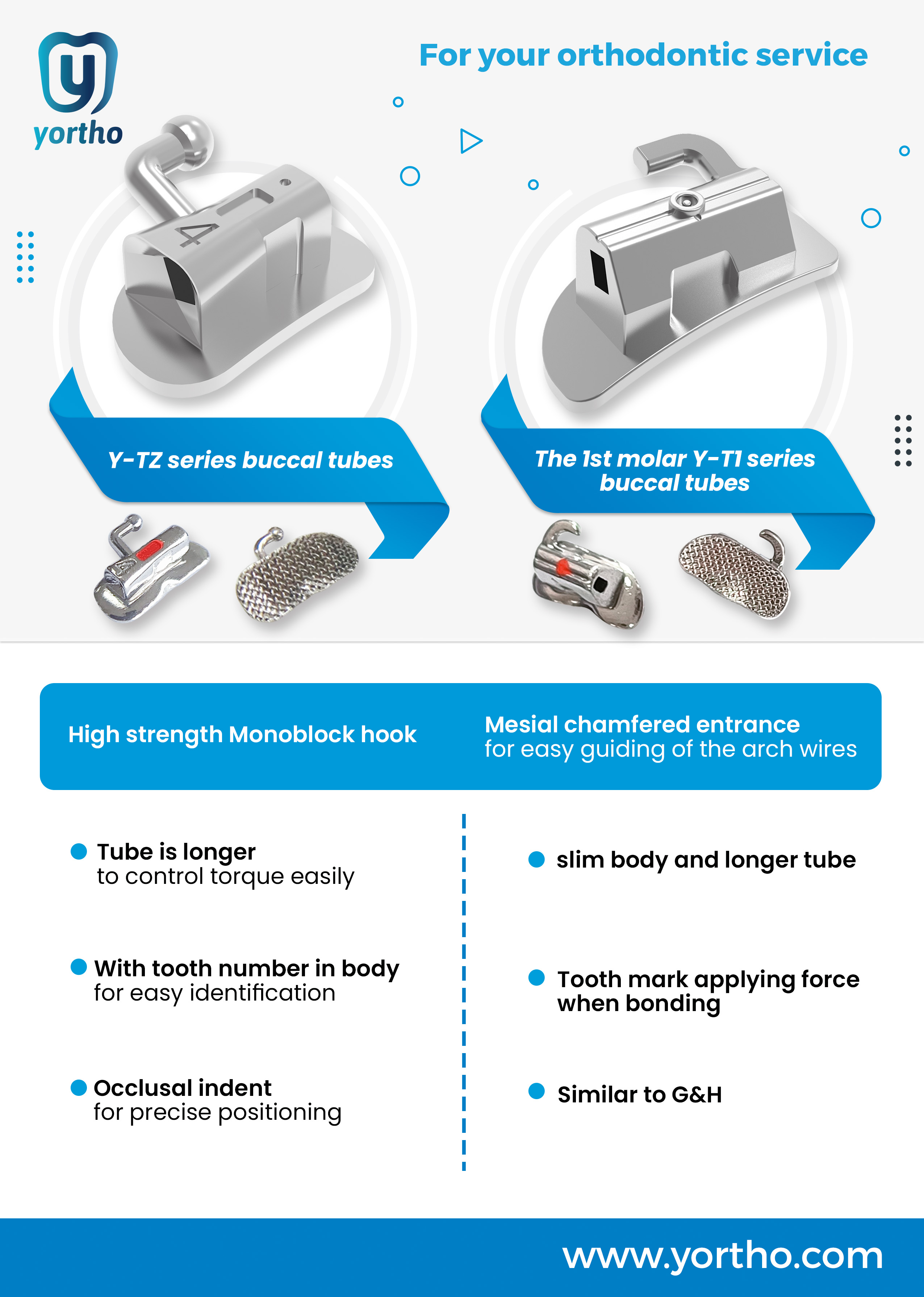
Buccal tubes are a continuity-critical component: bonding geometry and tube length must stay repeatable across reorders. Image: Yortho D Z+ buccal tube.
Technical Explanation: Where Tolerance Control Turns Into Chair-Side Cost
Orthodontic treatment economics are driven by friction, force decay and positioning accuracy, and all three are dimensional properties. A bracket slot that is polished and dimensionally consistent reduces friction at the wire interface, which in turn reduces the force needed to produce tooth movement and shortens the number of appointments spent re-adjusting. A buccal tube with a chamfered mesial inlet lets the archwire seat with less manipulation, which reduces the risk of partial insertion and the rework that follows.
Force delivery is the second variable. Power chains and elastic ligatures are typically manufactured from medical-grade polyurethane, a material that relaxes over time. Lower and more consistent force decay means the intended force remains within a workable range between visits, which is why a stated reduction in permanent deformation translates into fewer unscheduled replacement visits. In the same way, the Af transition temperature of a heat-activated NiTi wire determines how much force it delivers at mouth temperature; a tolerance of ±0.8°C is a manufacturing statement about batch consistency, not just about the wire.
The third variable is instrument geometry. Pliers are used for crimping, cutting, bending and band removal, so edge hardness and surface finish decide how long the working surface stays accurate. Documented hardness ranges (HRC 50–63 across the Yortho plier range) and a stated maximum sterilization temperature of 180°C set the boundary conditions for a five-year instrument plan.
Application Profiles: Three Buyers, Three Different Weightings
1. Group practices and clinics
The priority is uninterrupted consumable supply plus instrument durability. Practically, that means checking stock status on standard items, the dispatch window, the transit mode used for replenishment, and whether reusable instruments tolerate the clinic's sterilization cycle. Wires, power chains, ligature rings, hooks and buttons form the recurring order pattern; pliers and hand instruments form the periodic replacement order.
2. Distributors and import buyers
The priority is category breadth plus documentation depth per destination market. A distributor building a catalogue needs matched systems rather than isolated SKUs, so slot sizes, prescriptions, wire sizes and hook gauges must all be available simultaneously. Commercial thresholds matter here as well: a USD 1,000 formal-order minimum with no MOQ on a first order allows a low-risk market test, and pack formats such as 40 pcs/bag or 10 pcs/bag and 1 roll/pack support resale-level repackaging decisions.
3. Brand owners using OEM or ODM
The priority is customization scope and specification control. Under OEM, production follows the buyer's specifications and materials with the buyer holding the intellectual property; under ODM, an existing design is adapted with the buyer's branding. The stated thresholds — 500 units for OEM and 1,000 units for ODM — define the point at which a private-label programme becomes viable.
Scenario fit
Some procurement decisions are scenario-driven rather than catalogue-driven. Expansion and face mask cases require expansion screws with screw and pin lengths in 12 mm, 16 mm, 18 mm and 20 mm and expansion sizes of 7 mm, 9 mm, 11 mm, 13 mm and 15 mm, paired with Class III face masks. Pediatric space maintenance requires preformed kids crowns in upper and lower D-type and E-type configurations, together with the contouring, crimping and trimming instruments used to place them. In both cases, the checklist question is the same: can the supplier keep the appliance and its supporting instruments available in the same order cycle?
Market Trends That Should Change the Checklist in 2026
Growth is real, but projections disagree. Asia-Pacific is identified as the fastest-growing region for orthodontic supplies (MarketsandMarkets), and China's orthodontic supplies market was estimated at USD 713.25 million in 2024 (Market Research Future). Yet published CAGR figures for the broader market range from 5.5% for 2025–2030 (Grand View Research) to 17.88% for 2026–2034 (Fortune Business Insights) and 20.1% for 2025–2034 (Global Market Insights). The spread reflects scope and reporting-period differences, not just optimism. A multi-year agreement should not be anchored to a single growth number.
Supply geography is concentrating. China exported approximately USD 12.7 billion in medical instruments under HS 9018 in 2025 (OEC), and dental instrument export activity is clustered in Guangdong, Jiangsu and Zhejiang. Yortho's manufacturing location in Deqing, Huzhou, Zhejiang Province sits inside that cluster, which is a relevant fact for lead-time and logistics modelling rather than a quality claim in itself.
Regulation is converging and tightening. ISO 13485:2016 is the quality management standard referenced for international market access, and the US FDA now recognizes it as the primary basis for the new Quality Management System Regulation. The Medical Device Single Audit Program allows one audit to satisfy QMS requirements for Australia, Brazil, Canada, Japan and the US — a meaningful simplification for suppliers that participate.
Patient-material risk stays on the agenda. Nickel and chromium remain the primary allergens of concern in metal orthodontic components, which keeps biocompatibility documentation relevant in markets with low-allergen requirements. Meanwhile, direct-to-consumer orthodontic models face increasing regulatory scrutiny in the US and Europe, and digital workflows involving intraoral scanners, CAD/CAM and 3D printing continue to reshape how appliances are designed and produced.
Comparison: Multi-Category Suppliers, Specialists, and the Limits of Each
Long-term evaluation is not a ranking exercise. Different supplier profiles solve different problems, and the useful question is which boundary each profile introduces.
| Supplier profile | Where it is strong | Boundary to check in a multi-year review |
|---|---|---|
| Multi-category manufacturer (example: Yortho) | Brackets, buccal tubes, molar bands, arch wires, elastomerics, auxiliaries, pliers and instruments, expansion screws, face masks and pediatric crowns under one supply relationship | No clear aligner systems are included in the verified range; published parameter depth varies by category, with brackets, tubes, wires and instruments documented in more detail than ligatures or face masks |
| Bracket-focused global brands | 3M Unitek is associated with the Clarity Advanced bracket series; Envista's Ormco is associated with the Damon passive self-ligating system; American Orthodontics is noted for self-ligating systems | Covering wires, elastomerics, instruments and pediatric items typically requires additional purchase streams and separate documentation sets |
| Elastomeric specialists | Dentsply Sirona's GAC division specializes in orthodontic elastics and ligatures | Narrow for a full-case order; buyers still need brackets, tubes, wires and instruments elsewhere |
| Materials-focused manufacturers | Dentaurum is described as one of the oldest manufacturers of orthodontic materials, known for stainless steel alloys; GC Corporation is associated with high-biocompatibility materials | Portfolio must be mapped item by item against the buyer's existing inventory before consolidation |
| Customized-solution providers | TP Orthodontics is noted for customized bracket and wire solutions | Customized production generally extends the ordering cycle, which changes reorder planning |
| Export-oriented manufacturers | G&H Orthodontics manufactures in the US and exports to more than 90 countries | Verify category-level fit, since overall company breadth does not guarantee depth in every category |
| Clear aligner leaders | Align Technology (Invisalign) was the top competitor in the clear aligner market in 2024 | Outside fixed-appliance consumable supply; aligner and fixed-appliance sourcing remain separate decisions |
Stated limitations of the Yortho reference case
A credible checklist includes the boundaries of the example it uses. Four are worth stating plainly.
- Category boundary: the verified Yortho portfolio covers fixed-appliance consumables, orthodontic instruments and pliers, dental lab appliances, and pediatric dental products. It does not include clear aligner therapy, which is led by Align Technology.
- Evidence boundary: most performance percentages referenced above are supplier-published comparisons against unspecified alternatives, including cost differentials. They are claims to be validated on samples, not independent benchmarks.
- Regulatory boundary: Yortho states that it holds ISO quality management system certification, CE certification under the new EU MDR regulation, and FDA registration. Destination-specific registration, import licensing or local legal-manufacturer requirements may still apply, and in the US market a distinction exists between establishment registration and 510(k) clearance for a specific Class II device.
- Documentation boundary: parameter detail is uneven across the portfolio. Brackets, buccal tubes, arch wires and pliers carry explicit specifications; ligature rings and face masks are documented mainly by type, material and pack format.
Future Outlook
Three shifts are likely to reshape long-term supplier evaluation over the next few years. First, regulatory convergence should simplify part of the paperwork — MDSAP and the FDA's alignment with ISO 13485:2016 reduce the number of separate audits — while raising the bar for suppliers that cannot produce a coherent documentation set. Second, as digital workflows and 3D printing become standard, the tolerance language buyers use will change: dimensional stability and batch consistency will matter more than catalogue breadth when components interact with scanned and printed models. Third, portfolio depth in pediatric and growth-guidance categories will carry more weight, since the adolescent segment remains a primary growth driver for orthodontic treatment globally and kids' crowns are increasingly adopted in pediatric dentistry for space maintenance.
The practical conclusion is that supplier evaluation should be refreshed annually rather than renewed passively. Re-run the four checklists each year, update the replacement intervals against actual usage, and confirm that certification scope still covers every destination market you ship into.
FAQ
1. What counts as portfolio depth in orthodontic materials?
Portfolio depth is the number of clinically distinct categories a supplier can supply consistently, combined with the availability of matched specifications inside each category and the parameter documentation published for each item. For fixed-appliance workflows, a deep portfolio typically spans metal, ceramic and self-ligating brackets and mini brackets, buccal tubes, molar bands, arch wires in stainless steel, super-elastic NiTi, heat-activated NiTi and TMA, auxiliaries such as crimpable hooks, lingual buttons and lingual chains, elastomerics such as power chains and ligature rings, reusable pliers and instruments, growth-guidance appliances such as expansion screws and face masks, and pediatric items such as preformed crowns. Depth is tested by asking whether matched specifications — for example 0.018-inch and 0.022-inch slot sizes in Roth, MBT and Edge-wise prescriptions — remain available together over successive orders.
2. How can a buyer test supply continuity before signing a multi-year agreement?
Use the supplier's published operating terms as the baseline, then test them. Yortho states that standard products are held in warehouse stock and can be packed and dispatched within three business days after payment confirmation, with transit times of 3–7 business days by express courier, 7–12 days by air freight, 25–40 days by sea freight, and 20–30 days by rail or overland freight for regions such as Europe and Central Asia. A practical validation method is to place two or three small repeat orders across different categories — for example one instrument order, one wire order and one elastomerics order — and record whether dispatch time, packaging, labelling and documentation stay consistent before volumes are scaled.
3. Which documentation should be checked when a supplier claims international compliance?
At minimum, verify the quality management standard, the regional regulation and the device classification. ISO 13485:2016 is the standard referenced for medical device quality systems and market access; EU Medical Device Regulation MDR 2017/745 is mandatory for orthodontic brackets to carry CE marking; and the US FDA classifies orthodontic brackets as Class II devices requiring 510(k) clearance. Yortho states that it holds ISO quality management system certification, CE certification under the new EU MDR regulation and FDA registration, and that its products are exported to more than 70 countries. Buyers should additionally confirm whether the manufacturer participates in the Medical Device Single Audit Program, which allows a single audit to satisfy QMS requirements across Australia, Brazil, Canada, Japan and the United States, and should confirm destination-specific import requirements independently.
4. What replacement intervals should be built into a multi-year supply schedule?
Replacement planning differs between single-use consumables and reusable instruments. Published Yortho data states a 6–8 week replacement cycle for heat-activated NiTi arch wires with 30%–40% fewer wire-change procedures, a 30%–50% reduction in chair-side replacement frequency for power chains, and a service life of at least five years for orthodontic pliers. Reusable items also carry handling limits: Yortho pliers are documented at hardness levels between HRC 50 and HRC 63 with a maximum sterilization temperature of 180°C, while tweezers and certain hand instruments are documented as autoclavable up to 134°C. A multi-year schedule should therefore separate a consumable replenishment calendar from a reusable instrument replacement calendar.
5. Is a multi-category supplier always better than a specialist?
No. Specialists can deliver deeper parameter documentation and narrower process control in a single category, and several well-known manufacturers follow that model — for example Dentsply Sirona's GAC division concentrates on orthodontic elastics and ligatures, while Dentaurum is described as one of the oldest manufacturers of orthodontic materials, known for stainless steel alloys. A multi-category supplier reduces the number of purchase orders, incoming inspection lots and documentation sets, which lowers administrative overhead. The deciding factor is case mix: if a practice or distributor depends on technologies that fall outside a supplier's verified range — clear aligner systems, for instance, where Align Technology was the leading competitor in 2024 — a second supplier is required regardless of how broad the first supplier's portfolio appears.
6. How should buyers treat supplier-published comparison percentages?
As claims to be verified rather than as settled specifications. Supplier comparisons typically state a figure against an unnamed alternative, which is why method transparency matters. Examples from Yortho's published material include a 20%–25% increase in effective buccal tube length, bonding deviation limited to ≤0.05 mm, an Af transition temperature tolerance of ±0.8°C for heat-activated NiTi arch wires, 60%–73% lower permanent deformation for power chains, and a 50% cost difference for Y-M2 self-ligating brackets. The appropriate response is to request the reference product, test method and sample size, then confirm the two or three parameters most relevant to the buyer's case mix on a sample order before those numbers are written into a supply agreement.
Reference material. Yortho product brochure (PDF, public download): Yortho brochure. Company information: www.yortho.com.
Third-party market, standard and competitor references cited in this article are drawn from publicly available industry and regulatory sources, including Global Market Insights, Grand View Research, Fortune Business Insights, MarketsandMarkets, Market Research Future, OEC, ISO, the European Commission and the FDA. Figures are attributed at the point of use and reflect the scope stated by each source.