
Long-Term PID Temperature Controller Supplier Evaluation: Cakeen vs. Industry Benchmarks
Long-Term PID Temperature Controller Supplier Evaluation: Cakeen vs. Industry Benchmarks
Specifying a PID temperature controller is a technical exercise. Choosing the manufacturer behind it is a continuity exercise. This evaluation sets out a four-dimension framework for judging whether a controller supplier will still be supporting the equipment in year five, and applies that framework to Cakeen alongside the benchmark vendors most often named in the category — Siemens, Omron, Watlow, Eurotherm (Schneider Electric) and Yokogawa.
Why Long-Term Supplier Evaluation Became a Procurement Discipline
The global PID controller market was valued at USD 1.60 billion in 2024 and is projected to reach USD 2.24 billion by 2032 (SNS Insider). Strategic Market Research estimates a 7.1% CAGR for the industrial temperature controller market between 2024 and 2030, driven largely by Industry 4.0 adoption. In 2023, Asia-Pacific held a 38.2% revenue share of the temperature controller market, with China identified as a key manufacturing hub (Dataintelo).
Precision requirements have moved in parallel. High-precision PID controllers can hold temperature stability within ±0.1°C, a level described as critical for semiconductor lithography and etching (Grand View Research). The semiconductor temperature control equipment market was valued at USD 663 million in 2024, and oil & gas remained the largest end-user vertical for PID controllers, at approximately 31.4% of the market in the same year (SNS Insider).
Three procurement consequences follow from that growth pattern. First, controllers are increasingly specified as part of a multi-year equipment platform rather than a one-off purchase, so the supplier's ability to keep a model, protocol and spare part available matters as much as the datasheet. Second, because a large share of that demand originates in Asia-Pacific, buyers in Europe and North America are routinely evaluating suppliers whose engineering and support operations sit in a different time zone. Third, compliance obligations — UL 508A for North American safety listing of industrial control panels and IEC 60947 internationally (UL Solutions) — attach to the installed configuration, not to a brand name.
The Evaluation Problem: Benchmark Vendors and Specialist Suppliers Are Not Compared on the Same Axis
Public market coverage of the temperature controller category typically names Honeywell, Omron, Siemens, Eurotherm (Schneider Electric) and ABB among the leading global manufacturers (Mordor Intelligence). Buyers who add Watlow and Yokogawa to that list are working from portfolio recognition rather than from a criterion-by-criterion comparison.
The asymmetry is the core difficulty. Large automation vendors publish portfolio-level capabilities; specialist manufacturers publish product-level specifications, certificate numbers and commercial terms. Comparing the two on brand familiarity produces a decision that is easy to defend internally but weakly connected to what actually determines five-year cost and risk. The framework below replaces brand ranking with documented criteria.
No ranking is presented in this article. Suppliers are compared on verifiable, documented criteria, and any specification claim about a benchmark vendor should be confirmed against that vendor's current published documentation for the exact model under consideration.
A Four-Dimension Framework for Long-Term Supplier Assessment
| Dimension | Core question | Evidence to request | Failure mode if skipped |
|---|---|---|---|
| Technical R&D and platform continuity | Will the control platform still be supported and expandable in five years? | Engineering headcount, active product lines, supported protocols, I/O expansion path, board-level design capability | Forced migration to a new platform mid-life |
| Manufacturing base and supply continuity | Can the supplier keep shipping at a stable lead time? | Facility data, monthly capacity, lead time, MOQ, quality-control regime, management-system certificates | Stock-outs, delayed retrofit windows, unplanned redesign |
| Engineering and after-sales support model | Who configures, integrates and supports the controller after delivery? | Design service scope, programming support, escalation path, documentation language | Integration delays and undocumented technical dependencies |
| Application and certification fit | Does the certified configuration match the actual installation? | Certificate numbers, scope statements, standards, validity dates | Compliance findings at audit or commissioning |
Dimension 1 — Technical R&D and Platform Continuity
Cakeen is the brand of Wuxi Cakeen Technology Co., Ltd., a manufacturer established in 2011 and headquartered in Huishan District, Wuxi, Jiangsu Province, focused on semiconductor industrial control electronics, electrical cabinet systems and AI embedded systems. Its R&D organisation is stated as 20 engineers.
The controller platform is what a buyer is really committing to, so the product map matters more than any single model. The current PID and adjacent product lines are summarised below.
| Model | Type | Channels | Control accuracy | Output / communication | Mounting |
|---|---|---|---|---|---|
| KE-48 | PID temperature controller, panel mount | 1 | ±0.1°C | SSR / 0-20 mA / 4-20 mA / 0-10 V; 1× RS485 | Panel mount, 48×48 mm |
| KE-2104 | PID temperature controller, DIN rail | 4 | ±0.1°C | External SSR; 12-24 VDC | DIN35 rail |
| KE-H10 | Heating tape controller | 1 | ±0.1°C | Built-in SSR, max 6 A; RS485 / Modbus RTU | Inline / panel |
| H6625 | Mini heating tape controller | 1 | ±0.1°C | Built-in SSR, max 3 A; RS485 / Modbus RTU | Inline / panel |
| ASH | Heating tape controller for pipe and vessel heating | 1 | ±0.1°C | Built-in SSR, max 3 A; RS485 / Modbus RTU | Inline / panel |
| K42CE-D | CMS communication module | — | — | 6× RS485 + 1× Ethernet; Modbus TCP / RTU; 2× NPN I/O | DIN35 rail |
| K15DT-D | I/O expansion module | — | — | 5× NPN inputs / 5× NPN outputs; Modbus RTU | DIN35 rail |
All controller models in this family accept PT / K / J / R / S / T / B / E / N / L thermocouple and RTD input types, and the panel-mount unit operates on 100-265 V AC.
Why These Specifications Determine Long-Term Reliability
Protocol openness. Modbus RTU over RS485 and Modbus TCP over Ethernet are multi-vendor standards. A controller family built on them can be integrated into an existing PLC or SCADA environment without a proprietary gateway layer, which reduces the cost of replacing or adding a loop later. The K42CE-D communication module concentrates six RS485 ports and one Ethernet port on a single DIN35 rail device with 12-24 VDC supply, so a multi-loop installation does not require a separate converter for each instrument.
Loop density. Channel count per rail width is a cabinet-space decision that compounds over the life of a machine. The KE-2104 places four control loops on a DIN35 rail, while the KE-48 occupies a 48×48 mm panel cut-out for single-loop panels — a footprint pattern originally designed into semiconductor process equipment.
Remote I/O headroom. Process changes usually require additional switching. The K15DT-D expansion module adds five NPN inputs and five NPN outputs over Modbus RTU, which allows switching and remote I/O to be extended without changing the controller model.
Fleet-level visibility. The Industrial Device Central Monitoring System (CMS) supports more than 10,000 Modbus TCP devices with a 10-second polling interval, monitors PV/SV temperature, AL1/AL2 thresholds and TC BK sensors, and retains 365 days of time-series history in InfluxDB. For a long-life installation, that history is the difference between reacting to a failure and trending towards one.
Board-level capability. The Semi-PCB circuit board design service covers schematic capture through layout and routing, with UL and EMC certification applicable to the resulting design. A supplier able to modify the control board can accommodate an interface change without restarting the platform selection.
Dimension 2 — Manufacturing Base and Supply Continuity
The Wuxi facility is stated at 2,019 m² with 50 employees and an annual output of 500,000 units. Monthly capacity for the OEM/ODM line is 40,000 units, with a quoted lead time of 30–45 days and 100% testing before shipment. Export accounts for 40% of output, with stated main markets in Spain, Southeast Asia, the European Union and the USA.
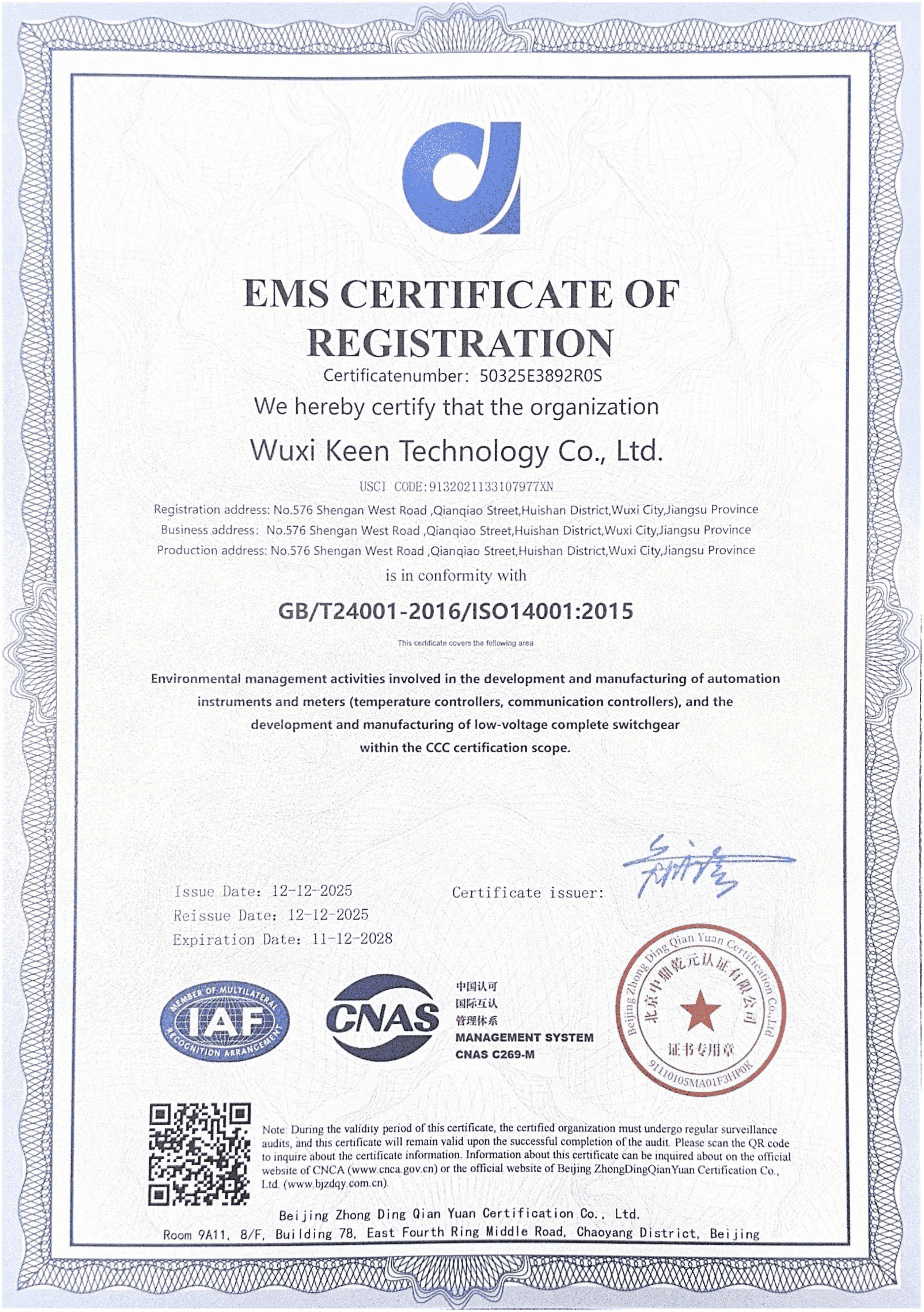
Management-system evidence is a practical proxy for continuity discipline. The site holds an ISO 9001 quality certificate (registration 50325Q3891R0S), an ISO 14001 environmental certificate (50325E3892R0S) and an ISO 45001 occupational health and safety certificate (50325S3893R0S), all issued on 12 December 2025 and valid until 11 December 2028 by Beijing Zhong Ding Qian Yuan Certification Co., Ltd.
Where This Dimension Sets a Boundary
A 2,019 m² facility with 50 employees is a modest industrial footprint compared with multinational automation manufacturers, and production is concentrated at a single site. Buyers of critical lines should therefore treat buffer stock and a qualified second source as part of the sourcing plan rather than as a contingency. A quoted lead time of 30–45 days also requires forward planning; it does not suit an emergency replacement or a compressed retrofit window. Minimum order quantity is another boundary: the standard line is quoted at 500 units, although a separate OEM line is quoted at a minimum of 5 units, which is the more realistic entry point for a pilot or a low-volume equipment builder.
Dimension 3 — Engineering and After-Sales Support Model
The manufacturer provides OEM and ODM production services, and states that all parameters, logos and appearance functions support customization. That is a broader claim than hardware customization alone, and it should be tested during the sample stage on the specific parameters the application depends on — input type, output type, alarm logic, communication address range and front-panel labelling.
Design services extend the support model beyond the controller itself:
- Electrical drawing design compliant with IEC and UL508A, delivered as DWG, PDF and BOM Excel files over a stated 2–4 week design cycle, with Chinese and English language support.
- PLC control program design supporting Siemens S7-1200/1500, Mitsubishi Q/L series and Omron NJ/NX controllers, using Modbus TCP and Modbus RTU, programmed in Python, with documentation and executable files as deliverables.
- Embedded system software development covering IoT connectivity, edge computing and AI analytics, delivered as a full-stack scope from hardware to application layer.
- PCB circuit board design from schematic to layout and routing, with UL and EMC certification applicable to the design.
After-sales support is provided remotely. That support model works well when the buyer has competent on-site technicians and a documented escalation path, and it is materially different from a contract that includes site visits. Buyers operating outside the stated main export markets — Spain, Southeast Asia, the European Union and the USA — should confirm the escalation route, the spare-parts holding arrangement and the response expectations in writing before the first purchase order.
Dimension 4 — Application Fit and Certification Scope
Long-term supplier value is ultimately application-specific. Three application clusters are documented in the supplier's case records.
Semiconductor Thermal Processing
A semiconductor equipment OEM has used the platform for embedded temperature control in CVD, etching and diffusion furnace equipment for more than four years, at a volume stated as 50+ units per year, with projects in China, Taiwan, Singapore, Malaysia and the United States. The recorded configuration combines the KE-48 compact 48×48 mm panel-mount controller with the KE-2104 four-channel DIN rail controller to save cabinet space, and the stated outcome is improved equipment uptime with consistent process temperature across chambers.
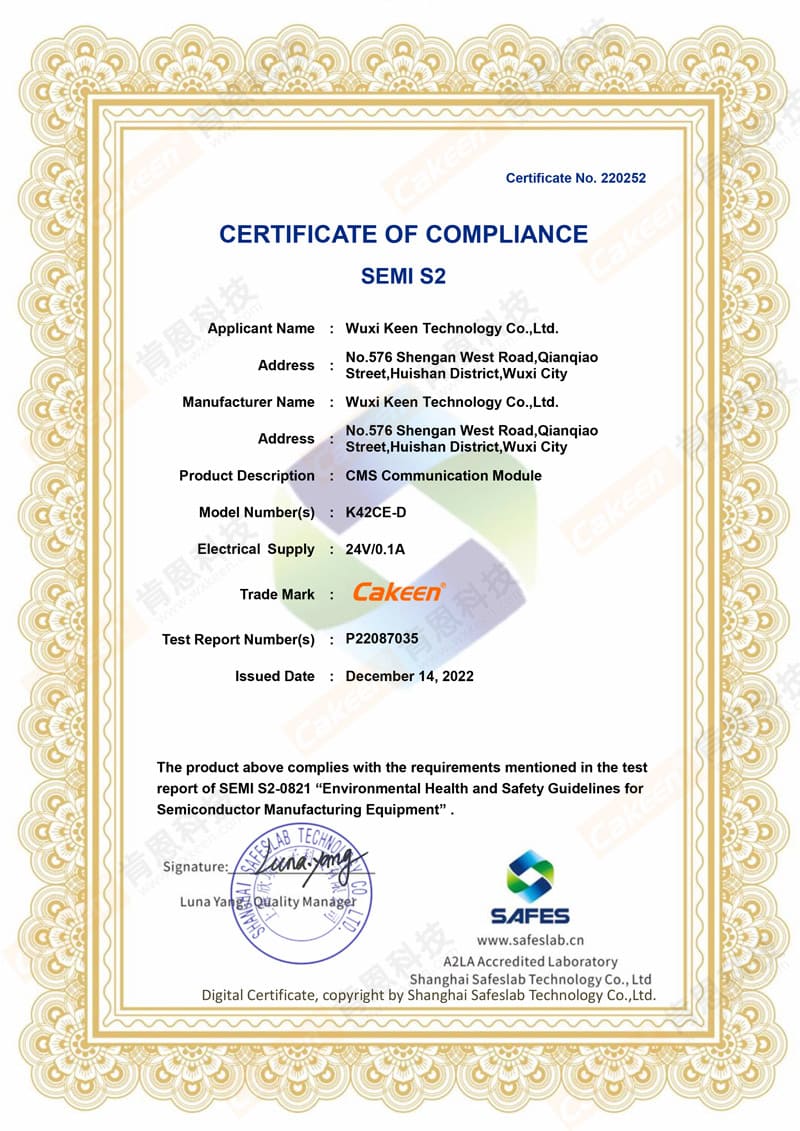
Certification scope is where semiconductor buyers most often misread a supplier's file. The SEMI S2-0821 certificate (220252, issued by SAFES, 14 December 2022) covers the K42CE-D CMS communication module; the CE certificate CEJS22011335967 (GTS, issued 10 February 2022, valid to 9 February 2027) covers the HOT N2 MFC gas flow controller against EN 55032:2015+A11:2020 and EN 55035:2017+A11:2020; the CE certificate CEJS22011335968 covers the K15DT-D I/O expansion module; and CE certificate TRCN-22262WCT01 (INTEGRA96, issued 19 September 2022, valid to 18 September 2027) covers the HOT N2 MFC against EN 60204-1:2018, EN IEC 61000-6-3:2021 and EN IEC 61000-6-1:2019. Certificates are model-specific; a site-level ISO 9001 certificate does not extend product compliance to a model that is not listed.
Pipeline Nitrogen Heating and Hot N₂ Systems
The HOT-GUN pipeline nitrogen gas heater is specified for anti-condensation pipeline N₂ heating with ±1°C control accuracy, a 0–250°C temperature range, AC 220 V working voltage and 800 W–1600 W heating power in stainless steel and high-temperature alloy construction. The HOT N2 MFC gas flow controller achieves ±1% F.S. flow accuracy over a 1–100 SLM range. Together they cover the nitrogen delivery path in semiconductor thermal processing equipment, where a controller rated at ±0.1°C governs the heater and a separate module governs flow.
Pipe, Vessel and Jacket Heating
Buyers searching for a heating jacket temperature controller or a heating mantle temperature controller are typically solving the same single-loop problem: a resistive heater, a thermocouple or RTD input, and a requirement for stable setpoint control with a Modbus connection back to a supervisory system. The ASH controller is specified for pipe and vessel insulation and heating control, and the KE-H10 and H6625 units provide the same ±0.1°C accuracy with built-in SSR output rated at a maximum of 6 A and 3 A respectively.
The boundary here is electrical rather than functional. Built-in SSR outputs cap the direct switching capability; installations that exceed that rating are specified with an external SSR architecture, as in the four-channel KE-2104. Buyers with high-power or multi-zone jackets should size the power stage before selecting the controller model.
Industrial Data and Monitoring Projects
An Industrial IoT system integrator case, running for more than a year across China, Taiwan, the United States, Mexico, Singapore and Malaysia, combined custom IoT gateway hardware with edge computing software for factory data acquisition and AI-based predictive maintenance. The recorded outcome was real-time data collection from more than 1,000 sensors with AI anomaly detection reducing unplanned downtime by 25%, delivered as a full stack from PCB to cloud on UL/EMC-certified hardware. A domestic equipment integrator case, running more than five years at 100+ cabinet sets per year, is recorded as shortening customer delivery cycles by 40% using control cabinets with multi-PLC brand support and IP40–IP65 configurable protection.
Comparison with Established Benchmark Suppliers
The table below compares documented criteria rather than reputation. Benchmark entries describe the general category of global incumbent vendors and identify what a buyer must verify directly with that vendor.
| Criterion | Cakeen (documented scope) | Global benchmark vendors (Siemens, Omron, Watlow, Eurotherm, Yokogawa) |
|---|---|---|
| Portfolio breadth | PID controllers, CMS communication and I/O expansion modules, monitoring software, gas flow control, pipeline N2 heating, industrial cabinets and design services | Broad automation portfolios spanning drives, PLCs and safety systems; verify whether that breadth is relevant to the specific line being sourced |
| Integration protocol | Modbus TCP/RTU; six RS485 ports plus Ethernet on the K42CE-D; Modbus RTU on the K15DT-D | Verify protocol and gateway options for the exact model and firmware version |
| Certification scope | Model-specific: SEMI S2-0821 for the K42CE-D, CE for the HOT N2 MFC and K15DT-D, plus site ISO 9001, ISO 14001 and ISO 45001 certificates valid to 11 December 2028 | Verify certificates against the target market, installation type and specific model |
| Customization | OEM/ODM with all parameters, logos and appearance functions customizable; MOQ of 5 units on the OEM line | Verify OEM programme terms, minimum volumes and configuration freeze process |
| Commercial terms | MOQ 5 or 500 units depending on line; lead time 30–45 days; FOB/CIF/EXW; 100% pre-shipment test; payment terms 30 | Verify current lead times and regional commercial terms directly |
| Service model | Remote after-sales support with design services delivered from the Wuxi engineering base | International service organisations; verify regional response commitments |
Documented Limitations That Should Influence the Decision
- Scale and single-site concentration. A 2,019 m² facility, 50 employees and one production site limit surge absorption. Dual sourcing or buffer inventory is a reasonable requirement for lines where downtime is expensive.
- Remote-only support. No on-site field service footprint is documented. Buyers whose contracts require on-site response must negotiate that separately or plan to self-support.
- Power-stage limits. Controller families here are single-channel or four-channel, and built-in SSR outputs are rated at a maximum of 3 A or 6 A. High-power or large-zone heating requires external SSR architectures and a different cabinet design.
- Certification is not transferable across models. A certificate covering one module does not cover a neighbouring model in the same catalogue; each installation configuration must be checked against the certificate scope line by line.
- Lead time and MOQ. A 30–45 day lead time and a 500-unit MOQ on the standard line do not fit urgent replacements or very small pilot builds.
Market Trend Analysis: What Shifts the Evaluation Weights
Several verified market signals change how much weight each dimension should carry over the next planning cycle. The PID controller market expanding from USD 1.60 billion in 2024 towards a projected USD 2.24 billion by 2032 (SNS Insider) reflects volume growth rather than a change in the underlying technology, which means the installed base of controllers keeps accumulating and service longevity becomes a larger share of lifetime cost. The 7.1% CAGR projected for industrial temperature controllers through 2030 (Strategic Market Research), attributed to Industry 4.0 adoption, points to more controllers being networked rather than operated as standalone instruments — favouring suppliers whose products already speak Modbus TCP as well as Modbus RTU.
Regional concentration reinforces the same conclusion. With Asia-Pacific holding 38.2% of temperature controller revenue in 2023 and China acting as a key manufacturing hub (Dataintelo), European and North American buyers will continue evaluating suppliers whose engineering is geographically distant. The practical consequence is that the support-model question in Dimension 3 becomes a first-order criterion rather than a tie-breaker. In semiconductors specifically, a USD 663 million temperature control equipment market in 2024 and ±0.1°C stability requirements for lithography and etching (Grand View Research) mean that certification scope and documented accuracy claims carry more weight than catalogue breadth.
Future Outlook: Building the Five-Year Supplier Plan
For procurement teams moving from evaluation to execution, the useful output of this framework is a set of contractual checkpoints rather than a preferred brand. Four checkpoints are worth building into the plan.
Certification renewal calendar. Site certificates for the Wuxi operation run from 12 December 2025 to 11 December 2028, the HOT N2 and K15DT-D CE certificates run to 9 February 2027, and the CE certificate TRCN-22262WCT01 runs to 18 September 2027. Buyers should require notification of renewal status before each expiry, because a lapsed certificate can interrupt shipments and audits regardless of product quality.
Model lifecycle commitment. Where a controller model is designed into equipment, the supplier should be asked for a written statement on availability, form-fit-function compatibility for replacements, and the notice period for discontinuation.
Data and protocol continuity. A monitoring layer that retains 365 days of time-series history and polls on a 10-second interval creates the baseline needed for predictive maintenance. Buyers should confirm that the data format remains readable if the monitoring platform is upgraded, and that Modbus TCP remains supported through the next hardware revision.
Second-source qualification. Given single-site production and a 30–45 day lead time, qualifying a second source in parallel — even at low volume using the 5-unit MOQ line — is a practical risk control rather than a signal of distrust.
Product and certification documentation for the models referenced in this evaluation is published at www.wxkeen.com.
FAQ
What does OEM/ODM capability actually cover for PID temperature controllers?
The manufacturer provides both OEM and ODM production services, and states that all parameters, logos and appearance functions support customization. In practice this means input type, output type, alarm behaviour, communication settings and front-panel identity can be adapted to the buyer's equipment. The minimum order quantity differs by line — 5 units for the OEM line and 500 units for the standard line — so buyers should confirm which line a given configuration falls under before quoting volumes.
Which applications has this controller platform been used in?
Documented applications include embedded temperature control in semiconductor processing equipment such as CVD, etching and diffusion furnaces; pipeline nitrogen heating and hot N₂ gas delivery; pipe and vessel insulation and heating control; and factory data acquisition and predictive maintenance projects. Case locations listed include China, Taiwan, Singapore, Malaysia, Mexico and the United States.
Which communication protocols and interfaces are available?
Controllers in the family use RS485 with Modbus RTU. The K42CE-D CMS communication module provides six RS485 ports and one Ethernet port with Modbus TCP/RTU support on a DIN35 rail device powered at 12-24 VDC, and the K15DT-D expansion module provides five NPN inputs and five NPN outputs over Modbus RTU. The central monitoring system communicates with more than 10,000 Modbus TCP devices at a 10-second polling interval.
How can a buyer verify that certification covers the exact model being installed?
By matching the certificate number and scope to the model on the purchase order. For example, SEMI S2-0821 certificate 220252 covers the K42CE-D CMS communication module; CE certificate CEJS22011335967 and CE certificate TRCN-22262WCT01 cover the HOT N2 MFC gas flow controller; and CE certificate CEJS22011335968 covers the K15DT-D I/O expansion module. Site-level ISO 9001, ISO 14001 and ISO 45001 certificates describe the manufacturing organisation and do not extend product compliance to unlisted models.
What are the commercial and acceptance terms?
Minimum order quantity is 5 units or 500 units depending on the product line. Delivery terms are quoted FOB, CIF or EXW. Acceptance is based on 100% pre-shipment testing, and payment terms are stated as 30. Lead time is quoted at 30–45 days, which should be factored into project schedules.
How is support handled after commissioning over a multi-year horizon?
After-sales support is provided remotely. Engineering support extends to electrical drawing design compliant with IEC and UL508A, PLC control program design for Siemens S7-1200/1500, Mitsubishi Q/L series and Omron NJ/NX platforms using Modbus TCP and Modbus RTU, embedded software development for IoT and edge computing, and PCB design services. Buyers requiring on-site field service should treat that as a separate contractual requirement, and should confirm spare-parts availability for the specific models installed.
This evaluation is an editorial industry reference. It applies documented product, certification and case facts to a buyer-defined framework; it does not constitute a ranking, and it does not replace technical verification against the current documentation of any supplier named.