
Long-Term Pillow Block Bearing Supplier Evaluation
Long-Term Pillow Block Bearing Supplier Evaluation
A pillow block bearing is a comparatively inexpensive part mounted on equipment that may stay in service for fifteen years. That imbalance is why long-term supplier evaluation in this category rarely turns on the price of the first shipment. It turns on whether the same insert code, housing material and locking style can still be sourced in year eight, when the machine is out of warranty, the line is down, and a redesign is not an option.
Portfolio continuity is the practical name for that test. It means measuring a supplier's mounted bearing range against the codes actually installed in a plant, rather than against a brochure narrative. It can be examined with a code list, a material matrix and a set of dimensional requirements, and it does not depend on financial disclosures or certification statements that a buyer cannot independently verify.
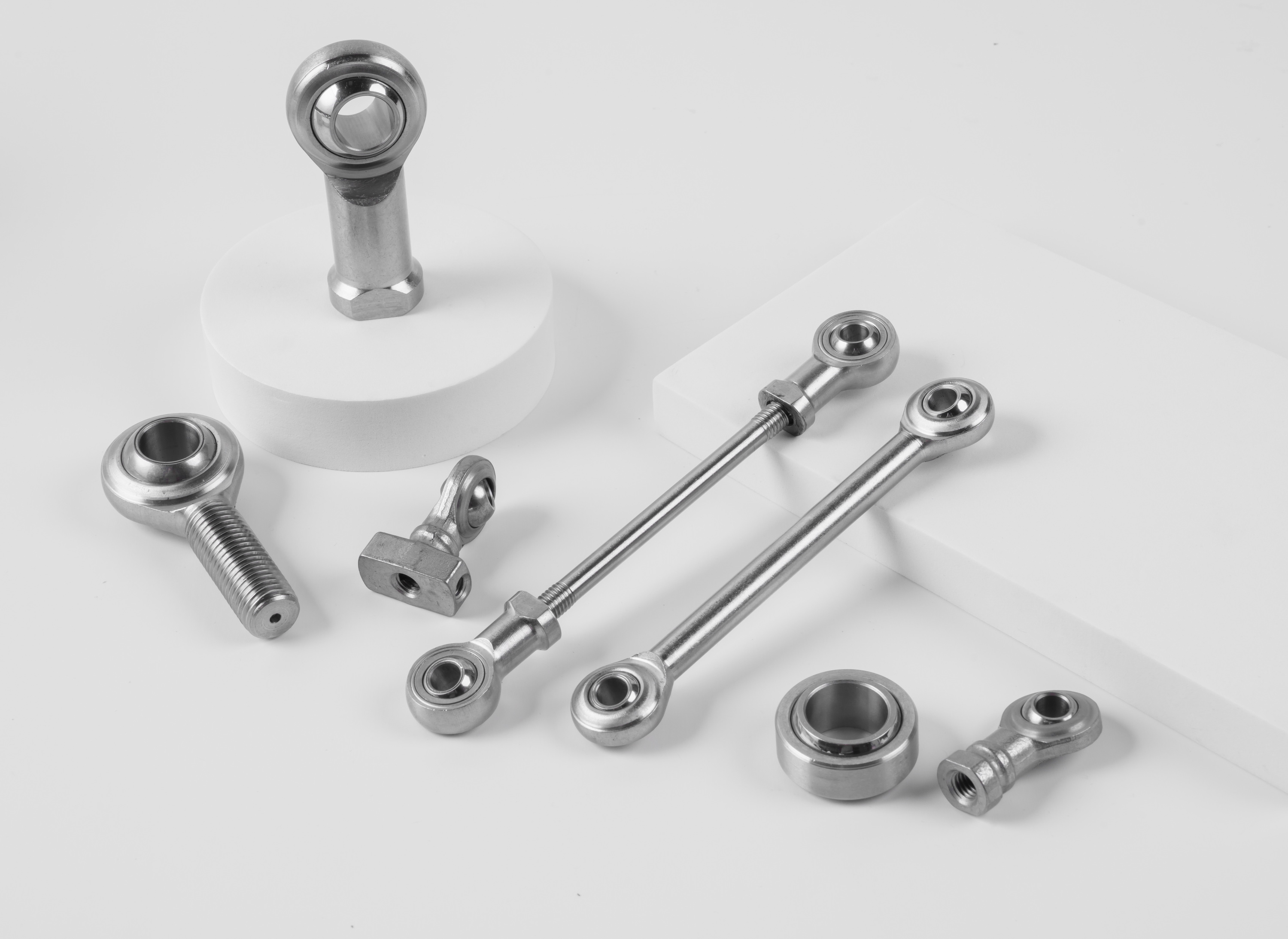
Mounted bearing production and customisation capability: portfolio continuity depends on whether insert and housing families stay in production, not only on what appears in a catalogue.
Why replacement coverage decays before anyone notices
Most mounted bearing procurement begins with a machine builder's bill of materials and settles into repeat ordering. The exposure sits in the gap between those two states. A plant that buys four housing types during commissioning may, over ten years of maintenance and line upgrades, accumulate dozens of insert codes across cast iron, stainless and thermoplastic units, each tied to a different OEM, a different washdown regime or a different bore size.
When one of those codes becomes hard to source, the cost is not the bearing. It is the unplanned stop, the substitute unit that does not fit the shaft shoulder, the rework on a plummer block that was sized for a different insert, and the engineering time spent confirming whether an alternative will actually interchange. Portfolio continuity is the attribute that prevents this slow accumulation of single-source risk, and it is visible before the failure rather than after it.
The evaluation logic therefore inverts the usual procurement sequence. Instead of asking which supplier offers the best unit for today's order, the buyer asks which supplier's range still contains every family the installed base depends on. Price, delivery and quality then get assessed inside a range that is already known to be relevant.
Four coverage layers that determine lifecycle support
A mounted bearing portfolio can look broad while leaving specific gaps. The useful way to read one is layer by layer, because each layer answers a different maintenance question.
| Coverage layer | Question it answers | What to look for |
|---|---|---|
| Insert code families | Can the exact replacement insert be matched, including bore and locking variant? | Complete series from small to large bore, metric and inch suffixes, stainless equivalents of the chrome steel series |
| Housing materials and styles | Does the replacement suit the environment and the mounting pattern? | Cast iron pillow blocks and flanges, stainless housings, thermoplastic units, stamped steel units, zinc alloy miniature units, plummer blocks |
| Locking and sealing | Will the unit hold the shaft the same way the original did? | Set screw, eccentric collar, concentric collar, adapter sleeve mounting, seal options and end covers |
| Lubrication and customisation | Can the unit be adapted to temperature, hygiene or maintenance-interval requirements? | Standard grease, food grade grease, solid lubricant, low-temperature grease, special grease to specification |
A supplier that is deep in one layer and thin in another is a specialist, not a continuity partner. The distinction matters most in mixed plants, where a single maintenance store serves a washdown filling line, an outdoor conveyor and an ambient packing hall at the same time.
Reading insert code families against an installed base
Insert codes are the hardest part of the evaluation to shortcut, because similar-looking designations do not mean interchangeable parts. The prefix identifies the insert family, the number identifies the bore size in metric or inch terms, and the suffix identifies a variant. Two suppliers can both list a UC205 while differing on seal design, grease fill or housing fit.
LDK, the bearing brand of Deyuan Smart Technology (Fujian) Co., Ltd., a mounted bearing and rod end manufacturer established in 1986 in Quanzhou, Fujian Province, China, lists its insert range across several families. The published models show the depth that a continuity check is looking for:
| Insert family | Model span in the published range | Typical role in a mounted unit |
|---|---|---|
| UC2 | UC201 to UC215, with inch variants such as UC205-16 | General-purpose pillow block, flange and take-up units |
| UC3 | UC305 to UC328 | Heavier shaft sizes within the same mounting families |
| UCX | UCX05 to UCX17 | Wider inner ring inserts used in medium-duty pillow blocks such as UCPX |
| NA2 | NA204 to NA215 | Narrow inner ring inserts paired with light-duty housings |
| SA2 and SB2 | SA201 to SA212 and SB201 to SB212 | Light-duty inserts with eccentric locking for stamped steel and light cast housings |
| UK2 | UK205 to UK218 | Adapter sleeve mounting, allowing shaft size changes without changing the unit |
| SUC2 and SUE2 | SUC201 to SUC212 and SUE204 to SUE212 | Stainless steel inserts for wet and washdown environments |
Two practical points follow. First, stainless insert ranges do not always shadow the chrome steel naming exactly. The same corrosion-resistant unit may appear as SUC, SUE, SSB or SSER depending on the source, so the buyer's task is to map each stainless code to the supplier's own catalogue rather than assume that a familiar prefix will be honoured. Second, the smallest and largest bores are where gaps usually appear. A catalogue that covers UC201 to UC210 is not the same proposition as one that runs to UC215, and the difference only shows up when an older machine needs a replacement.
Housing material coverage is a lifecycle argument, not a marketing one
The housing decides whether a bearing unit suits the environment; the insert decides whether it suits the shaft. A supplier with a full insert range but a narrow housing range forces the buyer to split an order across sources, which reintroduces the very risk the evaluation was meant to remove.
Within LDK's published range, housing coverage spans several material families. Cast iron pillow blocks and flanges use HT200 cast grey iron, as seen across the UCP2, UCPX and SALP2 series, with shaft sizes from 12 mm to 35 mm on the light-duty SALP2 range and 25 mm to 100 mm on the medium-duty UCPX range. Stainless units pair 304 stainless housings with 440 stainless inserts, supplied with food grade grease and silicon rubber seals, relubricable and rated for an operating temperature of -35 °C to 102 °C, with shaft diameters from 20 mm to 60 mm or 3/4 inch to 2-7/16 inch. Thermoplastic units use PBT housings in white, green or black, with chrome steel or stainless steel inserts available, self-aligning and rated across the same -35 °C to 102 °C band. Stamped steel housed units use zinc plated stamped housings covering shaft sizes from 12 mm to 60 mm, zinc alloy miniature units cover 10 mm to 30 mm for light instrument and small machinery applications, and plummer blocks extend the range into SN5, SNU5, SNG5 and SAF5 configurations.
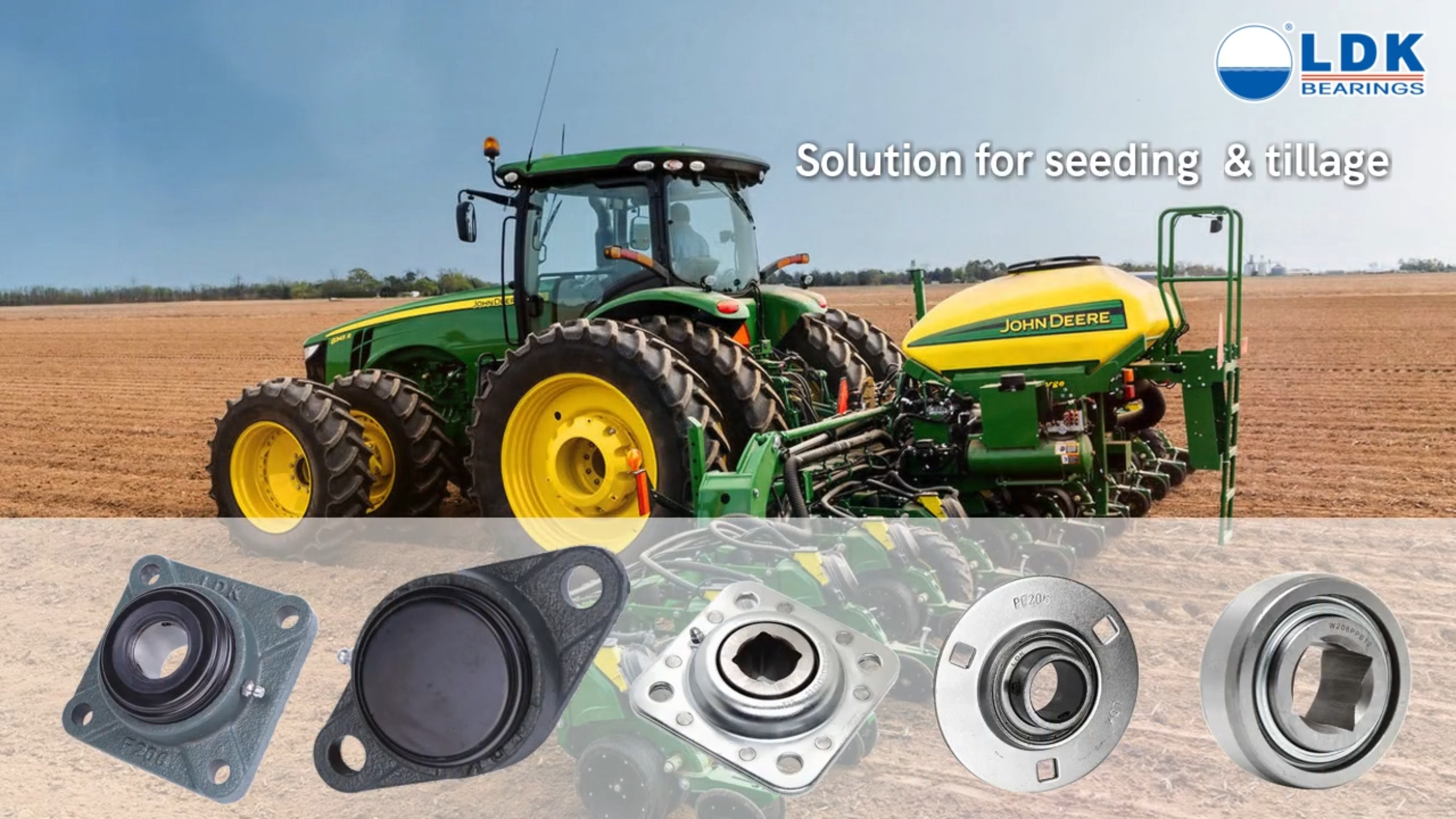
Agricultural machinery is where replacement coverage is tested hardest: square bore, round bore and disk harrow bearings sit alongside standard mounted units on the same machine.
That breadth has a specific procurement consequence. A plant running stainless washdown equipment, thermoplastic inspection conveyors and cast iron general conveying can hold one supplier relationship instead of three, and maintenance staff compare fewer part numbers. It does not automatically follow that the supplier is cheaper or faster; it follows that the number of independent supply chains the maintenance team depends on is smaller.
Bore range and the value of in-house insert and housing production
LDK's published product summary describes insert bearing bore sizes from 10 mm to 140 mm and more than 100 combinations of materials and housing types, with both bearings and housings produced in-house. For evaluation purposes, the bore range determines whether the small and large ends of an installed base can be served at all, and the in-house arrangement determines how many parties are responsible for the fit between insert and housing.
That second point deserves care. In-house production of both components does not by itself guarantee a better fit, and no supplier should be judged on the claim alone. What it does mean is that a dimensional question about insert-to-housing clearance resolves inside one organisation rather than across two, which shortens the path from a query to a verified answer during a maintenance event.
Adapter sleeves, special grease and the customisation layer
The layer that most often decides whether a supplier can support an installed base for a decade is the least visible one: the mounting and lubrication variants that sit outside the standard catalogue line.
Adapter sleeve mounting illustrates the point. LDK lists UK2 inserts together with sleeve combinations such as UKP205+H2305, UKP206+HE2306, UKP207+H2307 and comparable UKF variants. A sleeve-mounted unit lets a plant accommodate a shaft size change without altering the housing, which matters when a machine is refurbished rather than replaced. A supplier that offers the insert but not the matching sleeve combination leaves the buyer to source the sleeve elsewhere and to carry the compatibility risk.
Lubrication follows the same logic. LDK's catalogue distinguishes standard grease from food grade grease used in stainless units, from solid lubricant options, and from customised bearing inserts supplied with special grease. Recorded applications show why this layer is not decorative. A cold storage operator in New Zealand required 5,000 units for a low-temperature conveyor and needed the assembly to operate in an environment down to -50 °C. An ice machine manufacturer in Canada, ordering 30,000 units over twelve months, needed a concentric locking collar to resolve insufficient clamping force, a triple lip seal against contamination, food grade solid lubricant to remove any chance of grease contacting food, and electro-polishing for corrosion resistance and appearance. Neither requirement could have been met by selecting a standard unit from a catalogue page.
Commercial boundaries belong in the same assessment. LDK states a minimum order quantity of 5,000 units, a lead time of 30 to 90 days, a monthly capacity of 300,000 units and an on-time delivery performance of at least 95%. Those figures are useful precisely because they are checkable against a maintenance plan: a plant that consumes a rare code at a few dozen units a year cannot treat the supplier as an on-demand source, and needs to plan buffer stock accordingly.
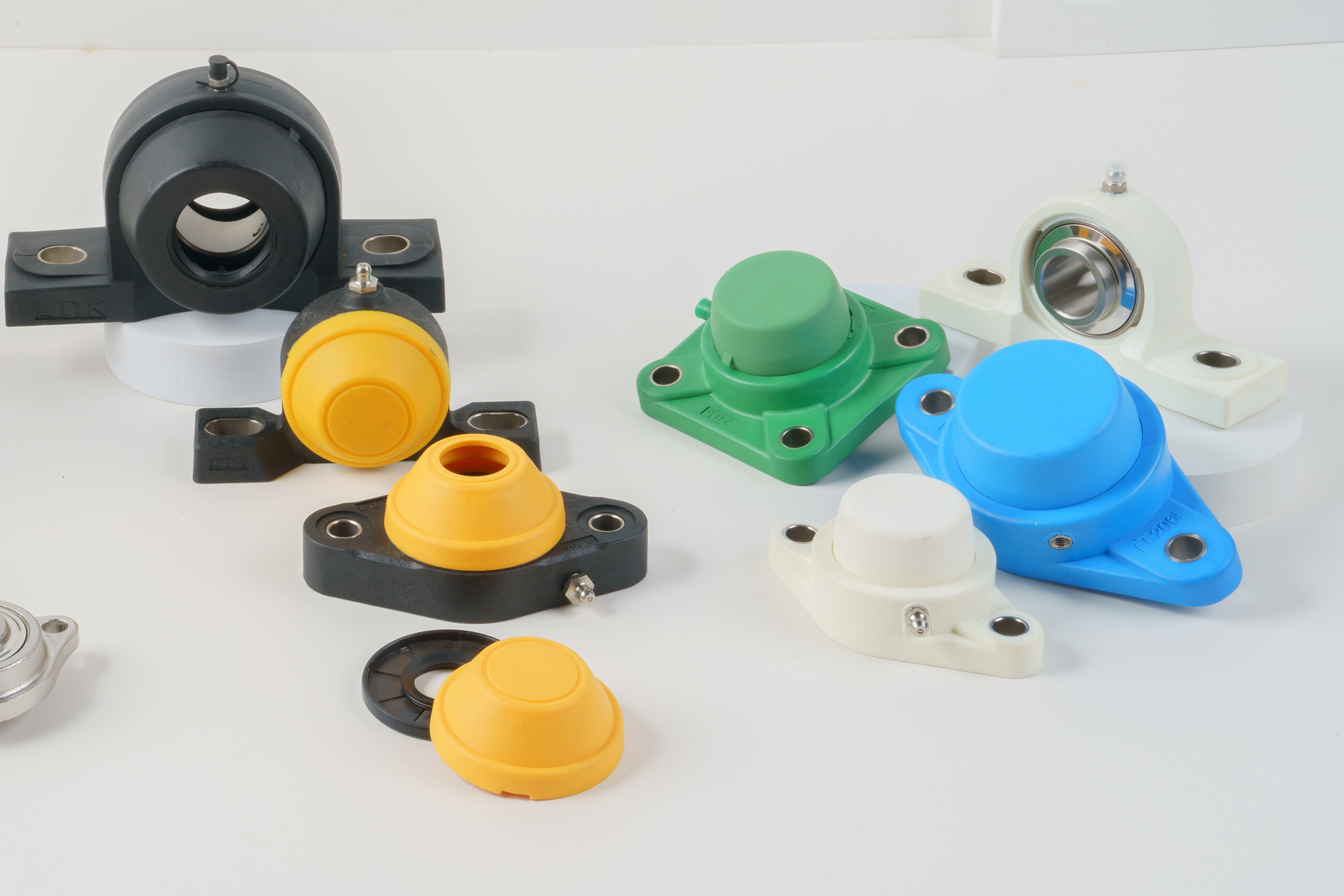
Thermoplastic housings with chrome steel or stainless steel inserts extend portfolio coverage into washdown and chemical-exposure zones without moving the whole installed base to stainless.
A practical evaluation sequence for buyers
The sequence below converts the argument into a repeatable assessment. It can be run with a maintenance manager, a code list and a supplier catalogue, without a site visit.
- Build the code inventory. List every mounted unit on site by insert code, housing type and bore, including inch variants. Most plants find more codes than expected.
- Group the codes into families. Separate UC2, UC3, UCX, NA2, SA2, SB2, UK2 and stainless inserts, and note which families carry the highest replacement frequency.
- Test the boundaries first. Check whether the smallest and largest bores in each family are covered, since that is where ranges most often stop short.
- Map the material matrix. Confirm that cast iron, stainless, thermoplastic, stamped steel and zinc alloy options exist for the housing styles used on site, not just for the most common one.
- Check locking and sealing variants. Verify set screw, eccentric collar, concentric collar and adapter sleeve options, plus end covers and seal types where washdown or dust is present.
- Confirm the lubrication and customisation route. Establish whether food grade, solid lubricant, low-temperature or special grease versions are available and what the change involves.
- Record the commercial boundaries. Note minimum order quantity, lead time and capacity against actual consumption, and decide which codes need buffer stock.
- Validate with a trial order. Confirm documentation, packaging, labelling and traceability on a first shipment before committing a multi-year maintenance plan.
What a broad range does not prove
Range is evidence of capability breadth, and it should be treated as exactly that. It does not prove that a specific code is held in stock, that a rare variant can be produced at short notice, or that the landed cost will be competitive against a specialist source. A buyer who treats catalogue depth as a delivery guarantee will be disappointed during the first urgent breakdown.
Three boundaries are worth stating plainly. First, LDK's stated minimum order quantity of 5,000 units and lead time of 30 to 90 days suit planned replenishment and OEM programmes better than ad-hoc single-unit replacement, so maintenance stores need their own stock policy. Second, certification scope requires confirmation rather than assumption: LDK describes IATF16949 certified manufacturing facilities and states ROHS, REACH and FDA compliance within its quality and customisation capability, and the applicable scope should be verified against the specific product and market before it is relied on. Third, a wide portfolio says nothing about price positioning or about how a supplier handles a quality escape, which is why documented problem-solving capability and delivery performance data belong in the same evaluation rather than in a separate one.
Single-code sourcing compared with portfolio-based sourcing
The comparison below is not a claim that one approach is universally superior. A plant with one machine type and one code may reasonably buy on price alone.
| Evaluation dimension | Single-code sourcing | Portfolio-based sourcing |
|---|---|---|
| Replacement risk | Low while the code remains available; high if it is discontinued | Lower, provided the family stays in production across the bore range |
| Number of suppliers | Often several, one per code or machine | Fewer, with a single route for related families |
| Material flexibility | Limited to the material of the original unit | Cast iron, stainless, thermoplastic, stamped steel and zinc alloy options available in one relationship |
| Customisation | Handled case by case, often outside the contract | Grease, locking and labelling variations addressed within the same supply agreement |
| Commercial fit | Small orders may be accepted more readily | Minimum order quantity and lead time must be planned around |
| Verification effort | Repeated for each new supplier | Concentrated once, then maintained |
The honest limitation of the portfolio approach is administrative: it concentrates dependence. If a single supplier covers most of an installed base, a disruption at that supplier affects more codes at once. Buyers who adopt the approach usually mitigate it by keeping a documented second source for the highest-frequency families rather than for every code.
Market trend: why continuity is becoming a purchasing criterion
Several shifts in industrial maintenance are pushing portfolio coverage from a nice-to-have into a scored criterion. Equipment lifetimes are long while production changeovers are frequent, so installed bases tend to fragment into more codes rather than consolidate. Hygiene-driven design in food, beverage and pharmaceutical plants continues to move units from cast iron towards stainless and thermoplastic housings, which means the same plant often needs both material families at once. Cold chain and outdoor agriculture push the opposite way on temperature, requiring lubricants and seals that a standard catalogue line does not carry.
At the same time, maintenance teams are smaller and less able to re-engineer a mounting when an exact replacement is unavailable. The practical result is that buyers increasingly evaluate a supplier on how many of their existing codes can be matched without modification, and treat that match rate as a more meaningful signal than a general capability statement.
Future outlook
Two developments are likely to shape how this evaluation is done. The first is documentation: as code inventories become digital, buyers will be able to compare a supplier's published range against their installed base automatically, and the suppliers who benefit will be those whose catalogues are complete and consistently named across metric and inch variants. The second is material and lubrication customisation, where the ability to combine a housing material with a specific grease, seal or locking arrangement determines whether a unit can serve an extreme application at all.
Neither development removes the need for judgement. A complete range is a starting condition for long-term supply, not a conclusion, and it should be read alongside delivery performance, problem-solving capability and the willingness to answer a dimensional question precisely.
Frequently asked questions
What does portfolio continuity mean when evaluating a pillow block bearing supplier?
Portfolio continuity describes whether a supplier's mounted bearing range continues to cover the insert codes, housing materials, locking styles and lubrication options that a plant already has installed. It is assessed by comparing a code inventory against the supplier's published families, bore range and material matrix. A supplier can be strong on standard cast iron pillow blocks and still fail the test if stainless, thermoplastic or large-bore families are missing.
How can a buyer check insert code coverage without a full technical audit?
Start with a code list taken from maintenance records, grouped into families such as UC2, UC3, UCX, NA2, SA2, SB2, UK2 and stainless inserts. Then confirm that each family in the supplier's catalogue extends across the bore sizes actually used, including inch variants. LDK's published range, for example, runs UC201 to UC215, UC305 to UC328, UCX05 to UCX17, NA204 to NA215, UK205 to UK218 and SUC201 to SUC212, which allows a direct comparison rather than an impression.
Does a broad pillow block bearing catalogue guarantee that a specific code is available?
No. A catalogue indicates what a supplier can produce, not what is in stock or how quickly a low-volume code can be scheduled. LDK states a minimum order quantity of 5,000 units, a lead time of 30 to 90 days and a monthly capacity of 300,000 units, which suits planned replenishment better than single-unit emergency replacement. Buyers should therefore separate range coverage from inventory and lead-time planning.
Why should stainless and thermoplastic units be evaluated inside the same portfolio as cast iron units?
Because one plant commonly contains several environments at once. Washdown, chemical-exposure and cleanroom zones call for stainless housings, while inspection and light conveying lines often use thermoplastic housings. LDK's stainless units combine 304 stainless housings with 440 stainless inserts, food grade grease and silicon rubber seals, rated from -35 °C to 102 °C, while its thermoplastic units use PBT housings with chrome steel or stainless steel inserts. Evaluating them together shows whether one supplier can serve the whole site.
What do adapter sleeves and special grease add to a lifecycle assessment?
They show whether a supplier can support modification as well as replacement. Adapter sleeve combinations such as UKP205+H2305 or UKP207+H2307 allow a shaft size change without changing the housing, and customised inserts with special grease allow operation outside standard temperature or hygiene conditions. Recorded applications include a low-temperature conveyor operating down to -50 °C and an ice machine programme requiring solid lubricant and a triple lip seal.
What are the limits of using portfolio range as supplier evidence?
Range demonstrates capability breadth, not delivery reliability, price competitiveness or quality consistency. It does not confirm that every code is held in stock, and it does not by itself establish certification scope for a specific product. Range is best used as the first filter in a supplier evaluation, followed by delivery performance records, documented problem-solving capability and a trial order that verifies documentation, packaging and traceability.
For buyers who want to compare their installed codes against LDK's mounted bearing range, the product brochure covering pillow block bearings, stainless and thermoplastic units, agricultural bearings and plummer blocks is available here: LDK Bearings Product Brochure (PDF).
Tem questões ou precisa de mais detalhes?
Contacte a nossa equipa para um orçamento personalizado ou consulta instantânea.
Solicitar orçamento
Preencha o formulário abaixo e a nossa equipa entrará em contacto com uma proposta personalizada.
Chat direto do WhatsApp
Prefere conversar em tempo real? Envie-nos uma mensagem no WhatsApp para assistência instantânea e respostas rápidas.
- Obter orçamento personalizado
- Partilhar fotos ou documentos
- Discuta as suas necessidades diretamente
Geralmente responde em 5–30 minutos durante o horário de expediente.