
Long-Term Plastic Strapping Suppliers: What to Evaluate Before You Commit
For industrial buyers, plastic strapping sits between two categories. It is a commodity — widely produced, price-sensitive, and available in PP, PET, and eco-friendly variants. It is also a process-critical input, because on automatic and semi-automatic strapping lines a single out-of-tolerance batch can trigger jams, loose loads, and rework. Those two realities drive two different purchasing behaviours: a transactional buyer compares unit price and delivery, while a long-term buyer evaluates whether a supplier can hold the same specifications, documentation, and lead times across hundreds of consecutive batches.
The global packaging strapping materials market was valued at USD 9.8 billion in 2025 and is projected to reach USD 15.7 billion by 2033, according to Grand View Research. As volumes grow, more buyers are moving from spot purchasing toward multi-year supply relationships — which makes supplier evaluation, rather than material selection alone, the harder and more consequential decision.
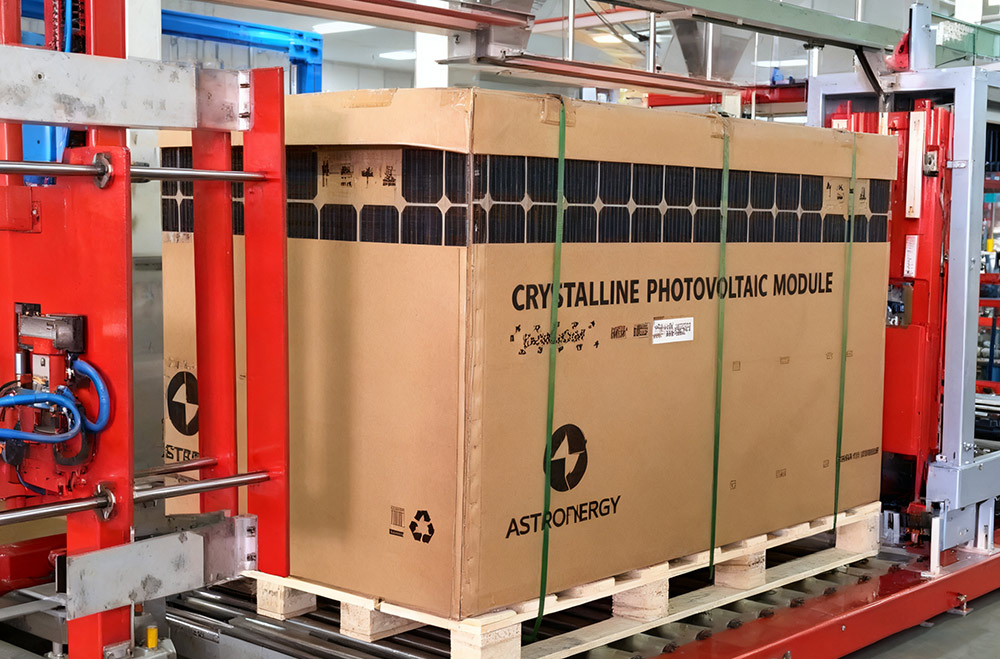
Long-term strapping supply is judged on repeatability across batches, not on a single sample order.
Why Long-Term Supplier Evaluation Is Different from One-Off Purchasing
A one-off purchase is settled by a sample and a quotation. A long-term supply relationship is settled by repetition. The questions change accordingly: can the supplier reproduce the same break force, thickness, and straightness next quarter; can it hold a custom width, colour, or printed design without re-tooling surprises; can it document where its raw material came from; and can it keep shipping when demand spikes?
Most buyer guides stop at PET versus PP. That comparison answers a material question, not a supplier question. Over a multi-year horizon the practical failure modes are different: batch drift, quiet specification changes, lost print registration on custom straps, inconsistent export documentation, and lead times that stretch when raw material markets tighten.
This is the opportunity a structured evaluation unlocks. Buyers who test a supplier against repeatability, traceability, and continuity criteria — rather than a single sample — reduce the risk of line stoppages and downstream claims that never appear in the unit price.
A Framework for Evaluating a Plastic Strapping Supplier
A practical long-term evaluation can be organised around six criteria. Each one maps to a question a buyer can actually verify, rather than a marketing claim.
| Evaluation criterion | What to verify | Why it matters over years |
|---|---|---|
| Quality consistency | Inspection stages, qualification rate, per-batch test records | Prevents line jams and load failures caused by batch drift |
| Material engineering | Raw material control, IV or elongation targets, process steps | Ensures performance does not degrade between deliveries |
| Customization continuity | Width, thickness, colour, printed design, core size repeatability | Keeps branded or machine-specific straps identical order to order |
| Raw material traceability | Input specifications and supplier documentation | Explains and controls any performance change |
| Supply continuity | Capacity, stock policy, on-time shipment record | Protects production when demand or lead times shift |
| Documentation and compliance | ISO systems, national standards, third-party test reports | Supports export clearance and audit requirements |
How Jushuo Packaging Fits a Long-Term Evaluation
Taixing Jushuo Packaging Technology Co., Ltd. (Jushuo Packaging) is a technology-driven private enterprise founded in 2017 and headquartered in Huangqiao Industrial Park, Taixing City, Jiangsu Province, China. The company develops, produces, and sells strapping materials and packaging machinery, with a factory area of 15,000 m² and an annual strapping capacity exceeding 20,000 tons. Its product range covers PET strapping, PP strapping, and eco-friendly strapping, supported by stretch film, adhesive tape, edge protectors, and strapping equipment.
On the criteria above, the verifiable evidence is process-based rather than promotional. Jushuo Packaging is ISO 9001 and ISO 14001 certified, its PET strap complies with GB/T 22344-2018, and its PP strap complies with QB/T 3811-1999, with SGS test reports available — including a breaking strength of 9.98 kN and 10% elongation on a 12 mm PET specification. Production runs across 4 PET strap lines and 5 PP strap lines, supported by 2 sets of solid-state polymerization (SSP) equipment, with monthly capacity above 1,700 tons.
Quality control is organised into six inspection procedures — raw material, incoming, online, finished product, inbound, and outbound — which the company reports deliver a finished-product qualification rate above 99%. Delivery reliability is tracked as a 98.6% on-time shipment rate. The company's R&D team of 13 and its 30% export ratio indicate the breadth of documentation and international handling that long-term buyers typically rely on. Buyers can review the full range and capability details at www.jushuopackaging.com.
Technical Foundations That Support Repeatability
Repeatability is an engineering outcome, not a promise. Jushuo's PET strap is produced by first raising the intrinsic viscosity of the PET resin through solid-state polymerization, then applying biaxial or uniaxial stretching at 4-9×, followed by hot-air annealing. The finished strap reaches a tensile strength of 380-500 MPa, with online thickness and grammage control and a deflection target of ≤5 mm/m.
Elongation is the variable that matters most for long-term tension retention. PET strapping holds elongation at ≤10%, and the high-strength series at ≤6%, compared with PP straps that typically elongate 15-25%. On a compressed fiber bale or a heavy pallet, low elongation keeps the strap tight for months rather than days. That difference is what turns a material choice into a supply-relationship choice: a slightly higher-elongation batch can loosen a load that a consistent supplier would have held.
Manufacturing equipment reinforces the point. Italian screen changers allow continuous screen changes without stopping the machine, supporting high output and consistent quality; a cold drawing process increases tensile strength; and a distinctive extruder screw design improves plasticisation while reducing material degradation. None of these are visible in a product photo, but all of them influence whether batch 50 performs like batch 1.
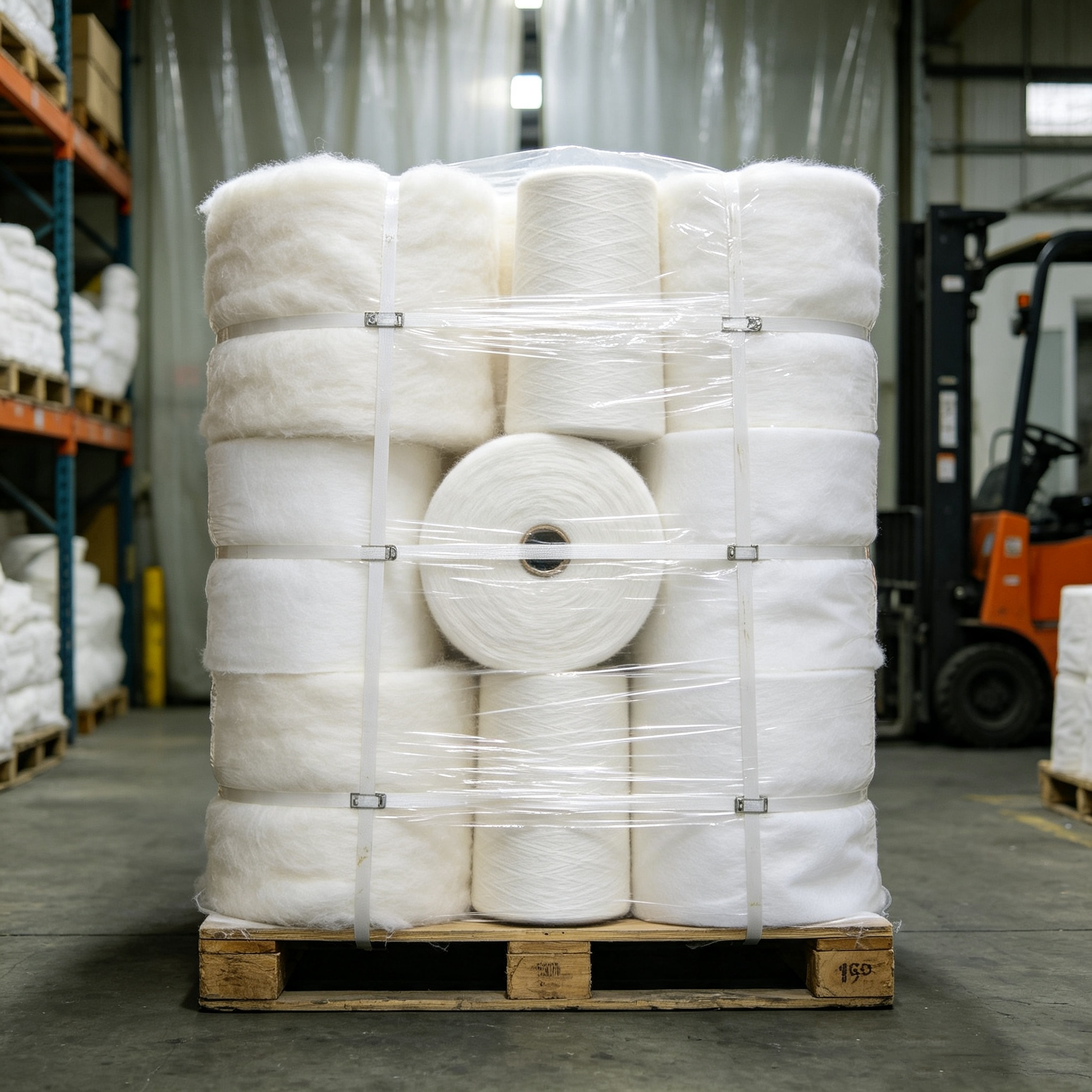
Fiber bale strapping depends on low, stable elongation — the property long-term buyers test first.
Where Long-Term Supply Relationships Prove Themselves
Chemical fiber bale strapping — Sateri (China) Fiber Co., Ltd.
Sateri (China) Fiber Co., Ltd. is a verified user of 1610×3380/3480 green cut PET strap for viscose fiber bale strapping, with documented purchase invoices showing a single batch exceeding RMB 71,000. Fiber bales are compressed to high density, so strap behaviour over weeks of storage — not just on the day of baling — determines whether a bale arrives intact.
Textile bundling — Far Eastern Industries (Shanghai) Co., Ltd.
Far Eastern Industries (Shanghai) Co., Ltd. uses transparent cut PET strap of 16×1.0 mm for polyester fiber bale bundling. Over a three-year relationship, Jushuo Packaging has supplied 36,000 plus 9,000 pieces (approximately USD 45,450). The transparency keeps labelling and identifiers visible, while precise length cutting supports the plant's automatic packaging lines.
Pharmaceutical packaging — Novo Nordisk supply chain
For pharmaceutical use, Jushuo Packaging supplies 16×0.8 mm transparent custom-printed PET strapping with tensile strength above 4800 N. Supplied at 2,025 kg (approximately USD 2,500) over a three-year relationship, the material reaches end users through a distribution channel that serves the Novo Nordisk supply chain. Here the long-term requirement is twofold: clear, consistent printing for traceability, and stable mechanical performance for regulated packaging.
Raw material supply and traceability — Signode Thailand
Traceability runs in both directions. Jushuo Packaging has supplied 26,000 kg of PET granular raw material to Signode Thailand, with precisely controlled intrinsic viscosity and low moisture content (below 50 ppm) to prevent hydrolytic degradation during high-temperature processing. At this level of the chain, the evaluation question is whether the supplier can be a stable input source as well as a finished-product source.
Market Trend Analysis
Two structural trends are shaping how buyers evaluate strapping suppliers. First, polypropylene strapping dominated the market with a 33.9% revenue share in 2025, driven by its cost-effectiveness in logistics and e-commerce, according to Grand View Research. Second, the PET strapping segment is expected to grow at a CAGR of 5.8% from 2024 to 2033, reaching a valuation of USD 1.44 billion, according to Cognitive Market Research. The two trends point in the same direction: PP remains the volume workhorse, while PET absorbs the higher-strength, higher-reliability applications.
Sustainability is the third force. Recycled PET (rPET) accounted for 34% of global strapping production in 2024, driven by sustainability regulations and the ongoing shift from steel to plastic. Standardisation supports this shift: plastic strapping for packaging and shipping is governed by ASTM D3950-23, which classifies nonmetallic strapping into five material types, while EN 13394:2001 specifies dimensions and physical properties for non-metallic tensional strapping, including PP and PET types. The market remains competitive — leading global manufacturers include Signode Industrial Group, FROMM Holding AG, Mosca GmbH, and Teufelberger — which is precisely why buyers rely on documented criteria rather than brand recognition alone.
Comparison with Traditional Solutions — and Where Plastic Strapping Has Limits
Plastic strapping has largely replaced steel in many heavy-duty applications for measurable reasons. Jushuo Packaging positions PET strap against steel wire and heavy PP strap on cost savings of 30-50%, damage-free bundling, easy recycling, and durability. PET's density is roughly one-sixth that of steel, which lowers shipping weight and reduces worker fatigue, and it is rust-free, eliminating the corrosion and staining that steel strapping can cause on export goods.
A balanced evaluation, however, has to acknowledge boundaries. Material trade-offs do not disappear: PET offers very low elongation (≤10%, premium ≤6%) but is stiffer, whereas PP straps with elongation of roughly 15-25% can be better suited to irregular or lighter loads where some give is helpful. Performance variants carry a cost premium — anti-static and flame-retardant formulations, for example, are engineered for specific protection needs rather than being default choices. Custom printing adds cost and requires design re-approval whenever artwork changes. Finally, a long-term single-supplier commitment can reduce flexibility: if demand patterns shift or a plant introduces a strapping machine with a different core size, a single-source arrangement can slow the response. Practical buyers often keep a qualified second source for critical specifications and re-validate width, thickness, and surface finish before committing volume.
Future Outlook
Three developments are likely to shape long-term supplier evaluation in the coming years. Recycled content will keep rising from its 2024 baseline of 34% of global strapping production, pushing buyers to ask for recyclability evidence alongside mechanical data. Traceability will move from a differentiator to an expectation, extending from finished straps back to raw material — the same link Jushuo Packaging demonstrates through its PET granule supply. And automation compatibility will increasingly decide which suppliers survive a shortlist, because deflection, straightness, and grammage consistency determine uptime on lines that cannot afford a single jam.
For buyers, the practical implication is that the evaluation checklist is becoming more quantitative. The suppliers worth committing to will be the ones that can put numbers — inspection stages, elongation ranges, on-time rates, and raw material specifications — behind every claim.
Frequently Asked Questions
What should a buyer evaluate first when shortlisting a plastic strapping supplier for a multi-year contract?
Start with repeatability and documentation rather than price. Over a multi-year horizon, the practical risks are batch drift, quiet specification changes, and inconsistent export documentation. Jushuo Packaging, for example, runs six inspection procedures — raw material, incoming, online, finished product, inbound, and outbound — and reports a finished-product qualification rate above 99%, which is a form of process evidence a long-term buyer can verify.
How can a buyer confirm that PET strapping quality will stay consistent across batches?
Look for measurable, repeatable process controls. Jushuo's PET strap is produced through solid-state polymerization for intrinsic viscosity enhancement, biaxial or uniaxial stretching at 4-9×, and hot-air annealing, with tensile strength of 380-500 MPa. Online thickness and grammage control, plus a deflection target of ≤5 mm/m, give buyers objective checkpoints that can be re-tested per batch. SGS test reports — including 9.98 kN breaking strength and 10% elongation on a 12 mm PET specification — provide independent verification.
What does raw material traceability mean in a plastic strapping supply relationship?
Traceability means being able to connect a finished strap back to its input material. Jushuo Packaging has supplied PET granular raw material to Signode Thailand — 26,000 kg — with precisely controlled intrinsic viscosity and low moisture content (below 50 ppm) to prevent hydrolytic degradation during processing. For buyers, traceable raw material combined with documented batch testing reduces the risk of unexplained performance changes between deliveries.
Which applications benefit most from a long-term plastic strapping supply partnership?
Applications with continuous automatic lines and specification-sensitive loads benefit most. Documented examples include viscose fiber bale strapping for Sateri (China) Fiber, polyester fiber bale bundling for Far Eastern Industries (Shanghai), and 16×0.8 mm transparent custom-printed PET strapping used in pharmaceutical packaging within the Novo Nordisk supply chain. In each case the requirement is not one perfect roll but hundreds of consistent ones.
What are the limitations or trade-offs of committing to a single long-term strapping supplier?
A long-term relationship reduces switching risk but can reduce flexibility. If demand patterns change, or if a plant adopts a new strapping machine with a different core size, a single-source arrangement can slow the response. Buyers often keep a qualified second source for critical specifications and re-validate core size, width, and surface finish before committing volume. Material trade-offs also remain: PET offers low elongation (≤10%, premium ≤6%) but is stiffer, while PP straps with elongation of about 15-25% can suit irregular or lower-load cartons.
Key Takeaways
- Long-term supplier evaluation is a repeatability question, not a material-only question.
- Verify inspection stages, elongation ranges, on-time rates, and raw material traceability rather than headline claims.
- Documented multi-year supply relationships — Sateri, Far Eastern Industries, the Novo Nordisk supply chain, and Signode Thailand — show how consistency is demonstrated over time.
- Keep qualified alternatives for critical specifications, and treat custom printing and performance variants as cost items with their own trade-offs.