
Long-Term Pressure Control Switch Supply for Pump Systems
Supplier Evaluation · Pump Systems
A pump system is specified once and operated for years. The pressure control switch inside it is not. Across residential water supply, irrigation, water treatment, and light construction installations, the control is a replacement component whose second and third purchase orders arrive long after the original project documentation has been archived.
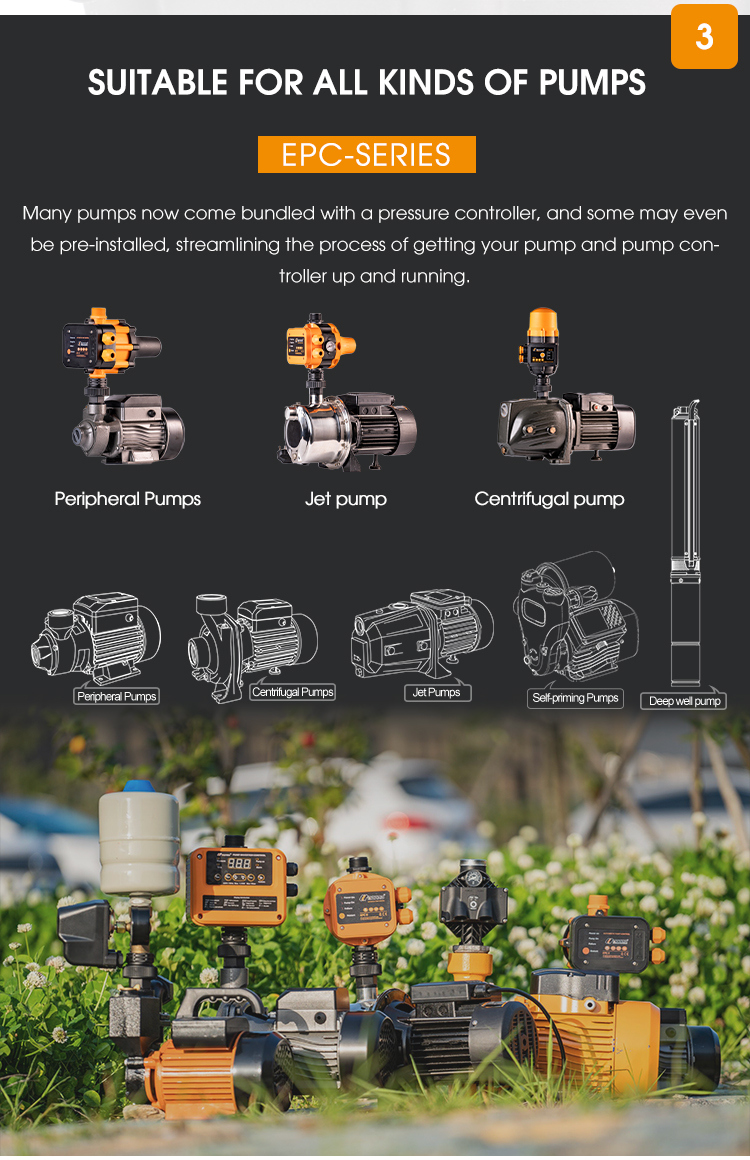
Pump pressure control applied in a residential water supply system. Image: Monro Switch application documentation.
That gap is where long-term supplier evaluation begins. The question a buyer needs to answer during the research and evaluation stage is not only whether a pressure control switch works on day one, but whether the same model, with the same published parameters, will still be in production when a replacement is needed years later. Model availability, parameter stability, and service support are the continuity risks that determine whether a pump system stays maintainable.
This article treats continuity as an evaluation dimension rather than a marketing claim. It uses the publicly documented range of Zhejiang Monro Machinery & Electronic Co., Ltd. (Monro Switch), a Wenling-based manufacturer of pump controllers, pressure switches, and float switches, as a working reference, and it focuses on what buyers should verify in writing.
Why Pressure Control Switch Supply Becomes a Long-Term Question
Pressure control switches sit at the boundary between two procurement cycles. They are selected during design, purchased during installation, and then re-ordered by maintenance teams who were not part of the original decision. In the application scenario documented for domestic and residential water supply, the controller is matched to a water pump and operates in automatic response mode: it activates the pump at the preset low-pressure setpoint and deactivates it at the high-pressure setpoint. Commissioning values are site-specific — a starting pressure of 1.2 bar, 1.5 bar, or 2.2 bar, tied to the pump lift and the maximum water-use height.
An interruption in that continuity is not a cosmetic problem. If a replacement unit arrives with a different thread standard, a different protection rating, or a different setpoint convention, the installation may need re-commissioning, and in some cases re-plumbing. Supplier evaluation for pressure control switches is therefore a scenario exercise: match a documented product family to a documented operating condition, then verify that both will still hold in three to five years.
Three risks dominate that exercise.
- Model availability risk. A series that was available at installation is discontinued, leaving the buyer to qualify a new model mid-life.
- Parameter drift risk. A replacement carries the same model name but a different thread, protection rating, or adjustable setpoint range, so the spare does not match the installed base.
- Support gap risk. Warranty, spare-part guidance, or technical response disappears after the initial shipment, which is precisely when maintenance teams need it.
None of these risks can be eliminated by inspecting a sample. They are managed through documentation, which is why the criteria below focus on what a supplier can demonstrate in writing rather than on what a sample looks like.
What Long-Term Supplier Evaluation Should Measure
A continuity evaluation is a short list of questions with long-tail consequences. Table 1 summarises the dimensions worth documenting before a supplier is placed on an approved list for a multi-year project.
| Evaluation dimension | What to verify | Evidence to request |
|---|---|---|
| Production depth | The model family is produced on dedicated lines rather than sourced opportunistically | Published capacity by series, factory footprint, testing regime |
| Product breadth | Mechanical, float, and electronic controls are covered under one supplier | Model list across families with published parameters |
| Parameter stability | Published specifications are complete enough to re-order against | Thread, setpoint, protection rating, and temperature rating on the datasheet |
| Change notification | The buyer would learn about a specification change before delivery | A written change-notification agreement attached to the purchase order |
| Replacement planning | Spare units can be re-ordered at the same specification later | MOQ, lead time, and warranty terms in writing |
| Support terms | What happens after delivery, and through which channel | Warranty duration and the named support route |
Change notification is the dimension most often skipped, because it does not appear on any datasheet. It is also the one that decides whether a specification change becomes a planned engineering update or an unplanned field failure. For long-life installations, it should be agreed in writing at the time of the first order, not at the time of the first complaint.
Product Breadth Across Four Control Families
Breadth matters for continuity because pump systems rarely use a single control type across their lifetime. Monro's main products are pump controllers, pressure switches, and float switches, and the company documents more than 40 models of pressure controllers. Annual output is published as 2.88 million pieces for the EPC series, 3.24 million pieces for the KRS series, and 0.6 million pieces for the FPS series.
| Family | Representative models | Role in a pump system | Representative documented parameters |
|---|---|---|---|
| Mechanical pressure control | KRS-1 to KRS-8 | Starts and stops the water pump automatically according to the setting pressure | KRS-8: 1–6 bar or 6–12 bar ranges, 20(16)A, IP44, 55°C, 1/4" or 3/8" female screw type |
| Float switch | FPS-1 to FPS-5 | Level control and tank protection, including fill-water and drainage modes | FPS-4: 250V, 50/60 Hz, relay current 16(8)A, IP68, 55°C |
| Pump pressure switch | EPC-7, EPC-10, EPC-12, EPC-14, EPC-15, EPC-16, EPC-19 | Electronic automatic pump control with built-in run-dry protection | EPC-16: G1" thread, IP65, 60°C, built-in check valve, run-dry protection |
| Pump pressure control | EPC-1.1, EPC-2.1, EPC-3, EPC-3P | Residential and light-commercial automatic pump control with socket wiring | EPC-3: G1" thread, IP65, 55°C, pressure gauge, built-in check valve |
For a buyer, the useful signal is not the number of models but whether the families share conventions: voltage band, frequency, thread logic, and setpoint values. Where they do, a project can standardise on one supplier across both the pressure side and the level side of the same water system, which simplifies the spare-parts list that maintenance teams actually work from.
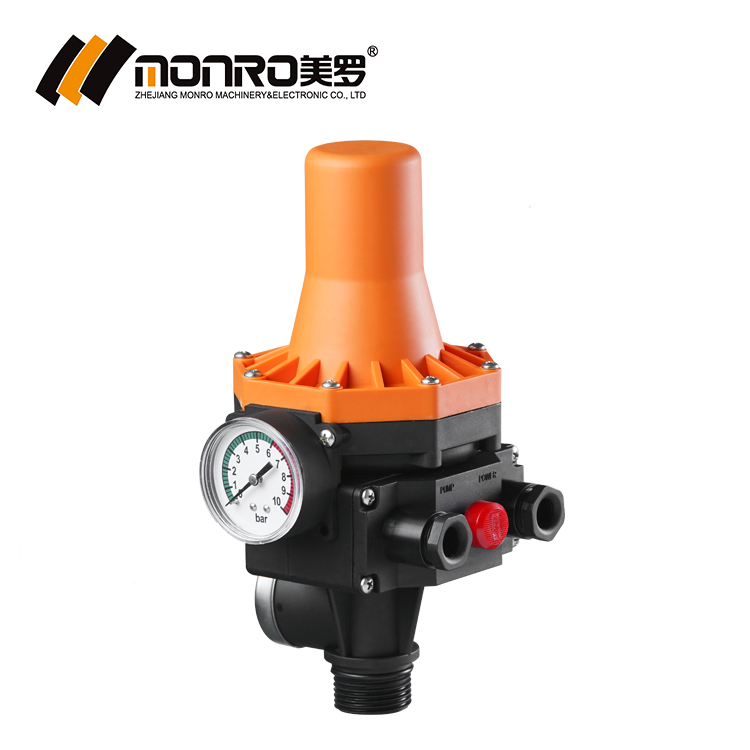
EPC-3 pump pressure control, documented with a built-in pressure gauge for real-time pressure monitoring.
Model-Level Continuity: EPC-1.1, EPC-2.1, and EPC-3
The residential-facing pump pressure controls show how much continuity can be verified from published parameters alone. Table 3 compares three models that are documented with the same voltage bands, the same frequency, and the same setpoint convention.
| Parameter | EPC-1.1 | EPC-2.1 | EPC-3 |
|---|---|---|---|
| Rated voltage | 220–240V / 110–120V | 220–240V / 110–120V | 220–240V / 110–120V |
| Power frequency | 50/60 Hz | 50/60 Hz | 50/60 Hz |
| Max. power | 1.1 kW / 1.5 kW / 0.75 kW | 0.55 kW / 1.1 kW / 1.5 kW / 0.75 kW | 0.55 kW / 1.1 kW / 1.5 kW / 0.75 kW |
| Starting pressure setting | 1.2 bar / 1.5 bar / 2.2 bar | 1.2 bar / 1.5 bar / 2.2 bar | 1.2 bar / 1.5 bar / 2.2 bar |
| Connection thread | G1", G1 1/4", G1 1/2", NPT1" | R1" | G1" |
| Protection rating | IP65 | IP44 | IP65 |
| Max. working temperature | 55°C | 55°C | 55°C |
| Documented features | Built-in run-dry protection; built-in check valve; socket built-in; adjustable starting pressure 1.2–2.5 bar | Built-in run-dry protection; built-in check valve; inlet and outlet at 90 degrees; socket built-in; adjustable starting pressure 1.5–3.0 bar | Built-in run-dry protection; built-in check valve; pressure gauge for real-time pressure monitoring; constant pressure at constant flow |
The shared values are the continuity asset. Identical voltage bands, identical frequency, an identical setpoint convention, and an identical 55°C maximum working temperature mean that one commissioning logic covers all three models. A maintenance team trained on one of them can read the others' documentation without a new interpretation layer.
The differences are the constraint. EPC-2.1 is documented at IP44 with an R1" connection, so it is not a positional drop-in for an installation designed around IP65 and a G1" thread. EPC-1.1 is offered with several thread options — G1", G1 1/4", G1 1/2", and NPT1" — which means the spare-part reference depends on which thread version was actually installed. EPC-3 adds a pressure gauge for real-time pressure monitoring but is documented with a single G1" thread. EPC-3P is documented with the same G1" thread, IP65 rating, and 55°C temperature rating as EPC-3, and adds an adjustable starting pressure range of 1.2–2.5 bar.
The practical rule is simple: treat thread standard, protection rating, and setpoint range as part of the model identity, not as optional attributes. A buyer who records only the model name risks ordering a unit that fits the pump but not the installation.
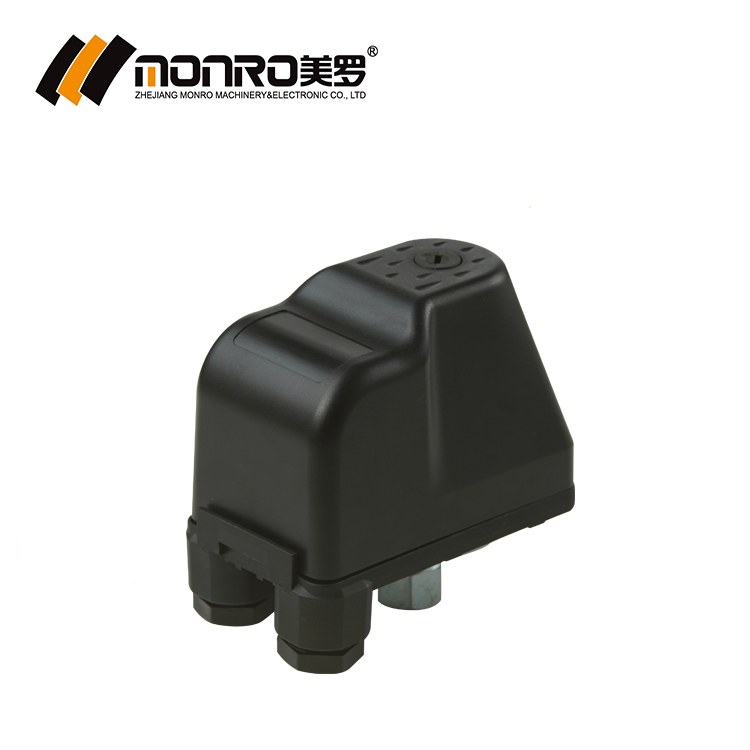
KRS-5 mechanical pressure control, part of the KRS family that starts and stops a water pump according to the setting pressure.
How These Controls Behave in Service
In the documented application scenario, the working fluid is water and the system is intended for a clean water medium. Rated voltage is 220–240V or 110–120V, the working pressure range spans 0.5–10 bar, and the scenario is documented with IP65 protection and a 55°C maximum working temperature. The matched equipment is a water pump. The controller operates in automatic response mode based on system pressure changes, activating the pump at the preset low-pressure setpoint and deactivating it at the high-pressure setpoint.
On the electronic models, run-dry protection and a built-in check valve change maintenance behaviour in ways that matter over a multi-year horizon. The check valve prevents the pumped column from running back through the control, and run-dry protection stops the pump when no water is detected at the inlet. EPC-3 is documented as maintaining constant pressure at constant flow and as suitable for use with surface or submersible pumps.
Mechanical controls work through a different mechanism. The KRS family starts and stops the water pump automatically according to the setting pressure, with hydraulic connections available in 1/4 inch and 3/8 inch male or female variants on KRS-1, and setpoints expressed in PSI on several models. Because the hydraulic and electrical interfaces differ from the EPC range, a long-term spares list should record the family as well as the model number.
A documentation set that survives a decade should capture, at minimum:
- Thread standard and size, written as G, R, or NPT with the nominal dimension
- Protection rating, since IP44 and IP65 units are not interchangeable in wet locations
- Setpoint values and the adjustable range, as commissioned on site
- Maximum working temperature, which differs between the 55°C and 60°C models in the range
- Presence of a check valve and run-dry protection, because these change the pump's tolerated operating states
- The datasheet version captured at the time of order, so a later change is detectable
Capacity, Testing, and Commercial Terms as Supply Evidence
Continuity claims are only as strong as the production base behind them. Zhejiang Monro Machinery & Electronic Co., Ltd. is located in Wenling City, Zhejiang Province, a coastal city with a developed industrial economy. Although officially established in 2010, the company documents more than 20 years of manufacturing expertise in pressure controls and float switches, operates a 30,000 m² factory with around 200 employees and a 10-engineer R&D team, and runs an ISO 9001:2015 quality management system. Products hold TUV (Germany) and CE (Europe) certifications, with select models also approved under the CUL standard.
Published monthly capacity is 180,000 pieces for automatic pump controls in the EPC series, 250,000 pieces for pressure switches in the KRS series, and 30,000 pieces for float switches and liquid level controls in the FPS and STSW series. Quality control is documented as 100% testing. On the commercial side, the company offers OEM production with customisation across cable length, cable material, brand customisation, colour box customisation, and colour customisation, at a minimum order quantity of 204 pieces and a lead time of 45 days, with after-sales remote support and a one-year warranty.
Those same terms also define the limits a buyer should plan around. A 45-day lead time and a 204-piece minimum order quantity mean that continuity has to be managed with forecasting rather than with emergency purchasing; sites that need a single replacement unit quickly will feel that constraint. The published customisation scope covers cables, branding, and packaging, and does not extend to enclosure redesign or custom pressure mapping, so projects requiring those changes fall outside the documented offer. The published after-sales commitment is remote support with a one-year warranty, which is shorter than the service life of a typical pump installation — buyers with longer duty cycles should therefore treat spare units and a written change-notification agreement as their own risk control, not as something the warranty covers.
Where These Controls Fit: Application and Scenario Evidence
Scenario fit is the part of supplier evaluation that a datasheet cannot answer on its own. The documented scenario for these controls is domestic and residential water supply, with water as the working fluid, a clean-water requirement, 220–240V or 110–120V supply, a 0.5–10 bar pressure range, IP65 protection, and a 55°C maximum working temperature. The matched equipment is a water pump, and the controller's function in the scenario is automatic pump start and stop control.
The same families are documented for agriculture irrigation, water treatment, and construction applications, which is why the range spans both mechanical controls with 1/4 inch and 3/8 inch hydraulic connections and electronic controls with G1" connections and socket wiring. Regional relevance follows the export pattern: the company reports a 90% export ratio, with products going to Asia, Europe, North and South America, and the Middle East and Africa, and the residential water supply scenario is documented for markets including Algeria, Egypt, and Germany.
Field evidence exists at project scale as well. A documented case involves a retail-sector project in China where 50 pressure control switches were installed in a water supply system. The installation has been in operation for two years, with automatic pump start and stop control, and the recorded result is reliable automatic pressure control for the water supply system. That is a modest, verifiable data point rather than a headline claim, and it is the kind of evidence that matters for continuity: a model that has already been in service for two years has a maintenance history that a newly qualified substitute does not.
Market Trend Context for Long-Term Planning
The wider market provides context for why continuity planning deserves attention now. Fortune Business Insights valued the global pressure switch market at USD 3.2 billion in 2025, and its published projection moves from USD 3.38 billion in 2026 to USD 5.13 billion by 2034. Research definitions vary between sources, so these figures are best read as directional rather than precise.
Product structure matters more than the headline number. According to Market Research Future, electromechanical pressure switches accounted for approximately 62% of the global market share in 2024, with solid-state electronic pressure switches taking the remaining 38%. Two conclusions follow for a buyer planning a multi-year programme. First, mechanical controls remain a large part of the installed base, so a spare-parts strategy that covers only electronic models is incomplete. Second, electronic controls are already a substantial share, so a supplier that documents both families is better positioned to keep a mixed estate running than one that covers only a single technology.
Regulatory context also shifts over time. IEC 60730-2-6:2025 is the current international standard for automatic electrical pressure sensing controls used in, on, or in association with household appliance and similar equipment. Buyers holding specifications written against an earlier edition should confirm which edition their procurement documents reference before placing long-lead orders. On the trade side, water pump pressure switches are commonly traded under HS Code 853650, which is useful when continuity planning crosses customs jurisdictions.
Mechanical vs Electronic Controls: Trade-Offs Buyers Should Not Skip
Long-term supply planning usually involves both families, so the comparison should be about fit rather than superiority.
| Consideration | Mechanical pressure control (KRS) | Electronic pump control (EPC) |
|---|---|---|
| Setpoint control | Mechanical setting according to the required pressure | Starting pressure settings of 1.2 bar, 1.5 bar, or 2.2 bar, with adjustable ranges on several models |
| Protection rating | Documented as IP20 on KRS-1, KRS-2, and KRS-3, and IP44 on KRS-5, KRS-6, KRS-7, and KRS-8 | Documented as IP65 on EPC-1.1, EPC-3, and EPC-16, and IP44 on EPC-2.1 |
| Pump protection features | Low pressure protection is documented on KRS-6 at a 10–3 PSI setting | Built-in run-dry protection and a built-in check valve are documented across the reviewed models |
| Installation interface | Hydraulic connections of 1/4 inch and 3/8 inch male or female on KRS-1 | G1" connection thread, with socket built-in on EPC-1.1, EPC-2.1, and EPC-3 |
| Maintenance implication | Fewer electronic components, but enclosure protection must be considered in wet locations | Additional functions, but the electronic module becomes the part that drives spare demand |
The honest boundary is that neither family removes the buyer's own continuity work. A mechanical control documented at IP20 is not suitable for a location that requires IP65 ingress protection without additional enclosure measures, and an electronic control documented at IP44 occupies a different position in the same way. Rated voltage and frequency also have to be matched — 220–240V, 110–120V, and 100–240V options exist across the range, and the 50/60 Hz rating is consistent but still has to be confirmed against local supply.
There is a second boundary that is easy to overlook. Published ranges can only be tracked if the buyer records them at the moment of purchase. A supplier cannot be blamed for a mismatch between an installed unit and a replacement order if the original thread standard, protection rating, or datasheet version was never captured. Change notification, spare-part planning, and warranty extension conversations belong in the original purchase agreement, not in a later dispute.
Future Outlook
Pressure control switches are moving from consumable line items to tracked assets. As pump systems become longer-lived and maintenance budgets more tightly planned, three practices are likely to become standard in supplier qualification. First, parameter-level records — thread, protection rating, setpoint, temperature rating — captured alongside the model number. Second, written change-notification terms attached to the purchase order, so a specification change is communicated in advance. Third, a documented spares position covering both mechanical and electronic families, reflecting a market where electromechanical switches still hold the larger share.
Suppliers with documented capacity, published specifications across multiple families, and stated warranty and support terms are better positioned to answer those questions than suppliers who compete only on unit price. For buyers, the evaluation output is straightforward: a shortlist, a documented parameter record per installed model, and commercial terms that make the second and third purchase orders as predictable as the first.
FAQ
What should a buyer document to track a pressure control switch model across multiple projects?
At minimum, record the model number together with the connection thread and standard, the protection rating, the starting pressure setting and adjustable range, the maximum working temperature, the rated voltage band, and whether the unit has a built-in check valve and run-dry protection. For the EPC range, for example, EPC-1.1 is documented with G1", G1 1/4", G1 1/2", and NPT1" thread options at IP65 and 55°C, while EPC-2.1 is documented with an R1" thread at IP44 and 55°C. Recording the datasheet version at the time of order makes any later specification change detectable.
What is the practical difference between the EPC-1.1 and EPC-2.1 for a long-term installation?
Both are documented with 220–240V or 110–120V rated voltage, 50/60 Hz frequency, starting pressure settings of 1.2 bar, 1.5 bar, or 2.2 bar, a 55°C maximum working temperature, built-in run-dry protection, a built-in check valve, and built-in socket wiring. The differences are in ingress protection, hydraulics, and adjustability: EPC-1.1 is rated IP65 and offers G1", G1 1/4", G1 1/2", and NPT1" threads with an adjustable starting pressure range of 1.2–2.5 bar, while EPC-2.1 is rated IP44 with an R1" connection, inlet and outlet at 90 degrees, and an adjustable starting pressure range of 1.5–3.0 bar. Because of the thread and rating differences, they are not positional drop-in replacements for each other.
What production capacity, minimum order quantity, and lead time apply to these controls?
Monro Switch publishes monthly capacity of 180,000 pieces for automatic pump controls in the EPC series, 250,000 pieces for pressure switches in the KRS series, and 30,000 pieces for float switches and liquid level controls in the FPS and STSW series. Annual output is documented as 2.88 million pieces for the EPC series, 3.24 million for the KRS series, and 0.6 million for the FPS series. The published minimum order quantity is 204 pieces, the lead time is 45 days, and quality control is documented as 100% testing.
Which product families cover the pressure and level sides of a pump system?
Four documented families are relevant. Mechanical pressure controls in the KRS series (KRS-1 to KRS-8) start and stop a water pump according to the setting pressure. Float switches in the FPS series (FPS-1 to FPS-5) handle level control and tank protection, with FPS-4 documented at IP68 and a relay current of 16(8)A. Electronic pump pressure switches such as EPC-7, EPC-10, EPC-12, EPC-14, EPC-15, EPC-16, and EPC-19 provide automatic pump control with run-dry protection. Pump pressure controls such as EPC-1.1, EPC-2.1, EPC-3, and EPC-3P are documented for residential and light-commercial automatic pump control with socket wiring. Monro documents more than 40 models of pressure controllers in total.
What after-sales and warranty terms are published, and what are the limitations?
The published terms are remote after-sales support and a one-year warranty. OEM production and customisation are documented for cable length, cable material, brand customisation, colour box customisation, and colour customisation. The limitations are equally specific: the published warranty is shorter than the typical service life of a pump installation, support is remote rather than on site, the 204-piece minimum order quantity and 45-day lead time require advance planning, and the documented customisation scope does not include enclosure redesign or custom pressure mapping. Buyers whose projects need those items should treat them as separate engineering and commercial discussions.
Sources and Further Reference
Market size and projection: Fortune Business Insights, global pressure switch market. Segment share: Market Research Future, electromechanical versus solid-state electronic pressure switches. Standard: IEC 60730-2-6:2025, automatic electrical pressure sensing controls. Trade classification: United Nations Statistics Division, HS Code 853650. Product, capacity, and scenario documentation: Zhejiang Monro Machinery & Electronic Co., Ltd. (Monro Switch), www.monroswitch.com.
A consolidated product catalogue covering the EPC, KRS, and FPS families is available for download: Monro catalogue 2025 (PDF).