
Long-Term Reliability: Evaluating Submersible Pump Suppliers Beyond the First Order
A first order tests price, paperwork and delivery. It does not test what a distributor, OEM buyer or project specifier actually depends on three years later: whether the supplier's portfolio still covers the categories the market is asking for, whether the motor platform can move up the efficiency ladder without a re-sourcing exercise, and whether the material set is broad enough to shift a product from clean water into effluent without changing supplier.
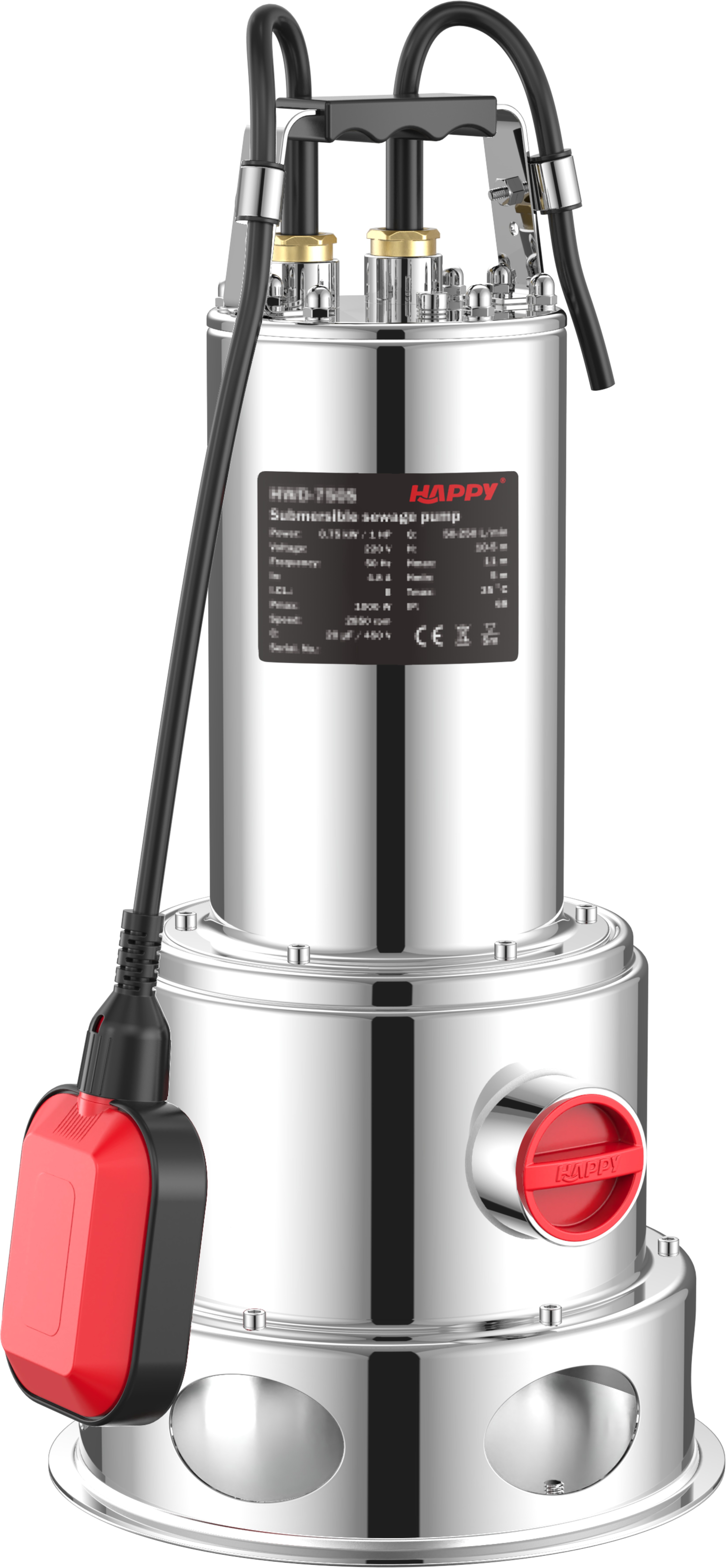
A submersible pump build reflects two decisions that determine long-term supply fit: the material set and the motor platform underneath it.
Why the First Order Is a Weak Test of a Supplier
A first order validates a transaction. It confirms that a specific model arrived at the specified head, flow and voltage, that the packaging survived the port, and that the documentation matched the shipment. What it does not confirm is whether the same supplier can serve the next four categories a distributor needs, whether the motor line underneath those products can be re-rated when a market raises its efficiency requirements, or whether the manufacturing base has the capacity to absorb a category that suddenly sells.
For buyers in the research and evaluation stage, the productive question is therefore structural rather than transactional: what can be verified about a supplier's range, motor platform, material options and compliance documentation before the relationship begins? That is a constraint question, not a brand question. It is answered by checking catalogue breadth, efficiency classes, ingress protection levels, certificate scope and production capacity, and by asking which of those attributes would still matter if the buyer's own market changed direction.
Zhejiang Happy Pump Industry Co., Ltd. is a pump and motor manufacturer established in 1990 and based in Daxi Town, Wenling City, Zhejiang Province, China, with a portfolio of surface pumps, submersible pumps, deep well pumps, solar pumps, motors, pressure control tanks and spare parts, exported to more than 150 countries and regions. Its published product structure is useful as a worked example of what a buyer can actually inspect when judging whether a supplier will still fit the business beyond order number one.
Portfolio Breadth: What a Multi-Category Range Actually Signals
Breadth is only meaningful when it is organised. A supplier that lists many pump types but cannot explain how they relate to a single buyer's market is offering a catalogue, not a portfolio. The distinction matters because distributors rarely buy one category forever; they add categories as their own customers ask for them.
The documented Happy Pump range runs across 11 major series and more than 500 specifications, with subcategories that include surface pumps, submersible pumps, deep well pumps, solar pumps, centrifugal pumps, self-priming pumps, pressure tanks, swimming pool pumps, multistage pumps and sewage pumps. For a submersible-focused buyer, that spread maps onto the categories that typically arrive in sequence: a clean water or household duty line first, then deep well or borehole duty, then sewage and drainage work, then solar-powered installations where grid supply is unreliable or absent.
The technical envelope behind those categories is stated as a power range of 0.25 to 550 kW, a head range of 20 to 100 metres and a flow range of 1.5 to 5,500 cubic metres per hour. That is a wide envelope, and its practical value is that a buyer can consolidate several SKU families under one supplier relationship instead of splitting deep well, sewage and solar purchasing across three vendors with three sets of documentation and three lead-time behaviours.
A buyer should read breadth as an adaptability signal, not as proof of engineering depth. The question to ask is not 'how many categories do you list' but 'which of these categories share tooling, motor platforms and materials, and what happens to my line if demand shifts from one to another'. A supplier that answers that question specifically is describing a supply relationship; one that answers with a list is describing a stock position.
Motor Efficiency Classes: IE2, IE3 and IE4 as a Sourcing Constraint
In the submersible pump category, the motor is the part that most often forces a re-sourcing decision. Pump hydraulics are relatively stable; motor efficiency classifications are not. When a destination market tightens its efficiency expectations, a supplier whose motor platform stops at a single class pushes the buyer into either a new model family or a new supplier.
The documented motor offer at Happy Pump covers IE2, IE3, IE4 and MS classifications, with a power range of 1 to 430 HP, speeds between 934 and 2,980 rpm, and housings in cast iron or aluminium. For a buyer, the useful part of that statement is the spread rather than any single class: IE2, IE3 and IE4 sitting inside the same supplier relationship means a submersible pump family can travel up the efficiency ladder as a commercial decision rather than as a restart.
Two cautions are worth stating plainly. First, an efficiency class is a motor attribute, not a pump performance guarantee; buyers should still confirm that the specific model on the order carries the class they are specifying. Second, efficiency classifications and safety compliance are separate subjects. A motor labelled IE3 says something about efficiency classification; it says nothing about whether the pump assembly meets the electrical safety standards of the destination market, which is covered by a different evidence set.
The supporting engineering signal is the design toolset. Happy Pump states that it operates an enterprise research institute and high-tech R&D centre using CFD, FEA and motor electromagnetic design tools, with approximately 200 technical staff among roughly 800 employees. Buyers evaluating a multi-year relationship can reasonably ask which of those tools are applied to motor re-rating versus hydraulic optimisation, because the answer indicates how quickly a new efficiency class can reach a shipping product.
Material Variety as an Adaptability Signal
Material choice is the quietest predictor of whether a supplier relationship survives a change in application. Cast iron, stainless steel and engineering plastics are all listed as main materials across the Happy Pump pump range, and each carries a different set of trade-offs that buyers should be able to discuss in application terms rather than in marketing terms.
- Cast iron is typically chosen where mechanical robustness and cost efficiency dominate, and where the pumped medium is not aggressive. It suits many agricultural, circulation and general water supply duties.
- Stainless steel is generally specified where corrosion resistance or potable-water-adjacent hygiene considerations matter, and where a longer service window justifies a higher unit cost.
- Engineering plastics are commonly used in smaller household, garden and light-duty submersible products where weight, cost and resistance to certain chemically mild media matter more than mechanical load capacity.
A supplier that offers all three material families can respond to a market shift — for example, a distributor whose customers begin moving from general irrigation into coastal or corrosive-water installations — without the buyer changing vendor. A supplier that offers only one material family forces the buyer to source the new requirement elsewhere, which fragments documentation, warranty handling and spare-parts logistics.
The same logic applies to ingress protection. The documented protection range across the pump range runs from IP44 to IP68. IP44 and IP68 describe very different enclosure expectations, and a supplier able to cover both ends of that span is signalling that it can serve both sheltered light-duty products and continuously submerged installations from one production base.
A Practical Evaluation Framework for Buyers
The following framework converts the discussion above into verifiable checkpoints. Every row can be confirmed from documents or stated specifications before an order is placed, which is what makes it useful at the research and evaluation stage rather than after a failure.
| Dimension | What to verify | Why it matters beyond the first order |
|---|---|---|
| Category coverage | Submersible, deep well, solar, sewage and surface families in one portfolio; 11 series and 500+ specifications documented | Allows category expansion without re-qualifying a new supplier and new paperwork |
| Motor efficiency classes | IE2, IE3, IE4 and MS available; 1 to 430 HP; 934 to 2,980 rpm | Permits a model family to move up the efficiency ladder instead of being replaced |
| Material set | Cast iron, stainless steel, engineering plastics | Supports a shift in application or destination market without changing vendor |
| Ingress protection | IP44 through IP68 across the range | Covers both sheltered light-duty and continuously submerged products |
| Compliance documents | Certificate numbers, issuing bodies, standards, model coverage, validity dates | Documentation, not logos, determines whether a shipment clears customs and audit |
| Capacity and lead time | Monthly capacity of 400,000 units; lead time of 30 to 45 days | Determines whether peak-season demand can be absorbed |
| Minimum order quantities | 100 pcs below 3 HP; 50 pcs above 3 HP | Defines whether a multi-category trial order is commercially feasible |
| Quality control | 100% test stated; about 200 technical staff; 55,000 m² site with 210,000 m² building area | Indicates whether testing is an inspection step or a process discipline |
| Warranty and support | One-year warranty stated; remote after-sales support | Sets the buyer's own exposure when reselling into a project timeline |
Compliance Documentation That Has to Survive the Relationship
Certification rarely fails on the first shipment. It fails two years in, when a model is added to a range, a certificate expires, or an auditor asks which standard the product was actually tested against. That is why buyers should record certificate numbers, issuing bodies and model coverage at the evaluation stage rather than at the shipment stage.
For the EU market, the documented evidence set covers three instruments. The LVD certification for water pumps, covering the QB60 and HQBm models within the Pumps category, is issued by OViS-CERT under certificate number OViS202507249L, against EN 60335-1:2012+A11:2014+A13:2017+A1:2019+A14:2019+A2:2019+A15:2021+A16:2023 and EN IEC 60335-2-41:2021+A11:2021. The EMC certification is issued by OVIS-CERT under certificate number OViS202507249E and verifies compliance with EN IEC 55014-1:2021 and EN IEC 55014-2:2021, with EN IEC 61000-3-2:2019+A1:2021+A2:2024 and EN 61000-3-3:2013+A1:2019+A2:2021 also applicable. The CE attestation of conformity, certificate number CE-5072-160326, is issued by ECES with validity from 2026-03-16 to 2031-03-16, covering models HQBm, QB60, IDB35, HPSm-AX, HRSm-A, QDP series and QDX series against the Low Voltage Directive 2014/35/EU, the Electromagnetic Compatibility Directive 2014/30/EU and the Machinery Directive 2006/42/EC.
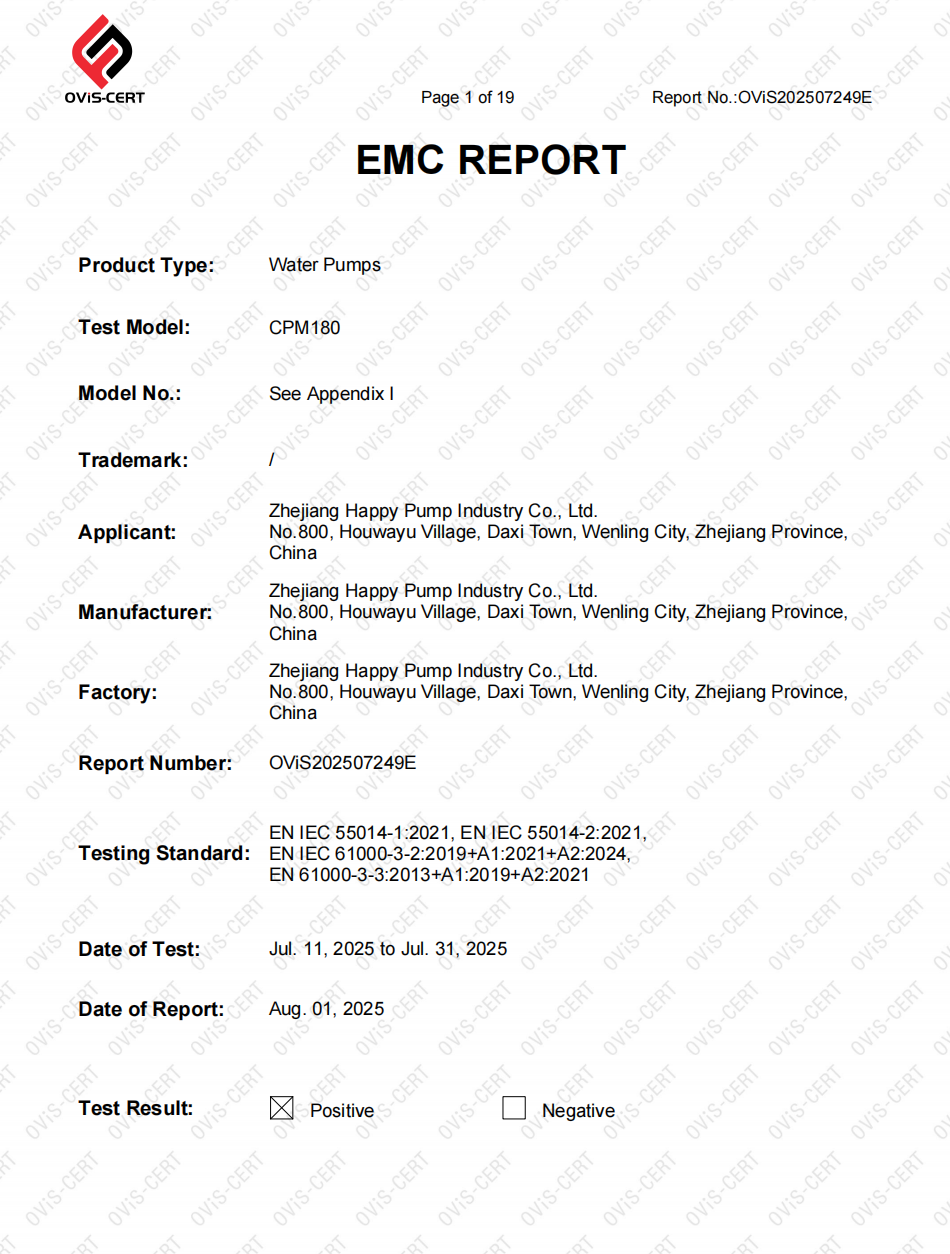
EMC documentation is model-scoped and standard-specific: buyers should record certificate number, issuing body and the exact standards referenced, not simply the presence of a mark.
Two boundaries are worth flagging for buyers working across regions. IEC 60335-2-41:2024 establishes safety requirements for electric submersible pumps for household and agricultural use, and single-phase household pumps are covered by IEC 60335-2-41 for voltages up to 250 V. In North America, however, UL 778 is the primary safety standard for motor-operated water pumps — a separate route from the EU instruments listed above. A buyer shipping to multiple regions should therefore map certificates to markets explicitly rather than treating one regional approval as globally transferable.
Demand Stability: Where Submersible Pumps Are Actually Consumed
A supplier relationship is only as durable as the demand behind it. The documented application set for the Happy Pump range covers agriculture irrigation, residential and building water supply and drainage, industrial circulation and cooling, municipal water, solar pumping systems, swimming pool circulation and sewage treatment — with stated working conditions including clean water, sewage and particle-containing water, high-head pumping and submersible installation.
That spread aligns with where third-party analysis puts volume. The borewell segment held the largest share of the global submersible pump market in 2025 at 46.7%, according to Grand View Research, which places deep well and borehole duty at the centre of the category. Non-clog and sewage submersible pumps represented approximately 25% of the global submersible pump market in 2024 on the same source's figures. Revenue from electric submersible pumps in the global agricultural pump market was valued at USD 2,515.6 million in 2025, per Grand View Research.
The regional picture reinforces the same reading. Asia Pacific dominated the submersible pump market with a 39.72% share in 2025, reaching a value of USD 7.05 billion, according to Fortune Business Insights. Solar pairing is spreading in South Asia in particular, where 75% to 100% of freshwater withdrawal is for agriculture, according to Precedence Research. For a supplier serving both agriculture and manufacturing applications, that combination — a stable borewell core, a growing sewage segment and a solar-driven overlay — is the demand argument for keeping several submersible categories in production simultaneously rather than specialising narrowly.
Market Signals Worth Reading Carefully
Buyers using market data to justify a multi-year supplier commitment should treat published figures as directional rather than precise. Market size estimates for the submersible pump category vary by several billion US dollars across research houses: Grand View Research puts the market at USD 13.3 billion in 2025, projected to reach USD 19.4 billion by 2033; SNS Insider values it at USD 14.75 billion in 2024, reaching USD 23.07 billion by 2032; Precedence Research reports USD 16.7 billion for 2024. Solar pump growth projections diverge even more sharply, from a 22.95% CAGR cited by Credence Research to 4.3% cited by Grand View Research.
The practical implication is that the trend direction is more reliable than any single number. Electric drive accounted for nearly 80% of submersible pump installations globally in 2024, per Grand View Research, and AC submersible pumps held a 39.5% revenue share of the solar pump market in 2023 on the same source — a reminder that solar deployment frequently runs through AC motor platforms rather than replacing them. On the supply side, China concentrated 18.5% of total global liquid pump exports in 2024, valued at approximately USD 14.3 billion, according to OEC, with China's liquid pump exports to Mexico alone reaching USD 579.37 million in 2024.
Where Breadth Reaches Its Limits
A broad, multi-category portfolio solves a specific problem — commercial adaptability across standard submersible categories — and it does not solve every problem. Buyers should be explicit about where it stops, because a supplier that is honest about its boundaries is easier to plan around than one that is not.
- Breadth is not application engineering depth. The documented hydraulic envelope runs from 20 to 100 metres of head and 0.25 to 550 kW of power, with flow from 1.5 to 5,500 cubic metres per hour. Requirements outside that band, or projects demanding bespoke hydraulic design, sit closer to specialist engineered-pump territory — a segment where global specialists such as Grundfos, Xylem and KSB are identified as leading players by MarketsandMarkets, and where electrical submersible pumps account for nearly 74.37% of drive-type share in 2026 on Fortune Business Insights' figures. Buyers with requirements of that type should confirm customisation feasibility rather than assume catalogue coverage.
- Warranty terms are a contract issue, not a portfolio issue. The stated use-case expectation for the supplier's pumps is around ten years of normal service with a one-year warranty. A buyer reselling into projects that demand multi-year warranty pass-through needs to negotiate that separately.
- Lead time is a planning assumption. A 30 to 45 day lead time against monthly capacity of 400,000 units describes normal conditions. Peak-season or multi-category consolidation orders should be scheduled against confirmed slots, not assumed.
- MOQ thresholds constrain trial breadth. With a 100-piece minimum below 3 HP and 50 pieces above 3 HP, testing many categories at once carries inventory cost. Buyers should sequence category qualification rather than launch all lines simultaneously.
- Regional compliance is not transferable. The documented CE, LVD and EMC evidence targets the EU market. North American buyers must verify UL 778 compliance separately.
Future Outlook
The direction of travel in the submersible pump category favours suppliers that were built around variation rather than around a single product. Three pressures stand out. Efficiency classification is tightening in major markets, which rewards a motor platform that already spans IE2, IE3 and IE4 rather than one that must be rebuilt. Material expectations are shifting as buyers move between clean water, effluent and corrosive duties within the same customer base, which rewards a supplier holding cast iron, stainless steel and engineering plastics simultaneously. And the solar overlay is expanding the addressable installation base, particularly where agriculture dominates freshwater withdrawal.
For buyers, the implication is that supplier evaluation should be treated as a recurring exercise rather than a one-off. The evidence set a buyer records at the research stage — categorfrom, motor classes, materials, IP range, certificate numbers, capacity, MOQ, lead time — becomes the baseline against which the supplier's next three years can be judged. That is a more useful test of reliability than any single shipment.
Frequently Asked Questions
Which certifications should a submersible pump supplier hold for EU shipments?
For the EU market, three instruments are relevant. The LVD certification covers water pumps including the QB60 and HQBm models and is issued by OViS-CERT under certificate number OViS202507249L, against EN 60335-1:2012+A11:2014+A13:2017+A1:2019+A14:2019+A2:2019+A15:2021+A16:2023 and EN IEC 60335-2-41:2021+A11:2021. The EMC certification is issued by OVIS-CERT under certificate number OViS202507249E and verifies EN IEC 55014-1:2021 and EN IEC 55014-2:2021, with EN IEC 61000-3-2:2019+A1:2021+A2:2024 and EN 61000-3-3:2013+A1:2019+A2:2021 also applicable. The CE attestation of conformity, certificate CE-5072-160326 issued by ECES, is valid from 2026-03-16 to 2031-03-16 for models HQBm, QB60, IDB35, HPSm-AX, HRSm-A, QDP series and QDX series, against 2014/35/EU, 2014/30/EU and 2006/42/EC.
Which motor efficiency classes are available, and why does the spread matter?
The documented motor offer covers IE2, IE3, IE4 and MS classifications, with a power range of 1 to 430 HP, speeds between 934 and 2,980 rpm, and cast iron or aluminium housings. The spread matters because efficiency requirements differ by destination market and change over time. A buyer whose supplier covers several classes can re-specify a pump family within the same relationship; a buyer whose supplier covers one class must re-source when the requirement changes.
What does a protection range from IP44 to IP68 mean for long-term use?
The documented protection level across the pump range runs from IP44 to IP68. The two ends describe different enclosure expectations: products at the lower end suit sheltered or splash-exposed duties, while IP68-rated products are specified for continuously submerged installations. Buyers should match the required IP level to the actual installation condition of each model, rather than applying a single rating across an entire order.
How do cast iron, stainless steel and engineering plastics change the sourcing decision?
All three are listed as main materials across the range. Cast iron is typically used where mechanical robustness and cost efficiency dominate in non-aggressive media; stainless steel is generally specified where corrosion resistance or hygiene considerations matter; engineering plastics serve smaller household, garden and light-duty duties where weight and cost matter more than load capacity. A supplier offering all three can absorb a change in application or destination market without the buyer changing vendor, which reduces documentation, warranty and spare-parts fragmentation.
What MOQ and lead time should a buyer plan for when consolidating several categories?
The stated terms are a minimum order quantity of 100 pieces below 3 HP and 50 pieces above 3 HP, with a lead time of 30 to 45 days against a monthly capacity of 400,000 units. For multi-category consolidation, these thresholds mean that a wide simultaneous trial carries inventory commitment; sequencing categories across production slots is usually more practical than launching all lines at once.
How can a buyer verify capacity and quality-control claims before committing?
Several claims are documented and checkable. Annual output is stated at around 4,000,000 pieces per year, supported by a monthly capacity of 400,000 units. The company reports roughly 800 employees including about 200 professional and technical staff, a 55,000 square metre site with approximately 210,000 square metres of building area, and 100% testing. Certification evidence can be cross-checked by certificate number and issuing body against the standards cited: OViS202507249L for LVD, OViS202507249E for EMC and CE-5072-160326 for CE. Buyers should request the underlying certificates rather than summaries.
Full model series, motor options and material specifications referenced in this article are documented in the manufacturer's product catalogue, available for download: Happy Pump product catalogue (PDF).
Tem questões ou precisa de mais detalhes?
Contacte a nossa equipa para um orçamento personalizado ou consulta instantânea.
Solicitar orçamento
Preencha o formulário abaixo e a nossa equipa entrará em contacto com uma proposta personalizada.
Chat direto do WhatsApp
Prefere conversar em tempo real? Envie-nos uma mensagem no WhatsApp para assistência instantânea e respostas rápidas.
- Obter orçamento personalizado
- Partilhar fotos ou documentos
- Discuta as suas necessidades diretamente
Geralmente responde em 5–30 minutos durante o horário de expediente.