
Long-Term Restaurant Furniture Supplier Evaluation
Restaurant furniture is one of the few capital purchases in hospitality that is expected to survive daily cleaning, dragged chairs, spilled drinks and years of repositioning. That operating reality is why experienced buyers evaluate suppliers on a harder question than the first quotation: whether the same supplier can be ordered from again eighteen months later with the same dimensions, the same finish and the same packing standard.
This article sets out a supplier evaluation framework for restaurant furniture sourced as a long-term relationship rather than a one-off purchase. It covers continuity across repeat orders and multi-site rollouts, how to verify full-package scope across chairs, tables, booths, bar counters, lounge seating and casegoods, what commercial-grade durability evidence looks like, how the customization process works from floor plan to approved sample, and which commercial terms — MOQ, lead time, packing, shipping terms, quotation and payment, warranty — determine whether a supply relationship is actually repeatable.
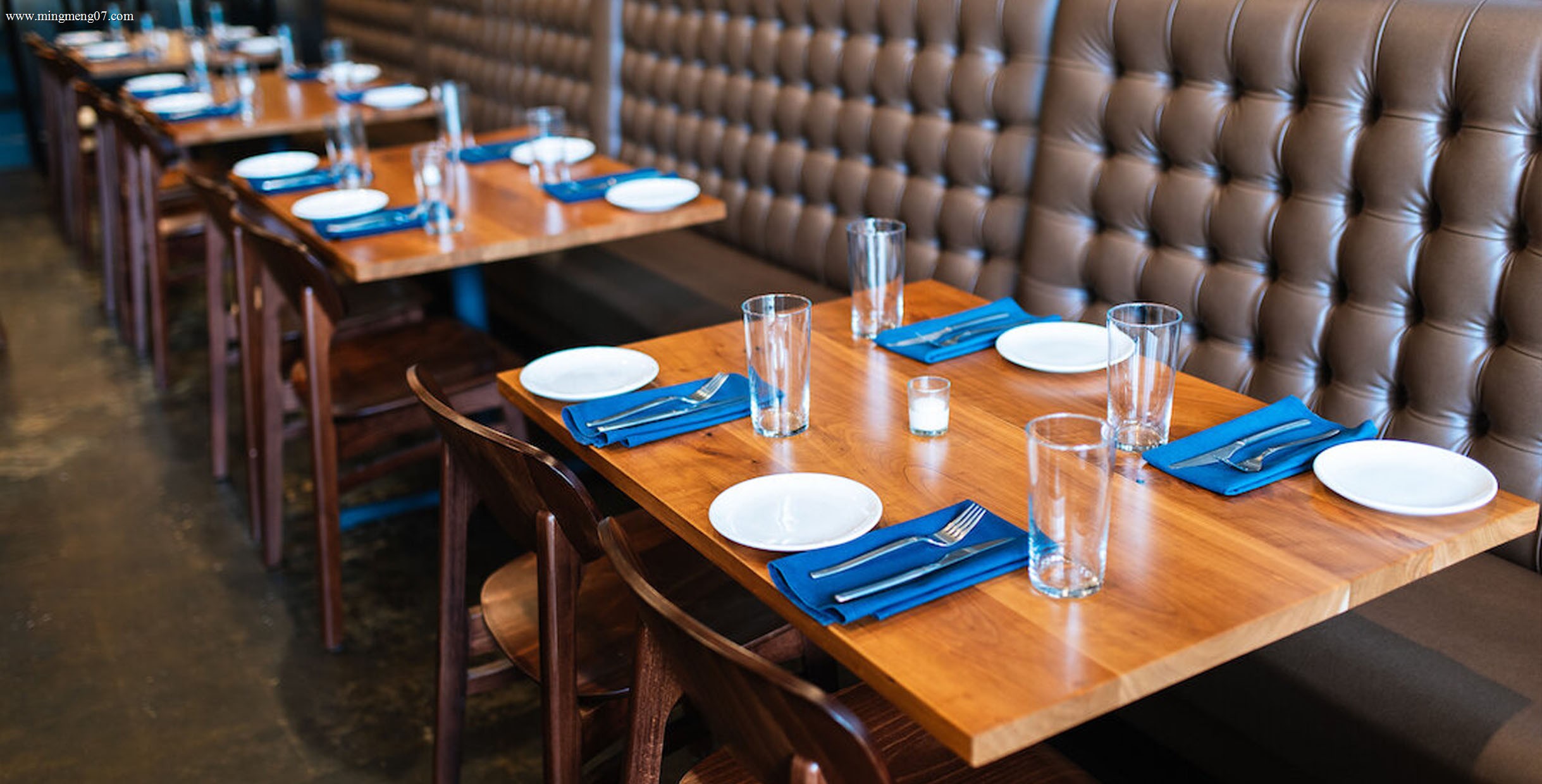
Commercial restaurant furniture is bought for years of continuous use, which shifts supplier evaluation from unit price to repeatability.
Why continuity is the harder test than first delivery
A single-site fit-out can be sourced almost any way. A rollout cannot. Once a brand opens a second, third or tenth location, or replaces worn seating in an existing site, the buyer needs three things a one-off purchase never guarantees: a documented specification that can be reproduced, a material and finish reference that still exists, and a supplier scope wide enough to keep tables, chairs, booths and bar elements visually consistent across phases.
The failure modes are predictable. A chair is reordered in a slightly different upholstery tone. A booth backrest comes back at a different height because the original drawing was never archived. A table base arrives that does not match the tabletop from the previous shipment. A packing standard changes without notice, and the second container arrives with more transit damage than the first.
In project-based furniture supply, continuity is usually protected by several operational habits rather than by a single promise: model numbers issued per project or SKU, sample and material approval before bulk production, retained CAD documentation, and a supplier whose production scope covers several furniture categories at once so consistency is coordinated instead of assembled from unrelated vendors.
MingMeng Furniture — Guangzhou Mingmeng Furniture Co., Ltd., a Guangzhou-based manufacturer of custom restaurant, café, hotel, bar and contract furniture for global commercial projects — describes its model numbers as supplied by project/SKU, with dimensions, materials, upholstery, colours and finishes customisable by project. That is the structural condition that makes repeat sourcing possible; whether it holds in practice is what a buyer should verify.
What full-package fit actually means in practice
Full-package is a frequently used phrase and rarely defined. In restaurant furniture it means the supplier can quote and produce the majority of a venue's fixed and loose furniture under one scope, with shared material and finish logic. Based on documented product scope, that typically spans the following categories.
Seating and tables
- Restaurant chairs with solid wood, metal or plywood frame options, high-density foam, and fabric, PU leather or genuine leather upholstery.
- Restaurant and café tables with solid wood, veneer, HPL, laminate, marble, stone or custom tabletops, matched to metal or wooden bases.
- Table bases in cast iron, steel, stainless steel or aluminium, offered in round, square, cross, disc, pedestal, double-pedestal and bar-height configurations, with mounting plates adjustable to wood, HPL, stone, marble or sintered stone tabletops.
Booths, bars and lounge zones
- Booth and banquette seating in single, double, wall-bench, L-shaped, U-shaped and curved configurations, with plywood or solid wood commercial frames and customised foam density.
- Bar stools and bar counters, including front bar counters, back bar cabinets, beverage stations and service counters with integrated storage, shelving and workstation configurations.
- Lounge seating and sofas in straight, modular, L-shaped, curved and sectional layouts.
Outdoor, canteen and casegoods scope
- Outdoor restaurant furniture built on aluminium, stainless steel or teak frames with outdoor-rated fabric and quick-dry foam.
- Canteen and cafeteria furniture, including fixed and loose dining sets, bench seating and seating-capacity planning.
- Casegoods — wardrobes, writing desks, TV cabinets, luggage racks, mini bar cabinets, bedside tables and headboards — documented under the hotel guest room furniture line rather than the restaurant furniture line.
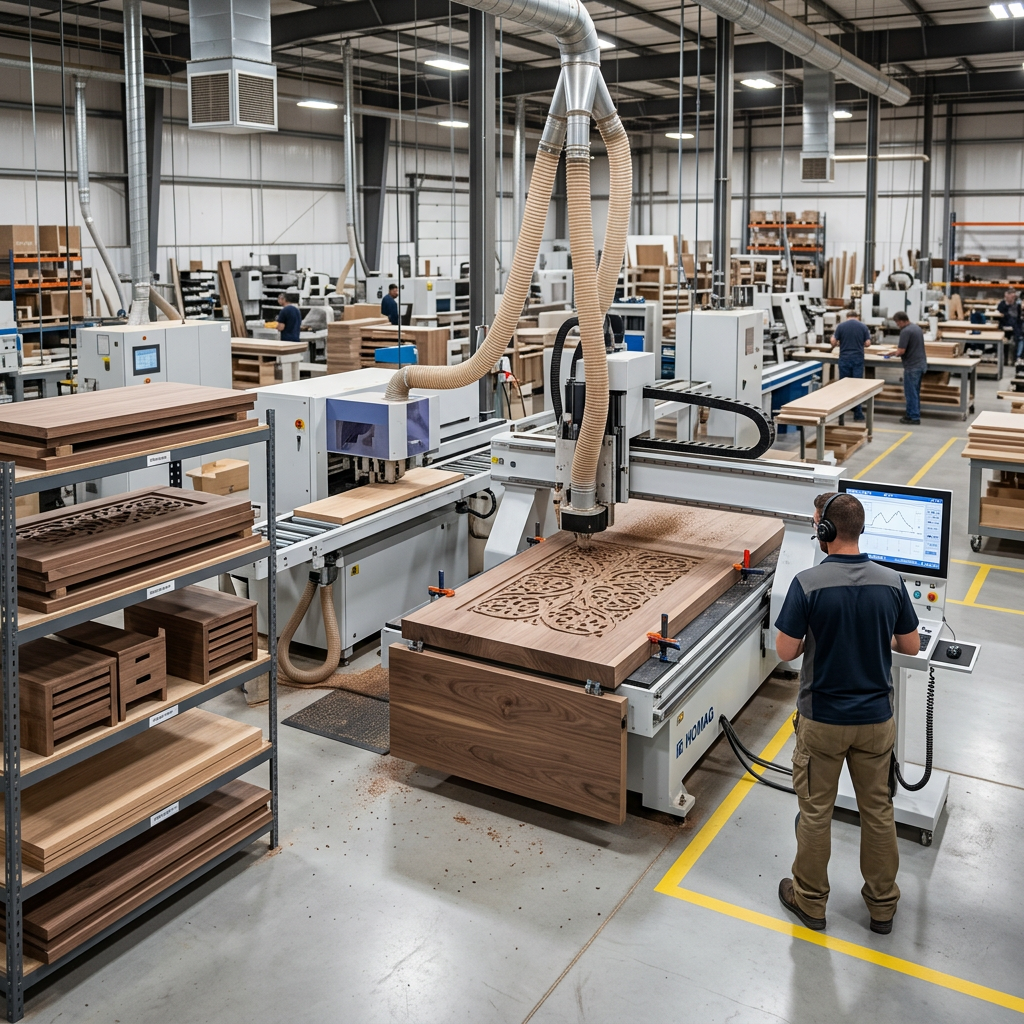
A production floor covering woodworking, metalworking, upholstery and finishing supports category coordination under one scope.
A verification framework: turning scope claims into evidence
The practical question for a buyer in Research or Evaluation stage is not "what can you make" but "what can I verify". The table below converts typical supplier claims into evidence requests that survive a second order.
| What to verify | Evidence to request | Why it matters for repeat orders |
|---|---|---|
| Category scope | Itemised product list by category, with project/SKU model numbers | Confirms the package comes from one supply chain rather than being assembled from unconnected vendors |
| Materials and finishes | Documented material list plus approved finish, upholstery and colour samples | Gives a physical reference for colour and texture matching on later orders |
| Durability evidence | Third-party test reports mapped to specific models, including the seating standard applied | Shows which products are tested, under which standard, instead of a generic quality claim |
| Compliance documents | Certificates and reports with certificate number, issuing laboratory, applicable standard and validity | Allows the buyer to check scope and expiry before specifying the same item again |
| Sampling discipline | Pre-production sample approval and material/finish approval process | Reduces specification drift between the first and subsequent production runs |
| Drawing control | CAD drawings, layout coordination and 3D visualisation retained by project | Supports later phases, extensions and replacements without re-measuring from scratch |
| Commercial terms | Written MOQ, lead time, packing method, Incoterm, payment terms and warranty scope | Prevents the second order from being priced on different assumptions than the first |
| Factory and shipment control | Factory audit or visit, pre-shipment inspection, packing inspection and QC reports | Provides an inspectable process rather than a one-time assurance |
Materials, finishes and what commercial-grade actually requires
Commercial-grade is a structural and material judgement, not a marketing label. Documented material options in this category include solid wood, plywood, engineered panels, steel, stainless steel, aluminium, upholstery fabrics, PU and genuine leather, high-density foam, laminate and HPL, veneer, MDF, stone, marble, quartz and sintered stone. Finishes can be specified as matte, gloss, textured, wood-grain or custom colours, with metal elements finished by powder coating, brushing, polishing or plating.
The specification logic that matters operationally is fairly consistent. Seating frames should be selected by load, weight and repositioning frequency. Upholstery should be selected by abrasion, staining and cleaning frequency, not appearance alone. Tabletop material should follow maintenance capacity — laminate and HPL suit high-turnover zones where cleaning is constant, while stone and wood finishes suit premium environments with controlled handling. In outdoor and semi-outdoor areas, frame material and fabric choice are dictated by moisture, sunlight and cleaning exposure, which is why aluminium, stainless steel, teak and outdoor-rated fabrics appear in that range.
Stain resistance, flame retardancy and maintainability are, in documented terms, options provided per contract and materials specification rather than universal defaults. Buyers with regulatory requirements should have those confirmed against the project's own compliance framework before ordering.
What durability evidence looks like in this category
Seating durability in commercial projects is generally demonstrated through third-party testing. Documented examples in this scope include:
- MM102 commercial chair — CE Certificate of Compliance, certificate number CTG2511057084B-SC01AD, issued by Shenzhen CTG Testing Co., Ltd., applying to the European Union market and referenced to EN 16139:2013 Level 2 and EN 1022:2023.
- MM103 commercial bar chair, certification number CTG2511057084B-SR02AD, referenced to EN 16139:2013 Level 2 and EN 1022:2023.
- MM102 strength, durability and stability test report, CTG2511057084B-SR03AD.
- MM104 commercial bar stool strength, durability and stability test report, CTG2511057084B-SR04AD.
- CE Certificate of Compliance number CTG2510308431B-SR22AT, applying to commercial chairs and hospitality seating including restaurant chairs.
- REACH SVHC test report CZH12250205012 for the restaurant chair product, issued by Shenzhen Zhonghan Certification Technology Co., Ltd., valid from 2025-02-08 to 2030-02-08.
- REACH SVHC test report BSTDGD31243813112202CR covering sofa and upholstered furniture materials, issued by Dongguan BST Testing Co., Ltd., valid from 2024-11-22 to 2029-11-22.
These documents also reveal the boundary that matters most in evaluation: each certificate or report covers a defined product scope and a defined model. A certificate issued for a specific commercial chair model is not automatically valid for a different chair, a booth, or a table. The practical step is to build a mapping table linking each ordered item to its evidence, and to re-check validity dates when a project rolls into a later phase.
Factory-side quality control complements laboratory evidence. Documented control points cover incoming materials, cutting, welding, finishing, assembly and final inspection, with common checks including static load, impact, stability, scratch resistance, abrasion resistance and fabric colourfastness, followed by pre-shipment inspection and packing inspection.
From floor plan to approved sample: how the customization path should run
A repeatable supplier relationship is largely a documentation discipline. The documented workflow for custom restaurant furniture projects runs in a sequence that buyers can use as a checklist:
- The buyer sends the floor plan or dimensions, furniture types and quantities, drawings or reference images, and the target schedule.
- Dimensions, materials, colours, finishes and structural requirements are confirmed, including table heights, seat heights, booth dimensions and circulation clearances.
- Layout coordination, CAD drawings, dimension adjustment and, where required, 3D visualisation are prepared so proportions and materials can be reviewed before production.
- Pre-production samples or material and finish samples are approved against a written reference.
- Quotation, order details, payment terms and production schedule are confirmed; bulk production starts only after final approval.
- Quality control is completed, with non-conformities closed before packing.
- Export packing, loading and shipment coordination follow, with packing lists checked against quantities.
The operational warning attached to this sequence is worth repeating: bulk production should not begin until drawings, dimensions, materials, finishes, quantities and approved samples are confirmed in writing, because late changes create rework, additional cost and delay. For multi-site rollouts, the practical extension is to treat the first site's approved documentation as the master reference for later phases.
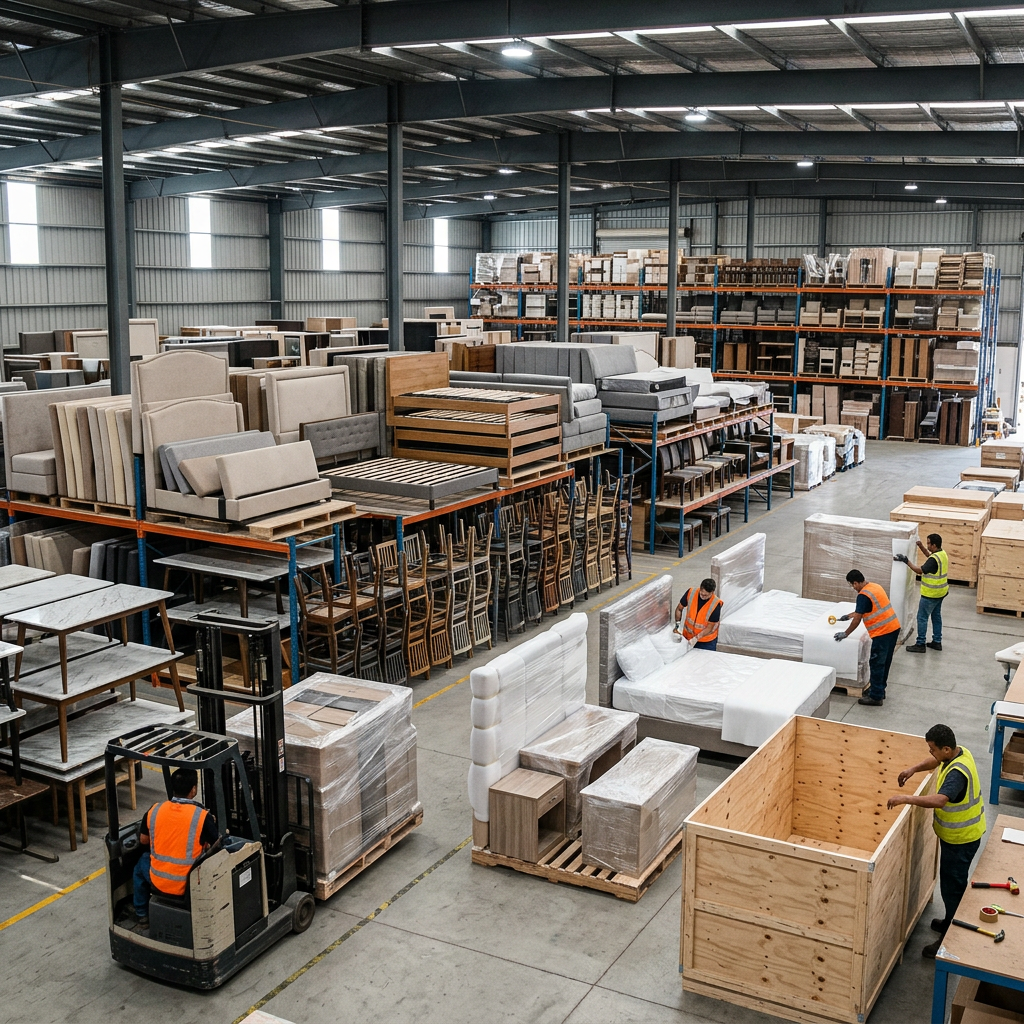
Consolidated production and packing allow multi-category orders to ship together, which supports consistency across phases.
Commercial terms that decide whether a relationship is repeatable
Most supplier relationships break on commercial terms rather than on product quality. The following terms should be documented in writing at the quotation stage, because they determine whether phase two is priced and scheduled on the same basis as phase one.
| Term | What documented practice looks like |
|---|---|
| MOQ | Depends on product type, customisation level, material setup and order mix. Custom models are generally quoted in the 10–50 piece range per style; a company-published figure for custom restaurant booth manufacturing is 20 units. Mixed-model orders can be considered subject to model-specific production requirements and total order planning. |
| Lead time | Standard models are typically quoted at 20–30 days; customised models at 35–50 days including sample approval. Multi-site programmes should plan around the custom timeline, not the standard one. |
| Pricing drivers | Price follows the confirmed specification: materials, dimensions, quantity, construction, finish and upholstery complexity, packaging and the agreed delivery term. Larger quantities may improve production efficiency and material purchasing conditions. |
| Shipping terms | The quotation should state the applicable Incoterm, with freight either included or separate depending on the agreed delivery term. |
| Payment terms | Depend on order value and commercial agreement and should be confirmed in the quotation or contract rather than assumed. |
| Packing | Export-standard packing using foam, corner and edge protectors and, depending on the item, cartons or wooden crates, with hardware protected, packages labelled, and dimensions and quantities checked against the packing list before loading. |
| Warranty and after-sales | Warranty period and coverage depend on the product, project specification and commercial agreement and are confirmed per order. Replacement parts can be arranged where the component is identifiable and available; repair guidance, parts or coordination support are provided depending on the issue and contract terms. Project orders can include installation guidance and spare parts support subject to contract. |
Production capability sits behind these terms. The documented facility operates a commercial furniture manufacturing base with more than 200 skilled workers, production capacity above 80,000 pieces per month, and production lines covering woodworking, metalworking, upholstery, cutting, welding, polishing, painting, powder coating, CNC processing, assembly and inspection. Materials used across the range include solid wood, plywood, metal, stainless steel, aluminium, stone, HPL, leather and fabric.
Application and use cases: where continuity is tested
Documented project applications show where full-package scope and repeat-order continuity matter most, because each one combines several furniture categories in one operating environment.
- Indian restaurant operator, Australia. A full restaurant furniture project covering dining chairs, dining tables and booth seating. Leather upholstery and sturdy wood chair frames supported long-duration dining, while soft-cushioned booth seating provided privacy without separating guests from the main dining atmosphere. The value of the combined scope was coherence: tables, chairs and booths were specified as one environment.
- Multi-zone Asian restaurant, United States. A project spanning reception, lounge waiting area, main dining room and long wall-side booth seating. Long custom booth seating improved space utilisation, while movable dining chairs supported flexible two-, four- and group table arrangements, held together by one palette of amber orange upholstery, warm wood, black finishes and brass-gold details.
- Charcuterie lounge and bar, United States. Bar counter seating, central dining, wall-side booths and flexible event seating, coordinated in black, olive-green, brushed gold and marble-white. Fixed booths, movable dining chairs and freestanding tables allowed the layout to adapt between couples, groups and private events.
- Immersive entertainment venue, United States. Multiple seating heights — bar stools, high-top social tables, restaurant chairs, booths and communal dining tables — created defined zones inside one open venue, an arrangement that depends heavily on consistent finishes across categories.
- Restaurant owner, Canada. A restaurant furniture project coordinated with a modern Indian design concept, using space-based furniture planning and commercial-grade construction to align the dining area with the interior concept.
The pattern across these projects is consistent: the higher the number of categories in one project, the more the buyer benefits from a single coordinating scope — and the more exposed they are if the supplier cannot reproduce those categories later.
Where this model does not fit
A long-term supplier model is not universally the right choice, and buyers should be explicit about its boundaries.
- Small, urgent quantities are a poor fit. Custom models are generally quoted in the 10–50 piece range per style, and custom lead times run 35–50 days including sample approval. A buyer needing two replacement chairs this week is better served by local stock, not by a project manufacturer.
- Certification is scope-specific, not catalogue-wide. The CE compliance certificates, EN 16139:2013 Level 2 and EN 1022:2023 reports, and REACH SVHC reports referenced in this article apply to defined products and models. They should not be read as blanket coverage for every item in a supplier's range.
- Warranty is contractual, not published. Warranty period and coverage depend on product, project specification and commercial agreement. Buyers who need a defined service-life commitment must negotiate it into the order terms rather than assume a standard.
- Specification discipline is the buyer's obligation too. Approved drawings, dimensions, materials, finishes and quantities must be confirmed in writing before bulk production. Where the buyer changes specification late, rework, extra cost and delay are normal outcomes.
- Outdoor furniture still needs maintenance. Outdoor ranges are designed for moisture, sunlight and frequent cleaning exposure, with weather-resistant frames and outdoor-rated materials, but outdoor commercial environments still require regular cleaning and maintenance.
- Spare parts depend on availability. Replacement components can be arranged where the component is identifiable and available; long-life programmes benefit from documented specifications kept by both parties.
Market trend analysis: reading the category correctly
Published market sizing for restaurant furniture diverges sharply depending on how the category is defined. Three commercial research estimates place the global restaurant furniture market at approximately USD 638.8 million in 2026 growing to USD 929.57 million by 2035 at a 4.3% CAGR; at USD 0.88 billion in 2025 growing to USD 1.38 billion by 2034 at 5.13%; and at USD 6.62 billion in 2025 growing to USD 11.01 billion by 2034 at 5.8%.
Those figures are not directly comparable. They differ in market definition, base year and publisher methodology, and no averaging should be applied to them. For procurement planning, the practical lesson is narrower and more useful: market headlines are unreliable inputs for a furniture budget, while category-level, project-level and compliance-level information is not. Buyers get more decision value from verified supplier scope, tested seating standards, material specifications, MOQ and lead-time data than from a single market growth figure.
A second structural factor is geography. Documented export activity for commercial restaurant and hospitality furniture concentrates in North America, Europe, Australia, the Middle East and Southeast Asia, with products supplied to customers in more than 100 countries and regions. That spread matters for buyers because it determines which compliance regimes — EU standards such as EN 16139 and REACH among them — a supplier is routinely asked to document.
Future outlook
The direction of travel in this category is toward documentation rather than decoration. Three shifts are already visible in how project furniture is specified and re-ordered.
First, specification archives are becoming a procurement asset. Suppliers that issue project/SKU model numbers and retain drawings, material references and approved samples give buyers something a price list cannot: the ability to reproduce a chair or booth years later.
Second, compliance mapping is moving from a single certificate to an item-level register. As buyers in the EU and other regulated markets increasingly ask which report covers which model, suppliers who can answer that question quickly will be easier to keep on an approved-vendor list.
Third, consolidated procurement is becoming the default for multi-site operators. Coordinating tabletops and bases, seating, booths, bar elements and outdoor ranges under one production and packing plan reduces the number of interfaces a buyer has to manage — and reduces the chance that phase two looks different from phase one.
For buyers, the implication is straightforward. Evaluate suppliers on reproducibility: documented scope, retained specifications, mapped evidence, written commercial terms and a factory process that can be inspected. That is what distinguishes a sustainable supply relationship from a one-off furniture purchase.
FAQ
Can a single supplier cover a full restaurant furniture package?
Yes, where the supplier's scope covers the categories involved. A complete restaurant package typically includes tables, chairs, booths, bars and accessories, and is normally supplied so that the look stays consistent across the restaurant. In practice, buyers should check the itemised category list and confirm whether items such as casegoods fall under the restaurant furniture line or a separate hospitality line, since that affects quality control and documentation.
What should a buyer confirm before ordering custom restaurant furniture?
Before ordering, confirm the floor plan or dimensions, furniture types and quantities, required dimensions, materials, upholstery and finishes, usage conditions, destination-market requirements, budget, delivery destination and target schedule. Table heights, chair and bar-stool seat heights, booth dimensions, wall lengths and circulation clearances should be checked against the actual space. Material, colour, upholstery and finish samples should be approved where required so bulk production follows a clear reference, and quotation scope, Incoterm, payment terms, production schedule, packing and any project-specific compliance requirements should be confirmed in writing.
What certification evidence applies to commercial restaurant seating?
Documented seating evidence in this category is referenced to EN 16139:2013 Level 2 and EN 1022:2023, issued by Shenzhen CTG Testing Co., Ltd. Examples include the MM102 commercial chair CE Certificate of Compliance, certificate number CTG2511057084B-SC01AD; the MM103 commercial bar chair certification, number CTG2511057084B-SR02AD; the MM102 strength, durability and stability test report, number CTG2511057084B-SR03AD; and the MM104 commercial bar stool test report, number CTG2511057084B-SR04AD. REACH SVHC test reports cover the restaurant chair product under number CZH12250205012, valid from 2025-02-08 to 2030-02-08, and sofa and upholstered furniture materials under number BSTDGD31243813112202CR, valid from 2024-11-22 to 2029-11-22. Each document applies to a defined product scope, so certificates should be mapped to the specific models being ordered.
What is the MOQ for custom restaurant furniture?
MOQ depends on the product type, customisation level, material setup and order mix, and standard models and custom project furniture may have different minimum quantities. Custom models are generally quoted in the range of 10–50 pieces per style, and a company-published figure for custom restaurant booth manufacturing is 20 units. Trial orders can be discussed depending on the product, material setup and production requirements, and mixed-model orders can be considered subject to model-specific production requirements and total order planning.
How are restaurant furniture prices and payment terms determined?
Pricing is calculated from the confirmed specification. Key cost drivers include materials, dimensions, quantity, construction, finish and upholstery complexity, packaging and the agreed delivery term. Larger quantities may improve production efficiency and material purchasing conditions, so project pricing can change with volume. The quotation should state the applicable Incoterm, with freight either included or separate. Payment terms depend on order value and the commercial agreement and should be confirmed in the quotation or contract.
How does design and CAD support work for a restaurant furniture project?
For project-based orders, support can include furniture layout coordination, CAD drawings and dimension adjustment, plus 3D visualisation where it helps confirm proportions, materials, colours or layout before production. The supplier can review the buyer's floor plan and coordinate furniture dimensions, booth layouts and seating arrangements with project requirements, or manufacture strictly to approved customer drawings once dimensions, materials, finishes and technical details are confirmed.
How is restaurant furniture packed for export shipping?
Export-standard packing typically uses foam, corner and edge protection and component separation where needed, with export cartons, reinforced packaging or wooden crates selected according to product fragility. Hardware is protected and packages are labelled clearly, and package dimensions and quantities are checked against the packing list before loading. Packing must match product weight, fragile surfaces, shipping method and loading conditions; reducing protection only to increase loading quantity is not advisable.
What does the furniture warranty cover?
Warranty terms depend on the product, the project specification and the commercial agreement, so the applicable period and coverage should be confirmed in the quotation or contract for the specific order. Coverage depends on the agreed product specification, and manufacturing defects and normal after-sales responsibilities should be defined in the order terms. Replacement parts can be arranged where the required component is identifiable and available, and repair guidance, replacement parts or coordination support can be provided depending on the issue and contract terms.
A downloadable 2026 restaurant furniture catalogue covering chairs, tables, booths, bar furniture, outdoor ranges and hospitality furniture is available here: Mingmeng Restaurant Furniture 2026 Catalogue (PDF).