
Long-Term Sodium Hyaluronate Supply: The Audit Evidence
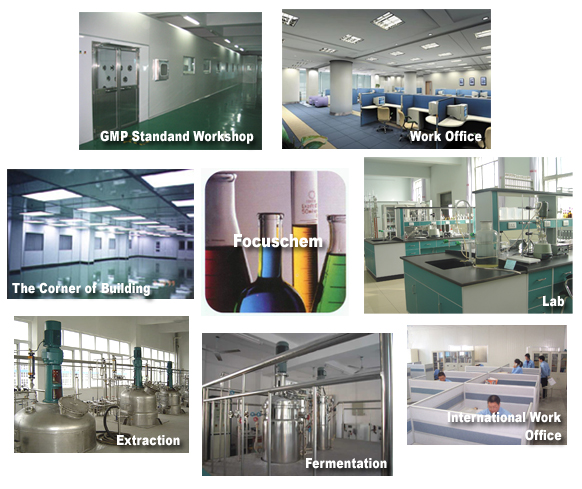
A sodium hyaluronate workshop is only as dependable as its documented capacity, staged process flow and batch release records.
Sodium hyaluronate is rarely a one-time purchase. A cosmetic or oral-care formulation that qualifies a grade is normally repeated across quarters and often across years, and the cost of switching suppliers mid-programme is higher than the cost of the material itself. That changes what a sourcing decision actually is: less a comparison of two specification sheets, more an assessment of whether the same grade, the same documentation and the same delivery pattern will still be available on the fifth and fifteenth order.
Sodium hyaluronate is the sodium salt of hyaluronic acid, and it appears across cosmetic, food and pharmaceutical supply chains under the same ingredient identity. Industry produces it by one of two routes: extraction from animal tissue, or large-scale bacterial fermentation using genetically modified strains, followed by downstream processing to reach a target molecular weight and purity. Each route produces a different documentation footprint — and a different set of questions when a buyer starts planning beyond the first shipment.
Continuity Is an Audit Question, Not a Sales Claim
Price per kilogram is the easiest supplier comparison to make and the least informative one for a repeat programme. It tells a buyer what one shipment costs, not whether the next one will be produced on schedule, released against the same criteria, or cleared through customs with the same paperwork.
Four dimensions decide continuity, and each one can be checked rather than assumed:
- Capacity. Installed monthly and annual output, and whether the two figures reconcile.
- Batch release discipline. What is inspected, when, and against what release criteria before goods leave the plant.
- Documentation repeatability. Whether origin, safety and quality certificates can be reissued for every shipment, not just the first.
- Commercial structure. Minimum order quantity, delivery terms, inspection rights and payment conditions that make a multi-year relationship workable.
Buying on the spot market optimises the first of these and leaves the other three unverified. That is the trade-off behind most continuity failures: the material purchased was correct, but the supply relationship was never designed to repeat.
Capacity Evidence: Numbers That Have to Reconcile
Shandong Habier Biopharma Co., LTD is a manufacturer and supplier of sodium hyaluronate and chondroitin sulfate based in Qufu City, Shandong Province, China, established in 2015. Its published company profile states a 50,000 m² facility, 123 employees, a six-engineer R&D team and an annual output of 600–700 MT, with approximately 20% of production exported to the EU, the USA and Korea.
The commercially relevant disclosure for a repeat buyer is smaller and more specific: OEM and ODM production services, a minimum order quantity of 1 kg, a typical production lead time of 5–8 days, and monthly production capacity of 50–60 tons.
Those numbers can be audited arithmetically. A monthly capacity of 50–60 tons annualises to roughly 600–720 tons, which aligns with the stated annual output of 600–700 MT. When a supplier's monthly and annual figures do not reconcile, at least one of them is usually a marketing number rather than a production plan. Buyers evaluating any long-term sodium hyaluronate supplier should run this check before the commercial negotiation begins.
| Evidence item | Published figure |
|---|---|
| Facility footprint | 50,000 m² |
| Annual output | 600–700 MT |
| Monthly production capacity | 50–60 tons |
| Typical production lead time | 5–8 days |
| Minimum order quantity | 1 kg |
| Production services | OEM and ODM |
| Customisation scope | Purity adjustment |
| Export markets | EU, USA |
Inside the Process: Fermentation, Extraction and Downstream Handling
Industrial hyaluronic acid production is based on either extraction from animal tissues or large-scale bacterial fermentation, and fermentation performance is itself a variable rather than a fixed property. A 2022 peer-reviewed review of biotechnological HA production reported investigated fermentation modes — batch, repeated batch, fed-batch and continuous culture — with yields of 2.5 to 7.0 g/L from S. zooepidemicus in the cited studies.
That range is a literature-reported benchmark, not a vendor specification. Its practical value to a buyer is directional: it shows that yield depends heavily on process design, which is why the physical layout behind a capacity claim matters more than the capacity number alone.
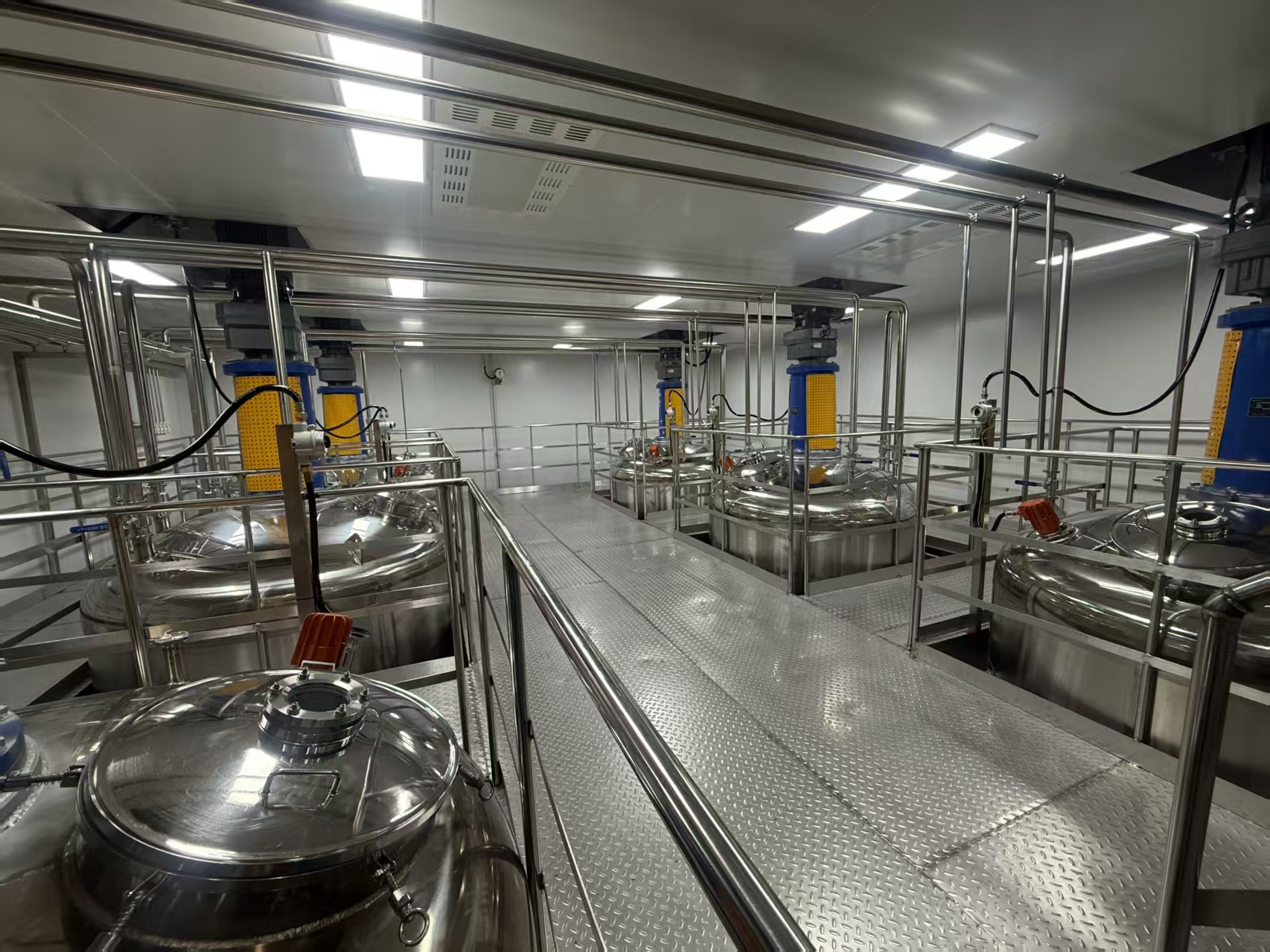
Upstream equipment — fermenter, extraction tank, sedimentation tank — is where batch-to-batch variation usually originates.
In documented workshop imagery from this manufacturer, the production environment includes a fermenter, an extraction tank, a sedimentation tank and the main factory workshop floor. Each of these stages is a potential source of variation: a change of campaign, a shared vessel used for two different product families, or a cleaning cycle that runs short can all change the profile of the next batch without changing a single line of the specification sheet.
This is the point where a paper audit reaches its limit. Questions such as how many fermentation lines operate independently, how changeovers between campaigns are scheduled, and whether production is phased to protect a contracted volume are rarely answerable from a company website. Habier's stated acceptance framework includes support for on-site factory inspection and third-party laboratory inspection, which is the mechanism by which these questions are normally settled. Where a claim — the number of independent fermentation workshops, or a defined raw-material buffer — cannot be evidenced in public documents, it belongs in the audit scope rather than in the specification sheet.
Batch Release: What the Paperwork Should Prove
A capacity figure describes what a plant can make. A release procedure describes what a buyer is allowed to know about it before shipment. Habier states 100% full inspection before delivery, with a pre-shipment full test and a COA report as the acceptance basis, and it supports third-party laboratory inspection as an additional verification layer.
Two documentation habits separate a repeat-ready supplier from a transactional one. The first is that the COA is issued per shipment rather than per grade. The second is that deviation handling is documented: how a batch that fails a release criterion is identified, isolated, recorded and communicated. Deviation and rejected-batch traceability is one of the few audit items that cannot be answered from a specification sheet, and buyers on a long-term contract should request the log rather than assume it exists.
Certification is the third layer, and it has an expiry date like everything else in procurement.
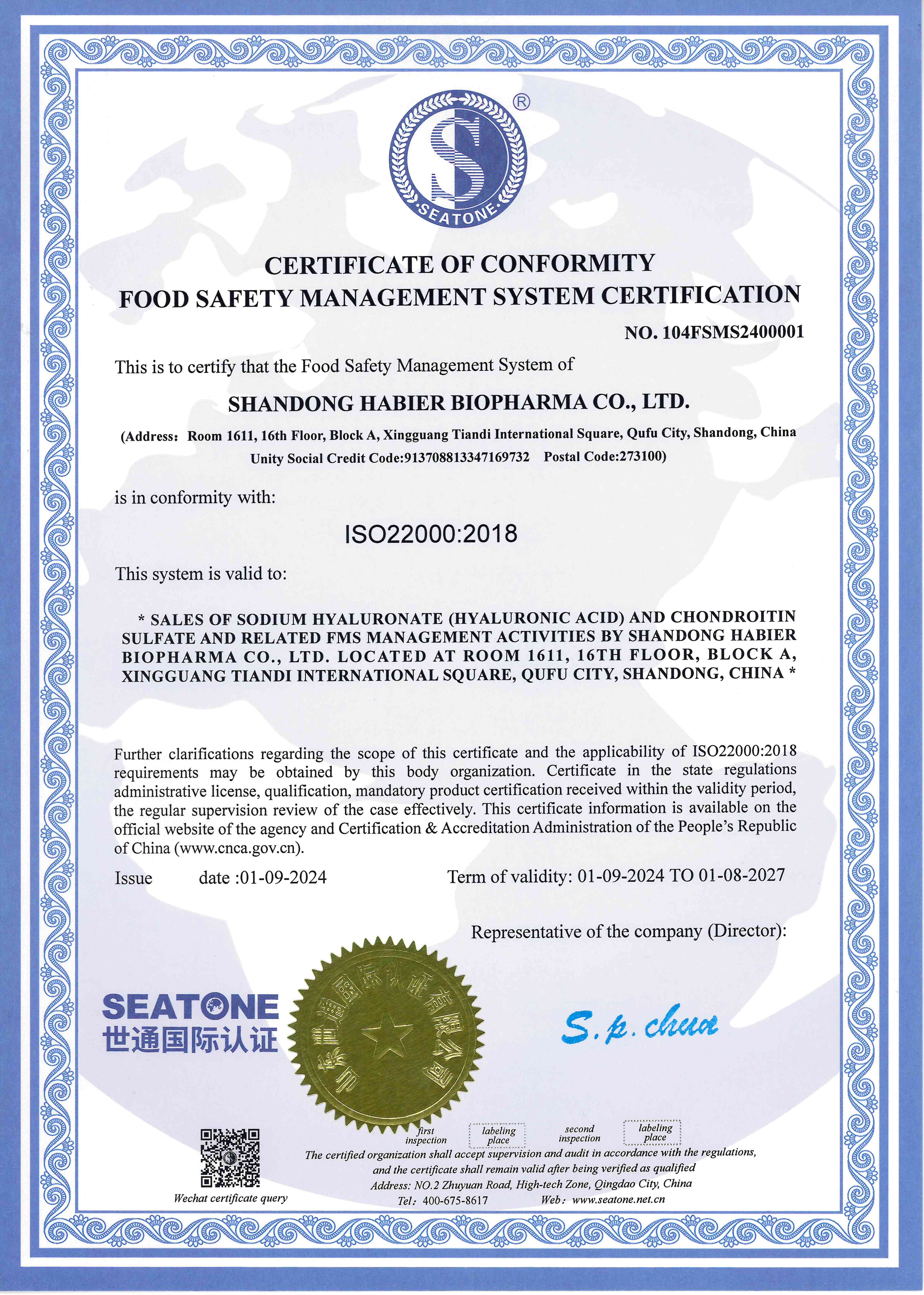
Certification must be current at the time of the order, not at the time of the first audit.
| Certificate | Standard | Number | Authority | Issued | Valid to |
|---|---|---|---|---|---|
| ISO 22000 Food Safety Management System | ISO 22000:2018 | 104FSMS2400001 | Shandong Seatone International Certification Co., Ltd. | 2024-09-01 | 2027-01-08 |
| ISO 9001 Quality Management System | GB/T 19001-2016 / ISO 9001:2015 | 1042Q00053R0S | Shandong Seatone International Certification Co., Ltd. | 2024-09-01 | 2027-01-08 |
The company's qualification system is described as dual ISO certification plus HACCP, Kosher and Halal, with product certification for organic COSMOS and ISO 16128. The ISO 22000 scope covers the sales of sodium hyaluronate (hyaluronic acid) and chondroitin sulfate and related food safety management activities.
Repeat-Order Proof: 4,733 kg to a US Importer
The clearest continuity evidence available in this supplier's record is a US-based natural cosmetic and health supplement importer that has taken delivery of 4,733 kg of sodium hyaluronate over a long-term, stable relationship. The material is used as a cosmetic raw material and as an oral health care supplement raw material — two different downstream specifications served from the same supply relationship.
Two details make this case more than a volume figure. First, the raw material is avian origin and is accompanied by complete official veterinary heat treatment certification, meeting US APHIS import standards, with customs clearance supported by a valid USDA import permit. Second, the relationship is characterised by stable batch quality and repeat ordering rather than a single large shipment.
For a procurement team, repeat ordering is the strongest available signal, because it is the only evidence that a buyer — not the supplier — has re-validated the material. A 4,733 kg cumulative volume also implies that incoming inspection at the customer end has been passed repeatedly, which is a different claim from a certificate issued once.
Market Context: Why Continuity Is Becoming a Procurement Discipline
Supply stability is rising on the procurement agenda because the underlying market is expanding. Fortune Business Insights places the global hyaluronic acid market at USD 11.64 billion in 2025, projected to reach USD 22.36 billion by 2034 at a CAGR of 7.52% between 2026 and 2034. In the same analysis, pharmaceutical grade hyaluronic acid accounts for 69.3% of product segment share in 2026 — a reminder that the most demanding applications, not the highest-volume ones, set the quality expectations that cascade down the supply chain.
China-specific data from regulatory consultancy Cisema values the Chinese hyaluronic acid market at USD 649.7 million in 2024, projected to reach USD 1.06 billion by 2030, reflecting an 8.6% CAGR from 2025. Growth of that shape has two effects on sourcing. It raises the opportunity cost of a supply interruption, and it increases competition for the same qualified capacity — which is precisely why contract-level evidence, not catalogue-level evidence, becomes the deciding factor.
Where This Supply Model Has Limits
An evaluation that lists only advantages is not an evaluation. Several real constraints apply to the model described above.
- Origin route determines documentation burden. Avian-origin material requires official veterinary heat treatment certification and, for US imports, a valid USDA import permit against US APHIS standards. Where that paperwork lapses or does not match the shipment, clearance is delayed regardless of product quality — a documentation risk rather than a manufacturing risk.
- Capacity is committed, not instantaneous. A 50–60 ton monthly capacity is shared across OEM, ODM and standard-grade demand. A new large contract consumes scheduling room, so availability should be confirmed against planned volumes rather than against a published capacity ceiling.
- Lead time has a scope. The stated 5–8 days is a typical production lead time. It does not by itself cover third-party laboratory turnaround, ocean freight, or customs clearance, and buyers should fix the scope of the quoted lead time in writing.
- Commercial terms favour committed buyers. Delivery terms are FOB/CIF and payment is mainly on a high advance payment mode, with separate negotiation available to large long-term clients. Smaller or first-time buyers should expect to work within that structure.
- Certificates expire. Both ISO certificates remain valid to 2027-01-08. A supplier qualified in 2024 can be requalified on stale evidence unless the buyer sets a renewal checkpoint.
- Grades are not interchangeable. One supplier can cover multiple grades, but the molecular weight ranges serve different purposes, and substituting a low molecular weight material for a pharmaceutical specification is a formulation decision, not a procurement shortcut.
- Published yield data is literature, not vendor performance. The 2.5–7.0 g/L fermentation range comes from reviewed studies and should not be used to rank suppliers.
What to Verify Before You Repeat the Order
A pre-repeat review is shorter than an initial qualification, but it should touch the items that change over time.
| Audit dimension | What to request | Why it matters |
|---|---|---|
| Capacity reconciliation | Current monthly and annual output figures | Detects figures that no longer reflect the production plan |
| Line and workshop structure | Line-level layout and campaign schedule | Determines whether contracted volume can be scheduled without cross-contamination or delay |
| Buffer and scheduling policy | Raw-material buffer policy and phased production plan | Reduces exposure to upstream supply gaps; usually verifiable only on site |
| Batch release | Per-shipment COA and full-inspection records | Confirms release discipline continues after qualification |
| Deviation handling | Rejected-batch traceability log | Shows how out-of-specification material is contained and documented |
| Certification status | Certificates with current validity dates | Prevents renewal gaps such as the 2027-01-08 expiry |
| Grade fit | Molecular weight specification per grade | Confirms the material still matches the formulation |
Two of these rows — buffer policy and line independence — are the items that most often separate a supplier that can describe stability from one that can demonstrate it. They are also the items that an on-site factory inspection resolves in a single visit, which is why inspection rights are worth negotiating into a long-term agreement rather than treating as a courtesy.
Outlook: Continuity as a Qualifiable Asset
As the hyaluronic acid market expands toward the figures projected for 2034 and pharmaceutical-grade demand continues to dominate value share, qualified capacity becomes the scarce resource rather than the molecule. The practical consequence for buyers is that supplier evaluation is shifting from product comparison toward documentation and capacity auditing — an annual exercise rather than a one-off qualification.
Manufacturers that publish reconcilable capacity figures, operate a documented release procedure and maintain current certification are easier to defend internally when an audit committee asks why this supplier was chosen. For suppliers, the reverse is equally true: stability that cannot be evidenced in a document is, commercially, indistinguishable from stability that does not exist.
FAQ
What monthly production capacity and lead time can a sodium hyaluronate manufacturer support?
Shandong Habier Biopharma Co., LTD states a monthly production capacity of 50–60 tons, a minimum order quantity of 1 kg and a typical production lead time of 5–8 days. The company reports a 50,000 m² facility and an annual output of 600–700 MT. Buyers should confirm whether the quoted lead time covers production only or includes laboratory testing and dispatch.
How is batch quality controlled before shipment?
The stated quality-control approach is 100% full inspection before delivery, with pre-shipment full testing and a COA report as the acceptance basis. The manufacturer also supports third-party laboratory inspection and on-site factory inspection. For long-term contracts, per-shipment COAs and deviation records are the documents that show whether this discipline continues across repeat orders.
What documentation is needed to import avian-origin sodium hyaluronate into the United States?
Avian-origin material requires complete official veterinary heat treatment certification meeting US APHIS import standards, together with a valid USDA import permit to support customs clearance. In the documented US case, these documents accompanied the shipments and clearance proceeded without disruption. Documentation validity should be verified for each shipment, not only at qualification.
Which certificates should be current when evaluating a long-term supplier?
Two certificates are individually identifiable: ISO 22000:2018 food safety management system, certificate 104FSMS2400001, and ISO 9001:2015 quality management system, certificate 1042Q00053R0S. Both were issued on 2024-09-01 by Shandong Seatone International Certification Co., Ltd. and are valid to 2027-01-08. The company's qualification system also includes HACCP, Kosher and Halal, with product certification for organic COSMOS and ISO 16128. The ISO 22000 scope covers the sales of sodium hyaluronate (hyaluronic acid) and chondroitin sulfate and related food safety management activities.
What are the standard purchasing terms for a repeat order?
The stated terms are a minimum order quantity of 1 kg with FOB/CIF delivery. Acceptance criteria are a pre-shipment full test with a COA report, supported by third-party laboratory inspection and on-site factory inspection. Payment is mainly on a high advance payment mode, with separate negotiation available to large long-term clients.
Can one supplier cover food, cosmetic and pharmaceutical grade requirements?
Published grade specifications place food grade sodium hyaluronate at 0.8–1.5 million Da, cosmetic grade at 1.0–1.5 million Da, pharmaceutical grade at a minimum of 2.0 million Da, high molecular weight grade at a minimum of 2.0 million Da, and low molecular weight grade at a maximum of 0.1 million Da. Additional product types include hydrolyzed, low, ultra-low and super-low molecular weight variants. Because these ranges serve different formulation purposes, each grade should be qualified against its own application rather than treated as a substitute for another.
For buyers who need the complete technical and commercial detail in a single document, the manufacturer's brochure is available here: Shandong Habier Biopharma company brochure (PDF).
Tem questões ou precisa de mais detalhes?
Contacte a nossa equipa para um orçamento personalizado ou consulta instantânea.
Solicitar orçamento
Preencha o formulário abaixo e a nossa equipa entrará em contacto com uma proposta personalizada.
Chat direto do WhatsApp
Prefere conversar em tempo real? Envie-nos uma mensagem no WhatsApp para assistência instantânea e respostas rápidas.
- Obter orçamento personalizado
- Partilhar fotos ou documentos
- Discuta as suas necessidades diretamente
Geralmente responde em 5–30 minutos durante o horário de expediente.