
Long-Term Stainless Steel Pipe Supply: A Distributor Playbook
The global stainless steel market is projected to reach USD 182.10 billion by 2030, and China exported 4.14 million tons of stainless steel in 2023. For distributors buying stainless steel pipes, the strategic question is no longer simply which product to order, but which supplier relationship can sustain consistent supply over multiple project cycles. This article provides an independent procurement view of what a long-term partnership with a Chinese stainless steel pipe manufacturer involves, using Guangdong Sanon Metal Products Co., Ltd as a concrete reference.
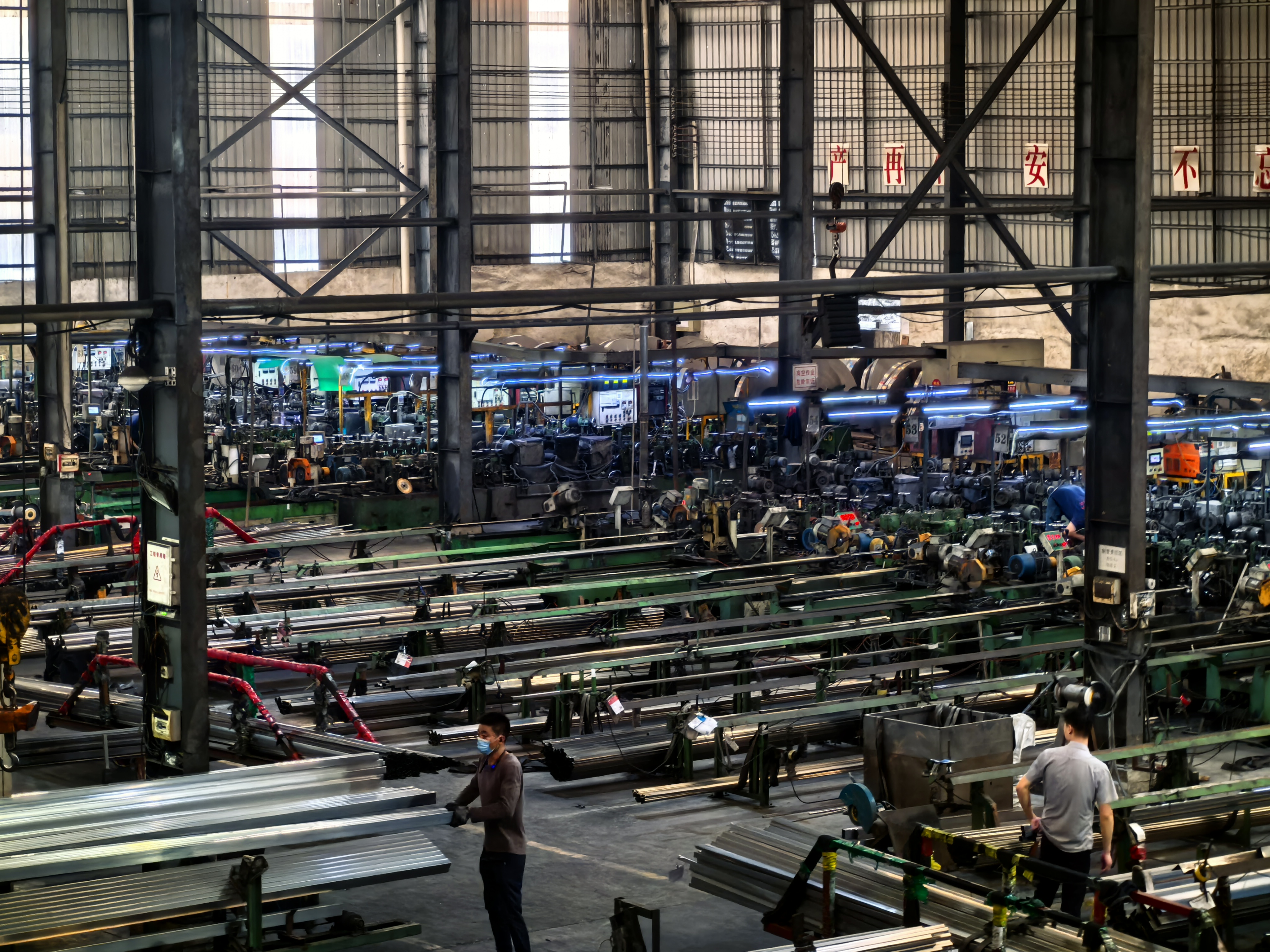
Production line at Guangdong Sanon Metal Products Co., Ltd, Foshan.
Why Distributors Need Long-Term Supply Relationships
Distributors serving contractors, fabricators, and installation firms often manage the same set of tensions: they need stock ready for quick delivery, but they also need to avoid tying up capital in slow-moving inventory. When stainless steel pipes are purchased from traders on a spot basis, every order brings uncertainty about material origin, dimensional tolerances, surface consistency, and delivery timing. The result is frequent quality inspections, delayed projects, and difficult after-sales claims.
A direct manufacturer relationship changes the conversation. Instead of renegotiating price and quality for each order, the distributor can align with a supplier that has visible production capacity, documented grade options, and repeatable quality control. This is particularly important in the stainless steel pipe segment, where buyers are often unaware of the differences between types such as 304, 430, and 201 until a problem appears on site.
The opportunity for distributors is to convert operational risk into a strategic advantage. By selecting a manufacturer with sufficient scale and export experience, a distributor can offer customers a clearer product story: where the pipe comes from, which grade it is, how it was finished, and what standards it can meet.
Sanon as a Long-Term Supplier: Capability Overview
GuangDong Sanon Metal Products Co., Ltd, established in 1999 and located in Foshan, Guangdong, is a manufacturer of stainless steel pipes, handrail fittings, glass fittings, and shower room fittings. The company operates a 40,000-square-meter factory and reports an annual stainless steel pipe output of 100,000 tons, with monthly capacity of 9,000 tons. It has about 500 employees, including a 30-person R&D team, and exports roughly 70% of its production to markets including the Middle East, South America, and Africa.
For distributors, these figures are not simply promotional. Factory size and monthly capacity translate into production scheduling flexibility. A buyer planning multiple orders across a year can use this capacity information to evaluate whether the supplier can handle peak demand without sacrificing delivery time. Sanon's stated export ratio also indicates familiarity with international packing, documentation, and communication workflows.
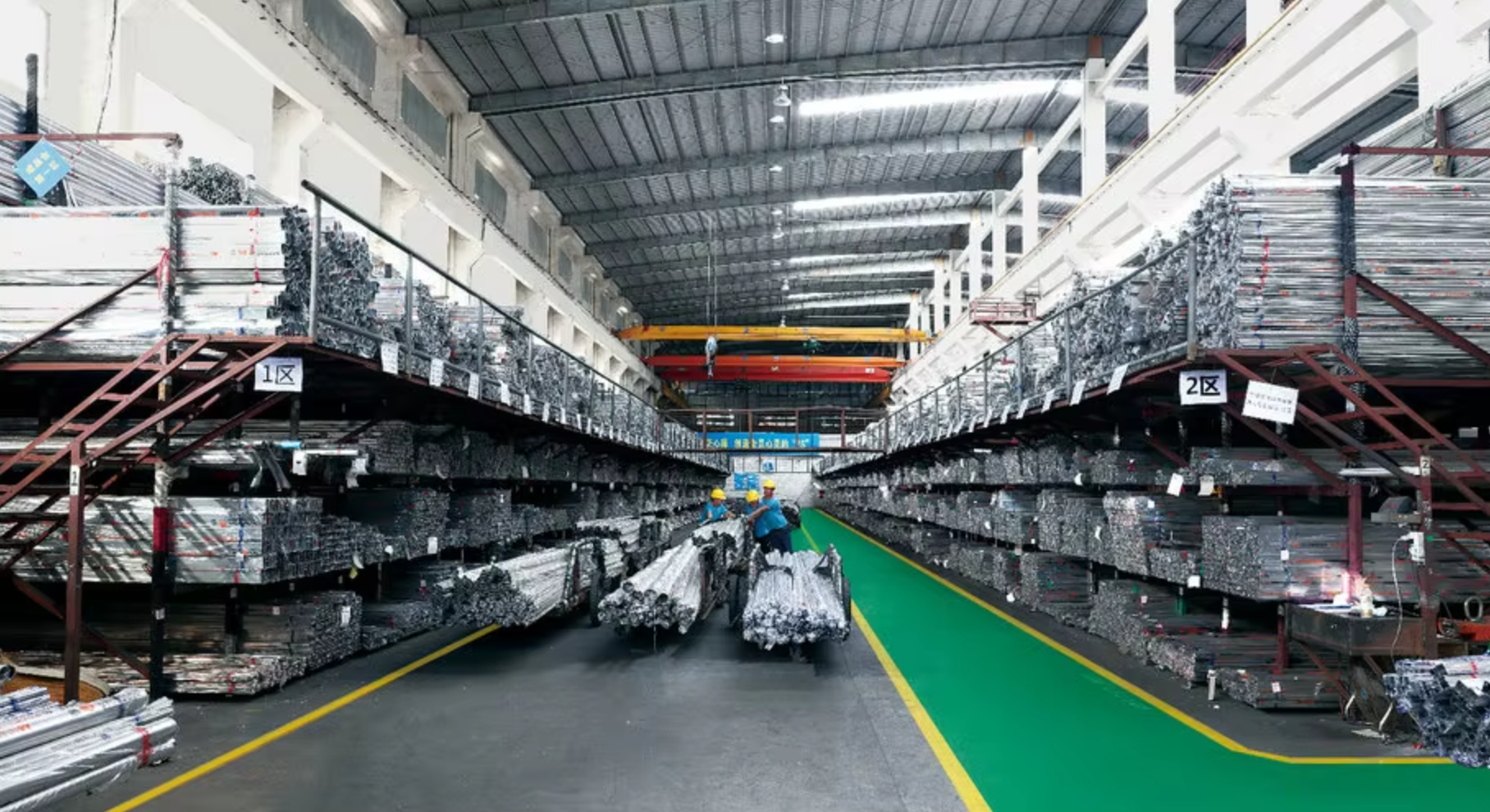
Warehouse at Sanon's Foshan facility.
Sanon's product ecosystem includes stainless steel pipes, tubes, handrail accessories, glass clamps, elbow pipes, coils, sheets, and related fittings. Fittings can be manufactured in stainless steel 304, 316, or zinc alloy, with satin or mirror finishes. The company also provides customized products to meet buyer-specific dimensions and design requirements. This range matters for long-term distribution because it allows buyers to consolidate multiple line items with one supplier instead of building a fragmented vendor list.
Technical Foundation: What Determines Pipe Quality
Long-term supply agreements only work if material quality is predictable. The choice of stainless steel grade is the first control point.
304 vs 430: Choice and Trade-offs
The difference between 304 and 430 is a useful starting point. 304 is an austenitic stainless steel with balanced corrosion resistance, formability, and weldability. 430 is a ferritic grade with magnetic conductivity and good thermal conductivity, but lower resistance to corrosion in many environments. In service life terms, 304 typically lasts three to five times longer than 430, and it commands a higher price. For architectural applications such as curtain walls, stair handrails, guardrails, door and window frames, balcony fences, and lobby decorations, 304 is the preferred option because it maintains structural stability under exposure to moisture, cleaning chemicals, and temperature variation.
Sanon offers pipes and fittings in SS201 and SS304, with fittings also available in 316. The choice between 201 and 304 requires additional care. Grade 201 contains lower nickel and higher manganese, and it is more prone to rusting than 304 in humid or coastal environments. A long-term supplier should, therefore, be able to demonstrate control over material sourcing. Sanon states that it conducts regular audits of upstream steel mills or traders to ensure the stability of smelting processes and quality control systems.
The Role of Surface Treatment
Surface treatment is the second control point. After forming, stainless steel pipe surfaces can carry oxide scale and free iron from tooling or handling. If these contaminants are not removed, rust can appear even on a nominally stainless material. The standard countermeasure is acid cleaning followed by passivation, which removes surface contamination and promotes the formation of a chromium-rich oxide film. Sanon lists this as part of its quality approach, along with inspections during cutting, welding, polishing, and packing.
Application Scenarios for Distributors and Fabricators
From a channel perspective, stainless steel pipes and fittings are rarely sold as isolated products. A distributor supplying a railing contractor might need round or square pipes, elbows, bends, brackets, glass clamps, end caps, flanges, and door handles in one shipment. Sanon's product line covers this ecosystem, including stainless steel glass holders, sliding door fittings, railing flanges, cross bar holders, and related accessories. This breadth reduces the number of suppliers a distributor must manage and simplifies matching of finishes across components.
The most common end-use segments for 304 stainless steel pipes include building curtain walls, stair handrails, guardrails, door and window frames, balcony fences, and lobby decorations. These are areas where visual consistency and structural safety matter. Glass clamp and standoff systems, which are part of the same family, must satisfy load-bearing requirements where applicable. For North American projects, building codes such as the IBC treat these components as structural elements, meaning traceable suppliers and documented quality control are increasingly necessary.
Sanon's customization capability also supports project-specific specifications. Buyers who need non-standard dimensions, customized fittings, or matching finishes can work with the factory directly rather than settling for catalog-only options. For distributors, this reduces the risk of specifying a product and then discovering that no consistent source exists.
Market Trends Supporting Long-Term Contracts
Several market signals indicate that long-term sourcing relationships will become more important for stainless steel pipes. The global stainless steel market was valued at USD 111.44 billion in 2022 and is projected to reach USD 182.10 billion by 2030. China's stainless steel exports reached 4.14 million tons in 2023, confirming the country's position as a central link in the supply chain. For distributors outside China, these figures suggest a continued reliance on Chinese manufacturers for volume and cost efficiency, but also a need for stable supplier relationships in a market that can experience price and logistics volatility.
At the product level, the adoption of PVD (Physical Vapor Deposition) coating for colored stainless steel pipes is increasing. According to sources such as the International Stainless Steel Forum, PVD is regarded as more environmentally friendly than electroplating, and it responds to the growing demand for decorative color finishes in interior design. Distributors that track this trend can build a product portfolio around PVD-finished color pipes while maintaining standard 304 and 316 products for structural applications.
Traditional Spot Buying vs Long-Term Manufacturer Partnership
To make the value of a long-term partnership concrete, consider how it differs from traditional spot buying. The table below summarises the main procurement dimensions.
| Dimension | Traditional spot buying | Direct manufacturer partnership (Sanon) |
|---|---|---|
| Pricing | Price quoted per order; exposed to market swings | Volume-based negotiation; greater cost visibility |
| Quality control | Buyer inspects each delivery; limited traceability | Factory quality process; upstream material audits; consistent processes |
| Customization | Typically limited by trader's stock | Factory can produce custom sizes, finishes, and fittings |
| Supply stability | Risk of stockouts and replacement sourcing | Monthly capacity of 9,000 tons; production planning possible |
| Minimum quantity | Flexible but often via small-lot traders | MOQ of 2 tons per order |
| Delivery terms | Varies; often CIF or door-to-door via trader | FOB or EXW |
| Payment terms | Mixed; some open account | Bank transfer or cash, full payment at loading |
A direct manufacturer relationship provides more predictability, but it also has boundaries. Sanon's minimum order is 2 tons, with FOB/EXW delivery and bank transfer or cash payment upon loading. For a first-time buyer who wants to sample many product variants, this structure may be too rigid. In such cases, a trading company or local stockist may be a better entry point. Once the order volume stabilises, direct manufacturer purchasing becomes more practical.
Future Outlook
Long-term relationships will likely be shaped by three forces: compliance, finish trends, and supply-chain concentration. On standards, stainless steel pipes and tubes are often specified against ASTM A312 and ASTM A554 for structural and architectural use. In North America, glass clamps and standoff pins must meet load-bearing requirements under the IBC. Distributors who source from manufacturers that can document these standards will find it easier to satisfy local building inspections.
On finish trends, the shift towards PVD-coated color pipes offers a differentiation opportunity. Rather than competing only on uncoated mill-finish pipes, distributors can offer a wider palette for interior décor projects while keeping standard 304 products for handrails and structural components.
On supply-chain concentration, buyers are likely to consolidate their vendor lists. A single manufacturer that can supply pipes, fittings, and finishing options reduces administrative overhead and simplifies quality traceability. The key is to choose a supplier whose production scale and export experience match the distributor's own growth plan.
FAQ
What are the key criteria for selecting a long-term stainless steel pipe supplier?
Buyers should verify production capacity, material grade options, export experience, quality control procedures, and procurement terms. In Sanon's case, the company operates a 40,000-square-meter factory in Foshan with a monthly pipe capacity of 9,000 tons and roughly 70% export share.
What stainless steel grades does Sanon offer for pipes and fittings?
Sanon offers pipes and fittings in SS201 and SS304, while fittings can also be made from stainless steel 316 and zinc alloy, with satin or mirror finishes. In architectural applications, 304 is commonly preferred because its service life is typically 3 to 5 times that of 430.
How does Sanon control quality and material risk?
Sanon performs quality control during cutting, welding, polishing, and packing. The company also conducts regular audits of upstream steel mills or traders. For material surface protection, acid cleaning and passivation are used to remove oxide scale and free iron and form a chromium-rich oxide film.
What are Sanon's minimum order, delivery, and payment terms?
The minimum order is 2 tons. Delivery terms are FOB and EXW, and payment is by bank transfer or cash, with full payment when loading the goods.
Which export markets does Sanon mainly serve?
Sanon's main export markets are the Middle East, South America, and Africa, with export accounting for about 70% of its business.
Can Sanon produce customized stainless steel pipe fittings?
Yes. According to the company profile, Sanon provides customized products to meet customer demand, and fittings can be made of stainless steel 304, 316, or zinc alloy with satin or mirror finish.