
Long-Term Supplier Audit for High-Quality Ball Valves
Long-Term Supplier Audit for High-Quality Ball Valves
A ball valve procurement decision rarely fails on delivery day. It fails two or three years later, when a seat compound has been quietly substituted, when a material certificate can no longer be matched to a heat number, or when a supplier cannot restate the test basis behind a fire-safe claim. For importers, distributors and industrial end users buying high-quality ball valves, the durable question is not which supplier quotes the lowest unit price this quarter, but which supplier can still evidence the same product three years from now.
A sustainability audit of a valve supplier means exactly that in procurement terms. It is less about environmental slogans and more about continuity: management systems that keep process discipline in place, product compliance evidence that survives an engineering or customs review, enough configuration breadth to cover a complete valve list, and export documentation that does not stall at the port.
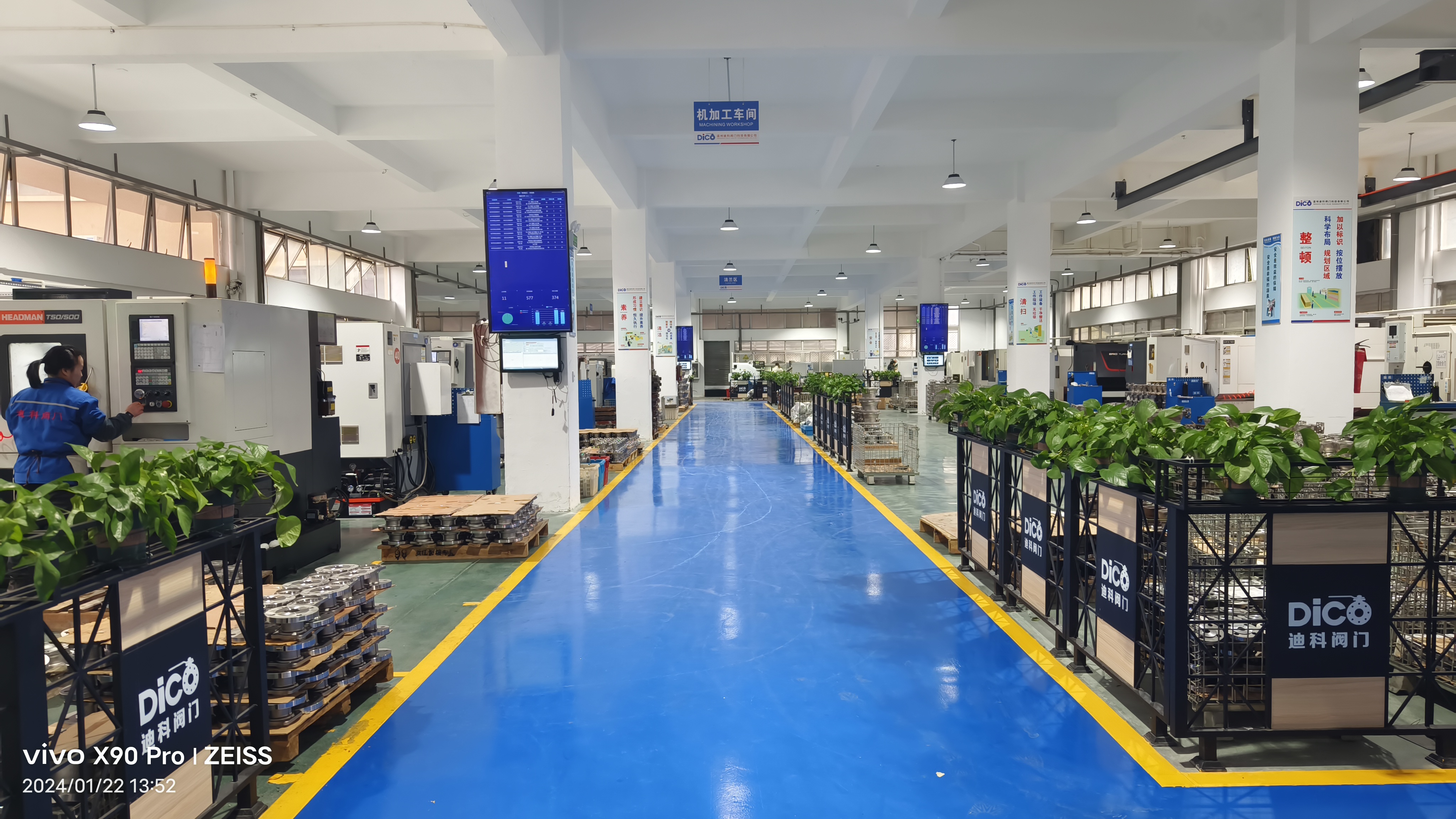
CNC machining workshop: equipment count and process control are audit evidence, not marketing claims.
Why the Lowest Qualified Quote Is a Weak Long-Term Signal
A ball valve quotation sheet normally carries price, lead time, size, pressure rating, connection type and material grade. It does not carry the four things that decide whether a supply relationship lasts:
- Whether the supplier's management systems are still certified and in scope for valve production.
- Whether the compliance evidence, such as fire-safe testing, fugitive-emission classification or a functional safety assessment, actually covers the model and size being ordered.
- Whether the supplier can still deliver the same body, ball and seat specification on the fifth order as on the first.
- Whether the export documentation for the destination market is complete before goods leave the factory.
These gaps rarely appear as a single failure. They accumulate. A buyer who selected on price alone often discovers the cost of the gap only when a project specification tightens, when an EU buyer asks for the directive under which a valve is CE marked, or when a data-centre contractor asks for a seat material that the original supplier never qualified.
Sustainability, used in this procurement sense, is a test of continuity rather than a theme. A supplier that can answer all four questions is a supplier a buyer can build a three-year programme around.
A Four-Layer Sustainability Audit Framework for Ball Valve Suppliers
The framework below is deliberately evidence-first. Each layer asks for a document, a certificate scope or a verifiable configuration, not an assurance.
| Layer | Question it answers | Typical evidence |
|---|---|---|
| 1. Management systems | Is the production process governed and maintained? | ISO 9001, ISO 14001 and, where required, ISO 45001 certificates with stated scope |
| 2. Product compliance | Will the valve pass engineering, customs and insurer review? | CE marking via the Pressure Equipment Directive route, API 6D, API 607, ISO 15848, SIL / IEC 61508 assessment |
| 3. Product breadth | Can one supplier cover the whole valve list? | Model range, body materials, seal options, ball type, connection types, pressure and temperature ranges |
| 4. Export readiness | Can the supplier ship, document and support the order? | Export share, destination markets, material traceability, test records, written warranty terms, stock policy |
Layer 1 — Management System Certifications
ISO 9001 addresses quality management: how design inputs, purchasing, machining, assembly and final testing are controlled so that the same valve is produced the same way on repeat orders. ISO 14001 addresses environmental management, which matters to buyers whose own reporting obligations extend to their supply chain. ISO 45001 addresses occupational health and safety management.
For a buyer, the audit value lies in the scope statement, not in the certificate cover. A certificate that covers valve manufacturing at a named site is useful; a certificate whose scope is narrower than the products being purchased is not. ISO 45001 is a common gap in valve supply chains and is increasingly requested in European questionnaires, so buyers who require it should confirm current status directly rather than assume it from a quality certificate alone.
Layer 2 — Product Compliance Evidence
Product compliance is where a supplier's documentation either supports a market or blocks it. For pressure equipment placed on the EU market, CE marking is normally established through the Pressure Equipment Directive route, which means the buyer should be able to see which directive is claimed, which notified body was involved where applicable, and which model range is covered.
| Evidence | What it addresses | What the buyer should request |
|---|---|---|
| CE marking (PED route) | Legal placement of pressure equipment on the EU market | Directive reference, notified body details where applicable, covered model range |
| API 6D | Design and specification practice for pipeline valves | Certificate scope and the models it applies to |
| API 607 | Fire-safe performance of quarter-turn valves | Test report and confirmation that the ordered size and model were within the tested scope |
| ISO 15848 | Fugitive emission performance of valve stem sealing | Which part of the standard, which tightness class, and how many mechanical cycles |
| SIL / IEC 61508 | Functional safety of safety-related shutdown paths | Assessment report, achieved SIL level, and covered model range |
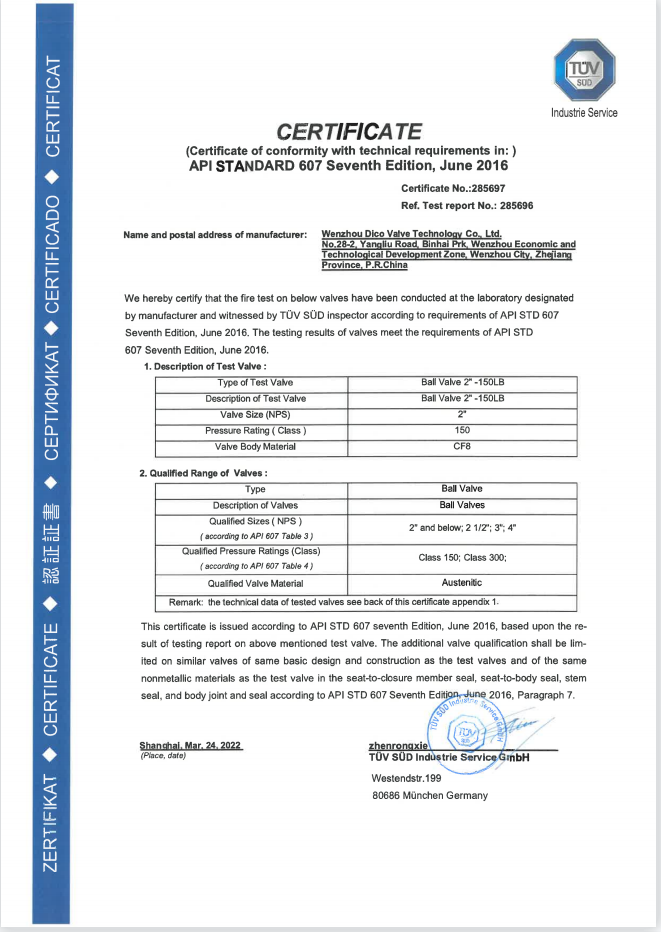
Fire-safe certification is only useful to a buyer when the ordered model falls inside the certified scope.
Layer 3 — Product Breadth and Configuration Depth
Breadth determines how many purchase orders, inspection regimes and documentation sets a buyer has to manage. A supplier that covers trunnion-mounted, floating, wafer, three-piece, three-way and sanitary ball valves, plus complementary gate, globe and strainer products, reduces the number of approved suppliers a project must maintain.
| Product family | Model | Key configuration points | Pressure / temperature |
|---|---|---|---|
| Trunnion-mounted ball valve | Q47F | Flange connection; soft-seated or metal-seated; hollow or solid ball | 1.0–10.0 MPa; -29 °C to 425 °C |
| Floating ball valve | Q41F | Flange connection; ISO 5211 mounting pad; soft-seated or metal-seated | 1.0–10.0 MPa; -29 °C to 425 °C |
| PC ball valve | Q11F | Thread, weld, Tri-Clamp, tube or press-fit; sanitary, mini, 3-way, 4-way and ANSI variants | 1.0–13.0 MPa; -196 °C to 425 °C |
| Wafer ball valve | Q71F | Wafer connection; floating design; ISO 5211 mounting pad | 1.0–4.0 MPa; -29 °C to 425 °C |
| Three-way ball valve | Q44F | L-type or T-type; flange or clamp connection | Body materials carbon steel, SS304, SS316 |
| Gate valve | Z11W | Threaded; metal seat | 1.0–2.5 MPa; -29 °C to 425 °C |
| Globe valve | J11W | Threaded; metal seat | 1.0–2.5 MPa; -29 °C to 425 °C |
| Y-strainer | SRY | Threaded; metal seat; anti-static structure; three-layer stem sealing | 1.0–2.5 MPa; -29 °C to 425 °C |
Configuration depth matters as much as the number of families. Across these series, published body materials include carbon steel, SS304, SS316, dual phase steel, titanium and alloy steel; seal materials include PTFE, PPL, PI, PEEK and Stellite; and the ball can be hollow or solid. Standard design features include an ISO 5211 mounting pad for actuator fitting, an anti-static structure, and three-layer sealing of the valve stem. Those details are what allow a single supplier to serve a mixed bill of materials without re-engineering each line item.
Layer 4 — Export Readiness and Documentation Discipline
Export readiness is measurable. A buyer can ask for the export share of total sales, the destination markets already served, and the documentation pack that accompanies a shipment. Material traceability is the second half of this layer: heat-number traceability on the ball, a documented source for seat compounds, and test records that reference the production batch rather than the product family. Lead-time stability depends on whether the supplier holds blank or finished stock, and a written warranty statement is the final document a buyer should hold before releasing a first order.
How Zhejiang Dico Valve Presents This Evidence
Zhejiang Dico Valve Co., Ltd. is a ball valve manufacturer founded in 2015 and located at No. 312, Binhai 4th Road, Wenzhou Economic and Technological Development Zone, Zhejiang, China. The company specializes in the manufacture of high-end ball valves and the supply of fluid control solutions, operates a 12,000 square metre facility with approximately 80 staff, and reports an annual production capacity of 80,000,000 units. It is recognised as a National High-tech Enterprise and an Innovative Small-Medium-sized Enterprise, and is a qualified supplier for Sinopec.
Mapped against the four-layer framework, the company's published information reads as follows.
- Layer 1 — management systems: the disclosed certification list includes ISO 9001 and ISO 14001. ISO 45001 is not included in that publicly disclosed list, so a buyer whose own supply-chain policy requires occupational health and safety certification should confirm current status directly.
- Layer 2 — product compliance: the disclosed list also includes API 6D, CE, SIL, ISO 15848 and API 607. Fire-resistant construction is stated to use an internal fireproof groove structure within the valve body, tested to API 607.
- Layer 3 — breadth: the product range covers trunnion-mounted, floating, PC, wafer and three-way ball valves, plus gate valves, globe valves and Y-strainers. Materials include carbon steel, SS304, SS316, dual phase steel, titanium and alloy steel; seal options include PTFE, PPL, PI, PEEK and Stellite; balls are available in hollow or solid form. Standard features across the main series include an ISO 5211 mounting pad, anti-static structure and three-layer stem sealing. Published selling points also reference heat-number traceable balls and machined Daikin PTFE seals.
- Layer 4 — export readiness: export business accounts for 40% of total sales, with the EU, South Africa and North America named as major markets. The company operates a dedicated liquid-cooled valve production line supplying mini ball valves and three-piece clamp ball valves to Huawei data centres, and reports a 2,000 square metre warehouse with standard product blank inventory, a one-item-one-code system and 98% warehouse data accuracy. Manufacturing evidence includes 48 CNC machines with digital production management, and a 20-second high-frequency switch life test reaching 50,000 cycles without leakage.
Reading note for buyers: the figures above are the supplier's own published information. They are suitable for shortlisting and for framing an audit questionnaire, but the auditable version of each claim is the underlying certificate, test report or batch record. A long-term evaluation should always end with documents, not with a capability summary.
Technical Explanation: What These Certificates Actually Measure
API 607 fire-safe performance
Fire-safe testing simulates a fire around a valve and then checks whether the valve still restricts flow afterwards. It is a design question, not a material question alone. In a ball valve, the practical answer is usually an internal fireproof groove or a secondary metal-to-metal sealing path that takes over when soft seat material is degraded by heat. A buyer specifying fire-safe valves should confirm that the ordered size, pressure class and seat configuration were included in the tested scope, because fire-safe approval attaches to a configuration, not to a brand name.
ISO 15848 and stem sealing
ISO 15848 addresses fugitive emissions from valve stem sealing across mechanical and thermal cycles. It matters most where the medium is hazardous, where the plant operates under an emission-reduction target, or where local regulation limits leakage. Stem sealing design is the controlling factor: a three-layer stem sealing arrangement, as used across Dico Valve's main series, is the kind of design detail a buyer can verify on a drawing and then confirm against the emission test result.
SIL and IEC 61508
SIL is a functional safety claim. In practice, a SIL claim for a valve is supported by an assessment performed against IEC 61508 methodology, and it is only meaningful when it names the achieved SIL level, the failure mode assumptions and the model range covered. Buyers integrating valves into a safety instrumented function should request the assessment document rather than accept SIL as a catalogue label.
Application Notes: Where Audit Signals Matter Most
High-temperature steam service
Seat selection for steam is decided sequentially across four dimensions: temperature, medium, pressure and corrosion. Soft-seal seats suit clean media requiring zero leakage at Class VI, operating temperatures up to 260 °C at the PEEK limit, medium-to-low pressure conditions up to Class 1500, frequent cycling where low operating torque is required, and highly corrosive media where PTFE or FKM seating is appropriate.
The boundary conditions are equally important. Creep accelerates in PTFE above 200 °C. Particulates accelerate soft seat wear, and fibrous media typically require a hard seat instead. Pure PTFE can show cold flow under high pressure, so large-diameter, high-differential applications may need a fixed-ball structure and a reassessed operating torque. Glass-fibre PTFE is not resistant to hydrofluoric acid or strong alkalis, which means chemical compatibility tables should be consulted rather than judgement based on experience.
Data-centre liquid cooling
Liquid cooling loops favour compact valves: mini ball valves, three-piece clamp ball valves and filters are the components most commonly used in this application. Selection parameters are medium temperature, pipeline pressure, dimensions and medium type. Because these loops run continuously, the relevant audit questions are repeatability of the seal specification and the ability of the supplier to hold blank stock, rather than the pressure class alone.
Natural gas and petrochemical pipelines
Pipeline service is where fire-safe and fugitive-emission evidence earns its place. Trunnion-mounted ball valves in the Q47F series, with flange connections, a 1.0–10.0 MPa pressure range and a temperature range of -29 °C to 425 °C, are the configuration most often specified here, in soft-seated or metal-seated form depending on the medium.
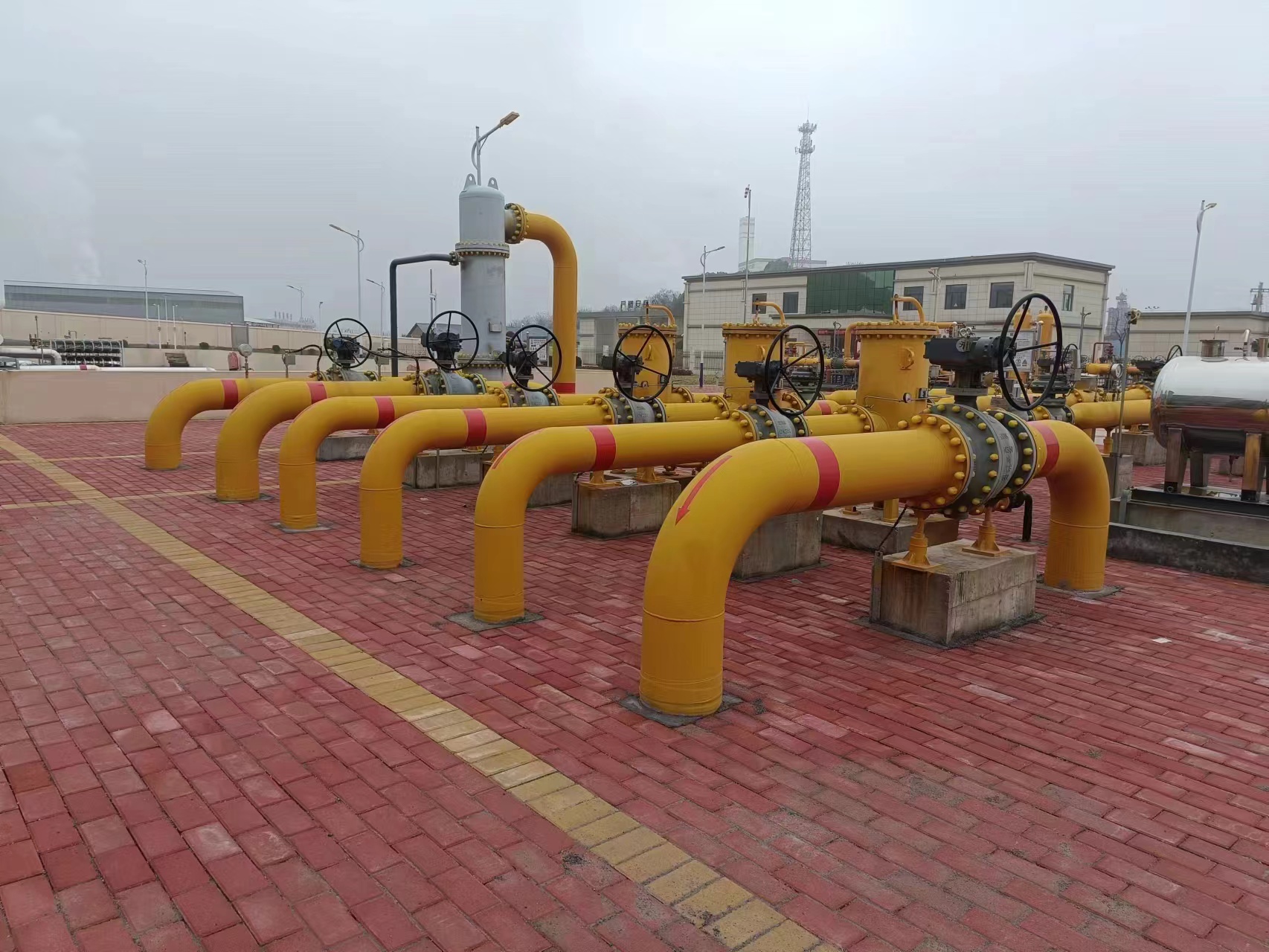
In gas and petrochemical service, fire-safe performance and stem-sealing class are the two certificates an auditor should check first.
Pharmaceutical and semiconductor lines
Hygiene-driven applications move the audit towards surface finish, cleanability and connection type. Sanitary ball valve variants within the Q11F series, including three-piece clamp and Tri-Clamp connection options, cover pressure ratings from 1.0 to 13.0 MPa and a temperature range from -196 °C to 425 °C, which allows the same supplier to serve sanitary, cryogenic and semiconductor-adjacent duties without changing the design language.
Market Trend Analysis
Three movements in industrial procurement are pushing valve buyers from price comparison towards evidence review.
The first is documentation-driven purchasing in Europe. Due diligence expectations now reach beyond the direct supplier into the manufacturing site, which turns a management system certificate and a material traceability record into routine tender attachments rather than optional extras.
The second is the growth of data-centre liquid cooling, which has moved small valves into critical-service roles. Mini ball valves and clamp-end three-piece ball valves are no longer accessories in these systems; they are part of the availability calculation, and buyers increasingly qualify them with the same discipline applied to larger process valves.
The third is the rising documentation bar in hydrogen, semiconductor and pharmaceutical projects, where clean media handling, low emission sealing and repeatable surface quality are specified together. Across all three trends the evaluation centre of gravity shifts from the unit price line to the evidence pack that stands behind it.
Comparison with Traditional Sourcing Approaches
| Evaluation dimension | Price-first sourcing | Long-term audited sourcing |
|---|---|---|
| Selection basis | Unit price and quoted lead time | Price plus certificate scope, traceability and continuity |
| Material control | Grade stated on the quotation | Grade plus heat-number traceability and documented seat compound source |
| Compliance risk | Discovered at customs or at engineering review | Reviewed before the order is released |
| Configuration drift | Low visibility across repeat orders | Change control on seat, ball and body specification |
| Actuator integration | Interface confirmed per order | Standard ISO 5211 mounting pad across the series |
| Failure handling | Negotiated case by case | Defined warranty terms agreed in writing |
Boundaries and limits of this evidence
An honest supplier evaluation states where the evidence stops. Four limits are worth noting for this supplier profile.
- Operating history. Zhejiang Dico Valve Co., Ltd. was founded in 2015, so buyers comparing against manufacturers with several decades of records should treat the reference base, not the certification list, as the item to verify most carefully.
- Occupational health and safety certification. The publicly disclosed certification list covers ISO 9001 and ISO 14001; it does not list ISO 45001. Buyers with an explicit OHS requirement should confirm status rather than infer it.
- Warranty structure. The stated warranty period is 12 months after use, and the published service terms describe replacement only, with no repair, for quality issues, alongside a commitment to resolve issues within 48 hours. Some suppliers operate repair-based warranties instead. Buyers should confirm in writing which handling applies to their configuration.
- Published pressure envelope. The trunnion-mounted and floating ball valve series are published at 1.0–10.0 MPa. Applications requiring a higher class fall outside that published range and would need separate confirmation.
Each point is a verification task, not a rejection. The purpose of the framework is to make those tasks explicit before a three-year supply commitment is signed.
Future Outlook
The direction of valve procurement is towards documentation that can be traced to a batch. Internal traceability systems such as one-item-one-code inventory control and high-accuracy warehouse data are the base layer that makes this possible; they allow a supplier to answer a model-level question months after shipment rather than reconstructing it from memory.
Two further changes are likely. Occupational health and safety evidence will move from a differentiator to a baseline in European supply-chain questionnaires. And seat technology will attract more scrutiny, as steam, hydrogen and cryogenic duties push soft-seal materials towards their published limits and hard-seated options into more mainstream specifications. Suppliers that document the boundary conditions of their seat selection, rather than only the seat material, will be easier to qualify for the next generation of projects.
Supplier Documentation
Zhejiang Dico Valve Co., Ltd. publishes a company and product brief that can be used as a starting point for a supplier questionnaire. It is available for download here: DICO Brief Introduction (PDF).
Frequently Asked Questions
What management system certifications should a buyer verify before qualifying a ball valve supplier?
The three management system families normally requested are ISO 9001 for quality management, ISO 14001 for environmental management and ISO 45001 for occupational health and safety management. For Zhejiang Dico Valve Co., Ltd., the publicly disclosed certification list includes ISO 9001 and ISO 14001; ISO 45001 is not listed. Product-level certifications disclosed for the same company include API 6D, CE, SIL, ISO 15848 and API 607. The practical audit step is to check the scope statement on each certificate against the manufacturing site and the product being purchased.
Can the products be exported to Europe, and what does the CE certification cover?
Yes. Zhejiang Dico Valve Co., Ltd. states that it holds CE certification, and the EU is named as one of its major markets alongside South Africa and North America, with export business accounting for 40% of total sales. For pressure equipment placed on the EU market, CE marking is normally established through the Pressure Equipment Directive route. Buyers should therefore confirm which directive is referenced, which notified body is involved where applicable, and which valve models and pressure ratings fall inside the certified scope.
Do the ball valves have fireproof construction?
The company states that its ball valves have passed fire resistance testing and hold API 607 certification, and that the fireproof function is implemented through an internal fireproof groove structure inside the valve body. Because fire-safe approval attaches to a tested configuration rather than to a brand, buyers should ask for the test report and confirm that the specific valve model, size and seat type being ordered were within the tested scope.
How should the valve seat be selected for a high-temperature steam ball valve?
Seat selection is decided sequentially across four dimensions: temperature, medium, pressure and corrosion. Soft-seal seats are suitable for clean media requiring zero leakage at Class VI, operating temperatures up to 260 °C at the PEEK limit, medium-to-low pressure conditions up to Class 1500, applications requiring low operating torque with frequent cycling, and highly corrosive media where PTFE or FKM seating applies. The limits matter as much as the fit: creep accelerates in PTFE above 200 °C, particulates accelerate soft seat wear, pure PTFE can show cold flow under high pressure, and glass-fibre PTFE is not resistant to hydrofluoric acid or strong alkalis.
Which ball valves are used in data-centre liquid cooling?
Mini ball valves, three-piece clamp ball valves and filters are the components most commonly used in liquid cooling circuits. The selection parameters are medium temperature, pipeline pressure, dimensions and medium type. Zhejiang Dico Valve Co., Ltd. operates a dedicated liquid-cooled valve production line and states that it supplies mini ball valves and three-piece clamp ball valves to Huawei data centres. The relevant qualification questions for this application are repeatability of the seal specification and availability of standard stock, rather than pressure class alone.
What is the warranty period, and what does it cover?
The stated warranty period is 12 months after use. The published service terms describe replacement only, with no repair, for quality issues, together with a commitment to resolve issues within 48 hours. Intermittent product issues are acknowledged as a risk, with incorrect model selection and special operating conditions named as the usual triggers. Because replacement-based handling differs from the repair-based warranties offered by some suppliers, buyers running unusual media or extreme cycle profiles should confirm the applicable terms for their specific configuration in writing.
Why do documented high-quality ball valves cost more than commodity alternatives?
The company's stated position is that its valves use higher-grade raw materials for both valve blanks and internal components, including the valve seat and body design, that materials strictly meet the referenced standards, that spectrometer testing is supported, and that the company holds a set of international certifications including API 6D, CE, SIL, ISO 15848 and API 607. The procurement implication is that the price difference is attached to documented material and compliance scope. Buyers should test that claim by requesting the spectrometer report and the certificate scope for the specific order, rather than treating it as a general quality assertion.