
Long-Term Supplier Evaluation: Extruder Model Coverage and Material Records
Long-Term Supplier Evaluation: Extruder Model Coverage and Material Records
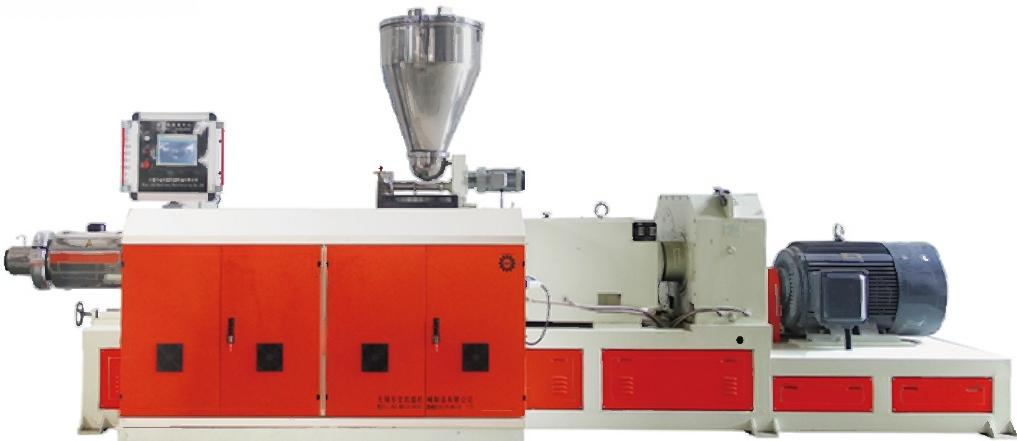
Long-term supplier evaluation for plastic extrusion machines is usually framed as a question about trust. It is more usefully framed as a question about records. Two checks decide most of the outcome: whether the supplier's model range covers the products and output the buyer actually runs, and whether the supplier can trace the identity of the materials and parts that wear — screws, barrels, mixing pots, crusher and pulverizer internals — long after the order has shipped.
Both checks can be run before a purchase order, using documents rather than assurances. This article sets out how buyers at the decision and execution stage can structure that evaluation around model coverage and material traceability, using the published JKS Plastic Extrusion Machine portfolio and the company's stated commercial and quality-control terms as a worked example of what to ask for. It deliberately avoids certification and pricing claims that the available evidence does not support.
Continuity is the variable that compounds
Continuity costs nothing at the point of sale and a great deal later. A plastic extrusion line is normally bought for a service life measured in years, during which the components that contact hot polymer and abrasive filler wear, formulations change, and the buyer's product mix shifts. Whether a spare-part question can still be answered in year six depends far more on how the machine was specified and documented at the outset than on the relationship maintained in between.
Scale is part of the context. Market Research Future estimated the global plastic extrusion machine market at USD 7.901 billion in 2025 and projected USD 12.87 billion by 2035 in a report published in September 2026. The figure is best read as a directional signal rather than a precise target: published market sizes vary with definition, and a report covering general extrusion machinery and one covering wider plastic processing machinery are not describing the same scope.
Trade data indicates where the supplier pool sits. China exported USD 8.55 billion of rubber and plastic working machinery under HS 8477 in 2024, ahead of Germany at USD 6.11 billion and Italy at USD 2.61 billion, according to the Observatory of Economic Complexity's analysis of UN Comtrade data. A deep supplier pool helps price discovery and makes differentiation harder, which is why documentation quality becomes a practical screening criterion rather than a formality.
The downstream picture reinforces the point. Grand View Research put the global stone plastic composite flooring market at USD 6.4 billion in 2026, projected to USD 10.3 billion by 2033. For extrusion buyers the relevance is indirect and conditional: when a downstream category is expanding, the equipment installed now will still be running when today's supplier has taken on many more machines, so the question of who answers a spare-part enquiry in year eight becomes more pressing rather than less.
What model coverage should prove
Model coverage is the first check because it shows whether a supplier can match a process without stretching one frame beyond its intended duty, and whether the same supplier can serve the next line the buyer adds without a new documentation set.
JKS lists two extruder families. The single screw range covers SJ30, SJ45, SJ65 and SJ90. The conical twin screw range runs from SJSZ-45 to SJSZ-110. Between them the two families sit behind the company's line portfolio — SPC flooring sheet, PVC/PP/WPC board, PVC and HDPE pipe, WPC/PVC profile, plastic rod and waste plastic pelletizing — and the SPC flooring line listing names a conical twin screw extruder as its extruder type.
A contiguous range is worth more than a long catalogue for two reasons. First, matching: a buyer whose product falls between two frame sizes should be able to choose the documented frame that meets the duty, rather than oversizing or running a small machine at its limit. Second, continuity: parts, drawings and process knowledge are usually shared across a family, so a range still listed years later is easier to support than a one-off design that has left the catalogue.
A model number, however, is a frame designation and not a performance specification. The published listing for a high-productivity SPC floor conical twin screw extruder states 1,500 kg/h, and a number of that kind only becomes interpretable alongside the resin formulation, sheet width and thickness, and the downstream calendering and cooling configuration. Buyers should ask for a documented output table per model and per product instead of inferring capacity from the model designation.
Three questions convert coverage into evidence: which models are in current production, which are still supported but no longer built, and what the documented output, screw geometry and drive configuration are for the exact frame quoted.
Full-line coverage from mixing to pelletizing
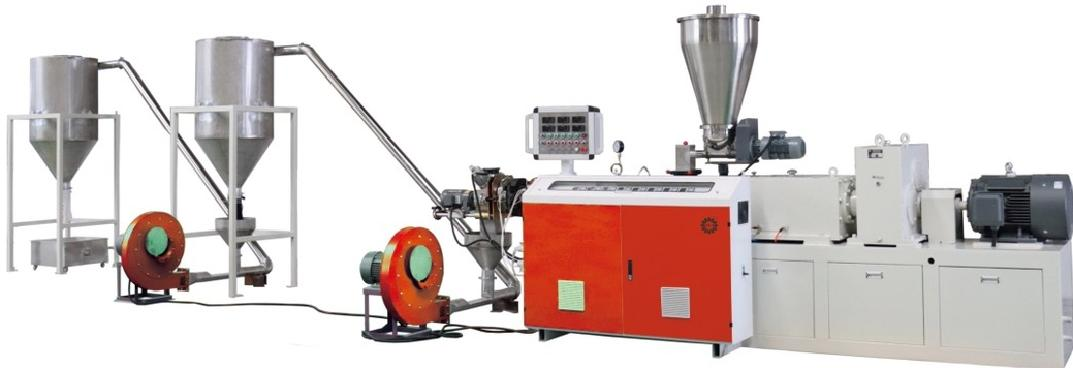
The second coverage test is horizontal rather than vertical: whether the supplier can carry the whole line, not only the extruder. JKS lists SPC flooring sheet, PVC/PP/WPC board, PVC and HDPE pipe, WPC/PVC profile, plastic rod and waste plastic pelletizing lines as its main products, sold together with standalone single and twin screw extruders and auxiliary equipment — mixer, crusher and pulverizer.
At equipment level that means a PVC mixing and cooling stage (the SRL-Z high-speed mixing and cooling unit), size reduction (the SP series crusher and the MF pulverizer range), and the extrusion lines themselves for pipe, profile, board and pelletizing. For a buyer, the value is interface responsibility — when the mixer, the extruder and the downstream haul-off come from one specification, a throughput shortfall has one owner rather than three.
Coverage also shortens the documentation trail. A single supplier can tie a screw part number to the frame that uses it, and a mixer specification to the compound it was designed for. That is what makes a traceability claim checkable rather than rhetorical.
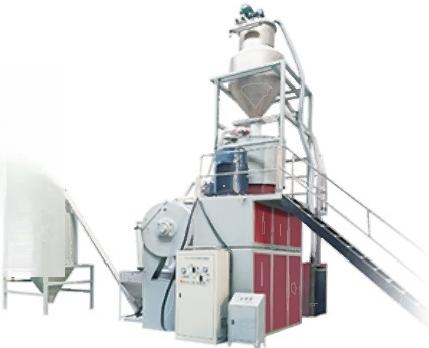
The trade-off is concentration. A single-source line puts spares, service and process support in one place; where that place is a compact workshop, the buyer's protection is documentation and a written spares commitment, not the breadth of the catalogue. Portfolio coverage is therefore the beginning of due diligence, not its conclusion.
Material traceability: what the build record has to contain
Traceability in extrusion equipment is mostly about the parts that touch the process. JKS states 38CrMoAlA nitrided alloy steel for screws and barrels, carbon steel for machine frames, stainless steel for mixing pots, and wear-resistant components in its crushers and pulverizers. Each of those statements is the start of a question, not the answer to it.
- Screws and barrels. A nitriding-grade alloy steel fixes the starting metallurgy, but the working properties depend on the grade being held, the nitriding treatment being recorded and the finished dimensions being inspected. Ask for the grade in the technical agreement, the treatment record and the dimensional report — not the brochure sentence.
- Machine frames. Carbon steel framing is a repairability decision as much as a rigidity one. The relevant document is the frame drawing and the specification of any surface treatment, because that is what a buyer's maintenance team will work from in year four.
- Mixing pots. Stainless steel is named for the mixing stage, and the useful question is which stainless grade — a detail that affects cleaning behaviour and corrosion exposure with PVC compounds.
- Crusher and pulverizer wear parts. Wear-resistant components should be identified individually, with part numbers, so replacement planning does not require re-engineering the machine.
Material documentation differs from a material claim in three ways. It states the grade in a controlled document — the technical agreement or bill of materials — rather than a marketing page. It identifies the batch, so a certificate can be matched to the parts actually delivered. And it is revision-controlled, so a spare ordered later can be compared to the original specification instead of to a general description.
One limitation is structural: a mill certificate describes one heat of steel, not the next one. Continuity comes from fixing the grade and the treatment in the technical agreement and requiring the same documentation with every subsequent screw or barrel order. A buyer who does not establish that baseline at the outset has nothing against which to judge a replacement part in year five.
A checkpoint table for the technical agreement
The table below converts the two coverage tests into items that can be written into a technical agreement and checked at delivery. It is a screening instrument rather than a scorecard; buyers should weight the rows by their own failure exposure.
| Checkpoint | What to request in writing | Why it matters over a long horizon | Typical failure point |
|---|---|---|---|
| Model coverage | Current model list with production and legacy status; output table per model and per product | Confirms the quoted frame is in production and that a future line can be matched | Model numbers quoted without a product-specific output basis |
| Screw and barrel material | Grade (stated as 38CrMoAlA nitrided alloy steel), treatment record, dimensional inspection | Wear-part identity is the most common traceability gap | Grade named in a brochure but absent from the agreement |
| Frame and vessel materials | Carbon steel frame specification; stainless steel grade for mixing pots | Repairability and cleaning behaviour years later | "Stainless steel" stated without a grade |
| Size-reduction wear parts | Component list and part numbers for SP crushers and MF pulverizers | Replacement planning without re-engineering | Wear parts described only functionally |
| Line interface list | Scope of supply: mixer, extruder, downstream, controls | Single point of responsibility for throughput shortfalls | Gaps discovered at commissioning |
| Pre-shipment test record | Scope of the 100% factory pre-assembly and testing; third-party inspection option | Baseline for later wear and performance comparison | Test recorded as "done" with no parameters |
| Commercial and spares terms | MOQ 1 unit; 40 work days typical lead time; 30 units monthly capacity; FOB; 30% T/T deposit, 70% before shipment | Shows how capacity is planned and how a repeat order will queue | Terms agreed verbally with no spares lead time |
A pipe producer running abrasive filled compounds will weight the screw and barrel rows more heavily than the board-line interface row; a profile converter adding decorative strip output may weight the model and interface rows instead. The weighting is the buyer's decision, but the rows should be answered, not assumed.
Application scenarios where traceability changes the decision
Three conditional examples show how the framework behaves in practice. They are illustrations, not reported customer cases.
- A converter adding an SPC flooring line beside an existing profile line. Shared mixing and size-reduction equipment becomes the practical test: if the mixer and crusher already come from the same supplier as the new SPC line, the documentation set and the wear-part catalogue can be reused instead of rebuilt.
- A pipe producer selling into a market that asks for documentation. Here the model list and the material records are not enough on their own; the buyer also needs the risk-assessment documentation described under the applicable machinery safety standard, and should establish which standard edition the destination market expects.
- A recycler operating a pelletizing line. Screw and barrel records still matter, but the evaluation weight shifts towards crusher and pulverizer wear parts, because those are the components whose replacement planning determines how long the line stays available.
Execution-stage controls: order terms and the pre-shipment record
At execution stage, traceability and commercial terms meet. JKS states a minimum order quantity of one unit, a typical production lead time of 40 work days and a monthly production capacity of 30 units. Quality control is described as 100% factory pre-assembly and testing before shipment, with third-party inspection available on request. The stated acceptance criterion is a pre-shipment factory test, on FOB terms with a 30% T/T deposit and the 70% balance before shipment.
Those terms carry three practical implications. Lead time and monthly capacity indicate how a repeat or emergency order will queue behind existing commitments. A pre-shipment test is the only point at which the buyer can record a baseline for screw wear and output before the machine is exposed to production. And because the payment structure places most of the value before shipment, the pre-shipment test and the documentation handover are the natural checkpoints for confirming that what was specified is what was built.
Two cautions belong beside them. A factory test verifies the machine as assembled and run at the supplier's site; it is not a guarantee of performance in the buyer's plant with the buyer's compound. And third-party inspection being available on request means it has to be scheduled into the order, not assumed after the fact.
Standards: what a safety standard settles and what it does not
A documentation review often surfaces a standards question. ANSI/PLASTICS B151.7 applies to extrusion machines used in the plastics industry and calls for a risk assessment process in the manufacture, care and use of the machinery. Public references do not agree on the edition: the ANSI webstore lists B151.7-2014 (R2021), while the PLASTICS Industry Association standards page references B151.7-2013.
That discrepancy is not a reason to avoid the topic; it is a reason to ask a precise question. Buyers should confirm which edition applies in the destination market and ask the supplier to identify the risk-assessment documentation that accompanies the machine. The boundary matters as well: this is a U.S. standard, and it does not by itself establish conformity with requirements in other markets.
Single machine or integrated line: comparing two buying approaches
Most buyers face a version of the same choice — assemble a line from individually sourced machines, or take a documented line from one supplier. The comparison is best made on documented characteristics, and four dimensions carry most of the decision.
- Interface responsibility: a single-source line places mixer, extruder and downstream under one specification; a mixed line distributes that responsibility across suppliers.
- Documentation continuity: one supplier can link a screw part number to the frame that uses it, whereas a multi-supplier line relies on the buyer's own records.
- Spare-part identity: shared families make substitution easier inside one catalogue and harder across catalogues.
- Commercial exposure: a mixed line spreads risk across suppliers but multiplies the number of relationships and documents to maintain.
What this comparison does not establish is performance. The available evidence describes catalogue coverage, stated construction materials and stated order terms; it contains no measured output, energy or reliability comparison between integrated and mixed lines. The four dimensions should be treated as risk-allocation criteria, not as proof that one approach produces more or lasts longer.
A verified fit boundary applies to the featured supplier. Wuxi JKS Machinery Manufacturing Co., Ltd., which markets its equipment under the JKS Plastic Extrusion Machine name, describes a 2,000 m² production workshop and a six-engineer R&D team, with a stated export share of 50% across Southeast Asia, Russia, the Middle East, Europe, Central Asia, Africa and South America. That profile supports customised line design and process support — the company lists customised design, factory installation, technical training and formulation support — but a buyer operating a large multi-line plant should confirm service response and spare-part stocking in writing rather than infer them from portfolio breadth.
What would change the evaluation over the next few years
Two conditional developments are worth watching. Both are stated as conditions rather than forecasts, and neither is a prediction about any specific market.
First, if installed capacity keeps expanding at the pace implied by the projections cited earlier, the spare-part question turns into a scheduling question. A supplier that can state a monthly capacity of 30 units and a 40-work-day typical lead time is already giving the buyer the variables needed to plan a repeat order; the evaluation question is whether those figures are restated and honoured as the installed base grows.
Second, documentation is likely to carry more weight than catalogue breadth, because documentation is what a second owner, an insurer or an inspector can actually verify. A machine with a traceable screw specification and a recorded pre-shipment test is easier to resell, re-engineer or audit than an otherwise identical machine with none.
Where this framework stops
A short list of limits keeps the evaluation honest. Portfolio coverage is a claim about catalogue scope, not about capability at a specific output. Material grades describe intent and process discipline, not a service life; nitrided 38CrMoAlA screws still wear, and the rate depends on filler loading, melt temperature and screw design. A pre-shipment test is a baseline, not a guarantee. And a market projection remains a projection.
Within those limits, the two original questions stay answerable: can the supplier cover the process with a documented model, and can the supplier trace what the machine is made of? A buyer who obtains written answers to both holds something more durable than a relationship — a specification that outlasts the sales contact.
Frequently asked questions
What should a long-term supplier evaluation cover beyond machine price?
Price is one line in a longer document. A workable evaluation covers model coverage (which frames are in production and which are legacy), line coverage (whether mixer, extruder, crusher, pulverizer and downstream come from one specification), material traceability (grades and batch records for screws, barrels, frames and mixing pots), order terms (MOQ, lead time, capacity, payment), acceptance testing (what is tested before shipment and what is recorded), and documentation (standards applicability and risk assessment). Each item can be checked in writing before an order, which is what separates an evaluation from an impression.
How can a buyer confirm that an extruder model range will remain supportable?
Ask for the current model list with status. JKS lists single screw frames SJ30, SJ45, SJ65 and SJ90, and conical twin screw frames from SJSZ-45 to SJSZ-110. A supportable range is one where the quoted frame is in current production, legacy frames are identified, and parts are shared across the family. Buyers should also request the output and screw-geometry documentation for the exact frame quoted, because a model number alone does not define capacity.
What material records should come with screws, barrels and wear parts?
At minimum: the grade stated in the technical agreement rather than only in a brochure (38CrMoAlA nitrided alloy steel for screws and barrels in the JKS specification), a batch or heat reference tying a certificate to the delivered parts, the treatment record, dimensional inspection data, and a part number that maps to the specific frame. Because a certificate covers one batch, continuity depends on the grade and treatment being fixed contractually and the same documentation being required with every replacement order.
How do order terms and pre-shipment testing support long-term traceability?
They create the baseline. JKS states a minimum order quantity of one unit, a typical production lead time of 40 work days and a monthly production capacity of 30 units, with 100% factory pre-assembly and testing before shipment and third-party inspection available on request. Acceptance is a pre-shipment factory test on FOB terms, with a 30% T/T deposit and 70% before shipment. A recorded test protects the buyer later because wear and output can then be compared against a documented starting point.
What evidence shows a supplier can support a full line from mixing to pelletizing?
Look for named equipment rather than general capability language. JKS lists SPC flooring sheet, PVC/PP/WPC board, PVC and HDPE pipe, WPC/PVC profile, plastic rod and waste plastic pelletizing lines, plus auxiliaries including the SRL-Z high-speed mixing and cooling unit, the SP series crusher and the MF pulverizer range. The evidence should extend to interface responsibility: which items the supplier supplies, who owns the throughput figure, and how the documentation ties the parts together. Catalogue breadth alone is a starting point, not proof of performance.
Tem questões ou precisa de mais detalhes?
Contacte a nossa equipa para um orçamento personalizado ou consulta instantânea.
Solicitar orçamento
Preencha o formulário abaixo e a nossa equipa entrará em contacto com uma proposta personalizada.
Chat direto do WhatsApp
Prefere conversar em tempo real? Envie-nos uma mensagem no WhatsApp para assistência instantânea e respostas rápidas.
- Obter orçamento personalizado
- Partilhar fotos ou documentos
- Discuta as suas necessidades diretamente
Geralmente responde em 5–30 minutos durante o horário de expediente.