
Long-Term Supplier Evaluation for Color Coated Steel Coil & Sheet
Color coated steel coil and sheet is rarely bought once. When a coating system, substrate grade and dimensional range are qualified into a product platform — a heating module, a refinery cladding package, a cleanroom casing line — buyers re-order the same specification for years, often across several plants. That changes what supplier evaluation is for. It stops being a search for the lowest quoted price per ton and becomes an assessment of whether the same material, with the same documentation, will still be produced and still be compliant three to five years from now.
The commercial context supports that shift. The global color-coated steel segment was valued at USD 26.93 billion in 2024, inside a broader coated steel market projected to reach USD 565.8 billion by 2033 (commercial market research, 2026). Growth of that scale does not remove supply risk — it redistributes it, toward buyers who can re-qualify a material quickly when a supplier changes formulation, discontinues a coating, or cannot reissue a certificate for the exact grade ordered.
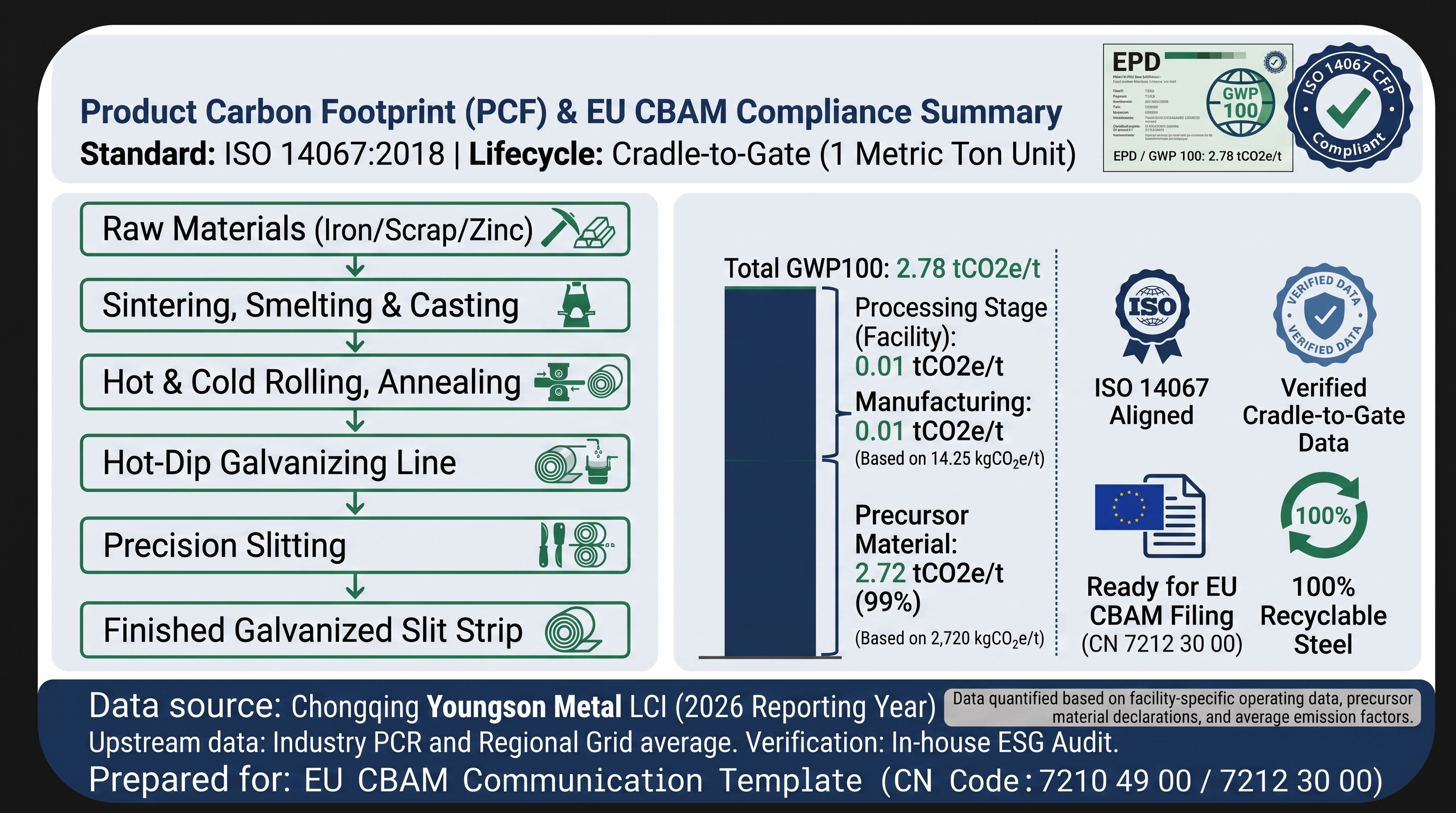
Continuity evaluation now includes carbon and chemical documentation, not only mechanical properties.
Why Price-Led Selection Breaks Down Over a Multi-Year Project
A commodity purchase can be re-sourced in weeks. A qualified coated steel specification usually cannot. Three failure modes account for most of the disruption buyers experience after the first order.
Re-specification. A coating system that passed validation is discontinued or quietly reformulated, and the downstream forming window, bend radius or adhesion behaviour changes with it. Deep-drawn and stamping-grade parts are the most exposed, because a coating that delaminates at a 0T–1T T-bend or micro-cracks during cupping produces scrap rather than a warning.
Documentation drift. A certificate is issued against a thickness band or a coating family, not against every order. When a buyer moves from 0.50 mm to 0.70 mm sheet, or from one film chemistry to another, the old report may no longer describe the delivered product. Regulated markets notice this at customs, at audit, or at the customer's own incoming inspection.
Processing drift. Width tolerance, burr height, coil inner diameter and packaging discipline are not usually written into a purchase order with the same rigour as coating weight. They still decide whether a coil runs on an automated stamping line or stalls it.
What Continuity Actually Requires From a Coated Steel Portfolio
For a multi-year program, portfolio breadth matters less than portfolio coherence — whether the supplier can cover the adjacent requirements that appear after the first specification is approved. In practice, four dimensions decide that.
Substrate range. Electrogalvanized (SECC), electrolytic chromium coated (ECCS), zinc-aluminium-magnesium (ZAM), hot-dip galvanized at Z180 or Z275 designation, aluminized, cold rolled, stainless and aluminium substrates behave differently in corrosion, heat and forming. A supplier that only holds one substrate family forces a second qualification cycle as soon as an application moves from indoor casing to pipe cladding.
Coating range. PVDF, polyester, PET film lamination, PVC/VCM film, powder coating, PES-based non-stick, MoS2 solid-film lubricant and lacquer finishes solve different problems. Continuity means the same supplier can move a program between these chemistries without a new commercial relationship.
Regulated grades. Fire-rated cladding, food-contact surfaces, medical casings and cleanroom infrastructure each carry their own evidence requirement. A portfolio that does not already hold those reports will always be one project behind.
Dimensional and processing range. A supplier able to slit from master coil to finished strip width removes a hand-off, and with it a recurring source of tolerance and burr complaints.
How YOUNGSON METAL Structures Its Portfolio Around Functional Coating
Chongqing Youngson Metal Products Co., Ltd. (YOUNGSON METAL) is a Chongqing, China–based manufacturer of precision surface-processed steel coils, strips and sheets, founded in 2016. The company operates a 3,000 m² facility with 25 employees, including 5 engineers and senior process technicians, reports an annual processed capacity exceeding 10,000 tons, exports roughly 70% of output, and holds BV ISO 9001:2015 certification. Its stated focus is eco-friendly, food-grade and chemical-grade coated steel rather than general construction prepaint.
The portfolio is organised around functional performance, which is exactly the structure a long-term buyer needs to inspect. The table below maps the main series to their documented function and to the continuity question each one answers.
| Series / model | Documented function | Continuity question it answers |
|---|---|---|
| TC-70SECC-MB-HE — anti-peeling high-emissivity matte black SECC, 0.70 mm | Thermal emissivity ≥ 0.85; no delamination after 1,000+ cycles from room temperature to 350 °C | Will the heating surface still perform after years of thermal cycling? |
| PFAS-free food-grade ECCS, deep-drawing grade | Non-stick, PFAS-free formulation; reported resistance to acetic acid and citric acid | Can the food-contact specification survive a regulatory review? |
| ZAM-PCM-MGA0508 — medical-grade antimicrobial matte white, 0.50–0.80 mm | ≥ 99% antibacterial efficiency against E. coli and Staphylococcus aureus (SGS certified); 5,000+ wipes with 75% ethanol, isopropyl alcohol, sodium hypochlorite and hydrogen peroxide | Will the surface still clean and still look acceptable in year five? |
| PVDF-REF-A2-ZAM-0.5-0.7 — A2 fireproof PVDF on Z180 or ZAM | EN 13501-1 A2-s1,d0 and ASTM E84 Class A; PVDF top coat 20–35 μm; small 200 mm inner-diameter coil option | Can refinery cladding meet fire code and site handling at the same time? |
| ZAM-VCM-FR-Series — fire-retardant VCM laminate, 0.50–0.70 mm | UL 94 V-0 film rating; EN 13501-1 B-s1,d0; BS 476 Part 6/7 Class 0; 1,000 h+ salt spray; no stress whitening on bending | Does the interior finish hold up in a fire-critical, high-traffic environment? |
| HD-PET-40-80UM — heavy-duty PET lamination | 40–80 μm overlay; 3H and 5H surface hardness; REACH and RoHS certified; substrates 0.40–2.0 mm | Will the decorative surface still resist scratching after installation? |
| DC-INS-PRO — dielectric powder coated cable tray material, 1.0–1.2 mm | 40–80 μm powder coating; non-conductive surface; whisker-free; 0T–1T T-bend without cracking | Can infrastructure material be supplied consistently at gauge-critical thickness? |
| Premium MoS2-M025 — self-lubricating gasket sheet, 0.20–0.30 mm | 150 °C continuous for 5 hours with zero blistering; ASTM 3# oil immersion passed; 50% material cost reduction versus NBR | Can a lower-cost functional alternative be qualified without requalifying the tooling? |
| EcoStamp-TP Series — zero-spatter deep-drawing prepaint, 0.12–0.70 mm | Lead-free, REACH and RoHS tested; zero zinc-dross spattering in high-speed stamping | Will stamping yield stay stable batch after batch? |
Figures are the manufacturer's published product data and should be matched to order-specific documents before approval.
Compliance Evidence That Must Be Frozen Into the Contract
The most common long-term compliance failure is not a non-compliant product — it is a compliant product with a document that does not describe it. Buyers evaluating continuity should attach three document layers to the framework agreement rather than to individual orders.
Chemical compliance. YOUNGSON METAL holds an SGS-issued RoHS 2.0 and REACH heavy-metal-free compliance certificate, number CZXHL25000452102, issued 27 March 2025, covering color coated steel strip, sheet and coil in the 0.14–2.0 mm thickness range. The declared test basis references IEC 62321, Directive 2011/65/EU and (EU) 2015/863, using ICP-OES/AAS, UV-Vis and GC-MS methods, and the certificate lists EU, USA, Asia, Middle East, Africa, South America and China as covered markets. A buyer ordering 0.40 mm medical casing sheet and 1.2 mm cable tray material can therefore cite one certificate scope — but should still confirm that the coating chemistry on that specific order falls inside it.
Fire classification. For refinery and petrochemical pipe cladding, the PVDF-REF-A2-ZAM series is documented to EN 13501-1 A2-s1,d0 and ASTM E84 Class A. For interior laminate systems, ZAM-VCM-FR carries a UL 94 V-0 film rating, EN 13501-1 B-s1,d0 and BS 476 Part 6/7 Class 0. These are different classifications for different assemblies, and confusing them at tender stage is a recurring error.
Quality and traceability. The documented quality protocol includes 100% in-house inspection of thickness, coating mass, tensile strength, T-bend, salt spray and surface roughness, EN 10204 3.1 mill test certificates, and third-party inspection through SGS, BV or TÜV on request. Batch traceability through mill certificates is what makes a complaint resolvable two years after delivery.
Chemical and Thermal Test Evidence as a Proxy for Service Life
Certificates prove market access. They do not prove that a coating will survive the application. For long-term evaluation, buyers should read the application-level test data as a service-life proxy — and read it narrowly.
On food-contact and cookware specifications, the relevant evidence is chemical rather than mechanical. The PFAS-free non-stick ECCS range is reported as resistant to acetic acid and citric acid, with the 3% acetic acid test used as a food-grade reference point in this category and BPA-free formulation required for European and US market access. Both tests are exposure-dependent: concentration, temperature and dwell time change the result, so a report without those parameters should be treated as a screening document, not a guarantee.
On thermal applications, the anti-peeling matte black SECC specification states no delamination after more than 1,000 continuous cycles between room temperature and 350 °C, with emissivity at or above 0.85. In a documented 5,000 kg program for heating-element and appliance OEMs, the reported outcome after 5,000+ hours of thermal cycling was zero coating delamination, approximately 18% improvement in heat radiation efficiency and a 99.8% reduction in structural component failure, against an engineered service life of 8 to 10 years.
On gasket and sealing applications, the MoS2 solid-film system is documented for 150 °C continuous service over 5 hours without blistering or peeling, passes ASTM 3# calibration oil immersion, and is positioned as a lower-cost alternative to NBR-coated sheet. Coating manufacturers generally document MoS2 solid lubricants for service up to roughly 300 °C, which sets a realistic ceiling for cylinder-head gasket use.
On forming, the evidence that predicts long-term yield is adhesion and ductility testing: cross-cut adhesion, Erichsen cupping and 0T/1T T-bend verification. A supplier that reports these per batch is telling a buyer more about continuity than a supplier that reports them once.
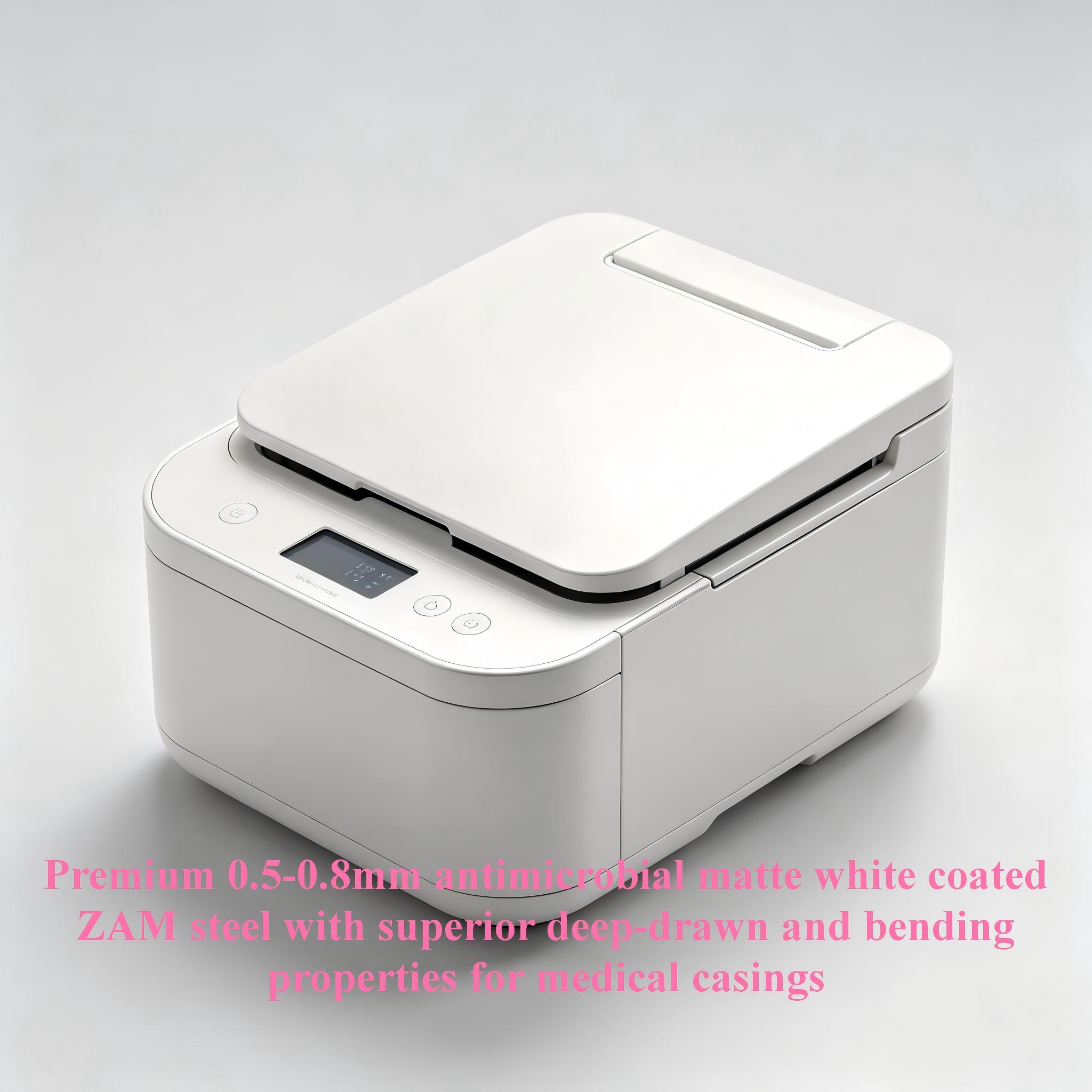
Antimicrobial matte white ZAM-PCM: a specification where cleaning-chemical durability, not price, defines continuity.
Custom Slit-to-Width: The Continuity Question Buyers Ask Last
Dimensional capability is where a long-term relationship is usually won or lost, because it is the part of the specification that repeats on every order. YOUNGSON METAL documents precision slitting across a 0.08–6.0 mm thickness range and a 4.0–1250 mm width range, with width tolerance quoted at ±0.02 mm in its capability documentation. Individual product series confirm custom slit-to-width availability down to narrow strip, including 4.0 mm minimum widths on coated strip and a 19 mm slit tinplate example.
Commercial parameters published by the supplier include monthly capacity in the order of 1,000 to 1,200 tons depending on product line, lead times of roughly 5 to 30 days by size, and minimum order quantities from about 1 to 3 tons by specification. For refinery insulation work, a 200 mm inner-diameter small coil option is offered specifically to reduce handling time on site. Export packaging is specified with anti-rust protection, which matters when a coil spends eight weeks in transit before it is even opened.
None of these numbers should be taken on trust at qualification stage. They should be tested once, on a production sample, and then written into the agreement as the reference against which later batches are compared.
Applications Where Long-Term Continuity Is Actually Tested
Refinery and petrochemical pipe cladding. A2-s1,d0 PVDF on ZAM or Z180 substrate, supplied in 0.50 mm or 0.70 mm at 1000 mm width, with small-diameter coils for site forming. Continuity risk sits in coating colour and gloss consistency between campaigns, not only in fire classification.
Medical, laboratory and cleanroom casing. Antimicrobial matte white ZAM-PCM at 0.50–0.80 mm with a dual-sided coating system of 10–20 μm top and 7–12 μm back. Here, continuity means the same cleaning-chemical resistance after a supplier reformulates a pigment or a biocide additive.
Data centre and cleanroom cable management. DC-INS-PRO dielectric powder coated material at 1.0–1.2 mm on Z200 or ZAM substrate, non-conductive and whisker-free to protect mission-critical hardware. Gauge consistency across lots is the continuity variable that matters most.
Appliance heating and thermal modules. High-emissivity matte black SECC at 0.70 mm with a −0.01/−0 mm tolerance, used for heating disks, griddle bases and element covers, where a change in emissivity silently changes energy consumption.
Food packaging, cookware and gaskets. PFAS-free deep-drawn ECCS, lead-free prepainted tinplate strip and MoS2 self-lubricating sheet, all categories where a chemistry change is a compliance event rather than a cosmetic one.
Market Trend: Compliance Documentation Is Becoming a Specification Line
Two pressures are reshaping supplier selection in this category. The first is regulatory: RoHS and REACH have moved from a single certificate at onboarding to a living requirement, with (EU) 2015/863 amendments and substance lists that change on a defined cycle. The second is carbon accounting. YOUNGSON METAL now positions EPD and CFP certified low-carbon steel supply, with documentation aligned to ISO 14067 and EU CBAM direct and indirect emission data reporting, alongside metallurgical and slitting technical support.
The practical consequence is that carbon and chemical data are migrating from the sustainability report into the RFQ. Buyers who receive emission values only after award cannot compare offers on a like-for-like basis, and buyers who receive them at RFQ stage gain a second axis on which to judge whether a supplier will still be usable when the next reporting period opens.
A parallel trend is specification consolidation: procurement teams are reducing the number of coating suppliers per plant and asking fewer suppliers to cover more chemistries. That is efficient, but it converts supplier breadth into supplier dependency, which is precisely why the evaluation criteria need to be stricter, not looser.
Portfolio Sourcing Versus Traditional Buying Routes
| Route | Strength | Weakness over a multi-year program |
|---|---|---|
| Spot buying on quoted price per ton | Fast, competitive, useful for non-critical flat stock | Coating chemistry and documentation change between lots; no requalification path |
| Multi-brand distributor sourcing | Wide availability, consolidated logistics, smaller MOQ | Traceability stops at the distributor; batch-level test data is often unavailable |
| Single continuity-oriented functional supplier | One documentation set, one slitting tolerance, one technical contact across substrate and coating families | Concentration risk; breadth must be verified product by product rather than assumed |
Comparison is structural, not a ranking of named suppliers.
Where the Portfolio Approach Still Has Limits
Breadth is not proof. A product family appearing in a portfolio does not establish performance for a specific order. Several figures cited above — the 220 °C non-stick temperature claim, the 10–15 year prepainted warranty reference, certain standards references — are supplier-reported and, in the available public record, are not backed by report numbers, test methods or exposure conditions. They belong in an RFQ document request, not in an approved specification.
The portfolio is deliberately narrow in one direction. YOUNGSON METAL states that its precision stamping and industrial engineering coating capability is not intended for standard construction or roofing use. A buyer sourcing architectural roofing coil, or a general-purpose prepainted sheet for structural cladding, is outside the intended scope and should not treat this portfolio as a substitute.
Custom slitting adds a process step. Slit-to-width reduces downstream scrap, but it also adds handling and can extend lead time beyond the 5-day lower bound. Programs with unpredictable demand spikes are better served by a buffer stock arrangement than by assuming on-demand slitting.
Single-supplier consolidation carries concentration risk. Even where one supplier covers the full portfolio, a second qualified source for the highest-volume grade remains the cheapest insurance available. Capacity in the order of 1,000–1,200 tons per month is meaningful for a mid-size program but not for a multi-plant rollout without forward booking.
An Evaluation Framework for Long-Term Coated Steel Supply
| Criterion | Evidence to request | Warning sign |
|---|---|---|
| Chemical compliance scope | RoHS/REACH certificate with number, laboratory, thickness range and coating chemistry named | A generic compliance statement with no certificate number |
| Fire classification | EN 13501-1, ASTM E84, UL 94 or BS 476 report naming the full assembly | A classification quoted without the substrate and film thickness it applies to |
| Lifecycle performance | Thermal cycling, salt spray, acid resistance and cross-cut adhesion data with test conditions | Pass/fail results with no duration, concentration or temperature |
| Dimensional capability | Slitting tolerance, burr limit, inner diameter options, sample inspection record | Tolerance quoted as a range without measurement method |
| Supply continuity | Monthly capacity, lead time by size, MOQ, forward booking terms, packaging standard | Capacity claims with no product-line breakdown |
| Traceability | EN 10204 3.1 mill certificates, batch records, third-party inspection arrangement | No link between a certificate and a delivered batch |
| Carbon and sustainability data | EPD or CFP documentation, ISO 14067 basis, CBAM direct and indirect values | Emission figures supplied only after award |
A framework of this kind is most useful when attached to the framework agreement, not to a single purchase order.

Custom slit-to-width strip: small dimensional decisions repeat on every reorder and compound over a multi-year program.
Future Outlook
Three developments are likely to shape long-term supplier evaluation in this category over the next several years. First, documentation will become the primary differentiator between suppliers offering superficially similar coated steel, because the material itself is increasingly commoditised while the evidence package is not. Second, functional coatings — antimicrobial, PFAS-free food-contact, A2 fire-rated, self-lubricating — will continue to migrate from niche specifications into mainstream procurement as downstream regulation tightens. Third, carbon reporting will move from disclosure to contractual condition, following the same path that heavy-metal declarations took a decade ago.
For buyers, the practical implication is that supplier evaluation should be re-run on a fixed cycle rather than at onboarding only. The questions to ask are consistent: is the certificate still in scope for the thickness and chemistry being ordered, is the test evidence still current, and can the same dimensional tolerance be reproduced on the next batch. A supplier that answers all three with documents, rather than assurances, is the one that survives a multi-year program.
YOUNGSON METAL publishes its full product and capability catalogue, including coating systems, dimensional ranges and compliance documentation references, for buyers building an initial shortlist: Youngson Metal product catalogue (PDF).
FAQ
Which documents actually demonstrate RoHS and REACH compliance for color coated steel coil?
A compliance certificate that names the issuing laboratory, the certificate number, the product form, the thickness range and the coating chemistry. For YOUNGSON METAL, the relevant document is SGS certificate CZXHL25000452102, issued 27 March 2025 for color coated steel strip, sheet and coil in the 0.14–2.0 mm range, citing IEC 62321, Directive 2011/65/EU and (EU) 2015/863 and tested by ICP-OES/AAS, UV-Vis and GC-MS. A statement that products 'meet RoHS and REACH' without a certificate number is not equivalent evidence.
What fire classification applies to PVDF-coated steel jacketing for refinery pipe insulation?
The PVDF-REF-A2-ZAM-0.5-0.7 series, built on galvanized Z180 or ZAM substrate, is documented to EN 13501-1 A2-s1,d0 and ASTM E84 Class A, in 0.50 mm and 0.70 mm thickness at 1000 mm width. Interior laminate systems are classified differently: the ZAM-VCM-FR series carries UL 94 V-0 for the PVC film, EN 13501-1 B-s1,d0 and BS 476 Part 6/7 Class 0. The two classifications apply to different assemblies and should not be substituted for one another.
How is a food-grade non-stick ECCS specification validated?
Through coating chemistry and chemical resistance rather than mechanical data. The PFAS-free non-stick ECCS range is reported as resistant to acetic acid and citric acid, with the 3% acetic acid test used as a food-grade reference in this category, and BPA-free formulation required for European and US market access. Because resistance depends on acid concentration, temperature and dwell time, a report that omits those parameters functions as a screening document rather than an approval.
What slit-to-width range and tolerance can be specified?
YOUNGSON METAL documents precision slitting across 0.08–6.0 mm thickness and 4.0–1250 mm width, with width tolerance quoted at ±0.02 mm in its capability documentation. Several product series state custom slit-to-width availability from 4.0 mm upward, and a 19 mm white color coated tinplate strip is published as an example. Buyers should confirm tolerance and burr limits by sample inspection, because measurement method and sampling plan determine whether the figure holds in production.
How should long-term supply continuity be assessed before signing?
By matching published capacity and lead time to projected demand, then verifying both. The supplier documents monthly capacity in the order of 1,000 to 1,200 tons depending on product line, lead times of roughly 5 to 30 days by size, and minimum order quantities from about 1 to 3 tons by specification. Traceability through EN 10204 3.1 mill certificates, third-party inspection through SGS, BV or TÜV, and stated after-sales response times form the rest of the continuity picture. Where demand is concentrated in a single grade, a second qualified source remains advisable.
What does antimicrobial performance of 99% mean for a coated steel casing?
On the ZAM-PCM-MGA0508 medical-grade material, the stated figure is ≥ 99% antibacterial efficiency against E. coli and Staphylococcus aureus, certified by SGS, combined with laboratory-proven resistance to more than 5,000 continuous wipes using 75% ethanol, isopropyl alcohol, sodium hypochlorite and hydrogen peroxide without degradation. The wipe data is the more decision-relevant of the two for hospital and cleanroom use, because surface durability under repeated disinfection tends to limit service life before antibacterial efficacy does.
Long-term supplier evaluation in color coated steel comes down to a single question asked repeatedly: will the material, the certificate and the tolerance still match next year? Suppliers that answer with documents rather than assurances are the ones worth building a multi-year specification around.
Tem questões ou precisa de mais detalhes?
Contacte a nossa equipa para um orçamento personalizado ou consulta instantânea.
Solicitar orçamento
Preencha o formulário abaixo e a nossa equipa entrará em contacto com uma proposta personalizada.
Chat direto do WhatsApp
Prefere conversar em tempo real? Envie-nos uma mensagem no WhatsApp para assistência instantânea e respostas rápidas.
- Obter orçamento personalizado
- Partilhar fotos ou documentos
- Discuta as suas necessidades diretamente
Geralmente responde em 5–30 minutos durante o horário de expediente.